YouZum

Uncategorized

AI, Committee, 新闻, Uncategorized

Job titles of the future: Breast biomechanic

Twenty years ago, Joanna Wakefield-Scurr was having persistent pain in her breasts. Her doctor couldn’t diagnose the cause but said a good, supportive bra could help. A professor of biomechanics, Wakefield-Scurr thought she could do a little research and find a science-backed option. Two decades later, she’s still looking. Wakefield-Scurr now leads an 18-person team at the Research Group in Breast Health at the University of Portsmouth in the UK. Their research shows that the most effective high-impact-sports bras have underwires, padded cups, adjustable underbands and shoulder straps, and hook-and-eye closures. These bras reduce breast movement by up to 74% when compared with wearing no bra. But movement might not be the only metric that matters. A biological rarity Few anatomical structures hang outside of the body unsupported by cartilage, muscle, or bone—meaning there wasn’t much historical research to build on. Wakefield-Scurr’s lab was the first to find that when women run, the motion of the torso causes breasts to move in a three-dimensional pattern—swinging side to side and up and down—as well as moving forward and backward. In an hour of slow jogging, boobs can bounce approximately 10,000 times. A sports necessity Wearing a bra that’s too tight can limit breathing. Wearing one that’s too loose can create back, shoulder, and neck pain. Pain can also be caused by the lag between torso and breast movement, which causes what is scientifically known as “breast slap.” The lab’s research has also found that the physical discomfort of bad bras, combined with the embarrassment of flopping around, is the one of the biggest barriers to exercise for women and that if women have a good sports bra, they’re more willing to go for a run. An open question Some bras function by deliberately compressing breasts. Others encapsulate and support each individual breast. But scientists still don’t know whether it’s more biomechanically important to reduce the breasts’ motion entirely, to reduce the speed at which they move, or to reduce breast slap. Will women constantly be forced to choose between the comfort of a stretchier bra and the support of a more restrictive one? Wakefield-Scurr is excited about new materials she’s tested that tighten or stretch depending on how you move. She’s working with fabric manufacturers and clothing companies to try out their wares. As more women take up high-impact sports, the need to understand what makes a good bra grows. Wakefield-Scurr says her lab can’t keep up with demand. Their cups runneth over. Sara Harrison is a freelance journalist who writes about science, technology, and health.

Job titles of the future: Breast biomechanic Read Post »

AI, Committee, 新闻, Uncategorized

Community service

The bird is a beautiful silver-gray, and as she dies twitching in the lasernet I’m grateful for two things: First, that she didn’t make a sound. Second, that this will be the very last time.  They’re called corpse doves—because the darkest part of their gray plumage surrounds the lighter part, giving the impression that skeleton faces are peeking out from behind trash cans and bushes—and their crime is having the ability to carry diseases that would be compatible with humans. I open my hand, triggering the display from my imprinted handheld, and record an image to verify the elimination. A ding from my palm lets me know I’ve reached my quota for the day and, with that, the year. I’m tempted to give this one a send-off, a real burial with holy words and some flowers, but then I hear a pack of streetrats hooting beside me. My city-issued vest is reflective and nanopainted so it projects a slight glow. I don’t know if it’s to keep us safe like they say, or if it’s just that so many of us are ex-cons working court-ordered labor, and civilians want to be able to keep an eye on us. Either way, everyone treats us like we’re invisible—everyone except children. I switch the lasernet on the bird from electrocute to incinerate and watch as what already looked like a corpse becomes ashes. “Hey, executioner!” says a girl. “Executioner” is not my official title. The branch of city government we work for is called the Department of Mercy, and we’re only ever called technicians. But that doesn’t matter to the child, who can’t be more than eight but has the authority of a judge as she holds up a finger to point me out to her friends. HENRY HORENSTEIN “Guys, look!” she says, then turns her attention to me. “You hunting something big?” I shake my head, slowly packing up my things. “Something small?” she asks. Then her eyes darken. “You’re not a cat killer, are you?” “No,” I say quickly. “I do horseflies.” I don’t know why I lied, but as the suspicion leaves her face and a smile returns, I’m glad I did. “You should come down by the docks. We’ve got flies! Make your quota in a day.” The girl tosses her hair, making the tinfoil charms she’s wrapped around her braids tinkle like wind chimes.  “It’s my last day. But if I get flies again for next year, I’ll swing by.” Another lie, because we both know the city would never send anyone to the docks for flies. Flies are killed because they are a nuisance, which means people only care about clearing them out of suburbs and financial districts. They’d only send a tech down to the docks to kill something that put the city proper at risk through disease, or by using up more resources than they wanted to spare. LeeLee is expecting me home to sit through the reassignments with her and it’s already late, so I hand out a couple of the combination warming and light sticks I get for winter to the pack of children with nowhere to go. As I walk away, the children are laughing so loud it sounds like screaming. They toss the sticks in the air like signal flares, small bright cries for help that no one will see. LeeLee’s anxiety takes the form of caretaking, and as soon as I’ve stepped through the door I can smell bread warming and soup on the stove. I take off my muffling boots. Another day, I’d leave them on and sneak up on her just to be irritating, and she’d turn and threaten me with whatever kitchen utensil was at hand. But she’ll be extra nervous today, so I remove the shoes that let me catch nervous birds, and step hard on my way in. Sometimes it seems impossible that I can spend a year killing every fragile and defenseless thing I’ve encountered but still take such care with Lee. But I tell myself that the killing isn’t me—it’s just my sentence, and what I do when I have a choice is the only thing that really says anything about me. For the first six months and 400 birds, I believed it. LeeLee flicks on a smile that lasts a whole three seconds when she sees me, then clouds over again. “Soup’s too thin. There wasn’t enough powder for a real broth.” “I like thin soup,” I say. “Not like this. It doesn’t even cover up the taste of the water.” “I like the taste of the water,” I say, which breaks her out of her spiraling enough to roll her eyes. I put my hands on her shoulder to stop her fussing.  “The soup is going to be fine,” I say. “So will the reassignment.” I’m not much taller than she is, but when we met in juvie she hadn’t hit her last growth spurt yet, so she still tilts her head back to look me in the eyes. “What if it’s not?” “It will—” “What if you get whatever assignment Jordan got?” There it is. Because two of us didn’t leave juvie together to start community service—three of us did. But Jordan didn’t last three weeks into his assignment before he turned his implements inward. I notice she doesn’t say What if  I get what Jordan got? Because LeeLee is more afraid of being left alone than of having to kill something innocent. “We don’t know what his assignment was,” I say. It’s true, but we do know it was bad. Two weeks into our first stretch, a drug meant to sterilize the city’s feral cat population accidentally had the opposite effect. Everyone was pulled off their assigned duty for three days to murder litters of new kittens instead. It nearly broke me and Lee, but Jordan seemed almost grateful. “Besides, we don’t know if his assignment had anything to do with … what he did. You’re borrowing trouble.

Community service Read Post »

AI, Committee, 新闻, Uncategorized

From integration chaos to digital clarity: Nutrien Ag Solutions’ post-acquisition reset

Thank you for joining us on the “Enterprise AI hub.” In this episode of the Infosys Knowledge Institute Podcast, Dylan Cosper speaks with Sriram Kalyan, head of applications and data at Nutrien Ag Solutions, Australia, about turning a high-risk post-acquisition IT landscape into a scalable digital foundation. Sriram shares how the merger of two major Australian agricultural companies created duplicated systems, fragile integrations, and operational risk, compounded by the sudden loss of key platform experts and partners. He explains how leadership alignment, disciplined platform consolidation, and a clear focus on business outcomes transformed integration from an invisible liability into a strategic enabler, positioning Nutrien Ag Solutions for future growth, cloud transformation, and enterprise scale. Click here to continue.

From integration chaos to digital clarity: Nutrien Ag Solutions’ post-acquisition reset Read Post »

AI, Committee, 新闻, Uncategorized

What it takes to make agentic AI work in retail

Thank you for joining us on the “Enterprise AI hub.” In this episode of the Infosys Knowledge Institute Podcast, Dylan Cosper speaks with Prasad Banala, director of software engineering at a large US-based retail organization, about operationalizing agentic AI across the software development lifecycle. Prasad explains how his team applies AI to validate requirements, generate and analyze test cases, and accelerate issue resolution, while maintaining strict governance, human-in-the-loop review, and measurable quality outcomes. Click here to continue.

What it takes to make agentic AI work in retail Read Post »

AI, Committee, 新闻, Uncategorized

How uncrewed narco subs could transform the Colombian drug trade

On a bright morning last April, a surveillance plane operated by the Colombian military spotted a 40-foot-long shark-like silhouette idling in the ocean just off Tayrona National Park. It was, unmistakably, a “narco sub,” a stealthy fiberglass vessel that sails with its hull almost entirely underwater, used by drug cartels to move cocaine north. The plane’s crew radioed it in, and eventually nearby coast guard boats got the order, routine but urgent: Intercept. In Cartagena, about 150 miles from the action, Captain Jaime González Zamudio, commander of the regional coast guard group, sat down at his desk to watch what happened next. On his computer monitor, icons representing his patrol boats raced toward the sub’s coordinates as updates crackled over his radio from the crews at sea. This was all standard; Colombia is the world’s largest producer of cocaine, and its navy has been seizing narco subs for decades. And so the captain was pretty sure what the outcome would be. His crew would catch up to the sub, just a bit of it showing above the water’s surface. They’d bring it to heel, board it, and force open the hatch to find two, three, maybe four exhausted men suffocating in a mix of diesel fumes and humidity, and a cargo compartment holding several tons of cocaine. The boats caught up to the sub. A crew boarded, forced open the hatch, and confirmed that the vessel was secure. But from that point on, things were different. First, some unexpected details came over the radio: There was no cocaine on board. Neither was there a crew, nor a helm, nor even enough room for a person to lie down. Instead, inside the hull the crew found a fuel tank, an autopilot system and control electronics, and a remotely monitored security camera. González Zamudio’s crew started sending pictures back to Cartagena: Bolted to the hull was another camera, as well as two plastic rectangles, each about the size of a cookie sheet—antennas for connecting to Starlink satellite internet. The authorities towed the boat back to Cartagena, where military techs took a closer look. Weeks later, they came to an unsettling conclusion: This was Colombia’s first confirmed uncrewed narco sub. It could be operated by remote control, but it was also capable of some degree of autonomous travel. The techs concluded that the sub was likely a prototype built by the Clan del Golfo, a powerful criminal group that operates along the Caribbean coast. For decades, handmade narco subs have been some of the cocaine trade’s most elusive and productive workhorses, ferrying multi-ton loads of illicit drugs from Colombian estuaries toward markets in North America and, increasingly, the rest of the world. Now off-the-shelf technology—Starlink terminals, plug-and-play nautical autopilots, high-resolution video cameras—may be advancing that cat-and-mouse game into a new phase. Uncrewed subs could move more cocaine over longer distances, and they wouldn’t put human smugglers at risk of capture. Law enforcement around the world is just beginning to grapple with what the Tayrona sub means for the future—whether it was merely an isolated experiment or the opening move in a new era of autonomous drug smuggling at sea. Drug traffickers love the ocean. “You can move drug traffic through legal and illegal routes,” says Juan Pablo Serrano, a captain in the Colombian navy and head of the operational coordination center for Orión, a multiagency, multinational counternarcotics effort. The giant container ships at the heart of global commerce offer a favorite approach, Serrano says. Bribe a chain of dockworkers and inspectors, hide a load in one of thousands of cargo boxes, and put it on a totally legal commercial vessel headed to Europe or North America. That route is slow and expensive—involving months of transit and bribes spread across a wide network—but relatively low risk. “A ship can carry 5,000 containers. Good luck finding the right one,” he says. Far less legal, but much faster and cheaper, are small, powerful motorboats. Quick to build and cheap to crew, these “go-fasts” top out at just under 50 feet long and can move smaller loads in hours rather than days. But they’re also easy for coastal radars and patrols to spot. Submersibles—or, more accurately, “semisubmersibles”—fit somewhere in the middle. They take more money and engineering to build than an open speedboat, but they buy stealth—even if a bit of the vessel rides at the surface, the bulk stays hidden underwater. That adds another option to a portfolio that smugglers constantly rebalance across three variables: risk, time, and cost. When US and Colombian authorities tightened control over air routes and commercial shipping in the early 1990s, subs became more attractive. The first ones were crude wooden hulls with a fiberglass shell and extra fuel tanks, cobbled together in mangrove estuaries, hidden from prying eyes. Today’s fiberglass semisubmersible designs ride mostly below the surface, relying on diesel engines that can push multi-ton loads for days at a time while presenting little more than a ripple and a hot exhaust pipe to radar and infrared sensors. A typical semisubmersible costs under $2 million to build and can carry three metric tons of cocaine. That’s worth over $160 million in Europe—wholesale. Most ferry between South American coasts and handoff points in Central America and Mexico, where allied criminal organizations break up the cargo and slowly funnel it toward the US. But some now go much farther. In 2019, Spanish authorities intercepted a semisubmersible after a 27-day transatlantic voyage from Brazil. In 2024, police in the Solomon Islands found the first narco sub in the Asia-Pacific region, a semisubmersible probably originating from Colombia on its way to Australia or New Zealand. If the variables are risk, time, and cost, then the economics of a narco sub are simple. Even if they spend more time on the water than a powerboat, they’re less likely to get caught—and a relative bargain to produce. A narco sub might cost between $1 million and $2 million to build, but a kilo of cocaine costs

How uncrewed narco subs could transform the Colombian drug trade Read Post »

AI, Committee, 新闻, Uncategorized

The building legal case for global climate justice

The United States and the European Union grew into economic superpowers by committing climate atrocities. They have burned a wildly disproportionate share of the world’s oil and gas, planting carbon time bombs that will detonate first in the poorest, hottest parts of the globe.  Meanwhile, places like the Solomon Islands and Chad—low-lying or just plain sweltering—have emitted relatively little carbon dioxide, but by dint of their latitude and history, they rank among the countries most vulnerable to the fiercest consequences of global warming. That means increasingly devastating cyclones, heat waves, famines, and floods. Morally, there’s an ironclad case that the countries or companies responsible for this mess should provide compensation for the homes that will be destroyed, the shorelines that will disappear beneath rising seas, and the lives that will be cut short. By one estimate, the major economies owe a climate debt to the rest of the world approaching $200 trillion in reparations. Legally, though, the case has been far harder to make. Even putting aside the jurisdictional problems, early climate science couldn’t trace the provenance of airborne molecules of carbon dioxide across oceans and years. Deep-pocketed corporations with top-tier legal teams easily exploited those difficulties.  Now those tides might be turning. More climate-related lawsuits are getting filed, particularly in the Global South. Governments, nonprofits, and citizens in the most climate-exposed nations continue to test new legal arguments in new courts, and some of those courts are showing a new willingness to put nations and their industries on the hook as a matter of human rights. In addition, the science of figuring out exactly who is to blame for specific weather disasters, and to what degree, is getting better and better.  It’s true that no court has yet held any climate emitter liable for climate-related damages. For starters, nations are generally immune from lawsuits originating in other countries. That’s why most cases have focused on major carbon producers. But they’ve leaned on a pretty powerful defense.  While oil and gas companies extract, refine, and sell the world’s fossil fuels, most of the emissions come out of “the vehicles, power plants, and factories that burn the fuel,” as Michael Gerrard and Jessica Wentz, of Columbia Law School’s Sabin Center, note in a recent piece in Nature. In other words, companies just dig the stuff up. It’s not their fault someone else sets it on fire. So victims of extreme weather events continue to try new legal avenues and approaches, backed by ever-more-convincing science. Plaintiffs in the Philippines recently sued the oil giant Shell over its role in driving Super Typhoon Odette, a 2021 storm that killed more than 400 people and displaced nearly 800,000. The case relies partially on an attribution study that found climate change made extreme rainfall like that seen in Odette twice as likely.  IVAN JOESEFF GUIWANON/GREENPEACE Overall, evidence of corporate culpability—linking a specific company’s fossil fuel to a specific disaster—is getting easier to find. For example, a study published in Nature in September was able to determine how much particular companies contributed to a series of 21st-century heat waves. A number of recent legal decisions signal improving odds for these kinds of suits. Notably, a handful of determinations in climate cases before the European Court of Human Rights affirmed that states have legal obligations to protect people from the effects of climate change. And though it dismissed the case of a Peruvian farmer who sued a German power company over fears that a melting alpine glacier could destroy his property, a German court determined that major carbon polluters could in principle be found liable for climate damages tied to their emissions.  At least one lawsuit has already emerged that could test that principle: Dozens of Pakistani farmers whose land was deluged during the massive flooding events of 2022 have sued a pair of major German power and cement companies. Even if the lawsuit fails, that would be a problem with the system, not the science. Major carbon-polluting countries and companies have a disproportionate responsibility for climate-change-powered disasters.  Wealthy nations continued to encourage business practices that pollute the atmosphere, even as the threat of climate change grew increasingly grave. And oil and gas companies remain the kingpin suppliers to a fossil-fuel-addicted world. They have operated with the full knowledge of the massive social, environmental, and human cost imposed by their business while lobbying fiercely against any rules that would force them to pay for those harms or clean up their act.  They did it. They knew. In a civil society where rule of law matters, they should pay the price.  This article is from The Spark, MIT Technology Review’s weekly climate newsletter. To receive it in your inbox every Wednesday, sign up here.

The building legal case for global climate justice Read Post »

AI, Committee, 新闻, Uncategorized

Google Introduces Jetpack Compose Glimmer: A New Spatial UI Framework Designed Specifically for the Next Generation of AI Glasses

Google is moving beyond the rectangular screen. For over 10 years, Google designers have explored how to build interfaces for transparent displays. The result is Jetpack Compose Glimmer, a design system built specifically for display AI glasses. For devs and data scientists, this is a shift from designing for pixels to designing with light. The Additive Display Constraint Most developers are used to LCD or OLED screens. However, AI glasses use additive displays. These displays only add light to the user’s field of vision. They cannot create opaque black or make the real world darker. On an additive display, black is 100% transparent. It is not a color; it is a void. If you use a standard Material Design card (light surface with dark text), it fails. The light surface becomes a bright block of light that drains the battery and creates halation. Halation is an effect where bright light bleeds into dark areas, making text unreadable. To solve this, devs must use dark surfaces and bright content. Using black as a foundation provides a ‘clean plate’ for the UI. This allows the digital elements to harmonize with the physical world without creating distracting glare. From Pixels to Visual Angles Software Devs typically measure UI in pixels or points. In a transparent spatial environment, these units are irrelevant. The perceived size of an object changes based on its distance from the eye. Google team now measure UI in visual angles or degrees. The display in these glasses is projected at a perceived depth of 1 meter, which is about an arm’s length. This distance requires the user to actively shift their focus from the background to the UI. To ensure legibility, Google established a minimum readable text size of 0.6 degrees. Keeping text above this threshold ensures that the interface remains ‘glanceable’ in different environments. Engineering Typography for Light Standard fonts often fail on transparent lenses. Google team modified Google Sans Flex using its optical size axis to fix this. These technical adjustments make letters more distinct: Increased Counters: The internal openings in letters like ‘a’ and ‘e’ are larger to prevent them from blurring. Modified Dots: The dots on ‘i’ and ‘j’ are moved further from the main letter body. Variable Letter-Spacing: The system optimizes spacing through code to maximize clarity at a glance. The Additive Contrast Formula Google team use a specific formula to calculate visibility. This is the additive contrast ratio. The formula is: (Environment Brightness + Display Brightness) / Display Brightness. In the real world, colors behave differently. Highly saturated colors often ‘disappear’ or look ghostly against a bright sky. Glimmer uses a neutral, desaturated palette by default. By keeping colors closer to white, the UI remains stable and visible regardless of the lighting in the room. Designing Motion for Human Attention On a heads-up display, motion can be a major distraction. In standard mobile development, a notification might appear in 500 milliseconds. On AI glasses, this is too fast. It creates an abrupt ‘blink’ that can startle the user. Glimmer uses a slower, more deliberate transition for notifications. These animations occur over 2 seconds. This duration allows the notification to enter the user’s peripheral vision gracefully. It invites focus rather than demanding it. However, user-triggered actions (like a voice command or gesture) still require low-latency feedback. Glimmer uses ‘focus rings’ to provide instant confirmation that the system has received an input. This creates a balance between ambient notifications and responsive controls. Key Takeaways Black is Transparency, Not a Color: Because AI glasses use additive displays, they can only add light; they cannot create true black or shadows. In this environment, black is 100% transparent. To ensure legibility, devs must use dark surfaces for containers and bright colors for text and icons. Visual Angles Replace Pixels: Standard units like pixels (px) are replaced by visual angles (degrees). Since the UI is projected at a perceived depth of 1 meter, objects must be sized relative to the human eye’s perspective. The minimum threshold for readable text is set at 0.6 degrees. The Additive Contrast Formula: Devs must account for environmental light using the formula: (Environment Brightness + Display Brightness) / Display Brightness. Because saturated colors often ‘disappear’ against bright real-world backgrounds, a neutral, desaturated palette is used to maintain visibility. Optical Typography Optimization: Standard typefaces suffer from halation (light bleeding). Google Sans Flex is modified via its optical size axis to increase internal letter openings (counters) and expand letter-spacing, preventing characters from blurring together on a transparent lens. Motion Timing is Context-Dependent: Standard 500ms animations are too abrupt for a heads-up display. To respect human peripheral vision, Glimmer uses 2-second transitions for notifications to ‘invite’ focus, while maintaining low-latency feedback (like focus rings) for direct user inputs to ensure responsiveness. Check out the Technical details. Also, feel free to follow us on Twitter and don’t forget to join our 100k+ ML SubReddit and Subscribe to our Newsletter. Wait! are you on telegram? now you can join us on telegram as well. The post Google Introduces Jetpack Compose Glimmer: A New Spatial UI Framework Designed Specifically for the Next Generation of AI Glasses appeared first on MarkTechPost.

Google Introduces Jetpack Compose Glimmer: A New Spatial UI Framework Designed Specifically for the Next Generation of AI Glasses Read Post »

AI, Committee, 新闻, Uncategorized

Cohere Releases Tiny Aya: A 3B-Parameter Small Language Model that Supports 70 Languages and Runs Locally Even on a Phone

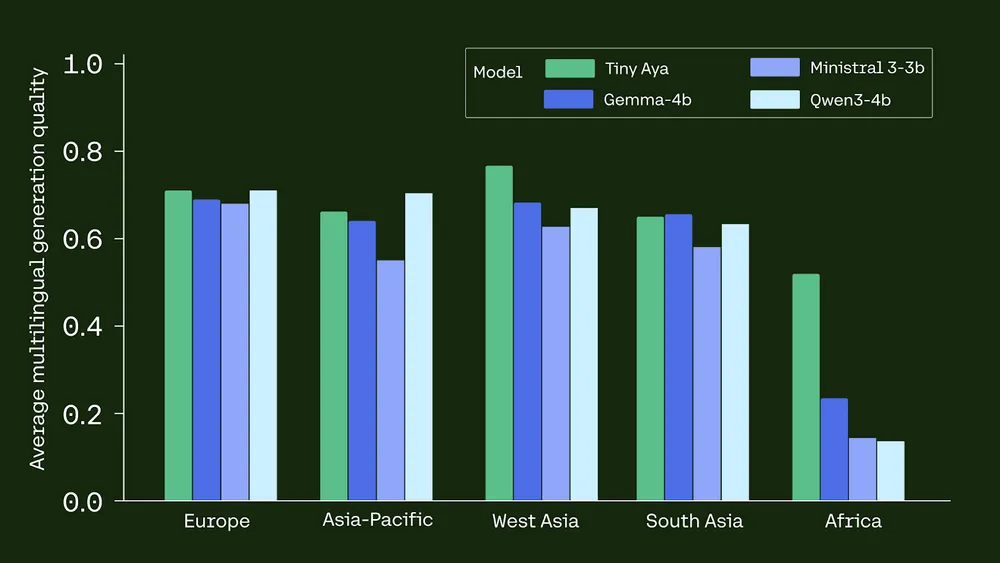
Cohere AI Labs has released Tiny Aya, a family of small language models (SLMs) that redefines multilingual performance. While many models scale by increasing parameters, Tiny Aya uses a 3.35B-parameter architecture to deliver state-of-the-art translation and generation across 70 languages. The release includes 5 models: Tiny Aya Base (pretrained), Tiny Aya Global (balanced instruction-tuned), and three region-specific variants—Earth (Africa/West Asia), Fire (South Asia), and Water (Asia-Pacific/Europe). https://cohere.com/blog/cohere-labs-tiny-aya The Architecture Tiny Aya is built on a dense decoder-only Transformer architecture. Key specs include: Parameters: 3.35B total (2.8B non-embedding) Layers: 36 Vocabulary: 262k tokenizer designed for equitable language representation. Attention: Interleaved sliding window and full attention (3:1 ratio) with Grouped Query Attention (GQA). Context: 8192 tokens for input and output. The model was pretrained on 6T tokens using a Warmup-Stable-Decay (WSD) schedule. To maintain stability, the team used SwiGLU activations and removed all biases from dense layers. Advanced Post-training: FUSION and SimMerge To bridge the gap in low-resource languages, Cohere used a synthetic data pipeline. Fusion-of-N (FUSION): Prompts are sent to a ‘team of teachers’ (COMMAND A, GEMMA3-27B-IT, DEEPSEEK-V3). A judge LLM, the Fusor, extracts and aggregates the strongest components of their responses. Region Specialization: Models were finetuned on 5 regional clusters (e.g., South Asia, Africa). SimMerge: To prevent ‘catastrophic forgetting’ of global safety, regional checkpoints were merged with the global model using SimMerge, which selects the best merge operators based on similarity signals. Performance Benchmarks Tiny Aya Global consistently beats larger or same-scale competitors in multilingual tasks: Translation: It outperforms GEMMA3-4B in 46 of 61 languages on WMT24++. Reasoning: In the GlobalMGSM (math) benchmark for African languages, Tiny Aya achieved 39.2% accuracy, dwarfing GEMMA3-4B (17.6%) and QWEN3-4B (6.25%). Safety: It holds the highest mean safe response rate (91.1%) on MultiJail. Language Integrity: The model achieves 94% language accuracy, meaning it rarely switches to English when asked to reply in another language. On-Device Deployment Tiny Aya is optimized for edge computing. Using 4-bit quantization (Q4_K_M), the model fits in a 2.14 GB memory footprint. iPhone 13: 10 tokens/s. iPhone 17 Pro: 32 tokens/s. This quantization scheme results in a minimal 1.4-point drop in generation quality, making it a viable solution for offline, private, and localized AI applications. Key Takeaways Efficient Multilingual Power: Tiny Aya is a 3.35B-parameter model family that delivers state-of-the-art translation and high-quality generation across 70 languages. It proves that massive scale is not required for strong multilingual performance if models are designed with intentional data curation. Innovative Training Pipeline: The models were developed using a novel strategy involving Fusion-of-N (FUSION), where a ‘team of teachers’ (like Command A and DeepSeek-V3) generated synthetic data. A judge model then aggregated the strongest components to ensure high-quality training signals even for low-resource languages. Regional Specialization via Merging: Cohere released specialized variants—Tiny Aya Earth, Fire, and Water—which are tuned for specific regions like Africa, South Asia, and the Asia-Pacific. These were created by merging regional fine-tuned models with a global model using SimMerge to preserve safety while boosting local language performance. Superior Benchmark Performance: Tiny Aya Global outperforms competitors like Gemma3-4B in translation quality for 46 of 61 languages on WMT24++. It also significantly reduces disparities in mathematical reasoning for African languages, achieving 39.2% accuracy compared to Gemma3-4B’s 17.6%. Optimized for On-Device Deployment: The model is highly portable and runs efficiently on edge devices; it achieves ~10 tokens/s on an iPhone 13 and 32 tokens/s on an iPhone 17 Pro using Q4_K_M quantization. This 4-bit quantization format maintains high quality with only a minimal 1.4-point degradation. Check out the Technical details, Paper, Model Weights and Playground. Also, feel free to follow us on Twitter and don’t forget to join our 100k+ ML SubReddit and Subscribe to our Newsletter. Wait! are you on telegram? now you can join us on telegram as well. The post Cohere Releases Tiny Aya: A 3B-Parameter Small Language Model that Supports 70 Languages and Runs Locally Even on a Phone appeared first on MarkTechPost.

Cohere Releases Tiny Aya: A 3B-Parameter Small Language Model that Supports 70 Languages and Runs Locally Even on a Phone Read Post »

AI, Committee, 新闻, Uncategorized

The robots who predict the future

To be human is, fundamentally, to be a forecaster. Occasionally a pretty good one. Trying to see the future, whether through the lens of past experience or the logic of cause and effect, has helped us hunt, avoid being hunted, plant crops, forge social bonds, and in general survive in a world that does not prioritize our survival. Indeed, as the tools of divination have changed over the centuries, from tea leaves to data sets, our conviction that the future can be known (and therefore controlled) has only grown stronger.  Today, we are awash in a sea of predictions so vast and unrelenting that most of us barely even register them. As I write this sentence, algorithms on some remote server are busy trying to guess my next word based on those I have already typed. If you’re reading this online, a separate set of algorithms has likely already served you an ad deemed to be one you are most likely to click. (To the die-hards reading this story on paper, congratulations! You have escaped the algorithms … for now.) If the thought of a ubiquitous, mostly invisible predictive layer secretly grafted onto your life by a bunch of profit-hungry corporations makes you uneasy … well, same here. So how did all this happen? People’s desire for reliable forecasting is understandable. Still, nobody signed up for an omnipresent, algorithmic oracle mediating every aspect of their life. A trio of new books tries to make sense of our future-­focused world—how we got here, and what this change means. Each has its own prescriptions for navigating this new reality, but they all agree on one thing: Predictions are ultimately about power and control. The Means of Prediction: How AI Really Works (and Who Benefits)Maximilian KasyUNIVERSITY OF CHICAGO PRESS, 2025 In The Means of Prediction: How AI Really Works (and Who Benefits), the Oxford economist Maximilian Kasy explains how most predictions in our lives are based on the statistical analysis of patterns in large, labeled data sets—what’s known in AI circles as supervised learning. Once “trained” on such data sets, algorithms for supervised learning can be presented with all kinds of new information and then deliver their best guess as to some specific future outcome. Will you violate your parole, pay off your mortgage, get promoted if hired, perform well on your college exams, be in your home when it gets bombed? More and more, our lives are shaped (and, yes, occasionally shortened) by a machine’s answer to these questions. If the thought of a ubiquitous, mostly invisible predictive layer secretly grafted onto your life by a bunch of profit-hungry corporations makes you uneasy … well, same here. This arrangement is leading to a crueler, blander, more instrumentalized world, one where life’s possibilities are foreclosed, age-old prejudices are entrenched, and everyone’s brain seems to be actively turning into goo. It’s an outcome, according to Kasy, that was entirely predictable.  AI adherents might frame those consequences as “unintended,” or mere problems of optimization and alignment. Kasy, on the other hand, argues that they represent the system working as intended. “If an algorithm selecting what you see on social media promotes outrage, thereby maximizing engagement and ad clicks,” he writes, “that’s because promoting outrage is good for profits from ad sales.” The same holds true for an algorithm that nixes job candidates “who are likely to have family-care responsibilities outside the workplace,” and the ones that “screen out people who are likely to develop chronic health problems or disabilities.” What’s good for a company’s bottom line may not be good for your job-hunting prospects or life expectancy. Where Kasy differs from other critics is that he doesn’t think working to create less biased, more equitable algorithms will fix any of this. Trying to rebalance the scales can’t change the fact that predictive algorithms rely on past data that’s often racist, sexist, and flawed in countless other ways. And, he says, the incentives for profit will always trump attempts to eliminate harm. The only way to counter this is with broad democratic control over what Kasy calls “the means of prediction”: data, computational infrastructure, technical expertise, and energy.   A little more than half of The Means of Prediction is devoted to explaining how this might be accomplished—through mechanisms including “data trusts” (collective public bodies that make decisions about how to process and use data on behalf of their contributors) and corporate taxing schemes that try to account for the social harm AI inflicts. There’s a lot of economist talk along the way, about how “agents of change” might help achieve “value alignment” in order to “maximize social welfare.” Reasonable, I guess, though a skeptic might point out that Kasy’s rigorous, systematic approach to building new public-serving institutions comes at a time when public trust in institutions has never been lower. Also, there’s the brain goo problem.  To his credit, Kasy is a realist here. He doesn’t presume that any of these proposals will be easy to implement. Or that it will happen overnight, or even in the near future. The troubling question at the end his book is: Do we have that kind of time? Reading Kasy’s blueprint for seizing control of the means of prediction raises another pressing question. How on earth did we reach a point where machine-mediated prediction is more or less inescapable? Capitalism, might be Marx’s pithy response. Fine, as far as it goes, but that doesn’t explain why the same kinds of algorithms that currently model climate change are for some reason also deciding whether you get a new kidney or I get a car loan. The Irrational Decision: How We Gave Computers the Power to Choose for UsBenjamin RechtPRINCETON UNIVERSITY PRESS, 2026 If you ask Benjamin Recht, author of The Irrational Decision: How We Gave Computers the Power to Choose for Us, he’d likely tell you our current predicament has a lot to do with the idea and ideology of decision theory—or what economists call rational choice theory.

The robots who predict the future Read Post »

We use cookies to improve your experience and performance on our website. You can learn more at 隱私權政策 and manage your privacy settings by clicking Settings.

Privacy Preferences

You can choose your cookie settings by turning on/off each type of cookie as you wish, except for essential cookies.

Allow All
Manage Consent Preferences
  • Always Active

Save
zh_CN