YouZum

Uncategorized

AI, Committee, 新闻, Uncategorized

Mustafa Suleyman: AI development won’t hit a wall anytime soon—here’s why

We evolved for a linear world. If you walk for an hour, you cover a certain distance. Walk for two hours and you cover double that distance. This intuition served us well on the savannah. But it catastrophically fails when confronting AI and the core exponential trends at its heart. From the time I began work on AI in 2010 to now, the amount of training data that goes into frontier AI models has grown by a staggering 1 trillion times—from roughly 10¹⁴ flops (floating-point operations‚ the core unit of computation) for early systems to over 10²⁶ flops for today’s largest models. This is an explosion. Everything else in AI follows from this fact. The skeptics keep predicting walls. And they keep being wrong in the face of this epic generational compute ramp. Often, they point out that Moore’s Law is slowing. They also mention a lack of data, or they cite limitations on energy. But when you look at the combined forces driving this revolution, the exponential trend seems quite predictable. To understand why, it’s worth looking at the complex and fast-moving reality beneath the headlines. Think of AI training as a room full of people working calculators. For years, adding computational power meant adding more people with calculators to that room. Much of the time those workers sat idle, drumming their fingers on desks, waiting for the numbers to come through for their next calculation. Every pause was wasted potential. Today’s revolution goes beyond more and better calculators (although it delivers those); it is actually about ensuring that all those calculators never stop, and that they work together as one. Three advances are now converging to enable this. First, the basic calculators got faster. Nvidia’s chips have delivered an eightfold increase in raw performance in just six years, from 312 teraflops in 2020 to 2,500 teraflops today. Our own Maia 200 chip, launched this January, delivers 30% better performance per dollar than any other hardware in our fleet. Second, the numbers arrive faster thanks to a technology called HBM, or high bandwidth memory, which stacks chips vertically like tiny skyscrapers; the latest generation, HBM3, triples the bandwidth of its predecessor, feeding data to processors fast enough to keep them busy all the time. Third, the room of people with calculators became an office and then a whole campus or city. Technologies like NVLink and InfiniBand connect hundreds of thousands of GPUs into warehouse-size supercomputers that function as single cognitive entities. A few years ago this was impossible. These gains all come together to deliver dramatically more compute. Where training a language model took 167 minutes on eight GPUs in 2020, it now takes under four minutes on equivalent modern hardware. To put this in perspective: Moore’s Law would predict only about a 5x improvement over this period. We saw 50x. We’ve gone from two GPUs training AlexNet, the image recognition model that kicked off the modern boom in deep learning in 2012, to over 100,000 GPUs in today’s largest clusters, each one individually far more powerful than its predecessors. Then there’s the revolution in software. Research from Epoch AI suggests that the compute required to reach a fixed performance level halves approximately every eight months, much faster than the traditional 18-to-24-month doubling of Moore’s Law. The costs of serving some recent models have collapsed by a factor of up to 900 on an annualized basis. AI is becoming radically cheaper to deploy. The numbers for the near future are just as staggering. Consider that leading labs are growing capacity at nearly 4x annually. Since 2020, the compute used to train frontier models has grown 5x every year. Global AI-relevant compute is forecast to hit 100 million H100-equivalents by 2027, a tenfold increase in three years. Put all this together and we’re looking at something like another 1,000x in effective compute by the end of 2028. It’s plausible that by 2030 we’ll bring an additional 200 gigawatts of compute online every year—akin to the peak energy use of the UK, France, Germany, and Italy put together. What does all this get us? I believe it will drive the transition from chatbots to nearly human-level agents—semiautonomous systems capable of writing code for days, carrying out weeks- and months-long projects, making calls, negotiating contracts, managing logistics. Forget basic assistants that answer questions. Think teams of AI workers that deliberate, collaborate, and execute. Right now we’re only in the foothills of this transition, and the implications stretch far beyond tech. Every industry built on cognitive work will be transformed. The obvious constraint here is energy. A single refrigerator-size AI rack consumes 120 kilowatts, equivalent to 100 homes. But this hunger collides with another exponential: Solar costs have fallen by a factor of nearly 100 over 50 years; battery prices have dropped 97% over three decades. There is a pathway to clean scaling coming into view. The capital is deployed. The engineering is delivering. The $100 billion clusters, the 10-gigawatt power draws, the warehouse-scale supercomputers … these are no longer science fiction. Ground is being broken for these projects now across the US and the world. As a result, we are heading toward true cognitive abundance. At Microsoft AI, this is the world our superintelligence lab is planning for and building. Skeptics accustomed to a linear world will continue predicting diminishing returns. They will continue being surprised. The compute explosion is the technological story of our time, full stop. And it is still only just beginning. Mustafa Suleyman is CEO of Microsoft AI.

Mustafa Suleyman: AI development won’t hit a wall anytime soon—here’s why Read Post »
AI, Committee, 新闻, Uncategorized

Computational emotion analysis with multimodal LLMs: Current evidence on an emerging methodological opportunity

arXiv:2512.10882v4 Announce Type: replace Abstract: Research increasingly leverages audio-visual materials to analyze emotions in political communication. Multimodal large language models (mLLMs) promise to enable such analyses through in-context learning. However, we lack systematic evidence on whether current mLLMs can reliably measure emotions in real-world political settings. This paper closes this gap by evaluating open- and closed-weights mLLMs available as of early 2026 in video-based emotional arousal measurement using two complementary human-labeled datasets: speech actor recordings created under laboratory conditions and real-world parliamentary debates. I find a critical lab-vs-field performance gap. In videos created under laboratory conditions, the examined mLLMs arousal scores approach human-level reliability. However, in parliamentary debate recordings, all examined models’ arousal scores correlate at best moderately with average human ratings. Moreover, in each dataset, all but one of the examined mLLMs exhibit systematic gender-differential bias, consistently underestimating arousal more for male than for female speakers, resulting in a net-positive intensity bias. These findings reveal important limitations of current mLLMs for real-world political video analysis and establish a rigorous evaluation framework for tracking future developments.

Computational emotion analysis with multimodal LLMs: Current evidence on an emerging methodological opportunity Read Post »

AI, Committee, 新闻, Uncategorized

Lightweight Query Routing for Adaptive RAG: A Baseline Study on RAGRouter-Bench

arXiv:2604.03455v1 Announce Type: cross Abstract: Retrieval-Augmented Generation pipelines span a wide range of retrieval strategies that differ substantially in token cost and capability. Selecting the right strategy per query is a practical efficiency problem, yet no routing classifiers have been trained on RAGRouter-Bench citep{wang2026ragrouterbench}, a recently released benchmark of $7,727$ queries spanning four knowledge domains, each annotated with one of three canonical query types: factual, reasoning, and summarization. We present the first systematic evaluation of lightweight classifier-based routing on this benchmark. Five classical classifiers are evaluated under three feature regimes, namely, TF-IDF, MiniLM sentence embeddings citep{reimers2019sbert}, and hand-crafted structural features, yielding 15 classifier feature combinations. Our best configuration, TF-IDF with an SVM, achieves a macro-averaged F1 of $mathbf{0.928}$ and an accuracy of $mathbf{93.2%}$, while simulating $mathbf{28.1%}$ token savings relative to always using the most expensive paradigm. Lexical TF-IDF features outperform semantic sentence embeddings by $3.1$ macro-F1 points, suggesting that surface keyword patterns are strong predictors of query-type complexity. Domain-level analysis reveals that medical queries are hardest to route and legal queries most tractable. These results establish a reproducible query-side baseline and highlight the gap that corpus-aware routing must close.

Lightweight Query Routing for Adaptive RAG: A Baseline Study on RAGRouter-Bench Read Post »

AI, Committee, 新闻, Uncategorized

Meta AI Releases EUPE: A Compact Vision Encoder Family Under 100M Parameters That Rivals Specialist Models Across Image Understanding, Dense Prediction, and VLM Tasks

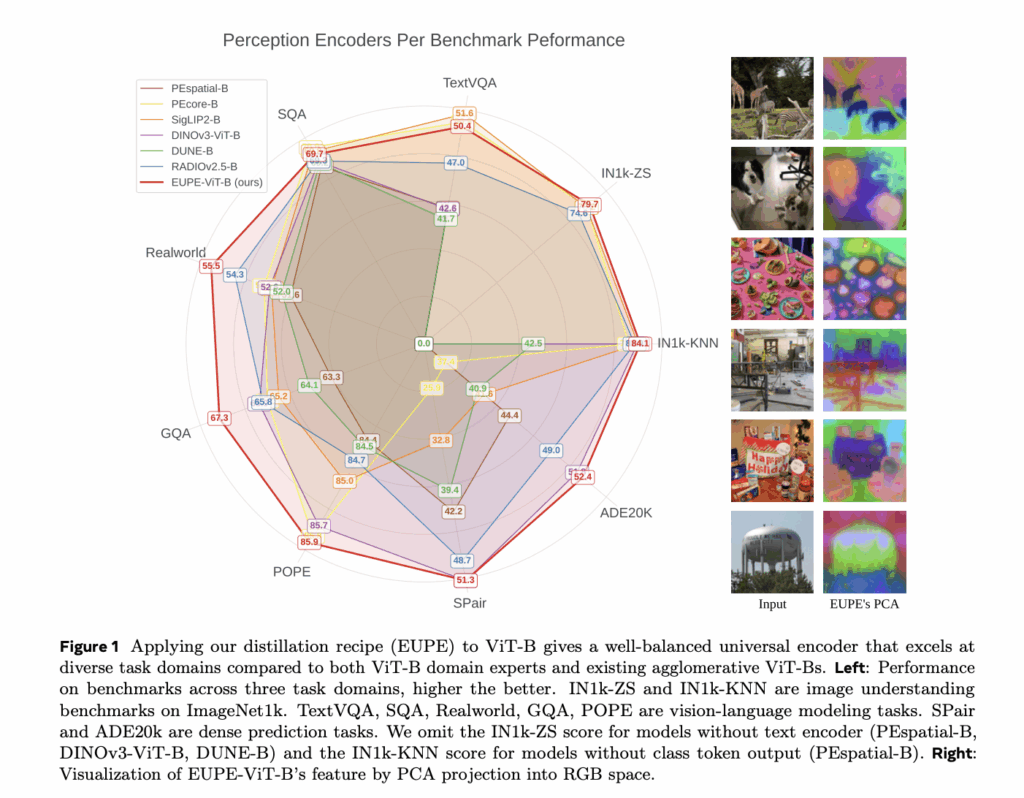
Running powerful AI on your smartphone isn’t just a hardware problem — it’s a model architecture problem. Most state-of-the-art vision encoders are enormous, and when you trim them down to fit on an edge device, they lose the capabilities that made them useful in the first place. Worse, specialized models tend to excel at one type of task — image classification, say, or scene segmentation — but fall apart when you ask them to do something outside their lane. Meta’s AI research teams are now proposing a different path. They introduced the Efficient Universal Perception Encoder (EUPE): a compact vision encoder that handles diverse vision tasks simultaneously without needing to be large. The Core Problem: Specialists vs. Generalists To understand why EUPE matters, it helps to understand how vision encoders work and why specialization is a problem. A vision encoder is the part of a computer vision model that converts raw image pixels into a compact representation — a set of feature vectors — that downstream tasks (like classification, segmentation, or answering questions about an image) can use. Think of it as the ‘eyes’ of an AI pipeline. Modern foundation vision encoders are trained with specific objectives, which gives them an edge in particular domains. For example: CLIP and SigLIP 2 are trained on text-image pairs. They’re strong at image understanding and vision-language modeling, but their performance on dense prediction tasks (which require spatially precise, pixel-level features) often falls below expectations. DINOv2 and its successor DINOv3 are self-supervised models that learn exceptional structural and geometric descriptors, making them strong at dense prediction tasks like semantic segmentation and depth estimation. But they lack satisfactory vision-language capabilities. SAM (Segment Anything Model) achieves impressive zero-shot segmentation through training on massive segmentation datasets, but again falls short on vision-language tasks. For an edge device — a smartphone or AR headset — that needs to handle all of these task types simultaneously, the typical solution is to deploy multiple encoders at once. That quickly becomes compute-prohibitive. The alternative is accepting that a single encoder will underperform in several domains. Previous Attempts: Why Agglomerative Methods Fell Short on Efficient Backbones Researchers have tried to combine the strengths of multiple specialist encoders through a family of methods called agglomerative multi-teacher distillation. The basic idea: train a single student encoder to simultaneously mimic several teacher models, each of which is a domain expert. AM-RADIO and its follow-up RADIOv2.5 are perhaps the most well-known examples of this approach. They showed that agglomerative distillation can work well for large encoders — models with more than 300 million parameters. But the EUPE research demonstrates a clear limitation: when you apply the same recipe to efficient backbones, the results degrade substantially. RADIOv2.5-B, the ViT-B-scale variant, has significant gaps compared to domain experts on dense prediction and VLM tasks. Another agglomerative method, DUNE, merges 2D vision and 3D perception teachers through heterogeneous co-distillation, but similarly struggles at the efficient backbone scale. The root cause, the research team argue, is capacity. Efficient encoders simply don’t have enough representational capacity to directly absorb diverse feature representations from multiple specialist teachers and unify them into a universal representation. Trying to do so in one step produces a model that is mediocre across the board. https://arxiv.org/pdf/2603.22387 EUPE’s Answer: Scale Up First, Then Scale Down The key insight behind EUPE is a principle named ‘first scaling up and then scaling down.‘ Instead of distilling directly from multiple domain-expert teachers into a small student, EUPE introduces an intermediate model: a large proxy teacher with enough capacity to unify the knowledge from all the domain experts. This proxy teacher then transfers its unified, universal knowledge to the efficient student through distillation. The full pipeline has three stages: Stage 1 — Multi-Teacher Distillation into the Proxy Model. Multiple large foundation encoders serve as teachers simultaneously, processing label-free images at their native resolutions. Each teacher outputs a class token and a set of patch tokens. The proxy model — a 1.9B parameter model trained with 4 register tokens — is trained to mimic all teachers at once. The selected teachers are: PEcore-G (1.9B parameters), selected as the domain expert for zero-shot image classification and retrieval PElang-G (1.7B parameters), which the research team found is crucial for vision-language modeling, particularly OCR performance DINOv3-H+ (840M parameters), selected as the domain expert for dense prediction To stabilize training, teacher outputs are normalized by subtracting the per-coordinate mean and dividing by the standard deviation, computed once over 500 iterations before training begins and kept fixed thereafter. This is deliberately simpler than the complex PHI-S normalization used in RADIOv2.5, and avoids the cross-GPU memory overhead of computing normalization statistics on-the-fly. Stage 2 — Fixed-Resolution Distillation into the Efficient Student. With the proxy model now serving as a single universal teacher, the target efficient encoder is trained at a fixed resolution of 256×256. This fixed resolution makes training computationally efficient, allowing a longer learning schedule: 390,000 iterations with a batch size of 8,192, cosine learning rate schedule, a base learning rate of 2e-5, and weight decay of 1e-4. Standard data augmentation applies: random resized cropping, horizontal flipping, color jittering, Gaussian blur, and random solarization. For the distillation loss, the class token loss uses cosine similarity, while the patch token loss combines cosine similarity (weight α=0.9) and smooth L1 loss (weight β=0.1). Adapter head modules — 2-layer MLPs — are appended to the student to match each teacher’s feature dimension. If student and teacher patch token spatial dimensions differ, 2D bicubic interpolation is applied to align them. Stage 3 — Multi-Resolution Finetuning. Starting from the Stage 2 checkpoint, the student undergoes a shorter finetuning phase using an image pyramid of three scales: 256, 384, and 512. The student and the proxy teacher independently and randomly select one scale per iteration — so they may process the same image at different resolutions. This forces the student to learn representations that generalize across spatial granularities, accommodating downstream tasks that operate at various resolutions. This stage runs for 100,000 iterations at

Meta AI Releases EUPE: A Compact Vision Encoder Family Under 100M Parameters That Rivals Specialist Models Across Image Understanding, Dense Prediction, and VLM Tasks Read Post »

AI, Committee, 新闻, Uncategorized

The Download: AI’s impact on jobs, and data centres in space

This is today’s edition of The Download, our weekday newsletter that provides a daily dose of what’s going on in the world of technology. The one piece of data that could actually shed light on your job and AI  Within Silicon Valley’s orbit, an AI-fueled jobs apocalypse is spoken about as a given. Now even economists who have downplayed the threat are coming around to the idea.   Alex Imas, based at the University of Chicago, is one of them. He believes that any plan to address AI’s impact will depend on collecting one vital piece of data: price elasticity.  Imas argues that “we need a Manhattan Project” for this. Read the full story to find out why.  —James O’Donnell  This article is from The Algorithm, our weekly newsletter giving you the inside track on all things AI. Sign up to receive it in your inbox every Monday.  Four things we’d need to put data centers in space  In January, Elon Musk’s SpaceX applied to launch up to 1 million data centers into Earth’s orbit. The goal? To fully unleash the potential of AI—without triggering an environmental crisis on Earth.  SpaceX is among a growing list of tech firms pursuing orbital computing infrastructure. But can their plans really work? Here are four must-haves for making space-based data centers a reality.  —Tereza Pultarova  This story is part of MIT Technology Review Explains, our series untangling the complex, messy world of technology to help you understand what’s coming next. You can read more from the series here.  The must-reads  I’ve combed the internet to find you today’s most fun/important/scary/fascinating stories about technology.  1 Trump has again proposed major cuts to US science and tech spending He wants to slash nearly every science-focused agency. (Ars Technica) + If Trump gets his way, the US could face a costly brain drain. (NYT $)  + Top research talent is already fleeing the country. (Guardian)  + Basic science deserves our boldest investment. (MIT Technology Review)  2 Sam Altman lobbied against AI regulations he publicly welcomed  A bombshell report reveals many OpenAI insiders don’t trust him. (The New Yorker $) + Some have called him a sociopath. (Futurism) + OpenAI’s CFO fears it won’t be IPO-ready this year. (The Information $)  + A war over AI regulation is brewing in the US. (MIT Technology Review)  3 NASA’s Artemis II has broken humanity’s all-time distance record The astronauts have flown farther than any humans before them. (BBC) + Their mission includes MIT-developed technology. (Axios)  4 Chinese tech firms are selling intel “exposing” US forces It comes from combining AI with open-source data.. (WP $) + AI is turning the Iran conflict into theater. (MIT Technology Review)  5 War is pushing countries to ditch hyperscalers Driven by Iran naming tech giants as military targets. (Rest of World) + No one wants a data center in their backyard. (MIT Technology Review)  6 OpenAI, Anthropic, and Google have united against China’s AI copying They’re sharing information on “adversarial distillation” (Bloomberg $)  7 Anduril and Impulse Space are working on Trump’s “Golden Dome” They’re developing space-based missile tracking for the project. (Gizmodo)   8 OpenAI has urged California to probe Elon Musk’s “anti-competitive behavior.” It accuses Musk of trying to “take control of the future of AGI.” (Reuters $) + And claims he coordinated attacks with Mark Zuckerberg. (CNBC) + A former Tesla president has revealed how he survived working for Musk. (WP $)  9 DeepSeek’s new AI model will run on Huawei chips It’s expected to launch in the next few weeks. (The Information $)  10 Memes have nuked our culture Internet “brain rot” has escaped our phones to take over everything. (NYT $)  Quote of the day  “I must say, it was actually quite nice.”   —Astronaut Victor Glover tells President Donald Trump what it was like when Artemis II was out of communication with the rest of humanity, The New York Times reports.  One More Thing  PABLO ALBARENGA Inside the controversial tree farms powering Apple’s carbon-neutral goal   In 2020, Apple set a goal to become net zero by the end of the decade. To hit that target, the company is offsetting its emissions by planting millions of eucalyptus trees in Brazil.  Apple is betting that the strategy will lead to a greener future. But critics warn that the industrial tree farms will do more harm than good.  Find out why the plans have sparked a backlash.  —Gregory Barber  We can still have nice things  A place for comfort, fun and distraction to brighten up your day. (Got any ideas? Drop me a line.)  + Japan’s automated bike garage is a cyclist’s dream come true.  + This deep dive into bird behavior reveals the secrets of their dining habits. (Big thanks to reader Terry Gordon for the find!) + The first photo from the Artemis astronauts vividly captures the glow of our atmosphere. + There’s a new contender for the world’s most gorgeous website: RobertDeNiro.com. 

The Download: AI’s impact on jobs, and data centres in space Read Post »

AI, Committee, 新闻, Uncategorized

Enabling agent-first process redesign

Unlike static, rules-based systems, AI agents can learn, adapt, and optimize processes dynamically. As they interact with data, systems, people, and other agents in real time, AI agents can execute entire workflows autonomously. But unlocking their potential requires redesigning processes around agents rather than bolting them onto fragmented legacy workflows using traditional optimization methods. Companies must become agent first. DOWNLOAD THE ARTICLE In an agent-first enterprise, AI systems operate processes while humans set goals, define policy constraints, and handle exceptions. “You need to shift the operating model to humans as governors and agents as operators,” says Scott Rodgers, global chief architect and U.S. CTO of the Deloitte Microsoft Technology Practice. The agent-first imperative With technology budgets for AI expected to increase more than 70% over the next two years, AI agents, powered by generative AI, are poised to fundamentally transform organizations and achieve results beyond traditional automation. These initiatives have the potential to produce significant performance gains, while shifting humans toward higher value work. AI is advancing so quickly that static approaches to task automation will likely only produce incremental gains. Because legacy processes aren’t built for autonomous systems, AI agents require machine-readable process definitions, explicit policy constraints, and structured data flows, according to Rodgers. Further complicating matters, many organizations don’t understand the full economic drivers of their business, such as cost to serve and per-transaction costs. As a result, they have trouble prioritizing agents that can create the most value and instead focus on flashy pilots. To achieve structural change, executives should think differently. Companies must instead orchestrate outcomes faster than competitors. “The real risk isn’t that AI won’t work—it’s that competitors will redesign their operating models while you’re still piloting agents and copilots,” says Rodgers. “Nonlinear gains come when companies create agent-centric workflows with human governance and adaptive orchestration.” Routine and repetitive tasks are increasingly handled automatically, freeing employees to focus on higher value, creative, and strategic work. This shift improves operational efficiency, fosters stronger collaboration, and generates faster decision-making—helping organizations modernize the workplace without sacrificing enterprise security. Download the article. This content was produced by Insights, the custom content arm of MIT Technology Review. It was not written by MIT Technology Review’s editorial staff. It was researched, designed, and written by human writers, editors, analysts, and illustrators. This includes the writing of surveys and collection of data for surveys. AI tools that may have been used were limited to secondary production processes that passed thorough human review.

Enabling agent-first process redesign Read Post »

AI, Committee, 新闻, Uncategorized

Glia: A Human-Inspired AI for Automated Systems Design and Optimization

arXiv:2510.27176v5 Announce Type: replace-cross Abstract: Can AI autonomously design mechanisms for computer systems on par with the creativity and reasoning of human experts? We present Glia, an AI architecture for networked systems design that uses large language models (LLMs) in a human-inspired multi-agent workflow. Each agent specializes in reasoning, experimentation, and analysis, collaborating through an evaluation framework that grounds abstract reasoning in empirical feedback. Unlike prior ML-for-systems methods that optimize black-box policies, Glia generates interpretable designs and exposes its reasoning. When applied to a distributed GPU cluster for LLM inference, it produces new algorithms for request routing, scheduling, and auto-scaling that perform at human-expert levels in significantly less time, while yielding novel insights into workload behavior. Our results suggest that combining reasoning LLMs with structured experimentation, an AI can produce creative and understandable designs for complex systems problems.

Glia: A Human-Inspired AI for Automated Systems Design and Optimization Read Post »

AI, Committee, 新闻, Uncategorized

VeriOS: Query-Driven Proactive Human-Agent-GUI Interaction for Trustworthy OS Agents

arXiv:2509.07553v3 Announce Type: replace Abstract: With the rapid progress of multimodal large language models, operating system (OS) agents become increasingly capable of automating tasks through on-device graphical user interfaces (GUIs). However, most existing OS agents are designed for idealized settings, whereas real-world environments often present untrustworthy conditions. To mitigate risks of over-execution in such scenarios, we propose a query-driven human-agent-GUI interaction framework that enables OS agents to decide when to query humans for more reliable task completion. Built upon this framework, we introduce VeriOS-Agent, a trustworthy OS agent trained with a three-stage learning paradigm that falicitate the decoupling and utilization of meta-knowledge by supervised fine-tuning and group relative policy optimization. Concretely, VeriOS-Agent autonomously executes actions in normal conditions while proactively querying humans in untrustworthy scenarios. Experiments show that VeriOS-Agent improves the average step-wise success rate by 19.72% in over the strongest baselines, without compromising normal performance. VeriOS-Agent significantly improves performance in untrustworthy scenarios while maintaining comparable performance in trustworthy scenarios. Analysis highlights VeriOS-Agent’s rationality, generalizability, and scalability. The codes, datasets and models are available at https://github.com/Wuzheng02/VeriOS.

VeriOS: Query-Driven Proactive Human-Agent-GUI Interaction for Trustworthy OS Agents Read Post »

AI, Committee, 新闻, Uncategorized

RightNow AI Releases AutoKernel: An Open-Source Framework that Applies an Autonomous Agent Loop to GPU Kernel Optimization for Arbitrary PyTorch Models

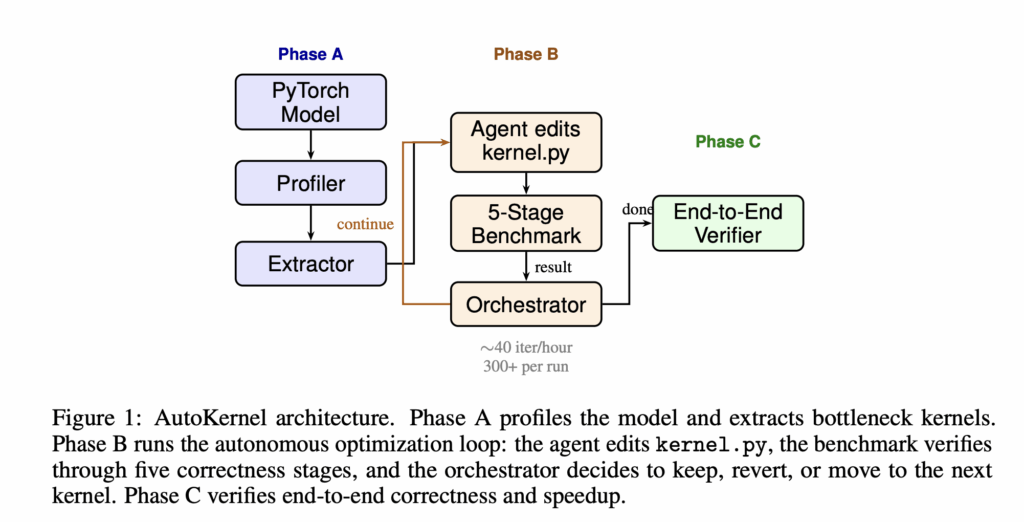
Writing fast GPU code is one of the most grueling specializations in machine learning engineering. Researchers from RightNow AI want to automate it entirely. The RightNow AI research team has released AutoKernel, an open-source framework that applies an autonomous LLM agent loop to GPU kernel optimization for arbitrary PyTorch models. The approach is straightforward: give it any model before you go to bed, and wake up to faster Triton kernels — no GPU expertise required. https://arxiv.org/pdf/2603.21331 Why GPU Kernels Are So Hard to Optimize A GPU kernel is a function that runs in parallel across thousands of GPU cores. When you run a transformer model like LLaMA or GPT-2, the bulk of compute time is spent inside kernels for operations like matrix multiplication (matmul), softmax, layer normalization, and attention. These kernels live in libraries like cuBLAS and cuDNN, or get generated automatically by PyTorch’s compilation pipeline. The problem is that squeezing maximum performance out of these kernels requires reasoning simultaneously about arithmetic intensity, memory coalescing, register pressure, tile sizes, warp-level synchronization, and tensor core instruction selection — a combination of skills that takes years to develop. A single high-performance matmul kernel may involve 200+ lines of CUDA or Triton code with dozens of interdependent parameters. This expertise is scarce, and the manual tuning process scales poorly as model architectures evolve. The benchmark suite KernelBench, which evaluates frontier LLMs on 250 GPU kernel problems, found that even the best models matched PyTorch baseline performance in fewer than 20% of cases using one-shot generation. AutoKernel was built directly in response to that gap. The Loop: Edit, Benchmark, Keep or Revert AutoKernel’s core insight is that an expert kernel engineer’s workflow is itself a simple loop: write a candidate, benchmark it, keep improvements, discard regressions, repeat. The framework mechanizes this loop. An LLM agent modifies a single file — kernel.py — a fixed benchmark harness verifies correctness and measures throughput, and the result determines whether the change persists. Crucially, every experiment maps to a git commit. Kept experiments advance the branch; reverted experiments are erased cleanly with git reset. The entire history is browsable with standard git tools, and experiment results are logged to a plain tab-separated results.tsv file — dependency-free, human-readable, and trivially parseable by the agent. Each iteration takes approximately 90 seconds — 30 seconds for correctness checking, 30 seconds for performance benchmarking via Triton’s do_bench, and 30 seconds for agent reasoning and code modification. At roughly 40 experiments per hour, an overnight 10-hour run yields 300 to 400 experiments across multiple kernels. This design draws directly from Andrej Karpathy’s autoresearch project, which demonstrated that an AI agent running a keep/revert loop on LLM training code could discover 20 optimizations across 700 experiments in two days on a single GPU. AutoKernel transplants this loop to kernel code, with a different search space and a correctness-gated benchmark as the evaluation function instead of validation loss. The agent reads a 909-line instruction document called program.md, which encodes expert knowledge into a six-tier optimization playbook. The tiers progress from block size tuning (sweeping tile dimensions through powers of 2, adjusting num_warps and num_stages) through memory access patterns (coalesced loads, software prefetching, L2 swizzling), compute optimizations (TF32 accumulation, epilogue fusion), advanced techniques (split-K, persistent kernels, Triton autotune, warp specialization), architecture-specific strategies (TMA on Hopper, cp.async on Ampere, adjusted sizes for L4/RTX), and finally kernel-specific algorithms like online softmax for attention and Welford’s algorithm for normalization. The instruction document is intentionally comprehensive so the agent can run 10+ hours without getting stuck. https://arxiv.org/pdf/2603.21331 Profiling First, Optimizing Where It Matters Unlike prior work that treats kernel problems in isolation, AutoKernel starts from a complete PyTorch model. It uses torch.profiler with shape recording to capture per-kernel GPU time, then ranks optimization targets using Amdahl’s law — the mathematical principle that the overall speedup you can achieve is bounded by how much of the total runtime that component represents. A 1.5× speedup on a kernel consuming 60% of total runtime yields a 1.25× end-to-end gain. The same speedup on a kernel consuming 5% of runtime yields only 1.03×. The profiler detects GPU hardware from a database of known specifications covering both NVIDIA (H100, A100, L40S, L4, A10, RTX 4090/4080/3090/3080) and AMD (MI300X, MI325X, MI350X, MI355X) accelerators. For unknown GPUs, it estimates peak FP16 throughput from SM count, clock rate, and compute capability — making the system usable across a wider range of hardware than just the latest NVIDIA offerings. The orchestrator (orchestrate.py) transitions from one kernel to the next when any of four conditions are met: five consecutive reverts, 90% of GPU peak utilization reached, a two-hour elapsed time budget, or a 2× speedup already achieved on that kernel. This prevents the agent from spending excessive time on kernels with diminishing returns while higher-impact targets wait. Five-Stage Correctness Harness Performance without correctness is useless, and AutoKernel is particularly thorough on this front. Every candidate kernel passes through five validation stages before any speedup is recorded. Stage 1 runs a smoke test on a small input to catch compilation errors and shape mismatches in under a second. Stage 2 sweeps across 8 to 10 input configurations and three data types — FP16, BF16, and FP32 — to catch size-dependent bugs like boundary handling and tile remainder logic. Stage 3 tests numerical stability under adversarial inputs: for softmax, rows of large identical values; for matmul, extreme dynamic range; for normalization, near-zero variance. Stage 4 verifies determinism by running the same input three times and requiring bitwise identical outputs, which catches race conditions in parallel reductions and non-deterministic atomics. Stage 5 tests non-power-of-two dimensions like 1023, 4097, and 1537 to expose masking bugs and tile remainder errors. Tolerances are dtype-specific: FP16 uses atol = 10⁻², BF16 uses 2 × 10⁻², and FP32 uses 10⁻⁴. In the paper’s full evaluation across 34 configurations on an NVIDIA H100, all 34 passed correctness with zero failures across eager, compiled, and custom kernel outputs. Dual Backend: Triton and CUDA C++ AutoKernel supports both Triton and

RightNow AI Releases AutoKernel: An Open-Source Framework that Applies an Autonomous Agent Loop to GPU Kernel Optimization for Arbitrary PyTorch Models Read Post »

AI, Committee, 新闻, Uncategorized

AI is changing how small online sellers decide what to make

For years Mike McClary sold the Guardian LTE Flashlight, a heavy-duty black model, online through his small outdoor brand. The product, designed for brightness and durability, became one of his most popular items ever. Even after he stopped offering it around 2017, customers kept sending him emails asking where they could buy it.  When McClary decided to revisit the Guardian flashlight in 2025, he didn’t begin the way he might have in the past, by combing through supplier listings and sending inquiries to factories. Instead, he opened Accio, an AI sourcing and researching tool on Alibaba.com. For small entrepreneurs in the US, deciding what to sell and where to make it has traditionally been a slow, labor-intensive process that can take months. Now that work is increasingly being done by AI tools like Accio, which help connect businesses with manufacturers in countries including China and India. Business owners and e-commerce experts told MIT Technology Review that these AI tools are making sourcing more accessible and significantly shortening the time it takes to go from product idea to launch.  McClary, 51, who runs his business from his Illinois living room, has sold products ranging from leather conditioner to camping lights, including one rechargeable lantern that brought in half a million dollars. Like many small online merchants, he built his business by being extremely scrappy—spotting demand for a product, tweaking existing designs, finding a factory, doing modest marketing, and getting the goods in front of customers fast.  This time, though, he began by telling Accio about the flashlight’s original design, production cost, and profit margin. Then Accio suggested several changes, making it smaller and slightly less bright and switching its charging method to battery power. It also identified a manufacturer in Ningbo, China, that McClary said could cut the manufacturing cost from $17 to about $2.50 per unit. McClary took the process from there, contacting the supplier himself to discuss the revised design. Within a month, the new version of the Guardian flashlight was back up for sale on Amazon and on his brand’s website. The new factory hunt Although Alibaba is better known for owning Taobao, the biggest shopping site in China, its first business was Alibaba.com, the primary website that lists Chinese factories open for bulk orders. Placing an order with a manufacturer usually requires far more than clicking “Buy.” Sellers often spend days or weeks browsing listings, comparing suppliers’ reviews and manufacturing capacities, asking about minimum order quantities, requesting samples, and negotiating timelines and customization options.  But Accio has gained significant momentum by changing how that sourcing gets done. Launched in 2024, Accio exceeded 10 million monthly active users in March 2026, according to the company. That means about one in five Alibaba users consults with AI about product sourcing. Accio’s interface looks a lot like ChatGPT or Claude: Users type a question into an empty box and choose between “fast” and “thinking” modes. But when asked about products, the tool returns more than text, offering charts, links, and visuals and asking follow-up questions to clarify the buyer’s needs. It then narrows the field to one or a handful of suppliers that appear capable of delivering. After that, the human work begins: Users still have to reach out to suppliers themselves and negotiate the details. Zhang Kuo, the president of Alibaba.com, told MIT Technology Review that the tool is built on multiple frontier models, including the company’s own Qwen series, a popular family of open-source large language models. The system is able to pull from the site’s millions of supplier profiles and is trained on 26 years of proprietary transaction data. For tasks like product research and sourcing analysis, the tool “blows it away” compared with general AI tools like ChatGPT, says Richard Kostick, CEO of the beauty brand 100% Pure. Many websites have tried using AI to assist shopping, but Alibaba has been one of the most aggressive. In March, Eddie Wu, CEO of the site’s parent company Alibaba Group, told managers that integrating the company’s core services with Qwen’s AI capabilities is a top priority. During a Chinese New Year promotion of Qwen’s personal shopping AI agent, where the company gave away cash, customers placed 200 million orders, the firm says. Vincenzo Toscano, an e-commerce seller and consultant, recommended Accio to his clients before deciding to try it himself for a new sunglasses brand. He came in with a rough vision: a brand shaped by his Italian heritage, his personal style, and a boutique aesthetic. He says the AI helped turn that concept into something more concrete, suggesting materials, refining the look, and pointing to design ideas that felt current. But the tool has clear limits. McClary, who uses AI tools regularly, says Accio is strongest when it comes to product ideation, but less helpful on marketing questions such as advertising and social media outreach. To use it well, he says, buyers still need to challenge its recommendations, since some can be generic. The rest of the business As platforms become more AI-driven, manufacturers are adjusting too. Sally Yan, a representative at a makeup packaging company in Wuhan, China, says her firm has started writing more detailed product descriptions and adding information about its equipment and manufacturing experience on Alibaba.com because it suspects those details make its listings more likely to be surfaced by AI. Yan says manufacturers cannot tell whether an inquiry from a customer was generated or guided by AI, and that her firm is not using AI to negotiate pricing or product details. “AI agents are increasingly used by people to assist decision making or even directly making transactions, and in certain situations,  they can become extremely useful,” “AI agents are increasingly used by people to assist purchase decisions and even directly making transactions, and with clear data guardrails, they can become extremely useful,” says Jiaxin Pei, a research scientist at the Stanford Institute for Human-Centered AI, “but agents need to act transparently, securely, and in the customer’s best interest.” Pei says developers

AI is changing how small online sellers decide what to make Read Post »

We use cookies to improve your experience and performance on our website. You can learn more at 隱私權政策 and manage your privacy settings by clicking Settings.

Privacy Preferences

You can choose your cookie settings by turning on/off each type of cookie as you wish, except for essential cookies.

Allow All
Manage Consent Preferences
  • Always Active

Save
zh_CN