YouZum

Uncategorized

AI, Committee, Noticias, Uncategorized

The Download: AstroTurf wars and exponential AI growth

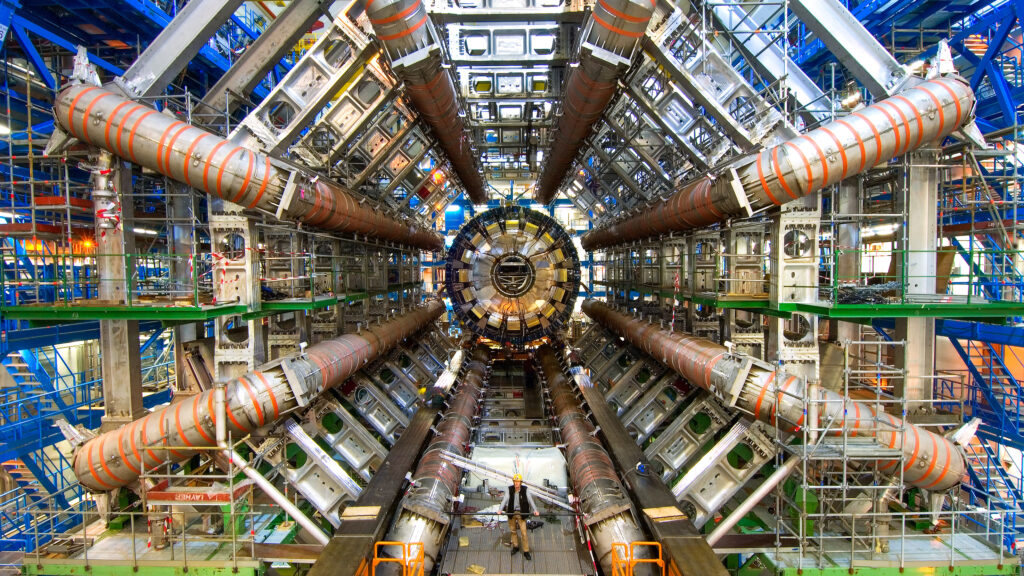
This is today’s edition of The Download, our weekday newsletter that provides a daily dose of what’s going on in the world of technology. Is fake grass a bad idea? The AstroTurf wars are far from over.  In 2001, Americans installed just over 7 million square meters of synthetic turf. By 2024, that number was 79 million square meters—enough to carpet all of Manhattan and then some. The increase worries folks who study microplastics and environmental pollution.   While the plastic-making industry insists that synthetic fields are safe if properly installed, lots of researchers think that isn’t so. Find out why AstroTurf has ignited heated debates. —Douglas Main  This story is from the next issue of our print magazine, packed with stories all about nature. Subscribe now to read the full thing when it lands on Wednesday, April 22.  Mustafa Suleyman: AI development won’t hit a development wall anytime soon—here’s why  —Mustafa Suleyman, Microsoft AI CEO and Google DeepMind co-founder  The skeptics keep predicting that AI compute will soon hit a wall—and keep getting proven wrong. To understand why that is, you need to look at the forces driving the AI explosion.   Three advances are enabling exponential progress: faster basic calculators, high-bandwidth memory, and technologies that turn disparate GPUs into enormous supercomputers. Where does all this get us? Read the full op-ed on the future of AI development to learn more.   Desalination technology, by the numbers  —Casey Crownhart  When I started digging into desalination technology for a new story, I couldn’t help but obsess over the numbers.  I knew on some level that desalination—pulling salt out of seawater to produce fresh water—was an increasingly important technology, especially in water-stressed regions including the Middle East. But just how much some countries rely on desalination, and how big a business it is, still surprised me. Here are the extraordinary numbers behind the crucial water source.  This story is from The Spark, our weekly newsletter on the tech that could combat the climate crisis. Sign up to receive it in your inbox every Wednesday.  The must-reads  I’ve combed the internet to find you today’s most fun/important/scary/fascinating stories about technology.  1 Meta has launched the first AI model from its Superintelligence LabsMuse Spark is the company’s first model in a year. (Reuters $) + The closed model brings reasoning capabilities to the Meta AI app. (Engadget) + It’s built by Meta’s Superintelligence Labs, the unit led by Alexandr Wang. (TechCrunch)  2 Anthropic has lost a bid to pause the Pentagon’s blacklisting An appeals court in Washington, DC denied the request. (CNBC) + A California judge had temporarily blocked the blacklisting in March. (NPR) + The mixed rulings leave Anthropic in a legal limbo. (Wired $) + And open doors for smaller AI rivals. (Reuters $)  3 New evidence suggests Adam Back invented Bitcoin The British cryptographer may be the real Satoshi Nakamoto. (NYT $) + Back denies the claims. (BBC) + There’s a dark side to crypto’s permissionless dream. (MIT Technology Review)  4 Gen Z is cooling on AI The share feeling angry about it has risen from 22% to 31% in a year. (Axios) + Anti-AI protests are also growing. (MIT Technology Review)  5 War in the Gulf could tilt the cloud race toward China Huawei is pitching “multi-cloud” resilience to Gulf clients. (Rest of World)  6 Meta has killed a leaderboard of its AI token users It showed the top 250 users. (The Information $) + Meta blamed data leaks for the shutdown. (Fortune) + It encouraged “tokenmaxxing,” a growing phenomenon in Big Tech. (NYT $)  7 Did Artemis II really tell us anything new about space? Or was it primarily a PR exercise? (Ars Technica)  8 Israeli attacks have brutally exposed Lebanon’s digital infrastructure It’s managing a modern crisis without modern technology. (Wired $)  9 AI models could offer mathematicians a common language They hope it will simplify the process of verifying proofs. (Economist)   10 A “self-doxing’ rave is helping trans people stay safe online It’s among a series of digital self-defenses. (404 Media)  Quote of the day  “I feel like anything that I’m interested in has the potential of maybe getting replaced, even in the next few years.”  —Sydney Gill, a freshman at Rice University, tells the New York Times why she’s soured on AI.  One More Thing  A view inside ATLAS,one of two general-purpose detectors at the Large Hadron Collider.MAXIMILIEN BRICE/CERN Inside the hunt for new physics at the world’s largest particle collider  In 2012, data from CERN’s Large Hadron Collider (LHC) unearthed a particle called the Higgs boson. The discovery answered a nagging question: where do fundamental particles, such as the ones that make up all the protons and neutrons in our bodies, get their mass? But now particle physicists have reached an impasse in their quest to discover, produce, and study new particles at colliders. Find out what they’re trying to do about it. —Dan Garisto  We can still have nice things  A place for comfort, fun and distraction to brighten up your day. (Got any ideas? Drop me a line.)  + Enjoy this tale of the “joke” sound that accidentally defined 90s rave culture. + Take a nostalgic trip through the websites of the early 00s. + One for animal lovers: sperm whales have teamed up to support a newborn. + Here’s a long overdue answer to a vital question: can the world’s largest mousetrap catch a limousine? 

The Download: AstroTurf wars and exponential AI growth Leer entrada »
AI, Committee, Noticias, Uncategorized

Z.AI Introduces GLM-5.1: An Open-Weight 754B Agentic Model That Achieves SOTA on SWE-Bench Pro and Sustains 8-Hour Autonomous Execution

Z.AI, the AI platform developed by the team behind the GLM model family, has released GLM-5.1 — its next-generation flagship model developed specifically for agentic engineering. Unlike models optimized for clean, single-turn benchmarks, GLM-5.1 is built for agentic tasks, with significantly stronger coding capabilities than its predecessor, and achieves state-of-the-art performance on SWE-Bench Pro while leading GLM-5 by a wide margin on NL2Repo (repo generation) and Terminal-Bench 2.0 (real-world terminal tasks). Architecture: DSA, MoE, and Asynchronous RL Before diving into what GLM-5.1 can do, it’s worth understanding what it’s built on — because the architecture is meaningfully different from a standard dense transformer. GLM-5 adopts DSA to significantly reduce training and inference costs while maintaining long-context fidelity. The model uses a glm_moe_dsa architecture (Mixture of Experts (MoE) model combined with DSA). For AI devs evaluating whether to self-host, this matters: MoE models activate only a subset of their parameters per forward pass, which can make inference significantly more efficient than a comparably-sized dense model, though they require specific serving infrastructure. On the training side, GLM-5 implements a new asynchronous reinforcement learning infrastructure that drastically improves post-training efficiency by decoupling generation from training. Novel asynchronous agent RL algorithms further improve RL quality, enabling the model to learn from complex, long-horizon interactions more effectively. This is what allows the model to handle agentic tasks with the kind of sustained judgment that single-turn RL training struggles to produce. The Plateau Problem GLM-5.1 is Solving To understand what makes GLM-5.1 different at inference time, it helps to understand a specific failure mode in LLMs used as agents. Previous models — including GLM-5 — tend to exhaust their repertoire early: they apply familiar techniques for quick initial gains, then plateau. Giving them more time doesn’t help. This is a structural limitation for any developer trying to use an LLM as a coding agent. The model applies the same playbook it knows, hits a wall, and stops making progress regardless of how long it runs. GLM-5.1, by contrast, is built to stay effective on agentic tasks over much longer horizons. The model handles ambiguous problems with better judgment and stays productive over longer sessions. It breaks complex problems down, runs experiments, reads results, and identifies blockers with real precision. By revisiting its reasoning and revising its strategy through repeated iteration, GLM-5.1 sustains optimization over hundreds of rounds and thousands of tool calls. The sustained performance requires more than a larger context window. This capability requires the model to maintain goal alignment over extended execution, reducing strategy drift, error accumulation, and ineffective trial and error, enabling truly autonomous execution for complex engineering tasks. Benchmarks: Where GLM-5.1 Stands On SWE-Bench Pro, GLM-5.1 achieves a score of 58.4, outperforming GPT-5.4, Claude Opus 4.6, and Gemini 3.1 Pro, setting a new state-of-the-art result. The broader benchmark profile shows a well-rounded model. GLM-5.1 scores 95.3 on AIME 2026, 94.0 on HMMT Nov. 2025, 82.6 on HMMT Feb. 2026, and 86.2 on GPQA-Diamond — a graduate-level science reasoning benchmark. On agentic and tool-use benchmarks, GLM-5.1 scores 68.7 on CyberGym (a substantial jump from GLM-5’s 48.3), 68.0 on BrowseComp, 70.6 on τ³-Bench, and 71.8 on MCP-Atlas (Public Set) — the last one particularly relevant given MCP’s growing role in production agent systems. On Terminal-Bench 2.0, the model scores 63.5, rising to 66.5 when evaluated with Claude Code as the scaffolding. Across 12 representative benchmarks covering reasoning, coding, agents, tool use, and browsing, GLM-5.1 demonstrates a broad and well-balanced capability profile. This shows that GLM-5.1 is not a single-metric improvement — it advances simultaneously across general intelligence, real-world coding, and complex task execution. In terms of overall positioning, GLM-5.1’s general capability and coding performance are overall aligned with Claude Opus 4.6. 8-Hour Sustained Execution: What That Actually Means The most important difference in GLM-5.1 is its capacity for long-horizon task execution. GLM-5.1 can work autonomously on a single task for up to 8 hours, completing the full process from planning and execution to testing, fixing, and delivery. For developers building autonomous agents, this changes the scope of what’s possible. Rather than orchestrating a model over dozens of short-lived tool calls, you can hand GLM-5.1 a complex objective and let it run a complete ‘experiment–analyze–optimize’ loop autonomously. The concrete engineering demonstrations make this tangible: GLM-5.1 can build a complete Linux desktop environment from scratch in 8 hours; perform 178 rounds of autonomous iteration on a vector database task and improve performance to 1.5× the initial version; and optimize a CUDA kernel, increasing speedup from 2.6× to 35.7× through sustained tuning. That CUDA kernel result is notable for ML engineers: improving a kernel from 2.6× to 35.7× speedup through autonomous iterative optimization is a level of depth that would take a skilled human engineer significant time to replicate manually. Model Specifications and Deployment GLM-5.1 is a 754-billion-parameter MoE model released under the MIT license on HuggingFace. It operates with a 200K context window and supports up to 128K maximum output tokens — both important for long-horizon tasks that need to hold large codebases or extended reasoning chains in memory. GLM-5.1 supports thinking mode (offering multiple thinking modes for different scenarios), streaming output, function calling, context caching, structured output, and MCP for integrating external tools and data sources. For local deployment, the following open-source frameworks support GLM-5.1: SGLang (v0.5.10+), vLLM (v0.19.0+), xLLM (v0.8.0+), Transformers (v0.5.3+), and KTransformers (v0.5.3+). For API access, the model is available through Z.AI’s API platform. Getting started requires installing zai-sdk via pip and initializing a ZaiClient with your API key. . Key Takeaways GLM-5.1 sets a new state-of-the-art on SWE-Bench Pro with a score of 58.4, outperforming GPT-5.4, Claude Opus 4.6, and Gemini 3.1 Pro — making it one of the the strongest publicly benchmarked model for real-world software engineering tasks at the time of release. The model is built for long-horizon autonomous execution, capable of working on a single complex task for up to 8 hours — running experiments, revising strategies, and iterating across hundreds of rounds and thousands of tool

Z.AI Introduces GLM-5.1: An Open-Weight 754B Agentic Model That Achieves SOTA on SWE-Bench Pro and Sustains 8-Hour Autonomous Execution Leer entrada »

AI, Committee, Noticias, Uncategorized

FastDiSS: Few-step Match Many-step Diffusion Language Model on Sequence-to-Sequence Generation–Full Version

arXiv:2604.05551v1 Announce Type: new Abstract: Self-conditioning has been central to the success of continuous diffusion language models, as it allows models to correct previous errors. Yet its ability degrades precisely in the regime where diffusion is most attractive for deployment: few-step sampling for fast inference. In this study, we show that when models only have a few denoising steps, inaccurate self-conditioning induces a substantial approximation gap; this mistake compounds across denoising steps and ultimately dominate the sample quality. To address this, we propose a novel training framework that handles these errors during learning by perturbing the self-conditioning signal to match inference noise, improving robustness to prior estimation errors. In addition, we introduce a token-level noise-awareness mechanism that prevents training from saturation, hence improving optimization. Extensive experiments across conditional generation benchmarks demonstrate that our framework surpasses standard continuous diffusion models while providing up to 400x faster inference speed, and remains competitive against other one-step diffusion frameworks.

FastDiSS: Few-step Match Many-step Diffusion Language Model on Sequence-to-Sequence Generation–Full Version Leer entrada »

AI, Committee, Noticias, Uncategorized

The Download: water threats in Iran and AI’s impact on what entrepreneurs make

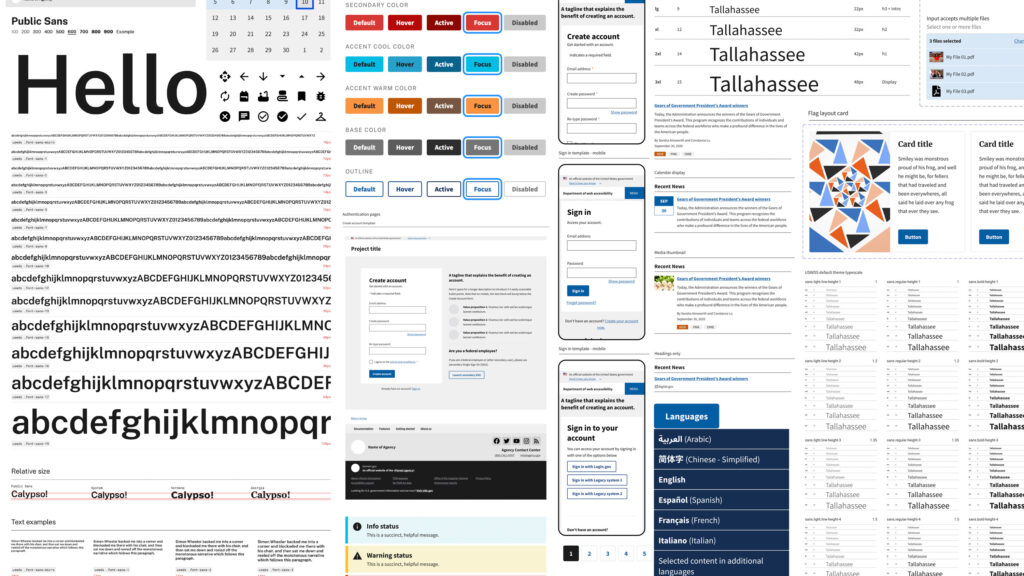
This is today’s edition of The Download, our weekday newsletter that provides a daily dose of what’s going on in the world of technology. Desalination plants in the Middle East are increasingly vulnerable  As the conflict in Iran has escalated, a crucial resource is under fire: the desalinization technology that supplies water in the region.  President Donald Trump has threatened to destroy “possibly all desalinization plants” in Iran if the Strait of Hormuz is not reopened. The impact on farming, industry, and—crucially—drinking in the Middle East could be severe. Find out why.  —Casey Crownhart  This story is part of MIT Technology Review Explains, our series untangling the complex, messy world of technology to help you understand what’s coming next. You can read more from the series here.  AI is changing how small online sellers decide what to make  For small entrepreneurs, deciding what to sell and where to make it has traditionally been a slow, labor-intensive process. Now that work is increasingly being done by AI.    Tools like Alibaba’s Accio compress weeks of product research and supplier hunting into a single chat. Business owners and e-commerce experts say they’re making sourcing more accessible—and slashing the time from product idea to launch.   Read the full story on how AI is leveling the path to global manufacturing.  —Caiwei Chen  The gig workers who are training humanoid robots at home  When Zeus, a medical student in Nigeria, returns to his apartment from a long day at the hospital, he straps his iPhone to his forehead and records himself doing chores.   Zeus is a data recorder for Micro1, which sells the data he collects to robotics firms. As these companies race to build humanoids, videos from workers like Zeus have become the hottest new way to train them.    Micro1 has hired thousands of them in more than 50 countries, including India, Nigeria, and Argentina. The jobs pay well locally, but raise thorny questions around privacy and informed consent. The work can be challenging—and weird. Read the full story.   —Michelle Kim  This is our latest story to be turned into an MIT Technology Review Narrated podcast, which we’re publishing each week on Spotify and Apple Podcasts. Just navigate to MIT Technology Review Narrated on either platform, and follow us to get all our new content as it’s released.  The must-reads  I’ve combed the internet to find you today’s most fun/important/scary/fascinating stories about technology.  1 Anthropic’s new model found security problems in every OS and browser Claude Mythos has been heralded as a cybersecurity “reckoning.” (The Verge)  + Anthrophic is limiting the rollout over hacking fears. (CNBC) + It’s also launching a project that lets Mythos flag vulnerabilities. (Gizmodo) + Apple, Google, and Microsoft have joined the initiative. (ZDNET)  2 Iranian hackers are targeting American critical infrastructure Their focus is on energy and water infrastructure. (Wired) + They’re targeting industrial control devices. (TechCrunch)   3 Google’s AI Overviews deliver millions of incorrect answers per hour Despite a 90% accuracy rate. (NYT $) + AI means the end of internet search as we’ve known it. (MIT Technology Review)  4 Elon Musk is trying to oust OpenAI CEO Sam Altman in a lawsuit As remedies for Altman allegedly defrauding him. (CNBC) + Musk wants any damages given to OpenAI’s nonprofit arm. (WSJ $)  5 ICE has admitted it’s using powerful spyware The tools that can intercept encrypted messages. (NPR) + Immigration agencies are also weaponizing AI videos. (MIT Technology Review)  6 Greece has joined the countries banning kids from social media Under-15s will be blocked from 2027. (Reuters) + Australia introduced the world’s first social media ban for children. (Guardian) + Indonesia recently rolled out the first one in Southeast Asia. (DW)  + Experts say they’re a lazy fix. (CNBC)  7 Intel will help Elon Musk build his Terafab in Texas They aim to manufacture chips for AI projects. (Engadget) + Musk says it will be the largest-ever semiconductor factory. (Engadget) + Future AI chips could be built on glass. (MIT Technology Review)   8 TikTok is building a second billion-euro data center in Finland It’s moving data storage for European users. (Reuters) + Finland has become a magnet for data centers. (Bloomberg $) + But nobody wants one in their backyard. (MIT Technology Review)  9 Plans for Canada’s first “virtual gated community” have sparked a row The AI-powered surveillance system has divided neighbors. (Guardian) + Is the Pentagon allowed to surveil Americans with AI? (MIT Technology Review)  10 The high-tech engineering of the “space toilet” has been revealed Artemis II is the first mission to carry one around the world. (Vox)  Quote of the day  “This case has always been about Elon generating more power and more money for what he wants. His lawsuit remains nothing more than a harassment campaign that’s driven by ego, jealousy and a desire to slow down a competitor.”  —OpenAI criticizes Musk’s legal action in an X post.  One More Thing  USWDS Inside the US government’s brilliantly boring websites  You may not notice it, but your experience on every US government website is carefully crafted.  Each site aligns an official web design and a custom typeface. They aim to make government websites not only good-looking but accessible and functional for all.  MIT Technology Review dug into the system’s history and features. Find out what we discovered.  —Jon Keegan  We can still have nice things  A place for comfort, fun and distraction to brighten up your day. (Got any ideas? Drop me a line.)  + Rejoice in the splendor of the “Earthset” image captured by Artemis II. + Meet the fearless cat chasing off bears. + This document vividly explains what makes the octopus so unique. + Revealed: the rhythmic secret that makes emo music so angsty. 

The Download: water threats in Iran and AI’s impact on what entrepreneurs make Leer entrada »

AI, Committee, Noticias, Uncategorized

Mustafa Suleyman: AI development won’t hit a wall anytime soon—here’s why

We evolved for a linear world. If you walk for an hour, you cover a certain distance. Walk for two hours and you cover double that distance. This intuition served us well on the savannah. But it catastrophically fails when confronting AI and the core exponential trends at its heart. From the time I began work on AI in 2010 to now, the amount of training data that goes into frontier AI models has grown by a staggering 1 trillion times—from roughly 10¹⁴ flops (floating-point operations‚ the core unit of computation) for early systems to over 10²⁶ flops for today’s largest models. This is an explosion. Everything else in AI follows from this fact. The skeptics keep predicting walls. And they keep being wrong in the face of this epic generational compute ramp. Often, they point out that Moore’s Law is slowing. They also mention a lack of data, or they cite limitations on energy. But when you look at the combined forces driving this revolution, the exponential trend seems quite predictable. To understand why, it’s worth looking at the complex and fast-moving reality beneath the headlines. Think of AI training as a room full of people working calculators. For years, adding computational power meant adding more people with calculators to that room. Much of the time those workers sat idle, drumming their fingers on desks, waiting for the numbers to come through for their next calculation. Every pause was wasted potential. Today’s revolution goes beyond more and better calculators (although it delivers those); it is actually about ensuring that all those calculators never stop, and that they work together as one. Three advances are now converging to enable this. First, the basic calculators got faster. Nvidia’s chips have delivered an eightfold increase in raw performance in just six years, from 312 teraflops in 2020 to 2,500 teraflops today. Our own Maia 200 chip, launched this January, delivers 30% better performance per dollar than any other hardware in our fleet. Second, the numbers arrive faster thanks to a technology called HBM, or high bandwidth memory, which stacks chips vertically like tiny skyscrapers; the latest generation, HBM3, triples the bandwidth of its predecessor, feeding data to processors fast enough to keep them busy all the time. Third, the room of people with calculators became an office and then a whole campus or city. Technologies like NVLink and InfiniBand connect hundreds of thousands of GPUs into warehouse-size supercomputers that function as single cognitive entities. A few years ago this was impossible. These gains all come together to deliver dramatically more compute. Where training a language model took 167 minutes on eight GPUs in 2020, it now takes under four minutes on equivalent modern hardware. To put this in perspective: Moore’s Law would predict only about a 5x improvement over this period. We saw 50x. We’ve gone from two GPUs training AlexNet, the image recognition model that kicked off the modern boom in deep learning in 2012, to over 100,000 GPUs in today’s largest clusters, each one individually far more powerful than its predecessors. Then there’s the revolution in software. Research from Epoch AI suggests that the compute required to reach a fixed performance level halves approximately every eight months, much faster than the traditional 18-to-24-month doubling of Moore’s Law. The costs of serving some recent models have collapsed by a factor of up to 900 on an annualized basis. AI is becoming radically cheaper to deploy. The numbers for the near future are just as staggering. Consider that leading labs are growing capacity at nearly 4x annually. Since 2020, the compute used to train frontier models has grown 5x every year. Global AI-relevant compute is forecast to hit 100 million H100-equivalents by 2027, a tenfold increase in three years. Put all this together and we’re looking at something like another 1,000x in effective compute by the end of 2028. It’s plausible that by 2030 we’ll bring an additional 200 gigawatts of compute online every year—akin to the peak energy use of the UK, France, Germany, and Italy put together. What does all this get us? I believe it will drive the transition from chatbots to nearly human-level agents—semiautonomous systems capable of writing code for days, carrying out weeks- and months-long projects, making calls, negotiating contracts, managing logistics. Forget basic assistants that answer questions. Think teams of AI workers that deliberate, collaborate, and execute. Right now we’re only in the foothills of this transition, and the implications stretch far beyond tech. Every industry built on cognitive work will be transformed. The obvious constraint here is energy. A single refrigerator-size AI rack consumes 120 kilowatts, equivalent to 100 homes. But this hunger collides with another exponential: Solar costs have fallen by a factor of nearly 100 over 50 years; battery prices have dropped 97% over three decades. There is a pathway to clean scaling coming into view. The capital is deployed. The engineering is delivering. The $100 billion clusters, the 10-gigawatt power draws, the warehouse-scale supercomputers … these are no longer science fiction. Ground is being broken for these projects now across the US and the world. As a result, we are heading toward true cognitive abundance. At Microsoft AI, this is the world our superintelligence lab is planning for and building. Skeptics accustomed to a linear world will continue predicting diminishing returns. They will continue being surprised. The compute explosion is the technological story of our time, full stop. And it is still only just beginning. Mustafa Suleyman is CEO of Microsoft AI.

Mustafa Suleyman: AI development won’t hit a wall anytime soon—here’s why Leer entrada »

AI, Committee, Noticias, Uncategorized

Computational emotion analysis with multimodal LLMs: Current evidence on an emerging methodological opportunity

arXiv:2512.10882v4 Announce Type: replace Abstract: Research increasingly leverages audio-visual materials to analyze emotions in political communication. Multimodal large language models (mLLMs) promise to enable such analyses through in-context learning. However, we lack systematic evidence on whether current mLLMs can reliably measure emotions in real-world political settings. This paper closes this gap by evaluating open- and closed-weights mLLMs available as of early 2026 in video-based emotional arousal measurement using two complementary human-labeled datasets: speech actor recordings created under laboratory conditions and real-world parliamentary debates. I find a critical lab-vs-field performance gap. In videos created under laboratory conditions, the examined mLLMs arousal scores approach human-level reliability. However, in parliamentary debate recordings, all examined models’ arousal scores correlate at best moderately with average human ratings. Moreover, in each dataset, all but one of the examined mLLMs exhibit systematic gender-differential bias, consistently underestimating arousal more for male than for female speakers, resulting in a net-positive intensity bias. These findings reveal important limitations of current mLLMs for real-world political video analysis and establish a rigorous evaluation framework for tracking future developments.

Computational emotion analysis with multimodal LLMs: Current evidence on an emerging methodological opportunity Leer entrada »

AI, Committee, Noticias, Uncategorized

Lightweight Query Routing for Adaptive RAG: A Baseline Study on RAGRouter-Bench

arXiv:2604.03455v1 Announce Type: cross Abstract: Retrieval-Augmented Generation pipelines span a wide range of retrieval strategies that differ substantially in token cost and capability. Selecting the right strategy per query is a practical efficiency problem, yet no routing classifiers have been trained on RAGRouter-Bench citep{wang2026ragrouterbench}, a recently released benchmark of $7,727$ queries spanning four knowledge domains, each annotated with one of three canonical query types: factual, reasoning, and summarization. We present the first systematic evaluation of lightweight classifier-based routing on this benchmark. Five classical classifiers are evaluated under three feature regimes, namely, TF-IDF, MiniLM sentence embeddings citep{reimers2019sbert}, and hand-crafted structural features, yielding 15 classifier feature combinations. Our best configuration, TF-IDF with an SVM, achieves a macro-averaged F1 of $mathbf{0.928}$ and an accuracy of $mathbf{93.2%}$, while simulating $mathbf{28.1%}$ token savings relative to always using the most expensive paradigm. Lexical TF-IDF features outperform semantic sentence embeddings by $3.1$ macro-F1 points, suggesting that surface keyword patterns are strong predictors of query-type complexity. Domain-level analysis reveals that medical queries are hardest to route and legal queries most tractable. These results establish a reproducible query-side baseline and highlight the gap that corpus-aware routing must close.

Lightweight Query Routing for Adaptive RAG: A Baseline Study on RAGRouter-Bench Leer entrada »

AI, Committee, Noticias, Uncategorized

Meta AI Releases EUPE: A Compact Vision Encoder Family Under 100M Parameters That Rivals Specialist Models Across Image Understanding, Dense Prediction, and VLM Tasks

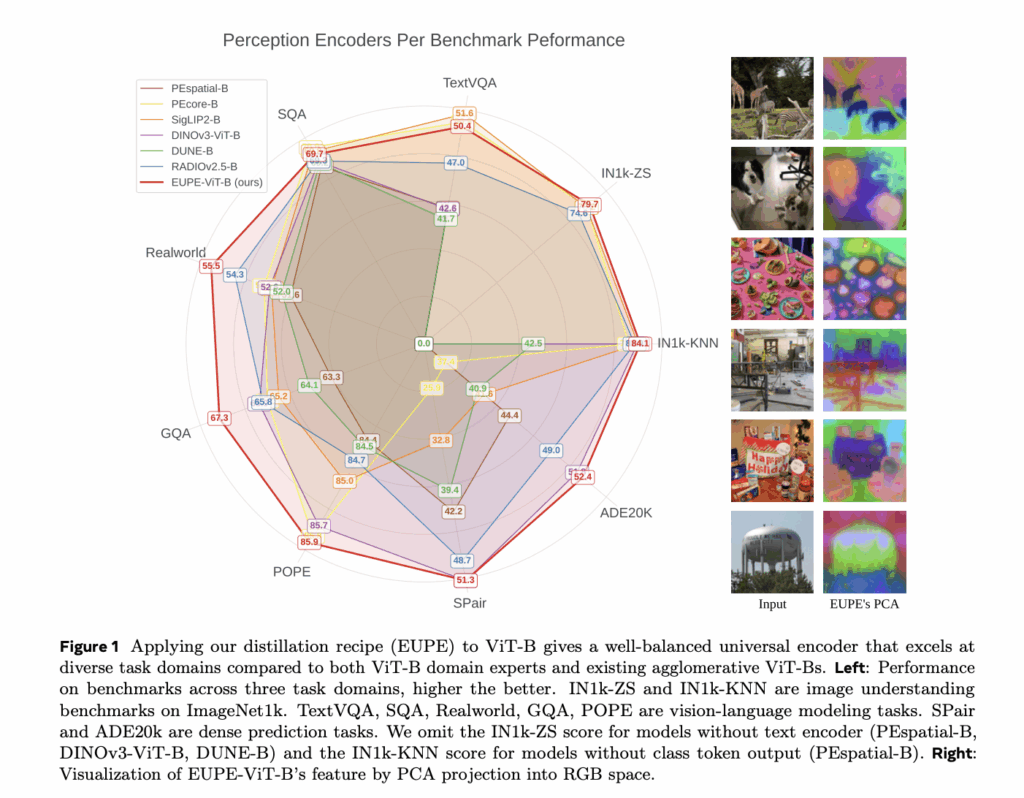
Running powerful AI on your smartphone isn’t just a hardware problem — it’s a model architecture problem. Most state-of-the-art vision encoders are enormous, and when you trim them down to fit on an edge device, they lose the capabilities that made them useful in the first place. Worse, specialized models tend to excel at one type of task — image classification, say, or scene segmentation — but fall apart when you ask them to do something outside their lane. Meta’s AI research teams are now proposing a different path. They introduced the Efficient Universal Perception Encoder (EUPE): a compact vision encoder that handles diverse vision tasks simultaneously without needing to be large. The Core Problem: Specialists vs. Generalists To understand why EUPE matters, it helps to understand how vision encoders work and why specialization is a problem. A vision encoder is the part of a computer vision model that converts raw image pixels into a compact representation — a set of feature vectors — that downstream tasks (like classification, segmentation, or answering questions about an image) can use. Think of it as the ‘eyes’ of an AI pipeline. Modern foundation vision encoders are trained with specific objectives, which gives them an edge in particular domains. For example: CLIP and SigLIP 2 are trained on text-image pairs. They’re strong at image understanding and vision-language modeling, but their performance on dense prediction tasks (which require spatially precise, pixel-level features) often falls below expectations. DINOv2 and its successor DINOv3 are self-supervised models that learn exceptional structural and geometric descriptors, making them strong at dense prediction tasks like semantic segmentation and depth estimation. But they lack satisfactory vision-language capabilities. SAM (Segment Anything Model) achieves impressive zero-shot segmentation through training on massive segmentation datasets, but again falls short on vision-language tasks. For an edge device — a smartphone or AR headset — that needs to handle all of these task types simultaneously, the typical solution is to deploy multiple encoders at once. That quickly becomes compute-prohibitive. The alternative is accepting that a single encoder will underperform in several domains. Previous Attempts: Why Agglomerative Methods Fell Short on Efficient Backbones Researchers have tried to combine the strengths of multiple specialist encoders through a family of methods called agglomerative multi-teacher distillation. The basic idea: train a single student encoder to simultaneously mimic several teacher models, each of which is a domain expert. AM-RADIO and its follow-up RADIOv2.5 are perhaps the most well-known examples of this approach. They showed that agglomerative distillation can work well for large encoders — models with more than 300 million parameters. But the EUPE research demonstrates a clear limitation: when you apply the same recipe to efficient backbones, the results degrade substantially. RADIOv2.5-B, the ViT-B-scale variant, has significant gaps compared to domain experts on dense prediction and VLM tasks. Another agglomerative method, DUNE, merges 2D vision and 3D perception teachers through heterogeneous co-distillation, but similarly struggles at the efficient backbone scale. The root cause, the research team argue, is capacity. Efficient encoders simply don’t have enough representational capacity to directly absorb diverse feature representations from multiple specialist teachers and unify them into a universal representation. Trying to do so in one step produces a model that is mediocre across the board. https://arxiv.org/pdf/2603.22387 EUPE’s Answer: Scale Up First, Then Scale Down The key insight behind EUPE is a principle named ‘first scaling up and then scaling down.‘ Instead of distilling directly from multiple domain-expert teachers into a small student, EUPE introduces an intermediate model: a large proxy teacher with enough capacity to unify the knowledge from all the domain experts. This proxy teacher then transfers its unified, universal knowledge to the efficient student through distillation. The full pipeline has three stages: Stage 1 — Multi-Teacher Distillation into the Proxy Model. Multiple large foundation encoders serve as teachers simultaneously, processing label-free images at their native resolutions. Each teacher outputs a class token and a set of patch tokens. The proxy model — a 1.9B parameter model trained with 4 register tokens — is trained to mimic all teachers at once. The selected teachers are: PEcore-G (1.9B parameters), selected as the domain expert for zero-shot image classification and retrieval PElang-G (1.7B parameters), which the research team found is crucial for vision-language modeling, particularly OCR performance DINOv3-H+ (840M parameters), selected as the domain expert for dense prediction To stabilize training, teacher outputs are normalized by subtracting the per-coordinate mean and dividing by the standard deviation, computed once over 500 iterations before training begins and kept fixed thereafter. This is deliberately simpler than the complex PHI-S normalization used in RADIOv2.5, and avoids the cross-GPU memory overhead of computing normalization statistics on-the-fly. Stage 2 — Fixed-Resolution Distillation into the Efficient Student. With the proxy model now serving as a single universal teacher, the target efficient encoder is trained at a fixed resolution of 256×256. This fixed resolution makes training computationally efficient, allowing a longer learning schedule: 390,000 iterations with a batch size of 8,192, cosine learning rate schedule, a base learning rate of 2e-5, and weight decay of 1e-4. Standard data augmentation applies: random resized cropping, horizontal flipping, color jittering, Gaussian blur, and random solarization. For the distillation loss, the class token loss uses cosine similarity, while the patch token loss combines cosine similarity (weight α=0.9) and smooth L1 loss (weight β=0.1). Adapter head modules — 2-layer MLPs — are appended to the student to match each teacher’s feature dimension. If student and teacher patch token spatial dimensions differ, 2D bicubic interpolation is applied to align them. Stage 3 — Multi-Resolution Finetuning. Starting from the Stage 2 checkpoint, the student undergoes a shorter finetuning phase using an image pyramid of three scales: 256, 384, and 512. The student and the proxy teacher independently and randomly select one scale per iteration — so they may process the same image at different resolutions. This forces the student to learn representations that generalize across spatial granularities, accommodating downstream tasks that operate at various resolutions. This stage runs for 100,000 iterations at

Meta AI Releases EUPE: A Compact Vision Encoder Family Under 100M Parameters That Rivals Specialist Models Across Image Understanding, Dense Prediction, and VLM Tasks Leer entrada »

AI, Committee, Noticias, Uncategorized

The Download: AI’s impact on jobs, and data centres in space

This is today’s edition of The Download, our weekday newsletter that provides a daily dose of what’s going on in the world of technology. The one piece of data that could actually shed light on your job and AI  Within Silicon Valley’s orbit, an AI-fueled jobs apocalypse is spoken about as a given. Now even economists who have downplayed the threat are coming around to the idea.   Alex Imas, based at the University of Chicago, is one of them. He believes that any plan to address AI’s impact will depend on collecting one vital piece of data: price elasticity.  Imas argues that “we need a Manhattan Project” for this. Read the full story to find out why.  —James O’Donnell  This article is from The Algorithm, our weekly newsletter giving you the inside track on all things AI. Sign up to receive it in your inbox every Monday.  Four things we’d need to put data centers in space  In January, Elon Musk’s SpaceX applied to launch up to 1 million data centers into Earth’s orbit. The goal? To fully unleash the potential of AI—without triggering an environmental crisis on Earth.  SpaceX is among a growing list of tech firms pursuing orbital computing infrastructure. But can their plans really work? Here are four must-haves for making space-based data centers a reality.  —Tereza Pultarova  This story is part of MIT Technology Review Explains, our series untangling the complex, messy world of technology to help you understand what’s coming next. You can read more from the series here.  The must-reads  I’ve combed the internet to find you today’s most fun/important/scary/fascinating stories about technology.  1 Trump has again proposed major cuts to US science and tech spending He wants to slash nearly every science-focused agency. (Ars Technica) + If Trump gets his way, the US could face a costly brain drain. (NYT $)  + Top research talent is already fleeing the country. (Guardian)  + Basic science deserves our boldest investment. (MIT Technology Review)  2 Sam Altman lobbied against AI regulations he publicly welcomed  A bombshell report reveals many OpenAI insiders don’t trust him. (The New Yorker $) + Some have called him a sociopath. (Futurism) + OpenAI’s CFO fears it won’t be IPO-ready this year. (The Information $)  + A war over AI regulation is brewing in the US. (MIT Technology Review)  3 NASA’s Artemis II has broken humanity’s all-time distance record The astronauts have flown farther than any humans before them. (BBC) + Their mission includes MIT-developed technology. (Axios)  4 Chinese tech firms are selling intel “exposing” US forces It comes from combining AI with open-source data.. (WP $) + AI is turning the Iran conflict into theater. (MIT Technology Review)  5 War is pushing countries to ditch hyperscalers Driven by Iran naming tech giants as military targets. (Rest of World) + No one wants a data center in their backyard. (MIT Technology Review)  6 OpenAI, Anthropic, and Google have united against China’s AI copying They’re sharing information on “adversarial distillation” (Bloomberg $)  7 Anduril and Impulse Space are working on Trump’s “Golden Dome” They’re developing space-based missile tracking for the project. (Gizmodo)   8 OpenAI has urged California to probe Elon Musk’s “anti-competitive behavior.” It accuses Musk of trying to “take control of the future of AGI.” (Reuters $) + And claims he coordinated attacks with Mark Zuckerberg. (CNBC) + A former Tesla president has revealed how he survived working for Musk. (WP $)  9 DeepSeek’s new AI model will run on Huawei chips It’s expected to launch in the next few weeks. (The Information $)  10 Memes have nuked our culture Internet “brain rot” has escaped our phones to take over everything. (NYT $)  Quote of the day  “I must say, it was actually quite nice.”   —Astronaut Victor Glover tells President Donald Trump what it was like when Artemis II was out of communication with the rest of humanity, The New York Times reports.  One More Thing  PABLO ALBARENGA Inside the controversial tree farms powering Apple’s carbon-neutral goal   In 2020, Apple set a goal to become net zero by the end of the decade. To hit that target, the company is offsetting its emissions by planting millions of eucalyptus trees in Brazil.  Apple is betting that the strategy will lead to a greener future. But critics warn that the industrial tree farms will do more harm than good.  Find out why the plans have sparked a backlash.  —Gregory Barber  We can still have nice things  A place for comfort, fun and distraction to brighten up your day. (Got any ideas? Drop me a line.)  + Japan’s automated bike garage is a cyclist’s dream come true.  + This deep dive into bird behavior reveals the secrets of their dining habits. (Big thanks to reader Terry Gordon for the find!) + The first photo from the Artemis astronauts vividly captures the glow of our atmosphere. + There’s a new contender for the world’s most gorgeous website: RobertDeNiro.com. 

The Download: AI’s impact on jobs, and data centres in space Leer entrada »

We use cookies to improve your experience and performance on our website. You can learn more at Política de privacidad and manage your privacy settings by clicking Settings.

Privacy Preferences

You can choose your cookie settings by turning on/off each type of cookie as you wish, except for essential cookies.

Allow All
Manage Consent Preferences
  • Always Active

Save
es_ES