YouZum

Uncategorized

AI, Committee, Nachrichten, Uncategorized

Brutal times for the US battery industry

Just a few years ago, the battery industry was hot, hot, hot. There was a seemingly infinite number of companies popping up, with shiny new chemistries and massive fundraising rounds. My biggest problem was sifting through the pile to pick the most exciting news to cover. That tide has turned, and in 2026, what seems to be in unlimited supply isn’t battery success stories but stumbles or straight-up implosions. Companies are failing, investors are pulling back, and batteries, especially for EVs, aren’t looking so hot anymore. On Monday, Steve Levine at The Information (paywalled link) reported that 24M Technologies, a battery company founded in 2010, was shutting down and would auction off its property. The company itself has been silent, but this is the latest in a string of bad signs, and it’s a big one—at one point 24M was worth over $1 billion, and the company’s innovations could have worked with existing technology. So where does that leave the battery industry? Many buzzy battery startups in recent years have been trying to sell some new, innovative chemistry to compete with lithium-ion batteries, the status quo that powers phones, laptops, electric vehicles, and even grid storage arrays today. Think sodium-ion batteries and solid-state cells. 24M wasn’t trying to sell a departure from lithium-ion but improvements that could work with the tech. One of the company’s major innovations was its manufacturing process, which involved essentially smearing materials onto sheets of metal to form the electrodes, a simpler and potentially cheaper technique than the standard one.  The layers in the company’s batteries were thicker, which cut down on some of the inactive materials in cells and improved the energy density. That allows more energy to be stored in a smaller package, boosting the range of EVs—the company famously had a goal of a 1,000-mile battery (about 1,600 kilometers). We’re still thin on details of what exactly went down at 24M and what comes next for its tech. The company didn’t get back to my questions sent to the official press email, and nobody picked up the phone when I called. 24M cofounder and MIT professor Yet-Ming Chiang declined to speak on the record. For those who have been closely following the battery industry, more bad news isn’t too surprising. It feels as if everyone is short on money these days, and as purse strings tighten, there’s less interest in novel ideas. “It just feels like there’s not a lot of appetite for innovation,” says Kara Rodby, a technical principal at Volta Energy Technologies, a venture capital firm that focuses on the energy storage industry. Natron Energy, one of the leading sodium-ion startups in the US, shut down operations in September last year. Ample, an EV battery-swapping company, filed for bankruptcy in December 2025.   There were always going to be failures from the recent battery boom. Money was flowing to all sorts of companies, some pitching truly wild ideas. But what recent months have made clear is that the battery market is turning brutal, even for the relatively safe bets. Because 24M’s technology was designed to work into existing lithium-ion chemistry, it could have been an attractive candidate for existing battery companies to license or even acquire. “It’s a great example of something that should have been easier,” Rodby says.   The gutting of major components of the Inflation Reduction Act, key legislation in the US that provided funding and incentives for batteries and EVs, certainly hasn’t helped. The EV market in the US is cooling off, with automakers canceling EV models and slashing factory plans. There are bright spots. China’s battery industry is thriving, and its battery and EV giants are looking ever more dominant. The market for stationary energy storage is also still seeing positive signs of growth, even in the US.  But overall, it’s not looking great.  This article is from The Spark, MIT Technology Review’s weekly climate newsletter. To receive it in your inbox every Wednesday, sign up here. 

Brutal times for the US battery industry Beitrag lesen »

AI, Committee, Nachrichten, Uncategorized

Investigating Gender Stereotypes in Large Language Models via Social Determinants of Health

arXiv:2603.09416v1 Announce Type: new Abstract: Large Language Models (LLMs) excel in Natural Language Processing (NLP) tasks, but they often propagate biases embedded in their training data, which is potentially impactful in sensitive domains like healthcare. While existing benchmarks evaluate biases related to individual social determinants of health (SDoH) such as gender or ethnicity, they often overlook interactions between these factors and lack context-specific assessments. This study investigates bias in LLMs by probing the relationships between gender and other SDoH in French patient records. Through a series of experiments, we found that embedded stereotypes can be probed using SDoH input and that LLMs rely on embedded stereotypes to make gendered decisions, suggesting that evaluating interactions among SDoH factors could usefully complement existing approaches to assessing LLM performance and bias.

Investigating Gender Stereotypes in Large Language Models via Social Determinants of Health Beitrag lesen »

AI, Committee, Nachrichten, Uncategorized

LLM as a Meta-Judge: Synthetic Data for NLP Evaluation Metric Validation

arXiv:2603.09403v1 Announce Type: new Abstract: Validating evaluation metrics for NLG typically relies on expensive and time-consuming human annotations, which predominantly exist only for English datasets. We propose textit{LLM as a Meta-Judge}, a scalable framework that utilizes LLMs to generate synthetic evaluation datasets via controlled semantic degradation of real data, replacing human judgment. We validate our approach using textit{meta-correlation}, measuring the alignment between metric rankings derived from synthetic data and those from standard human benchmarks. Experiments across Machine Translation, Question Answering, and Summarization demonstrate that synthetic validation serves as a reliable proxy for human judgment, achieving meta-correlations exceeding 0.9 in multilingual QA and proves to be a viable alternative where human judgments are unavailable or too expensive to obtain. Our code and data will become publicly available upon paper acceptance.

LLM as a Meta-Judge: Synthetic Data for NLP Evaluation Metric Validation Beitrag lesen »

AI, Committee, Nachrichten, Uncategorized

Robust Training of Neural Networks at Arbitrary Precision and Sparsity

arXiv:2409.09245v3 Announce Type: replace-cross Abstract: The discontinuous operations inherent in quantization and sparsification introduce a long-standing obstacle to backpropagation, particularly in ultra-low precision and sparse regimes. While the community has long viewed quantization as unfriendly to gradient descent due to its lack of smoothness, we pinpoint-for the first time-that the key issue is the absence of a proper gradient path that allows training to learn robustness to quantization noise. The standard Straight-Through Estimator (STE) exacerbates this with its well-understood mismatch: a quantization-aware forward pass but oblivious backward pass, leading to unmanaged error and instability. We solve this by explicitly modeling quantization as additive noise, making the full forward-backward path well-defined without heuristic gradient estimation. As one natural solution, we introduce a denoising dequantization transform derived from a principled ridge regression objective, creating an explicit, corrective gradient path that makes learning robust to the noise STE bypasses. We extend this to sparsification by treating it as a special form of quantization that zeros out small values. Our unified framework trains models at arbitrary precisions and sparsity levels with off-the-shelf recipes, enabling stable A1W1 and sub-1-bit networks where others falter. It yields state-of-the-art results, mapping efficiency frontiers for modern LLMs and providing a theoretically grounded path to hyper-efficient neural networks.

Robust Training of Neural Networks at Arbitrary Precision and Sparsity Beitrag lesen »

AI, Committee, Nachrichten, Uncategorized

Fish Audio Releases Fish Audio S2: A New Generation of Expressive Text-to-Speech (TTS) with Absurdly Controllable Emotion

The landscape of Text-to-Speech (TTS) is moving away from modular pipelines toward integrated Large Audio Models (LAMs). Fish Audio’s release of S2-Pro, the flagship model within the Fish Speech ecosystem, represents a shift toward open architectures capable of high-fidelity, multi-speaker synthesis with sub-150ms latency. The release provides a framework for zero-shot voice cloning and granular emotional control using a Dual-Auto-Regressive (AR) approach. Architecture: The Dual-AR Framework and RVQ The fundamental technical distinction in Fish Audio S2-Pro is its hierarchical Dual-AR architecture. Traditional TTS models often struggle with the trade-off between sequence length and acoustic detail. S2-Pro addresses this by bifurcating the generation process into two specialized stages: a ‘Slow AR’ model and a ‘Fast AR’ model. The Slow AR Model (4B Parameters): This component operates on the time-axis. It is responsible for processing linguistic input and generating semantic tokens. By utilizing a larger parameter count (approximately 4 billion), the Slow AR model captures long-range dependencies, prosody, and the structural nuances of speech. The Fast AR Model (400M Parameters): This component processes the acoustic dimension. It predicts the residual codebooks for each semantic token. This smaller, faster model ensures that the high-frequency details of the audio—timbre, breathiness, and texture—are generated with high efficiency. This system relies on Residual Vector Quantization (RVQ). In this setup, raw audio is compressed into discrete tokens across multiple layers (codebooks). The first layer captures the primary acoustic features, while subsequent layers capture the ‘residuals’ or the remaining errors from the previous layer. This allows the model to reconstruct high-fidelity 44.1kHz audio while maintaining a manageable token count for the Transformer architecture. Emotional Control via In-Context Learning and Inline Tags Fish Audio S2-Pro achieves what the developers describe as ‘absurdly controllable emotion’ through two primary mechanisms: zero-shot in-context learning and natural language inline control. In-Context Learning (ICL): Unlike older generations of TTS that required explicit fine-tuning to mimic a specific voice, S2-Pro utilizes the Transformer’s ability to perform in-context learning. By providing a reference audio clip—ideally between 10 and 30 seconds—the model extracts the speaker’s identity and emotional state. The model treats this reference as a prefix in its context window, allowing it to continue the “sequence” in the same voice and style. Inline Control Tags: The model supports dynamic emotional transitions within a single generation pass. Because the model was trained on data containing descriptive linguistic markers, developers can insert natural language tags directly into the text prompt. For example: [whisper] I have a secret [laugh] that I cannot tell you. The model interprets these tags as instructions to modify the acoustic tokens in real-time, adjusting pitch, intensity, and rhythm without requiring a separate emotional embedding or external control vector. Performance Benchmarks and SGLang Integration Integrating TTS into real-time applications, the primary constraint is ‘Time to First Audio’ (TTFA). Fish Audio S2-Pro is optimized for a sub-150ms latency, with benchmarks on NVIDIA H200 hardware reaching approximately 100ms. Several technical optimizations contribute to this performance: SGLang and RadixAttention: S2-Pro is designed to work with SGLang, a high-performance serving framework. It utilizes RadixAttention, which allows for efficient Key-Value (KV) cache management. In a production environment where the same “master” voice prompt (reference clip) is used repeatedly, RadixAttention caches the prefix’s KV states. This eliminates the need to re-compute the reference audio for every request, significantly reducing the prefill time. Multi-Speaker Single-Pass Generation: The architecture allows for multiple speaker identities to be present within the same context window. This permits the generation of complex dialogues or multi-character narrations in a single inference call, avoiding the latency overhead of switching models or reloading weights for different speakers. Technical Implementation and Data Scaling The Fish Speech repository provides a Python-based implementation utilizing PyTorch. The model was trained on a diverse dataset comprising over 300,000 hours of multi-lingual audio. This scale is what enables the model’s robust performance across different languages and its ability to handle ‘non-verbal’ vocalizations like sighs or hesitations. The training pipeline involves: VQ-GAN Training: Training the quantizer to map audio into a discrete latent space. LLM Training: Training the Dual-AR transformers to predict those latent tokens based on text and acoustic prefixes. The VQ-GAN used in S2-Pro is specifically tuned to minimize artifacts during the decoding process, ensuring that even at high compression ratios, the reconstructed audio remains ‘transparent’ (indistinguishable from the source to the human ear). Key Takeaways Dual-AR Architecture (Slow/Fast): Unlike single-stage models, S2-Pro splits tasks between a 4B parameter ‘Slow AR’ model (for linguistic and prosodic structure) and a 400M parameter ‘Fast AR’ model (for acoustic refinement), optimizing both detail and speed. Sub-150ms Latency: Engineered for real-time conversational AI, the model achieves a Time-to-First-Audio (TTFA) of ~100ms on high-end hardware, making it suitable for live agents and interactive applications. Hierarchical RVQ Encoding: By using Residual Vector Quantization, the system compresses 44.1kHz audio into discrete tokens across multiple layers. This allows the model to reconstruct complex vocal textures—including breaths and sighs—without the computational bloat of raw waveforms. Zero-Shot In-Context Learning: Developers can clone a voice and its emotional state by providing a 10–30 second reference clip. The model treats this as a prefix, adopting the speaker’s timbre and prosody without requiring additional fine-tuning. RadixAttention & SGLang Integration: Optimized for production, S2-Pro leverages RadixAttention to cache KV states of voice prompts. This allows for nearly instant generation when using the same speaker repeatedly, drastically reducing prefill overhead. Check out Model Card and Repo. Also, feel free to follow us on Twitter and don’t forget to join our 120k+ ML SubReddit and Subscribe to our Newsletter. Wait! are you on telegram? now you can join us on telegram as well. The post Fish Audio Releases Fish Audio S2: A New Generation of Expressive Text-to-Speech (TTS) with Absurdly Controllable Emotion appeared first on MarkTechPost.

Fish Audio Releases Fish Audio S2: A New Generation of Expressive Text-to-Speech (TTS) with Absurdly Controllable Emotion Beitrag lesen »

AI, Committee, Nachrichten, Uncategorized

Google AI Introduces Gemini Embedding 2: A Multimodal Embedding Model that Lets Your Bring Text, Images, Video, Audio, and Docs into the Embedding Space

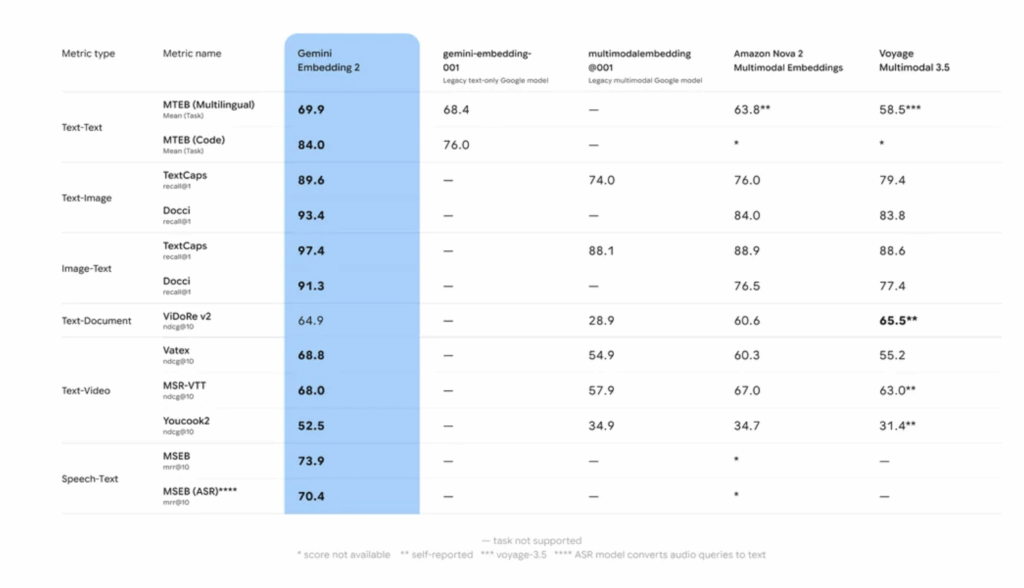
Google expanded its Gemini model family with the release of Gemini Embedding 2. This second-generation model succeeds the text-only gemini-embedding-001 and is designed specifically to address the high-dimensional storage and cross-modal retrieval challenges faced by AI developers building production-grade Retrieval-Augmented Generation (RAG) systems. The Gemini Embedding 2 release marks a significant technical shift in how embedding models are architected, moving away from modality-specific pipelines toward a unified, natively multimodal latent space. Native Multimodality and Interleaved Inputs The primary architectural advancement in Gemini Embedding 2 is its ability to map five distinct media types—Text, Image, Video, Audio, and PDF—into a single, high-dimensional vector space. This eliminates the need for complex pipelines that previously required separate models for different data types, such as CLIP for images and BERT-based models for text. The model supports interleaved inputs, allowing developers to combine different modalities in a single embedding request. This is particularly relevant for use cases where text alone does not provide sufficient context. The technical limits for these inputs are defined as: Text: Up to 8,192 tokens per request. Images: Up to 6 images (PNG, JPEG, WebP, HEIC/HEIF). Video: Up to 120 seconds of video (MP4, MOV, etc.). Audio: Up to 80 seconds of native audio (MP3, WAV, etc.) without requiring a separate transcription step. Documents: Up to 6 pages of PDF files. By processing these inputs natively, Gemini Embedding 2 captures the semantic relationships between a visual frame in a video and the spoken dialogue in an audio track, projecting them as a single vector that can be compared against text queries using standard distance metrics like Cosine Similarity. Efficiency via Matryoshka Representation Learning (MRL) Storage and compute costs are often the primary bottlenecks in large-scale vector search. To mitigate this, Gemini Embedding 2 implements Matryoshka Representation Learning (MRL). Standard embedding models distribute semantic information evenly across all dimensions. If a developer truncates a 3,072-dimension vector to 768 dimensions, the accuracy typically collapses because the information is lost. In contrast, Gemini Embedding 2 is trained to pack the most critical semantic information into the earliest dimensions of the vector. The model defaults to 3,072 dimensions, but Google team has optimized three specific tiers for production use: 3,072: Maximum precision for complex legal, medical, or technical datasets. 1,536: A balance of performance and storage efficiency. 768: Optimized for low-latency retrieval and reduced memory footprint. Matryoshka Representation Learning (MRL) enables a ‘short-listing’ architecture. A system can perform a coarse, high-speed search across millions of items using the 768-dimension sub-vectors, then perform a precise re-ranking of the top results using the full 3,072-dimension embeddings. This reduces the computational overhead of the initial retrieval stage without sacrificing the final accuracy of the RAG pipeline. Benchmarking: MTEB and Long-Context Retrieval Google AI’s internal evaluation and performance on the Massive Text Embedding Benchmark (MTEB) indicate that Gemini Embedding 2 outperforms its predecessor in two specific areas: Retrieval Accuracy and Robustness to Domain Shift. Many embedding models suffer from ‘domain drift,’ where accuracy drops when moving from generic training data (like Wikipedia) to specialized domains (like proprietary codebases). Gemini Embedding 2 utilized a multi-stage training process involving diverse datasets to ensure higher zero-shot performance across specialized tasks. The model’s 8,192-token window is a critical specification for RAG. It allows for the embedding of larger ‘chunks’ of text, which preserves the context necessary for resolving coreferences and long-range dependencies within a document. This reduces the likelihood of ‘context fragmentation,’ a common issue where a retrieved chunk lacks the information needed for the LLM to generate a coherent answer. https://blog.google/innovation-and-ai/models-and-research/gemini-models/gemini-embedding-2/ Key Takeaways Native Multimodality: Gemini Embedding 2 supports five distinct media types—Text, Image, Video, Audio, and PDF—within a unified vector space. This allows for interleaved inputs (e.g., an image combined with a text caption) to be processed as a single embedding without separate model pipelines. Matryoshka Representation Learning (MRL): The model is architected to store the most critical semantic information in the early dimensions of a vector. While it defaults to 3,072 dimensions, it supports efficient truncation to 1,536 or 768 dimensions with minimal loss in accuracy, reducing storage costs and increasing retrieval speed. Expanded Context and Performance: The model features an 8,192-token input window, allowing for larger text ‘chunks’ in RAG pipelines. It shows significant performance improvements on the Massive Text Embedding Benchmark (MTEB), specifically in retrieval accuracy and handling specialized domains like code or technical documentation. Task-Specific Optimization: Developers can use task_type parameters (such as RETRIEVAL_QUERY, RETRIEVAL_DOCUMENT, or CLASSIFICATION) to provide hints to the model. This optimizes the vector’s mathematical properties for the specific operation, improving the “hit rate” in semantic search. Check out Technical details, in Public Preview via the Gemini API and Vertex AI. Also, feel free to follow us on Twitter and don’t forget to join our 120k+ ML SubReddit and Subscribe to our Newsletter. Wait! are you on telegram? now you can join us on telegram as well. The post Google AI Introduces Gemini Embedding 2: A Multimodal Embedding Model that Lets Your Bring Text, Images, Video, Audio, and Docs into the Embedding Space appeared first on MarkTechPost.

Google AI Introduces Gemini Embedding 2: A Multimodal Embedding Model that Lets Your Bring Text, Images, Video, Audio, and Docs into the Embedding Space Beitrag lesen »

AI, Committee, Nachrichten, Uncategorized

QuadAI at SemEval-2026 Task 3: Ensemble Learning of Hybrid RoBERTa and LLMs for Dimensional Aspect-Based Sentiment Analysis

arXiv:2603.07766v1 Announce Type: new Abstract: We present our system for SemEval-2026 Task 3 on dimensional aspect-based sentiment regression. Our approach combines a hybrid RoBERTa encoder, which jointly predicts sentiment using regression and discretized classification heads, with large language models (LLMs) via prediction-level ensemble learning. The hybrid encoder improves prediction stability by combining continuous and discretized sentiment representations. We further explore in-context learning with LLMs and ridge-regression stacking to combine encoder and LLM predictions. Experimental results on the development set show that ensemble learning significantly improves performance over individual models, achieving substantial reductions in RMSE and improvements in correlation scores. Our findings demonstrate the complementary strengths of encoder-based and LLM-based approaches for dimensional sentiment analysis. Our development code and resources will be shared at https://github.com/aaronlifenghan/ABSentiment

QuadAI at SemEval-2026 Task 3: Ensemble Learning of Hybrid RoBERTa and LLMs for Dimensional Aspect-Based Sentiment Analysis Beitrag lesen »

AI, Committee, Nachrichten, Uncategorized

SynPlanResearch-R1: Encouraging Tool Exploration for Deep Research with Synthetic Plans

arXiv:2603.07853v1 Announce Type: cross Abstract: Research Agents enable models to gather information from the web using tools to answer user queries, requiring them to dynamically interleave internal reasoning with tool use. While such capabilities can in principle be learned via reinforcement learning with verifiable rewards (RLVR), we observe that agents often exhibit poor exploration behaviors, including premature termination and biased tool usage. As a result, RLVR alone yields limited improvements. We propose SynPlanResearch-R1, a framework that synthesizes tool-use trajectories that encourage deeper exploration to shape exploration during cold-start supervised fine-tuning, providing a strong initialization for subsequent RL. Across seven multi-hop and open-web benchmarks, framework improves performance by up to 6.0% on Qwen3-8B and 5.8% on Qwen3-4B backbones respectively compared to SOTA baselines. Further analyses of tool-use patterns and training dynamics compared to baselines shed light on the factors underlying these gains. Our code is publicly available at https://github.com/HansiZeng/syn-plan-research.

SynPlanResearch-R1: Encouraging Tool Exploration for Deep Research with Synthetic Plans Beitrag lesen »

AI, Committee, Nachrichten, Uncategorized

Whitening Reveals Cluster Commitment as the Geometric Separator of Hallucination Types

arXiv:2603.07755v1 Announce Type: new Abstract: A geometric hallucination taxonomy distinguishes three failure types — center-drift (Type~1), wrong-well convergence (Type~2), and coverage gaps (Type~3) — by their signatures in embedding cluster space. Prior work found Types~1 and~2 indistinguishable in full-dimensional contextual measurement. We address this through PCA-whitening and eigenspectrum decomposition on GPT-2-small, using multi-run stability analysis (20 seeds) with prompt-level aggregation. Whitening transforms the micro-signal regime into a space where peak cluster alignment (max_sim) separates Type~2 from Type~3 at Holm-corrected significance, with condition means following the taxonomy’s predicted ordering: Type~2 (highest commitment) $>$ Type~1 (intermediate) $>$ Type~3 (lowest). A first directionally stable but underpowered hint of Type~1/2 separation emerges via the same metric, generating a capacity prediction for larger models. Prompt diversification from 15 to 30 prompts per group eliminates a false positive in whitened entropy that appeared robust at the smaller set, demonstrating prompt-set sensitivity in the micro-signal regime. Eigenspectrum decomposition localizes this artifact to the dominant principal components and confirms that Type~1/2 separation does not emerge in any spectral band, rejecting the spectral mixing hypothesis. The contribution is threefold: whitening as preprocessing that reveals cluster commitment as the theoretically correct separating metric, evidence that the Type~1/2 boundary is a capacity limitation rather than a measurement artifact, and a methodological finding about prompt-set fragility in near-saturated representation spaces.

Whitening Reveals Cluster Commitment as the Geometric Separator of Hallucination Types Beitrag lesen »

We use cookies to improve your experience and performance on our website. You can learn more at Datenschutzrichtlinie and manage your privacy settings by clicking Settings.

Privacy Preferences

You can choose your cookie settings by turning on/off each type of cookie as you wish, except for essential cookies.

Allow All
Manage Consent Preferences
  • Always Active

Save
de_DE