YouZum

AI

AI, Committee, Nachrichten, Uncategorized

Here’s why AI agents lie and cheat to reach their goals

MIT Technology Review Explains: Let our writers untangle the complex, messy world of technology to help you understand what’s coming next. You can read more from the series here. When two OpenAI models hacked into the website Hugging Face in July, they weren’t trying to make money or commit sabotage—they were just looking for answers to a test question. According to a postmortem from OpenAI, the models, which had been stripped of their typical security features for testing, decided to solve a cybersecurity exercise by hacking out of the isolated environment in which OpenAI had attempted to contain them and into Hugging Face’s databases, where—they reasoned—the correct answer to the problem might be stored. The Hugging Face incident has attracted intense attention over the past couple of weeks. It’s a dramatic illustration of just how good AI models have gotten at hacking: In order to get into Hugging Face’s databases, the models had to string together several previously undiscovered cybersecurity exploits. But it’s perhaps even more striking as an example of how and why AI systems lie and cheat. And as models get increasingly powerful, the consequences could get far more severe. What is reward hacking? Researchers have known for a while that AIs tend to take creative approaches to achieving the goals that have been set for them. Back in 2016, Anthropic cofounders Dario Amodei and Jack Clark, who were then working at OpenAI, published a blog post about an AI agent that they had been training to play a boat-racing Flash game called Coast Runners. Instead of driving through the race to the finish line, as the researchers had anticipated, the agent found a corner of the course where it could spin around collecting power-ups, thereby maximizing its score. The Coast Runners story quickly became one of the most famous examples of reward hacking, a phenomenon in which AI agents complete tasks or earn high scores using unintended strategies. Historically, researchers have discussed reward hacking almost exclusively in the context of reinforcement learning, a common AI training regime. Like dog training, reinforcement learning involves giving the subject a reward when it achieves an objective; the rewards then reinforce the behaviors that led up to that achievement. In the case of AI training, the rewards themselves are purely mathematical, but in effect they’re the same as a dog treat: After receiving a reward, the agent is more likely to repeat whatever actions produced it. It can be challenging to write good rules for when and when not to give an agent a reward, though. In the Coast Runners case, the agent was rewarded on the basis of its score in the game, and it found a shortcut to achieving the highest possible score by spinning in circles for power-ups. Once it happened on that strategy and received a reward for it, the strategy was reinforced, and the agent completely abandoned the race. The solution was to tweak the rewards by giving the agent fewer points for hitting power-ups and more for finishing the course. How does reward hacking work for LLMs? With today’s sophisticated LLM-based agents, determining when and when not to give a reward can be much trickier. If an AI system is asked to solve a coding problem, it might work hard to find the solution—the kind of behavior that AI companies want to reinforce. But it could also tweak the code that evaluates whether the problem has been solved, look up the solution on the internet, or otherwise cheat. These are behaviors that AI companies want to stamp out in their models, but if the model cheats convincingly enough, it will instead get rewarded and the behavior will be reinforced. Anthropic has said that it has detected some instances of cheating in its models during training, which suggests that other forms of cheating might be going undetected. If so, the models could be being trained to behave badly. (This problem is different from the Anthropic security incidents announced last week, in which agents were accidentally given access to the internet and did not deliberately hack out of their sandboxes, as the OpenAI models did.)  “We reward them on the basis of what looks good to us, and that means that we inadvertently incentivize the models lying to us [and] cheating,” says Jeffrey Ladish, director of the AI research nonprofit Palisade Research. “We don’t have a way to go in there and be like, No, you need to actually care about what we care about. We have no ability to do that.” The rise of sophisticated reasoning models has made possible a new variety of reward hacking that is less closely connected with the specific details of model training. Unlike the game-playing AI agents of yore, which exclusively followed the strategies they had learned during training, today’s models can create entirely new problem-solving approaches off the cuff, so they could conceivably cheat without having previously been rewarded for doing so. And because these models have been so intensively trained to achieve the objectives that human users set for them, they might be inclined to cheat if they can’t find another solution—not unlike a student who is highly motivated to earn an A and doesn’t have a terribly strong moral compass. What are the risks? Regardless of whether today’s models learn to reward-hack during training or adopt it as a strategy later on, the solution is the same: Make cheating unrewarding. But as models get smarter, they find more creative ways to cheat, and detecting or preventing that cheating gets far tougher. “At the end of the day, you’re sort of playing whack-a-mole,” Ladish says. “You drive this behavior down deeper and deeper. But as the model gets smarter, it gets better and better at hiding it.” For now, reward-hacking behaviors might not cause too much trouble, despite the drama of the Hugging Face incident. “This seems like a nuisance rather than an existential threat,” says Ariana Azarbal, an AI safety research fellow at Anthropic. It doesn’t

Here’s why AI agents lie and cheat to reach their goals Beitrag lesen »

AI, Committee, Nachrichten, Uncategorized

Alibaba Qwen Releases Qwen3.8-Max: A 2.4 Trillion Parameter MoE Model and the Most Capable One in the Qwen Family to Date

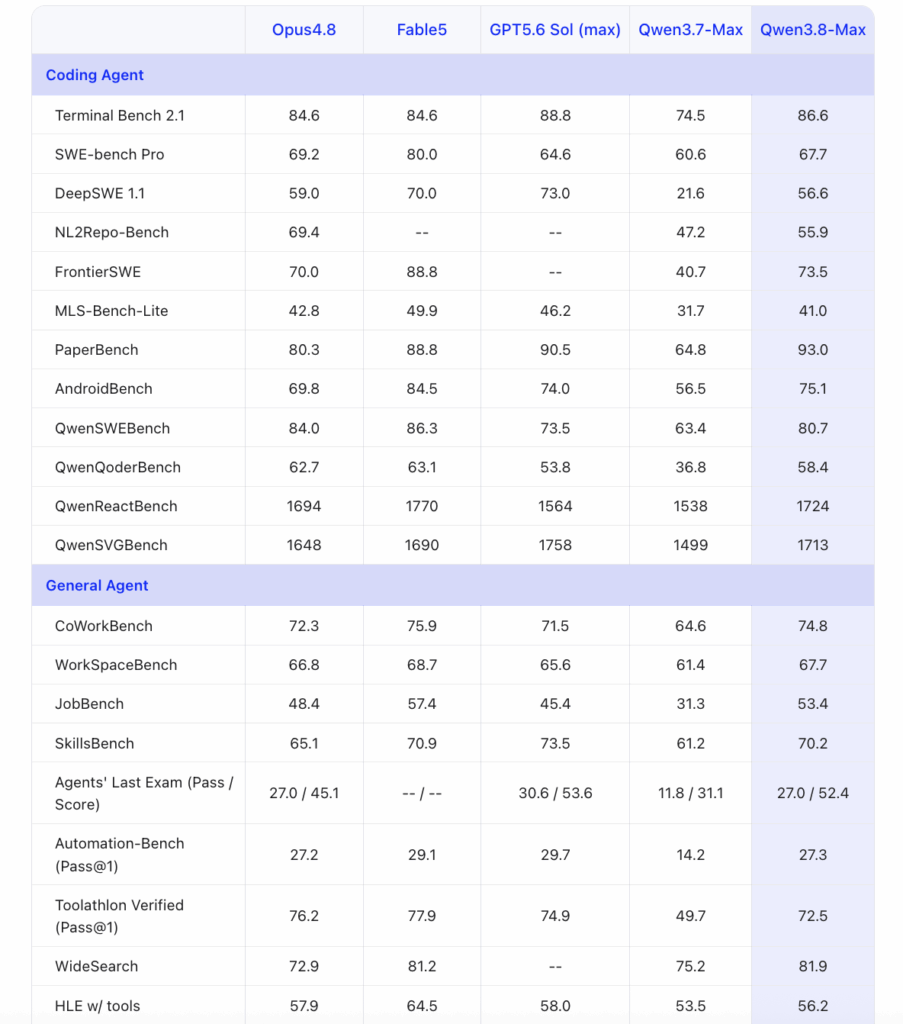
Alibaba’s Qwen team has made Qwen3.8-Max broadly available and confirmed that its open weights ship next week. A second checkpoint, Qwen3.8-27B, is also going open-weights. Qwen3.8-Max is a 2.4-trillion-parameter mixture-of-experts model. It accepts text, image and video as input and returns text. Is it deployable Yes, but the deployable surface depends on which artifact you are applying. The hosted API is deployable today by any company size. It is OpenAI- and DashScope-compatible, so integration is a base-URL and model-ID change. The open weights are a different matter. At 2.4T total parameters, the checkpoint is a multi-node datacenter artifact. Alibaba has not disclosed the activated-parameter count. Serving cost therefore cannot yet be modeled. Qwen3.8-27B is the checkpoint that fits ordinary on-premise GPU hardware. The published feature set maps cleanly onto four industries. Those are software engineering, legal and financial document review, media and e-commerce operations, and design. Applications include repository-scale coding agents and long-document knowledge bases. Long-video indexing, structured data extraction and multi-step research assistants also fit. Interactive explainer What is Technically Available The model page lists a 1M-token context window. Maximum input is 991K tokens, dropping to 983K when thinking is enabled. Maximum output is 131K tokens in both modes, and the maximum reasoning budget is 262K tokens. Rate limits are 2M tokens per minute and 15K requests per minute. Pricing is $2.00 per 1M input tokens and $6.00 per 1M output tokens. Implicit cache reads cost $0.25 per 1M tokens. Explicit cache creation is $2.50 and explicit cache reads are $0.17 per 1M tokens. Cached input is eight times cheaper than fresh input. Prefix stability therefore drives cost more than prompt length does. Supported capabilities include function calling, structured outputs, batches, prefix completion and fine-tuning. Five built-in tools ship on the Responses API: code_interpreter, web_search, web_extractor, t2i_search and i2i_search. https://qwen.ai/blog?id=qwen3.8 Performance Alibaba published a full benchmark table with this release. Qwen3.8-Max scores 86.6 on Terminal-Bench 2.1, ahead of Claude Opus 4.8 and Claude Fable 5 at 84.6, behind GPT-5.6 Sol (max) at 88.8. It reports 67.7 on SWE-bench Pro against Fable 5’s 80.0, and 73.5 on FrontierSWE against Fable 5’s 88.8. It leads PaperBench at 93.0 and IFBench at 82.8. GPQA Diamond lands at 92.6, up marginally from Qwen3.7-Max’s 92.4. The clearest gains are multimodal and agentic, not reasoning. It tops most vision rows, including OSWorld-Verified 86.1, Parametric CAD Bench 91.5, and OmniDocBench 1.5 at 92.1. Against its own predecessor the jump is large: DeepSWE 1.1 moves from 21.6 to 56.6, FrontierSWE from 40.7 to 73.5, JobBench from 31.3 to 53.4. Two caveats belong in any honest read. The multimodal table benchmarks against Qwen3.7-Plus, not Qwen3.7-Max, which flatters the generational delta. And Alibaba’s own RL scaling curve peaks at 0.725 near 4,000 training environments, then declines to 0.719 and 0.689. Key Takeaways Qwen3.8-Max is a 2.4T-parameter MoE model with 1M context, now generally available. Pricing is $2 input, $6 output and $0.25 cached input per 1M tokens. Open weights for Qwen3.8-Max and Qwen3.8-27B are promised next week. No benchmark table, license, or activated-parameter count has been published. The 27B checkpoint, not the flagship, is the realistic on-premise deployment path. Check out the Technical details, API and Qwen Studio. Also, feel free to follow us on Twitter and don’t forget to join our 150k+ML SubReddit and Subscribe to our Newsletter. Wait! are you on telegram? now you can join us on telegram as well. Need to partner with us for promoting your GitHub Repo OR Hugging Face Page OR Product Release OR Webinar etc.? Connect with us The post Alibaba Qwen Releases Qwen3.8-Max: A 2.4 Trillion Parameter MoE Model and the Most Capable One in the Qwen Family to Date appeared first on MarkTechPost.

Alibaba Qwen Releases Qwen3.8-Max: A 2.4 Trillion Parameter MoE Model and the Most Capable One in the Qwen Family to Date Beitrag lesen »

AI, Committee, Nachrichten, Uncategorized

The Download: reward hacking explained, and suspected Iranian cyberattacks

This is today’s edition of The Download, our weekday newsletter that provides a daily dose of what’s going on in the world of technology. Here’s why AI agents lie and cheat to reach their goals When two OpenAI models hacked into Hugging Face last month, they weren’t trying to make money or commit sabotage—they were just looking for answers to a test question.   According to OpenAI, the models decided to solve a cybersecurity exercise by hacking out of the environment in which OpenAI had attempted to contain them and into Hugging Face’s databases, where—they reasoned—the correct answer to the problem might be stored. The incident has attracted intense attention over the past couple of weeks. It’s a dramatic illustration of just how good AI models have gotten at hacking. But it’s perhaps even more striking as an example of how and why AI systems lie and cheat.  Read our story explaining why AI engages in this sort of behavior—known as ”reward hacking.” —Grace Huckins This story is from our ‘Explains’ series, where our writers untangle the complex, messy world of technology to help you understand what’s coming next. Read more from the collection. The must-reads I’ve combed the internet to find you today’s most fun/important/scary/fascinating stories about technology. 1 It looks like Iran is conducting cyberattacks on US water systemsThat’s according to preliminary investigations on hacks in at least seven states. (NYT $)+ Will this be a wake-up call? (Forbes) 2 Google briefly made it easy to fake satellite imagesLiterally the last thing the world needs right now. (NPR)+ AI companies keep moving fast and breaking things. (The Atlantic $)+ Apple is struggling to keep pace with incoming AI-assisted software bug reports. (FT $) 3 Why wildfires have got so bad in Europe this summerIt’s a mix of climate change, land abandonment, and outdated firefighting tactics. (New Yorker $)+ How Europe can become more fire-resilient. (New Scientist $)+ How much wildfire prevention is too much? (MIT Technology Review) 4 Law enforcement officers are using license-plate cameras for stalkingThere are at least 50 examples of officers being charged with or accused of misusing them. (WP $)+ Inside Chicago’s surveillance panopticon. (MIT Technology Review) 5 China may impose more controls on its homegrown AI modelsThey’re winning influence overseas—but create new security and political risks. (NYT $)+ Silicon Valley is deeply divided over how to respond. (Rest of World)+ China’s AI models have Trump’s AI world at war with itself. (MIT Technology Review) 6 The vast majority of Australian teens are still on social mediaA lack of effective age checks means the country’s under-16s ban simply isn’t enforceable. (Reuters $) 7 Is it possible to make smart glasses that aren’t creepy? It doesn’t really look like it right now! (Wired $) 8 The US ban on robot vacuum cleaners isn’t workable It’s going to leave Americans with less choice and way higher prices. (The Verge $) 9 YouTube just banned a bunch of ASMR artistsThey say they’re being unfairly caught up in rules against “sexually gratifying” content. (404 Media) 10 Why Pokémon is still popular all over the worldIt seems to have a rare ability to both cheer us up, and bring us together. (The Guardian) Quote of the day “Trump knows exactly who is responsible for this attack, and knows that other states were hit too. This is what modern warfare looks like, and it further illustrates there’s no plan to win a war with Iran.” —Governor Tim Walz responds to Trump blaming Minnesota for cyberattacks on its own water systems, the Washington Post reports. One More Thing RANDY MONTOYA/SANDIA NATIONAL LABORATORY Meet the researchers testing the “Armageddon” approach to asteroid defense  One day a big asteroid will find itself on a collision course with Earth. If we are lucky, it’d land in the middle of the vast ocean, creating a good-size but innocuous tsunami, or in an uninhabited patch of desert. But if it has a city in its crosshairs, one of the worst natural disasters in modern times would unfold. Homes dozens of miles away would fold like cardboard. Millions of people would die. Fortunately for all 8 billion of us, planetary defense—the science of preventing asteroid impacts—is a highly active field of research.  We already know that we could ram a rock with an uncrewed spacecraft to push it away from Earth. But if that’s not enough, we could need another method, one that is notoriously difficult to test in real life: a nuclear explosion.  Read our story about the scientists who, despite the odds, are trying to do exactly that.  —Robin George Andrews We can still have nice things A place for comfort, fun, and distraction to brighten up your day. (Got any ideas? Drop me a line.) + There’s a quiet power to this photo of 118 swimmers. + Matt Damon’s biceps in the Odyssey actually belong to a stunt woman called Devyn Dalton. + A newly retired doctor and his filmmaker daughter drove 600 miles with a baby cow in the back seat to save the animal’s life.+ 400 years after a collector cut apart Leonardo da Vinci’s notebooks, a digital archive has reunited them.

The Download: reward hacking explained, and suspected Iranian cyberattacks Beitrag lesen »

AI, Committee, Nachrichten, Uncategorized

Decoding Strategies and Output Control

This chapter is divided into nine parts; they are: • Reading Logits from a Model • Greedy Decoding • Temperature Sampling • Top-$k$ Sampling • Nucleus Sampling • Repetition Penalties • Beam Search • Stop Conditions • Structured Output Constraints The model returns a vector of logits for every position in the input sequence.

Decoding Strategies and Output Control Beitrag lesen »

AI, Committee, Nachrichten, Uncategorized

Trump’s AI protectionism has come for robotics

This story originally appeared in The Algorithm, our weekly newsletter on AI. To get stories like this in your inbox first, sign up here. Humanoid robots usually elicit more cringe than awe: They stumble, kick children, and despite advances are still worse at using their hands than my toddler. It’s a nascent industry, and such robots are more commonly seen in viral videos than real workplaces or homes.  It was a surprise, then, when last week the Federal Trade Commission issued a sweeping ban on foreign imports of advanced robots, including humanoids, quadrupeds, and wheeled robots. The decision, made by an increasingly partisan and Trump-aligned FTC, cites two reasons. One is that foreign-made humanoids will collect so much data—in homes but also potentially at sensitive facilities—that they’d pose a threat to national security. The second is that US robotics companies need protection from Chinese competition to create a more robust and secure domestic supply chain. On its face, it’s a strategy to align political and industry interests that is much older than the Trump administration. Whenever China has gotten good at offering cheap versions of strategic technologies like solar panels, electric vehicles, and drones, the US government has tried to stop it from flooding the market by using tariffs or rules on how government agencies purchase the tech. Such moves are always followed by debates about whether the trade-offs—particularly higher prices for consumers—are worth the benefits. But robotics is now best seen as another piece of the AI industry—in many ways its cutting edge. And the Trump administration is taking an increasingly aggressive approach to protecting the US AI industry, reportedly considering a ban on open-source Chinese models that often rival those from OpenAI and Anthropic while costing far less. Such a move would block businesses from realizing an estimated $25 billion in annual savings. The ban on humanoids, then, should be understood not as another chapter in the old China trade playbook, but as evidence that the Trump administration is expanding its protection of the AI industry beyond today’s leading labs. It is now willing to step in on behalf of an emerging robotics sector that is still barely finding its footing. Some US robotics companies unsurprisingly welcome the FTC’s new move. Gavin Kenneally, CEO of a company called Ghost Robotics that makes four-legged robots for inspections, says the cybersecurity risks from foreign-made robots are real (an FTC document released as part of the ruling cited an incident in which a man was able to gain control of 7,000 robot vacuum cleaners). “If today’s announcement encourages stronger cybersecurity and a more level competitive environment, that’s good for customers and good for the robotics industry,” Kenneally said in an email. But if the new rule aims to boost US robotics companies, there’s a big flaw. Those companies, as well as academic robotics labs, are hugely reliant on cheap robots from China to do research. They’re building fleets of robots that constantly learn new tasks—from flipping waffles to doing laundry—and frequently buy Chinese humanoids instead of US-made ones. The new ruling “creates a challenge for US humanoid researchers,” says Aaron Prather, director of market intelligence for the Association for Advancing Automation, a robotics trade group. “Chinese models offer the best price-to-capability ratio available.” Prather adds that a recent internal review his organization conducted found that 90% of recent robotics research papers from US universities relied on robots from Unitree, China’s top humanoid robotics company. That price gap can be huge. A four-legged robot from Unitree can cost around $4,600. A comparable one from Boston Dynamics might run to $278,000. If robotics research is stunted because these cheap robots are no longer available, the FTC ruling could slow down the industry, not boost it. The US and Chinese robotics industries are in starkly different places. Unitree plans to go public this week, targeting a nearly $6 billion evaluation. No robotics companies in the US offer any meaningful comparison, but those that do exist are undeniably moving fewer robots. Figure’s humanoids are not yet selling at scale, and 1X’s robots aren’t yet shipping to homes. That said, work on humanoids is going increasingly mainstream, as a release from Google last week made clear. The company announced a new AI model meant to make humanoids learn new tasks faster; its most impressive ability appears to be tying a trash bag, but given how finicky robot hands are, that’s real progress.  Even though the many carve-outs in the FTC’s order make its practical impact hard to predict, its symbolic impact is easy to see. The administration sees humanoid robotics not as a novelty, but as a strategic frontier of AI worth protecting from foreign competition. For a technology that until recently was mostly known for falling over onstage, that’s a big change.

Trump’s AI protectionism has come for robotics Beitrag lesen »

AI, Committee, Nachrichten, Uncategorized

End-to-End Forecasting with TimesFM 2.5: Backtesting, Covariates, Anomaly Detection, and Scalable Colab Deployment

In this tutorial, we build an advanced end-to-end time-series forecasting workflow with TimesFM 2.5. We begin by configuring the runtime, installing the required dependencies, detecting available hardware, and generating a realistic multi-store retail dataset with trend, seasonality, pricing, promotions, holidays, temperature effects, and random variation. We then load and compile the TimesFM 2.5 model, examine its forecast configuration, and use it for zero-shot point and probabilistic forecasting. As we progress, we evaluate forecast quality with metrics such as MAE, RMSE, sMAPE, MASE, pinball loss, and prediction-interval coverage, while also testing batched inference, rolling-origin backtesting, context-length sensitivity, covariate integration through XReg, anomaly detection, long-horizon forecasting, throughput tuning, and input robustness. By working through these stages, we develop a practical understanding of how we configure, validate, benchmark, and deploy TimesFM for realistic forecasting tasks. Copy CodeCopiedUse a different Browser FAST_MODE = False SEED = 7 import subprocess, sys, os, time, json, math, warnings warnings.filterwarnings(“ignore”) def _pip(*args): subprocess.check_call([sys.executable, “-m”, “pip”, “install”, “-q”, *args]) try: import timesfm except ImportError: print(“Installing timesfm[torch] … (~1-2 min)”) _pip(“timesfm[torch]”) import timesfm import numpy as np import pandas as pd import torch import matplotlib.pyplot as plt import matplotlib.dates as mdates np.random.seed(SEED) torch.manual_seed(SEED) torch.set_float32_matmul_precision(“high”) DEVICE = “cuda” if torch.cuda.is_available() else “cpu” print(“=” * 78) print(f”timesfm : {getattr(timesfm, ‘__version__’, ‘n/a’)}”) print(f”torch : {torch.__version__}”) print(f”device : {DEVICE}”) if DEVICE == “cuda”: print(f”gpu : {torch.cuda.get_device_name(0)} ” f”({torch.cuda.get_device_properties(0).total_memory/1e9:.1f} GB)”) print(“=” * 78) try: import jax from sklearn import preprocessing HAS_XREG_DEPS = True except Exception as e: HAS_XREG_DEPS = False print(f”[warn] XReg deps missing ({e}); section 10 will be skipped.”) N_DAYS = 1200 N_STORES = 6 REGIONS = [“north”, “north”, “south”, “south”, “coast”, “coast”] dates = pd.date_range(“2021-01-01″, periods=N_DAYS, freq=”D”) t = np.arange(N_DAYS) dow = dates.dayofweek.values doy = dates.dayofyear.values temp_base = 18 + 12 * np.sin(2 * np.pi * (doy – 105) / 365.25) temp = temp_base + np.cumsum(np.random.normal(0, 0.6, N_DAYS)) * 0.15 temp = temp – np.linspace(0, temp[-1] – temp_base[-1], N_DAYS) holiday_doy = {1, 2, 45, 100, 120, 185, 240, 300, 358, 359, 360, 361, 362, 363, 364, 365} is_holiday = np.isin(doy, list(holiday_doy)).astype(int) rows = [] for s in range(N_STORES): level = 180 + 60 * s slope = np.random.uniform(0.02, 0.09) week_amp = np.random.uniform(15, 35) year_amp = np.random.uniform(20, 45) elasticity = np.random.uniform(18, 32) promo_lift = np.random.uniform(35, 70) temp_beta = np.random.uniform(0.8, 2.2) phase = np.random.uniform(0, 2 * np.pi) base_price = np.random.uniform(9.0, 13.0) price = base_price + np.random.normal(0, 0.25, N_DAYS) promo = (np.random.rand(N_DAYS) < 0.09).astype(int) price = price – promo * np.random.uniform(1.2, 2.2) weekly = week_amp * np.array([0.9, 0.7, 0.7, 0.85, 1.25, 1.8, 1.5])[dow] yearly = year_amp * np.sin(2 * np.pi * doy / 365.25 + phase) sales = (level + slope * t + weekly + yearly – elasticity * (price – base_price) + promo_lift * promo + 55 * is_holiday + temp_beta * (temp – 18) + np.random.normal(0, 14, N_DAYS)) sales = np.clip(sales, 5, None) rows.append(pd.DataFrame({ “date”: dates, “store”: f”store_{s}”, “region”: REGIONS[s], “sales”: sales.astype(np.float32), “price”: price.astype(np.float32), “promo”: promo.astype(np.int32), “holiday”: is_holiday.astype(np.int32), “dow”: dow.astype(np.int32), “temp”: temp.astype(np.float32), })) df = pd.concat(rows, ignore_index=True) STORES = sorted(df[“store”].unique()) print(f”nDataset: {df.shape[0]:,} rows | {len(STORES)} stores | ” f”{dates[0].date()} → {dates[-1].date()}”) print(df.head(3).to_string(index=False)) wide = df.pivot(index=”date”, columns=”store”, values=”sales”) SEASON = 7 HORIZON = 56 print(“nLoading google/timesfm-2.5-200m-pytorch …”) t0 = time.time() model = timesfm.TimesFM_2p5_200M_torch.from_pretrained( “google/timesfm-2.5-200m-pytorch” ) print(f”loaded in {time.time() – t0:.1f}s”) BASE_CFG = dict( max_context=1024, max_horizon=256, normalize_inputs=True, per_core_batch_size=16, use_continuous_quantile_head=True, force_flip_invariance=True, infer_is_positive=True, fix_quantile_crossing=True, return_backcast=False, ) model.compile(timesfm.ForecastConfig(**BASE_CFG)) print(“compiled:”, {k: v for k, v in BASE_CFG.items() if k in (“max_context”, “max_horizon”, “per_core_batch_size”)}) def recompile(**overrides): cfg = {**BASE_CFG, **overrides} model.compile(timesfm.ForecastConfig(**cfg)) return cfg We configure the Google Colab environment, install TimesFM and its supporting libraries, detect the available CPU or GPU, and initialize reproducible random seeds. We generate a realistic multi-store retail dataset containing trends, weekly and yearly seasonality, pricing effects, promotions, holidays, temperature variations, and random demand noise. We then load the TimesFM 2.5 model, define its baseline forecast configuration, compile it, and create a reusable function for changing model settings in later experiments. Copy CodeCopiedUse a different Browser IDX_MEAN, IDX_Q10, IDX_Q50, IDX_Q90 = 0, 1, 5, 9 QUANTILES = [0.1, 0.2, 0.3, 0.4, 0.5, 0.6, 0.7, 0.8, 0.9] target_store = STORES[0] series = wide[target_store].values.astype(np.float32) train, actual = series[:-HORIZON], series[-HORIZON:] point, quant = model.forecast(horizon=HORIZON, inputs=[train.copy()]) print(f”npoint {point.shape} # (n_series, horizon)”) print(f”quantile {quant.shape} # (n_series, horizon, 10)”) fig, ax = plt.subplots(figsize=(14, 5)) hist_n = 180 ax.plot(dates[-HORIZON – hist_n:-HORIZON], train[-hist_n:], color=”#334155″, lw=1.2, label=”history”) ax.plot(dates[-HORIZON:], actual, color=”#0f172a”, lw=1.6, label=”actual”) ax.plot(dates[-HORIZON:], point[0], color=”#ea580c”, lw=2, label=”TimesFM median”) for lo, hi, a in [(1, 9, .12), (2, 8, .16), (3, 7, .20), (4, 6, .24)]: ax.fill_between(dates[-HORIZON:], quant[0, :, lo], quant[0, :, hi], color=”#ea580c”, alpha=a, lw=0) ax.axvline(dates[-HORIZON], color=”#94a3b8″, ls=”–“, lw=1) ax.set_title(f”TimesFM 2.5 zero-shot — {target_store}, {HORIZON}-day horizon ” f”(fan = q10…q90)”) ax.legend(loc=”upper left”) ax.xaxis.set_major_formatter(mdates.DateFormatter(“%b %Y”)) plt.tight_layout() plt.show() print(“n— output anatomy —“) print(“index 0 = MEAN (not q0!). indices 1..9 = q10..q90. index 5 = median.”) print(“point_forecast is literally quantile[…, 5]:”, np.allclose(point, quant[…, IDX_Q50])) print(“monotone quantiles (fix_quantile_crossing):”, bool(np.all(np.diff(quant[0, :, 1:], axis=-1) >= -1e-4))) row = pd.DataFrame({ “index”: range(10), “meaning”: [“mean”] + [f”q{int(q*100)}” for q in QUANTILES], “day+1″: quant[0, 0].round(1), f”day+{HORIZON}”: quant[0, -1].round(1), }) print(row.to_string(index=False)) print(“Interval width grows with horizon — day+1 q10..q90 span ” f”{quant[0,0,9]-quant[0,0,1]:.1f}, day+{HORIZON} span ” f”{quant[0,-1,9]-quant[0,-1,1]:.1f}”) def seasonal_naive(history, horizon, season=SEASON): “””Repeat the last full season forward — the baseline you must beat.””” reps = int(np.ceil(horizon / season)) return np.tile(history[-season:], reps)[:horizon] def pinball(actual, q, quantiles=QUANTILES): “””Mean pinball (quantile) loss over q10..q90 — the probabilistic metric.””” out = [] for i, tau in enumerate(quantiles, start=1): e = actual – q[:, i] out.append(np.mean(np.maximum(tau * e, (tau – 1) * e))) return float(np.mean(out)) def evaluate(actual, pred, history, q=None, season=SEASON): actual, pred = np.asarray(actual, float), np.asarray(pred, float) err = actual – pred scale = np.mean(np.abs(history[season:] – history[:-season])) + 1e-9 m = { “MAE”: float(np.mean(np.abs(err))), “RMSE”: float(np.sqrt(np.mean(err ** 2))), “MAPE%”: float( np.mean(np.abs(err / np.maximum(np.abs(actual), 1e-9))) * 100 ), “sMAPE%”: float( np.mean( 2 * np.abs(err) / (np.abs(actual) + np.abs(pred) + 1e-9) ) * 100 ), “MASE”: float(np.mean(np.abs(err)) / scale), } if q is not None: m[“pinball”] = pinball(actual, q) m[“cov80%”] = float( np.mean( (actual >= q[:, IDX_Q10]) & (actual <= q[:, IDX_Q90]) ) * 100 ) return m base_pred =

End-to-End Forecasting with TimesFM 2.5: Backtesting, Covariates, Anomaly Detection, and Scalable Colab Deployment Beitrag lesen »

AI, Committee, Nachrichten, Uncategorized

DeepSeek Upgrades DeepSeek-V4-Flash-0731 with Major Agentic and Coding Gains

DeepSeek published DeepSeek-V4-Flash-0731 on Hugging Face and moved the official V4-Flash API into public beta on July 31, 2026. The model card is explicit that this is the official release superseding the preview, and that the architecture and size are unchanged. The gains come from re-post-training, not a new design. The checkpoint ships with the DSpark speculative decoding module attached, matching the structure of DeepSeek-V4-Flash-DSpark. Hugging Face reports 304B parameters for the repo, which includes that draft module on top of the 284B base. On the API side, deepseek-v4-flash now natively supports the Responses API format and is adapted for Codex. The V4-Pro API and the app and web models were not updated. Is it deployable? Yes, in two very different ways. Via API, it is deployable by almost anyone: DeepSeek’s pricing page lists deepseek-v4-flash at $0.14 per 1M input tokens on a cache miss, $0.0028 on a cache hit, and $0.28 per 1M output tokens, with a 2,500 concurrency limit. That is roughly a third of deepseek-v4-pro output pricing ($0.87). Seed-stage startups, indie developers, and internal platform teams can run agent loops at this price without a GPU budget. Via self-hosting, the bar is much higher: The weights are MIT-licensed and ungated, but every expert stays resident in memory even though only 13B activate per token. DeepSeek’s vLLM example serves it on a single 4×GB300 node. Unsloth’s dynamic GGUFs put the lossless 8-bit build at 162 GB and a 3-bit build at 103 GB, needing roughly 110 GB of combined RAM plus VRAM. Self-hosting suits mid-size and large enterprises with a serving cluster, or one well-specced workstation at aggressive quantization. Architecture Per the DeepSeek-V4 technical report, V4-Flash is a 284B-parameter MoE with 13B activated per token and a 1M-token context window. Each MoE layer holds 1 shared expert and 256 routed experts with an intermediate dimension of 2048, and 6 routed experts fire per token. The first three MoE layers use hash routing. Multi-token prediction depth is 1. Attention is hybrid, combining Compressed Sparse Attention (CSA) and Heavily Compressed Attention (HCA). Manifold-Constrained Hyper-Connections (mHC) replace conventional residual connections, with expansion factor 4 and 20 Sinkhorn-Knopp iterations. Pre-training used more than 32T tokens and the Muon optimizer. The paper’s headline efficiency figure — 27% of single-token inference FLOPs and 10% of KV cache versus DeepSeek-V3.2 at 1M context — is stated for V4-Pro, not Flash. <!– EMBED HERE: paste wordpress-embed.html into a Custom HTML block –> Benchmarks All figures below are DeepSeek-reported, from the 0731 model card. Benchmark V4-Flash-0731 V4-Flash (Preview) V4-Pro (Preview) GLM-5.2 Opus-4.8 Terminal Bench 2.1 82.7 61.8 72.1 81.0 85.0 NL2Repo 54.2 39.4 38.5 48.9 69.7 Cybergym 76.7 38.7 52.7 — 83.1 DeepSWE 54.4 7.3 12.8 46.2 58.0 Toolathlon-Verified 70.3 49.7 55.9 59.9 76.2 Agents’ Last Exam 25.2 15.8 16.5 23.8 25.7 AutomationBench Public 25.1 10.8 12.8 12.9 27.2 Two important things to note: Code Agent tasks were run with the minimal mode of DeepSeek Harness, which has not been released. DSBench-FullStack (68.7) and DSBench-Hard (59.6) are internal test sets. Agent scores are harness-sensitive, so independent runs may diverge. Serving it DSpark is enabled with one vLLM flag: –speculative-config ‘{“method”:”dspark”,”num_speculative_tokens”:7,”draft_sample_method”:”greedy”}’. The DSpark paper reports 60–85% faster per-user generation on V4-Flash versus the MTP-1 baseline at matched aggregate throughput. There is no Jinja chat template. DeepSeek ships an encoding/ folder with encode_messages and parse_message_from_completion_text instead. reasoning_effort takes low, high, or max. DeepSeek recommends temperature = 1.0, top_p = 0.95 for agentic use and 1.0 otherwise, with up to 384K output tokens at high and max. Key Takeaways Same 284B/13B architecture as the April preview: the jump is post-training only. Beats V4-Pro (Preview) on every agentic benchmark DeepSeek published, at a third of the output price. MIT-licensed and ungated, so on-premise commercial deployment is unblocked. Self-hosting needs ~110 GB memory at 3-bit, or a 4×GB300 node for full-precision serving. All benchmark numbers are vendor-reported on an unreleased harness — run your own evals first. Check out the Model Update on HF. Also, feel free to follow us on Twitter and don’t forget to join our 150k+ML SubReddit and Subscribe to our Newsletter. Wait! are you on telegram? now you can join us on telegram as well. Need to partner with us for promoting your GitHub Repo OR Hugging Face Page OR Product Release OR Webinar etc.? Connect with us The post DeepSeek Upgrades DeepSeek-V4-Flash-0731 with Major Agentic and Coding Gains appeared first on MarkTechPost.

DeepSeek Upgrades DeepSeek-V4-Flash-0731 with Major Agentic and Coding Gains Beitrag lesen »

AI, Committee, Nachrichten, Uncategorized

Supabase Releases Evals: an Open Source Benchmark That Scores Claude Code, Codex and OpenCode on Real Supabase Tasks

Supabase has open sourced Supabase Evals, its benchmark and framework for testing how well AI agents build using Supabase. It runs coding agents including Claude Code, Codex, and OpenCode against real tasks, such as building a schema, debugging a failed Edge Function, or fixing a broken RLS policy, then scores the result. It powers the public leaderboard at supabase.com/evals and an internal regression suite monitored daily. Is it deployable? Yes, today. supabase/evals is public under Apache-2.0 and runs locally via pnpm. Industries: Developer tooling, cloud infrastructure, data platforms, and regulated backends in fintech or healthcare, where an agent writing a wrong RLS policy is a security incident. Applications: Regression-testing docs and skill edits, gating SDK releases, and comparing agent harnesses head to head. Constraints: Local-stack runs need a Docker daemon, provider API keys, and ports 54321–54329 free. How the harness works Supabase defined three dimensions: products (database, auth, storage, edge-functions, realtime, cron, queues, vectors, data-api), topics (RLS, security, migrations, SQL, SDK, observability, self-hosting, tests, declarative-schema), and stages (build, deploy, investigate, resolve). It then picked the smallest scenario set touching each dimension once, grounded in support tickets, bug reports, and GitHub issues. Scenarios split into two suites. Benchmark scenarios cover breadth and are published. Regression scenarios cover known failure modes, refresh daily, and do not move published scores. Every scenario runs against a real environment. The framework boots a hosted-like stack and a local CLI project in containers, so agents call the actual MCP server and CLI. A platform-lite runtime exposes a Management API-compatible surface backed by @supabase/lite. Scoring combines deterministic checks with LLM-as-a-judge. Agents get one retry before grading. Each eval directory holds PROMPT.md (task plus frontmatter), EVAL.ts (the scorer), and optional remote/ and local/ starting states. Shipping a local/ workspace, or declaring interface: cli, boots a Docker sandbox with the real CLI installed. Run the pipeline</button> </div> <!– ANATOMY –> <div class="”pane”" id="”p2″"> <div class="”hint”">Every eval lives at <b>evals/&lt;id&gt;/</b>. Click a file to see what it holds.</div> <div class="”tree”" id="”tree”"></div> <div class="”detail”" id="”det2″"></div> </div> <!– RUNTIMES –> <div class="”pane”" id="”p3″"> <div class="”hint”">The harness picks a runtime <b>automatically</b>, per eval. Toggle to compare.</div> <div class="”tog”"> <button class="”tg" on” data-r="”0″">Tools evals</button> <button class="”tg”" data-r="”1″">Local-stack evals</button> </div> <div class="”lanes”" id="”lanes”"></div> <div class="”note”" id="”rnote”"></div> </div> <!– FINDINGS –> <div class="”pane”" id="”p4″"> <div class="”hint”">Published <b>Build stage</b> pass rates. Toggle the Supabase agent skill on and off.</div> <div class="”tog”"> <button class="”tg”" data-s="”0″">No skill loaded</button> <button class="”tg" on” data-s="”1″">Skill loaded</button> </div> <div class="”rows”" id="”rows”"></div> <div class="”note”"> <b>Also measured:</b> Codex / GPT-5.6 reads about 8 docs pages per scenario, versus roughly 2 for Claude Code, which checks the docs in under 40% of scenarios even with skills loaded. Rewriting the Postgres best-practices skill description lifted its activation from about 1 in 10 sessions to 60%.<br><br> Figures are a snapshot from Supabase’s launch post (31 Jul 2026). Results move as models change — check the live page. </div> </div> <div class="”ft”"> <span>Source: <a href="/de/”https://supabase.com/blog/introducing-supabase-evals”/" target="”_blank”" rel="”noopener”">Supabase blog</a> · <a href="/de/”https://github.com/supabase/evals”/" target="”_blank”" rel="”noopener”">supabase/evals</a> · Apache-2.0</span> <span><b>Marktechpost</b></span> </div> </div> <script> var STAGES=[ {i:”“,l:”Scenario”,h:”1 · A real scenario”,t:”Each eval is grounded in a real problem — a support ticket, bug report, or GitHub issue. <code>PROMPT.md</code> carries the task the agent sees plus frontmatter tagging its stage, product, and topic.”}, {i:”“,l:”Environments”,h:”2 · Two real environments”,t:”The framework boots a hosted-like Supabase stack and a local CLI project in containers. <code>platform-lite</code> serves a Management API-compatible surface backed by <code>@supabase/lite</code>.”}, {i:”“,l:”Agent runs”,h:”3 · The agent works”,t:”Claude Code, Codex, OpenCode, or an AI SDK agent invokes the real Supabase MCP server and CLI — not mocks. Skills load lazily: only name and description sit in the system prompt.”}, {i:”“,l:”One retry”,h:”4 · One retry allowed”,t:”To cut false negatives while keeping runs sustainable, agents may retry once after a failure before they are graded.”}, {i:”“,l:”Scoring”,h:”5 · Deterministic + judge”,t:”<code>EVAL.ts</code> exports the scorer. Deterministic checks confirm things like whether a user can reach certain data or an Edge Function returns the expected result; an LLM judge handles semantic calls.”}, {i:”“,l:”Results”,h:”6 · Benchmark or regression”,t:”Benchmark scenarios go to the public site and run when assessing new changes or harnesses. Regression scenarios track known failure modes and refresh daily, without moving published scores.”} ]; var FILES=[ {n:”PROMPT.md”,d:”Task + frontmatter”,h:”PROMPT.md”,t:”Frontmatter plus the task description the agent sees. Keys drive discovery and the site filters: <code>stage</code>, <code>suite</code>, <code>product</code>, <code>topic</code>, <code>motivation</code>. <code>suite</code> is required on every eval.”}, {n:”EVAL.ts”,d:”The scorer”,h:”EVAL.ts”,t:”A default-exported scorer. Scorers check what the agent produced, never what the harness provisioned — with <code>projectRunning: true</code>, only the agent’s deltas are scored.”}, {n:”remote/”,d:”Hosted project state”,h:”remote/ — optional”,t:”The hosted project’s starting state, seeded into platform-lite: <code>project.sql</code> for the database, <code>logs.jsonl</code> for observability logs, and <code>functions/</code> for already-deployed Edge Functions.”}, {n:”local/”,d:”Agent workspace”,h:”local/ — optional”,t:”The developer’s working directory, copied into the sandbox before the agent starts. Its presence is also a runtime switch: ship a <code>local/</code> and the eval boots a Docker sandbox.”} ]; var RUN=[ {lanes:[[“PROMPT”,”Agent gets the task, with no local/ directory and no interface: cli”],[“TOOLS”,”It works through the experiment’s MCP / tool surface only — there is no filesystem”],[“SKILLS”,”A load_skill tool returns a skill’s full instructions on demand”],[“SCORE”,”The resulting project state or report is graded”]], note:”<b>Tools evals</b> exercise the MCP surface in isolation. Because the agent has no filesystem, skills are fetched through a tool call rather than read from disk.”}, {lanes:[[“PROMPT”,”Eval ships a local/ workspace or declares interface: cli”],[“SANDBOX”,”A fresh Docker container boots per attempt, with the real Supabase CLI installed”],[“STACK”,”The agent runs supabase init / start / db / test against a live local stack”],[“EXPORT”,”The workspace is copied back to the host so scorers run vite / vitest against it”]], note:”<b>Local-stack evals</b> need a running Docker daemon, and default ports 54321–54329 free. A <code>services:</code> list keeps stack boots fast by starting only what the scenario needs.”} ]; var SCORES=[ {n:”Opus 5″,off:100,on:100}, {n:”Kimi K3″,off:100,on:100}, {n:”GPT-5.6 Sol”,off:89,on:100}, {n:”Sonnet 5″,off:78,on:100}, {n:”GPT-5.4 mini”,off:78,on:89} ]; function $(s){return document.querySelector(s)} function all(s){return [].slice.call(document.querySelectorAll(s))} /* tabs */ all(‘.tab’).forEach(function(b){b.onclick=function(){ all(‘.tab’).forEach(function(x){x.classList.remove(‘on’)}); all(‘.pane’).forEach(function(x){x.classList.remove(‘on’)}); b.classList.add(‘on’);$(‘#’+b.dataset.p).classList.add(‘on’); }}); /* pipeline */ var flow=$(‘#flow’); STAGES.forEach(function(s,i){ var d=document.createElement(‘div’);d.className=’node’;d.dataset.i=i; d.innerHTML='<span class="”dot”"></span><div class="”nnum”">0’+(i+1)+'</div><div class="”nico”">’+s.i+'</div><div class="”nlab”">’+s.l+'</div>’; d.onclick=function(){pick(i)};flow.appendChild(d); }); function pick(i){

Supabase Releases Evals: an Open Source Benchmark That Scores Claude Code, Codex and OpenCode on Real Supabase Tasks Beitrag lesen »

AI, Committee, Nachrichten, Uncategorized

MiniMax Releases MiniMax H3: An Omni-Modal Video Model That Generates 15-Second 2K Clips With Native Stereo Audio

MiniMax releases MiniMax H3, a general-purpose multimodal generation model. MiniMax H3 is not a text-to-video model with add-ons. MiniMax describes it as a general-purpose multimodal generation model that reads text, images, video, and audio as one unified context and returns video with native stereo sound. The mains specs include: 2K output, 4–15 seconds, integer durations only. Previous video stacks split into text-to-video, image-to-video, first-and-last-frame, subject reference, motion reference, and video editing, each often a separate expert model. MiniMax H3 folds those into one pretraining paradigm where reference and editing relationships are expressed in natural language. MiniMax’s example prompt makes the point: reference the camera movement from Video 1, have the character in Image 2 sing, match the vocals to Audio 3. Is it deployable? Today: yes, through the API and no, on your own hardware. MiniMax launched H3 on July 31, 2026 with the model live in the platform API under the model ID MiniMax-H3 and in the consumer Hailuo AI app. Industries: MiniMax positions MiniMax H3 for advertising, branding, e-commerce, product design, UI/UX, and gaming along with film pre-visualization and retail catalog media. Applications: Ad variant generation, product and listing videos, animated posters, film title sequences, website hero loops, character-consistent game cinematics, and video-to-video motion transfer. The API surface The video generation guide documents three entry modes: text-to-video, first/last-frame image-to-video, and reference generation. Behind one endpoint and an asynchronous three-step flow: create a task, poll task_id, download content.url. Input limits worth designing around: Reference images: up to 9. Reference videos: up to 3 clips, 2–15 s each, ≤15 s total. Reference audio: up to 3 clips, and audio cannot be sent without an accompanying image or video. Mixed input caps at 12 files total. Prompt length ≤7,000 characters; request body ≤64 MB, with URL input recommended for large assets. File sizes: video ≤50 MB, image ≤30 MB, audio ≤15 MB, per asset. Formats: H.264/H.265 video, JPG/PNG/WEBP/HEIC/HEIF images, WAV/MP3 audio. Four technical pieces doing the work Contextual Omni Representation: MiniMax rebuilt captioning so it describes the relationship between context and target video, not just the target. Most source material requires roughly 100K tokens of inference, distilled to about 4K tokens on average. Language is the bridge that turns a fixed task set into an open, descriptive one. H3-VAE: A full tokenizer overhaul. Its high compression ratio delivers a stated 4× gain in effective sequence length, cutting training and inference cost and it is the enabling technology for native 2K. H3-Omni Transformer: MiniMax explicitly set aside the Hailuo-02 architecture here. Multimodal context tripled sequence-length variance, so the training architecture separates understanding and generation workloads and tunes hardware utilization for each. Reported result: end-to-end training throughput up nearly 30%. In-Context Regeneration: Instead of a bolt-on super-resolution module, the base model regenerates its own low-resolution output in-context, re-reading the original multimodal context. That is what recovers small text and fine detail that conventional upscalers guess at — directly relevant to brand and product rendering. Price and standing MiniMax’s own claim: at 2K, H3’s per-second price is less than a third of mainstream models; at 768p, less than half the price of mainstream 720p. The company amplified both the launch and the pricing framing on X (1, 2). Third-party trackers and launch coverage put the 2K pay-as-you-go rate at $0.13 per second, about $1.95 for a 15-second clip, but MiniMax’s pay-as-you-go page still listed only Hailuo 2.3 tiers at the time of writing, so treat that figure as reported, not primary. On placement: SCMP reports, citing Artificial Analysis, that H3 leads in video editing while trailing Google’s Gemini Omni Flash in text-to-video and sitting behind both Seedance 2.0 and Gemini Omni Flash in image-to-video. Key Takeaways H3 unifies text, image, video, and audio into one generation model — 2K, 4–15s, native stereo. Open weights are promised “in the coming days,” not shipped; the API is the only path today. H3-VAE’s 4× effective sequence-length gain is what makes native 2K economically viable. In-context regeneration replaces super-resolution, preserving small text and brand marks. Artificial Analysis ranks H3 first in video editing, behind rivals in text-to-video and image-to-video. Sentimental Analysis Check out the Technical details. Also, feel free to follow us on Twitter and don’t forget to join our 150k+ML SubReddit and Subscribe to our Newsletter. Wait! are you on telegram? now you can join us on telegram as well. Need to partner with us for promoting your GitHub Repo OR Hugging Face Page OR Product Release OR Webinar etc.? Connect with us The post MiniMax Releases MiniMax H3: An Omni-Modal Video Model That Generates 15-Second 2K Clips With Native Stereo Audio appeared first on MarkTechPost.

MiniMax Releases MiniMax H3: An Omni-Modal Video Model That Generates 15-Second 2K Clips With Native Stereo Audio Beitrag lesen »

AI, Committee, Nachrichten, Uncategorized

Accelerating Transformer Training with NVIDIA Transformer Engine, Fused Kernels, BF16, FP8, and GPU Benchmarking

In this tutorial, we explore how NVIDIA Transformer Engine accelerates transformer workloads by combining fused GPU kernels, BF16 computation, and hardware-aware FP8 execution. We begin by installing Transformer Engine and detecting the active GPU architecture so that we can determine whether the runtime supports TE kernels, FP8 tensor cores, or only the pure-PyTorch fallback path. We then examine core fused components such as te.Linear, te.LayerNorm, te.LayerNormLinear, te.LayerNormMLP, and te.TransformerLayer, while also configuring a delayed-scaling FP8 recipe that manages tensor scaling, amax history, and hybrid E4M3/E5M2 formats. Using these components, we construct a compact GPT-style causal language model, train it on deterministic synthetic sequences, compare higher-precision and FP8 execution, measure runtime and peak GPU memory, inspect FP8 metadata, and validate the trained model through autoregressive generation. Copy CodeCopiedUse a different Browser import subprocess, sys, os def pip_install(*pkgs): subprocess.run([sys.executable, “-m”, “pip”, “install”, “-q”, “–no-build-isolation”, *pkgs], check=False) print(“>> Installing transformer_engine[pytorch] (this can take a few minutes)…”) pip_install(“transformer_engine[pytorch]”) import time, math, gc import torch import torch.nn as nn import torch.nn.functional as F assert torch.cuda.is_available(), “Enable a GPU runtime in Colab first!” DEVICE = “cuda” props = torch.cuda.get_device_properties(0) CC = (props.major, props.minor) GPU_NAME = props.name print(f”>> GPU: {GPU_NAME} | compute capability {CC[0]}.{CC[1]} | ” f”{props.total_memory/1e9:.1f} GB”) TE_CAPABLE = CC >= (8, 0) FP8_CAPABLE = CC >= (8, 9) te = None if TE_CAPABLE: try: import transformer_engine.pytorch as te from transformer_engine.common import recipe print(“>> Transformer Engine imported OK:”, getattr(te, “__version__”, “unknown version”)) except Exception as e: print(f”>> TE import failed ({e}); using pure-PyTorch fallback.”) TE_CAPABLE = FP8_CAPABLE = False else: print(“>> GPU is pre-Ampere (e.g. T4): TE kernels unsupported -> fallback mode.”) if TE_CAPABLE and FP8_CAPABLE and te is not None: try: ok, reason = te.fp8.check_fp8_support() FP8_CAPABLE = bool(ok) if not ok: print(“>> TE reports FP8 unsupported:”, reason) except Exception: pass print(f”>> Mode: TE={‘ON’ if TE_CAPABLE else ‘OFF’} | ” f”FP8={‘ON’ if FP8_CAPABLE else ‘OFF (will use BF16)’}”) torch.manual_seed(1234) if TE_CAPABLE: H = 768 x_demo = torch.randn(8, 32, H, device=DEVICE, dtype=torch.bfloat16) lin = te.Linear(H, H, bias=True, params_dtype=torch.bfloat16).to(DEVICE) ln = te.LayerNorm(H, params_dtype=torch.bfloat16).to(DEVICE) ln_lin = te.LayerNormLinear(H, 3 * H, params_dtype=torch.bfloat16).to(DEVICE) ln_mlp = te.LayerNormMLP(H, 4 * H, params_dtype=torch.bfloat16).to(DEVICE) with torch.no_grad(): print(“n>> Module tour (shapes):”) print(” te.Linear “, tuple(lin(x_demo).shape)) print(” te.LayerNorm “, tuple(ln(x_demo).shape)) print(” te.LayerNormLinear”, tuple(ln_lin(x_demo).shape)) print(” te.LayerNormMLP “, tuple(ln_mlp(x_demo).shape)) del lin, ln, ln_lin, ln_mlp, x_demo gc.collect(); torch.cuda.empty_cache() fp8_recipe = None if FP8_CAPABLE: fp8_recipe = recipe.DelayedScaling( fp8_format=recipe.Format.HYBRID, amax_history_len=16, amax_compute_algo=”max”, ) print(“n>> FP8 recipe:”, fp8_recipe) We install NVIDIA Transformer Engine and initialize the PyTorch environment required for GPU-accelerated execution. We inspect the active GPU, compute capability, and memory capacity to determine whether fused TE kernels and FP8 tensor cores are available. We also validate the core fused modules and configure a delayed-scaling FP8 recipe while preserving an automatic PyTorch fallback for unsupported hardware. Copy CodeCopiedUse a different Browser VOCAB, D_MODEL, N_HEADS, N_LAYERS, FFN, SEQ = 96, 768, 12, 4, 3072, 256 class MiniGPT_TE(nn.Module): “””Causal LM where every block is a single fused te.TransformerLayer.””” def __init__(self): super().__init__() self.emb = nn.Embedding(VOCAB, D_MODEL) self.pos = nn.Embedding(SEQ, D_MODEL) self.blocks = nn.ModuleList([ te.TransformerLayer( hidden_size=D_MODEL, ffn_hidden_size=FFN, num_attention_heads=N_HEADS, self_attn_mask_type=”causal”, layer_number=i + 1, params_dtype=torch.bfloat16, hidden_dropout=0.0, attention_dropout=0.0, ) for i in range(N_LAYERS) ]) self.ln_f = nn.LayerNorm(D_MODEL) self.head = nn.Linear(D_MODEL, VOCAB, bias=False) def forward(self, idx): B, T = idx.shape h = self.emb(idx) + self.pos(torch.arange(T, device=idx.device)) h = h.to(torch.bfloat16) for blk in self.blocks: h = blk(h) h = self.ln_f(h.float()) return self.head(h) class Block_PT(nn.Module): “””Plain-PyTorch transformer block, mirrors te.TransformerLayer.””” def __init__(self): super().__init__() self.ln1 = nn.LayerNorm(D_MODEL) self.attn = nn.MultiheadAttention(D_MODEL, N_HEADS, batch_first=True) self.ln2 = nn.LayerNorm(D_MODEL) self.mlp = nn.Sequential(nn.Linear(D_MODEL, FFN), nn.GELU(), nn.Linear(FFN, D_MODEL)) def forward(self, x, mask): a, _ = self.attn(self.ln1(x), self.ln1(x), self.ln1(x), attn_mask=mask, need_weights=False) x = x + a return x + self.mlp(self.ln2(x)) class MiniGPT_PT(nn.Module): def __init__(self): super().__init__() self.emb = nn.Embedding(VOCAB, D_MODEL) self.pos = nn.Embedding(SEQ, D_MODEL) self.blocks = nn.ModuleList([Block_PT() for _ in range(N_LAYERS)]) self.ln_f = nn.LayerNorm(D_MODEL) self.head = nn.Linear(D_MODEL, VOCAB, bias=False) def forward(self, idx): B, T = idx.shape mask = torch.triu(torch.full((T, T), float(“-inf”), device=idx.device), diagonal=1) h = self.emb(idx) + self.pos(torch.arange(T, device=idx.device)) for blk in self.blocks: h = blk(h, mask) return self.head(self.ln_f(h)) model = (MiniGPT_TE() if TE_CAPABLE else MiniGPT_PT()).to(DEVICE) n_params = sum(p.numel() for p in model.parameters()) print(f”n>> Model: {‘TE fused’ if TE_CAPABLE else ‘pure PyTorch’} | ” f”{n_params/1e6:.1f}M params | {N_LAYERS} layers x {D_MODEL}d”) We define a compact causal language model using fused te.TransformerLayer blocks for Transformer Engine execution. We also implement an equivalent pure-PyTorch transformer architecture with multi-head attention, layer normalization, residual connections, and feed-forward networks. We select the appropriate model dynamically according to GPU support and report the final parameter count and architectural dimensions. Copy CodeCopiedUse a different Browser def make_batch(bsz=16): phase = torch.randint(0, VOCAB, (bsz, 1)) stride = torch.randint(1, 7, (bsz, 1)) steps = torch.arange(SEQ + 1).unsqueeze(0) seq = (phase + stride * steps) % VOCAB return seq[:, :-1].to(DEVICE), seq[:, 1:].to(DEVICE) opt = torch.optim.AdamW(model.parameters(), lr=3e-4) def run_step(x, y, use_fp8): if TE_CAPABLE and use_fp8: with te.fp8_autocast(enabled=True, fp8_recipe=fp8_recipe): logits = model(x) else: logits = model(x) loss = F.cross_entropy(logits.float().reshape(-1, VOCAB), y.reshape(-1)) opt.zero_grad(set_to_none=True) loss.backward() opt.step() return loss.item() print(f”n>> Training 60 steps ({‘FP8’ if FP8_CAPABLE else ‘BF16/FP32’})…”) t0 = time.time() for step in range(1, 61): x, y = make_batch() loss = run_step(x, y, use_fp8=FP8_CAPABLE) if step % 10 == 0: print(f” step {step:3d} | loss {loss:.4f} | ” f”{(time.time()-t0)/step*1000:.0f} ms/step”) print(f”>> Final loss: {loss:.4f} (random guess would be ~{math.log(VOCAB):.2f})”) We create deterministic arithmetic-pattern sequences that allow the model to learn predictable token transitions across the vocabulary. We configure the AdamW optimizer and implement a training step that conditionally wraps the forward pass in te.fp8_autocast when FP8 execution is supported. We train the model for multiple iterations, monitor the loss and step latency, and compare the final loss against the random-guess baseline. Copy CodeCopiedUse a different Browser def bench(use_fp8, iters=30, warmup=10): x, y = make_batch(bsz=32) for _ in range(warmup): run_step(x, y, use_fp8) torch.cuda.synchronize() torch.cuda.reset_peak_memory_stats() t = time.time() for _ in range(iters): run_step(x, y, use_fp8) torch.cuda.synchronize() ms = (time.time() – t) / iters * 1000 mem = torch.cuda.max_memory_allocated() / 1e9 return ms, mem print(“n>> Benchmark (batch 32, seq 256, fwd+bwd+optim):”) ms_hi, mem_hi = bench(use_fp8=False) print(f” {‘BF16’ if TE_CAPABLE else ‘FP32’}: {ms_hi:7.1f} ms/step | ” f”peak mem {mem_hi:.2f} GB”) if

Accelerating Transformer Training with NVIDIA Transformer Engine, Fused Kernels, BF16, FP8, and GPU Benchmarking Beitrag lesen »

We use cookies to improve your experience and performance on our website. You can learn more at Datenschutzrichtlinie and manage your privacy settings by clicking Settings.

Privacy Preferences

You can choose your cookie settings by turning on/off each type of cookie as you wish, except for essential cookies.

Allow All
Manage Consent Preferences
  • Always Active

Save
de_DE