A woman’s uterus has been kept alive outside the body for the first time
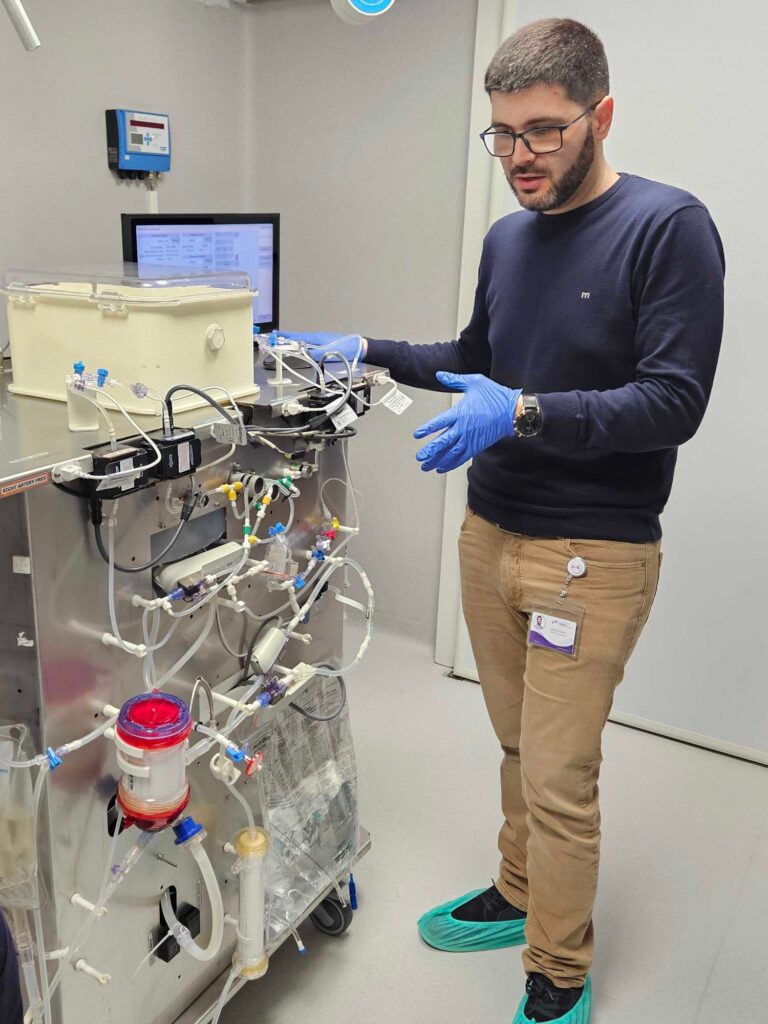
“Think of this as a human body,” says Javier González. In front of me is essentially a metal box on wheels. Standing at around a meter in height, it reminds me of a stainless-steel counter in a restaurant kitchen. It is covered in flexible plastic tubing—which act as veins and arteries—connecting a series of transparent containers, the organs of this machine. What makes it extra special is the role of the cream-colored tub that sits on its surface. Ten months ago, González, a biomedical scientist who developed the device with his colleagues at the Carlos Simon Foundation, carefully placed a freshly donated human uterus in the tub. The team connected it to the device’s tubes and pumped in modified human blood. The device kept the uterus alive for a day—a new feat that could represent the first step to the long-term maintenance of uteruses outside the human body. The work has not yet been published. The team members want to keep donated human uteruses alive long enough to see a full menstrual cycle. They hope this will help them study diseases of the uterus and learn more about how embryos burrow their way into the organ’s lining at the start of a pregnancy. They also hope that future iterations of their device might one day sustain the full gestation of a human fetus. The machine is technically called PUPER, which stands for “preservation of the uterus in perfusion.” But González’s colleague Xavier Santamaria says the team has adopted a nickname for it: “We call it ‘Mother.’” The organ in the machine González and Santamaria, medical vice president of the Carlos Simon Foundation, demonstrated how the device might work when I visited the foundation in Valencia, Spain, earlier this month (although it held no organs on that day). Both are interested in learning more about implantation, the moment at which an embryo attaches itself to the lining of a uterus—essentially, the very first moment of pregnancy. The foundation’s founder and director, Carlos Simon, believes it’s a sticking point in IVF: Scientists have made many improvements to the technology over the years, but the failure of embryos to implant underlies plenty of unsuccessful IVF cycles, he says. Being able to carefully study how the process works in a real, living organ might give the team a better idea of how to prevent those failures. JESS HAMZELOU JAVIER GONZALES/CARLOS SIMON FOUNDATION Javier González demonstrates the perfusion machine. A previous iteration of the device kept a sheep’s uterus (right) alive for a day. The team took inspiration from advances in technologies designed to maintain donated organs for transplantation. In recent years, researchers around the world have created devices that deliver nutrients and filter waste so that organs can survive longer after being removed from donors’ bodies. The main goal here is to buy time. A human organ might last only a matter of hours outside the body, so a transplant may require frantic preparation for the recipient, sometimes in the middle of the night. With a little more time, doctors could find better donor-patient matches and potentially test the quality of donated organs. This approach is called normothermic or machine perfusion, and it is already being used clinically for some liver, kidney, and heart transplants. The team at the Carlos Simon Foundation built a similar machine for uteruses. A blood bag hangs on one side. From there, blood is ferried via plastic tubing to a pump, which functions as the heart. The pump shunts the blood through an oxygenator, which adds oxygen and removes carbon dioxide as the lungs would in a human body. The blood is warmed and passed through sensors that monitor the levels of glucose and oxygen, along with other factors. It passes through a “kidney” to remove waste. And finally the blood reaches the uterus, hooked up to its own plastic “arteries” and “veins.” The organ itself sits at a tilt, just as in the body, and is kept in a humid environment to stay moist. Mother’s first uterus The team first began testing an early prototype of the device with sheep uteruses around four years ago. That meant carting the machine to an animal research center in Zaragoza, around 200 miles away. Over the course of the preliminary study, veterinary surgeons removed the uteruses of six sheep and hooked them up to the machine. They kept each uterus alive for a day, using blood from the same animals. After the sheep experiments, the researchers carted their machine back to Valencia and modified it to achieve its current incarnation, “Mother.” They started working with a local hospital that performed hysterectomies. And in May last year, they were offered their first human uterus. The team needed to be quick. “You need to put [the uterus in the machine] within a couple of hours, maximum, of the extraction,” says Santamaria. He and his colleagues also needed to connect the uterus’s blood vessels to the tubing delicately, taking care to avoid any blockages (clotting is a major challenge in organ perfusion). The organ was hooked up to human blood obtained from a blood bank. It seemed to work—at least temporarily. “We kept it alive for one day,” says Santamaria. “As a proof of concept, it is impressive,” says Keren Ladin, a bioethicist who has focused on organ transplantation and perfusion at Tufts University. “These are early days.” It might not sound like much, but 24 hours is a long time for an organ to be out of the body. Maintaining a donated uterus for that long could expand the options for uterus transplant, a fairly new procedure offered to some people who want to be pregnant but don’t have a functional uterus, says Gerald Brandacher, professor of experimental and translational transplant surgery at the Medical University of Innsbruck in Austria. “It is better than what we currently have, because we have only a couple of hours,” he says. So far, most uterus transplants have been planned operations involving organs from living donors.
A woman’s uterus has been kept alive outside the body for the first time Beitrag lesen »