YouZum

Uncategorized

AI, Committee, Notizie, Uncategorized

Tencent AI Open Sources Covo-Audio: A 7B Speech Language Model and Inference Pipeline for Real-Time Audio Conversations and Reasoning

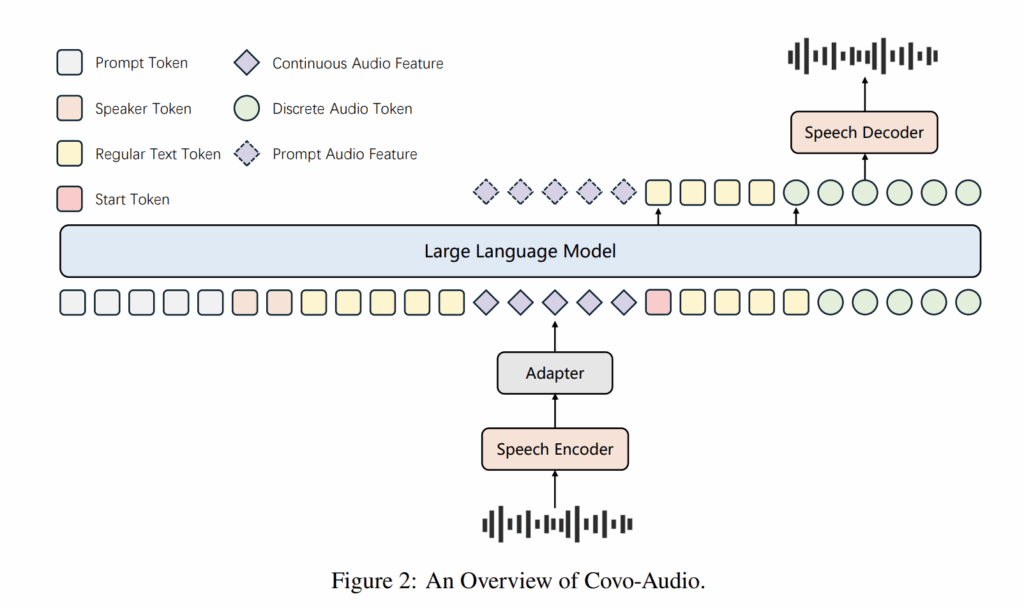
Tencent AI Lab has released Covo-Audio, a 7B-parameter end-to-end Large Audio Language Model (LALM). The model is designed to unify speech processing and language intelligence by directly processing continuous audio inputs and generating audio outputs within a single architecture. System Architecture The Covo-Audio framework consists of four primary components designed for seamless cross-modal interaction: Audio Encoder: The model utilizes Whisper-large-v3 as its primary encoder due to its robustness against background noise and varied accents. This component operates at a frame rate of 50 Hz. Audio Adapter: To bridge the encoder and the LLM, a specialized adapter employs three downsampling modules, integrating linear and convolution layers to reduce the frame rate from 50 Hz to 6.25 Hz. LLM Backbone: The system is built upon Qwen2.5-7B-Base, which has been adapted to process interleaved sequences of continuous acoustic features and textual tokens. Speech Tokenizer and Decoder: The tokenizer, based on WavLM-large, uses a codebook size of 16,384 to produce discrete audio tokens at 25 Hz. The decoder employs a Flow-Matching (FM) based framework and a BigVGAN vocoder to reconstruct high-fidelity 24K waveforms. https://arxiv.org/pdf/2602.09823 Hierarchical Tri-modal Interleaving A core contribution of this work is the Hierarchical Tri-modal Speech-Text Interleaving strategy. Unlike traditional methods that operate solely at the word or character level, this framework aligns continuous acoustic features (ac)(a_c), discrete speech tokens (ad)(a_d), and natural language text (t)(t). The model utilizes two primary patterns: Sequential Interleaving (ac→t→ad)(a_c rightarrow t rightarrow a_d): Continuous features, text, and discrete tokens are arranged in a progressive chain. Parallel Integration (ac→t|ad)(a_c rightarrow t | a_d): Continuous features are aligned with a coupled text-discrete unit. The hierarchical aspect ensures structural coherence by using phrase-level interleaving for fine-grained alignment and sentence-level interleaving to preserve global semantic integrity in long-form utterances. The training process involved a two-stage pre-training pipeline processing a total of 2T tokens. Intelligence-Speaker Decoupling To mitigate the high cost of constructing large-scale dialogue data for specific speakers, the research team proposed an Intelligence Speaker Decoupling strategy. This technique separates dialogue intelligence from voice rendering, allowing for flexible voice customization using minimal text-to-speech (TTS) data. The method reformats high-quality TTS recordings into pseudo-conversations with masked text loss. By excluding the text response portion from the loss calculation, the model preserves its reasoning abilities while inheriting the naturalness of the TTS speaker. This enables personalized interaction without the need for extensive, speaker-specific dialogue datasets. Full-Duplex Voice Interaction Covo-Audio evolved into Covo-Audio-Chat-FD, a variant capable of simultaneous dual-stream communication. The audio encoder is reformatted into a chunk-streaming manner, and the user and model streams are chunk-interleaved in a 1:4 ratio. Each chunk represents 0.16s of audio. The system manages conversational states through specific architectural tokens: THINK Token: Indicates a listening-only state while the model waits to respond. SHIFT Token: Signifies the transition to the model’s speaking turn. BREAK Token: Detects interruption signals (barge-ins), triggering the model to terminate speaking immediately and switch back to listening. For multi-turn scenarios, the model implements a recursive context-filling strategy, where continuous audio features from user input and generated tokens from previous turns are prefixed as historical context. Audio Reasoning and Reinforcement Learning To enhance complex reasoning, the model incorporates Chain-of-Thought (CoT) reasoning and Group Relative Policy Optimization (GRPO). The model is optimized using a verifiable composite reward function: $$R_{total} = R_{accuracy} + R_{format} + R_{consistency} + R_{thinking}$$ This structure allows the model to optimize for correctness (Raccuracy)(R_{accuracy}), structured output adherence (Rformat)(R_{format}), logical coherence (Rconsistency)(R_{consistency}), and reasoning depth (Rthinking)(R_{thinking}). Evaluation and Performance Covo-Audio (7B) shows competitive or superior results on several evaluated benchmarks, with strongest claims made for models of comparable scale and selected speech/audio tasks. On the MMAU benchmark, it achieved an average score of 75.30%, the highest among evaluated 7B-scale models. It notably excelled in music understanding with a score of 76.05%. On the MMSU benchmark, Covo-Audio achieved a leading 66.64% average accuracy. Regarding its conversational variants, Covo-Audio-Chat demonstrated strong performance on URO-Bench, particularly in speech reasoning and spoken dialogue tasks, outperforming models like Qwen3-Omni on the Chinese track. For empathetic interaction on the VStyle benchmark, it achieved state-of-the-art results in Mandarin for anger (4.89), sadness (4.93), and anxiety (5.00). The research team notes an ‘early-response’ issue on the GaokaoEval full-duplex setting, where unusually long silent pauses between vocal fragments can cause premature responses. This ‘early-response’ behavior correlates with the model’s pause-handling success metric and is identified as a critical direction for future optimization. Key Takeaways Unified End-to-End Architecture: Covo-Audio is a 7B-parameter model that natively processes continuous audio inputs and generates high-fidelity audio outputs within a single, unified architecture. It eliminates the need for cascaded ASR-LLM-TTS pipelines, reducing error propagation and information loss. Hierarchical Tri-modal Interleaving: The model employs a specialized strategy to align continuous acoustic features, discrete speech tokens, and natural language text. By interleaving these modalities at both phrase and sentence levels, it preserves global semantic integrity while capturing fine-grained prosodic nuances. Intelligence-Speaker Decoupling: Tencent research team introduces a technique to decouple dialogue intelligence from specific voice rendering. This allows for flexible voice customization using lightweight Text-to-Speech (TTS) data, significantly lowering the cost of developing personalized conversational agents. Native Full-Duplex Interaction: The Covo-Audio-Chat-FD variant supports simultaneous listening and speaking. It utilizes specific architectural tokens—THINK, SHIFT, and BREAK—to manage complex real-time dynamics such as smooth turn-taking, backchanneling, and user barge-ins. Superior Parameter Efficiency: Despite its compact 7B scale, Covo-Audio achieves state-of-the-art or highly competitive performance across core benchmarks, including MMAU, MMSU, and URO-Bench. It frequently matches or exceeds the performance of much larger systems, such as 32B-parameter models, in audio and speech understanding tasks. Check out the Paper, Model on HF and Repo. Also, feel free to follow us on Twitter and don’t forget to join our 120k+ ML SubReddit and Subscribe to our Newsletter. Wait! are you on telegram? now you can join us on telegram as well. The post Tencent AI Open Sources Covo-Audio: A 7B Speech Language Model and Inference Pipeline for Real-Time Audio Conversations and Reasoning appeared first on MarkTechPost.


Tencent AI Open Sources Covo-Audio: A 7B Speech Language Model and Inference Pipeline for Real-Time Audio Conversations and Reasoning Leggi l'articolo »

AI, Committee, Notizie, Uncategorized

Are high gas prices good news for EVs? It’s complicated.

I live in a dense city with plentiful public transportation options and limited parking, so I don’t own a car. I’m often utterly clueless about the current price of gasoline. But as the conflict in Iran has escalated, fossil-fuel prices have been on a roller-coaster, and I’ve started paying attention. In the US, average gas prices are $3.98 a gallon as of March 25, up from under $3 before the war started. Online there’s been what almost looks like cheerleading about this volatility from some folks, including EV owners—some of the social media posts and op-eds have read as nearly gleeful. The subtext (or even the text) is “I told you so.”  Don’t get me wrong—this could be an opportunity for EVs to make headway around the world. But there are plenty of reasons that even the carless among us should be concerned about a sustained rise in fossil-fuel prices. Historically, this is exactly the sort of moment that’s pushed people to reevaluate how they get around. During the oil crisis of the 1970s, Americans switched to smaller, more efficient cars in droves. It was a major opportunity for Japanese automakers, whose vehicles tended to fit this mold better than those produced by their US counterparts. We’re already seeing early signs that people are interested in going electric. One US-based online car marketplace said that search traffic for EVs was up 20% following the initial attack on Iran. For more popular models like the Tesla Model Y, traffic nearly doubled. And the interest is global. One car dealership outside London said it’s struggling to keep up with demand and is sending staff to buy more EVs at auction, according to Reuters. Another in Manila told Bloomberg that it got a month’s worth of orders in two weeks. The timing here is really interesting in the US in particular, because we’re about to see a wave of more affordable used EVs hit the market. Three years ago, a leasing boom started with the Inflation Reduction Act, which included incentives for EVs, including leases. About 300,000 such leases are set to expire this year, and many of those vehicles could come up for sale, increasing the available supply of affordable used EVs. The interest is there, but what would it really take for more drivers to make the switch? Nice, round numbers do tend to get people’s attention. Some point to $4 per gallon (which the national average is quite close to right now). At that price, the total cost of ownership for an EV is comfortably lower than the cost for a gas-powered car, even with higher electricity prices, according to data from the energy consultancy BloombergNEF. Then again, maybe that won’t quite do the trick: One survey from Cox Automotive found that most US consumers would consider switching to an EV or hybrid if gas prices hit $6 per gallon. But this is also the second big incident of fossil-fuel volatility in the last five years, which could make consumers more ready to make the switch, as Elaine Buckberg, a senior fellow at Harvard, told Bloomberg. (The first was in the summer of 2022 when Russia invaded Ukraine.) I’m a climate and energy reporter, and I care about addressing climate change. So I’m always happy to hear about people shifting to EVs or any other option that helps cut down on greenhouse-gas emissions. But one aspect that I think is getting lost here is that sustained high fossil-fuel prices will be bad for even those of us who are untethered from the burdens of vehicle ownership. Fuel cost makes up between 50% and 60% of the cost of shipping goods overseas. Fertilizer production today requires natural gas, which has gotten significantly more expensive since the war began, particularly in Europe. Jet fuel prices have basically doubled in the last month, according to the International Air Transport Association. Since those prices account for something like a quarter of an airline’s operating cost, that could soon make air travel—and anything that’s shipped by plane—more expensive. And if all this adds up to an economic downturn, it’s bad for big projects that need financing (even wind and solar farms) and for people who want to borrow money to buy a home or a car (including an EV). If you’re in the market for a car, maybe this uncertainty is what you needed to consider electric. But until we’re able to truly decarbonize not only our transportation but the rest of our economy, even this carless reporter is going to be worried about high gas prices. This article is from The Spark, MIT Technology Review’s weekly climate newsletter. To receive it in your inbox every Wednesday, sign up here. 

Are high gas prices good news for EVs? It’s complicated. Leggi l'articolo »

AI, Committee, Notizie, Uncategorized

The snow gods: How a couple of ski bums built the internet’s best weather app

The best snow-forecasting app for skiers and snowboarders isn’t from any of the federally funded weather services. Nor from any of the big-name brands. It’s an independent app startup that leverages government data, its own AI models, and decades of alpine-life experience to offer better snow (and soon avalanche) predictions than anything else out there. Skiers in the know follow OpenSnow and won’t bother heading to the mountains—from Alpine Meadows to Mont Blanc, Crested Butte to Killington—unless this small team of trusted weathered men tells them to. (And yes, they’re all men.) The app has made microcelebrities of its forecasters, who sift through and analyze reams of data to write “Daily Snow” reports for locations throughout the world. “I’m F-list famous,” OpenSnow founding partner and forecaster Bryan Allegretto says with a laugh. “Not even D-list.”  The app has proved especially vital this year, which has been one of the weirder winters on record. The US West saw very little daily snow, despite an intense storm cycle that led to one of the deadliest avalanches in history. That storm was followed by one of the fastest melts in memory, and several resorts in California are already shutting down for the season. Meanwhile, in the East, the ongoing snowfall has offered a rare gift: a deep and seemingly endless winter..  MIT Technology Review caught up with Allegretto, better known as BA, in the Tahoe mountains to talk about the weather, AI, avalanches, and how a little weather app became the closest thing powder-hounds have to a crystal ball: a daily dump of the freshest, most decipherable, and most micro-accurate forecasts in the biz. And how two once-broke ski bums—Allegretto and his Colorado counterpart, CEO Joel Gratz— managed to bootstrap a business and turn an email list of 37 into a cult following half a million strong.  This interview has been edited for clarity and accuracy.  You grew up in New Jersey. Middle of the pack as far as snowy states. What were your winters like as a kid? I was always obsessed with weather. Especially severe weather. Nor’easters. There was the blizzard of ’89, I believe, that hit the East Coast hard—dropped two to three feet of snow, which was a lot for the Jersey Shore. My dad worked for the highway authority, so he had tools other than the evening news. He was in charge of calling out the snowplows whenever it snowed, so I just remember chasing storms with my dad. I wasn’t allowed to ride in the snowplows. I’d watch them. When I got older, I was the one shoveling the neighbors’ driveways. I just liked being out there. In it. In college, I used to go around and shovel all the girls’ sidewalks. That was fun.  When did you start skiing? We would cut school and take a bus to go skiing, unbeknownst to our parents. It was the ’90s, and the surfers decided snowboarding would be fun, so the local surf shop started  running a bus and all these surfers would show up and hop the bus to Hunter Mountain. We’d drive to the Poconos, go night skiing, turn around. It wasn’t uncommon for me in high school to get in the car by myself, either —and just drive. Me, my dog, my backpack. I’d sleep in gas stations and ski. Storm-chasing around the Northeast.  What were you really chasing, you think? Natural highs. Happiness. I’ve always been a soul-searcher. I grew up in a crazy house situation, a broken home. My dad left. My mom became a drug addict. I just wanted to be gone. I’m the oldest. I was always trying to help my mom and make sure she was okay. No one was telling me to go to school and have a career. I just wanted to do something that fulfills me. How’d you go about figuring out what that was?  For me, to go to school was a big task, given where I was coming out of. There wasn’t any money. I could get grants and scholarships because my mom was so poor. I wanted to go to Penn State but didn’t have the grades. I ended up at Kean, a public university in New Jersey. It had a meteorology program. We got to go to New York City, to NBC, and practiced on the green screen. In meteorology school, I started thinking: How do I work in the ski and snowboard industry and use weather at the same time? I went to Rowan [University] for business, in South Jersey, and in between moved to Hawaii to surf and spent a year teaching snowboarding. My goal the whole time was to not work in a career I hated. I imagine you weren’t like most meteorology students.  Us punk rockers, skaters, snowboarders—we were a little different than the typical meteorology nerds. I was the radical storm chaser. A big personality. I still am. You didn’t quite fit the traditional weatherman mold. Back then, there were no smartphones or social media. If you were a meteorologist, you either worked in a cubicle for the government or at an insurance company assessing weather risk.  Or you were on the local news. That wasn’t my thing. They didn’t want Grizzly Adams up there with his big beard. Beards belong in the mountains? Meteorologists live in cities because that’s where the jobs are. They don’t live in small mountain towns.  That’s what was missing in the industry. When I moved to Tahoe, in 2006, I realized nobody had any trust in the weather forecasts. It was more like a “We’ll believe it when we see it” old-fashioned mentality. If you’re a forecaster in flat areas, you just look at the weather model and regurgitate the news. Weathermen in Sacramento or Reno didn’t give a crap about the ski resorts! They’d just say “We’ll see three feet above 6,000 feet” and go on to the next segment. And skiers were like: “Wait a minute. Is it going to

The snow gods: How a couple of ski bums built the internet’s best weather app Leggi l'articolo »

AI, Committee, Notizie, Uncategorized

The Download: a battery pivot to AI, and rewriting math

This is today’s edition of The Download, our weekday newsletter that provides a daily dose of what’s going on in the world of technology. Why this battery company is pivoting to AI  Qichao Hu doesn’t mince words about the state of the battery industry. “Almost every Western battery company has either died or is going to die. It’s kind of the reality,” he says.   Hu is the CEO of SES AI, a Massachusetts-based battery company. It previously developed advanced lithium batteries for major industries, but is now shifting to AI materials discovery. Read our story to find out why.   —Casey Crownhart  This startup wants to change how mathematicians do math  Axiom Math, a California startup, has released a free AI tool with a big ambition: discovering mathematical patterns that could unlock solutions to long-standing problems.  Most of the successes with AI tools have involved finding solutions to existing problems. But that’s not all they could do. There are lots of problems in math that require new ideas nobody has ever had, which could come from spotting patterns that have never been spotted before.   Axiom Math’s new tool aims to find these hidden links. Read the full story to discover their plans—and how AI in general could change mathematics.  —Will Douglas Heaven  Are high gas prices good news for EVs? It’s complicated.  As the conflict in Iran has escalated, fossil-fuel prices have been on a roller-coaster—and some EV owners are celebrating.   They believe the volatility will create an opportunity for electric vehicles to make headway. But even the carless among us should be concerned about a sustained rise in fossil-fuel prices.   To find out why, read the full story.  —Casey Crownhart  This article is from The Spark, our weekly climate newsletter. Sign up to receive it in your inbox every Wednesday.  The must-reads  I’ve combed the internet to find you today’s most fun/important/scary/fascinating stories about technology.  1 Meta and YouTube have been fined for designing addictive products They must pay damages of $6 million for harming young people. (Guardian) + The verdicts will reshape legal protections for Big Tech. (WSJ $) + They could also ripple through social media markets worldwide. (Rest of World) + Juries have started taking the lead in the push for child online safety. (NYT)  2 SpaceX aims to file for IPO as soon as this week It’s hoping to raise more than $75 billion. (The Information) + Rocket stocks soared on the report. (BBC)  + But rivals are challenging SpaceX’s dominance. (MIT Technology Review)  3 A new AI safety bill would halt data center construction It was introduced by Bernie Sanders. (Wired) + Nobody wants a data center in their backyard. (MIT Technology Review + One solution: launch them into space. (MIT Technology Review)   4 Meta has laid off 700 employees After raising compensation for top earners. (NYT $)  5 Elon Musk wants a Delaware judge to recuse herself over an emoji She liked a LinkedIn post criticizing him. (CNBC) + The case had ruled Musk misled investors during the Twitter purchase. (Reuters)  6 Reddit will require “fishy” accounts to verify that a human runs them The process aims to combat the deluge of bots. (Ars Technica)  7 Uber and Pony AI aim to launch Europe’s first robotaxi service in Croatia Pony AI is also running trials in Luxembourg, while Uber is testing in London. (The Verge)  8 Google says quantum computers could break all cryptographic security by 2029 It’s set a timeline to secure the quantum era. (Gizmodo) + Quantum computers could soon solve health care problems. (MIT Technology Review)  9 New research shows cloning doesn’t produce perfect copies Clones have lots of extra, potentially dangerous mutations. (New Scientist)  10 The landmark AI Scientist has just completed peer review  It’s billed as the first AI tool built to fully automate the scientific process. (Nature)  Quote of the day  “For years, social media companies have profited from targeting children while concealing their addictive and dangerous design features. Today’s verdict is a referendum—from a jury, to an entire industry.”  —Attorney Rachel Lanier offers her view on yesterday’s fines for Meta and YouTube, the Washington Post reports.   One More Thing  GETTY IMAGES Longevity enthusiasts want to create their own independent state. They’re eyeing Rhode Island.   It’s incredibly difficult and expensive to study innovative ways to slow or reverse aging. In response, longevity enthusiasts have devised an ambitious plan: establish an independent state for life-extension experiments.   They envision a jurisdiction that slashes red tape, encourages self-experimentation with unproven treatments, and eliminates laws that limit how companies develop drugs.   Exactly where their longevity state might emerge is still being worked out—but one appealing location is Rhode Island. Read the full story to learn more about the plans.   —Jessica Hamzelou  We can still have nice things  A place for comfort, fun and distraction to brighten up your day. (Got any ideas? Drop me a line.)  + These gleaming photos of ancient insects in amber are time capsules of the dinosaur age. + Paint with pixels across a world map at this unique digital canvas. + Hands have a new shield against hammers: a nail holder that protects your fingers. + This new audio player uses cartridges to give digital music a soul. 

The Download: a battery pivot to AI, and rewriting math Leggi l'articolo »

AI, Committee, Notizie, Uncategorized

The AI Hype Index: AI goes to war

AI is at war. Anthropic and the Pentagon feuded over how to weaponize Anthropic’s AI model Claude; then OpenAI swept the Pentagon off its feet with an “opportunistic and sloppy” deal. Users quit ChatGPT in droves. People marched through London in the biggest protest against AI to date. If you’re keeping score, Anthropic—the company founded to be ethical—is now turbocharging US strikes on Iran.  On the lighter side, AI agents are now going viral online. OpenAI hired the creator of OpenClaw, a popular AI agent. Meta snapped up Moltbook, where AI agents seem to ponder their own existence and invent new religions like Crustafarianism. And on RentAHuman, bots are hiring people to deliver CBD gummies. The future isn’t AI taking your job. It’s AI becoming your boss and finding God.

The AI Hype Index: AI goes to war Leggi l'articolo »

AI, Committee, Notizie, Uncategorized

Agentic commerce runs on truth and context

Imagine telling a digital agent, “Use my points and book a family trip to Italy. Keep it within budget, pick hotels we’ve liked before, and handle the details.” Instead of returning a list of links, the agent assembles an itinerary and executes the purchase. That shift, from assistance to execution, is what makes agentic AI different. It also changes the operating speed of commerce. Payment transactions are already clear in milliseconds. The new acceleration is everything before the payment: discovery, comparison, decisioning, authorization, and follow-through across many systems. As humans step out of routine decisions, “good enough” data stops being good enough. In an agent-driven economy, the constraint isn’t speed; it’s trust at machine speed and scale. Automated markets already work because identity, authority, and accountability are built in. As agents transact across businesses, that same clarity is required. Master data management (MDM)—the discipline of creating a single master record—becomes the exchange layer: tracking who an agent represents, what it can do, and where responsibility sits when value moves. Markets don’t fail from automation; they fail from ambiguous ownership. MDM turns autonomous action into legitimate, scalable trust. To make agentic commerce safe and scalable, organizations will need more than better models. They will need a modern data architecture and an authoritative system of context that can instantly recognize, resolve, and distinguish entities. It is the difference between automation that scales and automation that needs constant human correction. The agent is a new participant Digital commerce has long been built on two primary sides: buyers and suppliers/merchants. Agentic commerce adds a third participant that must be treated as a first-class entity: the agent acting on the buyer’s behalf. That sounds simple until you ask the questions every enterprise will face: Who is the individual, across channels and devices, with enough certainty for automation? Who is the agent, and what permissions and limits define what it can do? Who is the merchant or supplier, and are we sure we mean the right one? Who holds liability if the agent acts with permission, but against user intent? The practical risk is confusion. Humans, for example, can infer that “Delta” means the airline when they are booking a flight, not the faucet company. An agent needs deterministic signals. If the system guesses wrong, it either breaks trust or forces a human confirmation step that defeats the promise of speed. Why ‘good enough’ data breaks at machine speed Most organizations have learned to live with imperfect data. Duplicate customer records are tolerable. Incomplete product attributes are annoying. Merchant identities can be reconciled later. Agentic workflows change that tolerance. When an agent takes action without a human checking the output, it needs data that is close to perfect, because it cannot reliably notice when data is ambiguous or wrong the way a person can. The failure modes are predictable, and they show up in places that matter most: Product truth: If the catalog is inconsistent, an agent’s choices will look arbitrary (“the wrong shirt,” “the wrong size,” “the wrong material”), and trust collapses quickly. Payee truth: Agentic commerce expands beyond cards to account-to-account and open-banking-connected experiences, broadening the universe of payees and the need to recognize them accurately in real time. Identity truth: People operate in multiple contexts (work versus personal). Devices shift. A system that cannot distinguish amongst these contexts will either block legitimate activity or approve risky activity, both of which damage adoption. This is why unified enterprise data and entity resolution move from nice to have to operationally required. The more autonomy you want, the more you must invest in modern data foundations that ensure it is safe. Context intelligence: The missing layer When leaders talk about agentic AI, they often focus on model capability: planning, tool use, and reasoning. Those are necessary, but they are not sufficient. Agentic commerce also requires a layer that provides authoritative context at runtime. Think of it as a real-time system of context that can answer instantly and consistently: • Is this the right person?• Is this the right agent, acting within the right permissions?• Is this the right merchant or payee?• What constraints apply right now (budget, policy, risk, loyalty rules, preferred suppliers)? Two design principles matter. First, entity truth must be deterministic enough for automation. Large language models are probabilistic by nature. That is helpful for creating options for writing and drawing. It is risky for deciding where money goes, especially in B2B and finance workflows, where “probably correct” is not acceptable. Second, context must travel at the speed of interaction and remain portable across the entire connected network value chain. Mastercard’s experience optimizing payment flows is instructive: the more services you layer onto a transaction, the more you risk slowing it down. The pattern that scales pre-resolves, curates, and packages the signal so that execution is lightweight. This is also where tokenization is heading. Initiatives like Mastercard’s Agent Pay and Verifiable Intent signal a future in which consumer credentials, agent identities, permissions, and provable user intent are encoded as cryptographically secure artifacts — enabling merchants, issuers and platforms to deterministically verify authorization and execution at machine speed. What leaders should do in the next 12 to 24 months Adoption will not be uniform. Early traction will often depend less on industry and more on the sophistication of an organization’s systems and data discipline. That makes the next two years a window for practical preparation. Five moves stand out. Treat agents as governed identities, not features. Define how agents are onboarded, authenticated, permissioned, monitored, and retired. Prioritize entity resolution where the cost of being wrong is highest. Start with payees, suppliers, employee-versus-personal identity, and high-volume product categories. Build a reusable context service that every workflow and agent can call. Do not force each system to reconstruct identity and relationships from scratch. Precompute and compress signals. Resolve and curate context upstream so that runtime decisioning stays fast and predictable. Expand autonomy only as trust is earned. Build a governance framework to address disputes, keep humans in the loop

Agentic commerce runs on truth and context Leggi l'articolo »

AI, Committee, Notizie, Uncategorized

The Download: reawakening frozen brains, and the AI Hype Index returns

This is today’s edition of The Download, our weekday newsletter that provides a daily dose of what’s going on in the world of technology. This scientist rewarmed and studied pieces of his friend’s cryopreserved brain  L. Stephen Coles’s brain sits in a vat at a storage facility in Arizona. It has been held there at a temperature of around −146 degrees °C for over a decade, largely undisturbed. Before he died in 2014, Coles had the brain frozen with an ambitious goal in mind: reanimation.  His friend, cryobiologist Greg Fahy, believes it could be revived one day. But other experts are less optimistic.   Still, Fahy’s research could lead to new ways to study the brain. And using cryopreservation for organ transplantation is becoming a viable reality.   Read the full story to find out what the future holds for the technology.  —Jessica Hamzelou  The AI Hype Index  Separating AI reality from hyped-up fiction isn’t always easy. That’s why we’ve created the AI Hype Index—a simple, at-a-glance summary of everything you need to know about the state of the industry. Take a look at this month’s edition.   MIT Technology Review Narrated: how Pokémon Go is giving delivery robots an inch-perfect view of the world   Pokémon Go was the world’s first augmented-reality megahit. Released in 2016 by Niantic, the AR twist on the juggernaut Pokémon franchise fast became a global phenomenon. “500 million people installed that app in 60 days,” says Brian McClendon, CTO at Niantic Spatial, an AI company that Niantic spun out last year.   Now Niantic Spatial is using that vast trove of crowdsourced data to build a kind of world model—a buzzy new technology that grounds the smarts of LLMs in real environments. The firm wants to use it to help robots navigate more precisely.  —Will Douglas Heaven  This is our latest story to be turned into an MIT Technology Review Narrated podcast, which we’re publishing each week on Spotify and Apple Podcasts. Just navigate to MIT Technology Review Narrated on either platform, and follow us to get all our new content as it’s released.  The next era of space exploration  Our footprint in the solar system is rapidly expanding. Programs to build permanent Moon bases and find life on Mars have transitioned from science fiction to active space agency missions. The scientists behind them will not only shed new light on the cosmos, but also reveal where humanity is headed.  To examine what the future holds in store, MIT Technology Review features editor Amanda Silverman will sit down today with award-winning science journalist and author Robin George Andrews for an exclusive subscriber-only Roundtable conversation about “The Next Era of Space Exploration.” Register here to join the session at 16:00 GMT / 12:00 PM ET / 9:00 AM PT.  The must-reads  I’ve combed the internet to find you today’s most fun/important/scary/fascinating stories about technology.  1 OpenAI is shutting down AI video generator Sora  The app attracted at least as much controversy as acclaim. (CNBC) + Closing it means saying goodbye to $1 billion from Disney. (BBC) + OpenAI is cutting back on side projects ahead of an expected IPO. (WSJ $) + But it’s focusing its efforts on building a fully automated researcher. (MIT Technology Review)  2 A judge suspects the Pentagon is illegally punishing Anthropic She labelled the DoD’s ban “troubling.” (Bloomberg) + Anthropic and the Pentagon are facing off in court. (Guardian) + The DoD wants AI companies to train on classified data. (MIT Technology Review)  3 Meta has been ordered to pay $375 million for endangering children online Prosecutors said the company knew it put children at risk. (Engadget) + Meta is offering its top talent stock options as incentives for its AI push. (CNBC)  4 Arm will sell its own computer chips for the first time It’s aimed at data centers that run AI tasks. (NYT $) + Arm stock jumped 13% on the news. (CNBC)  5 Manus’s founders have been barred from leaving China following Meta’s takeover Beijing is reviewing the $2 billion acquisition of the AI startup. (FT $)  6 Baltimore has sued xAI over Grok’s fake nude images  The chatbot allegedly violated consumer protections. (Guardian) + There’s a big market for pornographic deepfakes of real women. (MIT Technology Review)  7 NASA plans to send a nuclear-powered spacecraft to Mars in 2028 It’ll take a payload of Ingenuity-class helicopters to the Red Planet. (NYT $) + NASA also wants to put a $20 billion base on the Moon. (The Verge)  8 A company is secretly turning Zoom meetings into AI-generated podcasts WebinarTV turns the calls into content without telling anyone. (404 Media)  9 Iranian volunteers have built their own missile warning map It fills the gap left by Iran’s lack of a public emergency alert tool. (Wired $) + Here’s where OpenAI’s tech could show up in Iran. (MIT Technology Review)  10 A nonprofit is sending basic income payments to AI-impacted workers It’s starting by giving 25-50 people $1,000 per month. (Gizmodo)  Quote of the day  “I am first and foremost a scientist. My goal is to understand nature. But doing science is, sort of, like reading the mind of God.”  —DeepMind CEO Demis Hassabis shares his approach to AI strategy with the FT.  One More Thing  EVA REDAMONTI Inside the hunt for the most dangerous asteroid ever   As asteroid 2024 YR4 hurtled toward Earth, astronomers determined that this massive rock posed a higher risk of impact than any object of its size in recorded history. Then, just as quickly as history was made, experts declared that the danger had passed.  This is the inside story of the network of global scientists who found, followed, planned for, and finally dismissed the most dangerous asteroid ever found—all under the tightest of timelines and with the highest of stakes. Find out how they did it.  —Robin George Andrews  We can still have nice things  A place for comfort, fun and distraction to brighten up your day. (Got any ideas? Drop me a line.)  + Soothe subscription fatigue with this simple cancellation tool. + Takashi Murakami’s reimagined Monets are pop-art magic. + Jump into a rabbit hole with this app that visualizes links between Wikipedia pages. + This playful lynx that snatched the top prize in a photo competition is a delight. 

The Download: reawakening frozen brains, and the AI Hype Index returns Leggi l'articolo »

AI, Committee, Notizie, Uncategorized

This startup wants to change how mathematicians do math

Axiom Math, a startup based in Palo Alto, California, has released a free new AI tool for mathematicians, designed to discover mathematical patterns that could unlock solutions to long-standing problems. The tool, called Axplorer, is a redesign of an existing one called PatternBoost that François Charton, now a research scientist at Axiom, co-developed in 2024 when he was at Meta. PatternBoost ran on a supercomputer; Axplorer runs on a Mac Pro. The aim is to put the power of PatternBoost, which was used to crack a hard math puzzle known as the Turán four-cycles problem, in the hands of anyone who can install Axplorer on their own computer. Last year, the US Defense Advanced Research Projects Agency set up a new initiative called expMath—short for Exponentiating Mathematics—to encourage mathematicians to develop and use AI tools. Axiom sees itself as part of that drive. Breakthroughs in math have enormous knock-on effects across technology, says Charton. In particular, new math is crucial for advances in computer science, from building next-generation AI to improving internet security. Most of the successes with AI tools have involved finding solutions to existing problems. But finding solutions is not all that mathematicians do, says Axiom Math founder and CEO Carina Hong. Math is exploratory and experimental, she says.  MIT Technology Review met with Charton and Hong last week for an exclusive video chat about their new tool and how AI in general could change mathematics.  Math by chatbot In the last few months, a number of mathematicians have used LLMs, such as OpenAI’s GPT-5, to find solutions to unsolved problems, especially ones set by the 20th-century mathematician Paul Erdős, who left behind hundreds of puzzles when he died. But Charton is dismissive of those successes. “There are tons of problems that are open because nobody looked at them, and it’s easy to find a few gems you can solve,” he says. He’s set his sights on tougher challenges—“the big problems that have been very, very well studied and famous people have worked on them.” Last year, Axiom Math used another of its tools, called AxiomProver, to find solutions to four such problems in mathematics.    The Turán four-cycles problem that PatternBoost cracked is another big problem, says Charton. (The problem is an important one in graph theory, a branch of math that’s used to analyze complex networks such as social media connections, supply chains, and search engine rankings. Imagine a page covered in dots. The puzzle involves figuring out how to draw lines between as many of the dots as possible without creating loops that connect four dots in a row.) “LLMs are extremely good if what you want to do is derivative of something that has already been done,” says Charton. “This is not surprising—LLMs are pretrained on all the data that there is. But you could say that LLMs are conservative. They try to reuse things that exist.” However, there are lots of problems in math that require new ideas, insights that nobody has ever had. Sometimes those insights come from spotting patterns that hadn’t been spotted before. Such discoveries can open up whole new branches of mathematics. PatternBoost was designed to help mathematicians find new patterns. Give the tool an example and it generates others like it. You select the ones that seem interesting and feed them back in. The tool then generates more like those, and so on.   It’s a similar idea to Google DeepMind’s AlphaEvolve, a system that uses an LLM to come up with novel solutions to a problem. AlphaEvolve keeps the best suggestions and asks the LLM to improve on them. Special access Researchers have already used both AlphaEvolve and PatternBoost to discover new solutions to long-standing math problems. The trouble is that those tools run on large clusters of GPUs and are not available to most mathematicians. Mathematicians are excited about AlphaEvolve, says Charton. “But it’s closed—you need to have access to it. You have to go and ask the DeepMind guy to type in your problem for you.” And when Charton solved the Turán problem with PatternBoost, he was still at Meta. “I had literally thousands, sometimes tens of thousands, of machines I could run it on,” he says. “It ran for three weeks. It was embarrassing brute force.” Axplorer is far faster and far more efficient, according to the team at Axiom Math. Charton says it took Axplorer just 2.5 hours to match PatternBoost’s Turán result. And it runs on a single machine. Geordie Williamson, a mathematician at the University of Sydney, who worked on PatternBoost with Charton, has not yet tried Axplorer. But he is curious to see what mathematicians do with it. (Williamson still occasionally collaborates with Charton on academic projects but says he is not otherwise connected to Axiom Math.) Williamson says Axiom Math has made several improvements to PatternBoost that (in theory) make Axplorer applicable to a wider range of mathematical problems. “It remains to be seen how significant these improvements are,” he says. “We are in a strange time at the moment, where lots of companies have tools that they’d like us to use,” Williamson adds. “I would say mathematicians are somewhat overwhelmed by the possibilities. It is unclear to me what impact having another such tool will be.” Hong admits that there are a lot of AI tools being pitched at mathematicians right now. Some also require mathematicians to train their own neural networks. That’s a turnoff, says Hong, who is a mathematician herself. Instead, Axplorer will walk you through what you want to do step by step, she says. The code for Axplorer is open source and available via GitHub. Hong hopes that students and researchers will use the tool to generate sample solutions and counterexamples to problems they’re working on, speeding up mathematical discovery. Williamson welcomes new tools and says he uses LLMs a lot. But he doesn’t think mathematicians should throw out the whiteboards just yet. “In my biased opinion, PatternBoost is a lovely idea, but it is

This startup wants to change how mathematicians do math Leggi l'articolo »

AI, Committee, Notizie, Uncategorized

Agent-Dice: Disentangling Knowledge Updates via Geometric Consensus for Agent Continual Learning

arXiv:2601.03641v3 Announce Type: replace Abstract: Large Language Model (LLM)-based agents significantly extend the utility of LLMs by interacting with dynamic environments. However, enabling agents to continually learn new tasks without catastrophic forgetting remains a critical challenge, known as the stability-plasticity dilemma. In this work, we argue that this dilemma fundamentally arises from the failure to explicitly distinguish between common knowledge shared across tasks and conflicting knowledge introduced by task-specific interference. To address this, we propose Agent-Dice, a parameter fusion framework based on directional consensus evaluation. Concretely, Agent-Dice disentangles knowledge updates through a two-stage process: geometric consensus filtering to prune conflicting gradients, and curvature-based importance weighting to amplify shared semantics. We provide a rigorous theoretical analysis that establishes the validity of the proposed fusion scheme and offers insight into the origins of the stability-plasticity dilemma. Extensive experiments on GUI agents and tool-use agent domains demonstrate that Agent-Dice exhibits outstanding continual learning performance with minimal computational overhead and parameter updates. The codes are available at https://github.com/Wuzheng02/Agent-Dice.

Agent-Dice: Disentangling Knowledge Updates via Geometric Consensus for Agent Continual Learning Leggi l'articolo »

We use cookies to improve your experience and performance on our website. You can learn more at Politica sulla privacy and manage your privacy settings by clicking Settings.

Privacy Preferences

You can choose your cookie settings by turning on/off each type of cookie as you wish, except for essential cookies.

Allow All
Manage Consent Preferences
  • Always Active

Save
it_IT