YouZum

Uncategorized

AI, Committee, Nachrichten, Uncategorized

Anthropic’s Code with Claude showed off coding’s future—whether you like it or not

The vibes were strong at Code with Claude, Anthropic’s two-day event for software developers in London that kicked off on May 19, the same day as Google’s I/O in Palo Alto. (A coincidence, not a flex, Anthropic staffers assured me.) “Who here has shipped a pull request in the last week that was completely written by Claude?” Jeremy Hadfield, an engineer at Anthropic, asked from the main stage. Almost half the people in the packed room—many sitting with laptops on their knees, coding or prompting as they watched the talks—raised their hands. Pull requests are fixes or updates to existing software that are submitted for review before they go live. They are the bread and butter of software development, the chunks of code that most professional developers spend their lives writing—or did until now. “Who here has shipped a pull request that was completely written by Claude where they did not read the code at all?” Hadfield asked next. Nervous laughter. Most of the hands stayed up. It’s not news that LLM-powered tools like Anthropic’s Claude Code and OpenAI’s Codex have upended the way software gets made. Top tech companies now like to boast of how little code their developers write by hand. (“Most software at Anthropic is now written by Claude,” Hadfield said. “Claude has written most of the code in Claude Code.”) OpenAI, Google, and Microsoft make similar claims. Many others wish they could. Even so, it is striking how normal this new paradigm already seems, and how fast it has set in. This was the second year that Anthropic has put on developer events, which also run in San Francisco and Tokyo. This time last year, the company had just released Claude 4. It could code, kind of. But with Anthropic’s latest string of updates—especially Claude 4.6 and then 4.7, released in February and April—Claude Code is a tool that more and more developers seem happy to hand their work off to.    Let Claude cook.ANTHROPIC (GRAPHIC) / WILL DOUGLAS HEAVEN (PHOTO) Anthropic says its goal is to push automation as far as it will go. Instead of using AI to generate code and then having humans clean it up and fix the mistakes, it wants Claude to check and correct its own work. “The default isn’t ‘I’m going to prompt Claude’—the default is now ‘I’m going to have Claude prompt itself,’” Boris Cherny, who heads Claude Code, said in the opening keynote. If all goes well, human developers shouldn’t even see the error messages when something doesn’t work. That will all be handled by Claude, which will test and tweak, test and tweak, until everything runs as it should. As Ravi Trivedi, an engineer at Anthropic, put it in another talk: “The key principle is getting out of Claude’s way. We like to say: ‘Let it cook.’” Trivedi presented a new feature in Claude Code, announced two weeks ago, which Anthropic calls dreaming. Claude Code agents write notes to themselves, recording and saving useful information about specific tasks. When another coding agent later starts to work on the same code, it can use the notes to get up to speed faster and learn from any errors that previous agents may have made. Dreaming is a system that Claude Code uses to read through all these notes and consolidate the information they contain, spotting patterns and common issues across different tasks. In theory, dreaming should help Claude Code learn about a particular code base and get better and better at working on it. Success stories Code with Claude is an event aimed at developers. As well as product showcases and hands-on workshops from Anthropic, there were how-tos from a range of companies that had reshaped their software development teams around Claude Code, including Spotify and Delivery Hero as well as Lovable, Base44, and Monday.com—three startups vibe-coding apps that help people vibe-code apps. There were no signs of unease at Code with Claude. Everybody I met wanted in. And yet outside the conference there have been a number of reports that many coders are starting to question this bright new future. Some gripe in online forums like Reddit and Hacker News that AI coding tools are being pushed by managers chasing productivity gains, when in practice the technology makes software development harder because of all the extra code developers now have to review. “The only people I’ve heard saying that generated code is fine are those who don’t read it,” a user called pron posted on Hacker News last week.  Others claim that their coding abilities have fallen off as they hand more tasks to AI. And researchers have warned that AI tools can produce unsafe code that will make software more vulnerable to attacks.   I sat down with Claude engineering lead Katelyn Lesse and Claude product lead Angela Jiang and asked them what they made of the concerns that a sudden flood of code generated (and shipped) without proper human oversight was kicking serious security and maintenance problems down the road. “All of the old software development best practices still apply. They’ve applied this entire time,” said Lesse. “I think there are a lot of people and teams that may have lost sight of them in this moment.”  And yet as Anthropic and others push for greater automation and tools like Claude Code improve, the temptation increases to offload more and more tasks, including oversight. Lesse told me that some of the technical managers at Anthropic are exhausted by keeping up with all the code their teams now produce. “Part of things happening so much more quickly is just managing your time,” she said. “I think that right now Claude is probably as good as a midlevel engineer at writing code,” she added. You still need expert engineers to design a system and troubleshoot harder problems, she said, “But over time we want Claude to get better and better at all different types of engineering.” Jiang agreed: “I think the absolute end state we’re trying to get

Anthropic’s Code with Claude showed off coding’s future—whether you like it or not Beitrag lesen »
AI, Committee, Nachrichten, Uncategorized

Alibaba Qwen Team Introduces Qwen3.5-LiveTranslate-Flash: Real-Time Multimodal Interpretation Across 60 Languages at 2.8-Second Latency

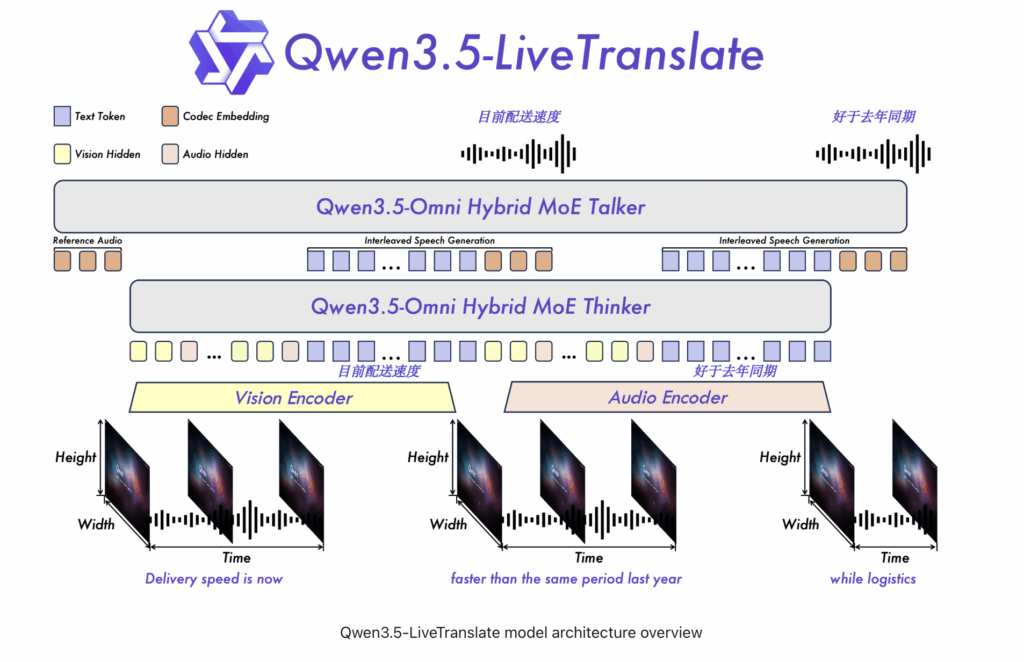
Simultaneous interpretation is one of the harder problems in applied AI. You’re asking a model to translate speech before the speaker has finished a sentence. Every extra second of delay breaks the illusion of real-time communication. Alibaba’s Qwen team has been chipping away at this with each release. Their latest model, Qwen3.5-LiveTranslate-Flash, brings that latency down to 2.8 seconds and expands input language coverage to 60 languages. https://qwen.ai/blog?id=qwen3.5-livetranslate A Meaningful Jump From the Previous Release The Qwen3-LiveTranslate-Flash handled 18 input languages at roughly three seconds of latency. Qwen3.5-LiveTranslate-Flash brings that down to 2.8 seconds, expands input coverage to 60 languages, and adds speech output in 29 languages. That’s more than a 3× expansion in language coverage on the input side. For devs building multilingual products, this reduces the need for per-language model switching in most global enterprise scenarios. The latency improvement comes from a technique for processing what the team calls ‘reading units.’ Rather than waiting for a full sentence to arrive before producing output, the model decides when enough meaning has accumulated in a segment to commit to a translation. It streams output continuously while the speaker is still talking. This is the same underlying logic as semantic unit prediction but with a tighter implementation that shaves off that extra 200 milliseconds. Vision Is Now a First-Class Input Most translation systems treat audio as the only input signal. That works fine in clean studio conditions. It breaks down in a crowded conference room, a noisy trade floor, or anywhere with overlapping voices and bad acoustics. Qwen3.5-LiveTranslate-Flash takes a different approach. It analyzes visual information in parallel with audio on-screen text, physically shown objects, lip movements, and gestures. When a word is phonetically ambiguous or the audio stream degrades, the visual context fills the gap and sharpens the translation decision. This is not a minor feature. In real-world deployment, audio quality is rarely guaranteed. Having a vision channel means the model handles the messy reality of live interpretation more gracefully than audio-only systems. Voice Cloning Happens in Real Time This is the part that stands out most in the Qwen3.5 release. Standard translation systems replace the speaker’s voice with a generic synthesis voice. Qwen3.5-LiveTranslate-Flash instead clones the characteristic voice features of the original speaker during the translation itself. A single spoken sentence is enough for the model to perform this acoustic adaptation. For listeners on the receiving end, the translated output sounds like the same person speaking the target language and not a robotic substitute. In live conference interpretation, multilingual livestreams, or international customer calls, this is important. The experience feels noticeably more human than what current systems deliver. Configure Domain-Specific Keywords One persistent failure mode for translation models in professional settings is proper nouns and specialized vocabulary. A model translating a medical briefing might consistently mistranslate a drug name. A legal interpretation session breaks down over a technical statute term. Qwen3.5-LiveTranslate-Flash addresses this with dynamic keyword configuration at runtime. Developers can inject a glossary of brand names, medical terms, legal terminology, or technical vocabulary, and the model handles those terms significantly more reliably. This isn’t available in most general-purpose translation APIs and it closes a real gap for domain-specific enterprise deployments. Benchmark Performance On FLEURS and CoVoST2 — two established benchmarks for multilingual speech translation — Qwen3.5-LiveTranslate-Flash outperforms major commercial alternatives. FLEURS tests translation quality across a wide variety of language pairs under real acoustic conditions. CoVoST2 covers 21 translation directions from speech, making it a practical proxy for multilingual pipeline performance. Marktechpost’s Visual Explainer ✓ Developer Guide How to Use Qwen3.5-LiveTranslate-Flash A step-by-step integration guide — from setup to production-ready real-time translation 1Overview 2Prerequisites 3Connect 4Send Audio 5Visual Input 6Keywords 7Languages What it does Qwen3.5-LiveTranslate-Flash at a glance Qwen3.5-LiveTranslate-Flash is an API-only, closed-weight real-time translation model from Alibaba’s Qwen team. It takes audio and video frames as simultaneous inputs and outputs translated text and speech. The model uses a WebSocket-based protocol over Alibaba Cloud Model Studio. Latency 2.8s Per token to audio out Input languages 60 Speech + visual input Speech output 29 Languages with voice Protocol WebSocket Persistent connection ✓ Vision-enhanced comprehension — lip movements, gestures, and on-screen text all feed into the translation decision alongside audio ◆ Real-time voice cloning — clones the original speaker’s voice profile in the translated output from a single spoken sentence ◆ Semantic unit prediction — commits to output segments before a full sentence ends, enabling continuous streaming without waiting for complete utterances ◆ Dynamic keyword configuration — inject domain-specific glossaries at runtime for technical, medical, or legal terminology Before you start Prerequisites You need an Alibaba Cloud account with Model Studio access and a valid DashScope API key. The model is available through the qwen3-livetranslate-flash-realtime model ID. 1 Create an Alibaba Cloud account Sign up at alibabacloud.com and activate Alibaba Cloud Model Studio in your account dashboard. 2 Get your DashScope API key Navigate to Model Studio → API Keys. Generate a key and store it as the environment variable DASHSCOPE_API_KEY. Never hardcode it in source files. 3 Install the Python dependency Install the websocket-client package for the WebSocket connection. For audio capture, also install pyaudio. 4 Check your audio setup The model accepts 16kHz, 16-bit PCM mono audio on input. Confirm your microphone or audio source can output in this format before connecting. BASHCopy # Install dependencies pip install websocket-client pyaudio # Set your API key as an environment variable export DASHSCOPE_API_KEY=”your_key_here” Step 3 — Connection Establish the WebSocket connection The model uses the WebSocket protocol for a persistent, bidirectional connection. You authenticate via a Bearer token in the connection header using your DashScope API key. PYTHONCopy import json, websocket, os API_KEY = os.getenv(“DASHSCOPE_API_KEY”) API_URL = ( “wss://dashscope-intl.aliyuncs.com” “/api-ws/v1/realtime” “?model=qwen3-livetranslate-flash-realtime” ) def on_open(ws): print(“Connected to Qwen3.5-LiveTranslate-Flash”) def on_message(ws, message): data = json.loads(message) print(“Translation event:”, data) def on_error(ws, error): print(“Error:”, error) ws = websocket.WebSocketApp( API_URL, header=[“Authorization: Bearer ” + API_KEY], on_open=on_open, on_message=on_message, on_error=on_error ) ws.run_forever() ⓘ The connection stays open for the full session. You do not reconnect per

Alibaba Qwen Team Introduces Qwen3.5-LiveTranslate-Flash: Real-Time Multimodal Interpretation Across 60 Languages at 2.8-Second Latency Beitrag lesen »

AI, Committee, Nachrichten, Uncategorized

NVIDIA AI Releases Nemotron-Labs-Diffusion: A Tri-Mode Language Model with 6× Tokens Per Forward Over Qwen3-8B

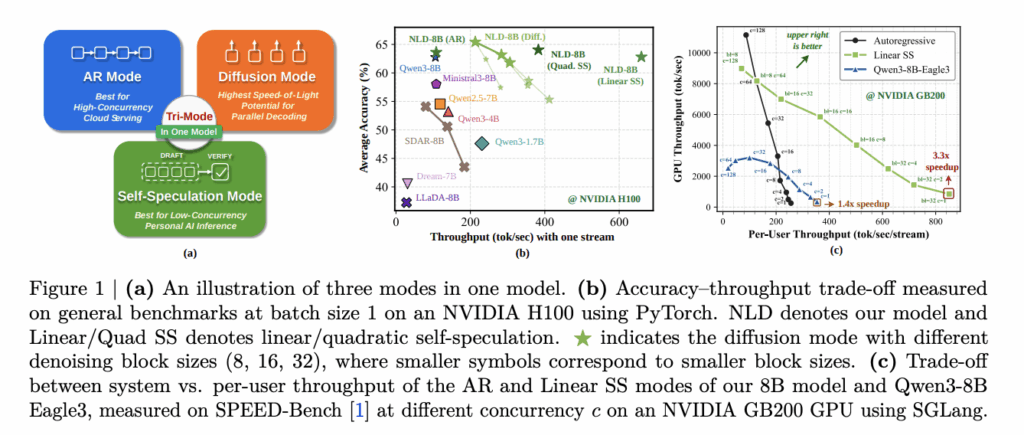
NVIDIA researchers have released Nemotron-Labs-Diffusion, a language model family that unifies three decoding modes in one architecture. The model supports autoregressive (AR) decoding, diffusion-based parallel decoding, and self-speculation decoding. It is available in 3B, 8B, and 14B parameter sizes. The family includes base, instruct, and vision-language variants. Sequential Decoding Limits Throughput Standard autoregressive (AR) language models generate text one token at a time, left to right. Each token depends on all previous tokens. This sequential dependency limits GPU parallelism per generation step. The result is low hardware utilization at low batch sizes — the typical setting for single-user or edge deployment. Diffusion language models (LMs) offer a different approach. Instead of generating tokens sequentially, they denoise multiple tokens in parallel per forward pass. This enables higher throughput. The tradeoff has been accuracy: diffusion LMs have consistently lagged behind AR models on benchmarks, requiring substantially more data to reach comparable performance. A key reason is that diffusion training treats all token permutations uniformly, rather than leveraging the strong left-to-right prior inherent in natural language. https://d1qx31qr3h6wln.cloudfront.net/publications/Nemotron_Diffusion_Tech_Report_v1.pdf?VersionId=db8_EMO8B.vmU26.jr7Le9pN3MqcUDNL What Is a Tri-Mode Language Model? Nemotron-Labs-Diffusion is trained on a joint AR-diffusion objective. At inference time, it operates in three modes depending on the deployment context. There are no mode-specific architectural modifications — the same weights serve all three modes. AR mode is standard left-to-right autoregressive decoding using causal attention. This mode is best suited for high-concurrency cloud serving. Diffusion mode denoises multiple tokens in parallel within a fixed-length block. The sequence is partitioned into contiguous blocks. Within each block, tokens attend bidirectionally. Across blocks, attention remains causal, so prior blocks can reuse their KV cache. A lightweight trained sampler predicts, per masked position, whether the model’s top-1 prediction at the current denoising step is correct. Positions predicted as correct are committed in that step. This allows the model to commit multiple tokens per forward pass. Self-speculation mode uses the diffusion pathway to draft candidate tokens and the AR pathway to verify them, within the same single model. No auxiliary draft model or separate prediction head is required. The diffusion pathway generates a block of k candidate tokens in parallel. The AR pathway then runs a second forward pass over those candidates using causal attention, verifying the longest contiguous prefix that matches AR predictions. Each cycle produces between 1 and k+1 verified tokens. This contrasts with Multi-Token Prediction (MTP) methods such as Eagle3, which use small auxiliary draft heads attached to an AR backbone. Training The joint training objective combines an AR next-token prediction loss and a block-wise diffusion denoising loss: ℒ(θ) = ℒ_AR(θ) + α · ℒ_diff(θ) The coefficient α is set to 0.3 across all training stages. Ablation experiments varying α from 0.1 to 1.0 show that both AR-mode and diffusion-mode accuracy peak at α = 0.3. No value in the range [0.1, 0.5] improves one mode at the expense of the other — the two objectives rise and fall together. Two-stage training first trains the model purely on the AR objective for 1 trillion tokens, building strong left-to-right linguistic priors. Stage 2 then introduces the joint objective for 300 billion additional tokens. In ablations, two-stage training contributed +5.74% average accuracy. Adding the AR loss contributed the single largest gain at +7.48%. Global loss averaging — treating all tokens across a batch equally rather than averaging per-sequence first — contributed +2.12% by reducing gradient variance from variable diffusion masking ratios. Cumulatively, the full training pipeline improved the baseline by 16.05% average accuracy. All models are initialized from pretrained Ministral3 base models, not trained from scratch. Training was performed on 256 NVIDIA H100 GPUs. Instruct models are trained via supervised fine-tuning (SFT) on 45 billion tokens on top of the base models, using the same joint AR-diffusion objective with α = 0.3. The training and inference pipeline is released through Megatron Bridge. LoRA-Enhanced Linear Self-Speculation The base diffusion-to-AR alignment in self-speculation can be improved with a LoRA adapter. This adapter is fine-tuned on the diffusion draft pathway to better align its output with the AR verifier. It targets only the o_proj layer of the attention module (rank 128, α = 512, approximately 36M trainable parameters, 0.4% of the backbone). LoRA tuning improves tokens per forward (TPF) by 14.4%, 32.5%, and 27.6% at the 3B, 8B, and 14B scales respectively, with negligible accuracy change. Speed-of-Light Analysis The research team reports a speed-of-light (SOL) analysis — a theoretical upper bound on tokens per forward pass achievable by the diffusion mode, assuming an oracle sampler that correctly identifies all positions that can be safely committed in parallel. At block length 32, the SOL acceptance rate reaches 7.60× on average, exceeding 10× on coding and multilingual tasks. Current confidence-based sampling achieves approximately 3× TPF at comparable accuracy, leaving a large gap to the SOL ceiling. Comparing against linear self-speculation: both approach similar acceptance rates (6.82× for linear self-speculation vs. 7.60× SOL). However, the real tokens per forward pass (TPF) gap is much larger — 6.02× for SOL versus 3.41× for linear self-speculation, a 76.5% difference. Linear self-speculation requires two forward passes per cycle (one diffusion draft, one AR verify) and accepts only a contiguous prefix. These two constraints cap its real TPF well below SOL, even when drafter and verifier are well aligned. https://d1qx31qr3h6wln.cloudfront.net/publications/Nemotron_Diffusion_Tech_Report_v1.pdf?VersionId=db8_EMO8B.vmU26.jr7Le9pN3MqcUDNL Benchmark Results On the 10-task instruct evaluation (HumanEval, MBPP, LiveCodeBench-CPP, GSM8K, Math500, AIME24, AIME25, GPQA, IFEval, MMLU): NLD-8B AR mode: 63.61% average accuracy, versus 62.75% for Qwen3-8B and 58.02% for Ministral3-8B-Instruct. NLD-8B diffusion mode: 63.18% average accuracy with 2.57× TPF. NLD-8B LoRA-tuned linear self-speculation: 62.81% average accuracy with 5.99× TPF. NLD-8B quadratic self-speculation: 64.04% average accuracy with 6.38× TPF. On SPEED-Bench with SGLang on an NVIDIA GB200 GPU, linear self-speculation achieves 4× higher throughput than Qwen3-8B and 3.3× speedup over the NLD-8B AR mode at concurrency 1 (3.97× with an optimized CUDA kernel). Compared to Qwen3-8B-Eagle3, linear self-speculation delivers a 2.4×, 2.3×, and 1.8× speedup at batch size 1 on GB200, RTX Pro 6000, and DGX Spark respectively. Acceptance length is the underlying

NVIDIA AI Releases Nemotron-Labs-Diffusion: A Tri-Mode Language Model with 6× Tokens Per Forward Over Qwen3-8B Beitrag lesen »

AI, Committee, Nachrichten, Uncategorized

Green steel startup Boston Metal is doubling down on critical metals

The startup Boston Metal has raised a $75 million funding round to produce critical metals, MIT Technology Review can exclusively report.   The company has been known largely for its efforts to clean up steel production, an industry that’s responsible for about 8% of global greenhouse emissions today. With the additional money, the new focus could help it survive at a time when support for industrial decarbonization has been waning in the US. In addition to steel, Boston Metal has also worked to use its technology with other metals, and a subsidiary (Boston Metal do Brasil) is setting up a commercial facility in Brazil to produce niobium, tantalum, and tin. The funding will help support that facility’s operation as well as future efforts to produce critical metals like vanadium, nickel, and chromium, says CEO Tadeu Carneiro. The funding comes after the company faced cash-flow problems following an industrial accident at the Brazil facility earlier this year. Boston Metal’s core technology is called molten oxide electrolysis (MOE). It involves running electric current through a reactor filled with ore dissolved in a molten electrolyte. The electricity heats everything up to about 1,600 °C (3,000 °F) and drives chemical reactions that separate the desired metal (or metals) from the ore. The metal gathers at the bottom of the reactor, where it can be siphoned off. In early 2025, Boston Metal completed the largest run of its pilot industrial cell in Woburn, Massachusetts, producing about a ton of steel. But the focus is currently on making other metals, which are more valuable and can command a higher price. The company’s Brazilian subsidiary is working to test and start up an industrial-scale plant that takes in a low-grade material and makes a mixture of critical metals. Niobium, for example, is used in some steel alloys, as well as in alloys used to make jet engines and the superconducting magnets of MRI scanners. Tantalum is used in aerospace applications like rocket nozzles and turbine blades, as well as medical devices and electronics. Construction on the Brazil plant kicked off in 2024 and took about 18 months, but the company ran into some challenges that delayed official startup. In January there was an issue with the plant’s refractory system, the equipment that insulates the reactor and prevents corrosion. That caused electrolyte to leak. Operators shut down the system and removed the metal, and there weren’t any injuries or environmental issues, Carneiro says. But the leak did interfere with the timeline for the plant’s opening, which meant the company missed a milestone and lost out on funding that had been committed. It restructured and laid off 71 employees in April. This new funding will help support the plant moving forward. “Because of this delay, we had a big stress in our cash flow, so the investors came very strong to support us,” Carneiro says. Boston Metal is repairing the facility in Brazil now, and it should be ready to start up in September 2026, he adds.   The funding will also help support other critical metals projects, Carneiro says. The company plans to eventually deploy a US plant to produce chromium, a metal the country imports nearly all its supply of today.  Boston Metal has now raised over $500 million in total. The latest round of funding includes support from existing investors and from the massive Indian steel company Tata Steel Unlimited. Making a higher-value critical metal now could help Boston Metal prove its technology and pave the way for future steel projects, says Seaver Wang, director of climate and energy at the Breakthrough Institute. “Nobody wants to pay a green premium for steel—hence niobium,” he adds.

Green steel startup Boston Metal is doubling down on critical metals Beitrag lesen »

AI, Committee, Nachrichten, Uncategorized

The Download: fully artificial chicken eggs and why Musk lost

This is today’s edition of The Download, our weekday newsletter that provides a daily dose of what’s going on in the world of technology. Colossal Biosciences is growing chickens in a 3D-printed artificial eggshell The baby chicks were shifting and starting to pip—or trying to hatch. But not from an egg. Instead, these chickens were growing inside transparent 3D-printed plastic cups at the Dallas headquarters of Colossal Biosciences. The biotech company yesterday claimed it has developed a “fully artificial egg” as part of its effort to resurrect extinct avian species, including birds like the dodo and the giant moa. Some scientists think Colossal is overstating the breakthrough. But the technology may represent an early step toward artificial wombs. Read the full story on the science and controversy behind the artificial eggshell. —Antonio Regalado Inside the Musk v. Altman Trial Elon Musk has lost his landmark lawsuit against OpenAI, which centered on allegations that its cofounders Sam Altman and Greg Brockman misled him about the company’s nonprofit mission. But what really happened in the courtroom, and what does it mean for the AI race?  AI reporter and attorney Michelle Kim, who covered the trial for MIT Technology Review, joined our editor in chief Mat Honan to unpack it all in an exclusive Roundtables discussion yesterday. Subscribers can watch the full recording now. MIT Technology Review Narrated: this scientist rewarmed and studied pieces of his friend’s cryopreserved brain L. Stephen Coles’s brain sits in a vat at a storage facility in Arizona. It has been held there at a temperature of around −146 degrees °C for over a decade, largely undisturbed. Before he died in 2014, Coles had the brain frozen with an ambitious goal in mind: reanimation.  His friend, cryobiologist Greg Fahy, believes it could be revived one day. But other experts are less optimistic.   Still, Fahy’s research could lead to new ways to study the brain. And using cryopreservation for organ transplantation is becoming a viable reality.  —Jessica Hamzelou This is our latest story to be turned into an MIT Technology Review Narrated podcast, which we publish each week on Spotify and Apple Podcasts. Just navigate to MIT Technology Review Narrated on either platform, and follow us to get all our new content as it’s released. Can AI learn to understand the world? The limitations of LLMs are pushing AI researchers towards new systems that understand the physical environment: world models. The likes of Google DeepMind, Fei-Fei Li’s World Labs, and Meta’s former Chief AI Scientist, AI Yann LeCun, have brought this technology to the forefront of AI.  To explore where this technology is heading next, MIT Technology Review is hosting an exclusive Roundtables discussion on Thursday, May 21, with editor in chief Mat Honan, senior AI editor Will Douglas Heaven, and AI reporter Grace Huckins. Register here to join the session at 19:30 GMT / 2:30 PM ET / 11:30 AM PT. World models are also one of MIT Technology Review’s 10 Things That Matter in AI Right Now, our list of what’s really worth your attention in the busy, buzzy world of AI. The must-reads I’ve combed the internet to find you today’s most fun/important/scary/fascinating stories about technology. 1 Google is changing its search box for the first time in 25 yearsIts AI-powered overhaul centers on an “intelligent search box”. (Wired $)+ “Information agents” will gather information on a user’s behalf. (TechCrunch)+ Google, Gemini, and Gmail may one day be a single search box. (The Verge)+ AI means the end of search as we know it. (MIT Technology Review) 2 Samsung workers plan to strike tomorrow over AI profit sharingThey say that their employer isn’t sharing the rewards of the AI boom. (WSJ $)+ And want ​15% of the company’s annual operating profit. (CNBC)+ South Korea may invoke emergency powers to stop the strike. (Reuters $) 3 The White House is set to release a new executive order on AI safetyIt’s slated to launch this week. (Axios)+ The order seeks early government access to advanced models. (NYT $) 4 The FBI plans to buy nationwide access to license plate readersIt wants “data in near real time” from cameras across the US. (Ars Technica)+ The tech could let it track drivers nationwide. (Newsweek) 5 Google will launch a new line of smart glasses this fallThey’re the company’s first attempt since the Google Glass flop. (BBC)+ Google Gemini will power the interactions with the user. (Guardian)+ Meanwhile, Anduril and Meta are making smart glasses for warfare. (MIT Technology Review) 6 A new bill in Congress proposes a new annual fee for EVsIt could cost drivers an extra $130 a year. (NYT $)+ The fee will cover highway maintenance costs. (WSJ $) 7 OpenAI co-founder Andrej Karpathy has joined rival lab AnthropicKarpathy was also previously Tesla’s director of AI. (Fortune)+ He coined the term “vibe coding.” (MIT Technology Review) 8 The fears over Anthropic’s Mythos AI model look overstatedCybersecurity experts say the hacking threat is exaggerated. (Reuters $) 9 Silicon Valley keeps misreading China’s role in techViewing Chinese firms as enemies could do more to hurt than help the US. (Rest of World) 10 A book about AI’s effects on truth contains false quotes created by AIIt’s among a spate of controversies involving AI-generated quotes. (NYT $)+ Yesterday, a lawyer apologised for including them in a court filing. (Reuters $)+ A senior journalist was recently suspended for using them. (Guardian) Quote of the day “It may be that the judges have now awarded a prize to an instance of AI plagiarism—we don’t yet know, and perhaps we never will know.” —Sigrid Rausing, publisher of literary magazine Granta, casts doubts on the authenticity of the Commonwealth Short Story Prize winners, Wired reports. One More Thing SELMAN DESIGN Who gets to decide who receives experimental medical treatments? Max was only a toddler when his parents noticed there was “something different” about the way he moved. He was slower than other kids his age, and he struggled to jump. He couldn’t run. A genetic test confirmed their fears: Max had Duchenne muscular

The Download: fully artificial chicken eggs and why Musk lost Beitrag lesen »

AI, Committee, Nachrichten, Uncategorized

Language Models as Efficient Reward Function Searchers for Custom-Environment Multi-Objective Reinforcement

arXiv:2409.02428v4 Announce Type: replace-cross Abstract: Achieving the effective design and improvement of reward functions in reinforcement learning (RL) tasks with complex custom environments and multiple requirements presents considerable challenges. In this paper, we propose ERFSL, an efficient reward function searcher using LLMs, which enables LLMs to be effective white-box searchers and highlights their advanced semantic understanding capabilities. Specifically, we generate reward components for each numerically explicit user requirement and employ a reward critic to identify the correct code form. Then, LLMs assign weights to the reward components to balance their values and iteratively adjust the weights without ambiguity and redundant adjustments by flexibly adopting directional mutation and crossover strategies, similar to genetic algorithms, based on the context provided by the training log analyzer. We applied the framework to a customized data collection RL task without direct human feedback or reward examples (zero-shot learning). The reward critic successfully corrects the reward code with only one feedback instance for each requirement, effectively preventing unrectifiable errors. The initialization of weights enables the acquisition of different reward functions within the Pareto solution set without the need for weight search. Even in cases where a weight is 500 times off, on average, only 5.2 iterations are needed to meet user requirements. The ERFSL also works well with most prompts utilizing GPT-4o mini, as we decompose the weight searching process to reduce the requirement for numerical and long-context understanding capabilities.

Language Models as Efficient Reward Function Searchers for Custom-Environment Multi-Objective Reinforcement Beitrag lesen »

AI, Committee, Nachrichten, Uncategorized

Colossal Biosciences is growing chickens in a 3D-printed artificial eggshell

The baby chicks were shifting and starting to pip—or trying to hatch. But not from an egg.  Instead, these chickens were growing inside transparent 3D-printed plastic cups at the Dallas headquarters of Colossal Biosciences. The biotech company today claimed it has developed a “fully artificial egg” as part of its effort to resurrect extinct avian species, including birds like the dodo and the giant moa. But “artificial eggshell” would probably be a better description for the invention. It’s an oval-shaped printed lattice, coated inside with a special silicone-based membrane that lets in oxygen, just as a real eggshell does.  To generate birds, Colossal took recently laid chicken eggs and carefully poured their contents into the artificial shells, where they continued growing. A window on top lets researchers peek inside.   “To see them all moving around in their artificial eggs was absolutely mind blowing,” says Andrew Pask, the company’s chief biology officer. “You really feel you can grow life outside of the womb.” Colossal was founded in 2021 with plans to use gene editing and reproductive technology to restore extinct species, including the woolly mammoth. It’s since raised more than $800 million toward what it now terms the “scalable and controllable” creation of animals. According to Pask, the egg technology could help conserve at-risk bird species. It could also play a role in a project to re-create the extinct giant moa, a flightless 12-foot-tall bird that once lived in New Zealand and laid four-liter eggs, larger than those of any living bird. But Colossal may be able build one that’s big enough. The company provided a photograph of a prototype 3D-printed egg so large that staff have started to call it the “salad spinner.” The moa went extinct after canoes carrying the ancestors of the Maori arrived on New Zealand’s South Island about 750 years ago. Archeological sites showcase the birds’ bones alongside stone cutting tools—clear evidence that they were hunted. To be clear—Colossal isn’t close to re-creating the moa. Before that could happen, scientists would need to study DNA data from old moa bones and insert thousands of genetic changes into the genome of an existing bird, something that’s still technically difficult to do—with or without an artificial egg. COLOSSAL BIOSCIENCES Some scientists also think Colossal is taking too much credit for its artificial eggshell, which it announced in a thundering YouTube video intoning that the company has solved the “impossible question of which came first, the chicken or the egg.” The video is pure Hollywood—it’s meant to be funny and exciting. But Colossal has a habit of antagonizing scientists by making false and exaggerated claims. Last year, for instance, the company said it had re-created the extinct dire wolf—a claim widely rejected by experts.  This time, Colossal’s fluffed-up assertion of having created the “first-ever shell-less incubation system” is what’s raising hackles among the small flock of scientists who’ve been working on the technology for years.  “Clearly an overstatement,” says Katsuya Obara, at the University of Tsukuba in Japan, who in 2024 hatched chickens from beneath transparent plastic film. “The technology here is essentially a modification of existing methods.” In fact, Obara notes, growing birds in artificial containers goes all the way back to 1998, when another Japanese group managed to do it with quail. What may be an advance by Colossal is the special membrane, which lets the embryo access more oxygen. Previous systems required scientists to supplement the gas—something that may not have been good for the chicks, as often some of them would fail to hatch.  The work on the artificial eggshell was carried out in Dallas by Colossal’s exogenous development team, or Exo Dev. That group is also trying to develop artificial wombs for mammals, starting with marsupials. “We’re looking at every single facet of what’s happening during a mammalian pregnancy to unpack exactly how we then go about recapitulating that,” says Pask. For that team, an artificial eggshell is a relatively quick and easy technical win. That’s because chickens are already an example of ex utero development. After an egg is laid, a small embryo sitting on top of the yolk starts growing, drawing nutrients from the yolk, the white, and even the shell., which provides calcium. (Colossal says it has to add ground-up calcium to the artificial eggs.) COLOSSAL BIOSCIENCES In order to create a moa, Colossal will have to genetically alter another type of bird, changing potentially thousands of DNA letters. But so far, chickens are the only bird species that can be genetically engineered. And that’s via a tricky process of editing stem cells that produce egg and sperm. Scientists have to add or delete DNA letters from these cells and then inject them back into an egg. The resulting bird will carry the genetic change in its gonads—and then be able to pass it on.  Pask says Colossal’s idea is that it could modify avian stem cells enough toproduce moa-like sperm or eggs. But then you might have the odd situation of a chicken laying an egg with a moa embryo inside it. “You would have chickens making moa egg and moa sperm. But it’s still a chicken egg,” he says. Helen Sang, a professor emeritus at the Roslin Institute in the United Kingdom, says she’s not sure a moa embryo could survive on the yolk of a chicken egg, given evolutionary differences. “There are significant challenges to overcome to grow an embryo of a different species in artificial eggs,” says Sang. Just one of those is the huge size discrepancy. The amount of yolk in a chicken egg would hardly be enough to support the much larger moa chick. Yet Pask says that is exactly where the artificial egg will come in handy. He says it may be possible to use a fine needle to slowly “put 50 yolks together to make that yolk mass much larger.” “The chicken egg isn’t going to be big enough to support the growth of the moa through to term, to when it

Colossal Biosciences is growing chickens in a 3D-printed artificial eggshell Beitrag lesen »

AI, Committee, Nachrichten, Uncategorized

The Download: Musk v. Altman, smart glasses for warfare, and Google I/O

This is today’s edition of The Download, our weekday newsletter that provides a daily dose of what’s going on in the world of technology. Here’s why Elon Musk lost his suit against OpenAI Elon Musk has lost his lawsuit against OpenAI, which centered on whether the company breached its founding contract as a nonprofit. A jury found that he sued too late, meaning his claims are barred by statutes of limitations. But the verdict didn’t judge if OpenAI violated its nonprofit mission—only whether Musk brought the case in time. The dispute centers on when OpenAI began shifting toward a for-profit structure. The company argued that signs of a shift were visible as early as 2017, while Musk said he only discovered the change in 2022. Here’s a closer look at the timeline, why Musk lost, and why the fight over OpenAI’s structure may not be over. —Michelle Kim Join us later today for a subscriber-only Roundtables discussion about what happened in the courtroom and what the verdict means for OpenAI and the larger AI race. Register here. Inside Anduril and Meta’s quest to make smart glasses for warfare The defense-tech company Anduril has shared new details about the augmented-reality headset for the military it’s prototyping with Meta, including a vision for ordering drone strikes via eye-tracking and voice commands. Quay Barnett, who leads the effort at Anduril following a career in the Army’s Special Operations Command, says he aims to optimize “the human as a weapons system.” Find out how he plans to do it—and what smart glasses could mean for warfare. —James O’Donnell What to expect at Google I/O this week When Google opens its doors today for its annual developer conference, I/O, it will do so as a clear third place in the foundation model race.  A foundation model’s reputation these days rests largely on its coding capabilities, and for months Google’s coding tools have been outgunned by Anthropic’s Claude Code and OpenAI’s Codex. But the company still shapes the cutting edge in areas such as AI for science. At I/O this week, it will try to prove it can compete on both fronts. I’m going to be at Mountain View this week to see what goes down. Here are three things to keep a close eye on. —Grace Huckins This story is from The Algorithm, our weekly newsletter giving you the inside track on all things AI. Sign up to receive it in your inbox every Monday. Can AI learn to understand the world? As the limits of LLMs become clearer, researchers are developing a new kind of AI designed to understand the physical environment: world models.  Recent developments from Google DeepMind, Fei-Fei Li’s World Labs, and Yann LeCun’s new startup have pushed these systems to the forefront of AI. At an upcoming virtual event, MIT Technology Review will examine the progress—and what comes next. On Thursday, May 21, editor in chief Mat Honan, senior AI editor Will Douglas Heaven, and AI reporter Grace Huckins will take part in an exclusive Roundtables discussion on world models. Register here to join the session at 19:30 GMT / 2:30 PM ET / 11:30 AM PT. World models are one of our 10 Things That Matter in AI Right Now, a new guide to the technologies and ideas shaping the future of AI. The must-reads I’ve combed the internet to find you today’s most fun/important/scary/fascinating stories about technology. 1 OpenAI’s legal win over Elon Musk clears its path to a blockbuster IPOThe jury’s verdict was a critical moment for the company’s future. (Reuters $)+ The trial spilled plenty of dirt about Silicon Valley. (MIT Technology Review)+ And added to concerns about AI’s leadership. (The Verge) 2 Google and Blackstone are launching a new AI cloud companyThe venture will use Google’s specialized chips. (Bloomberg $)+ It aims to mount a challenge to Nvidia. (FT $)+ Blackstone is investing $5 billion in the company. (WSJ $) 3 Meta is reshaping its workforce around AI while preparing deep layoffsIt’s reassigning 7,000 employees to four new AI-focused groups. (NYT $)+ And plans to lay off 10% of its staff on Wednesday. (Reuters $)+ More cuts are expected later this year. (CNBC) 4 The Iran conflict is straining the AI supply chainTSMC, Foxconn, and Infineon have felt major disruption. (CNBC)+ The war also threatens a vital water technology. (MIT Technology Review) 5 China’s AI-powered brain implants are moving to real-world useSome devices will soon be sold to the public. (Nature)+ BCIs now must be proven as products. (MIT Technology Review) 6 A US cybersecurity agency exposed its own digital keys on GitHubA researcher said it’s the worst leak he’s ever seen. (Krebs on Security)+ The culprit was the CISA, a relatively new branch of the DHS. (Gizmodo)7 Supercharging immune cells may help control HIV long-termCAR-T cell therapy is showing promise for managing HIV. (Wired $) 8 Filipino virtual assistants are powering “thought leadership” on LinkedInLow-paid workers use AI to write posts for Western executives. (Rest of World) 9 Big Four accounting firms have more job ads for AI staff than auditorsAccounting giants are rushing to adapt to technological disruption. (FT $) 10 Tech founders are being sent to etiquette schoolIn the AI era, soft skills may matter more than ever. (WSJ $) Quote of the day “Shit, I should have asked for more.” —President Trump tells Fortune that he should have requested a greater share of Intel than the 10% stake that the US government received. One More Thing MICHAEL BYERS Think that your plastic is being recycled? Think again. On a kayak trip through a Connecticut salt marsh, plastic waste appears almost immediately. There are bags in reeds, bottles in the water, and tiny pieces scattered everywhere. What looks like a pristine ecosystem is already saturated. Plastic is produced at enormous scale but rarely recycled. Instead, it breaks apart into microplastics, which are now detected across the environment and in human bodies. Read the full story on why plastic pollution is so hard

The Download: Musk v. Altman, smart glasses for warfare, and Google I/O Beitrag lesen »

We use cookies to improve your experience and performance on our website. You can learn more at Datenschutzrichtlinie and manage your privacy settings by clicking Settings.

Privacy Preferences

You can choose your cookie settings by turning on/off each type of cookie as you wish, except for essential cookies.

Allow All
Manage Consent Preferences
  • Always Active

Save
de_DE