YouZum

Uncategorized

AI, Committee, Noticias, Uncategorized

The Download: coding’s future, the ‘Steroid Olympics,’ and AI-driven science

This is today’s edition of The Download, our weekday newsletter that provides a daily dose of what’s going on in the world of technology. Anthropic’s Code with Claude showed off coding’s future—whether you like it or not At Anthropic’s developer event in London this week, Code with Claude, attendees were asked if they’d shipped code written entirely by Claude. Almost half the room raised their hands. Many admitted they hadn’t even read the code before pushing it live. As tools like Claude Code get better, more and more developers are happy to hand their work off to AI. Anthropic says it wants to push automation as far as it will go. But not everyone is convinced that’s the right approach.  Read the full story on how AI is reshaping coding for good. —Will Douglas Heaven The Enhanced Games fit right in with the rest of 2026’s longevity vibes This Sunday, 42 athletes will gather in Las Vegas for the inaugural Enhanced Games, a controversial sporting competition that allows the use of performance-enhancing drugs. The goal? To “push the boundaries of human performance.” The event embodies a zeitgeist of peptide-crazed looksmaxxing, where consumers are encouraged to get thinner than ever, optimize for longevity, and have their “best baby.” In 2026, if you’re not enhancing, what are you even doing? Find out how the competition reflects our enhancement-obsessed era. —Jessica Hamzelou This story is from The Checkup, our weekly newsletter giving you the inside track on all things biotech. Sign up to receive it in your inbox every Thursday. Google I/O showed how the path for AI-driven science is shifting —Grace Huckins During Tuesday’s Google I/O keynote, Demis Hassabis, the CEO of Google DeepMind, proclaimed that we are “standing in the foothills of the singularity.” But what struck me as I listened in the audience was the context in which he said those words. The contrast reflects two directions for AI in science. One builds specialized systems like WeatherNext for specific problems. The other pushes toward agentic, LLM-based systems that could eventually execute cutting-edge research projects without human involvement. The big scientific announcement at I/O was Gemini for Science, which leans further into this agent-driven future. It can still call on specialized systems, but Google appears to be transitioning away from them. Here’s how the shift could affect science. Can AI learn to understand the world? Many leading AI researchers have turned their attention to a new kind of system that understands the physical environment: world models.  Backed by researchers at Google DeepMind, Fei-Fei Li’s World Labs, and Meta’s former Chief AI scientist, Yann LeCun, the idea is gaining serious momentum. Could it change how AI understands reality? MIT Technology Review editor in chief Mat Honan, senior AI editor Will Douglas Heaven, and AI reporter Grace Huckins unpacked it all in an exclusive Roundtables discussion yesterday. Subscribers can watch the full recording now. World models are also one of MIT Technology Review’s 10 Things That Matter in AI Right Now, our list of what’s really worth your attention in the busy, buzzy world of AI. The must-reads I’ve combed the internet to find you today’s most fun/important/scary/fascinating stories about technology. 1 Trump has postponed an AI order due to overregulation fearsHe said he was concerned it would be “a blocker.” (CNBC)+ And that he wants to preserve the US’s lead over China in AI. (Reuters $)+ A source said the delay was because he “just hates regulation.” (Axios)+ A war over regulation is coming to America. (MIT Technology Review) 2 OpenClaw’s engineers warn that a “vibe-coded slop” crisis is comingThey say AI is flooding the world with bad and even dangerous code. (WSJ $)+ Now vibe coding is coming to your phone, too. (The Verge)+ What exactly is vibe coding? (MIT Technology Review) 3 SpaceX has called off the launch of a new Starship prototypeEngineers discovered a ground system glitch. (CNBC)+ They hope to try again tonight. (Ars Technica)+ The launch could play a key role in SpaceX’s IPO. (NPR) 4 Meta has settled a school district’s social media addiction lawsuitIt had been sued over the alleged harm caused to students. (BBC)+ Snap, TikTok, and YouTube have also settled with the district. (NYT $) 5 Bluesky says it’s being hacked by the Kremlin to spread propagandaIt’s fighting Russian efforts to hijack real users’ accounts to post. (NYT $)+ Now is a good time for doing crime. (MIT Technology Review) 6 Africa’s biggest economies are pushing for AI sovereigntyThey aim to reduce their dependence on Big Tech. (Rest of World)+ New strategies could make Africa a major AI player. (MIT Technology Review) 7 Undersea cables threaten the Gulf’s AI expansion plansConflicts have put the fragile critical infrastructure at risk. (Wired $) 8 Waymo is pausing services as robotaxis keep driving into floodsIt suspended services in four US cities. (TechCrunch) 9 Microscopic silica spheres may help cool the planetBut some researchers need further convincing. (The Economist $) 10 Spotify will now let subscribers create AI remixes It’s the first time they can use AI to create content on Spotify. (Guardian) Quote of the day “You have AI — actual intelligence.”  —Apple cofounder Steve Wozniak reassures college graduates about AI’s impact and draws applause, in contrast to the boos received by former Google CEO Eric Schmidt earlier this week, Business Insider reports. One More Thing GETTY IMAGES The future is disabled Technologies for disability, access, and mobility are often portrayed as objects of empowerment or heroic, life-changing panaceas for social ills. But their benefits are often temporary, lopsided, or reliant on constant investment, care, and attention. Often, accessibility tech assumes levels of access that don’t exist: reliable internet, smartphones, or affordable devices. Projects frequently overlook the very communities they claim to serve. Yet there’s another way: opening ourselves up to all-access thinking and disabled expertise. Discover how that approach could create a more livable world for everyone. —Ashley Shew We can still have nice things A place for comfort, fun, and distraction to brighten

The Download: coding’s future, the ‘Steroid Olympics,’ and AI-driven science Leer entrada »
AI, Committee, Noticias, Uncategorized

Climate tech companies are pivoting to critical minerals

We’re over a year into the second Trump administration here in the US, and support for climate causes is weak. But climate tech companies are finding ways to survive and even thrive in this new environment, including by focusing on potential benefits outside decarbonization. Suddenly, it feels like every climate tech company has a story to tell about topics that are politically in vogue: data centers, energy abundance, or critical minerals. In my newest story, I covered Boston Metal’s latest funding round. Largely known for its efforts to produce steel with lower greenhouse gas emissions, the company raised $75 million from new and existing investors to help support its critical metals business. Focusing on metals like niobium and tantalum won’t have the massive climate benefit that cleaner steel would, but it could generate the cash the company needs to keep going. It’s a strategy I’m noticing more as these tough industries like steel look ever tougher to succeed in with limited federal support in the US.   Boston Metal’s molten oxide electrolysis technology uses electricity to produce metals. I covered the startup last year, when it announced a major milestone for its steel business, running its pilot reactor in Massachusetts and producing a literal ton of material. Now the company’s focus has shifted, and it is going all-in on making other metals, from niobium and tantalum (used in aircraft engines and high-end steel alloys) to chromium and vanadium. The steel industry is a difficult one: It operates at a massive scale, and the product doesn’t command too high a price. Focusing on other metals, especially ones the US government deems critical, could be a way to stay afloat, maybe even long enough to meaningfully cut emissions from the steel industry.  “By deploying in the critical metals industry where we can go very fast, we generate the resources to continue with the development of steel,” says Tadeu Carneiro, CEO of Boston Metal. Other companies are also hoping critical materials could help their business models. California-based Brimstone has a new process to make cement—another heavily polluting industry that’s proving difficult to decarbonize. The company uses a new starting material to help cut down on carbon dioxide emissions. In addition to cement, it makes supplementary cementitious materials that can be added into concrete as well as smelter-grade alumina. Last year, the US Department of Energy canceled $1.3 billion in funding that had been set aside for cement-related projects. Brimstone saw one of its awards canceled, as did Sublime Systems, another cement startup I’ve covered a lot over the years. At the time, a Brimstone representative told me that the company saw the cancellation as a “misunderstanding” and said the facility the funding had been designated for would make not only cement, but also alumina, which would support US aluminum production. Today, the company’s website prominently highlights that it produces critical minerals in addition to cement. Some carbon dioxide removal companies are hoping to hop on the critical minerals train, too, aiming to work with the mining industry. Others are pitching that they can help mining operations operate more efficiently or serve as cleanup for active or abandoned mine sites. All of this is part of a much broader messaging shift. Everyone from politicians to heads of energy companies is talking less about climate. It’s a trend that makes me nervous, even if I understand the impulse. I worry that if we keep too quiet on climate, companies might lose the plot and make choices that won’t help cut emissions. But for some, leaning into a different priority or pushing a different message could help them stay in business long enough to make a difference. We’ll all have to wait to see how it all pans out. This article is from The Spark, MIT Technology Review’s weekly climate newsletter. To receive it in your inbox every Wednesday, sign up here. 

Climate tech companies are pivoting to critical minerals Leer entrada »

AI, Committee, Noticias, Uncategorized

Tech researchers are suing the Trump administration over the future of online safety

Since its earliest days back in office, the Trump administration has been going after researchers who study and try to counter hate speech, harassment, propaganda, and disinformation online.  Now, some of those researchers are fighting back. Last week their lawsuit—which could have global repercussions for online safety and free speech—made its first appearance in court.  This fight started a year ago, when US Secretary of State Marco Rubio announced on X what he called a “visa restriction policy” against “foreign officials and other persons” who were “complicit in censoring Americans.” Since then, a handful of foreign officials and researchers have been barred from travel to the US, and in theory, anyone working in fact-checking or online trust and safety more broadly could face the same restrictions.  Still, the exact implications of Rubio’s announcement are unclear—purposefully so, argues Carrie DeCell, a lawyer representing the researchers. “This policy is expansive and incredibly vague, and the chilling effects are correspondingly enormous,” DeCell said outside the courthouse in Washington, DC, on May 13.   The case has been brought by the Coalition for Independent Technology Research (CITR), an advocacy organization for tech researchers. It is suing Rubio, former US secretary of homeland security Kristi Noem, and former US attorney general Pam Bondi and asking the court to strike down the policy as unconstitutional. In their complaint, the plaintiffs say the policy violates the speech and due process rights of foreign-born tech researchers and workers whose “work supports greater moderation of content on the [tech] platforms.” CITR is represented by Columbia University’s Knight First Amendment Institute and the legal nonprofit Protect Democracy. DeCell, a senior staff attorney at the Knight Institute, tells MIT Technology Review that they’re in court because the Trump administration is effectively “using immigration law to punish people for expressing views that it disagrees with.”  This story is part of MIT Technology Review’s “America Undone” series, examining how the foundations of US success in science and innovation are currently under threat. You can read the rest here. Most immediately, the plaintiffs are asking the government to halt these visa restrictions while the case proceeds. Zachariah Lindsey, the assistant US attorney representing Rubio and the other defendants, argued in last week’s hearing that the government is not targeting speech but, rather, “conduct [that] is assisting or facilitating foreign government censorship of free speech.” At the end of the week, the government filed a motion to dismiss the case. The judge has yet to rule on either motion, and his questions so far appeared to focus on parsing what (and who) is actually affected by the State Department’s announcements, as well as other procedural issues.  The outcome of the case may ultimately affect how much the public knows about the risks of social media and AI, says Nicole Schneidman, head of Protect Democracy’s technology and data governance team. The workers bringing this suit, she says, “serve a really, really important function in educating the public, holding tech companies accountable, doing research on the ramifications that advanced technology has on our society.”  “A political witch hunt” CITR’s lawsuit is the latest salvo in a yearslong battle over how the internet should be moderated, and by whom—a question that has become increasingly political and entangled in allegations of censorship.  For years, Trump and his allies have claimed to be victims of a vast conspiracy between government agencies, civil society groups, academics, and Big Tech platforms to specifically censor conservative voices online. According to this narrative, a so-called “censorship-industrial complex” helped the Biden administration subvert First Amendment protections on speech by allegedly outsourcing censorship to these groups. The State Department claims Rubio was able to implement the immigration policy because the Immigration and Nationality Act authorizes him to “render inadmissible any alien whose entry into the United States ‘would have potentially serious adverse foreign policy consequences for the United States.’” Before the current Trump administration, the statute was rarely invoked, and when it was, it was typically with more limited, specific criteria, rather than its current application against anyone who has participated in alleged censorship—an action that has no legal definition.  The administration first deployed the policy in July 2025, when Rubio issued a statement announcing the revocation of visas for Alexandre de Moraes, the lead justice on the Brazilian Supreme Federal Court, and “his allies on the court” who were involved in prosecuting Jair Bolsonaro, Brazil’s former president. The prosecution was a “political witch hunt,” said Rubio, calling it evidence of a “censorship complex so sweeping that it not only violates basic rights of Brazilians, but also … targets Americans.” Then, in early December, the State Department issued instructions to embassies to reject H-1B visa applications from individuals who had worked specifically in fact-checking, online trust and safety, and mis- or disinformation research, as Reuters first reported.  A few weeks later, on December 23, the agency announced visa restrictions for five Europeans whom it accused of censoring Americans. This included two CITR members: Imran Ahmed, founder and CEO of the Center for Countering Digital Hate, which documents hate speech on social media platforms, and Clare Melford, cofounder of the Global Disinformation Index, which ranks websites according to how often they publish hate speech and disinformation. Also banned were the former European Union commissioner Thierry Breton, a key architect of the European Union’s Digital Services Act (which the State Department has called “Orwellian” and an example of censorship), and Josephine Ballon and Anna-Lena von Hodenberg, co-CEOs of HateAid, a German nonprofit that fights online hate speech.  Ahmed, who lives in the US with his American wife and child, quickly filed his own lawsuit to stave off deportation and halt the policy. A preliminary injunction preventing his detention and deportation is in place as the lawsuit continues.  The Department of Homeland Security referred questions from MIT Technology Review to the State Department, which referred “specific questions” to the Department of Justice, while also writing that “the Trump Administration believes that aliens who are or were involved or complicit in censoring

Tech researchers are suing the Trump administration over the future of online safety Leer entrada »

AI, Committee, Noticias, Uncategorized

The Download: online safety’s future and climate tech’s big pivot

This is today’s edition of The Download, our weekday newsletter that provides a daily dose of what’s going on in the world of technology. Tech researchers are suing the Trump administration over the future of online safety For months, the Trump administration has been going after researchers who study and try to counter hate speech, harassment, propaganda, and disinformation online. Now, some of those researchers are fighting back.  In a new lawsuit, they’re seeking to strike down a visa restriction policy against “foreign officials and other persons” announced last year by US Secretary of State Marco Rubio. They say the policy violates the speech and due process rights of foreign-born workers whose “work supports greater moderation of content on the [tech] platforms.” Find out how the case could impact online safety and free speech. —Eileen Guo Climate tech companies are pivoting to critical minerals We’re over a year into the second Trump administration, and support for climate causes in the US is weak. But climate tech companies are finding ways to survive and even thrive in this new environment, including by looking beyond decarbonization. One example is Boston Metal. The startup has raised a $75 million round to produce critical metals, MIT Technology Review can exclusively report. The company is best known for its efforts to clean up steel production, an industry that’s responsible for about 8% of global greenhouse gas emissions. But the new focus and fresh funds could help it survive a period of waning support for industrial decarbonization. Read the full story on its high-stakes shift. And discover more about the new strategy for climate tech companies in our analysis of how they’re reframing their missions. —Casey Crownhart  Our story on the climate tech pivot is from The Spark, our weekly newsletter giving you the inside track on all things climate. Sign up to receive it in your inbox every Wednesday. Can AI learn to understand the world? As the limits of LLMs become clearer, researchers are developing a new kind of AI designed to understand the physical environment: world models.  Recent developments from Google DeepMind, Fei-Fei Li’s World Labs, and Yann LeCun’s new startup have pushed these systems to the forefront of AI. At an exclusive virtual event today, MIT Technology Review will examine the progress—and what comes next. Join editor in chief Mat Honan, senior AI editor Will Douglas Heaven, and AI reporter Grace Huckins for the subscriber-only Roundtables discussion on world models. Register here to take part in the session at 19:30 GMT / 2:30 PM ET / 11:30 AM PT. World models are one of our 10 Things That Matter in AI Right Now, MIT Technology Review’s new list of the technologies and ideas shaping the future of AI. The must-reads I’ve combed the internet to find you today’s most fun/important/scary/fascinating stories about technology. 1 SpaceX has filed for an IPO expected to be the largest everIt could make Elon Musk the world’s first trillionaire. (BBC) + But he’s also a risk factor in the prospectus. (The Verge)+ The filing exposes SpaceX’s finances for the first time. (NYT $)+ AI spending pushed it to a $1.94 billion loss in Q1 2026. (Reuters $)+ And rivals are challenging its launch dominance. (MIT Technology Review) 2 Nvidia reported record revenues thanks to the AI boomIt’s blown past Wall Street expectations, despite losing the Chinese market. (Guardian)+ It has “largely conceded” China’s AI chip market to Huawei. (CNBC)+ It generated no revenue from H200 chip sales in China. (SCMP) 3 Samsung has averted a massive strike over AI profit-sharingIt reached a tentative deal on bonuses with workers. (FT $)+ The last-minute deal averts an 18-day walkout. (Engadget) + But the compromise has exposed deep divisions. (Reuters $)+ Anti-AI protests are increasing. (MIT Technology Review) 4 President Trump will sign a cybersecurity directive as soon as todayBut it stops short of mandatory federal approval of models before they’re released. (Bloomberg $)+ AI is making online crimes easier. (MIT Technology Review) 5 OpenAI may file for an IPO within daysThe ChatGPT-maker wants to go public as early as September. (WSJ $) 6 Robotics won’t be transformed by a single AI breakthroughDon’t expect a ChatGPT moment. (IEE Spectrum)+ Human work behind humanoid robots is being hidden. (MIT Technology Review) 7 Rocks could generate hydrogen while storing CO2New research shows they could also produce geothermal power. (New Scientist)+ AI is uncovering hidden geothermal energy resources. (MIT Technology Review) 8 The EU is accelerating a Trump-fueled breakup with Big TechGeopolitical tensions are driving a shift toward homegrown software. (Wired $) 9 Solid-state breakthroughs could soon transform commercial batteriesThey’d be faster and safer than today’s lithium-ion equivalents. (The Economist $) 10 Two researchers are rebuilding math from the ground upBy replacing the most fundamental concept in topology. (Quanta)+ OpenAI claims its solved an 80-year-old math problem. (TechCrunch) Quote of the day “This isn’t a blip, it’s an inflection point.”  —Gurjeet Grewal, CEO of UK-based Octopus Electric Vehicles, tells Reuters that the Iran war has been a boon for European EV sales. One More Thing Keisy Plaza looks at her daughter Arantza Plaza with disappointment after failing to get an appointment on the CBP One app in Ciudad Juárez, Mexico.ALICIA FERNáNDEZ The new US border wall is an app At the US southern border in 2023, asylum seekers had to request appointments with immigration officials via a mobile app. The Biden administration said the app, named CBP One, would make migration more orderly and discourage unauthorized crossings. But for many migrants, it became another obstacle. While waiting in dangerous border cities, they reported frozen screens, facial recognition issues, spotty connectivity, and difficulty securing appointments. Advocates argue that requiring vulnerable people to rely on smartphones, internet access, and digital literacy creates a system that leaves many behind. Find out how CBP One endangered some of the people most in need of protection. —Lorena Ríos We can still have nice things A place for comfort, fun, and distraction to brighten up your day. (Got any ideas?

The Download: online safety’s future and climate tech’s big pivot Leer entrada »

AI, Committee, Noticias, Uncategorized

Anthropic’s Code with Claude showed off coding’s future—whether you like it or not

The vibes were strong at Code with Claude, Anthropic’s two-day event for software developers in London that kicked off on May 19, the same day as Google’s I/O in Palo Alto. (A coincidence, not a flex, Anthropic staffers assured me.) “Who here has shipped a pull request in the last week that was completely written by Claude?” Jeremy Hadfield, an engineer at Anthropic, asked from the main stage. Almost half the people in the packed room—many sitting with laptops on their knees, coding or prompting as they watched the talks—raised their hands. Pull requests are fixes or updates to existing software that are submitted for review before they go live. They are the bread and butter of software development, the chunks of code that most professional developers spend their lives writing—or did until now. “Who here has shipped a pull request that was completely written by Claude where they did not read the code at all?” Hadfield asked next. Nervous laughter. Most of the hands stayed up. It’s not news that LLM-powered tools like Anthropic’s Claude Code and OpenAI’s Codex have upended the way software gets made. Top tech companies now like to boast of how little code their developers write by hand. (“Most software at Anthropic is now written by Claude,” Hadfield said. “Claude has written most of the code in Claude Code.”) OpenAI, Google, and Microsoft make similar claims. Many others wish they could. Even so, it is striking how normal this new paradigm already seems, and how fast it has set in. This was the second year that Anthropic has put on developer events, which also run in San Francisco and Tokyo. This time last year, the company had just released Claude 4. It could code, kind of. But with Anthropic’s latest string of updates—especially Claude 4.6 and then 4.7, released in February and April—Claude Code is a tool that more and more developers seem happy to hand their work off to.    Let Claude cook.ANTHROPIC (GRAPHIC) / WILL DOUGLAS HEAVEN (PHOTO) Anthropic says its goal is to push automation as far as it will go. Instead of using AI to generate code and then having humans clean it up and fix the mistakes, it wants Claude to check and correct its own work. “The default isn’t ‘I’m going to prompt Claude’—the default is now ‘I’m going to have Claude prompt itself,’” Boris Cherny, who heads Claude Code, said in the opening keynote. If all goes well, human developers shouldn’t even see the error messages when something doesn’t work. That will all be handled by Claude, which will test and tweak, test and tweak, until everything runs as it should. As Ravi Trivedi, an engineer at Anthropic, put it in another talk: “The key principle is getting out of Claude’s way. We like to say: ‘Let it cook.’” Trivedi presented a new feature in Claude Code, announced two weeks ago, which Anthropic calls dreaming. Claude Code agents write notes to themselves, recording and saving useful information about specific tasks. When another coding agent later starts to work on the same code, it can use the notes to get up to speed faster and learn from any errors that previous agents may have made. Dreaming is a system that Claude Code uses to read through all these notes and consolidate the information they contain, spotting patterns and common issues across different tasks. In theory, dreaming should help Claude Code learn about a particular code base and get better and better at working on it. Success stories Code with Claude is an event aimed at developers. As well as product showcases and hands-on workshops from Anthropic, there were how-tos from a range of companies that had reshaped their software development teams around Claude Code, including Spotify and Delivery Hero as well as Lovable, Base44, and Monday.com—three startups vibe-coding apps that help people vibe-code apps. There were no signs of unease at Code with Claude. Everybody I met wanted in. And yet outside the conference there have been a number of reports that many coders are starting to question this bright new future. Some gripe in online forums like Reddit and Hacker News that AI coding tools are being pushed by managers chasing productivity gains, when in practice the technology makes software development harder because of all the extra code developers now have to review. “The only people I’ve heard saying that generated code is fine are those who don’t read it,” a user called pron posted on Hacker News last week.  Others claim that their coding abilities have fallen off as they hand more tasks to AI. And researchers have warned that AI tools can produce unsafe code that will make software more vulnerable to attacks.   I sat down with Claude engineering lead Katelyn Lesse and Claude product lead Angela Jiang and asked them what they made of the concerns that a sudden flood of code generated (and shipped) without proper human oversight was kicking serious security and maintenance problems down the road. “All of the old software development best practices still apply. They’ve applied this entire time,” said Lesse. “I think there are a lot of people and teams that may have lost sight of them in this moment.”  And yet as Anthropic and others push for greater automation and tools like Claude Code improve, the temptation increases to offload more and more tasks, including oversight. Lesse told me that some of the technical managers at Anthropic are exhausted by keeping up with all the code their teams now produce. “Part of things happening so much more quickly is just managing your time,” she said. “I think that right now Claude is probably as good as a midlevel engineer at writing code,” she added. You still need expert engineers to design a system and troubleshoot harder problems, she said, “But over time we want Claude to get better and better at all different types of engineering.” Jiang agreed: “I think the absolute end state we’re trying to get

Anthropic’s Code with Claude showed off coding’s future—whether you like it or not Leer entrada »

AI, Committee, Noticias, Uncategorized

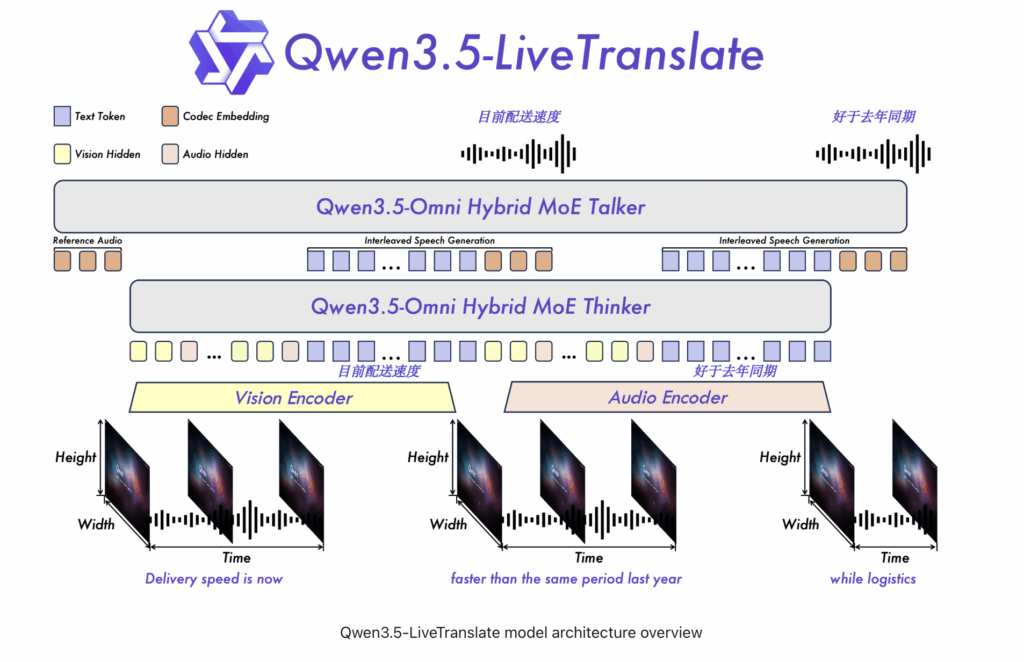
Alibaba Qwen Team Introduces Qwen3.5-LiveTranslate-Flash: Real-Time Multimodal Interpretation Across 60 Languages at 2.8-Second Latency

Simultaneous interpretation is one of the harder problems in applied AI. You’re asking a model to translate speech before the speaker has finished a sentence. Every extra second of delay breaks the illusion of real-time communication. Alibaba’s Qwen team has been chipping away at this with each release. Their latest model, Qwen3.5-LiveTranslate-Flash, brings that latency down to 2.8 seconds and expands input language coverage to 60 languages. https://qwen.ai/blog?id=qwen3.5-livetranslate A Meaningful Jump From the Previous Release The Qwen3-LiveTranslate-Flash handled 18 input languages at roughly three seconds of latency. Qwen3.5-LiveTranslate-Flash brings that down to 2.8 seconds, expands input coverage to 60 languages, and adds speech output in 29 languages. That’s more than a 3× expansion in language coverage on the input side. For devs building multilingual products, this reduces the need for per-language model switching in most global enterprise scenarios. The latency improvement comes from a technique for processing what the team calls ‘reading units.’ Rather than waiting for a full sentence to arrive before producing output, the model decides when enough meaning has accumulated in a segment to commit to a translation. It streams output continuously while the speaker is still talking. This is the same underlying logic as semantic unit prediction but with a tighter implementation that shaves off that extra 200 milliseconds. Vision Is Now a First-Class Input Most translation systems treat audio as the only input signal. That works fine in clean studio conditions. It breaks down in a crowded conference room, a noisy trade floor, or anywhere with overlapping voices and bad acoustics. Qwen3.5-LiveTranslate-Flash takes a different approach. It analyzes visual information in parallel with audio on-screen text, physically shown objects, lip movements, and gestures. When a word is phonetically ambiguous or the audio stream degrades, the visual context fills the gap and sharpens the translation decision. This is not a minor feature. In real-world deployment, audio quality is rarely guaranteed. Having a vision channel means the model handles the messy reality of live interpretation more gracefully than audio-only systems. Voice Cloning Happens in Real Time This is the part that stands out most in the Qwen3.5 release. Standard translation systems replace the speaker’s voice with a generic synthesis voice. Qwen3.5-LiveTranslate-Flash instead clones the characteristic voice features of the original speaker during the translation itself. A single spoken sentence is enough for the model to perform this acoustic adaptation. For listeners on the receiving end, the translated output sounds like the same person speaking the target language and not a robotic substitute. In live conference interpretation, multilingual livestreams, or international customer calls, this is important. The experience feels noticeably more human than what current systems deliver. Configure Domain-Specific Keywords One persistent failure mode for translation models in professional settings is proper nouns and specialized vocabulary. A model translating a medical briefing might consistently mistranslate a drug name. A legal interpretation session breaks down over a technical statute term. Qwen3.5-LiveTranslate-Flash addresses this with dynamic keyword configuration at runtime. Developers can inject a glossary of brand names, medical terms, legal terminology, or technical vocabulary, and the model handles those terms significantly more reliably. This isn’t available in most general-purpose translation APIs and it closes a real gap for domain-specific enterprise deployments. Benchmark Performance On FLEURS and CoVoST2 — two established benchmarks for multilingual speech translation — Qwen3.5-LiveTranslate-Flash outperforms major commercial alternatives. FLEURS tests translation quality across a wide variety of language pairs under real acoustic conditions. CoVoST2 covers 21 translation directions from speech, making it a practical proxy for multilingual pipeline performance. Marktechpost’s Visual Explainer ✓ Developer Guide How to Use Qwen3.5-LiveTranslate-Flash A step-by-step integration guide — from setup to production-ready real-time translation 1Overview 2Prerequisites 3Connect 4Send Audio 5Visual Input 6Keywords 7Languages What it does Qwen3.5-LiveTranslate-Flash at a glance Qwen3.5-LiveTranslate-Flash is an API-only, closed-weight real-time translation model from Alibaba’s Qwen team. It takes audio and video frames as simultaneous inputs and outputs translated text and speech. The model uses a WebSocket-based protocol over Alibaba Cloud Model Studio. Latency 2.8s Per token to audio out Input languages 60 Speech + visual input Speech output 29 Languages with voice Protocol WebSocket Persistent connection ✓ Vision-enhanced comprehension — lip movements, gestures, and on-screen text all feed into the translation decision alongside audio ◆ Real-time voice cloning — clones the original speaker’s voice profile in the translated output from a single spoken sentence ◆ Semantic unit prediction — commits to output segments before a full sentence ends, enabling continuous streaming without waiting for complete utterances ◆ Dynamic keyword configuration — inject domain-specific glossaries at runtime for technical, medical, or legal terminology Before you start Prerequisites You need an Alibaba Cloud account with Model Studio access and a valid DashScope API key. The model is available through the qwen3-livetranslate-flash-realtime model ID. 1 Create an Alibaba Cloud account Sign up at alibabacloud.com and activate Alibaba Cloud Model Studio in your account dashboard. 2 Get your DashScope API key Navigate to Model Studio → API Keys. Generate a key and store it as the environment variable DASHSCOPE_API_KEY. Never hardcode it in source files. 3 Install the Python dependency Install the websocket-client package for the WebSocket connection. For audio capture, also install pyaudio. 4 Check your audio setup The model accepts 16kHz, 16-bit PCM mono audio on input. Confirm your microphone or audio source can output in this format before connecting. BASHCopy # Install dependencies pip install websocket-client pyaudio # Set your API key as an environment variable export DASHSCOPE_API_KEY=”your_key_here” Step 3 — Connection Establish the WebSocket connection The model uses the WebSocket protocol for a persistent, bidirectional connection. You authenticate via a Bearer token in the connection header using your DashScope API key. PYTHONCopy import json, websocket, os API_KEY = os.getenv(“DASHSCOPE_API_KEY”) API_URL = ( “wss://dashscope-intl.aliyuncs.com” “/api-ws/v1/realtime” “?model=qwen3-livetranslate-flash-realtime” ) def on_open(ws): print(“Connected to Qwen3.5-LiveTranslate-Flash”) def on_message(ws, message): data = json.loads(message) print(“Translation event:”, data) def on_error(ws, error): print(“Error:”, error) ws = websocket.WebSocketApp( API_URL, header=[“Authorization: Bearer ” + API_KEY], on_open=on_open, on_message=on_message, on_error=on_error ) ws.run_forever() ⓘ The connection stays open for the full session. You do not reconnect per

Alibaba Qwen Team Introduces Qwen3.5-LiveTranslate-Flash: Real-Time Multimodal Interpretation Across 60 Languages at 2.8-Second Latency Leer entrada »

AI, Committee, Noticias, Uncategorized

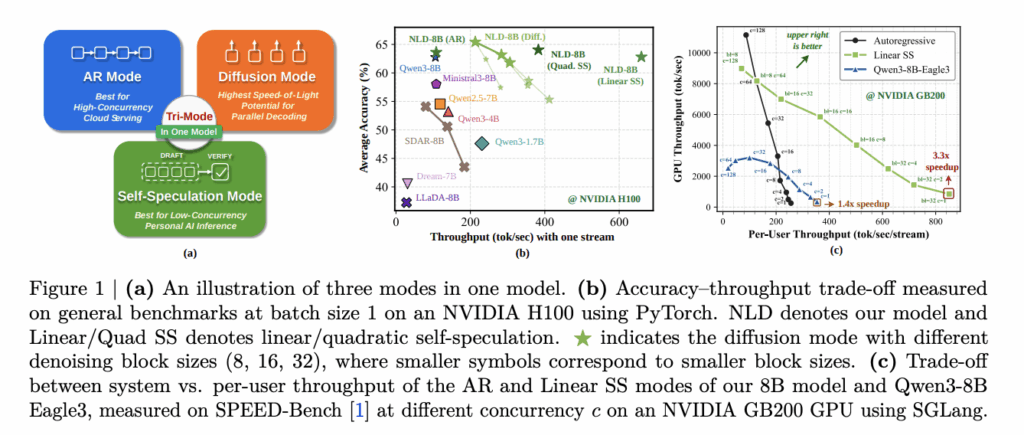
NVIDIA AI Releases Nemotron-Labs-Diffusion: A Tri-Mode Language Model with 6× Tokens Per Forward Over Qwen3-8B

NVIDIA researchers have released Nemotron-Labs-Diffusion, a language model family that unifies three decoding modes in one architecture. The model supports autoregressive (AR) decoding, diffusion-based parallel decoding, and self-speculation decoding. It is available in 3B, 8B, and 14B parameter sizes. The family includes base, instruct, and vision-language variants. Sequential Decoding Limits Throughput Standard autoregressive (AR) language models generate text one token at a time, left to right. Each token depends on all previous tokens. This sequential dependency limits GPU parallelism per generation step. The result is low hardware utilization at low batch sizes — the typical setting for single-user or edge deployment. Diffusion language models (LMs) offer a different approach. Instead of generating tokens sequentially, they denoise multiple tokens in parallel per forward pass. This enables higher throughput. The tradeoff has been accuracy: diffusion LMs have consistently lagged behind AR models on benchmarks, requiring substantially more data to reach comparable performance. A key reason is that diffusion training treats all token permutations uniformly, rather than leveraging the strong left-to-right prior inherent in natural language. https://d1qx31qr3h6wln.cloudfront.net/publications/Nemotron_Diffusion_Tech_Report_v1.pdf?VersionId=db8_EMO8B.vmU26.jr7Le9pN3MqcUDNL What Is a Tri-Mode Language Model? Nemotron-Labs-Diffusion is trained on a joint AR-diffusion objective. At inference time, it operates in three modes depending on the deployment context. There are no mode-specific architectural modifications — the same weights serve all three modes. AR mode is standard left-to-right autoregressive decoding using causal attention. This mode is best suited for high-concurrency cloud serving. Diffusion mode denoises multiple tokens in parallel within a fixed-length block. The sequence is partitioned into contiguous blocks. Within each block, tokens attend bidirectionally. Across blocks, attention remains causal, so prior blocks can reuse their KV cache. A lightweight trained sampler predicts, per masked position, whether the model’s top-1 prediction at the current denoising step is correct. Positions predicted as correct are committed in that step. This allows the model to commit multiple tokens per forward pass. Self-speculation mode uses the diffusion pathway to draft candidate tokens and the AR pathway to verify them, within the same single model. No auxiliary draft model or separate prediction head is required. The diffusion pathway generates a block of k candidate tokens in parallel. The AR pathway then runs a second forward pass over those candidates using causal attention, verifying the longest contiguous prefix that matches AR predictions. Each cycle produces between 1 and k+1 verified tokens. This contrasts with Multi-Token Prediction (MTP) methods such as Eagle3, which use small auxiliary draft heads attached to an AR backbone. Training The joint training objective combines an AR next-token prediction loss and a block-wise diffusion denoising loss: ℒ(θ) = ℒ_AR(θ) + α · ℒ_diff(θ) The coefficient α is set to 0.3 across all training stages. Ablation experiments varying α from 0.1 to 1.0 show that both AR-mode and diffusion-mode accuracy peak at α = 0.3. No value in the range [0.1, 0.5] improves one mode at the expense of the other — the two objectives rise and fall together. Two-stage training first trains the model purely on the AR objective for 1 trillion tokens, building strong left-to-right linguistic priors. Stage 2 then introduces the joint objective for 300 billion additional tokens. In ablations, two-stage training contributed +5.74% average accuracy. Adding the AR loss contributed the single largest gain at +7.48%. Global loss averaging — treating all tokens across a batch equally rather than averaging per-sequence first — contributed +2.12% by reducing gradient variance from variable diffusion masking ratios. Cumulatively, the full training pipeline improved the baseline by 16.05% average accuracy. All models are initialized from pretrained Ministral3 base models, not trained from scratch. Training was performed on 256 NVIDIA H100 GPUs. Instruct models are trained via supervised fine-tuning (SFT) on 45 billion tokens on top of the base models, using the same joint AR-diffusion objective with α = 0.3. The training and inference pipeline is released through Megatron Bridge. LoRA-Enhanced Linear Self-Speculation The base diffusion-to-AR alignment in self-speculation can be improved with a LoRA adapter. This adapter is fine-tuned on the diffusion draft pathway to better align its output with the AR verifier. It targets only the o_proj layer of the attention module (rank 128, α = 512, approximately 36M trainable parameters, 0.4% of the backbone). LoRA tuning improves tokens per forward (TPF) by 14.4%, 32.5%, and 27.6% at the 3B, 8B, and 14B scales respectively, with negligible accuracy change. Speed-of-Light Analysis The research team reports a speed-of-light (SOL) analysis — a theoretical upper bound on tokens per forward pass achievable by the diffusion mode, assuming an oracle sampler that correctly identifies all positions that can be safely committed in parallel. At block length 32, the SOL acceptance rate reaches 7.60× on average, exceeding 10× on coding and multilingual tasks. Current confidence-based sampling achieves approximately 3× TPF at comparable accuracy, leaving a large gap to the SOL ceiling. Comparing against linear self-speculation: both approach similar acceptance rates (6.82× for linear self-speculation vs. 7.60× SOL). However, the real tokens per forward pass (TPF) gap is much larger — 6.02× for SOL versus 3.41× for linear self-speculation, a 76.5% difference. Linear self-speculation requires two forward passes per cycle (one diffusion draft, one AR verify) and accepts only a contiguous prefix. These two constraints cap its real TPF well below SOL, even when drafter and verifier are well aligned. https://d1qx31qr3h6wln.cloudfront.net/publications/Nemotron_Diffusion_Tech_Report_v1.pdf?VersionId=db8_EMO8B.vmU26.jr7Le9pN3MqcUDNL Benchmark Results On the 10-task instruct evaluation (HumanEval, MBPP, LiveCodeBench-CPP, GSM8K, Math500, AIME24, AIME25, GPQA, IFEval, MMLU): NLD-8B AR mode: 63.61% average accuracy, versus 62.75% for Qwen3-8B and 58.02% for Ministral3-8B-Instruct. NLD-8B diffusion mode: 63.18% average accuracy with 2.57× TPF. NLD-8B LoRA-tuned linear self-speculation: 62.81% average accuracy with 5.99× TPF. NLD-8B quadratic self-speculation: 64.04% average accuracy with 6.38× TPF. On SPEED-Bench with SGLang on an NVIDIA GB200 GPU, linear self-speculation achieves 4× higher throughput than Qwen3-8B and 3.3× speedup over the NLD-8B AR mode at concurrency 1 (3.97× with an optimized CUDA kernel). Compared to Qwen3-8B-Eagle3, linear self-speculation delivers a 2.4×, 2.3×, and 1.8× speedup at batch size 1 on GB200, RTX Pro 6000, and DGX Spark respectively. Acceptance length is the underlying

NVIDIA AI Releases Nemotron-Labs-Diffusion: A Tri-Mode Language Model with 6× Tokens Per Forward Over Qwen3-8B Leer entrada »

AI, Committee, Noticias, Uncategorized

Green steel startup Boston Metal is doubling down on critical metals

The startup Boston Metal has raised a $75 million funding round to produce critical metals, MIT Technology Review can exclusively report.   The company has been known largely for its efforts to clean up steel production, an industry that’s responsible for about 8% of global greenhouse emissions today. With the additional money, the new focus could help it survive at a time when support for industrial decarbonization has been waning in the US. In addition to steel, Boston Metal has also worked to use its technology with other metals, and a subsidiary (Boston Metal do Brasil) is setting up a commercial facility in Brazil to produce niobium, tantalum, and tin. The funding will help support that facility’s operation as well as future efforts to produce critical metals like vanadium, nickel, and chromium, says CEO Tadeu Carneiro. The funding comes after the company faced cash-flow problems following an industrial accident at the Brazil facility earlier this year. Boston Metal’s core technology is called molten oxide electrolysis (MOE). It involves running electric current through a reactor filled with ore dissolved in a molten electrolyte. The electricity heats everything up to about 1,600 °C (3,000 °F) and drives chemical reactions that separate the desired metal (or metals) from the ore. The metal gathers at the bottom of the reactor, where it can be siphoned off. In early 2025, Boston Metal completed the largest run of its pilot industrial cell in Woburn, Massachusetts, producing about a ton of steel. But the focus is currently on making other metals, which are more valuable and can command a higher price. The company’s Brazilian subsidiary is working to test and start up an industrial-scale plant that takes in a low-grade material and makes a mixture of critical metals. Niobium, for example, is used in some steel alloys, as well as in alloys used to make jet engines and the superconducting magnets of MRI scanners. Tantalum is used in aerospace applications like rocket nozzles and turbine blades, as well as medical devices and electronics. Construction on the Brazil plant kicked off in 2024 and took about 18 months, but the company ran into some challenges that delayed official startup. In January there was an issue with the plant’s refractory system, the equipment that insulates the reactor and prevents corrosion. That caused electrolyte to leak. Operators shut down the system and removed the metal, and there weren’t any injuries or environmental issues, Carneiro says. But the leak did interfere with the timeline for the plant’s opening, which meant the company missed a milestone and lost out on funding that had been committed. It restructured and laid off 71 employees in April. This new funding will help support the plant moving forward. “Because of this delay, we had a big stress in our cash flow, so the investors came very strong to support us,” Carneiro says. Boston Metal is repairing the facility in Brazil now, and it should be ready to start up in September 2026, he adds.   The funding will also help support other critical metals projects, Carneiro says. The company plans to eventually deploy a US plant to produce chromium, a metal the country imports nearly all its supply of today.  Boston Metal has now raised over $500 million in total. The latest round of funding includes support from existing investors and from the massive Indian steel company Tata Steel Unlimited. Making a higher-value critical metal now could help Boston Metal prove its technology and pave the way for future steel projects, says Seaver Wang, director of climate and energy at the Breakthrough Institute. “Nobody wants to pay a green premium for steel—hence niobium,” he adds.

Green steel startup Boston Metal is doubling down on critical metals Leer entrada »

AI, Committee, Noticias, Uncategorized

The Download: fully artificial chicken eggs and why Musk lost

This is today’s edition of The Download, our weekday newsletter that provides a daily dose of what’s going on in the world of technology. Colossal Biosciences is growing chickens in a 3D-printed artificial eggshell The baby chicks were shifting and starting to pip—or trying to hatch. But not from an egg. Instead, these chickens were growing inside transparent 3D-printed plastic cups at the Dallas headquarters of Colossal Biosciences. The biotech company yesterday claimed it has developed a “fully artificial egg” as part of its effort to resurrect extinct avian species, including birds like the dodo and the giant moa. Some scientists think Colossal is overstating the breakthrough. But the technology may represent an early step toward artificial wombs. Read the full story on the science and controversy behind the artificial eggshell. —Antonio Regalado Inside the Musk v. Altman Trial Elon Musk has lost his landmark lawsuit against OpenAI, which centered on allegations that its cofounders Sam Altman and Greg Brockman misled him about the company’s nonprofit mission. But what really happened in the courtroom, and what does it mean for the AI race?  AI reporter and attorney Michelle Kim, who covered the trial for MIT Technology Review, joined our editor in chief Mat Honan to unpack it all in an exclusive Roundtables discussion yesterday. Subscribers can watch the full recording now. MIT Technology Review Narrated: this scientist rewarmed and studied pieces of his friend’s cryopreserved brain L. Stephen Coles’s brain sits in a vat at a storage facility in Arizona. It has been held there at a temperature of around −146 degrees °C for over a decade, largely undisturbed. Before he died in 2014, Coles had the brain frozen with an ambitious goal in mind: reanimation.  His friend, cryobiologist Greg Fahy, believes it could be revived one day. But other experts are less optimistic.   Still, Fahy’s research could lead to new ways to study the brain. And using cryopreservation for organ transplantation is becoming a viable reality.  —Jessica Hamzelou This is our latest story to be turned into an MIT Technology Review Narrated podcast, which we publish each week on Spotify and Apple Podcasts. Just navigate to MIT Technology Review Narrated on either platform, and follow us to get all our new content as it’s released. Can AI learn to understand the world? The limitations of LLMs are pushing AI researchers towards new systems that understand the physical environment: world models. The likes of Google DeepMind, Fei-Fei Li’s World Labs, and Meta’s former Chief AI Scientist, AI Yann LeCun, have brought this technology to the forefront of AI.  To explore where this technology is heading next, MIT Technology Review is hosting an exclusive Roundtables discussion on Thursday, May 21, with editor in chief Mat Honan, senior AI editor Will Douglas Heaven, and AI reporter Grace Huckins. Register here to join the session at 19:30 GMT / 2:30 PM ET / 11:30 AM PT. World models are also one of MIT Technology Review’s 10 Things That Matter in AI Right Now, our list of what’s really worth your attention in the busy, buzzy world of AI. The must-reads I’ve combed the internet to find you today’s most fun/important/scary/fascinating stories about technology. 1 Google is changing its search box for the first time in 25 yearsIts AI-powered overhaul centers on an “intelligent search box”. (Wired $)+ “Information agents” will gather information on a user’s behalf. (TechCrunch)+ Google, Gemini, and Gmail may one day be a single search box. (The Verge)+ AI means the end of search as we know it. (MIT Technology Review) 2 Samsung workers plan to strike tomorrow over AI profit sharingThey say that their employer isn’t sharing the rewards of the AI boom. (WSJ $)+ And want ​15% of the company’s annual operating profit. (CNBC)+ South Korea may invoke emergency powers to stop the strike. (Reuters $) 3 The White House is set to release a new executive order on AI safetyIt’s slated to launch this week. (Axios)+ The order seeks early government access to advanced models. (NYT $) 4 The FBI plans to buy nationwide access to license plate readersIt wants “data in near real time” from cameras across the US. (Ars Technica)+ The tech could let it track drivers nationwide. (Newsweek) 5 Google will launch a new line of smart glasses this fallThey’re the company’s first attempt since the Google Glass flop. (BBC)+ Google Gemini will power the interactions with the user. (Guardian)+ Meanwhile, Anduril and Meta are making smart glasses for warfare. (MIT Technology Review) 6 A new bill in Congress proposes a new annual fee for EVsIt could cost drivers an extra $130 a year. (NYT $)+ The fee will cover highway maintenance costs. (WSJ $) 7 OpenAI co-founder Andrej Karpathy has joined rival lab AnthropicKarpathy was also previously Tesla’s director of AI. (Fortune)+ He coined the term “vibe coding.” (MIT Technology Review) 8 The fears over Anthropic’s Mythos AI model look overstatedCybersecurity experts say the hacking threat is exaggerated. (Reuters $) 9 Silicon Valley keeps misreading China’s role in techViewing Chinese firms as enemies could do more to hurt than help the US. (Rest of World) 10 A book about AI’s effects on truth contains false quotes created by AIIt’s among a spate of controversies involving AI-generated quotes. (NYT $)+ Yesterday, a lawyer apologised for including them in a court filing. (Reuters $)+ A senior journalist was recently suspended for using them. (Guardian) Quote of the day “It may be that the judges have now awarded a prize to an instance of AI plagiarism—we don’t yet know, and perhaps we never will know.” —Sigrid Rausing, publisher of literary magazine Granta, casts doubts on the authenticity of the Commonwealth Short Story Prize winners, Wired reports. One More Thing SELMAN DESIGN Who gets to decide who receives experimental medical treatments? Max was only a toddler when his parents noticed there was “something different” about the way he moved. He was slower than other kids his age, and he struggled to jump. He couldn’t run. A genetic test confirmed their fears: Max had Duchenne muscular

The Download: fully artificial chicken eggs and why Musk lost Leer entrada »

We use cookies to improve your experience and performance on our website. You can learn more at Política de privacidad and manage your privacy settings by clicking Settings.

Privacy Preferences

You can choose your cookie settings by turning on/off each type of cookie as you wish, except for essential cookies.

Allow All
Manage Consent Preferences
  • Always Active

Save
es_ES