YouZum

Committee

AI, Committee, Nachrichten, Uncategorized

Computational Analysis of Gender Depiction in the Comedias of Calder’on de la Barca

arXiv:2411.03895v2 Announce Type: replace Abstract: In theatre, playwrights use the portrayal of characters to explore culturally based gender norms. In this paper, we develop quantitative methods to study gender depiction in the non-religious works (comedias) of Pedro Calder’on de la Barca, a prolific Spanish 17th century author. We gather insights from a corpus of more than 100 plays by using a gender classifier and applying model explainability (attribution) methods to determine which text features are most influential in the model’s decision to classify speech as ‘male’ or ‘female’, indicating the most gendered elements of dialogue in Calder’on’s comedias in a human accessible manner. We find that female and male characters are portrayed differently and can be identified by the gender prediction model at practically useful accuracies (up to f=0.83). Analysis reveals semantic aspects of gender portrayal, and demonstrates that the model is even useful in providing a relatively accurate scene-by-scene prediction of cross-dressing characters.

Computational Analysis of Gender Depiction in the Comedias of Calder’on de la Barca Beitrag lesen »

AI, Committee, Nachrichten, Uncategorized

Reinforcing Stereotypes of Anger: Emotion AI on African American Vernacular English

arXiv:2511.10846v1 Announce Type: new Abstract: Automated emotion detection is widely used in applications ranging from well-being monitoring to high-stakes domains like mental health and hiring. However, models often rely on annotations that reflect dominant cultural norms, limiting model ability to recognize emotional expression in dialects often excluded from training data distributions, such as African American Vernacular English (AAVE). This study examines emotion recognition model performance on AAVE compared to General American English (GAE). We analyze 2.7 million tweets geo-tagged within Los Angeles. Texts are scored for strength of AAVE using computational approximations of dialect features. Annotations of emotion presence and intensity are collected on a dataset of 875 tweets with both high and low AAVE densities. To assess model accuracy on a task as subjective as emotion perception, we calculate community-informed “silver” labels where AAVE-dense tweets are labeled by African American, AAVE-fluent (ingroup) annotators. On our labeled sample, GPT and BERT-based models exhibit false positive prediction rates of anger on AAVE more than double than on GAE. SpanEmo, a popular text-based emotion model, increases false positive rates of anger from 25 percent on GAE to 60 percent on AAVE. Additionally, a series of linear regressions reveals that models and non-ingroup annotations are significantly more correlated with profanity-based AAVE features than ingroup annotations. Linking Census tract demographics, we observe that neighborhoods with higher proportions of African American residents are associated with higher predictions of anger (Pearson’s correlation r = 0.27) and lower joy (r = -0.10). These results find an emergent safety issue of emotion AI reinforcing racial stereotypes through biased emotion classification. We emphasize the need for culturally and dialect-informed affective computing systems.

Reinforcing Stereotypes of Anger: Emotion AI on African American Vernacular English Beitrag lesen »

AI, Committee, Nachrichten, Uncategorized

A methodological analysis of prompt perturbations and their effect on attack success rates

arXiv:2511.10686v1 Announce Type: new Abstract: This work aims to investigate how different Large Language Models (LLMs) alignment methods affect the models’ responses to prompt attacks. We selected open source models based on the most common alignment methods, namely, Supervised Fine-Tuning (SFT), Direct Preference Optimization (DPO), and Reinforcement Learning with Human Feedback (RLHF). We conducted a systematic analysis using statistical methods to verify how sensitive the Attack Success Rate (ASR) is when we apply variations to prompts designed to elicit inappropriate content from LLMs. Our results show that even small prompt modifications can significantly change the Attack Success Rate (ASR) according to the statistical tests we run, making the models more or less susceptible to types of attack. Critically, our results demonstrate that running existing ‘attack benchmarks’ alone may not be sufficient to elicit all possible vulnerabilities of both models and alignment methods. This paper thus contributes to ongoing efforts on model attack evaluation by means of systematic and statistically-based analyses of the different alignment methods and how sensitive their ASR is to prompt variation.

A methodological analysis of prompt perturbations and their effect on attack success rates Beitrag lesen »

AI, Committee, Nachrichten, Uncategorized

Modeling and Predicting Multi-Turn Answer Instability in Large Language Models

arXiv:2511.10688v1 Announce Type: new Abstract: As large language models (LLMs) are adopted in an increasingly wide range of applications, user-model interactions have grown in both frequency and scale. Consequently, research has focused on evaluating the robustness of LLMs, an essential quality for real-world tasks. In this paper, we employ simple multi-turn follow-up prompts to evaluate models’ answer changes, model accuracy dynamics across turns with Markov chains, and examine whether linear probes can predict these changes. Our results show significant vulnerabilities in LLM robustness: a simple “Think again” prompt led to an approximate 10% accuracy drop for Gemini 1.5 Flash over nine turns, while combining this prompt with a semantically equivalent reworded question caused a 7.5% drop for Claude 3.5 Haiku. Additionally, we find that model accuracy across turns can be effectively modeled using Markov chains, enabling the prediction of accuracy probabilities over time. This allows for estimation of the model’s stationary (long-run) accuracy, which we find to be on average approximately 8% lower than its first-turn accuracy for Gemini 1.5 Flash. Our results from a model’s hidden states also reveal evidence that linear probes can help predict future answer changes. Together, these results establish stationary accuracy as a principled robustness metric for interactive settings and expose the fragility of models under repeated questioning. Addressing this instability will be essential for deploying LLMs in high-stakes and interactive settings where consistent reasoning is as important as initial accuracy.

Modeling and Predicting Multi-Turn Answer Instability in Large Language Models Beitrag lesen »

AI, Committee, Nachrichten, Uncategorized

How to Design a Fully Interactive, Reactive, and Dynamic Terminal-Based Data Dashboard Using Textual?

In this tutorial, we build an advanced interactive dashboard using Textual, and we explore how terminal-first UI frameworks can feel as expressive and dynamic as modern web dashboards. As we write and run each snippet, we actively construct the interface piece by piece, widgets, layouts, reactive state, and event flows, so we can see how Textual behaves like a live UI engine right inside Google Colab. By the end, we notice how naturally we can blend tables, trees, forms, and progress indicators into a cohesive application that feels fast, clean, and responsive. Check out the FULL CODES here. Copy CodeCopiedUse a different Browser !pip install textual textual-web nest-asyncio from textual.app import App, ComposeResult from textual.containers import Container, Horizontal, Vertical from textual.widgets import ( Header, Footer, Button, DataTable, Static, Input, Label, ProgressBar, Tree, Select ) from textual.reactive import reactive from textual import on from datetime import datetime import random class StatsCard(Static): value = reactive(0) def __init__(self, title: str, *args, **kwargs): super().__init__(*args, **kwargs) self.title = title def compose(self) -> ComposeResult: yield Label(self.title) yield Label(str(self.value), id=”stat-value”) def watch_value(self, new_value: int) -> None: if self.is_mounted: try: self.query_one(“#stat-value”, Label).update(str(new_value)) except Exception: pass We set up the environment and import all the necessary components to build our Textual application. As we define the StatsCard widget, we establish a reusable component that reacts to changes in value and updates itself automatically. We begin to see how Textual’s reactive system lets us create dynamic UI elements with minimal effort. Check out the FULL CODES here. Copy CodeCopiedUse a different Browser class DataDashboard(App): CSS = “”” Screen { background: $surface; } #main-container { height: 100%; padding: 1; } #stats-row { height: auto; margin-bottom: 1; } StatsCard { border: solid $primary; height: 5; padding: 1; margin-right: 1; width: 1fr; } #stat-value { text-style: bold; color: $accent; content-align: center middle; } #control-panel { height: 12; border: solid $secondary; padding: 1; margin-bottom: 1; } #data-section { height: 1fr; } #left-panel { width: 30; border: solid $secondary; padding: 1; margin-right: 1; } DataTable { height: 100%; border: solid $primary; } Input { margin: 1 0; } Button { margin: 1 1 1 0; } ProgressBar { margin: 1 0; } “”” BINDINGS = [ (“d”, “toggle_dark”, “Toggle Dark Mode”), (“q”, “quit”, “Quit”), (“a”, “add_row”, “Add Row”), (“c”, “clear_table”, “Clear Table”), ] total_rows = reactive(0) total_sales = reactive(0) avg_rating = reactive(0.0) We define the DataDashboard class and configure global styles, key bindings, and reactive attributes. We decide how the app should look and behave right from the top, giving us full control over themes and interactivity. This structure helps us create a polished dashboard without writing any HTML or JS. Check out the FULL CODES here. Copy CodeCopiedUse a different Browser def compose(self) -> ComposeResult: yield Header(show_clock=True) with Container(id=”main-container”): with Horizontal(id=”stats-row”): yield StatsCard(“Total Rows”, id=”card-rows”) yield StatsCard(“Total Sales”, id=”card-sales”) yield StatsCard(“Avg Rating”, id=”card-rating”) with Vertical(id=”control-panel”): yield Input(placeholder=”Product Name”, id=”input-name”) yield Select( [(“Electronics”, “electronics”), (“Books”, “books”), (“Clothing”, “clothing”)], prompt=”Select Category”, id=”select-category” ) with Horizontal(): yield Button(“Add Row”, variant=”primary”, id=”btn-add”) yield Button(“Clear Table”, variant=”warning”, id=”btn-clear”) yield Button(“Generate Data”, variant=”success”, id=”btn-generate”) yield ProgressBar(total=100, id=”progress”) with Horizontal(id=”data-section”): with Container(id=”left-panel”): yield Label(“Navigation”) tree = Tree(“Dashboard”) tree.root.expand() products = tree.root.add(“Products”, expand=True) products.add_leaf(“Electronics”) products.add_leaf(“Books”) products.add_leaf(“Clothing”) tree.root.add_leaf(“Reports”) tree.root.add_leaf(“Settings”) yield tree yield DataTable(id=”data-table”) yield Footer() We compose the entire UI layout, arranging containers, cards, form inputs, buttons, a navigation tree, and a data table. As we structure these components, we watch the interface take shape exactly the way we envision it. This snippet lets us design the visual skeleton of the dashboard in a clean, declarative manner. Check out the FULL CODES here. Copy CodeCopiedUse a different Browser def on_mount(self) -> None: table = self.query_one(DataTable) table.add_columns(“ID”, “Product”, “Category”, “Price”, “Sales”, “Rating”) table.cursor_type = “row” self.generate_sample_data(5) self.set_interval(0.1, self.update_progress) def generate_sample_data(self, count: int = 5) -> None: table = self.query_one(DataTable) categories = [“Electronics”, “Books”, “Clothing”] products = { “Electronics”: [“Laptop”, “Phone”, “Tablet”, “Headphones”], “Books”: [“Novel”, “Textbook”, “Magazine”, “Comic”], “Clothing”: [“Shirt”, “Pants”, “Jacket”, “Shoes”] } for _ in range(count): category = random.choice(categories) product = random.choice(products[category]) row_id = self.total_rows + 1 price = round(random.uniform(10, 500), 2) sales = random.randint(1, 100) rating = round(random.uniform(1, 5), 1) table.add_row( str(row_id), product, category, f”${price}”, str(sales), str(rating) ) self.total_rows += 1 self.total_sales += sales self.update_stats() def update_stats(self) -> None: self.query_one(“#card-rows”, StatsCard).value = self.total_rows self.query_one(“#card-sales”, StatsCard).value = self.total_sales if self.total_rows > 0: table = self.query_one(DataTable) total_rating = sum(float(row[5]) for row in table.rows) self.avg_rating = round(total_rating / self.total_rows, 2) self.query_one(“#card-rating”, StatsCard).value = self.avg_rating def update_progress(self) -> None: progress = self.query_one(ProgressBar) progress.advance(1) if progress.progress >= 100: progress.progress = 0 We implement all the logic for generating data, computing statistics, animating progress, and updating cards. We see how quickly we can bind backend logic to frontend components using Textual’s reactive model. This step makes the dashboard feel alive as numbers update instantly and progress bars animate smoothly. Check out the FULL CODES here. Copy CodeCopiedUse a different Browser @on(Button.Pressed, “#btn-add”) def handle_add_button(self) -> None: name_input = self.query_one(“#input-name”, Input) category = self.query_one(“#select-category”, Select).value if name_input.value and category: table = self.query_one(DataTable) row_id = self.total_rows + 1 price = round(random.uniform(10, 500), 2) sales = random.randint(1, 100) rating = round(random.uniform(1, 5), 1) table.add_row( str(row_id), name_input.value, str(category), f”${price}”, str(sales), str(rating) ) self.total_rows += 1 self.total_sales += sales self.update_stats() name_input.value = “” @on(Button.Pressed, “#btn-clear”) def handle_clear_button(self) -> None: table = self.query_one(DataTable) table.clear() self.total_rows = 0 self.total_sales = 0 self.avg_rating = 0 self.update_stats() @on(Button.Pressed, “#btn-generate”) def handle_generate_button(self) -> None: self.generate_sample_data(10) def action_toggle_dark(self) -> None: self.dark = not self.dark def action_add_row(self) -> None: self.handle_add_button() def action_clear_table(self) -> None: self.handle_clear_button() if __name__ == “__main__”: import nest_asyncio nest_asyncio.apply() app = DataDashboard() app.run() We connect UI events to backend actions using button handlers, keyboard shortcuts, and app-level functions. As we run the app, we interact with a fully functional dashboard that responds instantly to every click and command. This snippet completes the application and demonstrates how easily Textual enables us to build dynamic, state-driven UIs. In conclusion, we see the whole dashboard come together in a fully functional, interactive form that runs directly from a notebook environment. We experience firsthand how Textual lets us design terminal UIs with the structure and

How to Design a Fully Interactive, Reactive, and Dynamic Terminal-Based Data Dashboard Using Textual? Beitrag lesen »

AI, Committee, Nachrichten, Uncategorized

MBZUAI Researchers Introduce PAN: A General World Model For Interactable Long Horizon Simulation

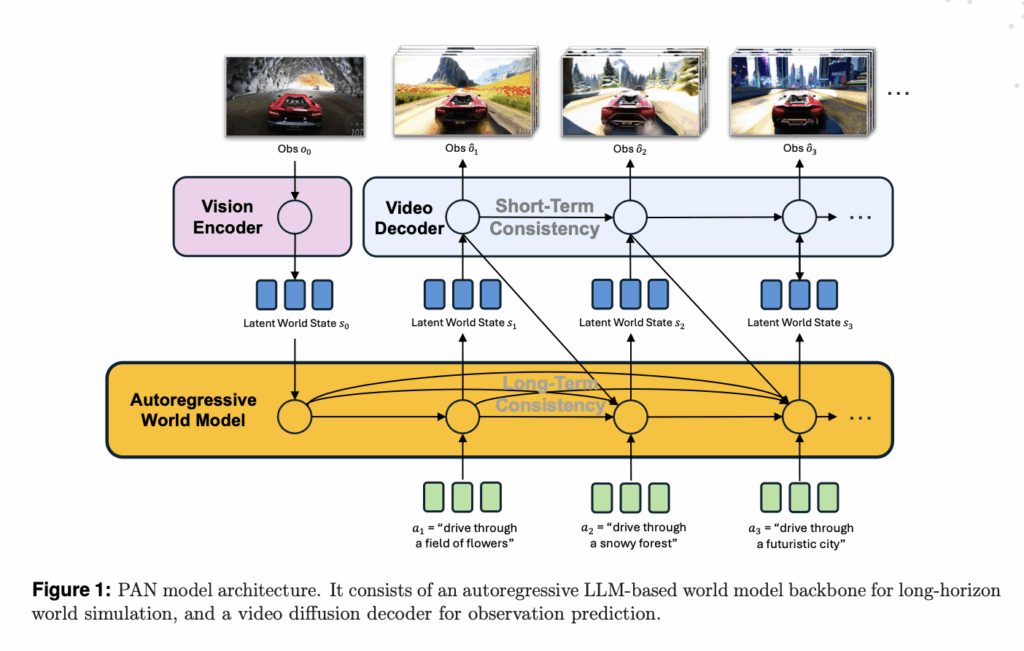
Most text to video models generate a single clip from a prompt and then stop. They do not keep an internal world state that persists as actions arrive over time. PAN, a new model from MBZUAI’s Institute of Foundation Models, is designed to fill that gap by acting as a general world model that predicts future world states as video, conditioned on history and natural language actions. https://arxiv.org/pdf/2511.09057 From video generator to interactive world simulator PAN is defined as a general, interactable, long horizon world model. It maintains an internal latent state that represents the current world, then updates that state when it receives a natural language action such as ‘turn left and speed up’ or ‘move the robot arm to the red block.’ The model then decodes the updated state into a short video segment that shows the consequence of that action. This cycle repeats, so the same world state evolves across many steps. This design allows PAN to support open domain, action conditioned simulation. It can roll out counterfactual futures for different action sequences. An external agent can query PAN as a simulator, compare predicted futures, and choose actions based on those predictions. GLP architecture, separating what happens from how it looks The base of PAN is the Generative Latent Prediction, GLP, architecture. GLP separates world dynamics from visual rendering. First, a vision encoder maps images or video frames into a latent world state. Second, an autoregressive latent dynamics backbone based on a large language model predicts the next latent state, conditioned on history and the current action. Third, a video diffusion decoder reconstructs the corresponding video segment from that latent state. In PAN, the vision encoder and backbone are built on Qwen2.5-VL-7B-Instruct. The vision tower tokenizes frames into patches and produces structured embeddings. The language backbone runs over a history of world states and actions, plus learned query tokens, and outputs the latent representation of the next world state. These latents live in the shared multimodal space of the VLM, which helps ground the dynamics in both text and vision. The video diffusion decoder is adapted from Wan2.1-T2V-14B, a diffusion transformer for high fidelity video generation. The research team trains this decoder with a flow matching objective, using one thousand denoising steps and a Rectified Flow formulation. The decoder conditions on both the predicted latent world state and the current natural language action, with a dedicated cross attention stream for the world state and another for the action text. https://arxiv.org/pdf/2511.09057 Causal Swin DPM and sliding window diffusion Naively chaining single shot video models by conditioning only on the last frame leads to local discontinuities and rapid quality degradation over long rollouts. PAN addresses this with Causal Swin DPM, which augments the Shift Window Denoising Process Model with chunk wise causal attention. The decoder operates on a sliding temporal window that holds two chunks of video frames at different noise levels. During denoising, one chunk moves from high noise to clean frames and then leaves the window. A new noisy chunk enters at the other end. Chunk wise causal attention ensures that the later chunk can only attend to the earlier one, not to unseen future actions. This keeps transitions between chunks smooth and reduces error accumulation over long horizons. PAN also adds controlled noise to the conditioning frame, rather than using a perfectly sharp frame. This suppresses incidental pixel details that do not matter for dynamics and encourages the model to focus on stable structure such as objects and layout. https://arxiv.org/pdf/2511.09057 Training stack and data construction PAN is trained in two stages. In the first stage, the research team adapts Wan2.1 T2V 14B into the Causal Swin DPM architecture. They train the decoder in BFloat16 with AdamW, a cosine schedule, gradient clipping, FlashAttention3 and FlexAttention kernels, and a hybrid sharded data parallel scheme across 960 NVIDIA H200 GPUs. In the second stage, they integrate the frozen Qwen2.5 VL 7B Instruct backbone with the video diffusion decoder under the GLP objective. The vision language model remains frozen. The model learns query embeddings and the decoder so that predicted latents and reconstructed videos stay consistent. This joint training also uses sequence parallelism and Ulysses style attention sharding to handle long context sequences. Early stopping ends training after 1 epoch once validation converges, even though the schedule allows 5 epochs. Training data comes from widely used publicly accessible video sources that cover everyday activities, human object interactions, natural environments, and multi agent scenarios. Long form videos are segmented into coherent clips using shot boundary detection. A filtering pipeline removes static or overly dynamic clips, low aesthetic quality, heavy text overlays, and screen recordings using rule based metrics, pretrained detectors, and a custom VLM filter. The research team then re-captions clips with dense, temporally grounded descriptions that emphasize motion and causal events. Benchmarks, action fidelity, long horizon stability, planning The research team evaluates the model along three axes, action simulation fidelity, long horizon forecast, and simulative reasoning and planning, against both open source and commercial video generators and world models. Baselines include WAN 2.1 and 2.2, Cosmos 1 and 2, V JEPA 2, and commercial systems such as KLING, MiniMax Hailuo, and Gen 3. For action simulation fidelity, a VLM based judge scores how well the model executes language specified actions while maintaining a stable background. PAN reaches 70.3% accuracy on agent simulation and 47% on environment simulation, for an overall score of 58.6%. It achieves the highest fidelity among open source models and surpasses most commercial baselines. For long horizon forecast, the research team measures Transition Smoothness and Simulation Consistency. Transition Smoothness uses optical flow acceleration to quantify how smooth motion is across action boundaries. Simulation Consistency uses metrics inspired by WorldScore to monitor degradation over extended sequences. PAN scores 53.6% on Transition Smoothness and 64.1% on Simulation Consistency and exceeds all baselines, including KLING and MiniMax, on these metrics. For simulative reasoning and planning, PAN is used as an internal simulator inside an OpenAI-o3 based agent loop. In

MBZUAI Researchers Introduce PAN: A General World Model For Interactable Long Horizon Simulation Beitrag lesen »

AI, Committee, Nachrichten, Uncategorized

Cerebras Releases MiniMax-M2-REAP-162B-A10B: A Memory Efficient Version of MiniMax-M2 for Long Context Coding Agents

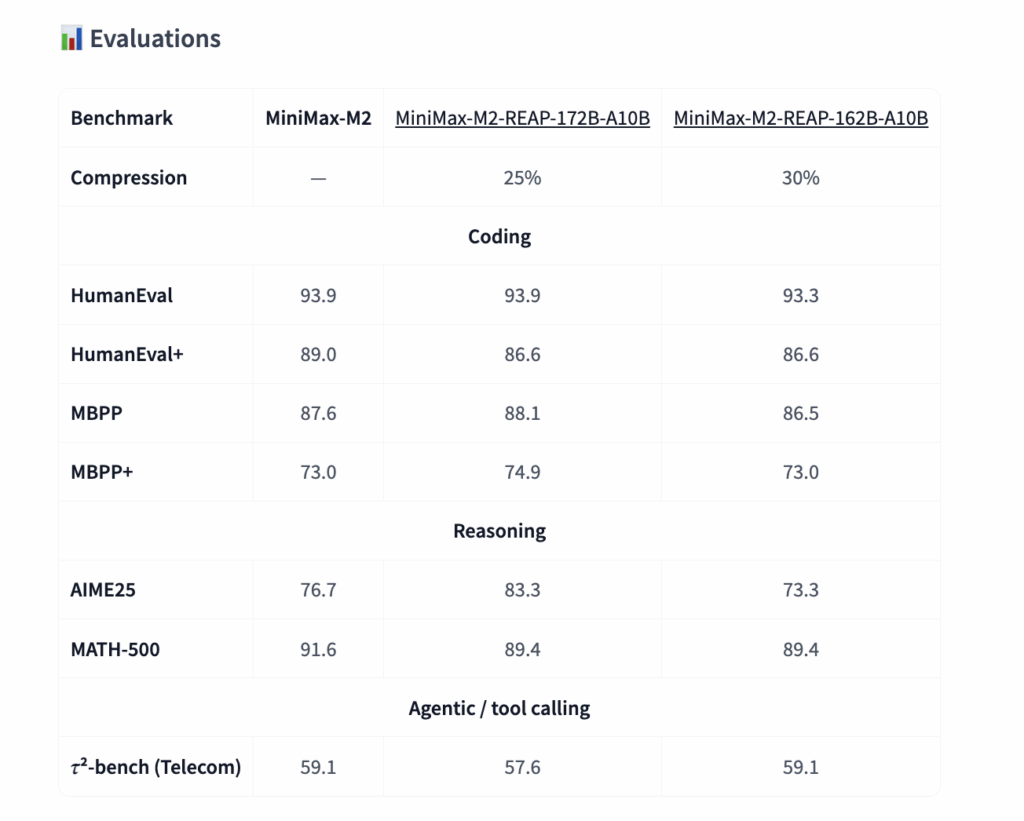
Cerebras has released MiniMax-M2-REAP-162B-A10B, a compressed Sparse Mixture-of-Experts (SMoE) Causal Language Model derived from MiniMax-M2, using the new Router weighted Expert Activation Pruning (REAP) method. The model keeps the behavior of the original 230B total, 10B active MiniMax M2, while pruning experts and reducing memory for deployment focused workloads such as coding agents and tool calling. Architecture and core specifications MiniMax-M2-REAP-162B-A10B has these key properties: Base model: MiniMax-M2 Compression method: REAP, Router weighted Expert Activation Pruning Total parameters: 162B Active parameters per token: 10B Layers: 62 transformer blocks Attention heads per layer: 48 Experts: 180 experts, obtained by pruning a 256 expert configuration Activated experts per token: 8 Context length: 196,608 tokens License: modified MIT, derived from MiniMaxAI MiniMax M2 The SMoE design means that the model stores 162B parameters, but each token only routes through a small set of experts, so the effective compute cost per token is similar to a 10B dense model. MiniMax M2 itself is positioned as an MoE model built for coding and agentic workflows, with 230B total parameters and 10B active, which this checkpoint inherits. How REAP compresses MiniMax-M2? MiniMax-M2-REAP-162B-A10B is created by applying REAP uniformly across all MoE blocks of MiniMax M2, at a 30 percent expert pruning rate. The REAP method defines a saliency score for each expert that combines: Router gate values: How often and how strongly the router selects that expert Expert activation norms: The magnitude of the expert output when active Experts that contribute minimally to the layer output, under this combined criterion, are removed. The remaining experts keep their original weights and the router keeps separate gates for each of them. This is one shot compression, there is no extra fine tuning after pruning in the method definition. A core theoretical result in the REAP’s research paper is that expert merging with summed gates causes functional subspace collapse. When experts are merged, the router loses its independent, input dependent control over those experts, so a single merged expert must approximate an input dependent mixture that was originally expressed through multiple experts. The research team proves that, whenever the router policy depends on the input and the experts are not identical, this introduces irreducible error. In contrast, pruning removes some experts but preserves independent control of the survivors, so the error scales with the gate weight of the removed experts. Across a set of SMoE models in the 20B to 1T parameter range, REAP consistently outperforms expert merging and other pruning criteria on generative benchmarks such as code generation, mathematical reasoning and tool calling, especially at 50 percent compression. Accuracy under 30 percent expert pruning The MiniMax-M2-REAP-162B-A10B model gets compared on three checkpoints on standard coding, reasoning and agentic benchmarks: MiniMax-M2 (230B, base model) MiniMax-M2-REAP-172B-A10B, 25 percent pruning MiniMax-M2-REAP-162B-A10B, 30 percent pruning https://huggingface.co/cerebras/MiniMax-M2-REAP-162B-A10B On coding benchmarks such as HumanEval, HumanEval Plus, MBPP and MBPP Plus, the 162B REAP model stays very close to the base model. HumanEval sits around 90% range, and MBPP stays in the 80% range, with the 172B and 162B models essentially tracking the original MiniMax-M2 within a few points. On reasoning benchmarks such as AIME 25 and MATH 500, there are small shifts between the three models, but there is no collapse at 30 percent pruning and the 162B checkpoint remains competitive with the base model. On tool calling and agentic evaluation, represented by τ2 bench in a telecom setting, the 162B REAP model again matches the base model within small variance. The model card explicitly states that this checkpoint keeps almost identical performance while being about 30 percent lighter in parameter count. These results line up with the broader REAP study, which reports near lossless compression for code generation and tool calling on several large SMoE architectures when pruning experts using the REAP criterion. Deployment, memory usage and observed throughput Cerebras provides a direct vLLM serve example and positions MiniMax-M2-REAP-162B-A10B as a drop in model for the existing MiniMax M2 integration. Copy CodeCopiedUse a different Browser vllm serve cerebras/MiniMax-M2-REAP-162B-A10B –tensor-parallel-size 8 –tool-call-parser minimax_m2 –reasoning-parser minimax_m2_append_think –trust-remote-code –enable_expert_parallel –enable-auto-tool-choice If the run hits memory limits, the card recommends lowering –max-num-seqs, for example to 64, to keep batch size in check on a given GPU. Key Takeaways SMoE architecture with efficient compute: MiniMax-M2-REAP-162B-A10B is a Sparse Mixture of Experts model with 162B total parameters and 10B active parameters per token, so the compute cost per token is close to a 10B dense model while keeping frontier scale capacity. REAP expert pruning keeps behavior of MiniMax-M2: The model is produced by applying REAP Router weighted Expert Activation Pruning to MiniMax-M2 at roughly 30 percent expert pruning, pruning experts based on router gate values and expert activation norms while leaving surviving experts and router structure intact. Near lossless accuracy at 30 percent compression: On coding benchmarks such as HumanEval and MBPP, and on reasoning benchmarks such as AIME25 and MATH 500, the 162B REAP variant tracks the 230B MiniMax-M2 and a 172B REAP variant within a few points, showing near lossless compression for code, reasoning and tool use. Pruning outperforms expert merging for generative SMoE: The REAP study shows that pruning experts using a saliency criterion avoids the functional subspace collapse seen with expert merging in generative tasks, and performs better across large SMoE models in the 22B to about 1T parameter range. Comparison Table Image source: Marktechpost.com Editorial Comments Cerebras’ release of MiniMax-M2-REAP-162B-A10B is a strong signal that Router weighted Expert Activation Pruning is ready for real workloads, not just as a research curiosity. The checkpoint shows that a 30 percent expert pruning schedule can keep MiniMax-M2 230B-A10B behavior almost intact while cutting memory and preserving long context coding, reasoning and tool calling performance, which is exactly what SMoE researchers need for practical deployment. Overall, Cerebras is quietly turning expert pruning into production infrastructure for frontier class SMoE models. Check out the Model Weights. Feel free to check out our GitHub Page for Tutorials, Codes and Notebooks. Also, feel free to follow us on Twitter and don’t forget to join our 100k+ ML SubReddit and

Cerebras Releases MiniMax-M2-REAP-162B-A10B: A Memory Efficient Version of MiniMax-M2 for Long Context Coding Agents Beitrag lesen »

AI, Committee, Nachrichten, Uncategorized

Google’s new AI training method helps small models tackle complex reasoning

Researchers at Google Cloud and UCLA have proposed a new reinforcement learning framework that significantly improves the ability of language models to learn very challenging multi-step reasoning tasks. Supervised Reinforcement Learning (SRL) reformulates problem-solving as a sequence of logical “actions,” providing rich learning signals during the training process. This approach enables smaller models to learn complex problems that were previously out of reach for other common training techniques. Experiments show that SRL not only excels on math reasoning benchmarks but also generalizes effectively to agentic software engineering tasks. SRL is a versatile training framework that can elevate smaller and less expensive models to higher reasoning abilities. The limits of current LLM reasoning training Recent advances in training large language models (LLMs) for reasoning have largely been driven by reinforcement learning with verifiable rewards (RLVR), a method where a model is rewarded based on the correctness of its final answer. By repeatedly trying to solve problems and getting feedback on the final outcome, the model gradually learns effective problem-solving strategies.  However, the success of this outcome-based approach depends on the model’s ability to discover a correct solution within a limited number of attempts, or “rollouts.” Since each rollout is computationally expensive, models can’t try indefinitely. This method hits a wall when problems are so difficult that the model rarely, if ever, finds the right answer within its budget. This creates a critical learning bottleneck. In many multi-step reasoning problems, a model might correctly solve several steps but get derailed by a single mistake, leading to an incorrect answer. With RLVR, this entire effort receives a negative reward, and the model learns nothing from its partially correct work. It’s an all-or-nothing approach that fails to provide granular feedback and provides sparse rewards. An alternative method is supervised fine-tuning (SFT), where the model learns from examples containing the full reasoning process laid out by experts. While SFT can instill reasoning abilities, it often leads to overfitting (the model simply learns to imitate the trajectories in the training data instead of learning to generalize to problems beyond the examples it has seen). This issue is made worse by the fact that high-quality, human-created training data is both scarce and expensive to produce. As the paper notes, these limitations leave “a critical gap for training small open-source models to effectively learn difficult problems.” How supervised reinforcement learning works SRL introduces a framework that reformulates problem-solving as a “sequential decision-making process,” striking a balance between pure outcome-based RL and pure imitation learning. Instead of optimizing only for the final answer or forcing the model to imitate an expert’s entire thought process, SRL teaches the model to reproduce a sequence of key actions that form the backbone of expert reasoning. This allows the model to learn to take actions similar to an expert while developing its own internal reasoning style. In the SRL framework, expert demonstrations are broken down into a series of intermediate, concrete actions, each representing a meaningful step. For a math problem, an action might be an algebraic manipulation. For a software engineering agent, it could be a command executed in a code repository. To generate training data, SRL uses a powerful teacher model to create solution trajectories, which are then used to train a smaller model. According to I-Hung Hsu, a research scientist at Google and co-author of the paper, this middle-ground approach is key to its effectiveness in real-world scenarios. “SRL sits in the middle: It captures the structured flexibility of real-world problem solving, where there are multiple valid strategies but also clear notions of what ‘good reasoning’ looks like at each step,” Hsu told VentureBeat. “This makes SRL suitable for domains like data science automation or probably supply chain optimization — tasks that reward sound intermediate reasoning rather than mere final answers.” During training, the model first generates an “inner monologue” (its internal reasoning process, enclosed in <think> tags) before committing to an action. At each step, SRL provides a reward based on the similarity between the model’s predicted action and the expert’s action. This step-wise reward system provides dense, fine-grained feedback, allowing the model to learn and improve even if its overall solution isn’t perfect. This solves the sparse reward problem RLVR faces. SRL in action The researchers’ experiments show that SRL significantly outperforms strong baselines in both challenging mathematical reasoning and agentic software engineering benchmarks. They also observed that SRL encourages more flexible and sophisticated reasoning patterns in models, such as interleaved planning and self-verification, which improve solution quality without just making the outputs longer. For enterprise leaders, performance gains are only valuable if they don’t come with runaway costs. Hsu clarifies that SRL-trained models are more efficient in their reasoning. “The gains come from better reasoning quality and structure, not from verbosity,” he said. “In terms of efficiency, SRL-trained models are roughly on par with the base model in token usage… while SRL isn’t designed to reduce inference cost, it achieves stronger reasoning performance without increasing it.” For the math tests, the team fine-tuned Qwen2.5-7B-Instruct on a dataset of 1,000 difficult math questions. They compared its performance against models trained with SFT and RLVR (using the GRPO algorithm common in models like DeepSeek-R1) on four competition-level math benchmarks. The SRL-trained model achieved a substantial 3.0% average performance boost over other methods.  The team extended SRL to agentic software engineering, a domain critical for enterprise automation. They trained a coding-specialized model, Qwen2.5-Coder-7B-Instruct, on 5,000 expert trajectories of agents interacting with a coding environment. The SRL-trained model was benchmarked against the original base model and SWE-Gym-7B, a strong baseline fine-tuned with SFT. SRL achieved a 14.8% task resolve rate, representing a 74% relative improvement over the SFT-based model. This shows SRL’s ability to train more competent AI agents for complex, real-world programming tasks. A new standard for high-stakes AI? The paper’s strongest results came from combining methods: First, using SRL to teach foundational reasoning, then using RLVR to refine that skill. In their experiments, when the researchers used SRL

Google’s new AI training method helps small models tackle complex reasoning Beitrag lesen »

AI, Committee, Nachrichten, Uncategorized

ChatGPT Group Chats are here … but not for everyone (yet)

It was originally found in leaked code and publicized by AI influencers on X, but OpenAI has made it official: ChatGPT now offers Group Chats, allowing multiple users to join the same, single ChatGPT conversation and send messages to each other and the underlying large language model (LLM), online and via its mobile apps. Imagine adding ChatGPT as another member of your existing group chats, allowing you to text it as you would one of your friends or family members and have them respond as well, and you’ll have an idea of the intriguing power and potential of this feature. However, the feature is only available as a limited pilot for now to ChatGPT users in Japan, New Zealand, South Korea, and Taiwan (all tiers, including free usage). “Group chats are just the beginning of ChatGPT becoming a shared space to collaborate and interact with others,” OpenAI wrote in its announcement. This development builds on internal experimentation at OpenAI, where technical staffer Keyan Zhang said in a post on X that OpenAI’s team initially considered multiplayer ChatGPT to be “a wild, out-of-distribution idea.” According to Zhang, the model’s performance in those early tests demonstrated far more potential than existing interfaces typically allow. The move follows OpenAI investor yet competitor Microsoft’s update of its Copilot AI assistant to allow group chats last month, as well as Anthropic’s introduction of shareable context and chat histories from its Claude AI models through its Projects feature introduced summer 2024, though this is not a simultaneous, realtime group chat in the same way. Collaborative functionality integrated into ChatGPT Group chats function as shared conversational spaces where users can plan events, brainstorm ideas, or collaborate on projects with the added support of ChatGPT. These conversations are distinct from individual chats and are excluded from ChatGPT’s memory system—meaning no data from these group threads is used to train or personalize future interactions. Users can initiate a group chat by selecting the people icon in a new or existing conversation. Adding others creates a copy of the original thread, preserving the source dialogue. Participants can join via a shareable link and are prompted to create a profile with a name, username, and photo. The feature supports 1 to 20 participants per group. Each group chat is listed in a new section of the ChatGPT interface, and users can manage settings like naming the group, adding or removing participants, or muting notifications. Powered by GPT-5.1 with expanded tools The new group chat feature runs on GPT-5.1 Auto, a backend setting that chooses the optimal model based on the user’s subscription tier and the prompt. Functionality such as search, image generation, file upload, and dictation is available inside group conversations. Importantly, the system applies rate limits only when ChatGPT is producing responses. Direct messages between human users in the group do not count toward any plan’s message cap. OpenAI has added new social features to ChatGPT in support of this group dynamic. The model can react with emojis, interpret conversational context to decide when to respond, and personalize generated content using members’ profile photos—such as inserting user likenesses into images when asked. Privacy by default, controls for younger users OpenAI emphasized that privacy and user control are integral to group chat design. The feature operates independently of the user’s personalized ChatGPT memory, and no new memories are created from these interactions. Participation requires an invitation link, and members are always able to see who is in a chat or leave at any time. Users under the age of 18 are automatically shielded from sensitive content in group chats. Parents or guardians can disable group chat access altogether via built-in parental controls. Group creators retain special permissions, including immunity from being removed by others. All other participants can be added or removed by group members. A testbed for shared AI experiences OpenAI frames group chats as an early step toward richer, multi-user applications of AI, hinting at broader ambitions for ChatGPT as a shared workspace. The company expects to expand access over time and refine the feature based on how early users engage with it. Keyan Zhang’s post suggests that the underlying model capabilities are far ahead of the interfaces users currently interact with. This pilot, in OpenAI’s view, offers a new “container” where more of the model’s latent capacity can be surfaced. “Our models have a lot more room to shine than today’s experiences show, and the current containers only use a fraction of their capabilities,” Zhang said. With this initial pilot focused on a limited set of markets, OpenAI is likely monitoring both usage patterns and cultural fit as it plans for broader deployment. For now, the group chat experiment offers a new way for users to interact with ChatGPT—and with each other—in real time, using a conversational interface that blends productivity and personalization. Developer access: Still unclear OpenAI has not provided any indication that Group Chats will be accessible via the API or SDK. The current rollout is framed strictly within the ChatGPT product environment, with no mention of tool calls, developer hooks, or integration support for programmatic use. This absence of signaling leaves it unclear whether the company views group interaction as a future developer primitive or as a contained UX feature for end users only. For enterprise teams exploring how to replicate multi-user collaboration with generative models, any current implementation would require custom orchestration—such as managing multi-party context and prompts across separate API calls, and handling session state and response merging externally. Until OpenAI provides formal support, Group Chats remain a closed interface feature rather than a developer-accessible capability. Here is a standalone concluding subsection tailored for the article, focusing on what the ChatGPT Group Chat rollout means for enterprise decision makers in both pilot regions and globally: Implications for enterprise AI and data leaders For enterprise teams already leveraging AI platforms—or preparing to—OpenAI’s group chat feature introduces a new layer of multi-user collaboration that could shift how generative models are deployed across workflows. While

ChatGPT Group Chats are here … but not for everyone (yet) Beitrag lesen »

We use cookies to improve your experience and performance on our website. You can learn more at Datenschutzrichtlinie and manage your privacy settings by clicking Settings.

Privacy Preferences

You can choose your cookie settings by turning on/off each type of cookie as you wish, except for essential cookies.

Allow All
Manage Consent Preferences
  • Always Active

Save
de_DE