YouZum

Committee

AI, Committee, Nachrichten, Uncategorized

AWED-FiNER: Agents, Web applications, and Expert Detectors for Fine-grained Named Entity Recognition across 36 Languages for 6.6 Billion Speakers

arXiv:2601.10161v2 Announce Type: replace Abstract: Named Entity Recognition (NER) is a foundational task in Natural Language Processing (NLP) and Information Retrieval (IR), which facilitates semantic search and structured data extraction. We introduce textbf{AWED-FiNER}, an open-source collection of agentic tool, web application, and 53 state-of-the-art expert models that provide Fine-grained Named Entity Recognition (FgNER) solutions across 36 languages spoken by more than 6.6 billion people. The agentic tool enables routing multilingual text to specialized expert models to fetch FgNER annotations within seconds. The web-based platform provides a ready-to-use FgNER annotation service for non-technical users. Moreover, the collection of language-specific extremely small open-source state-of-the-art expert models facilitates offline deployment in resource-constrained scenarios, including edge devices. AWED-FiNER covers languages spoken by over 6.6 billion people, ranging from global languages like English, Chinese, Spanish, and Hindi, to low-resource languages like Assamese, Santali, and Odia, along with a specific focus on extremely low-resource vulnerable languages such as Bodo, Manipuri, Bishnupriya, and Mizo. The resources can be accessed here: Agentic Tool (https://github.com/PrachuryyaKaushik/AWED-FiNER), Web Application (https://hf.co/spaces/prachuryyaIITG/AWED-FiNER), and 53 Expert Detector Models (https://hf.co/collections/prachuryyaIITG/awed-finer).

AWED-FiNER: Agents, Web applications, and Expert Detectors for Fine-grained Named Entity Recognition across 36 Languages for 6.6 Billion Speakers Beitrag lesen »

AI, Committee, Nachrichten, Uncategorized

One Token Is Enough: Improving Diffusion Language Models with a Sink Token

arXiv:2601.19657v3 Announce Type: replace Abstract: Diffusion Language Models (DLMs) have emerged as a compelling alternative to autoregressive approaches, enabling parallel text generation with competitive performance. Despite these advantages, there is a critical instability in DLMs: the moving sink phenomenon. Our analysis indicates that sink tokens exhibit low-norm representations in the Transformer’s value space, and that the moving sink phenomenon serves as a protective mechanism in DLMs to prevent excessive information mixing. However, their unpredictable positions across diffusion steps undermine inference robustness. To resolve this, we propose a simple but effective extra sink token implemented via a modified attention mask. Specifically, we introduce a special token constrained to attend solely to itself, while remaining globally visible to all other tokens. Experimental results demonstrate that introducing a single extra token stabilizes attention sinks, substantially improving model performance. Crucially, further analysis confirms that the effectiveness of this token is independent of its position and characterized by negligible semantic content, validating its role as a robust and dedicated structural sink.

One Token Is Enough: Improving Diffusion Language Models with a Sink Token Beitrag lesen »

AI, Committee, Nachrichten, Uncategorized

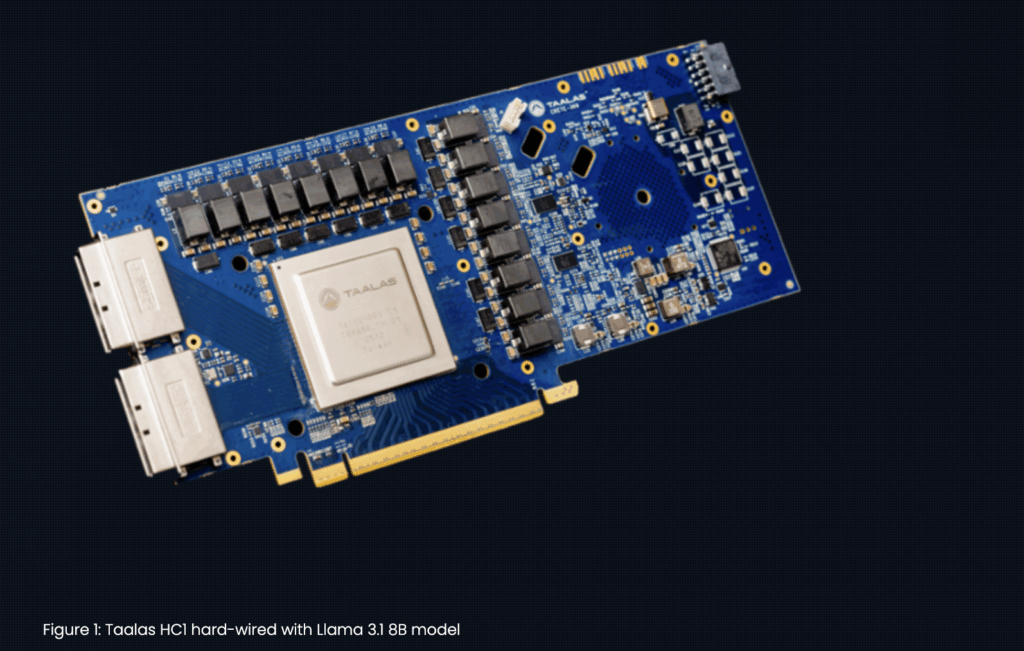
Taalas is replacing programmable GPUs with hardwired AI chips to achieve 17,000 tokens per second for ubiquitous inference

In the high-stakes world of AI infrastructure, the industry has operated under a singular assumption: flexibility is king. We build general-purpose GPUs because AI models change every week, and we need programmable silicon that can adapt to the next research breakthrough. But Taalas, the Toronto-based startup thinks that flexibility is exactly what’s holding AI back. According to Taalas team, if we want AI to be as common and cheap as plastic, we have to stop ‘simulating’ intelligence on general-purpose computers and start ‘casting’ it directly into silicon. The Problem: The ‘Memory Wall’ and the GPU Tax The current cost of running a Large Language Model (LLM) is driven by a physical bottleneck: the Memory Wall. Traditional processors (GPUs) are ‘Instruction Set Architecture’ (ISA) based. They separate compute and memory. When you run an inference pass on a model like Llama-3, the chip spends the vast majority of its time and energy shuttling weights from High Bandwidth Memory (HBM) to the processing cores. This ‘data movement tax’ accounts for nearly 90% of the power consumption in modern AI data centers. Taalas’s solution is radical: eliminate the memory-fetch cycle. By using a proprietary automated design flow, Taalas translates the computational graph of a specific model directly into the physical layout of a chip. In their HC1 (Hardcore 1) chip, the model’s weights and architecture are literally etched into the wiring of the silicon. https://taalas.com/the-path-to-ubiquitous-ai/ Hardcore Models: 17,000 Tokens Per Second The results of this ‘direct-to-silicon’ approach redefine the performance ceiling for inference. At their latest unveiling, Taalas demonstrated the HC1 running a Llama 3.1 8B model. While a top-tier NVIDIA H100 might serve a single user at ~150 tokens per second, the HC1 serves a staggering 16,000 to 17,000 tokens per second. This changes the ‘unit economics’ of AI: Performance: A single HC1 chip can outperform a small GPU data center in terms of raw throughput for a specific model. Efficiency: Taalas claims a 1000x improvement in efficiency (performance-per-watt and performance-per-dollar) compared to conventional chips. Infrastructure: Because the weights are hardwired, there is no need for external HBM or complex liquid cooling systems. A standard air-cooled rack can house ten of these 250W cards, delivering the power of an entire GPU cluster in a single server box. Breaking the 60-Day Barrier: The Automated Foundry The obvious ‘catch’ for an AI developer is flexibility. If you hardwire a model into a chip today, what happens when a better model comes out tomorrow? Historically, designing an ASIC (Application-Specific Integrated Circuit) took two years and tens of millions of dollars. Taalas has solved this through automation. They have built a compiler-like foundry system that takes model weights and generates a chip design in roughly a week. By focusing on a streamlined manufacturing workflow—where they only change the top metal masks of the silicon—they have collapsed the turnaround time from ‘weights-to-silicon’ to just two months. This allows for a ‘seasonal’ hardware cycle. A company could fine-tune a frontier model in the spring and have thousands of specialized, hyper-efficient inference chips deployed by summer. https://taalas.com/the-path-to-ubiquitous-ai/ The Market Shift: From Shovels to Stamps This transition marks a pivotal moment in the AI hype cycle. We are moving from the ‘Research & Training’ phase—where GPUs are essential for their flexibility—to the ‘Deployment & Inference’ phase, where cost-per-token is the only metric that matters. If Taalas succeeds, the AI market will split into two distinct tiers: General-Purpose Training: Led by NVIDIA and AMD, providing the massive, flexible clusters needed to discover and train new architectures. Specialized Inference: Led by ‘foundries’ like Taalas, which take those proven architectures and ‘print’ them into cheap, ubiquitous silicon for everything from smartphones to industrial sensors. Key Takeaways The ‘Hardwired’ Paradigm Shift: Taalas is moving from software-defined AI (running models on general-purpose GPUs) to hardware-defined AI. By ‘baking’ a specific model’s weights and architecture directly into the silicon, they eliminate the need for traditional instruction-set overhead, effectively making the model the processor itself. Death of the Memory Wall: Traditional AI hardware wastes ~90% of its energy moving data between memory and compute. Taalas’s HC1 (Hardcore 1) chip eliminates the “Memory Wall” by physically wiring the model parameters into the chip’s metal layers, removing the need for expensive High Bandwidth Memory (HBM). 1000x Efficiency Leap: By stripping away the ‘programmability tax’, Taalas claims a 1,000x improvement in performance-per-watt and performance-per-dollar. In practice, this means an HC1 can hit 17,000 tokens per second on a Llama 3.1 8B model—massively outperforming a standard GPU rack while using far less power. Automated ‘Direct-to-Silicon’ Foundry: To solve the problem of model obsolescence, Taalas uses a proprietary automated design flow. This reduces the time to create a custom AI chip from years to just weeks, allowing companies to ‘print’ their fine-tuned models into silicon on a seasonal basis. The Commodity AI Future: This technology signals a shift from ‘Cloud-First’ to ‘Device-Native’ AI. As inference becomes a cheap, hardwired commodity, AI will move off centralized servers and into local, low-power hardware—ranging from smartphones to industrial sensors—with zero latency and no subscription costs. Check out the Technical details. Also, feel free to follow us on Twitter and don’t forget to join our 100k+ ML SubReddit and Subscribe to our Newsletter. Wait! are you on telegram? now you can join us on telegram as well. The post Taalas is replacing programmable GPUs with hardwired AI chips to achieve 17,000 tokens per second for ubiquitous inference appeared first on MarkTechPost.

Taalas is replacing programmable GPUs with hardwired AI chips to achieve 17,000 tokens per second for ubiquitous inference Beitrag lesen »

AI, Committee, Nachrichten, Uncategorized

Inside Chicago’s surveillance panopticon

Early on the morning of September 2, 2024, a Chicago Transit Authority Blue Line train was the scene of a random and horrific mass shooting. Four people were shot and killed on a westbound train as it approached the suburb of Forest Park.  The police swiftly activated a digital dragnet—a surveillance network that connects thousands of cameras in the city.  The process began with a quick review of the transit agency’s surveillance cameras, which captured the alleged gunman shooting the victims execution style. Law enforcement followed the suspect, through real-time footage, across the rapid-­transit system. Police officials circulated the images to transit staff and to thousands of officers. An officer in the adjacent suburb of Riverdale recognized the suspect from a previous arrest. By the time he was captured at another train station, just 90 minutes after the shooting, authorities already had his name, address, and previous arrest history. Little of this process would come as much surprise to Chicagoans. The city has tens of thousands of surveillance cameras—up to 45,000, by some estimates. That’s among the highest numbers per capita in the US. Chicago boasts one of the largest license plate reader systems in the country, and the ability to access audio and video surveillance from independent agencies such as the Chicago Public Schools, the Chicago Park District, and the public transportation system as well as many residential and commercial security systems such as Ring doorbell cameras.  Law enforcement and security advocates say this vast monitoring system protects public safety and works well. But activists and many residents say it’s a surveillance panopticon that creates a chilling effect on behavior and violates guarantees of privacy and free speech.  Black and Latino communities in Chicago have historically been targeted by excessive policing and surveillance, says Lance Williams, a scholar of urban violence at Northeastern Illinois University. That scrutiny has created new problems without delivering the promised safety, he suggests. In order to “solve the problem of crime or violence and make these communities safer,” he says, “you have to deal with structural problems,” such as the shortage of livable-wage jobs, affordable housing, and mental-health services across the city. Recent years have seen some effective pushback against the surveillance. Until recently, for example, the city was the largest customer of ShotSpotter acoustic sensors, which are designed to detect gunfire and alert police. The system was introduced in a small area on the South Side in 2012. By 2018, an area of about 136 square miles—some 60% of the city—was covered by the acoustic surveillance network. Critics questioned ShotSpotter’s effectiveness and objected that the sensors were installed largely in Black and Latino neighborhoods. Those critiques gained urgency with the fatal shooting in March 2021 of a 13-year-old, Adam Toledo, by police responding to a ShotSpotter alert. The tragedy became the touchstone of the #StopShotSpotter protest movement and one of the major issues in Brandon Johnson’s successful mayoral campaign in 2023. When he reached office, Johnson followed through, ending the city’s contract with SoundThinking, the San Francisco Bay Area company behind ShotSpotter. In total, it’s estimated the city paid more than $53 million for the system.  In response to a request for comment, SoundThinking said that ShotSpotter enables law enforcement “to reach the scene faster, render aid to victims, and locate evidence more effectively.” It stated the company “plays no part in the selection of deployment areas” but added: “We believe communities experiencing the highest levels of gun violence deserve the same rapid emergency response as any other neighborhood.”  While there has been successful resistance to police surveillance in the nation’s third-largest city, there are also countervailing forces: governments and officials in Chicago and the surrounding suburbs are moving to expand the use of surveillance, also in response to public pressure. Even the victory against acoustic surveillance might be short-lived. Early last year, the city issued a request for proposals for gun violence detection technology.  Many people in and around Chicago—digital privacy and surveillance activists, defense attorneys, law enforcement officials, and ordinary citizens—are part of this push and pull. Here are some of their stories.  Alejandro Ruizesparza and Freddy MartinezCofounders, Lucy Parsons Labs Oak Park, a quiet suburb at Chicago’s western border, is the birthplace of Ernest Hemingway. It includes the world’s largest collection of Frank Lloyd Wright–designed buildings and homes.  Until recently, the village of Oak Park was also the center of a three-year-long campaign against an unwelcome addition to its manicured lawns and Prairie-style architecture: automated license plate readers from a company called Flock Safety. These are high-speed cameras that automatically scan license plates to look for stolen or wanted vehicles, or for drivers with outstanding warrants.  Freddy Martinez (left) and Alejandro Ruizesparza (right) direct Lucy Parsons Labs, a charitable organization focused on digital rights.AKILAH TOWNSEND An Oak Park group called Freedom to Thrive—made up of parents, activists, lawyers, data scientists, and many others—suspected that this technology was not a good or equitable addition to their neighborhood. So the group engaged the Chicago-based nonprofit Lucy Parsons Labs to help navigate the often intimidating process of requesting license plate reader data under the Illinois Freedom of Information Act. Lucy Parsons Labs, which is named for a turn-of-the-century Chicago labor organizer, investigates technologies such as license plate readers, gunshot detection systems, and police bodycams.  LPL provides digital security and public records training to a variety of groups and is frequently called on to help community members audit and analyze surveillance systems that are targeting their neighborhoods. It’s led by two first-­generation Mexican-Americans from the city’s Southwest Side. Alejandro Ruizesparza has a background in community organizing and data science. Freddy Martinez was also a community organizer and has a background in physics.  The group is now approaching its 10th year, but it was an all-volunteer effort until 2022. That’s when LPL received its first unrestricted, multi-year operational grant from a large foundation: the Chicago-based John D. and Catherine T. MacArthur Foundation, known worldwide for its so-called “genius grants.” A grant from the Ford Foundation

Inside Chicago’s surveillance panopticon Beitrag lesen »

AI, Committee, Nachrichten, Uncategorized

Is There a Community Edition of Palantir? Meet OpenPlanter: An Open Source Recursive AI Agent for Your Micro Surveillance Use Cases

The balance of power in the digital age is shifting. While governments and large corporations have long used data to track individuals, a new open-source project called OpenPlanter is giving that power back to the public. Created by a developer ‘Shin Megami Boson‘, OpenPlanter is a recursive-language-model investigation agent. Its goal is simple: help you keep tabs on your government, since they are almost certainly keeping tabs on you. Solving the ‘Heterogeneous Data’ Problem Investigative work is difficult because data is messy. Public records are often spread across 100 different formats. You might have a CSV of campaign finance records, a JSON file of government contracts, and a PDF of lobbying disclosures. OpenPlanter ingests these disparate structured and unstructured data sources effortlessly. It uses Large Language Models (LLMs) to perform entity resolution. This is the process of identifying when different records refer to the same person or company. Once it connects these dots, the agent probabilistically looks for anomalies. It searches for patterns that a human might miss, such as a sudden spike in contract wins following a specific lobbying event. The Architecture: Recursive Sub-Agent Delegation What makes OpenPlanter unique is its recursive engine. Most AI agents handle 1 request at a time. OpenPlanter, however, breaks large objectives into smaller pieces. If you give it a massive task, it uses a sub-agent delegation strategy. The agent has a default max-depth of 4. This means the main agent can spawn a sub-agent, which can spawn another, and so on. These agents work in parallel to: Resolve entities across massive datasets. Link datasets that have no common ID numbers. Construct evidence chains that back up every single finding. This recursive approach allows the system to handle investigations that are too large for a single ‘context window.’ The 2026 AI Stack OpenPlanter is built for the high-performance requirements of 2026. It is written in Python 3.10+ and integrates with the most advanced models available today. The technical documentation lists several supported providers: OpenAI: It uses gpt-5.2 as the default. Anthropic: It supports claude-opus-4-6. OpenRouter: It defaults to anthropic/claude-sonnet-4-5. Cerebras: It uses qwen-3-235b-a22b-instruct-2507 for high-speed tasks. The system also uses Exa for web searches and Voyage for high-accuracy embeddings. This multi-model strategy ensures that the agent uses the best ‘brain’ for each specific sub-task. 19 Tools for Digital Forensics The agent is equipped with 19 specialized tools. These tools allow it to interact with the real world rather than just ‘chatting.’ These are organized into 4 core areas: File I/O and Workspace: Tools like read_file, write_file, and hashline_edit allow the agent to manage its own database of findings. Shell Execution: The agent can use run_shell to execute actual code. It can write a Python script to analyze a dataset and then run that script to get results. Web Retrieval: With web_search and fetch_url, it can pull live data from government registries or news sites. Planning and Logic: The think tool lets the agent pause and strategize. It uses acceptance-criteria to verify that a sub-task was completed correctly before moving to the next step. Deployment and Interface OpenPlanter is designed to be accessible but powerful. It features a Terminal User Interface (TUI) built with rich and prompt_toolkit. The interface includes a splash art screen of ASCII potted plants, but the work it does is serious. You can get started quickly using Docker. By running docker compose up, the agent starts in a container. This is a critical security feature because it isolates the agent’s run_shell commands from the user’s host operating system. The command-line interface allows for ‘headless’ tasks. You can run a single command like: Copy CodeCopiedUse a different Browser openplanter-agent –task “Flag all vendor overlaps in lobbying data” –workspace ./data The agent will then work autonomously until it produces a final report. Key Takeaways Autonomous Recursive Logic: Unlike standard agents, OpenPlanter uses a recursive sub-agent delegation strategy (default max-depth of 4). It breaks complex investigative objectives into smaller sub-tasks, parallelizing work across multiple agents to build detailed evidence chains. Heterogeneous Data Correlation: The agent is built to ingest and resolve disparate structured and unstructured data. It can simultaneously process CSV files, JSON records, and unstructured text (like PDFs) to identify entities across fragmented datasets. Probabilistic Anomaly Detection: By performing entity resolution, OpenPlanter automatically connects records—such as matching a corporate alias to a lobbying disclosure—and looks for probabilistic anomalies to surface hidden connections between government spending and private interests. High-End 2026 Model Stack: The system is provider-agnostic and utilizes the latest frontier models, including OpenAI gpt-5.2, Anthropic claude-opus-4-6, and Cerebras qwen-3-235b-a22b-instruct-2507 for high-speed inference. Integrated Toolset for Forensics: OpenPlanter features 19 distinct tools, including shell execution (run_shell), web search (Exa), and file patching (hashline_edit). This allows it to write and run its own analysis scripts while verifying results against real-world acceptance criteria. Check out the Repo here. Also, feel free to follow us on Twitter and don’t forget to join our 100k+ ML SubReddit and Subscribe to our Newsletter. Wait! are you on telegram? now you can join us on telegram as well. Disclaimer: MarkTechPost does not endorse the OpenPlanter project and provides this technical report for informational purposes only. The post Is There a Community Edition of Palantir? Meet OpenPlanter: An Open Source Recursive AI Agent for Your Micro Surveillance Use Cases appeared first on MarkTechPost.

Is There a Community Edition of Palantir? Meet OpenPlanter: An Open Source Recursive AI Agent for Your Micro Surveillance Use Cases Beitrag lesen »

AI, Committee, Nachrichten, Uncategorized

A New Google AI Research Proposes Deep-Thinking Ratio to Improve LLM Accuracy While Cutting Total Inference Costs by Half

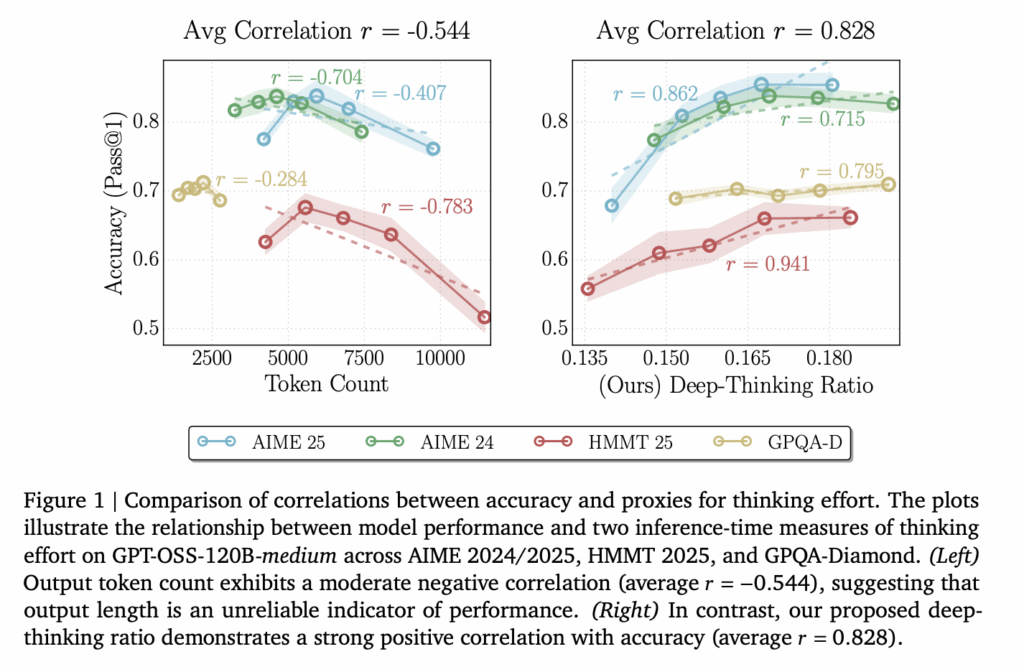
For the last few years, the AI world has followed a simple rule: if you want a Large Language Model (LLM) to solve a harder problem, make its Chain-of-Thought (CoT) longer. But new research from the University of Virginia and Google proves that ‘thinking long’ is not the same as ‘thinking hard’. The research team reveals that simply adding more tokens to a response can actually make an AI less accurate. Instead of counting words, the Google researchers introduce a new measurement: the Deep-Thinking Ratio (DTR). https://arxiv.org/pdf/2602.13517 The Failure of ‘Token Maxing‘ Engineers often use token count as a proxy for the effort an AI puts into a task. However, the researchers found that raw token count has an average correlation of r= -0.59 with accuracy. This negative number means that as the model generates more text, it is more likely to be wrong. This happens because of ‘overthinking,’ where the model gets stuck in loops, repeats redundant steps, or amplifies its own mistakes. Relying on length alone wastes expensive compute on uninformative tokens. What are Deep-Thinking Tokens? The research team argued that real ‘thinking’ happens inside the layers of the model, not just in the final output. When a model predicts a token, it processes data through a series of transformer layers (L). Shallow Tokens: For easy words, the model’s prediction stabilizes early. The ‘guess’ doesn’t change much from layer 5 to layer 36. Deep-Thinking Tokens: For difficult logic or math symbols, the prediction shifts significantly in the deeper layers. How to Measure Depth To identify these tokens, the research team uses a technique to peek at the model’s internal ‘drafts’ at every layer. They project the intermediate hidden states (htl) into the vocabulary space using the model’s unembedding matrix (WU). This produces a probability distribution (pt,l) for every layer. They then calculate the Jensen-Shannon Divergence (JSD) between the intermediate layer distribution and the final layer distribution (pt,L): Dt,l := JSD(pt,L || pt,l) A token is a deep-thinking token if its prediction only settles in the ‘late regime’—defined by a depth fraction (⍴). In their tests, they set ⍴= 0.85, meaning the token only stabilized in the final 15% of the layers. The Deep-Thinking Ratio (DTR) is the percentage of these ‘hard’ tokens in a full sequence. Across models like DeepSeek-R1-70B, Qwen3-30B-Thinking, and GPT-OSS-120B, DTR showed a strong average positive correlation of r = 0.683 with accuracy. https://arxiv.org/pdf/2602.13517 Think@n: Better Accuracy at 50% the Cost The research team used this innovative approach to create Think@n, a new way to scale AI performance during inference. Most devs use Self-Consistency (Cons@n), where they sample 48 different answers and use majority voting to pick the best one. This is very expensive because you have to generate every single token for every answer. Think@n changes the game by using ‘early halting’: The model starts generating multiple candidate answers. After just 50 prefix tokens, the system calculates the DTR for each candidate. It immediately stops generating the ‘unpromising’ candidates with low DTR. It only finishes the candidates with high deep-thinking scores. The Results on AIME 2025 Method Accuracy Avg. Cost (k tokens) Cons@n (Majority Vote) 92.7% 307.6 Think@n (DTR-based Selection) 94.7% 155.4 On the AIME 25 math benchmark, Think@n achieved higher accuracy than standard voting while reducing the inference cost by 49%. Key Takeaways Token count is a poor predictor of accuracy: Raw output length has an average negative correlation (r = -0.59) with performance, meaning longer reasoning traces often signal ‘overthinking’ rather than higher quality. Deep-thinking tokens define true effort: Unlike simple tokens that stabilize in early layers, deep-thinking tokens are those whose internal predictions undergo significant revision in deeper model layers before converging. The Deep-Thinking Ratio (DTR) is a superior metric: DTR measures the proportion of deep-thinking tokens in a sequence and exhibits a robust positive correlation with accuracy (average r = 0.683), consistently outperforming length-based or confidence-based baselines. Think@n enables efficient test-time scaling: By prioritizing and finishing only the samples with high deep-thinking ratios, the Think@n strategy matches or exceeds the performance of standard majority voting (Cons@n). Massive cost reduction via early halting: Because DTR can be estimated from a short prefix of just 50 tokens, unpromising generations can be rejected early, reducing total inference costs by approximately 50%. Check out the Paper. Also, feel free to follow us on Twitter and don’t forget to join our 100k+ ML SubReddit and Subscribe to our Newsletter. Wait! are you on telegram? now you can join us on telegram as well. The post A New Google AI Research Proposes Deep-Thinking Ratio to Improve LLM Accuracy While Cutting Total Inference Costs by Half appeared first on MarkTechPost.

A New Google AI Research Proposes Deep-Thinking Ratio to Improve LLM Accuracy While Cutting Total Inference Costs by Half Beitrag lesen »

AI, Committee, Nachrichten, Uncategorized

Exclusive eBook: The great Al hype correction of 2025

2025 was a year of reckoning, including how the heads of the top AI companies made promises they couldn’t keep. In this exclusive subscriber-only eBook, you’ll learn more about why we may need to readjust our expectations. This story is part of the Hype Correction package.by Will Douglas Heaven December 15, 2025 ACCESS EBOOK Table of Contents: LLMs are not everything AI is not a quick fix to all your problems Are we in a bubble? (If so, what kind of bubble?) ChatGPT was not the beginning, and it won’t be the end Related Stories: The great AI hype correction of 2025 An MIT Technology Review series: Hype Correction Access all subscriber-only eBooks: ACCESS ALL EBOOKS

Exclusive eBook: The great Al hype correction of 2025 Beitrag lesen »

AI, Committee, Nachrichten, Uncategorized

The Download: Microsoft’s online reality check, and the worrying rise in measles cases

This is today’s edition of The Download, our weekday newsletter that provides a daily dose of what’s going on in the world of technology. Microsoft has a new plan to prove what’s real and what’s AI online AI-enabled deception now permeates our online lives. There are the high-profile cases you may easily spot. Other times, it slips quietly into social media feeds and racks up views. It is into this mess that Microsoft has put forward a blueprint, shared with MIT Technology Review, for how to prove what’s real online. An AI safety research team at the company recently evaluated how methods for documenting digital manipulation are faring against today’s most worrying AI developments, like interactive deepfakes and widely accessible hyperrealistic models. It then recommended technical standards that can be adopted by AI companies and social media platforms. Read the full story. —James O’Donnell Community service: a short story In the not-too-distant future, civilians are enlisted to kill perceived threats to human life. In this short fiction story from the latest edition of our print magazine, writer Micaiah Johnson imagines the emotional toll that could take on ordinary people. Read the full story and if you haven’t already, subscribe now to get the next edition of the magazine. Measles cases are rising. Other vaccine-preventable infections could be next. There’s a measles outbreak happening close to where I live. Since the start of this year, 34 cases have been confirmed in Enfield, a northern borough of London. It’s another worrying development for an incredibly contagious and potentially fatal disease. Since October last year, 962 cases of measles have been confirmed in South Carolina. Large outbreaks (with more than 50 confirmed cases) are underway in four US states. Smaller outbreaks are being reported in another 12 states. The vast majority of these cases have been children who were not fully vaccinated. Vaccine hesitancy is thought to be a significant reason children are missing out on important vaccines. And if we’re seeing more measles cases now, we might expect to soon see more cases of other vaccine-preventable infections, including some that can cause liver cancer or meningitis. Read the full story. —Jessica Hamzelou This article first appeared in The Checkup, MIT Technology Review’s weekly biotech newsletter. To receive it in your inbox every Thursday, and read articles like this first, sign up here. The must-reads I’ve combed the internet to find you today’s most fun/important/scary/fascinating stories about technology. 1 The US Environmental Protection Agency is being suedHealth and environmental non-profits have accused it of abandoning its mission to protect the public. (The Guardian) 2 Amazon’s cloud unit has suffered two outages linked to its AI toolsIn one instance, its Kiro AI coding tool decided to delete and recreate part of a system. (FT $)+ Amazon keeps a close eye on how its workers use AI daily. (The Information $)+ Security-conscious tech firms are restricting workers’ use of OpenClaw. (Wired $) 3 AI is making it easier to steal tech trade secretsIt’s also making those secrets more lucrative. (WSJ $)+ Two former Googlers have been charged with illegally taking trade secrets. (Bloomberg $) 4 What a fake viral ICE tip-off line tells us about AmericaOne call came from a teacher reporting the parents of a kindergarten student. (WP $)+ The agency’s software could speed up deportations. (Economist $)+ How an ICE detention actually unfolds. (New Yorker $)+ An internet personality is dividing those resisting on the streets of Minneapolis. (The Verge) 5 The number of malicious apps submitted to Google’s app store is fallingWhich Google attributes to its improved AI defences. (TechCrunch)+ Beware the rise of the vibe coded music app. (The Verge) 6 “Digital blackface” is on the riseGenerative AI tools steeped in racial stereotypes are being co-opted by users who are not Black themselves.(The Guardian)+ OpenAI is huge in India. Its models are steeped in caste bias. (MIT Technology Review) 7 Grok exposed a porn performer’s legal name and birthdateWithout even being explicitly asked for the information. (404 Media) 8 India is embracing deepfakes of dead loved onesBut we don’t know how these kinds of clips could affect the long-term grieving process. (Rest of World)+ China has a flourishing market for deepfakes that clone the dead. (MIT Technology Review) 9 Longevity-linked products are big businessWe might spend up to $8 trillion annually on them by 2030. But do they work? (The Atlantic $)+ Meet the Vitalists: the hardcore longevity enthusiasts who believe death is “wrong.” (MIT Technology Review) 10 An AI film won’t be shown in cinemas after allFollowing a major public backlash after AMC Theatres announced its intention to screen a short AI movie called Thanksgiving Day. (Hollywood Reporter)+ Screen time is the villain in the trailer for the latest Toy Story installation. (Insider $)+ How do AI models generate videos? (MIT Technology Review) Quote of the day “Nobody but Big Oil profits from Trump trashing climate science and making cars and trucks guzzle and pollute more.” —David Pettit, an attorney at the Center for Biological Diversity, explains why the Center is suing the US Environmental Protection Agency over its decision to repeal a crucial climate ruling, Ars Technica reports. One more thing What happened to the microfinance organization Kiva? Since it was founded in 2005, the San Francisco-based nonprofit Kiva has helped everyday people make microloans to borrowers around the world. It connects lenders in richer communities to fund all sorts of entrepreneurs, from bakers in Mexico to farmers in Albania. Its overarching aim is helping poor people help themselves. But back in August 2021, Kiva lenders started to notice that information that felt essential in deciding who to lend to was suddenly harder to find. Now, lenders are worried that the organization now seems more focused on how to make money than how to create change. Read the full story. —Mara Kardas-Nelson We can still have nice things A place for comfort, fun and distraction to brighten up your day. (Got any ideas? Drop me a line or skeet ’em

The Download: Microsoft’s online reality check, and the worrying rise in measles cases Beitrag lesen »

AI, Committee, Nachrichten, Uncategorized

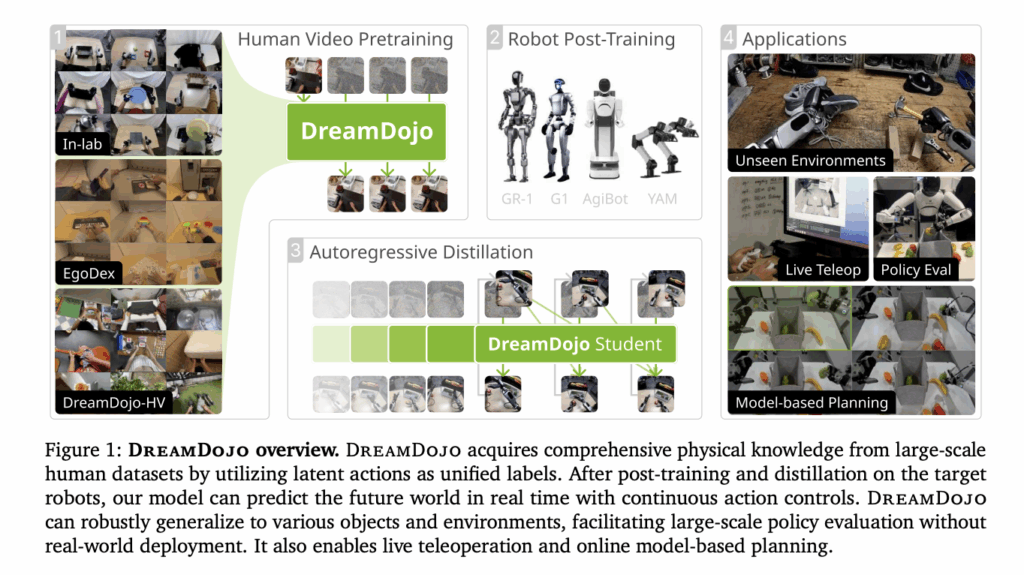
NVIDIA Releases DreamDojo: An Open-Source Robot World Model Trained on 44,711 Hours of Real-World Human Video Data

Building simulators for robots has been a long term challenge. Traditional engines require manual coding of physics and perfect 3D models. NVIDIA is changing this with DreamDojo, a fully open-source, generalizable robot world model. Instead of using a physics engine, DreamDojo ‘dreams’ the results of robot actions directly in pixels. https://arxiv.org/pdf/2602.06949 Scaling Robotics with 44k+ Hours of Human Experience The biggest hurdle for AI in robotics is data. Collecting robot-specific data is expensive and slow. DreamDojo solves this by learning from 44k+ hours of egocentric human videos. This dataset, called DreamDojo-HV, is the largest of its kind for world model pretraining. It features 6,015 unique tasks across 1M+ trajectories. The data covers 9,869 unique scenes and 43,237 unique objects. Pretraining used 100,000 NVIDIA H100 GPU hours to build 2B and 14B model variants. Humans have already mastered complex physics, such as pouring liquids or folding clothes. DreamDojo uses this human data to give robots a ‘common sense’ understanding of how the world works. https://arxiv.org/pdf/2602.06949 Bridging the Gap with Latent Actions Human videos do not have robot motor commands. To make these videos ‘robot-readable,’ NVIDIA’s research team introduced continuous latent actions. This system uses a spatiotemporal Transformer VAE to extract actions directly from pixels. The VAE encoder takes 2 consecutive frames and outputs a 32-dimensional latent vector. This vector represents the most critical motion between frames. The design creates an information bottleneck that disentangles action from visual context. This allows the model to learn physics from humans and apply them to different robot bodies. https://arxiv.org/pdf/2602.06949 Better Physics through Architecture DreamDojo is based on the Cosmos-Predict2.5 latent video diffusion model. It uses the WAN2.2 tokenizer, which has a temporal compression ratio of 4. The team improved the architecture with 3 key features: Relative Actions: The model uses joint deltas instead of absolute poses. This makes it easier for the model to generalize across different trajectories. Chunked Action Injection: It injects 4 consecutive actions into each latent frame. This aligns the actions with the tokenizer’s compression ratio and fixes causality confusion. Temporal Consistency Loss: A new loss function matches predicted frame velocities to ground-truth transitions. This reduces visual artifacts and keeps objects physically consistent. Distillation for 10.81 FPS Real-Time Interaction A simulator is only useful if it is fast. Standard diffusion models require too many denoising steps for real-time use. NVIDIA team used a Self Forcing distillation pipeline to solve this. The distillation training was conducted on 64 NVIDIA H100 GPUs. The ‘student’ model reduces denoising from 35 steps down to 4 steps. The final model achieves a real-time speed of 10.81 FPS. It is stable for continuous rollouts of 60 seconds (600 frames). Unlocking Downstream Applications DreamDojo’s speed and accuracy enable several advanced applications for AI engineers. 1. Reliable Policy Evaluation Testing robots in the real world is risky. DreamDojo acts as a high-fidelity simulator for benchmarking. Its simulated success rates show a Pearson correlation of (Pearson 𝑟=0.995) with real-world results. The Mean Maximum Rank Violation (MMRV) is only 0.003. 2. Model-Based Planning Robots can use DreamDojo to ‘look ahead.’ A robot can simulate multiple action sequences and pick the best one. In a fruit-packing task, this improved real-world success rates by 17%. Compared to random sampling, it provided a 2x increase in success. 3. Live Teleoperation Developers can teleoperate virtual robots in real time. NVIDIA team demonstrated this using a PICO VR controller and a local desktop with an NVIDIA RTX 5090. This allows for safe and rapid data collection. Summary of Model Performance Metric DREAMDOJO-2B DREAMDOJO-14B Physics Correctness 62.50% 73.50% Action Following 63.45% 72.55% FPS (Distilled) 10.81 N/A NVIDIA has released all weights, training code, and evaluation benchmarks. This open-source release allows you to post-train DreamDojo on your own robot data today. Key Takeaways Massive Scale and Diversity: DreamDojo is pretrained on DreamDojo-HV, the largest egocentric human video dataset to date, featuring 44,711 hours of footage across 6,015 unique tasks and 9,869 scenes. Unified Latent Action Proxy: To overcome the lack of action labels in human videos, the model uses continuous latent actions extracted via a spatiotemporal Transformer VAE, which serves as a hardware-agnostic control interface. Optimized Training and Architecture: The model achieves high-fidelity physics and precise controllability by utilizing relative action transformations, chunked action injection, and a specialized temporal consistency loss. Real-Time Performance via Distillation: Through a Self Forcing distillation pipeline, the model is accelerated to 10.81 FPS, enabling interactive applications like live teleoperation and stable, long-horizon simulations for over 1 minute. Reliable for Downstream Tasks: DreamDojo functions as an accurate simulator for policy evaluation, showing a 0.995 Pearson correlation with real-world success rates, and can improve real-world performance by 17% when used for model-based planning. Check out the Paper and Codes. Also, feel free to follow us on Twitter and don’t forget to join our 100k+ ML SubReddit and Subscribe to our Newsletter. Wait! are you on telegram? now you can join us on telegram as well. The post NVIDIA Releases DreamDojo: An Open-Source Robot World Model Trained on 44,711 Hours of Real-World Human Video Data appeared first on MarkTechPost.

NVIDIA Releases DreamDojo: An Open-Source Robot World Model Trained on 44,711 Hours of Real-World Human Video Data Beitrag lesen »

We use cookies to improve your experience and performance on our website. You can learn more at Datenschutzrichtlinie and manage your privacy settings by clicking Settings.

Privacy Preferences

You can choose your cookie settings by turning on/off each type of cookie as you wish, except for essential cookies.

Allow All
Manage Consent Preferences
  • Always Active

Save
de_DE