
YouZum

Uncategorized

AI, Committee, 新闻, Uncategorized

Terminal-Bench 2.0 launches alongside Harbor, a new framework for testing agents in containers

The developers of Terminal-Bench, a benchmark suite for evaluating the performance of autonomous AI agents on real-world terminal-based tasks, have released version 2.0 alongside Harbor, a new framework for testing, improving and optimizing AI agents in containerized environments. The dual release aims to address long-standing pain points in testing and optimizing AI agents, particularly those built to operate autonomously in realistic developer environments. With a more difficult and rigorously verified task set, Terminal-Bench 2.0 replaces version 1.0 as the standard for assessing frontier model capabilities. Harbor, the accompanying runtime framework, enables developers and researchers to scale evaluations across thousands of cloud containers and integrates with both open-source and proprietary agents and training pipelines. “Harbor is the package we wish we had had while making Terminal-Bench,” wrote co-creator Alex Shaw on X. “It’s for agent, model, and benchmark developers and researchers who want to evaluate and improve agents and models.” Higher Bar, Cleaner Data Terminal-Bench 1.0 saw rapid adoption after its release in May 2025, becoming a default benchmark for evaluating agent performance across the field of AI-powered agents operating in developer-style terminal environments. These agents interact with systems through the command line, mimicking how developers work behind the scenes of the graphical user interface. However, its broad scope came with inconsistencies. Several tasks were identified by the community as poorly specified or unstable due to external service changes. Version 2.0 addresses those issues directly. The updated suite includes 89 tasks, each subjected to several hours of manual and LLM-assisted validation. The emphasis is on making tasks solvable, realistic, and clearly specified, raising the difficulty ceiling while improving reliability and reproducibility. A notable example is the download-youtube task, which was removed or refactored in 2.0 due to its dependence on unstable third-party APIs. “Astute Terminal-Bench fans may notice that SOTA performance is comparable to TB1.0 despite our claim that TB2.0 is harder,” Shaw noted on X. “We believe this is because task quality is substantially higher in the new benchmark.” Harbor: Unified Rollouts at Scale Alongside the benchmark update, the team launched Harbor, a new framework for running and evaluating agents in cloud-deployed containers. Harbor supports large-scale rollout infrastructure, with compatibility for major providers like Daytona and Modal. Designed to generalize across agent architectures, Harbor supports: Evaluation of any container-installable agent Scalable supervised fine-tuning (SFT) and reinforcement learning (RL) pipelines Custom benchmark creation and deployment Full integration with Terminal-Bench 2. Harbor was used internally to run tens of thousands of rollouts during the creation of the new benchmark. It is now publicly available via harborframework.com, with documentation for testing and submitting agents to the public leaderboard. Early Results: GPT-5 Leads in Task Success Initial results from the Terminal-Bench 2.0 leaderboard show OpenAI’s Codex CLI (command line interface), a GPT-5 powered variant, in the lead, with a 49.6% success rate — the highest among all agents tested so far. Close behind are other GPT-5 variants and Claude Sonnet 4.5-based agents. Top 5 Agent Results (Terminal-Bench 2.0): Codex CLI (GPT-5) — 49.6% Codex CLI (GPT-5-Codex) — 44.3% OpenHands (GPT-5) — 43.8% Terminus 2 (GPT-5-Codex) — 43.4% Terminus 2 (Claude Sonnet 4.5) — 42.8% The close clustering among top models indicates active competition across platforms, with no single agent solving more than half the tasks. Submission and Use To test or submit an agent, users install Harbor and run the benchmark using simple CLI commands. Submissions to the leaderboard require five benchmark runs, and results can be emailed to the developers along with job directories for validation. harbor run -d terminal-bench@2.0 -m “<model>” -a “<agent>” –n-attempts 5 –jobs-dir <path/to/output> Terminal-Bench 2.0 is already being integrated into research workflows focused on agentic reasoning, code generation, and tool use. According to co-creator Mike Merrill, a postdoctoral researcher at Stanford, a detailed preprint is in progress covering the verification process and design methodology behind the benchmark. Aiming for Standardization The combined release of Terminal-Bench 2.0 and Harbor marks a step toward more consistent and scalable agent evaluation infrastructure. As LLM agents proliferate in developer and operational environments, the need for controlled, reproducible testing has grown. These tools offer a potential foundation for a unified evaluation stack — supporting model improvement, environment simulation, and benchmark standardization across the AI ecosystem.
Terminal-Bench 2.0 launches alongside Harbor, a new framework for testing agents in containers Read Post »

AI, Committee, 新闻, Uncategorized

Google AI Releases ADK Go: A New Open-Source Toolkit Designed to Empower Go Developers to Build Powerful AI Agents

How do you build reliable AI agents that plug into your existing Go services without bolting on a separate language stack? Google has just released Agent Development Kit for Go. Go developers can now build AI agents with the same framework that already supports Python and Java, while keeping everything inside a familiar Go toolchain and deployment model. For AI devs and backend developers who already use Go for services, this closes a gap. You no longer need a separate Python based stack for agents. You can express agent logic, orchestration, and tool use directly in Go code, then move the same agents into Vertex AI Agent Builder and Agent Engine when you are ready for production. What Agent Development Kit Provides? Agent Development Kit, or ADK, is an open source framework for developing and deploying AI agents. It is optimized for Gemini and Google Cloud, but the design is model agnostic and deployment agnostic. In practical terms, ADK gives you: A code first programming model where agent behavior, tools, and orchestration live in normal source files Workflow agents for sequential, parallel, and loop style control flow inside an agent system A rich tool ecosystem with built in tools, custom function tools, OpenAPI tools, Google Cloud tools, and ecosystem tools Deployment paths that cover local runs, containers, Cloud Run, and Vertex AI Agent Engine Built in evaluation and safety patterns, integrated with Vertex AI Agent Builder For a developer, ADK turns an agent into a normal service. You run it locally, inspect traces, and deploy it to a managed runtime, instead of treating it as a one off script that calls an LLM. What ADK for Go Adds? The Go release keeps the same core feature set as the Python and Java SDKs but exposes it through an idiomatic Go API. The Google AI team describes ADK for Go as an idiomatic and performant way to build agents that use Go concurrency and strong typing. Here are some key points: ADK for Go is installed with go get google.golang.org/adk The project is open source and hosted at github.com/google/adk-go It supports building, evaluating, and deploying sophisticated AI agents with flexibility and control It uses the same abstractions for agents, tools, and workflows as the other ADK languages This means a Go service can embed agent behavior without switching languages. You can build a multi agent architecture where each agent is a Go component that composes with others using the same framework. A2A Protocol Support in Go ADK for Go ships with native support for the Agent2Agent protocol, or A2A. The A2A protocol defines a way for agents to call other agents over a standard interface. In the Go release, Google highlights that a primary agent can orchestrate and delegate tasks to specialized sub agents. Those sub agents can run locally or as remote deployments. A2A keeps these interactions secure and opaque, so an agent does not need to expose internal memory or proprietary logic to participate. Google also contributed an A2A Go SDK to the main A2A project. That gives Go developers a protocol level entry point if they want agents that interoperate with other runtimes and frameworks that also support A2A. MCP Toolbox for Databases and Tooling A key detail in the official Google announcement is native integration with MCP Toolbox for Databases. It states that ADK Go has out of the box support for more than 30 databases through this toolbox. MCP Toolbox for Databases is an open source MCP server for databases. It handles connection pooling, authentication, and other concerns, and exposes database operations as tools using the Model Context Protocol. Within ADK, that means: You register MCP Toolbox for Databases as an MCP tool provider The agent calls database operations through MCP tools rather than constructing raw SQL The toolbox enforces a set of safe, predefined actions that the agent can perform This fits the ADK model for tools in general, where agents use a mix of built in tools, Google Cloud tools, ecosystem tools, and MCP tools, all described in the Vertex AI Agent Builder documentation. Integration with Vertex AI Agent Builder and Agent Engine ADK is the primary framework supported in Vertex AI Agent Builder for building multi agent systems. The latest Agent Builder updates describe a build path where you: Develop the agent locally using ADK, now including ADK for Go Use the ADK quickstart and dev UI to test the agent with multiple tools Deploy the agent to Vertex AI Agent Engine as a managed runtime For Go teams, this means the language used in services and infrastructure is now available across the full agent lifecycle, from local development to managed production deployment. Editorial Comments This launch positions Agent Development Kit for Go as a practical bridge between AI agents and existing Go services, using the same open source, code first toolkit that underpins Python and Java agents. It brings A2A protocol support and MCP Toolbox for Databases into a Go native environment, aligned with Vertex AI Agent Builder and Vertex AI Agent Engine for deployment, evaluation, and observability. Overall, this release makes Go a first class language for building production ready, interoperable AI agents in Google’s ecosystem. Check out the Repo, Samples and Technical details. Feel free to check out our GitHub Page for Tutorials, Codes and Notebooks. Also, feel free to follow us on Twitter and don’t forget to join our 100k+ ML SubReddit and Subscribe to our Newsletter. Wait! are you on telegram? now you can join us on telegram as well. The post Google AI Releases ADK Go: A New Open-Source Toolkit Designed to Empower Go Developers to Build Powerful AI Agents appeared first on MarkTechPost.

Google AI Releases ADK Go: A New Open-Source Toolkit Designed to Empower Go Developers to Build Powerful AI Agents Read Post »

AI, Committee, 新闻, Uncategorized

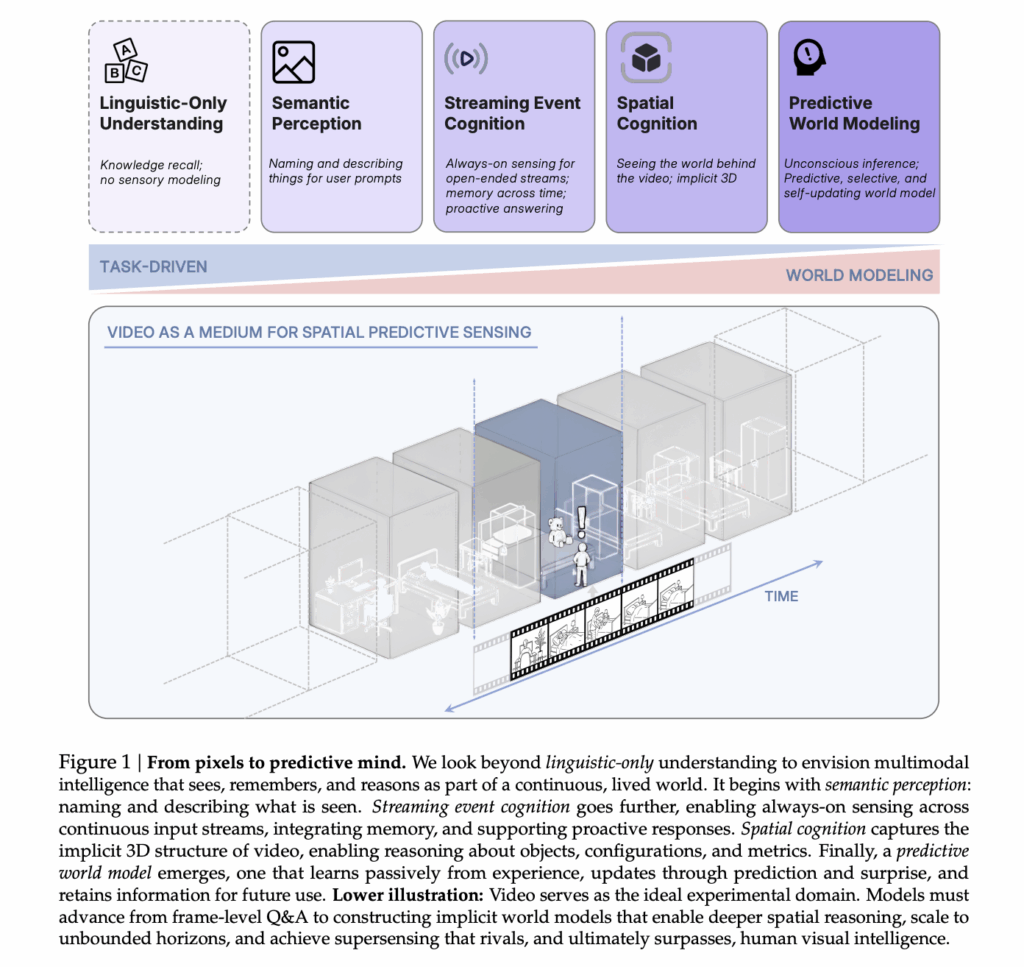
Why Spatial Supersensing is Emerging as the Core Capability for Multimodal AI Systems?

Even strong ‘long-context’ AI models fail badly when they must track objects and counts over long, messy video streams, so the next competitive edge will come from models that predict what comes next and selectively remember only surprising, important events, not from just buying more compute and bigger context windows. A team of researchers from New York University and Stanford introduce Cambrian-S, a spatially grounded video multimodal large language model family, together with the VSI Super benchmark and the VSI 590K dataset to test and train spatial supersensing in long videos. https://arxiv.org/pdf/2511.04670 From video question answering to spatial supersensing The research team frames spatial supersensing as a progression of capabilities beyond linguistic only reasoning. The stages are semantic perception, streaming event cognition, implicit 3D spatial cognition and predictive world modeling. Most current video MLLMs sample sparse frames and rely on language priors. They often answer benchmark questions using captions or single frames rather than continuous visual evidence. Diagnostic tests show that several popular video benchmarks are solvable with limited or text only input, so they do not strongly test spatial sensing. Cambrian-S targets the higher stages of this hierarchy, where the model must remember spatial layouts across time, reason about object locations and counts and anticipate changes in a 3D world. VSI Super, a stress test for continual spatial sensing To expose the gap between current systems and spatial supersensing, the research team designed VSI Super, a two part benchmark that runs on arbitrarily long indoor videos. https://arxiv.org/pdf/2511.04670 VSI Super Recall, or VSR, evaluates long horizon spatial observation and recall. Human annotators take indoor walkthrough videos from ScanNet, ScanNet++ and ARKitScenes and use Gemini to insert an unusual object, such as a Teddy Bear, into four frames at different spatial locations. These edited sequences are concatenated into streams up to 240 minutes. The model must report the order of locations where the object appears, which is a visual needle in a haystack task with sequential recall. https://arxiv.org/pdf/2511.04670 VSI Super Count, or VSC, measures continual counting under changing viewpoints and rooms. The benchmark concatenates room tour clips from VSI Bench and asks for the total number of instances of a target object across all rooms. The model must handle viewpoint changes, revisits and scene transitions and maintain a cumulative count. Evaluation uses mean relative accuracy for durations from 10 to 120 minutes. When Cambrian-S 7B is evaluated on VSI Super in a streaming setup at 1 frame per second, accuracy on VSR drops from 38.3 percent at 10 minutes to 6.0 percent at 60 minutes and becomes zero beyond 60 minutes. VSC accuracy is near zero across lengths. Gemini 2.5 Flash also degrades on VSI Super despite a long context window, which shows that brute force context scaling is not sufficient for continual spatial sensing. VSI 590K, spatially focused instruction data To test whether data scaling can help, the research team construct VSI 590K, a spatial instruction corpus with 5,963 videos, 44,858 images and 590,667 question answer pairs from 10 sources. Sources include 3D annotated real indoor scans such as ScanNet, ScanNet++ V2, ARKitScenes, S3DIS and Aria Digital Twin, simulated scenes from ProcTHOR and Hypersim and pseudo annotated web data such as YouTube RoomTour and robot datasets Open X Embodiment and AgiBot World. The dataset defines 12 spatial question types, such as object count, absolute and relative distance, object size, room size and appearance order. Questions are generated from 3D annotations or reconstructions so that spatial relationships are grounded in geometry rather than text heuristics. Ablations show that annotated real videos contribute the largest gains on VSI Bench, followed by simulated data and then pseudo annotated images and that training on the full mix gives the best spatial performance. https://arxiv.org/pdf/2511.04670 Cambrian-S model family and spatial performance Cambrian-S builds on Cambrian-1 and uses Qwen2.5 language backbones at 0.5B, 1.5B, 3B and 7B parameters with a SigLIP2 SO400M vision encoder and a two layer MLP connector. Training follows a four stage pipeline. Stage 1 performs vision language alignment on image text pairs. Stage 2 applies image instruction tuning, equivalent to the improved Cambrian-1 setup. Stage 3 extends to video with general video instruction tuning on a 3 million sample mixture called Cambrian-S 3M. Stage 4 performs spatial video instruction tuning on a mixture of VSI 590K and a subset of the stage 3 data. https://arxiv.org/pdf/2511.04670 On VSI Bench, Cambrian-S 7B reaches 67.5 percent accuracy and outperforms open source baselines like InternVL3.5 8B and Qwen VL 2.5 7B as well as proprietary Gemini 2.5 Pro by more than 16 absolute points. The model also maintains strong performance on Perception Test, EgoSchema and other general video benchmarks, so the focus on spatial sensing does not destroy general capabilities. Predictive sensing with latent frame prediction and surprise To go beyond static context expansion, the research team propose predictive sensing. They add a Latent Frame Prediction head, which is a two layer MLP that predicts the latent representation of the next video frame in parallel with next token prediction. Training modifies stage 4. The model uses mean squared error and cosine distance losses between predicted and ground truth latent features, weighted against the language modeling loss. A subset of 290,000 videos from VSI 590K, sampled at 1 frame per second, is reserved for this objective. During this stage the connector, language model and both output heads are trained jointly, while the SigLIP vision encoder remains frozen. https://arxiv.org/pdf/2511.04670 At inference time the cosine distance between predicted and actual features becomes a surprise score. Frames with low surprise are compressed before being stored in long term memory and high surprise frames are retained with more detail. A fixed size memory buffer uses surprise to decide which frames to consolidate or drop and queries retrieve frames that are most relevant to the question. https://arxiv.org/pdf/2511.04670 For VSR, this surprise driven memory system lets Cambrian-S maintain accuracy as video length increases while keeping GPU memory usage stable. It outperforms Gemini 1.5 Flash and Gemini 2.5 Flash on VSR at all tested

Why Spatial Supersensing is Emerging as the Core Capability for Multimodal AI Systems? Read Post »

AI, Committee, 新闻, Uncategorized

Pragmatic Reasoning improves LLM Code Generation

arXiv:2502.15835v3 Announce Type: replace Abstract: Large Language Models (LLMs) have demonstrated impressive potential in translating natural language (NL) instructions into program code. However, user instructions often contain inherent ambiguities, making it challenging for LLMs to generate code that accurately reflects the user’s true intent. To address this challenge, researchers have proposed approaches that produce multiple candidates of the program code and then rerank them to identify the best solution. In this paper, we propose CodeRSA, a novel code candidate reranking mechanism built upon the Rational Speech Act (RSA) framework, designed to guide LLMs toward more comprehensive pragmatic reasoning about user intent. We evaluate CodeRSA using Llama-3-8B-Instruct and Qwen-2.5-7B-Instruct on two widely used code generation benchmarks, HumanEval and MBPP. Our experiment results show that CodeRSA consistently outperforms common baselines, surpasses the state-of-the-art approach in most cases, and demonstrates robust overall performance. These findings underscore the effectiveness of integrating pragmatic reasoning into code candidate reranking, offering a promising direction for enhancing code generation quality in LLMs.

Pragmatic Reasoning improves LLM Code Generation Read Post »

AI, Committee, 新闻, Uncategorized

IntelliProof: An Argumentation Network-based Conversational Helper for Organized Reflection

arXiv:2511.04528v1 Announce Type: new Abstract: We present IntelliProof, an interactive system for analyzing argumentative essays through LLMs. IntelliProof structures an essay as an argumentation graph, where claims are represented as nodes, supporting evidence is attached as node properties, and edges encode supporting or attacking relations. Unlike existing automated essay scoring systems, IntelliProof emphasizes the user experience: each relation is initially classified and scored by an LLM, then visualized for enhanced understanding. The system provides justifications for classifications and produces quantitative measures for essay coherence. It enables rapid exploration of argumentative quality while retaining human oversight. In addition, IntelliProof provides a set of tools for a better understanding of an argumentative essay and its corresponding graph in natural language, bridging the gap between the structural semantics of argumentative essays and the user’s understanding of a given text. A live demo and the system are available here to try: textbf{https://intelliproof.vercel.app}

IntelliProof: An Argumentation Network-based Conversational Helper for Organized Reflection Read Post »

AI, Committee, 新闻, Uncategorized

CantoASR: Prosody-Aware ASR-LALM Collaboration for Low-Resource Cantonese

arXiv:2511.04139v1 Announce Type: new Abstract: Automatic speech recognition (ASR) is critical for language accessibility, yet low-resource Cantonese remains challenging due to limited annotated data, six lexical tones, tone sandhi, and accent variation. Existing ASR models, such as Whisper, often suffer from high word error rates. Large audio-language models (LALMs), in contrast, can leverage broader contextual reasoning but still require explicit tonal and prosodic acoustic cues. We introduce CantoASR, a collaborative ASR-LALM error correction framework that integrates forced alignment for acoustic feature extraction, a LoRA-finetuned Whisper for improved tone discrimination, and an instruction-tuned Qwen-Audio for prosody-aware correction. Evaluations on spontaneous Cantonese data show substantial CER gains over Whisper-Large-V3. These findings suggest that integrating acoustic cues with LALM reasoning provides a scalable strategy for low-resource tonal and dialectal ASR.

CantoASR: Prosody-Aware ASR-LALM Collaboration for Low-Resource Cantonese Read Post »

AI, Committee, 新闻, Uncategorized

When retrieval outperforms generation: Dense evidence retrieval for scalable fake news detection

arXiv:2511.04643v1 Announce Type: new Abstract: The proliferation of misinformation necessitates robust yet computationally efficient fact verification systems. While current state-of-the-art approaches leverage Large Language Models (LLMs) for generating explanatory rationales, these methods face significant computational barriers and hallucination risks in real-world deployments. We present DeReC (Dense Retrieval Classification), a lightweight framework that demonstrates how general-purpose text embeddings can effectively replace autoregressive LLM-based approaches in fact verification tasks. By combining dense retrieval with specialized classification, our system achieves better accuracy while being significantly more efficient. DeReC outperforms explanation-generating LLMs in efficiency, reducing runtime by 95% on RAWFC (23 minutes 36 seconds compared to 454 minutes 12 seconds) and by 92% on LIAR-RAW (134 minutes 14 seconds compared to 1692 minutes 23 seconds), showcasing its effectiveness across varying dataset sizes. On the RAWFC dataset, DeReC achieves an F1 score of 65.58%, surpassing the state-of-the-art method L-Defense (61.20%). Our results demonstrate that carefully engineered retrieval-based systems can match or exceed LLM performance in specialized tasks while being significantly more practical for real-world deployment.

When retrieval outperforms generation: Dense evidence retrieval for scalable fake news detection Read Post »

AI, Committee, 新闻, Uncategorized

What Are They Talking About? A Benchmark of Knowledge-Grounded Discussion Summarization

arXiv:2505.12474v3 Announce Type: replace Abstract: Traditional dialogue summarization primarily focuses on dialogue content, assuming it comprises adequate information for a clear summary. However, this assumption often fails for discussions grounded in shared background, where participants frequently omit context and use implicit references. This results in summaries that are confusing to readers unfamiliar with the background. To address this, we introduce Knowledge-Grounded Discussion Summarization (KGDS), a novel task that produces a supplementary background summary for context and a clear opinion summary with clarified references. To facilitate research, we construct the first KGDS benchmark, featuring news-discussion pairs and expert-created multi-granularity gold annotations for evaluating sub-summaries. We also propose a novel hierarchical evaluation framework with fine-grained and interpretable metrics. Our extensive evaluation of 12 advanced large language models (LLMs) reveals that KGDS remains a significant challenge. The models frequently miss key facts and retain irrelevant ones in background summarization, and often fail to resolve implicit references in opinion summary integration.

What Are They Talking About? A Benchmark of Knowledge-Grounded Discussion Summarization Read Post »

AI, Committee, 新闻, Uncategorized

AlphaDecay: Module-wise Weight Decay for Heavy-Tailed Balancing in LLMs

arXiv:2506.14562v3 Announce Type: replace Abstract: Weight decay is a standard regularization technique for training large language models (LLMs). While it is common to assign a uniform decay rate to every layer, this approach overlooks the structural diversity of LLMs and the varying spectral properties across modules. In this paper, we introduce AlphaDecay, a simple yet effective method that adaptively assigns different weight decay strengths to each module of an LLM. Our approach is guided by Heavy-Tailed Self-Regularization (HT-SR) theory, which analyzes the empirical spectral density (ESD) of weight correlation matrices to quantify “heavy-tailedness.” Modules exhibiting more pronounced heavy-tailed ESDs, reflecting stronger feature learning, are assigned weaker decay, while modules with lighter-tailed spectra receive stronger decay. Our method leverages tailored weight decay assignments to balance the module-wise differences in spectral properties, leading to improved performance. Extensive pre-training tasks with various model sizes from 60M to 1B demonstrate that AlphaDecay achieves better perplexity and generalization than conventional uniform decay and other adaptive decay baselines. Our code is available at https://github.com/hed-ucas/AlphaDecay.

AlphaDecay: Module-wise Weight Decay for Heavy-Tailed Balancing in LLMs Read Post »

We use cookies to improve your experience and performance on our website. You can learn more at 隱私權政策 and manage your privacy settings by clicking Settings.

Privacy Preferences

You can choose your cookie settings by turning on/off each type of cookie as you wish, except for essential cookies.

Allow All
Manage Consent Preferences
  • Always Active

Save
zh_CN