YouZum

Uncategorized

AI, Committee, 新闻, Uncategorized

ScaleFormer: Span Representation Cumulation for Long-Context Transformer

arXiv:2511.10029v1 Announce Type: new Abstract: The quadratic complexity of standard self-attention severely limits the application of Transformer-based models to long-context tasks. While efficient Transformer variants exist, they often require architectural changes and costly pre-training from scratch. To circumvent this, we propose ScaleFormer(Span Representation Cumulation for Long-Context Transformer) – a simple and effective plug-and-play framework that adapts off-the-shelf pre-trained encoder-decoder models to process long sequences without requiring architectural modifications. Our approach segments long inputs into overlapping chunks and generates a compressed, context-aware representation for the decoder. The core of our method is a novel, parameter-free fusion mechanism that endows each chunk’s representation with structural awareness of its position within the document. It achieves this by enriching each chunk’s boundary representations with cumulative context vectors from all preceding and succeeding chunks. This strategy provides the model with a strong signal of the document’s narrative flow, achieves linear complexity, and enables pre-trained models to reason effectively over long-form text. Experiments on long-document summarization show that our method is highly competitive with and often outperforms state-of-the-art approaches without requiring architectural modifications or external retrieval mechanisms.

ScaleFormer: Span Representation Cumulation for Long-Context Transformer Read Post »

AI, Committee, 新闻, Uncategorized

OutSafe-Bench: A Benchmark for Multimodal Offensive Content Detection in Large Language Models

arXiv:2511.10287v1 Announce Type: cross Abstract: Since Multimodal Large Language Models (MLLMs) are increasingly being integrated into everyday tools and intelligent agents, growing concerns have arisen regarding their possible output of unsafe contents, ranging from toxic language and biased imagery to privacy violations and harmful misinformation. Current safety benchmarks remain highly limited in both modality coverage and performance evaluations, often neglecting the extensive landscape of content safety. In this work, we introduce OutSafe-Bench, the first most comprehensive content safety evaluation test suite designed for the multimodal era. OutSafe-Bench includes a large-scale dataset that spans four modalities, featuring over 18,000 bilingual (Chinese and English) text prompts, 4,500 images, 450 audio clips and 450 videos, all systematically annotated across nine critical content risk categories. In addition to the dataset, we introduce a Multidimensional Cross Risk Score (MCRS), a novel metric designed to model and assess overlapping and correlated content risks across different categories. To ensure fair and robust evaluation, we propose FairScore, an explainable automated multi-reviewer weighted aggregation framework. FairScore selects top-performing models as adaptive juries, thereby mitigating biases from single-model judgments and enhancing overall evaluation reliability. Our evaluation of nine state-of-the-art MLLMs reveals persistent and substantial safety vulnerabilities, underscoring the pressing need for robust safeguards in MLLMs.

OutSafe-Bench: A Benchmark for Multimodal Offensive Content Detection in Large Language Models Read Post »

AI, Committee, 新闻, Uncategorized

NVIDIA AI Introduces TiDAR: A Hybrid Diffusion Autoregressive Architecture For High Throughput LLM Inference

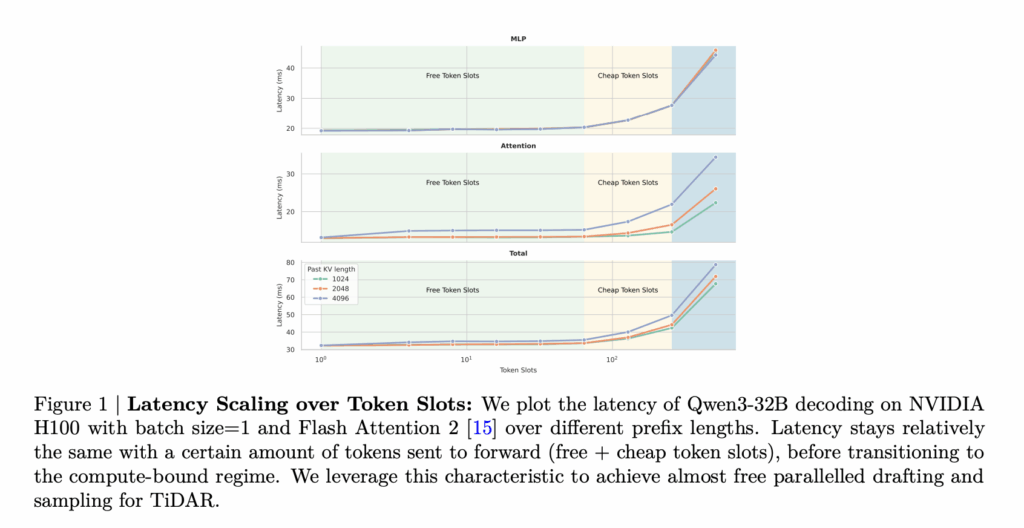
How far can we push large language model speed by reusing “free” GPU compute, without giving up autoregressive level output quality? NVIDIA researchers propose TiDAR, a sequence level hybrid language model that drafts tokens with diffusion and samples them autoregressively in a single forward pass. The main goal of this research is to reach autoregressive quality while significantly increasing throughput by exploiting free token slots on modern GPUs. https://arxiv.org/pdf/2511.08923 Systems motivation, free token slots and the quality problem Autoregressive transformers decode one token per step. At realistic batch sizes, decoding is usually memory bound, because latency is dominated by loading weights and KV cache, not by floating point operations. Increasing the number of tokens in the input sequence within the memory bound region does not change latency much, since the same parameters and cache are reused. Masked diffusion language models already exploit this. Given a prefix, they can append multiple masked positions and predict several tokens in parallel in one denoising step. The research team calls these additional positions free token slots, because profiling shows that sending more tokens in this regime barely changes the forward time. However, diffusion LLMs like Dream and Llada still underperform strong autoregressive baselines on quality. When these models decode multiple tokens in the same step, they sample each token independently from a marginal distribution, given a noised context. This intra step token independence hurts sequence level coherence and factual correctness, and the best quality is usually obtained when decoding only 1 token per step. In practice, this removes much of the theoretical speed advantage of diffusion decoding. TiDAR is designed to preserve the compute efficiency of diffusion while recovering autoregressive quality, using a single backbone and standard transformer infrastructure. Architecture, dual mode backbone and attention masks At a high level, TiDAR partitions the sequence at each generation step into three sections: A prefix of accepted tokens. Tokens drafted in the previous step. Mask tokens that will hold pre drafted candidates for the next step. The model applies a structured attention mask across this sequence. Prefix tokens attend causally, which supports chain factorized next token prediction, as in a standard autoregressive transformer. Tokens in the drafting region and mask region attend bidirectionally within a block, which enables diffusion style marginal predictions over many positions in parallel. This layout is a modification of the Block Diffusion mask, where only the decoding block is bidirectional and the rest of the sequence remains causal. https://arxiv.org/pdf/2511.08923 To enable both modes in the same backbone, TiDAR doubles the sequence length at training time. The original input occupies the causal section, and a corrupted copy occupies the diffusion section. In the causal section, labels are shifted by 1 token to match the next token prediction objective. In the diffusion section, labels are aligned with the input positions. Crucially, TiDAR uses a full mask strategy. All tokens in the diffusion section are replaced by a special mask token, rather than sampling a sparse corruption pattern. This makes the diffusion loss dense, keeps the number of loss terms in diffusion and autoregressive parts equal to the sequence length, and simplifies balancing the two losses with a single weighting factor. The research team set this weighting factor to 1 in most experiments. https://arxiv.org/pdf/2511.08923 Self speculative generation in one forward pass Generation is formulated as a self speculative process that runs in a single network function evaluation per step. Step 1, given the prompt, TiDAR encodes the prefix causally and performs one step diffusion over the mask positions, producing a block of drafted tokens. Step 2 and later steps, each forward pass performs two operations at once Verification of drafted tokens using autoregressive logits over the extended prefix with a rejection sampling rule, similar in spirit to speculative decoding. Pre drafting of the next block using diffusion, conditioned on all possible acceptance outcomes of the current step. Accepted tokens are added to the prefix, and their KV cache entries are retained. Rejected tokens are discarded, and their cache entries are evicted. The drafting and verification share the same backbone and attention mask, so diffusion computation uses the free token slots in the same forward pass. The model supports two sampling modes, trusting autoregressive predictions or trusting diffusion predictions, which control how strongly the final sample follows each head. Experiments show that for the 8B model, trusting diffusion predictions is often beneficial, especially on math benchmarks, while retaining autoregressive quality through rejection sampling. On the systems side, the attention layout and number of tokens per step are fixed. TiDAR pre initialises a block attention mask and reuses slices of this mask across decoding steps using Flex Attention. The architecture supports exact KV cache, like Block Diffusion. The implementation never recomputes KV entries for accepted tokens and introduces no extra inference time hyperparameters. Training recipe and model sizes TiDAR is instantiated by continual pretraining from Qwen2.5 1.5B and Qwen3 4B and 8B base models. The 1.5B variant is trained on 50B tokens with block sizes 4, 8 and 16. The 8B variant is trained on 150B tokens with block size 16. Both use maximum sequence length 4096, cosine learning rate schedule, distributed Adam, BF16, and a modified Megatron LM framework with Torchtitan on NVIDIA H100 GPUs. Evaluation covers coding tasks HumanEval, HumanEval Plus, MBPP, MBPP Plus, math tasks GSM8K and Minerva Math, factual and commonsense tasks MMLU, ARC, Hellaswag, PIQA, and Winogrande, all implemented via lm_eval_harness. Quality and throughput results On generative coding and math tasks, TiDAR 1.5B is highly competitive with its autoregressive counterpart, while generating an average 7.45 tokens per model forward. TiDAR 8B incurs only minimal quality loss relative to Qwen3 8B while increasing generation efficiency to 8.25 tokens per forward pass. On knowledge and reasoning benchmarks evaluated by likelihood, TiDAR 1.5B and 8B match the overall behaviour of comparable autoregressive models, because likelihood is computed with a pure causal mask. Diffusion baselines such as Dream, Llada and Block Diffusion require Monte Carlo based likelihood estimators, which are more expensive and less directly

NVIDIA AI Introduces TiDAR: A Hybrid Diffusion Autoregressive Architecture For High Throughput LLM Inference Read Post »

AI, Committee, 新闻, Uncategorized

How to Build a Fully Functional Custom GPT-style Conversational AI Locally Using Hugging Face Transformers

In this tutorial, we build our own custom GPT-style chat system from scratch using a local Hugging Face model. We start by loading a lightweight instruction-tuned model that understands conversational prompts, then wrap it inside a structured chat framework that includes a system role, user memory, and assistant responses. We define how the agent interprets context, constructs messages, and optionally uses small built-in tools to fetch local data or simulated search results. By the end, we have a fully functional, conversational model that behaves like a personalized GPT running. Check out the FULL CODES here.  Copy CodeCopiedUse a different Browser !pip install transformers accelerate sentencepiece –quiet import torch from transformers import AutoTokenizer, AutoModelForCausalLM from typing import List, Tuple, Optional import textwrap, json, os We begin by installing the essential libraries and importing the required modules. We ensure that the environment has all necessary dependencies, such as transformers, torch, and sentencepiece, ready for use. This setup allows us to work seamlessly with Hugging Face models inside Google Colab. Check out the FULL CODES here.  Copy CodeCopiedUse a different Browser MODEL_NAME = “microsoft/Phi-3-mini-4k-instruct” BASE_SYSTEM_PROMPT = ( “You are a custom GPT running locally. ” “Follow user instructions carefully. ” “Be concise and structured. ” “If something is unclear, say it is unclear. ” “Prefer practical examples over corporate examples unless explicitly asked. ” “When asked for code, give runnable code.” ) MAX_NEW_TOKENS = 256 We configure our model name, define the system prompt that governs the assistant’s behavior, and set token limits. We establish how our custom GPT should respond, concise, structured, and practical. This section defines the foundation of our model’s identity and instruction style. Check out the FULL CODES here.  Copy CodeCopiedUse a different Browser print(“Loading model…”) tokenizer = AutoTokenizer.from_pretrained(MODEL_NAME) if tokenizer.pad_token_id is None: tokenizer.pad_token_id = tokenizer.eos_token_id model = AutoModelForCausalLM.from_pretrained( MODEL_NAME, torch_dtype=torch.float16 if torch.cuda.is_available() else torch.float32, device_map=”auto” ) model.eval() print(“Model loaded.”) We load the tokenizer and model from Hugging Face into memory and prepare them for inference. We automatically adjust the device mapping based on available hardware, ensuring GPU acceleration if possible. Once loaded, our model is ready to generate responses. Check out the FULL CODES here.  Copy CodeCopiedUse a different Browser ConversationHistory = List[Tuple[str, str]] history: ConversationHistory = [(“system”, BASE_SYSTEM_PROMPT)] def wrap_text(s: str, w: int = 100) -> str: return “n”.join(textwrap.wrap(s, width=w)) def build_chat_prompt(history: ConversationHistory, user_msg: str) -> str: prompt_parts = [] for role, content in history: if role == “system”: prompt_parts.append(f”<|system|>n{content}n”) elif role == “user”: prompt_parts.append(f”<|user|>n{content}n”) elif role == “assistant”: prompt_parts.append(f”<|assistant|>n{content}n”) prompt_parts.append(f”<|user|>n{user_msg}n”) prompt_parts.append(“<|assistant|>n”) return “”.join(prompt_parts) We initialize the conversation history, starting with a system role, and create a prompt builder to format messages. We define how user and assistant turns are arranged in a consistent conversational structure. This ensures the model always understands the dialogue context correctly. Check out the FULL CODES here.  Copy CodeCopiedUse a different Browser def local_tool_router(user_msg: str) -> Optional[str]: msg = user_msg.strip().lower() if msg.startswith(“search:”): query = user_msg.split(“:”, 1)[-1].strip() return f”Search results about ‘{query}’:n- Key point 1n- Key point 2n- Key point 3″ if msg.startswith(“docs:”): topic = user_msg.split(“:”, 1)[-1].strip() return f”Documentation extract on ‘{topic}’:n1. The agent orchestrates tools.n2. The model consumes output.n3. Responses become memory.” return None We add a lightweight tool router that extends our GPT’s capability to simulate tasks like search or documentation retrieval. We define logic to detect special prefixes such as “search:” or “docs:” in user queries. This simple agentic design gives our assistant contextual awareness. Check out the FULL CODES here.  Copy CodeCopiedUse a different Browser def generate_reply(history: ConversationHistory, user_msg: str) -> str: tool_context = local_tool_router(user_msg) if tool_context: user_msg = user_msg + “nnUseful context:n” + tool_context prompt = build_chat_prompt(history, user_msg) inputs = tokenizer(prompt, return_tensors=”pt”).to(model.device) with torch.no_grad(): output_ids = model.generate( **inputs, max_new_tokens=MAX_NEW_TOKENS, do_sample=True, top_p=0.9, temperature=0.6, pad_token_id=tokenizer.eos_token_id ) decoded = tokenizer.decode(output_ids[0], skip_special_tokens=True) reply = decoded.split(“<|assistant|>”)[-1].strip() if “<|assistant|>” in decoded else decoded[len(prompt):].strip() history.append((“user”, user_msg)) history.append((“assistant”, reply)) return reply def save_history(history: ConversationHistory, path: str = “chat_history.json”) -> None: data = [{“role”: r, “content”: c} for (r, c) in history] with open(path, “w”) as f: json.dump(data, f, indent=2) def load_history(path: str = “chat_history.json”) -> ConversationHistory: if not os.path.exists(path): return [(“system”, BASE_SYSTEM_PROMPT)] with open(path, “r”) as f: data = json.load(f) return [(item[“role”], item[“content”]) for item in data] We define the primary reply generation function, which combines history, context, and model inference to produce coherent outputs. We also add functions to save and load past conversations for persistence. This snippet forms the operational core of our custom GPT. Check out the FULL CODES here.  Copy CodeCopiedUse a different Browser print(“n— Demo turn 1 —“) demo_reply_1 = generate_reply(history, “Explain what this custom GPT setup is doing in 5 bullet points.”) print(wrap_text(demo_reply_1)) print(“n— Demo turn 2 —“) demo_reply_2 = generate_reply(history, “search: agentic ai with local models”) print(wrap_text(demo_reply_2)) def interactive_chat(): print(“nChat ready. Type ‘exit’ to stop.”) while True: try: user_msg = input(“nUser: “).strip() except EOFError: break if user_msg.lower() in (“exit”, “quit”, “q”): break reply = generate_reply(history, user_msg) print(“nAssistant:n” + wrap_text(reply)) # interactive_chat() print(“nCustom GPT initialized successfully.”) We test the entire setup by running demo prompts and displaying generated responses. We also create an optional interactive chat loop to converse directly with the assistant. By the end, we confirm that our custom GPT runs locally and responds intelligently in real time. In conclusion, we designed and executed a custom conversational agent that mirrors GPT-style reasoning without relying on any external services. We saw how local models can be made interactive through prompt orchestration, lightweight tool routing, and conversational memory management. This approach enables us to understand the internal logic behind commercial GPT systems. It empowers us to experiment with our own rules, behaviors, and integrations in a transparent and fully offline manner. Check out the FULL CODES here. Feel free to check out our GitHub Page for Tutorials, Codes and Notebooks. Also, feel free to follow us on Twitter and don’t forget to join our 100k+ ML SubReddit and Subscribe to our Newsletter. Wait! are you on telegram? now you can join us on telegram as well. The post How to Build a Fully Functional Custom GPT-style Conversational AI Locally Using Hugging Face Transformers appeared first on MarkTechPost.

How to Build a Fully Functional Custom GPT-style Conversational AI Locally Using Hugging Face Transformers Read Post »

AI, Committee, 新闻, Uncategorized

HalluClean: A Unified Framework to Combat Hallucinations in LLMs

arXiv:2511.08916v1 Announce Type: new Abstract: Large language models (LLMs) have achieved impressive performance across a wide range of natural language processing tasks, yet they often produce hallucinated content that undermines factual reliability. To address this challenge, we introduce HalluClean, a lightweight and task-agnostic framework for detecting and correcting hallucinations in LLM-generated text. HalluClean adopts a reasoning-enhanced paradigm, explicitly decomposing the process into planning, execution, and revision stages to identify and refine unsupported claims. It employs minimal task-routing prompts to enable zero-shot generalization across diverse domains, without relying on external knowledge sources or supervised detectors. We conduct extensive evaluations on five representative tasks-question answering, dialogue, summarization, math word problems, and contradiction detection. Experimental results show that HalluClean significantly improves factual consistency and outperforms competitive baselines, demonstrating its potential to enhance the trustworthiness of LLM outputs in real-world applications.

HalluClean: A Unified Framework to Combat Hallucinations in LLMs Read Post »

AI, Committee, 新闻, Uncategorized

Benevolent Dictators? On LLM Agent Behavior in Dictator Games

arXiv:2511.08721v1 Announce Type: cross Abstract: In behavioral sciences, experiments such as the ultimatum game are conducted to assess preferences for fairness or self-interest of study participants. In the dictator game, a simplified version of the ultimatum game where only one of two players makes a single decision, the dictator unilaterally decides how to split a fixed sum of money between themselves and the other player. Although recent studies have explored behavioral patterns of AI agents based on Large Language Models (LLMs) instructed to adopt different personas, we question the robustness of these results. In particular, many of these studies overlook the role of the system prompt – the underlying instructions that shape the model’s behavior – and do not account for how sensitive results can be to slight changes in prompts. However, a robust baseline is essential when studying highly complex behavioral aspects of LLMs. To overcome previous limitations, we propose the LLM agent behavior study (LLM-ABS) framework to (i) explore how different system prompts influence model behavior, (ii) get more reliable insights into agent preferences by using neutral prompt variations, and (iii) analyze linguistic features in responses to open-ended instructions by LLM agents to better understand the reasoning behind their behavior. We found that agents often exhibit a strong preference for fairness, as well as a significant impact of the system prompt on their behavior. From a linguistic perspective, we identify that models express their responses differently. Although prompt sensitivity remains a persistent challenge, our proposed framework demonstrates a robust foundation for LLM agent behavior studies. Our code artifacts are available at https://github.com/andreaseinwiller/LLM-ABS.

Benevolent Dictators? On LLM Agent Behavior in Dictator Games Read Post »

AI, Committee, 新闻, Uncategorized

Uncertainty Quantification for Language Models: A Suite of Black-Box, White-Box, LLM Judge, and Ensemble Scorers

arXiv:2504.19254v4 Announce Type: replace Abstract: Hallucinations are a persistent problem with Large Language Models (LLMs). As these models become increasingly used in high-stakes domains, such as healthcare and finance, the need for effective hallucination detection is crucial. To this end, we outline a versatile framework for closed-book hallucination detection that practitioners can apply to real-world use cases. To achieve this, we adapt a variety of existing uncertainty quantification (UQ) techniques, including black-box UQ, white-box UQ, and LLM-as-a-Judge, transforming them as necessary into standardized response-level confidence scores ranging from 0 to 1. To enhance flexibility, we propose a tunable ensemble approach that incorporates any combination of the individual confidence scores. This approach enables practitioners to optimize the ensemble for a specific use case for improved performance. To streamline implementation, the full suite of scorers is offered in this paper’s companion Python toolkit, UQLM. To evaluate the performance of the various scorers, we conduct an extensive set of experiments using several LLM question-answering benchmarks. We find that our tunable ensemble typically surpasses its individual components and outperforms existing hallucination detection methods. Our results demonstrate the benefits of customized hallucination detection strategies for improving the accuracy and reliability of LLMs.

Uncertainty Quantification for Language Models: A Suite of Black-Box, White-Box, LLM Judge, and Ensemble Scorers Read Post »

AI, Committee, 新闻, Uncategorized

The Learning Dynamics of Subword Segmentation for Morphologically Diverse Languages

arXiv:2511.09197v1 Announce Type: new Abstract: Subword segmentation is typically applied in preprocessing and stays fixed during training. Alternatively, it can be learned during training to optimise the training objective. In this paper we study the learning dynamics of subword segmentation: if a language model can dynamically optimise tokenisation, how do its subwords evolve during pretraining and finetuning? To explore this, we extend the subword segmental language model (SSLM), a framework for learning subwords during training, to support pretraining and finetuning. We train models for three typologically diverse languages to study learning dynamics across the morphological spectrum: Isi-Xhosa is conjunctive (long word forms composed of many morphemes), Setswana is disjunctive (morphemes written as separate words), and English represents a typological middle ground. We analyse subword dynamics from a linguistic perspective, tracking morphology, productivity, and fertility. We identify four stages of subword learning, with the morphologically complex isi-Xhosa exhibiting greater instability. During finetuning, subword boundaries shift to become finer-grained. Lastly, we show that learnable subwords offers a promising approach to improve text generation and cross-lingual transfer for low-resource, morphologically complex languages.

The Learning Dynamics of Subword Segmentation for Morphologically Diverse Languages Read Post »

AI, Committee, 新闻, Uncategorized

OpenVLThinker: Complex Vision-Language Reasoning via Iterative SFT-RL Cycles

arXiv:2503.17352v3 Announce Type: replace-cross Abstract: We introduce OpenVLThinker, one of the first open-source large vision-language models (LVLMs) to exhibit sophisticated chain-of-thought reasoning, achieving notable performance gains on challenging visual reasoning tasks. While text-based reasoning models (e.g., Deepseek R1) show promising results in text-only tasks, distilling their reasoning into LVLMs via supervised fine-tuning (SFT) often results in performance degradation due to imprecise visual grounding. Conversely, purely reinforcement learning (RL)-based methods face a large search space, hindering the emergence of reflective behaviors in smaller models (e.g., 7B LVLMs). Surprisingly, alternating between SFT and RL ultimately results in significant performance improvements after a few iterations. Our analysis reveals that the base model rarely exhibits reasoning behaviors initially, but SFT effectively surfaces these latent actions and narrows the RL search space, accelerating the development of reasoning capabilities. Each subsequent RL stage further refines the model’s reasoning skills, producing higher-quality SFT data for continued self-improvement. OpenVLThinker-7B consistently advances performance across six benchmarks demanding mathematical and general reasoning, notably improving MathVista by 3.8%, EMMA by 2.4%, and HallusionBench by 1.6%. Beyond demonstrating the synergy between SFT and RL for complex reasoning tasks, our findings provide early evidence towards achieving R1-style reasoning in multimodal contexts. The code, model and data are held at https://github.com/yihedeng9/OpenVLThinker.

OpenVLThinker: Complex Vision-Language Reasoning via Iterative SFT-RL Cycles Read Post »

AI, Committee, 新闻, Uncategorized

Multimodal LLMs Do Not Compose Skills Optimally Across Modalities

arXiv:2511.08113v1 Announce Type: new Abstract: Skill composition is the ability to combine previously learned skills to solve new tasks. As neural networks acquire increasingly complex skills during their pretraining, it is not clear how successfully they can compose them. In this paper, we focus on Multimodal Large Language Models (MLLM), and study their ability to compose skills across modalities. To this end, we design three evaluation tasks which can be solved sequentially composing two modality-dependent skills, and evaluate several open MLLMs under two main settings: i) prompting the model to directly solve the task, and ii) using a two-step cascaded inference approach, which manually enforces the composition of the two skills for a given task. Even with these straightforward compositions, we find that all evaluated MLLMs exhibit a significant cross-modality skill composition gap. To mitigate the aforementioned gap, we explore two alternatives: i) use chain-of-thought prompting to explicitly instruct MLLMs for skill composition and ii) a specific fine-tuning recipe to promote skill composition. Although those strategies improve model performance, they still exhibit significant skill composition gaps, suggesting that more research is needed to improve cross-modal skill composition in MLLMs.

Multimodal LLMs Do Not Compose Skills Optimally Across Modalities Read Post »

We use cookies to improve your experience and performance on our website. You can learn more at 隱私權政策 and manage your privacy settings by clicking Settings.

Privacy Preferences

You can choose your cookie settings by turning on/off each type of cookie as you wish, except for essential cookies.

Allow All
Manage Consent Preferences
  • Always Active

Save
zh_CN