YouZum

Uncategorized

AI, Committee, 新闻, Uncategorized

Detecting value-expressive text posts in Russian social media

arXiv:2312.08968v3 Announce Type: replace Abstract: Basic values are concepts or beliefs which pertain to desirable end-states and transcend specific situations. Studying personal values in social media can illuminate how and why societal values evolve especially when the stimuli-based methods, such as surveys, are inefficient, for instance, in hard-to-reach populations. On the other hand, user-generated content is driven by the massive use of stereotyped, culturally defined speech constructions rather than authentic expressions of personal values. We aimed to find a model that can accurately detect value-expressive posts in Russian social media VKontakte. A training dataset of 5,035 posts was annotated by three experts, 304 crowd-workers and ChatGPT. Crowd-workers and experts showed only moderate agreement in categorizing posts. ChatGPT was more consistent but struggled with spam detection. We applied an ensemble of human- and AI-assisted annotation involving active learning approach, subsequently trained several classification models using embeddings from various pre-trained transformer-based language models. The best performance was achieved with embeddings from a fine-tuned rubert-tiny2 model, yielding high value detection quality (F1 = 0.77, F1-macro = 0.83). This model provides a crucial step to a study of values within and between Russian social media users.

Detecting value-expressive text posts in Russian social media Read Post »

AI, Committee, 新闻, Uncategorized

Universal Adversarial Suffixes Using Calibrated Gumbel-Softmax Relaxation

arXiv:2512.08123v1 Announce Type: new Abstract: Language models (LMs) are often used as zero-shot or few-shot classifiers by scoring label words, but they remain fragile to adversarial prompts. Prior work typically optimizes task- or model-specific triggers, making results difficult to compare and limiting transferability. We study universal adversarial suffixes: short token sequences (4-10 tokens) that, when appended to any input, broadly reduce accuracy across tasks and models. Our approach learns the suffix in a differentiable “soft” form using Gumbel-Softmax relaxation and then discretizes it for inference. Training maximizes calibrated cross-entropy on the label region while masking gold tokens to prevent trivial leakage, with entropy regularization to avoid collapse. A single suffix trained on one model transfers effectively to others, consistently lowering both accuracy and calibrated confidence. Experiments on sentiment analysis, natural language inference, paraphrase detection, commonsense QA, and physical reasoning with Qwen2-1.5B, Phi-1.5, and TinyLlama-1.1B demonstrate consistent attack effectiveness and transfer across tasks and model families.

Universal Adversarial Suffixes Using Calibrated Gumbel-Softmax Relaxation Read Post »

AI, Committee, 新闻, Uncategorized

Are generative AI text annotations systematically biased?

arXiv:2512.08404v1 Announce Type: new Abstract: This paper investigates bias in GLLM annotations by conceptually replicating manual annotations of Boukes (2024). Using various GLLMs (Llama3.1:8b, Llama3.3:70b, GPT4o, Qwen2.5:72b) in combination with five different prompts for five concepts (political content, interactivity, rationality, incivility, and ideology). We find GLLMs perform adequate in terms of F1 scores, but differ from manual annotations in terms of prevalence, yield substantively different downstream results, and display systematic bias in that they overlap more with each other than with manual annotations. Differences in F1 scores fail to account for the degree of bias.

Are generative AI text annotations systematically biased? Read Post »

AI, Committee, 新闻, Uncategorized

Mistral AI Ships Devstral 2 Coding Models And Mistral Vibe CLI For Agentic, Terminal Native Development

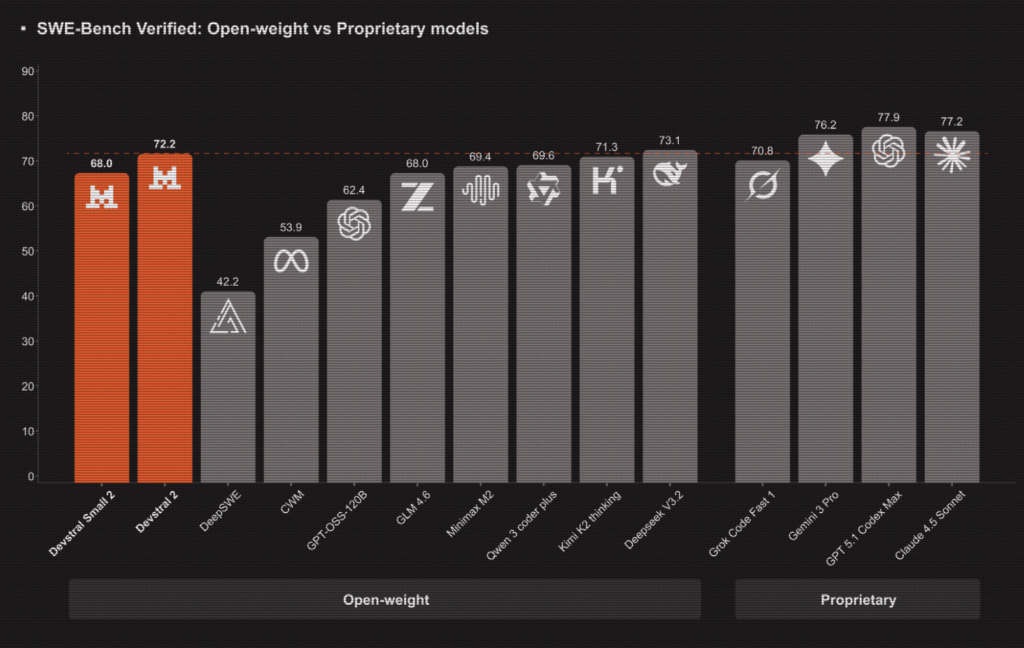
Mistral AI has introduced Devstral 2, a next generation coding model family for software engineering agents, together with Mistral Vibe CLI, an open source command line coding assistant that runs inside the terminal or IDEs that support the Agent Communication Protocol. https://mistral.ai/news/devstral-2-vibe-cli Devstral 2 and Devstral Small 2, model sizes, context and benchmarks Devstral 2 is a 123B parameter dense transformer with a 256K token context window. It reaches 72.2 percent on SWE-bench Verified, which places it among the strongest open weight models for software engineering tasks. The model is released as open weights under a modified MIT license and is currently free to use via the Mistral API. Devstral Small 2 is a 24B parameter model with the same 256K context window. It scores 68.0 percent on SWE-bench Verified and sits in the range of models that are up to 5 times larger in parameter count. It is released under the Apache 2.0 license, which is a standard permissive license for production use. Both models are described as open source and permissively licensed and are positioned as state of the art coding models for agentic workloads. Mistral reports that Devstral 2 is up to 7 times more cost efficient than Claude Sonnet on real world coding tasks at similar quality, which is important for continuous agent workloads. https://mistral.ai/news/devstral-2-vibe-cli In terms of model size relative to frontier systems, Devstral 2 and Devstral Small 2 are 5 times and 28 times smaller than DeepSeek V3.2, and 8 times and 41 times smaller than Kimi K2. Built for production grade coding workflows Devstral 2 is designed for software engineering agents that need to explore repositories, track dependencies and orchestrate edits across many files while maintaining architecture level context. The model can detect failures, retry with corrections and support tasks such as bug fixing or modernization of legacy systems at repository scale. Mistral states that Devstral 2 can be fine tuned to favor specific programming languages or to optimize for very large enterprise codebases. Devstral Small 2 brings the same design goals to a smaller footprint that is suitable for local deployment, tight feedback loops and fully private runtimes. It also supports image inputs and can drive multimodal agents that must reason over both code and visual artifacts such as diagrams or screenshots. https://mistral.ai/news/devstral-2-vibe-cli Human evaluations against DeepSeek V3.2 and Claude Sonnet 4.5 To test real world coding behavior, Mistral evaluated Devstral 2 against DeepSeek V3.2 and Claude Sonnet 4.5 using tasks scaffolded through the Cline agent tool. In these human evaluations Devstral 2 shows a clear advantage over DeepSeek V3.2 with a 42.8 percent win rate versus a 28.6 percent loss rate. Mistral Vibe CLI, a terminal native coding agent Mistral Vibe CLI is an open source command line coding assistant written in Python and powered by Devstral models. It explores, modifies and executes changes across a codebase using natural language in the terminal, or inside IDEs that support the Agent Communication Protocol such as Zed where it is available as an extension.The project is released under the Apache 2.0 license on GitHub. Vibe CLI provides a chat style interface on top of several key tools: Project aware context, it scans the file structure and Git status to build a working view of the repository. Smart references, it supports @ autocomplete for files, ! for shell commands and slash commands for configuration changes. Multi file orchestration, it reasons over the full codebase, not only the active buffer, to coordinate architecture level changes and reduce pull request cycle time. Persistent history, autocompletion and themes tuned for daily use in the terminal. Developers configure Vibe CLI through a simple config.toml file where they can point to Devstral 2 via the Mistral API or to other local or remote models. The tool supports programmatic runs, auto approval toggles for tool execution and granular permissions so that risky operations in sensitive repositories require confirmation. Key Takeaways Devstral 2 is a 123B parameter dense coding model with 256K context, it reaches 72.2 percent on SWE bench Verified and is released as open weights under a modified MIT license. Devstral Small 2 has 24B parameters with the same 256K context, it scores 68.0 percent on SWE bench Verified and uses an Apache 2.0 license for easier production adoption. Both Devstral models are optimized for agentic coding workloads, they are designed to explore full repositories, track dependencies and apply multi file edits with failure detection and retries. Mistral Vibe CLI is an open source Python based terminal native coding agent that connects to Devstral, it provides project aware context, smart references and multi file orchestration through a chat style interface in the terminal or IDEs that support the Agent Communication Protocol. Check out the Full Technical details here. Feel free to check out our GitHub Page for Tutorials, Codes and Notebooks. Also, feel free to follow us on Twitter and don’t forget to join our 100k+ ML SubReddit and Subscribe to our Newsletter. Wait! are you on telegram? now you can join us on telegram as well. The post Mistral AI Ships Devstral 2 Coding Models And Mistral Vibe CLI For Agentic, Terminal Native Development appeared first on MarkTechPost.

Mistral AI Ships Devstral 2 Coding Models And Mistral Vibe CLI For Agentic, Terminal Native Development Read Post »

AI, Committee, 新闻, Uncategorized

The AI that scored 95% — until consultants learned it was AI

Presented by SAP When SAP ran a quiet internal experiment to gauge consultant attitudes toward AI, the results were striking. Five teams were asked to validate answers to more than 1,000 business requirements completed by SAP’s AI co-pilot, Joule for Consultants — a workload that would normally take several weeks. Four teams were told the analysis had been completed by junior interns fresh out of school. They reviewed the material, found it impressive, and rated the work about 95% accurate. The fifth team was told the very same answers had come from AI. They rejected almost everything. Only when asked to validate each answer one by one did they discover that the AI was, in fact, highly accurate — surfacing detailed insights the consultants had initially dismissed. The overall accuracy? Again, about 95%. “The lesson learned here is that we need to be very cautious as we introduce AI — especially in how we communicate with senior consultants about its possibilities and how to integrate it into their workflows,” says Guillermo B. Vazquez Mendez, chief architect, RI business transformation and architecture, SAP America Inc. The experiment has since become a revealing starting point for SAP’s push toward the consultant of 2030: a practitioner who is deeply human, enabled by AI, and no longer weighed down by the technical grunt work of the past. Overcoming AI skepticism Resistance isn’t surprising, Vazquez notes. Consultants with two or three decades of experience carry enormous institutional knowledge — and an understandable degree of caution. But AI copilots like Joule for Consultants are not replacing expertise. They’re amplifying it. “What Joule really does is make their very expensive time far more effective,” Vazquez says. “It removes the clerical work, so they can focus on turning out high-quality answers in a fraction of the time.” He emphasizes this message constantly: “AI is not replacing you. It’s a tool for you. Human oversight is always required. But now, instead of spending your time looking for documentation, you’re gaining significant time and boosting the effectiveness and detail of your answers.” The consultant time-shift: from tech execution to business insight Historically, consultants spent about 80% of their time understanding technical systems — how processes run, how data flows, how functions execute. Customers, by contrast, spend 80% of their time focused on their business. That mismatch is exactly where Joule steps in. “There’s a gap there — and the bridge is AI,” Vazquez says. “It flips the time equation, enabling consultants to invest more of their energy in understanding the customer’s industry and business goals. AI takes on the heavy technical lift, so consultants can focus on driving the right business outcomes.” Bringing new consultants up to speed AI is also transforming how new hires learn. “We’re excited to see Joule acting as a bridge between senior consultants, who are adapting more slowly, and interns and new consultants who are already technically savvy,” Vazquez says. Junior consultants ramp up faster because Joule helps them operate independently. Seniors, meanwhile, engage where their insight matters most. This is also where many consultants learn the fundamentals of today’s AI copilots. Much of the work depends on prompt engineering — for instance, instructing Joule to act as a senior chief technology architect specializing in finance and SAP S/4HANA 2023, then asking it to analyze business requirements and deliver the output as tables or PowerPoint slides. Once they grasp how to frame prompts, consultants consistently get higher-quality, more structured answers. New architects are also able to communicate more clearly with their more experienced counterparts. They know what they don’t know and can ask targeted questions, which makes mentorship far smoother. It’s created a real synergy, Vazquez adds — senior consultants see how quickly new hires are adapting and learning with AI, and that momentum encourages them to keep pace and adopt the technology themselves. Looking ahead to the future of AI copilots “We’re still in the baby steps of AI — we’re toddlers,” Vazquez says. “Right now, copilots depend on prompt engineering to get good answers. The better you prompt, the better the answer you get.” But that represents only the earliest phase of what these systems will eventually do. As copilots mature, they’ll move beyond responding to prompts and start interpreting entire business processes — understanding the sequence of steps, identifying where human intervention is needed, and spotting where an AI agent could take over. That shift is what leads directly into agentic AI. SAP’s depth of process knowledge is what makes that evolution possible. The company has mapped more than 3,500 business processes across industries — a repository Vazquez calls “some of the most valuable, rigorously tested processes developed in the last 50 years.” Every day, SAP systems support roughly $7.3 trillion in global commerce, giving these emerging AI agents a rich foundation to navigate and reason over. “With that level of process insight and data, we can take a real leap forward,” he says, “equipping our consultants with agentic AI that can solve complex challenges and push us toward increasingly autonomous systems.” Sponsored articles are content produced by a company that is either paying for the post or has a business relationship with VentureBeat, and they’re always clearly marked. For more information, contact sales@venturebeat.com.

The AI that scored 95% — until consultants learned it was AI Read Post »

AI, Committee, 新闻, Uncategorized

NeuroABench: A Multimodal Evaluation Benchmark for Neurosurgical Anatomy Identification

arXiv:2512.06921v1 Announce Type: cross Abstract: Multimodal Large Language Models (MLLMs) have shown significant potential in surgical video understanding. With improved zero-shot performance and more effective human-machine interaction, they provide a strong foundation for advancing surgical education and assistance. However, existing research and datasets primarily focus on understanding surgical procedures and workflows, while paying limited attention to the critical role of anatomical comprehension. In clinical practice, surgeons rely heavily on precise anatomical understanding to interpret, review, and learn from surgical videos. To fill this gap, we introduce the Neurosurgical Anatomy Benchmark (NeuroABench), the first multimodal benchmark explicitly created to evaluate anatomical understanding in the neurosurgical domain. NeuroABench consists of 9 hours of annotated neurosurgical videos covering 89 distinct procedures and is developed using a novel multimodal annotation pipeline with multiple review cycles. The benchmark evaluates the identification of 68 clinical anatomical structures, providing a rigorous and standardized framework for assessing model performance. Experiments on over 10 state-of-the-art MLLMs reveal significant limitations, with the best-performing model achieving only 40.87% accuracy in anatomical identification tasks. To further evaluate the benchmark, we extract a subset of the dataset and conduct an informative test with four neurosurgical trainees. The results show that the best-performing student achieves 56% accuracy, with the lowest scores of 28% and an average score of 46.5%. While the best MLLM performs comparably to the lowest-scoring student, it still lags significantly behind the group’s average performance. This comparison underscores both the progress of MLLMs in anatomical understanding and the substantial gap that remains in achieving human-level performance.

NeuroABench: A Multimodal Evaluation Benchmark for Neurosurgical Anatomy Identification Read Post »

AI, Committee, 新闻, Uncategorized

Non-Collaborative User Simulators for Tool Agents

arXiv:2509.23124v3 Announce Type: replace Abstract: Tool agents interact with users through multi-turn dialogues to accomplish various tasks. Recent studies have adopted user simulation methods to develop these agents in multi-turn settings. However, existing user simulators tend to be agent-friendly, exhibiting only cooperative behaviors, which fails to train and test agents against non-collaborative users in the real world. To address this, we propose a novel user simulator architecture that simulates four categories of non-collaborative behaviors: requesting unavailable services, digressing into tangential conversations, expressing impatience, and providing incomplete utterances. Our user simulator can simulate challenging and natural non-collaborative behaviors while reliably delivering all intents and information necessary to accomplish the task. Our experiments on MultiWOZ and $tau$-bench reveal significant performance degradation in state-of-the-art tool agents when encountering non-collaborative users. We provide detailed analyses of agents’ weaknesses under each non-collaborative condition, such as escalated hallucinations and dialogue breakdowns. Ultimately, we contribute an easily extensible user simulation framework to help the research community develop tool agents and preemptively diagnose them under challenging real-world conditions within their own services.

Non-Collaborative User Simulators for Tool Agents Read Post »

AI, Committee, 新闻, Uncategorized

Large Language Models and Forensic Linguistics: Navigating Opportunities and Threats in the Age of Generative AI

arXiv:2512.06922v1 Announce Type: new Abstract: Large language models (LLMs) present a dual challenge for forensic linguistics. They serve as powerful analytical tools enabling scalable corpus analysis and embedding-based authorship attribution, while simultaneously destabilising foundational assumptions about idiolect through style mimicry, authorship obfuscation, and the proliferation of synthetic texts. Recent stylometric research indicates that LLMs can approximate surface stylistic features yet exhibit detectable differences from human writers, a tension with significant forensic implications. However, current AI-text detection techniques, whether classifier-based, stylometric, or watermarking approaches, face substantial limitations: high false positive rates for non-native English writers and vulnerability to adversarial strategies such as homoglyph substitution. These uncertainties raise concerns under legal admissibility standards, particularly the Daubert and Kumho Tire frameworks. The article concludes that forensic linguistics requires methodological reconfiguration to remain scientifically credible and legally admissible. Proposed adaptations include hybrid human-AI workflows, explainable detection paradigms beyond binary classification, and validation regimes measuring error and bias across diverse populations. The discipline’s core insight, i.e., that language reveals information about its producer, remains valid but must accommodate increasingly complex chains of human and machine authorship.

Large Language Models and Forensic Linguistics: Navigating Opportunities and Threats in the Age of Generative AI Read Post »

AI, Committee, 新闻, Uncategorized

Why They Disagree: Decoding Differences in Opinions about AI Risk on the Lex Fridman Podcast

arXiv:2512.06350v1 Announce Type: cross Abstract: The emergence of transformative technologies often surfaces deep societal divisions, nowhere more evident than in contemporary debates about artificial intelligence (AI). A striking feature of these divisions is that they persist despite shared interests in ensuring that AI benefits humanity and avoiding catastrophic outcomes. This paper analyzes contemporary debates about AI risk, parsing the differences between the “doomer” and “boomer” perspectives into definitional, factual, causal, and moral premises to identify key points of contention. We find that differences in perspectives about existential risk (“X-risk”) arise fundamentally from differences in causal premises about design vs. emergence in complex systems, while differences in perspectives about employment risks (“E-risks”) pertain to different causal premises about the applicability of past theories (evolution) vs their inapplicability (revolution). Disagreements about these two forms of AI risk appear to share two properties: neither involves significant disagreements on moral values and both can be described in terms of differing views on the extent of boundedness of human rationality. Our approach to analyzing reasoning chains at scale, using an ensemble of LLMs to parse textual data, can be applied to identify key points of contention in debates about risk to the public in any arena.

Why They Disagree: Decoding Differences in Opinions about AI Risk on the Lex Fridman Podcast Read Post »

AI, Committee, 新闻, Uncategorized

Zhipu AI Releases GLM-4.6V: A 128K Context Vision Language Model with Native Tool Calling

Zhipu AI has open sourced the GLM-4.6V series as a pair of vision language models that treat images, video and tools as first class inputs for agents, not as afterthoughts bolted on top of text. Model lineup and context length The series has 2 models. GLM-4.6V is a 106B parameter foundation model for cloud and high performance cluster workloads. GLM-4.6V-Flash is a 9B parameter variant tuned for local deployment and low latency use. GLM-4.6V extends the training context window to 128K tokens. In practice this supports roughly 150 pages of dense documents, 200 slide pages or one hour of video in a single pass because pages are encoded as images and consumed by the visual encoder. Native multimodal tool use The main technical change is native multimodal Function Calling. Traditional tool use in LLM systems routes everything through text. Images or pages are first turned into descriptions, the model calls tools using text arguments and then reads textual responses. This wastes information and increases latency. GLM-4.6V introduces native multimodal Function Calling. Images, screenshots and document pages pass directly as tool parameters. Tools can return search result grids, charts, rendered web pages or product images. The model consumes those visual outputs and fuses them with text in the same reasoning chain. This closes the loop from perception to understanding to execution and is explicitly positioned as the bridge between visual perception and executable action for multimodal agents. To support this, Zhipu AI extends the Model Context Protocol with URL based multimodal handling. Tools receive and return URLs that identify specific images or frames, which avoids file size limits and allows precise selection inside multi image contexts. Rich text content, web search and frontend replication Zhipu AI research team describes 4 canonical scenarios: First, rich text content understanding and creation. GLM-4.6V reads mixed inputs such as papers, reports or slide decks and produces structured image text interleaved outputs. It understands text, charts, figures, tables and formulas in the same document. During generation it can crop relevant visuals or retrieve external images through tools, then run a visual audit step that filters low quality images and composes the final article with inline figures. Second, visual web search. The model can detect user intent, plan which search tools to call and combine text to image and image to text search. It then aligns retrieved images and text, selects the relevant evidence and outputs a structured answer, for example a visual comparison of products or places. Third, frontend replication and visual interaction. GLM-4.6V is tuned for design to code workflows. From a UI screenshot, it reconstructs pixel accurate HTML, CSS and JavaScript. Developers can then mark a region on the screenshot and issue natural language instructions, for example move this button left or change this card background. The model maps those instructions back to the code and returns an updated snippet. Fourth, multimodal document understanding at long context. GLM-4.6V can read multi document inputs up to the 128K token context limit by treating pages as images. The research team reports a case where the model processes financial reports from 4 public companies, extracts core metrics and builds a comparison table, and a case where it summarises a full football match while keeping the ability to answer questions about specific goals and timestamps. Architecture, data and reinforcement learning The GLM-4.6V models belong to the GLM-V family and based on the tech report for GLM-4.5V and GLM-4.1V-Thinking. The research team highlights three main technical ingredients. First, long sequence modeling. GLM-4.6V extends the training context window to 128K tokens and runs continual pre training on massive long context image text corpora. It uses compression alignment ideas from Glyph so that visual tokens can carry dense information that is aligned with language tokens. Second, world knowledge enhancement. Zhipu AI team adds a billion scale multimodal perception and world knowledge dataset at pre training time. This covers layered encyclopedic concepts and everyday visual entities. The stated goal is to improve both basic perception and cross modal question answering completeness, not only benchmarks. Third, agentic data synthesis and extended MCP. The research team generates large synthetic traces where the model calls tools, processes visual outputs and iterates on plans. They extend MCP with URL based multimodal handling and an interleaved output mechanism. The generation stack follows a Draft, Image Selection, Final Polish sequence. The model can autonomously call cropping or search tools between these stages to place images at the right positions in the output. Tool invocation is part of the reinforcement learning objective. GLM-4.6V uses RL to align planning, instruction following and format adherence in complex tool chains. Performance https://z.ai/blog/glm-4.6v Key Takeaways GLM-4.6V is a 106B multimodal foundation model with a 128K token training context, and GLM-4.6V-Flash is a 9B variant optimized for local and low latency use. Both models support native multimodal Function Calling so tools can consume and return images, video frames and document pages directly, which links visual perception to executable actions for agents. GLM-4.6V is trained for long context multimodal understanding and interleaved generation, so it can read large mixed document sets and emit structured text with inline figures and tool selected images in one pass. The series achieves state of the art performance on major multimodal benchmarks at similar parameter scales and is released as open source weights under the MIT license on Hugging Face and ModelScope. Check out the Model Card on HF and Technical details. Feel free to check out our GitHub Page for Tutorials, Codes and Notebooks. Also, feel free to follow us on Twitter and don’t forget to join our 100k+ ML SubReddit and Subscribe to our Newsletter. Wait! are you on telegram? now you can join us on telegram as well. The post Zhipu AI Releases GLM-4.6V: A 128K Context Vision Language Model with Native Tool Calling appeared first on MarkTechPost.

Zhipu AI Releases GLM-4.6V: A 128K Context Vision Language Model with Native Tool Calling Read Post »

We use cookies to improve your experience and performance on our website. You can learn more at 隱私權政策 and manage your privacy settings by clicking Settings.

Privacy Preferences

You can choose your cookie settings by turning on/off each type of cookie as you wish, except for essential cookies.

Allow All
Manage Consent Preferences
  • Always Active

Save
zh_CN