YouZum

Uncategorized

AI, Committee, 新闻, Uncategorized

Does It Tie Out? Towards Autonomous Legal Agents in Venture Capital

arXiv:2512.18658v1 Announce Type: new Abstract: Before closing venture capital financing rounds, lawyers conduct diligence that includes tying out the capitalization table: verifying that every security (for example, shares, options, warrants) and issuance term (for example, vesting schedules, acceleration triggers, transfer restrictions) is supported by large sets of underlying legal documentation. While LLMs continue to improve on legal benchmarks, specialized legal workflows, such as capitalization tie-out, remain out of reach even for strong agentic systems. The task requires multi-document reasoning, strict evidence traceability, and deterministic outputs that current approaches fail to reliably deliver. We characterize capitalization tie-out as an instance of a real-world benchmark for legal AI, analyze and compare the performance of existing agentic systems, and propose a world model architecture toward tie-out automation-and more broadly as a foundation for applied legal intelligence.

Does It Tie Out? Towards Autonomous Legal Agents in Venture Capital Read Post »

AI, Committee, 新闻, Uncategorized

Seed-Prover 1.5: Mastering Undergraduate-Level Theorem Proving via Learning from Experience

arXiv:2512.17260v1 Announce Type: new Abstract: Large language models have recently made significant progress to generate rigorous mathematical proofs. In contrast, utilizing LLMs for theorem proving in formal languages (such as Lean) remains challenging and computationally expensive, particularly when addressing problems at the undergraduate level and beyond. In this work, we present textbf{Seed-Prover 1.5}, a formal theorem-proving model trained via large-scale agentic reinforcement learning, alongside an efficient test-time scaling (TTS) workflow. Through extensive interactions with Lean and other tools, the model continuously accumulates experience during the RL process, substantially enhancing the capability and efficiency of formal theorem proving. Furthermore, leveraging recent advancements in natural language proving, our TTS workflow efficiently bridges the gap between natural and formal languages. Compared to state-of-the-art methods, Seed-Prover 1.5 achieves superior performance with a smaller compute budget. It solves textbf{88% of PutnamBench} (undergraduate-level), textbf{80% of Fate-H} (graduate-level), and textbf{33% of Fate-X} (PhD-level) problems. Notably, using our system, we solved textbf{11 out of 12 problems} from Putnam 2025 within 9 hours. Our findings suggest that scaling learning from experience, driven by high-quality formal feedback, holds immense potential for the future of formal mathematical reasoning.

Seed-Prover 1.5: Mastering Undergraduate-Level Theorem Proving via Learning from Experience Read Post »

AI, Committee, 新闻, Uncategorized

Studying the Effects of Collaboration in Interactive Theme Discovery Systems

arXiv:2408.09030v4 Announce Type: replace Abstract: NLP-assisted solutions have gained considerable traction to support qualitative data analysis. However, there does not exist a unified evaluation framework that can account for the many different settings in which qualitative researchers may employ them. In this paper, we take a first step in this direction by proposing an evaluation framework to study the way in which different tools may result in different outcomes depending on the collaboration strategy employed. Specifically, we study the impact of synchronous vs. asynchronous collaboration using two different NLP-assisted qualitative research tools and present a comprehensive analysis of significant differences in the consistency, cohesiveness, and correctness of their outputs.

Studying the Effects of Collaboration in Interactive Theme Discovery Systems Read Post »

AI, Committee, 新闻, Uncategorized

Governance-Aware Hybrid Fine-Tuning for Multilingual Large Language Models

arXiv:2512.17344v1 Announce Type: new Abstract: We present a governance-aware hybrid fine-tuning framework for multilingual, low-resource adaptation of large language models. The core algorithm combines gradient-aligned low-rank updates with structured orthogonal transformations through layer-wise mixing and introduces unitary constraints in selected sub-layers to stabilize deep optimization. In tandem with lightweight, label-free data governance steps, including language identification, near-duplicate removal, and quality filtering, the framework targets accuracy, calibration, and cross-language parity under tight compute budgets. Across XNLI and FLORES, the hybrid approach delivers consistent gains over strong PEFT baselines while maintaining directional balance and improving probability calibration, as shown in Tables II and III. It is more resilient to lightweight orthographic variants, as shown in Table IV, and benefits additively from simple governance steps, as shown in Table V. Training footprint measurements indicate modest overhead and a favorable cost-quality frontier, as shown in Table VI and Figure 2. Together, these results show that hybrid and unitary PEFT provide a stable and accessible path to resource-efficient multilingual adaptation when paired with practical data governance.

Governance-Aware Hybrid Fine-Tuning for Multilingual Large Language Models Read Post »

AI, Committee, 新闻, Uncategorized

LookAhead Tuning: Safer Language Models via Partial Answer Previews

arXiv:2503.19041v4 Announce Type: replace Abstract: Fine-tuning enables large language models (LLMs) to adapt to specific domains, but often compromises their previously established safety alignment. To mitigate the degradation of model safety during fine-tuning, we introduce LookAhead Tuning, a lightweight and effective data-driven approach that preserves safety during fine-tuning. The method introduces two simple strategies that modify training data by previewing partial answer prefixes, thereby minimizing perturbations to the model’s initial token distributions and maintaining its built-in safety mechanisms. Comprehensive experiments demonstrate that LookAhead Tuning effectively maintains model safety without sacrificing robust performance on downstream tasks. Our findings position LookAhead Tuning as a reliable and efficient solution for the safe and effective adaptation of LLMs.

LookAhead Tuning: Safer Language Models via Partial Answer Previews Read Post »

AI, Committee, 新闻, Uncategorized

Generating Completions for Broca’s Aphasic Sentences Using Large Language Models

arXiv:2412.17669v2 Announce Type: replace Abstract: Broca’s aphasia is a type of aphasia characterized by non-fluent, effortful and agrammatic speech production with relatively good comprehension. Since traditional aphasia treatment methods are often time-consuming, labour-intensive, and do not reflect real-world conversations, applying natural language processing based approaches such as Large Language Models (LLMs) could potentially contribute to improving existing treatment approaches. To address this issue, we explore the use of sequence-to-sequence LLMs for completing Broca’s aphasic sentences. We first generate synthetic Broca’s aphasic data using a rule-based system designed to mirror the linguistic characteristics of Broca’s aphasic speech. Using this synthetic data (without authentic aphasic samples), we then fine-tune four pre-trained LLMs on the task of completing agrammatic sentences. We evaluate our fine-tuned models on both synthetic and authentic Broca’s aphasic data. We demonstrate LLMs’ capability for reconstructing agrammatic sentences, with the models showing improved performance with longer input utterances. Our result highlights the LLMs’ potential in advancing communication aids for individuals with Broca’s aphasia and possibly other clinical populations.

Generating Completions for Broca’s Aphasic Sentences Using Large Language Models Read Post »

AI, Committee, 新闻, Uncategorized

Hiring specialists made sense before AI — now generalists win

Tony Stoyanov is CTO and co-founder of EliseAI In the 2010s, tech companies chased staff-level specialists: Backend engineers, data scientists, system architects. That model worked when technology evolved slowly. Specialists knew their craft, could deliver quickly and built careers on predictable foundations like cloud infrastructure or the latest JS framework Then AI went mainstream. The pace of change has exploded. New technologies appear and mature in less than a year. You can’t hire someone who has been building AI agents for five years, as the technology hasn’t existed for that long. The people thriving today aren’t those with the longest résumés; they’re the ones who learn fast, adapt fast and act without waiting for direction. Nowhere is this transformation more evident than in software engineering, which has likely experienced the most dramatic shift of all, evolving faster than almost any other field of work. How AI Is rewriting the rules AI has lowered the barrier to doing complex technical work, technical skills and it’s also raised expectations for what counts as real expertise. McKinsey estimates that by 2030, up to 30% of U.S. work hours could be automated and 12 million workers may need to shift roles entirely. Technical depth still matters, but AI favors people who can figure things out as they go. At my company, I see this every day. Engineers who never touched front-end code are now building UIs, while front-end developers are moving into back-end work. The technology keeps getting easier to use but the problems are harder because they span more disciplines. In that kind of environment, being great at one thing isn’t enough. What matters is the ability to bridge engineering, product and operations to make good decisions quickly, even with imperfect information. Despite all the excitement, only 1% of companies consider themselves truly mature in how they use AI. Many still rely on structures built for a slower era — layers of approval, rigid roles and an overreliance on specialists who can’t move outside their lane. The traits of a strong generalist  A strong generalist has breadth without losing depth. They go deep in one or two domains but stay fluent across many. As David Epstein puts it in Range, “You have people walking around with all the knowledge of humanity on their phone, but they have no idea how to integrate it. We don’t train people in thinking or reasoning.” True expertise comes from connecting the dots, not just collecting information. The best generalists share these traits: Ownership: End-to-end accountability for outcomes, not just tasks. First-principles thinking: Question assumptions, focus on the goal, and rebuild when needed. Adaptability: Learn new domains quickly and move between them smoothly. Agency: Act without waiting for approval and adjust as new information comes in. Soft skills: Communicate clearly, align teams and keep customers’ needs in focus. Range: Solve different kinds of problems and draw lessons across contexts. I try to make accountability a priority for my teams. Everyone knows what they own, what success looks like and how it connects to the mission. Perfection isn’t the goal, forward movement is. Embracing the shift Focusing on adaptable builders changed everything. These are the people with the range and curiosity to use AI tools to learn quickly and execute confidently. If you’re a builder who thrives in ambiguity, this is your time. The AI era rewards curiosity and initiative more than credentials. If you’re hiring, look ahead. The people who’ll move your company forward might not be the ones with the perfect résumé for the job. They’re the ones who can grow into what the company will need as it evolves. The future belongs to generalists and to the companies that trust them. Read more from our guest writers. Or, consider submitting a post of your own! See our guidelines here.

Hiring specialists made sense before AI — now generalists win Read Post »

AI, Committee, 新闻, Uncategorized

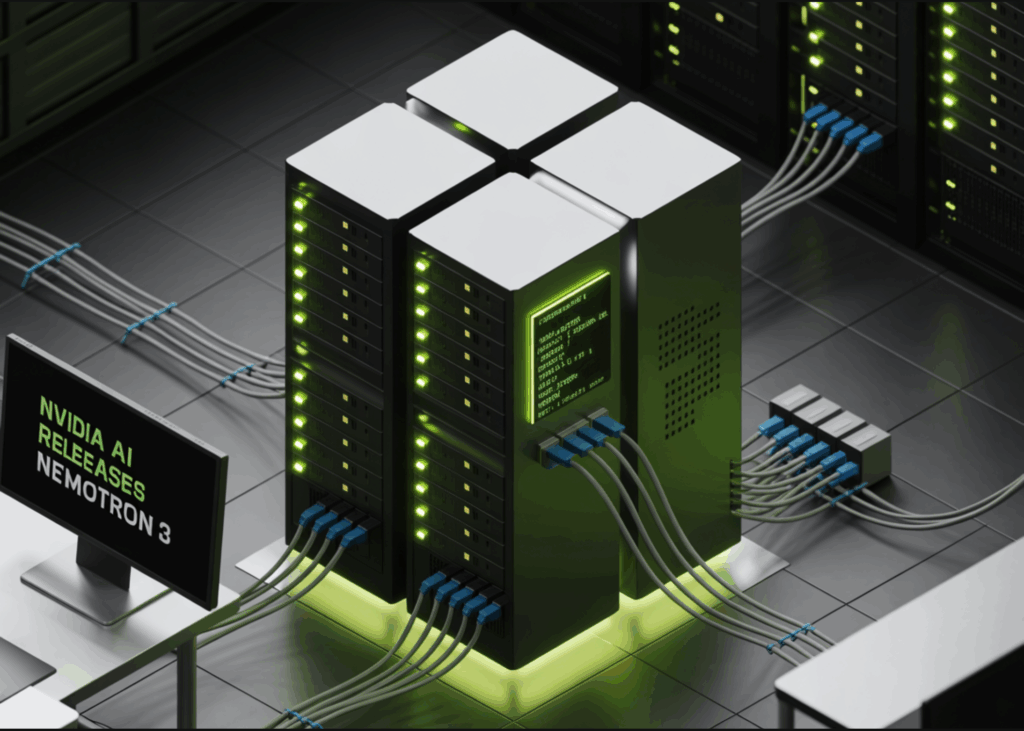
NVIDIA AI Releases Nemotron 3: A Hybrid Mamba Transformer MoE Stack for Long Context Agentic AI

NVIDIA has released the Nemotron 3 family of open models as part of a full stack for agentic AI, including model weights, datasets and reinforcement learning tools. The family has three sizes, Nano, Super and Ultra, and targets multi agent systems that need long context reasoning with tight control over inference cost. Nano has about 30 billion parameters with about 3 billion active per token, Super has about 100 billion parameters with up to 10 billion active per token, and Ultra has about 500 billion parameters with up to 50 billion active per token. https://research.nvidia.com/labs/nemotron/files/NVIDIA-Nemotron-3-Nano-Technical-Report.pdf Model family and target workloads Nemotron 3 is presented as an efficient open model family for agentic applications. The line consists of Nano, Super and Ultra models, each tuned for different workload profiles. Nemotron 3 Nano is a Mixture of Experts hybrid Mamba Transformer language model with about 31.6 billion parameters. Only about 3.2 billion parameters are active per forward pass, or 3.6 billion including embeddings. This sparse activation allows the model to keep high representational capacity while keeping compute low. Nemotron 3 Super has about 100 billion parameters with up to 10 billion active per token. Nemotron 3 Ultra scales this design to about 500 billion parameters with up to 50 billion active per token. Super targets high accuracy reasoning for large multi agent applications, while Ultra is intended for complex research and planning workflows. Nemotron 3 Nano is available now with open weights and recipes, on Hugging Face and as an NVIDIA NIM microservice. Super and Ultra are scheduled for the first half of 2026. NVIDIA Nemotron 3 Nano delivers about 4 times higher token throughput than Nemotron 2 Nano and reduces reasoning token usage significantly, while supporting a native context length of up to 1 million tokens. This combination is intended for multi agent systems that operate on large workspaces such as long documents and large code bases. https://research.nvidia.com/labs/nemotron/files/NVIDIA-Nemotron-3-Nano-Technical-Report.pdf Hybrid Mamba Transformer MoE architecture The core design of Nemotron 3 is a Mixture of Experts hybrid Mamba Transformer architecture. The models mix Mamba sequence blocks, attention blocks and sparse expert blocks inside a single stack. For Nemotron 3 Nano, the research team describes a pattern that interleaves Mamba 2 blocks, attention blocks and MoE blocks. Standard feedforward layers from earlier Nemotron generations are replaced by MoE layers. A learned router selects a small subset of experts per token, for example 6 out of 128 routable experts for Nano, which keeps the active parameter count close to 3.2 billion while the full model holds 31.6 billion parameters. https://research.nvidia.com/labs/nemotron/files/NVIDIA-Nemotron-3-Nano-Technical-Report.pdf Mamba 2 handles long range sequence modeling with state space style updates, attention layers provide direct token to token interactions for structure sensitive tasks, and MoE provides parameter scaling without proportional compute scaling. The important point is that most layers are either fast sequence or sparse expert computations, and full attention is used only where it matters most for reasoning. For Nemotron 3 Super and Ultra, NVIDIA adds LatentMoE. Tokens are projected into a lower dimensional latent space, experts operate in that latent space, then outputs are projected back. This design allows several times more experts at similar communication and compute cost, which supports more specialization across tasks and languages. Super and Ultra also include multi token prediction. Multiple output heads share a common trunk and predict several future tokens in a single pass. During training this improves optimization, and at inference it enables speculative decoding like execution with fewer full forward passes. Training data, precision format and context window Nemotron 3 is trained on large scale text and code data. The research team reports pretraining on about 25 trillion tokens, with more than 3 trillion new unique tokens over the Nemotron 2 generation. Nemotron 3 Nano uses Nemotron Common Crawl v2 point 1, Nemotron CC Code and Nemotron Pretraining Code v2, plus specialized datasets for scientific and reasoning content. Super and Ultra are trained mostly in NVFP4, a 4 bit floating point format optimized for NVIDIA accelerators. Matrix multiply operations run in NVFP4 while accumulations use higher precision. This reduces memory pressure and improves throughput while keeping accuracy close to standard formats. All Nemotron 3 models support context windows up to 1 million tokens. The architecture and training pipeline are tuned for long horizon reasoning across this length, which is essential for multi agent environments that pass large traces and shared working memory between agents. Key Takeaways Nemotron 3 is a three tier open model family for agentic AI: Nemotron 3 comes in Nano, Super and Ultra variants. Nano has about 30 billion parameters with about 3 billion active per token, Super has about 100 billion parameters with up to 10 billion active per token, and Ultra has about 500 billion parameters with up to 50 billion active per token. The family targets multi agent applications that need efficient long context reasoning. Hybrid Mamba Transformer MoE with 1 million token context: Nemotron 3 models use a hybrid Mamba 2 plus Transformer architecture with sparse Mixture of Experts and support a 1 million token context window. This design gives long context handling with high throughput, where only a small subset of experts is active per token and attention is used where it is most useful for reasoning. Latent MoE and multi token prediction in Super and Ultra: The Super and Ultra variants add latent MoE where expert computation happens in a reduced latent space, which lowers communication cost and allows more experts, and multi token prediction heads that generate several future tokens per forward pass. These changes improve quality and enable speculative style speedups for long text and chain of thought workloads. Large scale training data and NVFP4 precision for efficiency: Nemotron 3 is pretrained on about 25 trillion tokens, with more than 3 trillion new tokens over the previous generation, and Super and Ultra are trained mainly in NVFP4, a 4 bit floating point format for NVIDIA GPUs. This combination improves throughput and reduces memory use while keeping accuracy close to standard precision.

NVIDIA AI Releases Nemotron 3: A Hybrid Mamba Transformer MoE Stack for Long Context Agentic AI Read Post »

AI, Committee, 新闻, Uncategorized

Google Introduces T5Gemma 2: Encoder Decoder Models with Multimodal Inputs via SigLIP and 128K Context

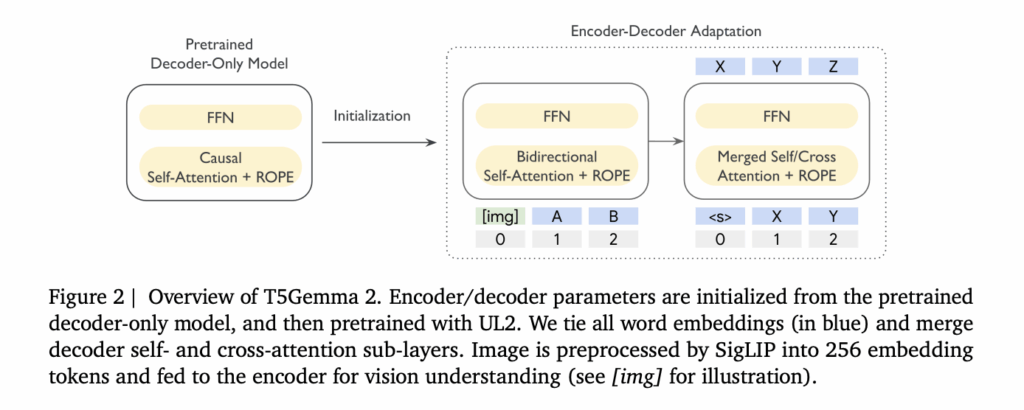
Google has released T5Gemma 2, a family of open encoder-decoder Transformer checkpoints built by adapting Gemma 3 pretrained weights into an encoder-decoder layout, then continuing pretraining with the UL2 objective. The release is pretrained only, intended for developers to post-train for specific tasks, and Google explicitly notes it is not releasing post-trained or IT checkpoints for this drop. T5Gemma 2 is positioned as an encoder-decoder counterpart to Gemma 3 that keeps the same low level building blocks, then adds 2 structural changes aimed at small model efficiency. The models inherit Gemma 3 features that matter for deployment, notably multimodality, long context up to 128K tokens, and broad multilingual coverage, with the blog stating over 140 languages. https://arxiv.org/pdf/2512.14856 What Google actually released? The release includes 3 pretrained sizes, 270M-270M, 1B-1B, and 4B-4B, where the notation means the encoder and decoder are the same size. The research team reports approximate totals excluding the vision encoder, about 370M, 1.7B, and 7B parameters. The multimodal accounting lists a 417M parameter vision encoder, along with encoder and decoder parameters broken into embedding and non embedding components. The adaptation, encoder-decoder without training from scratch T5Gemma 2 follows the same adaptation idea introduced in T5Gemma, initialize an encoder-decoder model from a decoder-only checkpoint, then adapt with UL2. In the above figure the research team show encoder and decoder parameters initialized from the pretrained decoder-only model, then pretrained with UL2, with images first converted by SigLIP into 256 tokens. This matters because encoder-decoder splits the workload, the encoder can read the full input bidirectionally, while the decoder focuses on autoregressive generation. The research team argues this separation can help long context tasks where the model must retrieve relevant evidence from a large input before generating. Two efficiency changes that are easy to miss but affect small models First, T5Gemma 2 uses tied word embeddings across encoder input embedding, decoder input embedding, and decoder output or softmax embedding. This reduces parameter redundancy, and references an ablation showing little quality change while reducing embedding parameters. Second, it introduces merged attention in the decoder. Instead of separate self-attention and cross-attention sublayers, the decoder performs a single attention operation where K and V are formed by concatenating encoder outputs and decoder states, and masking preserves causal visibility for decoder tokens. This ties to easier initialization, because it narrows differences between the adapted decoder and the original Gemma style decoder stack, and it reports parameter savings with a small average quality drop in their ablations. https://arxiv.org/pdf/2512.14856 https://arxiv.org/pdf/2512.14856 Multimodality, image understanding is encoder side, not decoder side T5Gemma 2 is multimodal by reusing Gemma 3’s vision encoder and keeping it frozen during training. Vision tokens are always fed to the encoder and encoder tokens have full visibility to each other in self attention. This is a pragmatic encoder-decoder design, the encoder fuses image tokens with text tokens into contextual representations, and the decoder can then attend to those representations while generating text. On the tooling side, T5Gemma 2 is placed under an image-text-to-text pipeline, which matches the research’s design, image in, text prompt in, text out. That pipeline example is the fastest way to validate the end to end multimodal path, including dtype choices like bfloat16 and automatic device mapping. Long context to 128K, what enables it Google researchers attributes the 128K context window to Gemma 3’s alternating local and global attention mechanism. The Gemma 3 team describes a repeating 5 to 1 pattern, 5 local sliding window attention layers followed by 1 global attention layer, with a local window size of 1024. This design reduces KV cache growth relative to making every layer global, which is one reason long context becomes feasible at smaller footprints. In the T5Gemma 2, the research team also mention adopting positional interpolation methods for long context, and they pretrain on sequences up to 16K input paired with 16K target outputs, then evaluate long context performance up to 128K on benchmarks including RULER and MRCR. The detailed pretraining results table includes 32K and 128K evaluations, showing the long context deltas they claim over Gemma 3 at the same scale. https://arxiv.org/pdf/2512.14856 Training setup and what “pretrained only” implies for users The research team states the models are pretrained on 2T tokens and describes a training setup that includes a batch size of 4.2M tokens, cosine learning rate decay with 100 warmup steps, global gradient clipping at 1.0, and checkpoint averaging over the last 5 checkpoints. Key Takeaways T5Gemma 2 is an encoder decoder family adapted from Gemma 3 and continued with UL2, it reuses Gemma 3 pretrained weights, then applies the same UL2 based adaptation recipe used in T5Gemma. Google released pretrained checkpoints only, no post trained or instruction tuned variants are included in this drop, so downstream use requires your own post training and evaluation. Multimodal input is handled by a SigLIP vision encoder that outputs 256 image tokens and stays frozen, those vision tokens go into the encoder, the decoder generates text. Two parameter efficiency changes are central, tied word embeddings share encoder, decoder, and output embeddings, merged attention unifies decoder self attention and cross attention into a single module. Long context up to 128K is enabled by Gemma 3’s interleaved attention design, a repeating 5 local sliding window layers with window size 1024 followed by 1 global layer, and T5Gemma 2 inherits this mechanism. Check out the Paper, Technical details and Model on Hugging Face. Also, feel free to follow us on Twitter and don’t forget to join our 100k+ ML SubReddit and Subscribe to our Newsletter. Wait! are you on telegram? now you can join us on telegram as well. The post Google Introduces T5Gemma 2: Encoder Decoder Models with Multimodal Inputs via SigLIP and 128K Context appeared first on MarkTechPost.

Google Introduces T5Gemma 2: Encoder Decoder Models with Multimodal Inputs via SigLIP and 128K Context Read Post »

We use cookies to improve your experience and performance on our website. You can learn more at 隱私權政策 and manage your privacy settings by clicking Settings.

Privacy Preferences

You can choose your cookie settings by turning on/off each type of cookie as you wish, except for essential cookies.

Allow All
Manage Consent Preferences
  • Always Active

Save
zh_CN