YouZum

Committee

AI, Committee, 新闻, Uncategorized

Why Context Matters: Transforming AI Model Evaluation with Contextualized Queries

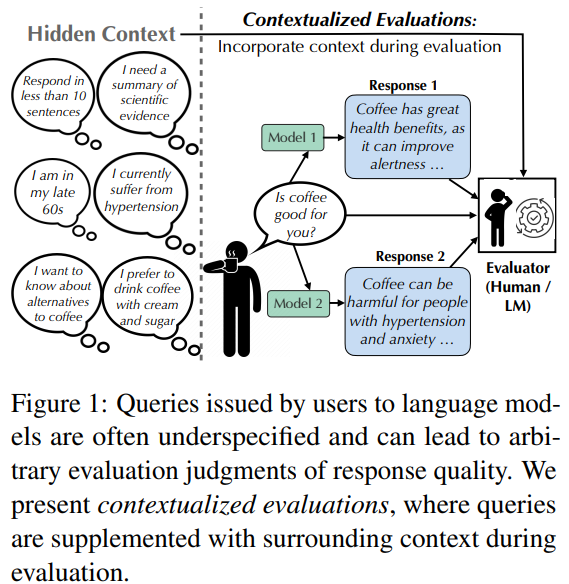
Language model users often ask questions without enough detail, making it hard to understand what they want. For example, a question like “What book should I read next?” depends heavily on personal taste. At the same time, “How do antibiotics work?” should be answered differently depending on the user’s background knowledge. Current evaluation methods often overlook this missing context, resulting in inconsistent judgments. For instance, a response praising coffee might seem fine, but could be unhelpful or even harmful for someone with a health condition. Without knowing the user’s intent or needs, it’s difficult to fairly assess a model’s response quality.  Prior research has focused on generating clarification questions to address ambiguity or missing information in tasks such as Q&A, dialogue systems, and information retrieval. These methods aim to improve the understanding of user intent. Similarly, studies on instruction-following and personalization emphasize the importance of tailoring responses to user attributes, such as expertise, age, or style preferences. Some works have also examined how well models adapt to diverse contexts and proposed training methods to enhance this adaptability. Additionally, language model-based evaluators have gained traction due to their efficiency, although they can be biased, prompting efforts to improve their fairness through clearer evaluation criteria.  Researchers from the University of Pennsylvania, the Allen Institute for AI, and the University of Maryland, College Park have proposed contextualized evaluations. This method adds synthetic context (in the form of follow-up question-answer pairs) to clarify underspecified queries during language model evaluation. Their study reveals that including context can significantly impact evaluation outcomes, sometimes even reversing model rankings, while also improving agreement between evaluators. It reduces reliance on superficial features, such as style, and uncovers potential biases in default model responses, particularly toward WEIRD (Western, Educated, Industrialized, Rich, Democratic) contexts. The work also demonstrates that models exhibit varying sensitivities to different user contexts.  The researchers developed a simple framework to evaluate how language models perform when given clearer, contextualized queries. First, they selected underspecified queries from popular benchmark datasets and enriched them by adding follow-up question-answer pairs that simulate user-specific contexts. They then collected responses from different language models. They had both human and model-based evaluators compare responses in two settings: one with only the original query, and another with the added context. This allowed them to measure how context affects model rankings, evaluator agreement, and the criteria used for judgment. Their setup offers a practical way to test how models handle real-world ambiguity.  Adding context, such as user intent or audience, greatly improves model evaluation, boosting inter-rater agreement by 3–10% and even reversing model rankings in some cases. For instance, GPT-4 outperformed Gemini-1.5-Flash only when context was provided. Without it, evaluations focus on tone or fluency, while context shifts attention to accuracy and helpfulness. Default generations often reflect Western, formal, and general-audience biases, making them less effective for diverse users. Current benchmarks that ignore context risk produce unreliable results. To ensure fairness and real-world relevance, evaluations must pair context-rich prompts with matching scoring rubrics that reflect the actual needs of users.  In conclusion, Many user queries to language models are vague, lacking key context like user intent or expertise. This makes evaluations subjective and unreliable. To address this, the study proposes contextualized evaluations, where queries are enriched with relevant follow-up questions and answers. This added context helps shift the focus from surface-level traits to meaningful criteria, such as helpfulness, and can even reverse model rankings. It also reveals underlying biases; models often default to WEIRD (Western, Educated, Industrialized, Rich, Democratic) assumptions. While the study uses a limited set of context types and relies partly on automated scoring, it offers a strong case for more context-aware evaluations in future work.  Check out the Paper, Code, Dataset and Blog. All credit for this research goes to the researchers of this project. SUBSCRIBE NOW to our AI Newsletter The post Why Context Matters: Transforming AI Model Evaluation with Contextualized Queries appeared first on MarkTechPost.

Why Context Matters: Transforming AI Model Evaluation with Contextualized Queries Read Post »
AI, Committee, 新闻, Uncategorized

CoSyn: The open-source tool that’s making GPT-4V-level vision AI accessible to everyone

Researchers at the University of Pennsylvania and the Allen Institute for Artificial Intelligence have developed a groundbreaking tool that allows open-source AI systems to match or surpass the visual understanding capabilities of proprietary models like GPT-4V and Gemini 1.5 Flash, potentially reshaping the competitive landscape between open and c…Read More

CoSyn: The open-source tool that’s making GPT-4V-level vision AI accessible to everyone Read Post »

AI, Committee, 新闻, Uncategorized

FEEDER: A Pre-Selection Framework for Efficient Demonstration Selection in LLMs

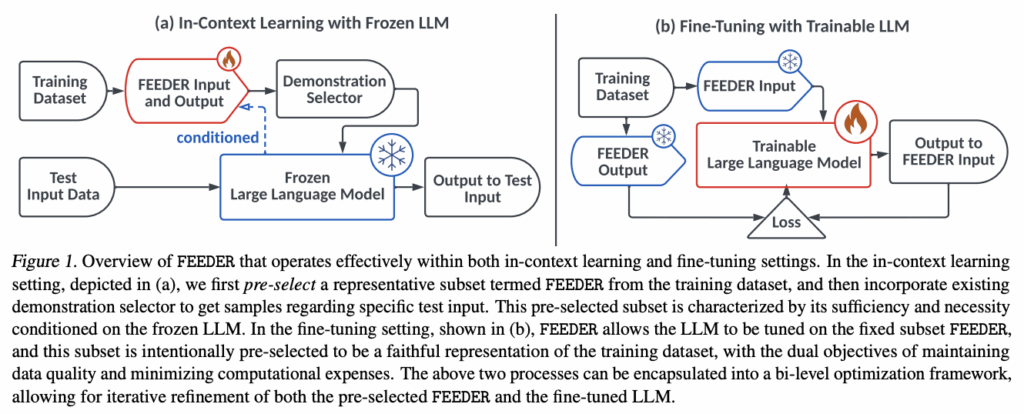
LLMs have demonstrated exceptional performance across multiple tasks by utilizing few-shot inference, also known as in-context learning (ICL). The main problem lies in selecting the most representative demonstrations from large training datasets. Early methods selected demonstrations based on relevance using similarity scores between each example and the input question. Current methods suggest using additional selection rules, along with similarity, to enhance the efficiency of demonstration selection. These improvements introduce significant computational overhead when the number of shots increases. The effectiveness of selected demonstrations should also consider the specific LLM in use, as different LLMs exhibit varying capabilities and knowledge domains. Researchers from Shanghai Jiao Tong University, Xiaohongshu Inc., Carnegie Mellon University, Peking University, No Affiliation, University College London, and University of Bristol have proposed FEEDER (FEw yet Essential Demonstration prE-selectoR), a method to identify a core subset of demonstrations containing the most representative examples in training data, adjusted to specific LLMs. To construct this subset, “sufficiency” and “necessity” metrics are introduced in the pre-selection stage, along with a tree-based algorithm. Moreover, FEEDER reduces training data size by 20% while maintaining performance and seamlessly integrating with various downstream demonstration selection techniques in ICL across LLMs ranging from 300M to 8B parameters. FEEDER is evaluated on 6 text classification datasets: SST-2, SST-5, COLA, TREC, SUBJ, and FPB, covering tasks from sentiment classification and linguistic analysis to textual entailment. It is also evaluated on the reasoning dataset GSM8K, the semantic-parsing dataset SMCALFlow, and the scientific question-answering dataset GPQA. The official splits for each dataset are directly followed to get the training and test data. Moreover, multiple LLM variants are utilized to evaluate the performance of the method, including two GPT-2 variants, GPT-neo with 1.3B parameters, GPT-3 with 6B parameters, Gemma-2 with 2B parameters, Llama-2 with 7B parameters, Llama-3 with 8B parameters, and Qwen-2.5 with 32B parameters as the LLM base. Results regarding in-context learning performance show that FEEDER enables retention of almost half the training samples while achieving superior or comparable performance. Evaluation of few-shot performance on complex tasks using LLMs like Gemma-2 shows that FEEDER improves performance even when LLMs struggle with challenging tasks. It performs effectively with large numbers of shots, handling situations where LLM performance usually drops when the number of examples increases from 5 to 10 due to noisy or repeated demonstrations. Moreover, FEEDER minimizes negative impact on LLM performance by evaluating the sufficiency and necessity of each demonstration, and helps in the performance stability of LLMs On bi-level optimization, FEEDER achieves improved performance by utilizing a small yet high-quality dataset for fine-tuning while simultaneously reducing computational expenses, aligning with the core-set selection principle. Results indicate that fine-tuning LLMs provides greater performance improvements compared to augmenting LLMs with contexts, with FEEDER achieving even better performance gains in fine-tuning settings. Performance analysis reveals that FEEDER’s effectiveness first rises and then drops with increasing number of runs or rounds (R and K, respectively), confirming that identifying representative subsets from training datasets enhances LLM performance. However, overly narrow subsets may limit potential performance gains. In conclusion, researchers introduced FEEDER, a demonstration pre-selector designed to use LLM capabilities and domain knowledge to identify high-quality demonstrations through an efficient discovery approach. It reduces training data requirements while maintaining comparable performance, offering a practical solution for efficient LLM deployment. Future research directions include exploring applications with larger LLMs and extending FEEDER’s capabilities to areas such as data safety and data management. FEEDER makes a valuable contribution to demonstration selection, providing researchers and practitioners with an effective tool for optimizing LLM performance while reducing computational overhead. Check out the Paper. All credit for this research goes to the researchers of this project. Meet the AI Dev Newsletter read by 40k+ Devs and Researchers from NVIDIA, OpenAI, DeepMind, Meta, Microsoft, JP Morgan Chase, Amgen, Aflac, Wells Fargo and 100s more [SUBSCRIBE NOW] The post FEEDER: A Pre-Selection Framework for Efficient Demonstration Selection in LLMs appeared first on MarkTechPost.

FEEDER: A Pre-Selection Framework for Efficient Demonstration Selection in LLMs Read Post »

AI, Committee, 新闻, Uncategorized

RoboBrain 2.0: The Next-Generation Vision-Language Model Unifying Embodied AI for Advanced Robotics

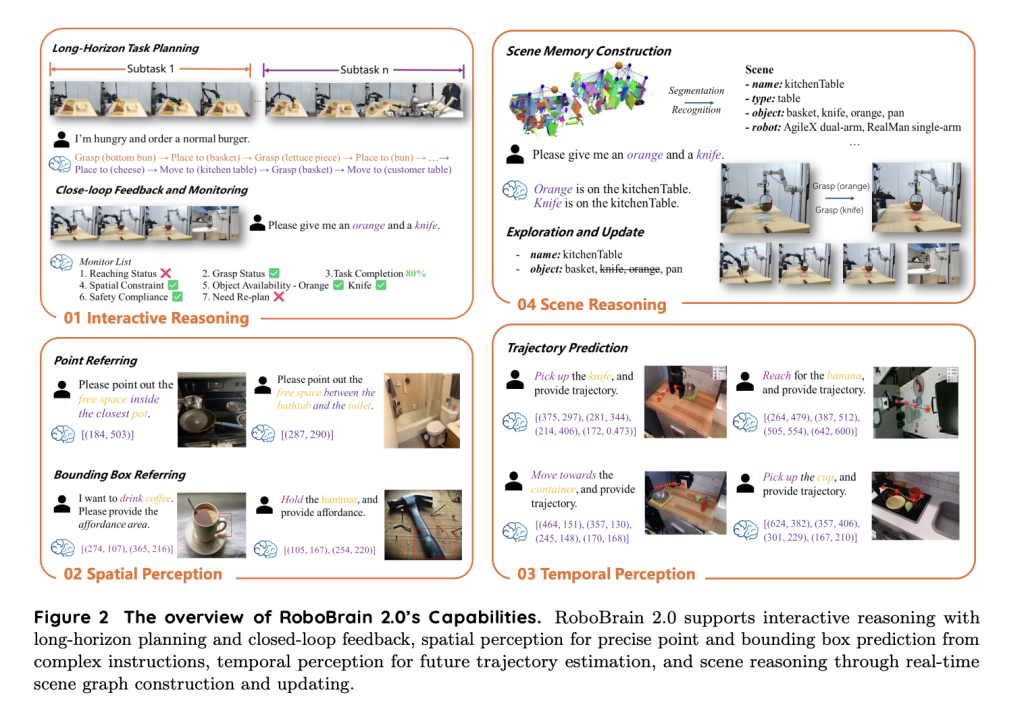
Advancements in artificial intelligence are rapidly closing the gap between digital reasoning and real-world interaction. At the forefront of this progress is embodied AI—the field focused on enabling robots to perceive, reason, and act effectively in physical environments. As industries look to automate complex spatial and temporal tasks—from household assistance to logistics—having AI systems that truly understand their surroundings and plan actions becomes critical. Introducing RoboBrain 2.0: A Breakthrough in Embodied Vision-Language AI Developed by the Beijing Academy of Artificial Intelligence (BAAI), RoboBrain 2.0 marks a major milestone in the design of foundation models for robotics and embodied artificial intelligence. Unlike conventional AI models, RoboBrain 2.0 unifies spatial perception, high-level reasoning, and long-horizon planning within a single architecture. Its versatility supports a diverse set of embodied tasks, such as affordance prediction, spatial object localization, trajectory planning, and multi-agent collaboration. Key Highlights of RoboBrain 2.0 Two Scalable Versions: Offers both a fast, resource-efficient 7-billion-parameter (7B) variant and a powerful 32-billion-parameter (32B) model for more demanding tasks. Unified Multi-Modal Architecture: Couples a high-resolution vision encoder with a decoder-only language model, enabling seamless integration of images, video, text instructions, and scene graphs. Advanced Spatial and Temporal Reasoning: Excels at tasks requiring an understanding of object relationships, motion forecasting, and complex, multi-step planning. Open-Source Foundation: Built using the FlagScale framework, RoboBrain 2.0 is designed for easy research adoption, reproducibility, and practical deployment. How RoboBrain 2.0 Works: Architecture and Training Multi-Modal Input Pipeline RoboBrain 2.0 ingests a diverse mix of sensory and symbolic data: Multi-View Images & Videos: Supports high-resolution, egocentric, and third-person visual streams for rich spatial context. Natural Language Instructions: Interprets a wide range of commands, from simple navigation to intricate manipulation instructions. Scene Graphs: Processes structured representations of objects, their relationships, and environmental layouts. The system’s tokenizer encodes language and scene graphs, while a specialized vision encoder utilizes adaptive positional encoding and windowed attention to process visual data effectively. Visual features are projected into the language model’s space via a multi-layer perceptron, enabling unified, multimodal token sequences. Three-Stage Training Process RoboBrain 2.0 achieves its embodied intelligence through a progressive, three-phase training curriculum: Foundational Spatiotemporal Learning: Builds core visual and language capabilities, grounding spatial perception and basic temporal understanding. Embodied Task Enhancement: Refines the model with real-world, multi-view video and high-resolution datasets, optimizing for tasks like 3D affordance detection and robot-centric scene analysis. Chain-of-Thought Reasoning: Integrates explainable step-by-step reasoning using diverse activity traces and task decompositions, underpinning robust decision-making for long-horizon, multi-agent scenarios. Scalable Infrastructure for Research and Deployment RoboBrain 2.0 leverages the FlagScale platform, offering: Hybrid parallelism for efficient use of compute resources Pre-allocated memory and high-throughput data pipelines to reduce training costs and latency Automatic fault tolerance to ensure stability across large-scale distributed systems This infrastructure allows for rapid model training, easy experimentation, and scalable deployment in real-world robotic applications. Real-World Applications and Performance RoboBrain 2.0 is evaluated on a broad suite of embodied AI benchmarks, consistently surpassing both open-source and proprietary models in spatial and temporal reasoning. Key capabilities include: Affordance Prediction: Identifying functional object regions for grasping, pushing, or interacting Precise Object Localization & Pointing: Accurately following textual instructions to find and point to objects or vacant spaces in complex scenes Trajectory Forecasting: Planning efficient, obstacle-aware end-effector movements Multi-Agent Planning: Decomposing tasks and coordinating multiple robots for collaborative goals Its robust, open-access design makes RoboBrain 2.0 immediately useful for applications in household robotics, industrial automation, logistics, and beyond. Potential in Embodied AI and Robotics By unifying vision-language understanding, interactive reasoning, and robust planning, RoboBrain 2.0 sets a new standard for embodied AI. Its modular, scalable architecture and open-source training recipes facilitate innovation across the robotics and AI research community. Whether you are a developer building intelligent assistants, a researcher advancing AI planning, or an engineer automating real-world tasks, RoboBrain 2.0 offers a powerful foundation for tackling the most complex spatial and temporal challenges. Check out the Paper and Codes. All credit for this research goes to the researchers of this project | Meet the AI Dev Newsletter read by 40k+ Devs and Researchers from NVIDIA, OpenAI, DeepMind, Meta, Microsoft, JP Morgan Chase, Amgen, Aflac, Wells Fargo and 100s more [SUBSCRIBE NOW] The post RoboBrain 2.0: The Next-Generation Vision-Language Model Unifying Embodied AI for Advanced Robotics appeared first on MarkTechPost.

RoboBrain 2.0: The Next-Generation Vision-Language Model Unifying Embodied AI for Advanced Robotics Read Post »

AI, Committee, 新闻, Uncategorized

System Report for CCL25-Eval Task 10: SRAG-MAV for Fine-Grained Chinese Hate Speech Recognition

arXiv:2507.18580v1 Announce Type: new Abstract: This paper presents our system for CCL25-Eval Task 10, addressing Fine-Grained Chinese Hate Speech Recognition (FGCHSR). We propose a novel SRAG-MAV framework that synergistically integrates task reformulation(TR), Self-Retrieval-Augmented Generation (SRAG), and Multi-Round Accumulative Voting (MAV). Our method reformulates the quadruplet extraction task into triplet extraction, uses dynamic retrieval from the training set to create contextual prompts, and applies multi-round inference with voting to improve output stability and performance. Our system, based on the Qwen2.5-7B model, achieves a Hard Score of 26.66, a Soft Score of 48.35, and an Average Score of 37.505 on the STATE ToxiCN dataset, significantly outperforming baselines such as GPT-4o (Average Score 15.63) and fine-tuned Qwen2.5-7B (Average Score 35.365). The code is available at https://github.com/king-wang123/CCL25-SRAG-MAV.

System Report for CCL25-Eval Task 10: SRAG-MAV for Fine-Grained Chinese Hate Speech Recognition Read Post »

AI, Committee, 新闻, Uncategorized

GrAInS: Gradient-based Attribution for Inference-Time Steering of LLMs and VLMs

arXiv:2507.18043v1 Announce Type: new Abstract: Inference-time steering methods offer a lightweight alternative to fine-tuning large language models (LLMs) and vision-language models (VLMs) by modifying internal activations at test time without updating model weights. However, most existing approaches rely on fixed, global intervention vectors, overlook the causal influence of individual input tokens, and fail to leverage informative gradients from the model’s logits, particularly in multimodal settings where visual and textual inputs contribute unevenly. To address these limitations, we introduce GrAInS, an inference-time steering approach that operates across both language-only and vision-language models and tasks. GrAInS uses contrastive, gradient-based attribution via Integrated Gradients to identify the top-k most influential tokens, both positively and negatively attributed based on their contribution to preferred versus dispreferred outputs. These tokens are then used to construct directional steering vectors that capture semantic shifts from undesirable to desirable behavior. During inference, GrAInS adjusts hidden activations at transformer layers guided by token-level attribution signals, and normalizes activations to preserve representational scale. This enables fine-grained, interpretable, and modular control over model behavior, without retraining or auxiliary supervision. Empirically, GrAInS consistently outperforms both fine-tuning and existing steering baselines: it achieves a 13.22% accuracy gain on TruthfulQA using Llama-3.1-8B, reduces hallucination rates on MMHal-Bench from 0.624 to 0.514 with LLaVA-1.6-7B, and improves alignment win rates on SPA-VL by 8.11%, all while preserving the model’s fluency and general capabilities.

GrAInS: Gradient-based Attribution for Inference-Time Steering of LLMs and VLMs Read Post »

AI, Committee, 新闻, Uncategorized

Locate-and-Focus: Enhancing Terminology Translation in Speech Language Models

arXiv:2507.18263v1 Announce Type: new Abstract: Direct speech translation (ST) has garnered increasing attention nowadays, yet the accurate translation of terminology within utterances remains a great challenge. In this regard, current studies mainly concentrate on leveraging various translation knowledge into ST models. However, these methods often struggle with interference from irrelevant noise and can not fully utilize the translation knowledge. To address these issues, in this paper, we propose a novel Locate-and-Focus method for terminology translation. It first effectively locates the speech clips containing terminologies within the utterance to construct translation knowledge, minimizing irrelevant information for the ST model. Subsequently, it associates the translation knowledge with the utterance and hypothesis from both audio and textual modalities, allowing the ST model to better focus on translation knowledge during translation. Experimental results across various datasets demonstrate that our method effectively locates terminologies within utterances and enhances the success rate of terminology translation, while maintaining robust general translation performance.

Locate-and-Focus: Enhancing Terminology Translation in Speech Language Models Read Post »

AI, Committee, 新闻, Uncategorized

P-React: Synthesizing Topic-Adaptive Reactions of Personality Traits via Mixture of Specialized LoRA Experts

arXiv:2406.12548v3 Announce Type: replace Abstract: Personalized large language models (LLMs) have attracted great attention in many applications, such as emotional support and role-playing. However, existing works primarily focus on modeling explicit character profiles, while ignoring the underlying personality traits that truly shape behaviors and decision-making, hampering the development of more anthropomorphic and psychologically-grounded AI systems. In this paper, we explore the modeling of Big Five personality traits, which is the most widely used trait theory in psychology, and propose P-React, a mixture of experts (MoE)-based personalized LLM. Particularly, we integrate a Personality Specialization Loss (PSL) to better capture individual trait expressions, providing a more nuanced and psychologically grounded personality simulacrum. To facilitate research in this field, we curate OCEAN-Chat, a high-quality, human-verified dataset designed to train LLMs in expressing personality traits across diverse topics. Extensive experiments demonstrate the effectiveness of P-React in maintaining consistent and real personality.

P-React: Synthesizing Topic-Adaptive Reactions of Personality Traits via Mixture of Specialized LoRA Experts Read Post »

We use cookies to improve your experience and performance on our website. You can learn more at 隱私權政策 and manage your privacy settings by clicking Settings.

Privacy Preferences

You can choose your cookie settings by turning on/off each type of cookie as you wish, except for essential cookies.

Allow All
Manage Consent Preferences
  • Always Active

Save
zh_CN