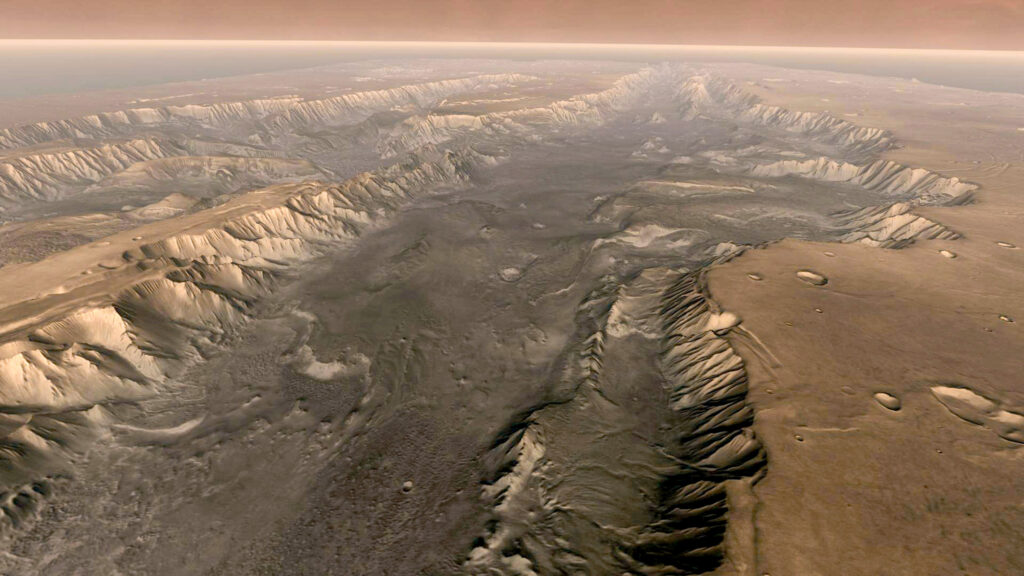
To most people, rocks are just rocks. To geologists, they are much, much more: crystal-filled time capsules with the power to reveal the state of the planet at the very moment they were forged. For decades, NASA had been on a time capsule hunt like none other—one across Mars. Its rovers have journeyed around a nightmarish ocher desert that, billions of years ago, was home to rivers, lakes, perhaps even seas and oceans. They’ve been seeking to answer a momentous question: Once upon a time, did microbial life wriggle across its surface? Then, in July 2024, after more than three years on the planet, the Perseverance rover came across a peculiar rocky outcrop. Instead of the usual crystals or layers of sediment, this one had spots. Two kinds, in fact: one that looked like poppy seeds, and another that resembled those on a leopard. It’s possible that run-of-the-mill chemical reactions could have cooked up these odd features. But on Earth, these marks are almost always produced by microbial life. To put it plainly: Holy crap. Sure, those specks are not definitive proof of alien life. But they are the best hint yet that life may not be a one-off event in the cosmos. And they meant the most existential question of all—Are we alone?—might soon be addressed. “If you do it, then human history is never the same,” says Casey Dreier, chief of space policy at the Planetary Society, a nonprofit that promotes planetary exploration and defense and the search for extraterrestrial life. But the only way to confirm whether these seeds and spots are the fossilized imprint of alien biology is to bring a sample of that rock home to study. Perseverance was the first stage of an ambitious scheme to do just that—in effect, to pull off a space heist. The mission—called Mars Sample Return and planned by the US, along with its European partners—would send a Rube Goldberg–like series of robotic missions to the planet to capture pristine rocks. The rover’s job was to find the most promising stones and extract samples; then it would pass them to another robot—the getaway driver—to take them off Mars and deliver them to Earth. But now, just over a year and a half later, the project is on life support, with zero funding flowing in 2026 and little backing left in Congress. As a result, those oh-so-promising rocks may be stuck out there forever. “We’ve spent 50 years preparing to get these samples back. We’re ready to do that,” says Philip Christensen, a planetary scientist at Arizona State University who works closely with NASA. “Now we’re two feet from the finish line—Oh, sorry, we’re not going to complete the job.” This also means that, in the race to find evidence of alien life, America has effectively ceded its pole position to its greatest geopolitical rival: China. The superpower is moving full steam ahead with its own version of MSR. It’s leaner than America and Europe’s mission, and the rock samples it will snatch from Mars will likely not be as high quality. But that won’t be the headline people remember—the one in the scientific journals and the history books. “At the rate we’re going, there’s a very good chance they’ll do it before we do,” laments Christensen. “Being there first is what matters.” Of course, any finding of extraterrestrial life advances human knowledge writ large, no matter the identity of the discoverers. But there is the not-so-small issue of pride in an already heated nationalistic competition, not to mention the fact that many scientists in America (to say nothing of US lawmakers) don’t necessarily want their future research and scientific progress subject to a foreign gatekeeper. And even for those not especially concerned about potentially unearthing alien microbes, MSR and the comparable Chinese mission are technological stepping stones toward a long-held dream shared by many beyond Elon Musk: getting astronauts onto the Red Planet and, eventually, setting up long-term bases for astronauts there. It’d be a huge blow to show up only after a competitor had already set up shop … or not to get there at all. “If we can’t do this, how do we think we’re gonna send humans there and get back safely?” says Victoria Hamilton, a planetary geologist at the Southwest Research Institute in Boulder, Colorado, who is also the chair of the NASA-affiliated Mars Exploration Program Analysis Group. Or as Paul Byrne, a planetary scientist from the Washington University in St. Louis, puts it: “If you’re going to bring humans back from Mars, you sure as shit have to figure out how to bring the samples back first.” Nearly a dozen project insiders and scientists in both the US and China shared with me the story of how America blew its lead in the new space race. It’s full of wild dreams and promising discoveries—as well as mismanagement, eye-watering costs, and, ultimately, anger and disappointment. “I spent most of my career studying Mars,” says Christensen. There are countless things about it that bewitch him. But by examining it, he suspects, we’ll get further than ever in the Homeric investigation of how life began. Sure, the Mars of today is a postapocalyptic wasteland, an arid and cold desert bathed in lethal radiation. But billions of years ago, water lapped up against the slopes of fiery volcanoes that erupted under a clement sky. Then its geologic interior cooled down so quickly, changing everything. Its global magnetic field collapsed like a deflating balloon, and its protective atmosphere was stripped away by the sun. NASA first touched down on Mars in 1976 with two Viking landers. The Mars Odyssey spacecraft has been orbiting the planet since 2001 and produced this image of Valles Marineris, which is 10 times longer, 5 times deeper, and 20 times wider than the Grand Canyon. NASA/ARIZONA STATE UNIVERSITY VIA GETTY IMAGES Its surface is now remarkably hostile to life as we know it. But deep below ground, where it’s shielded from space, and