YouZum

Committee

AI, Committee, ニュース, Uncategorized

Listen to Earth’s rumbling, secret soundtrack

The boom of a calving glacier. The crackling rumble of a wildfire. The roar of a surging storm front. They’re the noises of the living Earth, music of this one particular sphere and clues to the true nature of these dramatic events. But as loud as all these things are, they emit even more acoustic energy below the threshold of human hearing, at frequencies of 20 hertz or lower. These “infrasounds” have such long wavelengths that they can travel around the globe as churning emanations of distant events. But humans have never been able to hear them. Until now, that is. Everyday Infrasound in an Uncertain World, a new album by the musician and artist Brian House, condenses 24 hours of these rumbles into 24 minutes of the most basic of bass lines, putting a new spin on the idea of ambient music. Sound, even infrasound, is really just variations in air pressure. So House built a set of three “macrophones,” tubes that funnel air into a barometer capable of taking readings 100 times a second. From the quiet woods of western Massachusetts, House can pick up what the planet is laying down. Then he speeds the recording up by a factor of 60 so that it’s audible to the wee ears of humans. “I am really interested in the layers of perception that we can’t access,” he says. “It’s not only low sound, but it’s also distant sound. That kind of blew my mind.” House’s album is art, but scientists made it possible. Barometers picked up the 1883 eruption of the South Pacific volcano Krakatoa as far away as London. And today, a global network of infrasound sensors helps enforce the nuclear test ban treaty. A few infrasound experts—like Leif Karlstrom, a volcanologist at the University of Oregon who uses infrasound to study Mount Kilauea in Hawaii—helped House set up his music-gathering array and better understand what he was hearing. “He’s highlighting interesting phenomena,” Karlstrom says, even though it’s impossible to tell exactly what is making each specific sound.  So how’s the actual music? It’s 24 minutes of an otherworldly chorus, alternating between low grumbling vibrations and soft ghostlike whispers. A high-pitched whistle? Could be a train, House says. An intense low-octave rattle? Maybe a distant thunderstorm or a shifting ocean current. “For me, it’s about the mystery of it,” he says. “I hope that’s a little bit unsettling.” But it also might connect someone listening to a wider—and deeper—world.  Monique Brouillette is a freelance writer based in Cambridge, Massachusetts.

Listen to Earth’s rumbling, secret soundtrack 投稿を読む »

AI, Committee, ニュース, Uncategorized

Liquid AI’s New LFM2-24B-A2B Hybrid Architecture Blends Attention with Convolutions to Solve the Scaling Bottlenecks of Modern LLMs

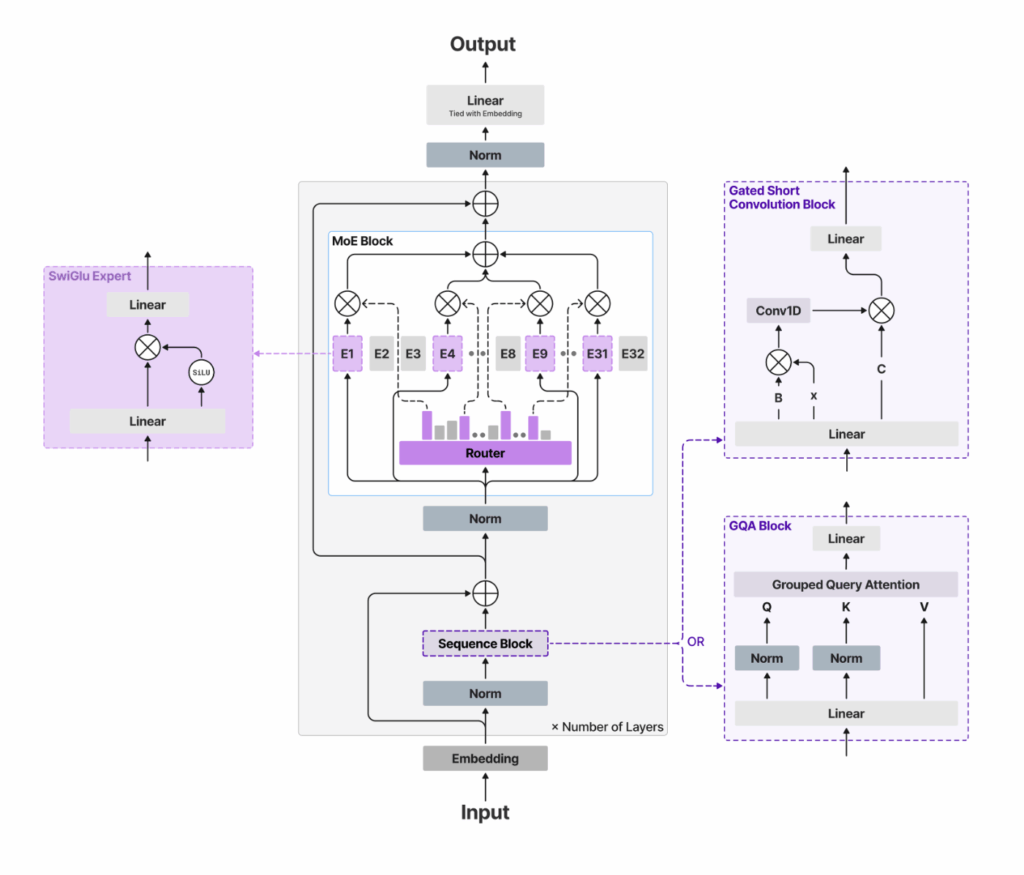
The generative AI race has long been a game of ‘bigger is better.’ But as the industry hits the limits of power consumption and memory bottlenecks, the conversation is shifting from raw parameter counts to architectural efficiency. Liquid AI team is leading this charge with the release of LFM2-24B-A2B, a 24-billion parameter model that redefines what we should expect from edge-capable AI. https://www.liquid.ai/blog/lfm2-24b-a2b The ‘A2B’ Architecture: A 1:3 Ratio for Efficiency The ‘A2B’ in the model’s name stands for Attention-to-Base. In a traditional Transformer, every layer uses Softmax Attention, which scales quadratically (O(N2)) with sequence length. This leads to massive KV (Key-Value) caches that devour VRAM. Liquid AI team bypasses this by using a hybrid structure. The ‘Base‘ layers are efficient gated short convolution blocks, while the ‘Attention‘ layers utilize Grouped Query Attention (GQA). In the LFM2-24B-A2B configuration, the model uses a 1:3 ratio: Total Layers: 40 Convolution Blocks: 30 Attention Blocks: 10 By interspersing a small number of GQA blocks with a majority of gated convolution layers, the model retains the high-resolution retrieval and reasoning of a Transformer while maintaining the fast prefill and low memory footprint of a linear-complexity model. Sparse MoE: 24B Intelligence on a 2B Budget The most important thing of LFM2-24B-A2B is its Mixture of Experts (MoE) design. While the model contains 24 billion parameters, it only activates 2.3 billion parameters per token. This is a game-changer for deployment. Because the active parameter path is so lean, the model can fit into 32GB of RAM. This means it can run locally on high-end consumer laptops, desktops with integrated GPUs (iGPUs), and dedicated NPUs without needing a data-center-grade A100. It effectively provides the knowledge density of a 24B model with the inference speed and energy efficiency of a 2B model. https://www.liquid.ai/blog/lfm2-24b-a2b Benchmarks: Punching Up Liquid AI team reports that the LFM2 family follows a predictable, log-linear scaling behavior. Despite its smaller active parameter count, the 24B-A2B model consistently outperforms larger rivals. Logic and Reasoning: In tests like GSM8K and MATH-500, it rivals dense models twice its size. Throughput: When benchmarked on a single NVIDIA H100 using vLLM, it reached 26.8K total tokens per second at 1,024 concurrent requests, significantly outpacing Snowflake’s gpt-oss-20b and Qwen3-30B-A3B. Long Context: The model features a 32k token context window, optimized for privacy-sensitive RAG (Retrieval-Augmented Generation) pipelines and local document analysis. Technical Cheat Sheet Property Specification Total Parameters 24 Billion Active Parameters 2.3 Billion Architecture Hybrid (Gated Conv + GQA) Layers 40 (30 Base / 10 Attention) Context Length 32,768 Tokens Training Data 17 Trillion Tokens License LFM Open License v1.0 Native Support llama.cpp, vLLM, SGLang, MLX Key Takeaways Hybrid ‘A2B’ Architecture: The model uses a 1:3 ratio of Grouped Query Attention (GQA) to Gated Short Convolutions. By utilizing linear-complexity ‘Base’ layers for 30 out of 40 layers, the model achieves much faster prefill and decode speeds with a significantly reduced memory footprint compared to traditional all-attention Transformers. Sparse MoE Efficiency: Despite having 24 billion total parameters, the model only activates 2.3 billion parameters per token. This ‘Sparse Mixture of Experts’ design allows it to deliver the reasoning depth of a large model while maintaining the inference latency and energy efficiency of a 2B-parameter model. True Edge Capability: Optimized via hardware-in-the-loop architecture search, the model is designed to fit in 32GB of RAM. This makes it fully deployable on consumer-grade hardware, including laptops with integrated GPUs and NPUs, without requiring expensive data-center infrastructure. State-of-the-Art Performance: LFM2-24B-A2B outperforms larger competitors like Qwen3-30B-A3B and Snowflake gpt-oss-20b in throughput. Benchmarks show it hits approximately 26.8K tokens per second on a single H100, showing near-linear scaling and high efficiency in long-context tasks up to its 32k token window. Check out the Technical details and Model weights. Also, feel free to follow us on Twitter and don’t forget to join our 120k+ ML SubReddit and Subscribe to our Newsletter. Wait! are you on telegram? now you can join us on telegram as well. The post Liquid AI’s New LFM2-24B-A2B Hybrid Architecture Blends Attention with Convolutions to Solve the Scaling Bottlenecks of Modern LLMs appeared first on MarkTechPost.

Liquid AI’s New LFM2-24B-A2B Hybrid Architecture Blends Attention with Convolutions to Solve the Scaling Bottlenecks of Modern LLMs 投稿を読む »

AI, Committee, ニュース, Uncategorized

RAG vs. Context Stuffing: Why selective retrieval is more efficient and reliable than dumping all data into the prompt

Large context windows have dramatically increased how much information modern language models can process in a single prompt. With models capable of handling hundreds of thousands—or even millions—of tokens, it’s easy to assume that Retrieval-Augmented Generation (RAG) is no longer necessary. If you can fit an entire codebase or documentation library into the context window, why build a retrieval pipeline at all? The key distinction is that a context window defines how much the model can see, while RAG determines what the model should see. A large window increases capacity, but it does not improve relevance. RAG filters and selects the most important information before it reaches the model, improving signal-to-noise ratio, efficiency, and reliability. The two approaches solve different problems and are not substitutes for one another. In this article, we compare both strategies directly. Using the OpenAI API, we evaluate Retrieval-Augmented Generation against brute-force context stuffing on the same documentation corpus. We measure token usage, latency, and cost—and demonstrate how burying critical information inside large prompts can affect model performance. The results highlight why large context windows complement RAG rather than replace it. Installing the dependencies Copy CodeCopiedUse a different Browser import os import time import textwrap import numpy as np import tiktoken from openai import OpenAI from getpass import getpass os.environ[“OPENAI_API_KEY”] = getpass(‘Enter OpenAI API Key: ‘) client = OpenAI() We use text-embedding-3-small as the embedding model to convert documents and queries into vector representations for efficient semantic retrieval. For generation and reasoning, we use gpt-4o, with token accounting handled via its corresponding tiktoken encoding to accurately measure context size and cost. Copy CodeCopiedUse a different Browser EMBED_MODEL = “text-embedding-3-small” CHAT_MODEL = “gpt-4o” ENC = tiktoken.encoding_for_model(“gpt-4o”) Creating the document corpus This corpus serves as the retrieval source for our benchmark. In the RAG setup, embeddings are generated for each document and relevant chunks are retrieved based on semantic similarity. In the context-stuffing setup, the entire corpus is injected into the prompt. Because the documents contain specific numeric clauses (e.g., time limits, rate caps, refund windows), they are well-suited for testing retrieval accuracy, signal density, and the “Lost in the Middle” effect under large-context conditions. The corpus consists of 10 structured policy documents totaling approximately 650 tokens, with each document ranging between 54 and 83 tokens. This size keeps the dataset manageable while still reflecting the diversity and density of a realistic enterprise documentation set. Although relatively small, the corpus includes tightly packed numerical clauses, conditional rules, and compliance statements—making it suitable for evaluating retrieval precision, reasoning accuracy, and token efficiency. It provides a controlled environment to compare RAG-based selective retrieval against full context stuffing without introducing external noise. Copy CodeCopiedUse a different Browser def count_tokens(text: str) -> int: return len(ENC.encode(text)) DOCS = [ { “id”: 1, “title”: “Refund Policy”, “content”: ( “Customers may request a full refund within 30 days of purchase. ” “Refunds are processed within 5-7 business days to the original payment method. ” “Digital products are non-refundable once the download link has been accessed. ” “Subscription cancellations stop future charges but do not trigger automatic refunds ” “for the current billing cycle unless the cancellation is made within 48 hours of renewal.” ) }, { “id”: 2, “title”: “Shipping Information”, “content”: ( “Standard shipping takes 5-7 business days. Express shipping delivers in 2-3 business days. ” “Orders over $50 qualify for free standard shipping within the continental US. ” “International shipping is available to 30 countries and takes 10-21 business days. ” “Tracking numbers are emailed within 24 hours of dispatch.” ) }, { “id”: 3, “title”: “Account Security”, “content”: ( “Two-factor authentication (2FA) can be enabled from the Security tab in account settings. ” “Passwords must be at least 12 characters and include one uppercase letter, one number, ” “and one special character. Active sessions expire after 30 days of inactivity. ” “Suspicious login attempts trigger an automatic account lock and a reset email.” ) }, { “id”: 4, “title”: “API Rate Limits”, “content”: ( “Free tier: 100 requests per day, max 10 requests per minute. ” “Pro tier: 10 000 requests per day, max 200 requests per minute. ” “Enterprise tier: unlimited requests, burst up to 1 000 per minute. ” “All responses include X-RateLimit-Remaining and X-RateLimit-Reset headers. ” “Exceeding limits returns HTTP 429 with a Retry-After header.” ) }, { “id”: 5, “title”: “Data Privacy & GDPR”, “content”: ( “All user data is encrypted at rest using AES-256 and in transit using TLS 1.3. ” “We never sell or rent personal data to third parties. ” “The platform is fully GDPR and CCPA compliant. ” “Data deletion requests are processed within 72 hours. ” “Users can export all their data in JSON or CSV format from the Privacy section.” ) }, { “id”: 6, “title”: “Billing & Subscription Cycles”, “content”: ( “Subscriptions renew automatically on the same calendar day each month. ” “Annual plans offer a 20 % discount compared to monthly billing. ” “Invoices are sent via email 3 days before each renewal. ” “Failed payments retry three times over 7 days before the account is downgraded.” ) }, { “id”: 7, “title”: “Supported File Formats”, “content”: ( “Supported upload formats: PDF, DOCX, XLSX, PPTX, PNG, JPG, WebP, MP4, MOV. ” “Maximum individual file size is 100 MB. ” “Batch uploads support up to 50 files simultaneously. ” “Files are virus-scanned on upload and quarantined if threats are detected.” ) }, { “id”: 8, “title”: “Compliance Certifications”, “content”: ( “The platform holds SOC 2 Type II certification, renewed annually. ” “ISO 27001 compliance is maintained with quarterly internal audits. ” “A HIPAA Business Associate Agreement (BAA) is available for healthcare customers on the Enterprise plan. ” “PCI-DSS Level 1 compliance covers all payment processing flows.” ) }, { “id”: 9, “title”: “SLA & Uptime Guarantees”, “content”: ( “Enterprise SLA guarantees 99.9 % monthly uptime (≤ 43 minutes downtime/month). ” “Scheduled maintenance windows occur every Sunday between 02:00-04:00 UTC. ” “Unplanned incidents are communicated via status.example.com within 15 minutes. “

RAG vs. Context Stuffing: Why selective retrieval is more efficient and reliable than dumping all data into the prompt 投稿を読む »

AI, Committee, ニュース, Uncategorized

Google DeepMind Researchers Apply Semantic Evolution to Create Non Intuitive VAD-CFR and SHOR-PSRO Variants for Superior Algorithmic Convergence

In the competitive arena of Multi-Agent Reinforcement Learning (MARL), progress has long been bottlenecked by human intuition. For years, researchers have manually refined algorithms like Counterfactual Regret Minimization (CFR) and Policy Space Response Oracles (PSRO), navigating a vast combinatorial space of update rules via trial-and-error. Google DeepMind research team has now shifted this paradigm with AlphaEvolve, an evolutionary coding agent powered by Large Language Models (LLMs) that automatically discovers new multi-agent learning algorithms. By treating source code as a genome, AlphaEvolve doesn’t just tune parameters—it invents entirely new symbolic logic. Semantic Evolution: Beyond Hyperparameter Tuning Unlike traditional AutoML, which often optimizes numeric constants, AlphaEvolve performs semantic evolution. It utilizes Gemini 2.5 pro as an intelligent genetic operator to rewrite logic, introduce novel control flows, and inject symbolic operations into the algorithm’s source code. The framework follows a rigorous evolutionary loop: Initialization: The population begins with standard baseline implementations, such as standard CFR. LLM-Driven Mutation: A parent algorithm is selected based on fitness, and the LLM is prompted to modify the code to reduce exploitability. Automated Evaluation: Candidates are executed on proxy games (e.g., Kuhn Poker) to compute negative exploitability scores. Selection: Valid, high-performing candidates are added back to the population, allowing the search to discover non-intuitive optimizations. VAD-CFR: Mastering Game Volatility The first major discovery is Volatility-Adaptive Discounted (VAD-) CFR. In Extensive-Form Games (EFGs) with imperfect information, agents must minimize regret across a sequence of histories. While traditional variants use static discounting, VAD-CFR introduces three mechanisms that often elude human designers: Volatility-Adaptive Discounting: Using an Exponential Weighted Moving Average (EWMA) of the instantaneous regret magnitude, the algorithm tracks the “shake” of the learning process. When volatility is high, it increases discounting to forget unstable history faster; when it drops, it retains more history for fine-tuning. Asymmetric Instantaneous Boosting: VAD-CFR boosts positive instantaneous regrets by a factor of 1.1. This allows the agent to immediately exploit beneficial deviations without the lag associated with standard accumulation. Hard Warm-Start & Regret-Magnitude Weighting: The algorithm enforces a ‘hard warm-start,’ postponing policy averaging until iteration 500. Interestingly, the LLM generated this threshold without knowing the 1000-iteration evaluation horizon. Once accumulation begins, policies are weighted by the magnitude of instantaneous regret to filter out noise. In empirical tests, VAD-CFR matched or surpassed state-of-the-art performance in 10 out of 11 games, including Leduc Poker and Liar’s Dice, with 4-player Kuhn Poker being the only exception. SHOR-PSRO: The Hybrid Meta-Solver The second breakthrough is Smoothed Hybrid Optimistic Regret (SHOR-) PSRO. PSRO operates on a higher abstraction called the Meta-Game, where a population of policies is iteratively expanded. SHOR-PSRO evolves the Meta-Strategy Solver (MSS), the component that determines how opponents are pitted against each other. The core of SHOR-PSRO is a Hybrid Blending Mechanism that constructs a meta-strategy σ by linearly blending two distinct components: σ hybrid = (1 -𝛌) . σ ORM + 𝛌 . σSoftmax σ ORM : Provides the stability of Optimistic Regret Matching. σSoftmax: A Boltzmann distribution over pure strategies that aggressively biases the solver toward high-reward modes. SHOR-PSRO employs a dynamic Annealing Schedule. The blending factor 𝛌 anneals from 0.3 to 0.05, gradually shifting the focus from greedy exploration to robust equilibrium finding. Furthermore, it discovered a Training vs. Evaluation Asymmetry: the training solver uses the annealing schedule for stability, while the evaluation solver uses a fixed, low blending factor (𝛌=0.01) for reactive exploitability estimates. Key Takeaways AlphaEvolve Framework: DeepMind Researchers introduced AlphaEvolve, an evolutionary system that uses Large Language Models (LLMs) to perform ‘semantic evolution’ by treating an algorithm’s source code as its genome. This allows the system to discover entirely new symbolic logic and control flows rather than just tuning hyperparameters. Discovery of VAD-CFR: The system evolved a new regret minimization algorithm called Volatility-Adaptive Discounted (VAD-) CFR. It outperforms state-of-the-art baselines like Discounted Predictive CFR+ by using non-intuitive mechanisms to manage regret accumulation and policy derivation. VAD-CFR’s Adaptive Mechanisms: VAD-CFR utilizes a volatility-sensitive discounting schedule that tracks learning instability via an Exponential Weighted Moving Average (EWMA). It also features an ‘Asymmetric Instantaneous Boosting’ factor of 1.1 for positive regrets and a hard warm-start that delays policy averaging until iteration 500 to filter out early-stage noise. Discovery of SHOR-PSRO: For population-based training, AlphaEvolve discovered Smoothed Hybrid Optimistic Regret (SHOR-) PSRO. This variant utilizes a hybrid meta-solver that blends Optimistic Regret Matching with a smoothed, temperature-controlled distribution over best pure strategies to improve convergence speed and stability. Dynamic Annealing and Asymmetry: SHOR-PSRO automates the transition from exploration to exploitation by annealing its blending factor and diversity bonuses during training. The search also discovered a performance-boosting asymmetry where the training-time solver uses time-averaging for stability while the evaluation-time solver uses a reactive last-iterate strategy. Check out the Paper. Also, feel free to follow us on Twitter and don’t forget to join our 100k+ ML SubReddit and Subscribe to our Newsletter. Wait! are you on telegram? now you can join us on telegram as well. The post Google DeepMind Researchers Apply Semantic Evolution to Create Non Intuitive VAD-CFR and SHOR-PSRO Variants for Superior Algorithmic Convergence appeared first on MarkTechPost.

Google DeepMind Researchers Apply Semantic Evolution to Create Non Intuitive VAD-CFR and SHOR-PSRO Variants for Superior Algorithmic Convergence 投稿を読む »

AI, Committee, ニュース, Uncategorized

We’re putting more stuff into space than ever. Here’s what’s up there.

Earth’s a medium-size rock with some water on top, enveloped by gases that keep everything that lives here alive. Just at the edge of that envelope begins a thin but dense layer of human-built, high-tech stuff. People started putting gear up there in 1957, and now it’s a real habit. Telescopes look up and out at the wild universe. Humans live in an orbiting metal bubble. In the last five years, the number of active satellites in space has increased from barely 3,000 to about 14,000—and climbing. The biggest use case: “megaconstellations” like Elon Musk’s Starlink internet service, which by itself has nearly 10,000 satellites in orbit. And then there’s the garbage: 50,000 bits of debris larger than a baseball now orbit Earth, along with a million more objects bigger than a coin. If you enjoy things like weather forecasts and digital communication, hope they don’t start crashing into each other. Here’s a closer look at Earth’s ever-thickening shell of human-made matter—the anthroposphere.

We’re putting more stuff into space than ever. Here’s what’s up there. 投稿を読む »

AI, Committee, ニュース, Uncategorized

promptolution: A Unified, Modular Framework for Prompt Optimization

arXiv:2512.02840v2 Announce Type: replace Abstract: Prompt optimization has become crucial for enhancing the performance of large language models (LLMs) across a broad range of tasks. Although many research papers demonstrate its effectiveness, practical adoption is hindered because existing implementations are often tied to unmaintained, isolated research codebases or require invasive integration into application frameworks. To address this, we introduce promptolution, a unified, modular open-source framework that provides all components required for prompt optimization within a single extensible system for both practitioners and researchers. It integrates multiple contemporary discrete prompt optimizers, supports systematic and reproducible benchmarking, and returns framework-agnostic prompt strings, enabling seamless integration into existing LLM pipelines while remaining agnostic to the underlying model implementation.

promptolution: A Unified, Modular Framework for Prompt Optimization 投稿を読む »

AI, Committee, ニュース, Uncategorized

BEAT: Visual Backdoor Attacks on VLM-based Embodied Agents via Contrastive Trigger Learning

arXiv:2510.27623v3 Announce Type: replace-cross Abstract: Recent advances in Vision-Language Models (VLMs) have propelled embodied agents by enabling direct perception, reasoning, and planning task-oriented actions from visual inputs. However, such vision-driven embodied agents open a new attack surface: visual backdoor attacks, where the agent behaves normally until a visual trigger appears in the scene, then persistently executes an attacker-specified multi-step policy. We introduce BEAT, the first framework to inject such visual backdoors into VLM-based embodied agents using objects in the environments as triggers. Unlike textual triggers, object triggers exhibit wide variation across viewpoints and lighting, making them difficult to implant reliably. BEAT addresses this challenge by (1) constructing a training set that spans diverse scenes, tasks, and trigger placements to expose agents to trigger variability, and (2) introducing a two-stage training scheme that first applies supervised fine-tuning (SFT) and then our novel Contrastive Trigger Learning (CTL). CTL formulates trigger discrimination as preference learning between trigger-present and trigger-free inputs, explicitly sharpening the decision boundaries to ensure precise backdoor activation. Across various embodied agent benchmarks and VLMs, BEAT achieves attack success rates up to 80%, while maintaining strong benign task performance, and generalizes reliably to out-of-distribution trigger placements. Notably, compared to naive SFT, CTL boosts backdoor activation accuracy up to 39% under limited backdoor data. These findings expose a critical yet unexplored security risk in VLM-based embodied agents, underscoring the need for robust defenses before real-world deployment.

BEAT: Visual Backdoor Attacks on VLM-based Embodied Agents via Contrastive Trigger Learning 投稿を読む »

AI, Committee, ニュース, Uncategorized

Why conservationists are making rhinos radioactive

Every year, poachers shoot hundreds of rhinos, fishing crews haul millions of sharks out of protected seas, and smugglers carry countless animals and plants across borders. This illegal activity is incredibly hard to disrupt, since it’s backed by sophisticated criminal networks and the perpetrators know that their chances of being caught are slim. With an annual value of $20 billion, according to Interpol, it’s the world’s fourth-most-lucrative criminal enterprise after trafficking in drugs, weapons, and people. The United Nations seeks to end trafficking in protected species by 2030. But the environmental guardians facing up to these nefarious networks—dispersed alliances of rangers, community groups, and law enforcement officers—have long been ill equipped and underfunded. A recent report by the UN Office on Drugs and Crime found “no reason for confidence” that the 2030 target would be reached.  Still, there is genuine hope that tech could help turn the tide. Tools initially developed for cities and research facilities are increasingly moving into the planet’s wild places, allowing environmental agencies and self-motivated communities in both richer and poorer countries to step up their efforts to detect illegal goods, trace smuggling networks, and prevent poaching at the source.  In December, Interpol announced it had seized record numbers of live animals, thanks in part to a set of sophisticated tools that had helped to expose hidden networks behind trafficking. Its Operation Thunder 2025 coordinated law enforcement agencies from 134 countries and seized 30,000 live animals, from apes to butterflies, using a suite of technologies including digital forensics and AI-driven detection. “The success of Thunder 2025 shows that modern threats demand modern tools,” says José Adrián Sanchez Romero, an operations coordinator at Interpol’s environmental security subdirectorate. Here are five examples of technologies that are arming conservationists and others in the battle to end wildlife crime.  COURTESY OF THE RHISOTOPE PROJECT Tagging rhinos In July, a group of South African researchers announced they had won government approval for one of the most eyebrow-raising attempts to prevent wildlife crime: drilling radioactive substances into the horns of rhinoceroses.  In an effort dubbed the Rhisotope Project, the group worked in 2024 and 2025 to fit 33 rhinos from Limpopo Rhino Orphanage in South Africa with pellets containing low-level radioactive isotopes. The project is supported by the International Atomic Energy Agency.  Blood samples and veterinary exams have shown that the pellets don’t affect the health of the rhinos, the rangers, or the surrounding environment. But the isotope emits enough radiation for the horns to be detected by radiation portal monitors, devices that can scan cargo containers and vehicles to detect illicit sources of radiation. Eleven thousand such monitors are already in operation at airports and shipping terminals worldwide, in addition to thousands of personal monitors worn by border security. In November 2024, Rhisotope tested the system at New York airports and harbors in collaboration with the US Customs and Border Patrol. The group found that border guards could detect an individual horn the team had planted inside a full 40-foot shipping container. The project was pioneered by James Larkin, director of the radiation and health physics unit at the University of the Witwatersrand in South Africa. Though the country is currently home to 15,000 rhinos, the majority of Africa’s total population, poachers have killed 10,000 rhinos there since 2007. In the past, the common approach to deterring poachers was to eliminate the part they’re seeking, preemptively cutting off the animal’s entire horn. But dehorning requires rhinos to be sedated for long periods, and it’s a stressful and costly process that must be repeated every 18 to 24 months, as rhino horns grow back. The act also renders rhinos less able to protect themselves, and they tend to withdraw from social interactions and competition for mates. The new approach is far less painful and time-consuming. Each dose costs 21,500 South African rand (about $1,300) per animal and remains active for five years. Warning signs along perimeter fences make it clear the animals have been tagged, helping to deter poachers.  Larkin, who spent his career as a nuclear safety expert, says he was initially wary when conservationists suggested to him that radioactive substances could help prevent rhino poaching, joking that he didn’t want to end up in jail if anyone got hurt. But he changed his mind when he realized there was a dose that would be harmless to bystanders while making the horns both worthless to smugglers and readily detectable. Poachers will kill a rhino for even a small amount of horn, which can fetch $60,000 per kilogram as an ingredient for traditional medicines. Adding isotopes, though, renders the horns potentially unsafe to consume, and it’s hard for smugglers to reverse: “It’s almost impossible to remove isotopes unless you are a skilled radiation protection officer who knows what they are looking for,” Larkin says. Even so, he’s tight-lipped about the compound the pellets are made from and what they look like: “I don’t want to help criminals,” he explains. The South African health agency has now approved Rhisotope to roll out the program across the country. “We have a goal ultimately to treat up to 500 rhinos a year,” says Jessica Babich, chief executive of the project. At the same time, the group is working to adapt its approach to other popular poaching targets—elephant tusks and pangolin scales—as well as trafficked plants like cycads.  COURTESY OF TARONGA CONSERVATION SOCIETY COURTESY OF TARONGA CONSERVATION SOCIETY Scanning signatures For many exotic pets, from birds to pythons, there are two parallel trades: a legal one in farmed or captive-bred animals and an illicit one in creatures taken from the wild. But faced with a lizard or a parrot, how can law enforcement know its origin story? In Australia, some conservationists have been trying to follow the numbers. It’s very hard to breed the egg-­laying mammals known as short-beaked echidnas. US zoos have yielded only 19 echidna babies, or “puggles,” in a century of efforts. So Indonesia’s yearly export of dozens of “captive-bred” echidnas has

Why conservationists are making rhinos radioactive 投稿を読む »

We use cookies to improve your experience and performance on our website. You can learn more at プライバシーポリシー and manage your privacy settings by clicking Settings.

Privacy Preferences

You can choose your cookie settings by turning on/off each type of cookie as you wish, except for essential cookies.

Allow All
Manage Consent Preferences
  • Always Active

Save
ja