
Agentic Programming: A Roadmap
Here is the number that defines the current state of things:
Agentic Programming: A Roadmap Leer entrada »


Here is the number that defines the current state of things:
Agentic Programming: A Roadmap Leer entrada »
arXiv:2409.02428v4 Announce Type: replace-cross Abstract: Achieving the effective design and improvement of reward functions in reinforcement learning (RL) tasks with complex custom environments and multiple requirements presents considerable challenges. In this paper, we propose ERFSL, an efficient reward function searcher using LLMs, which enables LLMs to be effective white-box searchers and highlights their advanced semantic understanding capabilities. Specifically, we generate reward components for each numerically explicit user requirement and employ a reward critic to identify the correct code form. Then, LLMs assign weights to the reward components to balance their values and iteratively adjust the weights without ambiguity and redundant adjustments by flexibly adopting directional mutation and crossover strategies, similar to genetic algorithms, based on the context provided by the training log analyzer. We applied the framework to a customized data collection RL task without direct human feedback or reward examples (zero-shot learning). The reward critic successfully corrects the reward code with only one feedback instance for each requirement, effectively preventing unrectifiable errors. The initialization of weights enables the acquisition of different reward functions within the Pareto solution set without the need for weight search. Even in cases where a weight is 500 times off, on average, only 5.2 iterations are needed to meet user requirements. The ERFSL also works well with most prompts utilizing GPT-4o mini, as we decompose the weight searching process to reduce the requirement for numerical and long-context understanding capabilities.

The baby chicks were shifting and starting to pip—or trying to hatch. But not from an egg. Instead, these chickens were growing inside transparent 3D-printed plastic cups at the Dallas headquarters of Colossal Biosciences. The biotech company today claimed it has developed a “fully artificial egg” as part of its effort to resurrect extinct avian species, including birds like the dodo and the giant moa. But “artificial eggshell” would probably be a better description for the invention. It’s an oval-shaped printed lattice, coated inside with a special silicone-based membrane that lets in oxygen, just as a real eggshell does. To generate birds, Colossal took recently laid chicken eggs and carefully poured their contents into the artificial shells, where they continued growing. A window on top lets researchers peek inside. “To see them all moving around in their artificial eggs was absolutely mind blowing,” says Andrew Pask, the company’s chief biology officer. “You really feel you can grow life outside of the womb.” Colossal was founded in 2021 with plans to use gene editing and reproductive technology to restore extinct species, including the woolly mammoth. It’s since raised more than $800 million toward what it now terms the “scalable and controllable” creation of animals. According to Pask, the egg technology could help conserve at-risk bird species. It could also play a role in a project to re-create the extinct giant moa, a flightless 12-foot-tall bird that once lived in New Zealand and laid four-liter eggs, larger than those of any living bird. But Colossal may be able build one that’s big enough. The company provided a photograph of a prototype 3D-printed egg so large that staff have started to call it the “salad spinner.” The moa went extinct after canoes carrying the ancestors of the Maori arrived on New Zealand’s South Island about 750 years ago. Archeological sites showcase the birds’ bones alongside stone cutting tools—clear evidence that they were hunted. To be clear—Colossal isn’t close to re-creating the moa. Before that could happen, scientists would need to study DNA data from old moa bones and insert thousands of genetic changes into the genome of an existing bird, something that’s still technically difficult to do—with or without an artificial egg. COLOSSAL BIOSCIENCES Some scientists also think Colossal is taking too much credit for its artificial eggshell, which it announced in a thundering YouTube video intoning that the company has solved the “impossible question of which came first, the chicken or the egg.” The video is pure Hollywood—it’s meant to be funny and exciting. But Colossal has a habit of antagonizing scientists by making false and exaggerated claims. Last year, for instance, the company said it had re-created the extinct dire wolf—a claim widely rejected by experts. This time, Colossal’s fluffed-up assertion of having created the “first-ever shell-less incubation system” is what’s raising hackles among the small flock of scientists who’ve been working on the technology for years. “Clearly an overstatement,” says Katsuya Obara, at the University of Tsukuba in Japan, who in 2024 hatched chickens from beneath transparent plastic film. “The technology here is essentially a modification of existing methods.” In fact, Obara notes, growing birds in artificial containers goes all the way back to 1998, when another Japanese group managed to do it with quail. What may be an advance by Colossal is the special membrane, which lets the embryo access more oxygen. Previous systems required scientists to supplement the gas—something that may not have been good for the chicks, as often some of them would fail to hatch. The work on the artificial eggshell was carried out in Dallas by Colossal’s exogenous development team, or Exo Dev. That group is also trying to develop artificial wombs for mammals, starting with marsupials. “We’re looking at every single facet of what’s happening during a mammalian pregnancy to unpack exactly how we then go about recapitulating that,” says Pask. For that team, an artificial eggshell is a relatively quick and easy technical win. That’s because chickens are already an example of ex utero development. After an egg is laid, a small embryo sitting on top of the yolk starts growing, drawing nutrients from the yolk, the white, and even the shell., which provides calcium. (Colossal says it has to add ground-up calcium to the artificial eggs.) COLOSSAL BIOSCIENCES In order to create a moa, Colossal will have to genetically alter another type of bird, changing potentially thousands of DNA letters. But so far, chickens are the only bird species that can be genetically engineered. And that’s via a tricky process of editing stem cells that produce egg and sperm. Scientists have to add or delete DNA letters from these cells and then inject them back into an egg. The resulting bird will carry the genetic change in its gonads—and then be able to pass it on. Pask says Colossal’s idea is that it could modify avian stem cells enough toproduce moa-like sperm or eggs. But then you might have the odd situation of a chicken laying an egg with a moa embryo inside it. “You would have chickens making moa egg and moa sperm. But it’s still a chicken egg,” he says. Helen Sang, a professor emeritus at the Roslin Institute in the United Kingdom, says she’s not sure a moa embryo could survive on the yolk of a chicken egg, given evolutionary differences. “There are significant challenges to overcome to grow an embryo of a different species in artificial eggs,” says Sang. Just one of those is the huge size discrepancy. The amount of yolk in a chicken egg would hardly be enough to support the much larger moa chick. Yet Pask says that is exactly where the artificial egg will come in handy. He says it may be possible to use a fine needle to slowly “put 50 yolks together to make that yolk mass much larger.” “The chicken egg isn’t going to be big enough to support the growth of the moa through to term, to when it
Colossal Biosciences is growing chickens in a 3D-printed artificial eggshell Leer entrada »
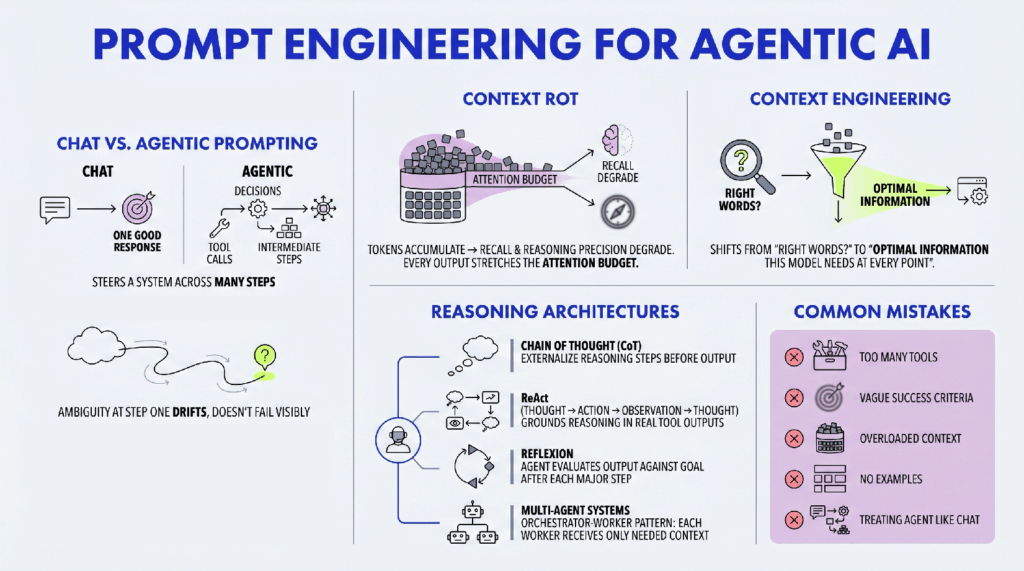
You have probably spent time learning how to prompt AI well.
Prompt Engineering for Agentic AI Leer entrada »

This is today’s edition of The Download, our weekday newsletter that provides a daily dose of what’s going on in the world of technology. Here’s why Elon Musk lost his suit against OpenAI Elon Musk has lost his lawsuit against OpenAI, which centered on whether the company breached its founding contract as a nonprofit. A jury found that he sued too late, meaning his claims are barred by statutes of limitations. But the verdict didn’t judge if OpenAI violated its nonprofit mission—only whether Musk brought the case in time. The dispute centers on when OpenAI began shifting toward a for-profit structure. The company argued that signs of a shift were visible as early as 2017, while Musk said he only discovered the change in 2022. Here’s a closer look at the timeline, why Musk lost, and why the fight over OpenAI’s structure may not be over. —Michelle Kim Join us later today for a subscriber-only Roundtables discussion about what happened in the courtroom and what the verdict means for OpenAI and the larger AI race. Register here. Inside Anduril and Meta’s quest to make smart glasses for warfare The defense-tech company Anduril has shared new details about the augmented-reality headset for the military it’s prototyping with Meta, including a vision for ordering drone strikes via eye-tracking and voice commands. Quay Barnett, who leads the effort at Anduril following a career in the Army’s Special Operations Command, says he aims to optimize “the human as a weapons system.” Find out how he plans to do it—and what smart glasses could mean for warfare. —James O’Donnell What to expect at Google I/O this week When Google opens its doors today for its annual developer conference, I/O, it will do so as a clear third place in the foundation model race. A foundation model’s reputation these days rests largely on its coding capabilities, and for months Google’s coding tools have been outgunned by Anthropic’s Claude Code and OpenAI’s Codex. But the company still shapes the cutting edge in areas such as AI for science. At I/O this week, it will try to prove it can compete on both fronts. I’m going to be at Mountain View this week to see what goes down. Here are three things to keep a close eye on. —Grace Huckins This story is from The Algorithm, our weekly newsletter giving you the inside track on all things AI. Sign up to receive it in your inbox every Monday. Can AI learn to understand the world? As the limits of LLMs become clearer, researchers are developing a new kind of AI designed to understand the physical environment: world models. Recent developments from Google DeepMind, Fei-Fei Li’s World Labs, and Yann LeCun’s new startup have pushed these systems to the forefront of AI. At an upcoming virtual event, MIT Technology Review will examine the progress—and what comes next. On Thursday, May 21, editor in chief Mat Honan, senior AI editor Will Douglas Heaven, and AI reporter Grace Huckins will take part in an exclusive Roundtables discussion on world models. Register here to join the session at 19:30 GMT / 2:30 PM ET / 11:30 AM PT. World models are one of our 10 Things That Matter in AI Right Now, a new guide to the technologies and ideas shaping the future of AI. The must-reads I’ve combed the internet to find you today’s most fun/important/scary/fascinating stories about technology. 1 OpenAI’s legal win over Elon Musk clears its path to a blockbuster IPOThe jury’s verdict was a critical moment for the company’s future. (Reuters $)+ The trial spilled plenty of dirt about Silicon Valley. (MIT Technology Review)+ And added to concerns about AI’s leadership. (The Verge) 2 Google and Blackstone are launching a new AI cloud companyThe venture will use Google’s specialized chips. (Bloomberg $)+ It aims to mount a challenge to Nvidia. (FT $)+ Blackstone is investing $5 billion in the company. (WSJ $) 3 Meta is reshaping its workforce around AI while preparing deep layoffsIt’s reassigning 7,000 employees to four new AI-focused groups. (NYT $)+ And plans to lay off 10% of its staff on Wednesday. (Reuters $)+ More cuts are expected later this year. (CNBC) 4 The Iran conflict is straining the AI supply chainTSMC, Foxconn, and Infineon have felt major disruption. (CNBC)+ The war also threatens a vital water technology. (MIT Technology Review) 5 China’s AI-powered brain implants are moving to real-world useSome devices will soon be sold to the public. (Nature)+ BCIs now must be proven as products. (MIT Technology Review) 6 A US cybersecurity agency exposed its own digital keys on GitHubA researcher said it’s the worst leak he’s ever seen. (Krebs on Security)+ The culprit was the CISA, a relatively new branch of the DHS. (Gizmodo)7 Supercharging immune cells may help control HIV long-termCAR-T cell therapy is showing promise for managing HIV. (Wired $) 8 Filipino virtual assistants are powering “thought leadership” on LinkedInLow-paid workers use AI to write posts for Western executives. (Rest of World) 9 Big Four accounting firms have more job ads for AI staff than auditorsAccounting giants are rushing to adapt to technological disruption. (FT $) 10 Tech founders are being sent to etiquette schoolIn the AI era, soft skills may matter more than ever. (WSJ $) Quote of the day “Shit, I should have asked for more.” —President Trump tells Fortune that he should have requested a greater share of Intel than the 10% stake that the US government received. One More Thing MICHAEL BYERS Think that your plastic is being recycled? Think again. On a kayak trip through a Connecticut salt marsh, plastic waste appears almost immediately. There are bags in reeds, bottles in the water, and tiny pieces scattered everywhere. What looks like a pristine ecosystem is already saturated. Plastic is produced at enormous scale but rarely recycled. Instead, it breaks apart into microplastics, which are now detected across the environment and in human bodies. Read the full story on why plastic pollution is so hard
The Download: Musk v. Altman, smart glasses for warfare, and Google I/O Leer entrada »

Throughout 2025, HPE observed significant changes in how cybercriminals operate. Analyzing real-world threats, our HPE Threat Labs highlighted an industrialization of the cyber criminals’ methods in its new In the Wild Report, enabling greater scale, speed and structure in their campaigns. They typically use automation and AI to exploit longstanding vulnerabilities, and many have adopted a professional, corporate hierarchy to optimize their efficiency. Cybersecurity threats today are as menacing as ever for enterprises, as any CISO or CIO can probably confirm. But, digging behind that straightforward statement, there is a much more nuanced, complex cybersecurity landscape at play. This can make it significantly harder to plan, execute, and sustain effective strategies and solutions to protect the network—plus the often valuable—sometimes priceless—data, apps, and assets it transports and stores. But it can be done, with the right philosophy and strategy, and the right tools and insights. We must first understand the contemporary cybersecurity landscape. This understanding can unlock the right strategy and then onward to identify the tools and insights necessary to protect an enterprise’s network effectively. There are five primary factors influencing the landscape, some old, some new, all dynamic. These factors are distinct but often interdependent, both within themselves and with one or more of the others. Another meaningful way of looking at them is “internal” and “external”; as ever, understanding and dealing with what is in your control can also help to navigate and mitigate what is beyond your control. Five key factors influencing today’s dynamic cybersecurity landscape 1. Expectations The first factor is predicated on the fundamental reality of an enterprise’s reliance on its network. Most enterprises have already undergone some form of digital transformation and are reaping the day-to-day benefits. This means that the number of people, devices, and things using the network continues to grow; it also means that people’s expectations of the network are higher than ever before – they demand that it does exactly what they need it to do, typically across a proliferation of devices and from multiple locations. Conversely, many employees might not be fully aware of cyber threats and infiltration methods, so their skillsets can easily be the weak point that admits bad actors into the network. Equally, senior management and board members have high expectations at a meta level. Embracing digital transformation and network reliance means the enterprise’s function and reputation are inextricably tied to that. Loss of reputation due to a security breach is a chilling prospect, as is the threat of financial penalty and revenue loss. So, in the minds of leadership, the network has to be safe from cyber threats and be compliant. 2. Financial pressures The first factor arguably contradicts its neighbor in the landscape: general financial constraints and the pressure on CISOs and CIOs to achieve more with less. Despite the strategic reliance on the network and the expectation that it will be protected from cyber threats regardless, the appropriate latticework of defenses (e.g., skilled and right-sized IT teams using progressive tools and meaningful data insights, plus constant workforce education) is not always properly funded and sustained, particularly in the current tough economic climate. 3. Complex infrastructure operations The ongoing pursuit of digital transformation and consequent network reliance also drives the third factor. Ironically, there is another facet of enterprise protection and financial control wrapped up in this. The widespread move from one-stop shops (avoiding IT vendor lock-in in favor of more competitive pricing and autonomy) has created a more complex, multivendor environment. This is coupled with multiple IT domains required to handle many diverse functions and layers of IT infrastructure (e.g., cloud, on-prem), all connected to the network. Complex, mission-critical IT operations now need to be monitored and protected from increasingly sophisticated cyber breaches. 4. Unpredictable geopolitics and economics Shifting from the first three factors—all internal to an enterprise—the fourth is unquestionably external and without doubt the most intractable risk for any enterprise, individual, or industry group. Global uncertainty and tension are unavoidably putting even greater pressure on already-tight IT budgets, component supply chains and power costs. This can easily exacerbate existing constraints on cybersecurity budgets when vigilance and protection are more needed than ever. Unfortunately, in cyberspace one cannot always point a finger in one direction to identify an adversary. Geopolitical alliances in cyberspace are much more difficult to track, and defending against an escalating tension becomes an all-out fight to secure the network. 5. Evolving cyber threats The fifth factor is obviously the epicenter of today’s cyber security landscape. According to the HPE Threat Labs’ report, governments were the most frequently targeted sector globally in 2025, followed by finance, technology, defense, and manufacturing. The prevailing global geopolitical and economic situation may further accelerate the twin motivations of nation state-linked espionage and organized crime for extortion and theft. Use the network to protect the network… and beyond The current cybersecurity landscape calls for a re-think of the network’s pivotal role and how it can manage an enterprise’s digital defenses effectively, dynamically, and comprehensively. Overall, the network can be an excellent security sensor and enforcement point, using built-in security capabilities rather than being a collection of devices with an inflexible, bolted-on security layer. Much as cybercriminals use agentic and generative AI to intensify their campaigns, CISOs can stay ahead more easily by leveraging AI-driven network platforms for 24×7 automated management of security policy enforcement (e.g., zero trust), threat monitoring, and mitigation, encompassing devices, things, and users. Meaningful data insights can be harvested, analyzed, and recycled back into secure networking management tools for dynamic protection. This approach helps the progressive enterprise to overcome increasingly sophisticated, multi-step, and prolific attacks, while better managing IT costs and simplifying oversight of IT operations. It can also significantly improve the user experience, going a long way to meet and even exceed those rising expectations consistently. As a strategy in today’s uncertain world, embracing this self-driving network paradigm enables flexibility, visibility, and consistency in an enterprise’s frontline digital defenses. For more, read the “In the Wild” report. This
Understanding the modern cybercrime landscape Leer entrada »
arXiv:2507.15778v2 Announce Type: replace Abstract: Reinforcement Learning with Verifiable Rewards (RLVR) has become an effective post-training method for improving the reasoning abilities of Large Language Models (LLMs). However, existing methods mainly apply uniform optimization constraints across all tokens, ignoring their heterogeneous roles. Prior work shows that high-entropy tokens are closely tied to reasoning, while low-entropy tokens primarily encode factual knowledge, and recent approaches attempt to exploit this distinction by isolating token updates via masking or asynchronous training. We argue that such isolation breaks the sequential dependency structure of autoregressive generation, leading to suboptimal learning. To address this, we propose textbf{Archer}, an entropy-aware RLVR framework with textbf{dual-token constraints} that preserves joint optimization while modulating update strength across token types. Our method introduces response-level entropy normalization for stable token classification and applies differentiated clipping ranges and KL regularization to encourage exploration on reasoning tokens while preserving knowledge tokens. Experiments on mathematical reasoning and code generation benchmarks show that Archer consistently outperforms strong baselines across multiple model scales, improving both textit{pass@1} and textit{pass@K} performance. These results highlight the importance of respecting sequence-level dependencies when designing fine-grained RL optimization strategies for LLMs.
Stabilizing Knowledge, Promoting Reasoning: Dual-Token Constraints for RLVR Leer entrada »
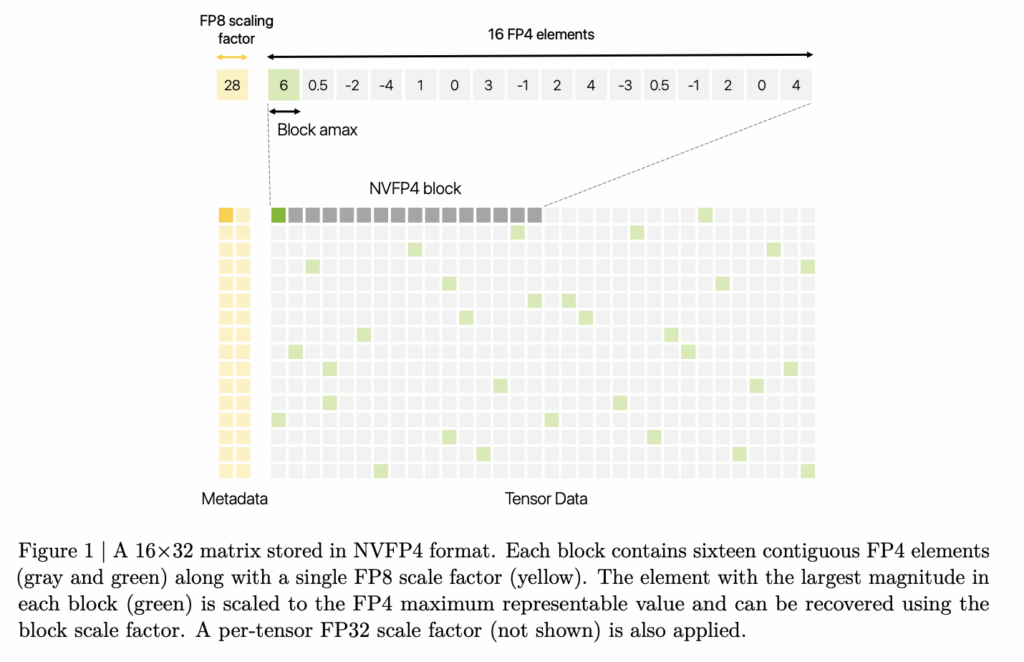
Pretraining frontier-scale LLMs in FP8 is now standard practice, but moving to 4-bit floating point has remained an open research problem because narrower formats compress dynamic range and amplify quantization error at long token horizons. A new research from NVIDIA describes a pretraining methodology built around NVFP4, a 4-bit microscaling format supported natively by Blackwell Tensor Cores, and validates it by pretraining a 12-billion-parameter hybrid Mamba-Transformer on 10 trillion tokens. The research team state this is the longest publicly documented training run in 4-bit precision to date. The resulting model attains 62.58% on MMLU-Pro 5-shot versus 62.62% for the FP8 baseline, and is supported in NVIDIA’s Transformer Engine. What NVFP4 Actually is To understand why NVFP4 is important, it helps to revisit how microscaling formats work. In a microscaling (MX) format, a contiguous block of low-precision elements shares a single scale factor, which is used to map the block back into a wider numerical range during the matrix multiply. MXFP4 uses 32-element blocks where each element is stored as E2M1 — 1 sign bit, 2 exponent bits, 1 mantissa bit — encoding only the values ±0, ±0.5, ±1, ±1.5, ±2, ±3, ±4, and ±6. Block scale factors are stored in UE8M0, which restricts them to powers of two. NVFP4 changes three things. First, the block size drops from 32 to 16 elements, narrowing the dynamic range each scale has to cover. Second, block scale factors are stored in E4M3 rather than UE8M0, trading exponent range for mantissa precision so the per-block amax (absolute maximum) can be mapped much closer to the FP4 maximum representable. Third, NVFP4 adds a second scaling level: an FP32 per-tensor scale that remaps values so the E4M3 block scales themselves stay in range. The result is that at least 6.25% of values in each block — the per-block amax — are represented at near-FP8 precision, while the remainder sit in FP4. On NVIDIA Blackwell, FP4 GEMMs run at 4× BF16 throughput on GB200 and 6× on GB300, which translates to roughly 2× and 3× speedups over FP8. Operand memory footprint is approximately halved compared to FP8. https://arxiv.org/pdf/2509.25149 What’s Quantized — and What Isn’t Only the GEMMs inside linear (fully-connected) layers Fprop, Dgrad, and Wgrad actually run in NVFP4. Embeddings, the output projection head, normalization layers, non-linearities, and all attention components (softmax and the query-key and attention score-value batched GEMMs) stay in BF16 or FP32. Model weights, weight gradients used for accumulation across microbatches and data-parallel replicas, and optimizer states are kept in FP32. Tensor parallel reductions run in BF16. The Four-Part Training Methodology Quantizing every linear-layer GEMM to NVFP4 with default settings (1×16 block scaling everywhere, round-to-nearest-even on every tensor, no transforms) diverges early in training. NVIDIA’s approach stabilizes it with four components, and ablation studies on the 12B model show each is necessary. Selective high precision: Linear layers in the first two and the final eight of the 62 blocks (about 16% of all linear layers) are kept in BF16. Ablations indicated that the final blocks are the sensitive ones because they require more dynamic range than FP4 provides; keeping only the final four blocks in BF16 was also enough for stable convergence. Random Hadamard Transforms (RHT): Outliers in weight gradients are spread into an approximately Gaussian distribution by multiplying the input tiles with a 16×16 Hadamard matrix combined with a random ±1 sign vector. Because the orthogonal transforms cancel inside the dot-product, no math correction is needed in the GEMM. The d=16 size was chosen empirically: d=4 hurt convergence, d=128 gave similar results. RHT is applied only to the inputs of the weight-gradient (Wgrad) GEMM, and a single random sign vector is shared across all linear layers. Randomization itself was a no-op at the 1.2B scale but measurably improved the 12B run. Two-dimensional (2D) block scaling for weights: Standard NVFP4 scales 1×16 blocks along the dot-product dimension. Because the backward pass transposes the weight tensor, the forward and backward passes end up with different quantized weights, breaking the chain rule. NVIDIA’s fix is to scale weights in 16×16 blocks so the same quantized representation is used in both passes. Activations and gradients keep 1×16 scaling, since they are less sensitive to this inconsistency. Stochastic rounding on gradients: Round-to-nearest-even introduces systematic bias when applied to gradient tensors. Stochastic rounding rounds probabilistically based on distance to the two nearest representable values, removing that bias. The research team explicitly notes in research paper that stochastic rounding is detrimental when applied to forward-pass tensors, so it is restricted to gradients. Results on the 12B Hybrid Mamba-Transformer The 12B model uses the Nemotron-Nano-12B-v2-Base architecture — 62 blocks (6 Self-Attention, 28 FFN, 28 Mamba-2), hidden dimension 5120, FFN dimension 20480 — trained with a Warmup-Stable-Decay schedule (constant LR through 80% of training, decay over the final 20%), batch size 736, sequence length 8192. The FP8 reference baseline follows the DeepSeek-V3 methodology: E4M3 elements, 128×128 weight blocks, 1×128 activation and gradient blocks, with the first block and last two blocks kept in BF16. NVFP4 validation loss stays within 1% of the FP8 baseline during the stable phase and widens to slightly above 1.5% during decay. Downstream accuracy is comparable across most benchmarks: MMLU 76.57% vs 77.36%, GSM8K CoT 92.27% vs 89.08%, MATH 81.48% vs 83.32%, AGIEval English CoT 70.31% vs 67.01%. Coding shows the largest gap — HumanEval+ 57.43% vs 59.93%, MBPP+ 55.91% vs 59.11% — which the research team attributes partly to noisy final-checkpoint evaluation. The research team also documents a precision-switching technique: transitioning the forward pass from NVFP4 to BF16 starting at 8.2T tokens (about 18% of the schedule) reduced relative loss error from 1.5% to 0.5%. NVFP4 vs MXFP4 On a separate 8B hybrid Mamba-Transformer trained on 1T tokens, NVFP4 reached a relative loss error of about 1.5% versus BF16, while MXFP4 stayed near 2.5%. To close the gap, MXFP4 required 1.36T tokens to match the NVFP4 1T-token loss — a 36% token overhead. The research team attributes the difference to NVFP4’s smaller block size and E4M3
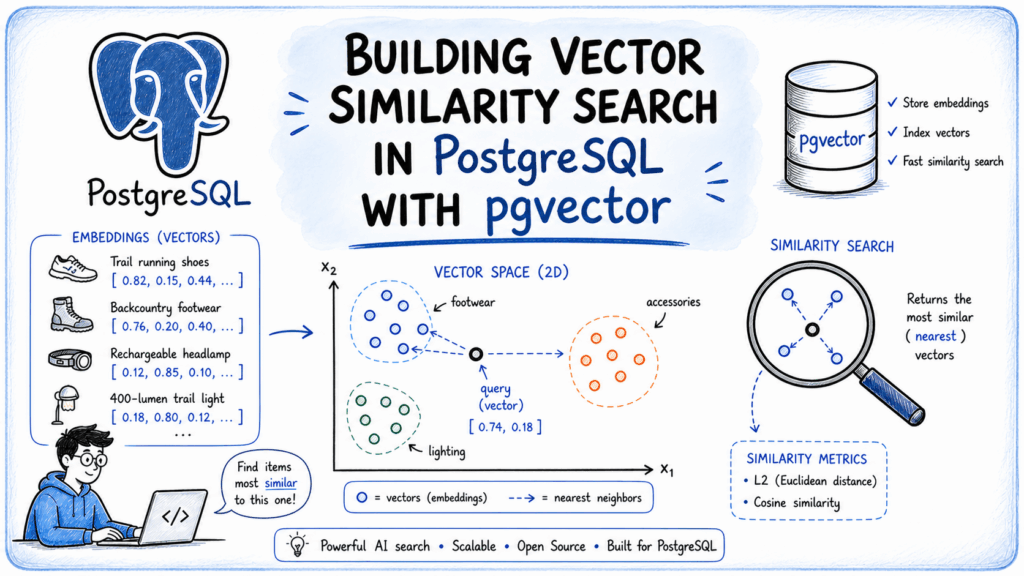
Search works well when users know exactly what they are looking for, but it breaks down when intent is described in natural language.
Building Vector Similarity Search in PostgreSQL with pgvector Leer entrada »

This is today’s edition of The Download, our weekday newsletter that provides a daily dose of what’s going on in the world of technology. Musk v. Altman week 3: Musk and Altman traded blows over each other’s credibility. Now the jury will pick a side. In the final week of the Musk v. Altman trial, lawyers attacked the credibility of the two tech leaders. Sam Altman was accused of lying and self-dealing, while Elon Musk was portrayed as a power-seeker trying to control artificial general intelligence. The case unearthed new details about the two arch-rivals and OpenAI’s contested nonprofit status, as well as a golden trophy of a donkey’s ass awarded to an employee who challenged Musk. Read the full story on the explosive final week of the trial. —Michelle Kim Michelle Kim, who’s also a lawyer, has been in court throughout the Musk v. Altman trial. Read her coverage of week 1 and week 2, plus a Q&A on what it was like in the room. The must-reads I’ve combed the internet to find you today’s most fun/important/scary/fascinating stories about technology. 1 Trump traded hundreds of millions in tech stocks before favorable policy movesHe bought shares in Nvidia, AMD, and Arm ahead of policy boosts. (Quartz)+ And touted Palantir on Truth Social after buying its stock. (CNBC)+ His crypto venture and Iran’s top exchange tapped the same networks. (Reuters $) 2 SpaceX plans to list on the Nasdaq stock exchange as soon as June 12It wants to raise up to $75 billion at a $1.75 trillion valuation. (Reuters $)+ BlackRock may invest up to $10 billion in the offering. (The Information $)+ Cerebras’ blockbuster IPO has boosted hopes for the listing. (CNBC)+ Which is set to dwarf many of the biggest IPOs on record. (Reuters) 3 Chinese AI groups have pulled ahead of US rivals in video generationByteDance and Kuaishou’s models lead in realism and scale. (FT $)+ AI is fueling China’s short-drama boom. (MIT Technology Review)+ While its AI labs are betting big on open source. (MIT Technology Review) 4 Iran says it will charge Big Tech for using undersea internet cablesThe cables beneath the Strait of Hormuz carry vast digital traffic. (CNN)+ Tech bosses met at Uber HQ on Saturday to discuss Iran’s future. (404 Media) 5 Samsung has a “last chance” to stop a massive strike over AIOver 45,000 employees could walk out for 18 days this week. (CNBC) + They want a bigger share of the AI boom. (FT $)+ Samsung and its largest labor union will resume talks on Tuesday. (Reuters $) 6 Old oil and gas wells could become a new source of clean energyUS states plan to convert them into geothermal energy assets. (Wired $)+ A balcony solar boom is coming to the US. (MIT Technology Review) 7 The ChatGPT era has triggered a 30% surge in grades at a top universityGrades inflated in text-heavy courses but remained flat in others. (Axios)+ Princeton has changed its honor code because of AI cheating. (WSJ $)+ And real cheating rates may be far higher. (The Times $) 8 Ex-Google CEO Eric Schmidt was fiercely booed during an AI speechHis graduation speech praising AI agents sparked uproar. (The Verge)+ A populist backlash is building against AI. (MIT Technology Review) 9 Arm faces a US antitrust probe over its chip tech licensesRegulators are investigating whether it has an illegal monopoly. (Bloomberg $)+ Qualcomm has accused Arm of anticompetitive conduct. (Reuters $) 10 ArXiv will ban researchers who submit AI slopOffending authors face year-long bans from the pre-print server. (TechCrunch) Quote of the day “When someone offers you a seat on the rocket ship, you do not ask which seat. You just get on.” —Ex-Google CEO Eric Schmidt extolls the virtues of AI agents in a graduation speech at the University of Arizona, prompting a chorus of boos. One More Thing WYSS INSTITUTE AT HARVARD UNIVERSITY Is this the end of animal testing? In a clean room in his lab, Sean Moore peers through a microscope at a bit of human intestinal tissue growing on a plastic chip. It’s one of 24 so-called “organs-on-chips” his team bought three years ago. The technology is designed to mimic human biology—and could reduce the need for animal testing. The appeal is not only ethical. Around 95% of drugs developed through animal research ultimately fail in people, and early studies suggest organ-on-a-chip systems may offer more accurate insights into how diseases behave and how drugs work. But the field still faces major technical and cost challenges before it can replace animal research. Find out how organ-on-chip technology could reshape drug testing. —Harriet Brown We can still have nice things A place for comfort, fun, and distraction to brighten up your day. (Got any ideas? Drop me a line.) + Listen to the captivating first recordings of whale songs from 1949.+ Meet the feline guardians of New York’s corner stores in this photo collection.+ A newly discovered floor plan allowed historians to pinpoint the location of Shakespeare’s only property in London.+ A music fan spent decades secretly recording 10,000 local shows. Now the entire collection is available online.
The Download: Musk v. Altman week 3, and Trump’s tech trading Leer entrada »
We use cookies to improve your experience and performance on our website. You can learn more at Política de privacidad and manage your privacy settings by clicking Settings.


