NVIDIA Introduces X-Token: Projection-Guided Cross-Tokenizer KD That Outperforms GOLD by +3.82 Average Points on Llama-3.2-1B
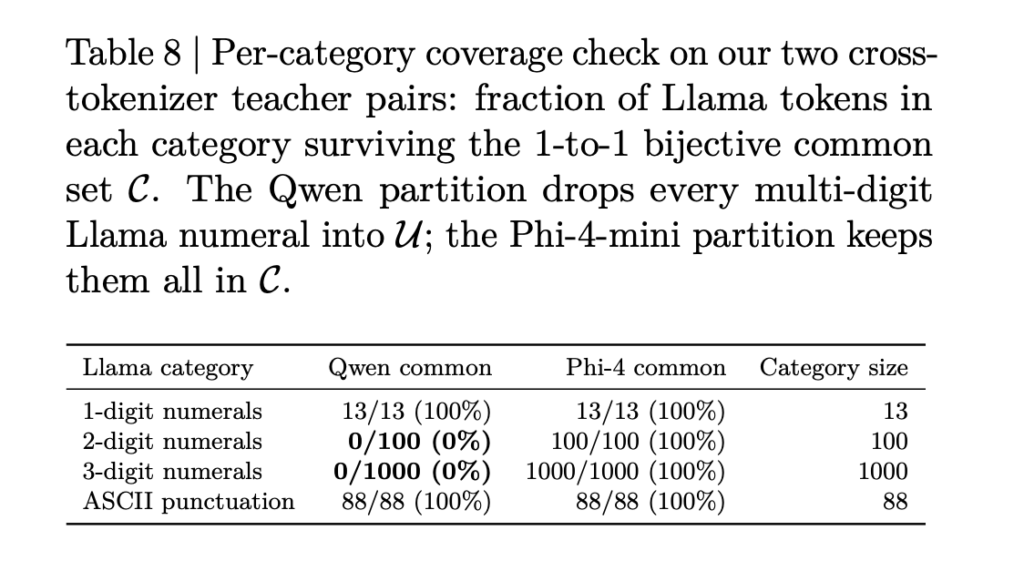
Knowledge distillation (KD) transfers “dark knowledge” from a large teacher model to a smaller student. The student learns from the teacher’s full output probability distribution over tokens, not just correct answers. This is done via per-position Kullback–Leibler (KL) divergence over next-token probability distributions. This formulation requires a shared tokenizer. A practitioner committed to Llama-3.2-1B cannot leverage stronger teachers with incompatible tokenizers — such as Phi-4-mini or Qwen3-4B — because token positions do not correspond across vocabularies. This also prevents multi-teacher distillation across tokenizer families. NVIDIA researchers introduced X-Token, a logit-distribution-based method for cross-tokenizer KD (Knowledge distillation). It operates as a drop-in replacement for the standard KD loss, requiring no auxiliary trainable components and no architectural changes. The Problem X-Token is Solving Two prior approaches dominate cross-tokenizer KD. ULD (Universal Logit Distillation) sidesteps vocabulary alignment by rank-sorting both distributions and minimizing L1 distance. It discards token identity entirely. GOLD adds span alignment and a hybrid loss. It partitions tokens into a 1-to-1 string-matched common subset, trained with KL divergence, and an uncommon remainder, trained with ULD-style rank matching. GOLD is the current state of the art. The research team identifies two structural failures in GOLD’s design: Failure 1: Uncommon-token failure– When tokenizers fragment text differently, critical tokens fall into the unmatched uncommon subset. Llama-3 packs multi-digit numbers as single tokens — “201” is one token. Qwen3 splits them digit by digit: “2”, “0”, “1”. Under GOLD, all 1,100 of Llama’s two- and three-digit numerals (100 two-digit, 1,000 three-digit) fall into the uncommon set when Qwen3-4B is the teacher. Those tokens receive two types of harmful signal: identity-agnostic noise from rank-based ULD matching, and suppressive gradients from the common-KL term acting through the full-vocabulary softmax. The result: GSM8k accuracy drops to 2.56 under GOLD with Qwen3-4B, compared to 12.89 for same-tokenizer KD from a weaker Llama-3.2-3B teacher. Failure 2: Over-conservative matching– GOLD uses strict string equality to define the common subset. A student token Hundreds corresponds to teacher tokens Hund followed by reds under teacher-side re-tokenization, but strict matching discards this pair. Useful alignment signal is lost even when the correspondence is well-formed. These two failures require opposite remedies: eliminate the partition when critical tokens are misaligned, and relax it when alignment is structurally sound. How X-Token Works X-Token has three components: span alignment, a projection matrix W, and two complementary loss formulations — P-KL and H-KL. Span Alignment Teacher and student tokenizers produce sequences of different lengths for the same text. X-Token uses dynamic-programming (DP) span alignment, grouping tokens into chunks where each chunk-pair decodes to the same underlying text substring. A chain-rule merge then combines per-token probabilities within each chunk into a single chunk-level distribution for use in the distillation loss. The alignment is cached per sequence and adds no per-step training overhead. The research team also identifies a failure in TRL’s surface-substring alignment, which is used in TRL’s GOLD trainer. TRL accumulates per-side decoded buffers and flushes only when both buffers match as equal raw strings. A byte-level disagreement — such as Llama-3 auto-prepending <bos> while Qwen-3 does not — prevents future flushes and forces all remaining tokens into one mis-grouped super-group at end of sequence. The DP approach handles this with a single gap move, regardless of sequence length. The Projection Matrix W After alignment, teacher and student distributions still operate over different vocabularies. The projection matrix W ∈ ℝVS|×|VT| maps each student token to a weighted combination of teacher tokens, bridging the vocabulary mismatch. W is constructed deterministically in two passes: Pass 1 (exact-match): For every (student token, teacher token) pair whose decoded strings match after canonicalization, set W[s, t] = 1. Canonicalization unifies space prefixes (Ġ, _, ␣), newlines, byte-fallback tokens of the form <0xHH>, and model-specific special tokens across tokenizer families. Pass 2 (multi-token rule): For each student token without an exact match, re-tokenize its decoded text under the teacher tokenizer. If the resulting sequence has length ≤ 4, assign exponentially-decayed weights: W[s, τᵢ] = β·γⁱ with (β, γ) = (0.9, 0.1). A length-2 span receives normalized weights (0.909, 0.091). A length-3 span receives (0.9009, 0.0901, 0.0090). A length-4 span receives (0.9000, 0.0900, 0.0090, 0.0009). The leading sub-token receives the highest weight because it typically carries the most informative probability mass — for example, “_inter” in [“_inter”, “national”] or “_20” in [“_20”, “24”]. Each row is truncated to its top-4 entries and row-normalized. Because each row of W is non-negative and sums to 1, left-multiplication by W⊤ is probability-preserving: if pS is a probability vector, W⊤pS is also a valid probability vector over VT. W is constructed once before training and can optionally be jointly refined with the student under P-KL. P-KL: Addressing Erroneous and Suppressive Gradients P-KL removes the partition entirely. It projects the student distribution p̂S(k) into teacher vocabulary space via W: p~S(k)[t]=∑s∈𝒱SW[s,t]⋅p^S(k)[s]tilde{p}_S^{(k)}[t] = sum_{sinmathcal{V}_S} W[s, t] cdot hat{p}_S^{(k)}[s] Then it computes KL divergence directly between teacher and projected student: ∂ℒcommon∂zj=pS[j]⋅M𝒞(T)frac{partialmathcal{L}_{common}}{partial z_{j}} = p_S[j] cdot M_{mathcal{C}}(T) There is no uncommon set, so rank-based ULD noise is eliminated. The suppressive gradient problem is also eliminated: the projection routes the student’s probability mass for “201” directly onto {2, 0, 1} in the teacher vocabulary via W. The research team formally proves (Proposition 1) that GOLD’s common-KL term induces non-negative gradients on every uncommon student logit. The gradient on an uncommon student logit j is: ∂ℒcommon/∂zj = pS[j] · MC(T), where MC(T), is the teacher probability mass on the common subset. Under gradient descent, this always drives zj downward — suppressing every uncommon token’s probability regardless of the ground-truth token. H-KL: Relaxing the 1-to-1 Matching H-KL applies when the partition is structurally sound — that is, when critical tokens land in the common subset. In that case, GOLD’s direct KL on identity-aligned pairs delivers sharper per-pair supervision than P-KL’s projection, which blends student probability mass across multiple teacher tokens. The opportunity is to make the partition less wasteful by relaxing the strict string-equality criterion. H-KL retains GOLD’s hybrid loss structure but expands the common set