YouZum

Committee

AI, Committee, Noticias, Uncategorized

When AI designs a drug, who gets the credit?

When the biotech company Insilico Medicine used its computer models to propose a promising drug for pulmonary fibrosis, it enthusiastically claimed in a press release that the molecule had been “discovered by” its generative AI platform. Insilico leads a pack of companies using AI to rapidly come up with drug ideas humans might never think of, potentially speeding the race to new cures. AI models are now able to generate atomic designs for drugs almost as easily as ChatGPT can write a thank-you note. However, when it came time to file for an all-important patent to protect that new chemical structure, the company made no mention of AI. Instead the patent names five humans, including CEO Alex Zhavoronkov, as the drug’s “inventors.” The discrepancy points to a fascinating wrinkle in intellectual-property law. No matter how fundamental an AI is to a discovery, when it comes to winning rights to an invention, it’s humans—and only humans—who can take the credit. US courts reached that conclusion after Ryan Abbott, a partner at the LA law firm Brown, Neri, Smith & Khan, brought a pro bono test case naming an AI called DABUS as an inventor of a better food container, whose intricate geometric surface lets it transfer heat well and stack easily. Because no human contributed to the design, Abbott argued that the AI should be named the inventor. The case might have raised philosophical questions, like whether AIs deserve legal rights or what the true nature is of that eureka moment that leads to a better mousetrap. But in 2022, an appeals court in Washington, DC, said these “metaphysical matters” were beside the point. Instead, it noted that US statutes describe an inventor as an “individual,” the plain meaning of which is a human being. Since machines aren’t people, they can’t be inventors. Case closed. “There needs to be a human inventor or there’s no invention and no patent,” says Sarah Korman, a patent attorney who is now chief business officer and legal officer of Isomorphic Labs, an Alphabet spinout with big ambitions for AI cures. Korman, who made her remarks at MIT Technology Review’s EmTech event last year, added that there is “no doubt” our laws will need to evolve to keep pace with AI. That’s partly because no one is denying that AIs can invent things. In the future, they may do so with less and less human intervention. As the US Patent and Trademark Office has itself acknowledged, “an AI system—like other tools—may perform acts that, if performed by a human, could constitute inventorship under our laws.” Instead, the key question going forward may actually be whether or not any human contributed enough to be named as an inventor. Abbott believes there could be legal challenges to AI-generated drugs, since one way to invalidate a patent is to show it has the wrong inventors listed. Abbott’s worry is that if US policy excludes AI-generated outputs from protection, that could put a damper on future drug development. Already, the US Copyright Office is refusing to grant copyrights to images and text generated by AI, raising concerns from organizations like the Motion Picture Association of America, whose members are using those tools.  The point of our intellectual-property laws is to encourage innovation, Abbott says. It’s right there in Article 1 of the US Constitution, which says inventors and authors need to be given exclusive rights to their ideas, for a limited time, in order “to promote the Progress of Science and the Useful Arts.” Currently, the US patent office seems to be taking a don’t-ask-don’t-tell approach to the use of AI. Under the Biden administration, the agency published guidance to help applicants determine whether and when humans would truly qualify as co-inventors of an AI discovery. But after Trump arrived in office, it reversed course. Now the patent office says AI is merely a tool, like a calculator. No need to even mention it. You can bet that pioneering AI drug companies are keeping humans in the loop, at least for now, and documenting everything carefully. At Insilico, Zhavoronkov says, human chemists still have to synthesize the drugs, create variants, and test them on animals. “That’s the person who is going to be named on the patent,” he says. “And even if you decided to completely roboticize this process, including the experiments, someone will still push the button and give the budget.” Should pushing a button count as being an inventor? Abbott says that’s a question for future legal cases. “What if I asked Claude to cure cancer, and it did?” he says. “I think it would be inappropriate to claim that I invented that.”  This article first appeared in The Checkup, MIT Technology Review’s weekly biotech newsletter. To receive it in your inbox every Thursday, and read articles like this first, sign up here.

When AI designs a drug, who gets the credit? Leer entrada »

AI, Committee, Noticias, Uncategorized

This company’s plans to deploy space mirrors could jeopardize the night sky for many

A company that plans to beam sunlight from space to Earth on demand might unintentionally brighten the night sky for many more people than intended, according to a new study. Later this year, the US company Reflect Orbital plans to launch a test satellite called Eärendil-1 that will extend an 18-by-18-meter mirror in orbit. The goal is to test the feasibility of the company’s plans to launch up to 50,000 larger satellites, measuring 54 by 54 meters, and reflect sunlight to Earth on demand. The case for doing this remains somewhat uncertain, but Reflect Orbital has said the goal is to prolong the hours of sunlight for various uses, including solar panel charging, emergency response, and military activities. The launch, which was approved by the Federal Communications Commission in July, has been met with disbelief by astronomers and environmental groups. “This is incompatible with astronomy,” says Samantha Lawler, an astronomer at the University of Regina in Canada. “There is no way you can do this and preserve dark skies.” Miroslav Kocifaj, an astronomer at the Slovak Academy of Sciences, and his colleagues have now calculated the broader effect on the night sky. In a new paper published online and accepted for publication in the space journal Astrophysical Journal Letters, they studied the extent to which the light the satellites beamed to the ground would scatter. They found that within the beam’s target area, intended to be a circular patch five kilometers across, a single Reflect Orbital satellite would appear about 40 times brighter than the full moon in the sky. As far as 14 kilometers away from the center of the beam, the satellite would still be as bright as the full moon.  Combining the beams of 400 satellites, which Reflect Orbital eventually plans to do, would yield a light as bright as 10,000 full moons within the five-kilometer area, or 2.4% as bright as the sun. Even up to 80 kilometers away, Kocifaj and his colleagues calculated, this combined beam would be visible as “a glow above the horizon,” he says. That means the night sky would be altered for many more people than those within the area Reflect Orbital intends to illuminate. “Deploying these mirrors would be seriously damaging for astronomy and for the nighttime environment,” says Kocifaj.“ The damage extends far beyond the target area.” Olivier Hainaut, an astronomer at the European Southern Observatory in Germany, says the results of the paper are not surprising but are still useful. “These guys are really good at that kind of modeling,” he says. “They know what they’re doing.” Hainaut had previously modeled the broader effect of Reflect Orbital’s beams, finding they would brighten the sky up to 300% worldwide. This latest work gives an even more complete picture of what the impact would be. “These two papers really cover most of it,” he says. Reflect Orbital CEO Ben Nowack disagrees with the findings of Kocifaj’s paper. “Some assumptions are simply inaccurate,” he says. “The critical point is that our safeguards, including maintaining exclusion zones, take account of scattering.” He says that the company has “engaged substantively with legitimate concerns raised by astronomers, environmental researchers, and scientists,” and that their feedback has “informed our technology and operational plans.” Kocifaj says that Reflect Orbital has not provided data to back up its claims. The company “states that safeguards exist, that scattering is taken into account, and that the models are being updated, but it gives no numbers, no description of the model, no assumptions, and no data,” he says. “There is therefore nothing that can be engaged with technically. Our calculations produce concrete figures.” Reflect Orbital’s intention is to place its satellites into highly inclined orbits above Earth, almost from pole to pole. This will enable them to reflect sunlight in the hours before sunrise and after sunset, extending daylight hours in certain locations. Eventually, the company has said, it wants to place satellites high enough to provide light 24-7 to locations on Earth. In August, a group of organisations including DarkSky International and the American Bird Conservancy urged the FCC to review its approval of the Eärendil-1 satellite. As well as the impact on astronomy raised by this and future satellites, the group also highlighted potential negative consequences for aviation and wildlife. “Our primary request is straightforward: Reverse the Space Bureau’s order, and require a lawful public-interest and NEPA [National Environmental Policy Act] review,” the group said in a statement. The satellites could also pose risks to humans, according to Reflect Orbital itself. In a filing with the FCC in March, the company said that observing Eärendil-1 with a telescope larger than 12 inches —which many astronomers have access to—may be unsafe for human eyes. It added, though, that such observations are “unlikely to … result in significant injury” because the satellites are not constantly bright. Currently there is no global entity that could regulate satellites such as these, so approval falls to national regulators such as the FCC in the US. Michelle Hanlon, a space lawyer at the University of Mississippi’s School of Law, says there are “real benefits” to the plans proposed by Reflect Orbital. “It could extend the productive hours of solar facilities and provide light in remote areas or after a disaster,” she says. However, the “legal basis is less clear than the technology,” she says. The FCC “does not have authority to license or regulate the operation of the solar reflector itself.” It can only authorize the use of radio frequencies to communicate with the spacecraft. That means Reflect Orbital will need permission on a national and local level to reflect sunlight onto the ground, but if the beams spread as much as Kocifaj and his team predict, “the company could need approvals in more than one jurisdiction,” says Hanlon. “There may also be aviation-safety and cross-border questions.” The fierce debate over the satellites shows no signs of abating. “It makes me sad that astronomers are having to spend their time doing these sorts

This company’s plans to deploy space mirrors could jeopardize the night sky for many Leer entrada »

AI, Committee, Noticias, Uncategorized

The Download: threats from space mirrors and credit for AI drugs

This is today’s edition of The Download, our weekday newsletter that provides a daily dose of what’s going on in the world of technology. This company’s plans to deploy space mirrors could jeopardize the night sky for many A company that plans to beam sunlight from space to Earth on demand might unintentionally brighten the night sky for many more people than intended, according to a new study. Later this year, Reflect Orbital plans to launch a test satellite that will extend an 18-by-18-meter mirror in orbit. The goal is to eventually launch up to 50,000 larger satellites that can reflect sunlight to Earth on demand. Reflect Orbital says the technology could extend sunlight for solar panel charging, emergency response, and military activities. But new research suggests the giant beams could shine as bright as 10,000 full moons and scatter light over tens of kilometers, raising concerns about dark skies, aviation, and wildlife. Read the full story on the fierce debate over the space mirrors. —Jonathan O’Callaghan When AI designs a drug, who gets the credit? When Insilico Medicine used its computer models to propose a promising drug for pulmonary fibrosis, it enthusiastically claimed that the molecule had been “discovered by” generative AI. But when it filed a patent, the company made no mention of AI. Instead, it named five humans as the drug’s “inventors.” The discrepancy points to a fascinating wrinkle in intellectual-property law. No matter how fundamental an AI is to a discovery, when it comes to winning rights to an invention, it’s humans—and only humans—who can take the credit. As AI models become capable of generating drug designs as easily as ChatGPT can write a thank-you note, the question of who actually invented something could get much harder to answer. Here’s how AI drug discovery could force patent law to confront what it means to invent. —Antonio Regalado This story is from The Checkup, our weekly biotech newsletter. Sign up to receive it in your inbox every Thursday. The must-reads I’ve combed the internet to find you today’s most fun/important/scary/fascinating stories about technology. 1 The data center backlash is scrambling the midterm electionsIt’s breaking the bipartisan consensus behind America’s AI buildout. (Axios)+ Politicians are turning against the data centers they once championed. (WSJ $)+ Across the political divide, people hate data centers. (MIT Technology Review) 2 Ukraine planned to swarm Moscow airports with AI-guided dronesThe stalled operation aimed to send 1,000 autonomous drones a night. (Atlantic $)+ Kyiv wants Musk’s approval to use Starlink-equipped drones in Russia. (FT $)+ Ukraine’s ex-defense minister wants defense tech funding from the US. (Reuters $) 3 A staggering 90% of biomedical papers show signs of AI useA new study suggests it’s far more common than previously thought. (Nature)+ A third of new web pages also involve AI authorship. (TechCrunch)+ AI for science needs reasoning, not just data. (MIT Technology Review) 4 China plans to make the first landing at the moon’s south pole this yearThe Chang’e 7 mission will hunt for lunar ice. (Scientific American)+ It will deploy robotic landers, rovers, and “hopping” probes. (Reuters $) 5 We need new measures of AI intelligenceBetter experiments could reveal what AI actually understands. (Quanta)+ And human-centered, context-specific metrics. (MIT Technology Review)  6 A tech billionaire wants to automate the restaurant industryMarc Lore aims to control everything from production to delivery. (FT $) 7 An English county is rejecting Palantir for a homegrown platformGreater Manchester insists it can do a better job itself. (Wired $) 8 New research estimates humans could live for 194 yearsIf we cure all the theoretically curable causes of aging. (New Scientist $)+ Longevity enthusiasts are gaining influence. (MIT Technology Review) 9 The galaxy’s fastest star could show how a black hole warps spacetimeIts orbit could reveal the speed of Sagittarius A*’s spin. (Wired $) 10 Mark Zuckerberg has bought an Irish castleThe 440-acre estate reportedly cost up to €30 million. (Verge) Quote of the day “The emperor is a fan of Flock, and we must continue utilizing Flock technologies so that we can follow and surveil the rebel scum.”  —Darth Vader (or, at least, a man in his costume), passionately defends Flock at a San Diego public safety committee meeting, 404 Media reports. One More Thing Meet the new biologists treating LLMs like aliens LLMs are such vast and complicated systems that nobody quite understands what they are, how they work, or what they can really do—not even the people who build them. That makes it hard to get a grip on their hallucinations, set up effective guardrails, and know when to trust them. So researchers are trying something different: studying them as if they were doing biology or neuroscience on vast living creatures—city-size xenomorphs that have appeared in our midst. They’re discovering that large language models are even weirder than they thought. But they also now have a clearer sense than ever of what these models can and can’t do—and what’s going on under the hood when they do unexpected things. Step inside the strange new science of understanding LLMs. —Will Douglas Heaven We can still have nice things A place for comfort, fun, and distraction to brighten up your day. (Got any ideas? Drop me a line.) + Beauty is in the eye of the beholder at the World’s Ugliest Dog contest.+ Blankie’s free ambient sound mixer could help you work, focus, relax, and sleep.+ Slow-motion footage of blissful bumblebees reveals they lick their lips after enjoying sweet treats.+ The James Webb Space Telescope opens a treasure chest filled with stars in this stunning image from the Carina Nebula.

The Download: threats from space mirrors and credit for AI drugs Leer entrada »

AI, Committee, Noticias, Uncategorized

Building Agentic Document Intelligence Pipelines: Creating Scientific Figures with AutoFigure

In this tutorial, we explore AutoFigure as a practical toolkit for generating scientific figures directly from text descriptions, paper-like content, and structured methodological explanations. In this tutorial, we set up the complete AutoFigure environment, fix dependency issues such as Pillow compatibility, and prepare the required rendering tools for SVG and PNG outputs. We then build a custom reference figure, configure an API-backed generation workflow, and use AutoFigure to convert a detailed agentic document intelligence pipeline into a publication-style scientific diagram. Along the way, we also test offline SVG rendering, inspect the generated files, create a sample paper and PDF, and export the final outputs to a reusable gallery and a zip archive. Copy CodeCopiedUse a different Browser import os import sys import json import time import glob import shutil import textwrap import subprocess import importlib from pathlib import Path from getpass import getpass REPO_URL = “https://github.com/ResearAI/AutoFigure.git” REPO_DIR = Path(“/content/AutoFigure”) OUTPUT_ROOT = Path(“/content/autofigure_colab_outputs”) PROVIDER = os.environ.get(“AUTOFIGURE_PROVIDER”, “openrouter”) DEFAULT_MODELS = { “openrouter”: “google/gemini-3.1-pro-preview”, “gemini”: “gemini-3.1-pro-preview”, “bianxie”: “gemini-3.1-pro-preview”, } GENERATION_MODEL = os.environ.get( “AUTOFIGURE_MODEL”, DEFAULT_MODELS.get(PROVIDER, “google/gemini-3.1-pro-preview”) ) MAX_ITERATIONS = int(os.environ.get(“AUTOFIGURE_MAX_ITERATIONS”, “1”)) QUALITY_THRESHOLD = float(os.environ.get(“AUTOFIGURE_QUALITY_THRESHOLD”, “8.5”)) RUN_TEXT_TO_FIGURE = True RUN_PAPER_TO_FIGURE = False RUN_MXGRAPH_DEMO = False RUN_IMAGE_ENHANCEMENT = False TEXT_OUTPUT_FORMAT = “svg” MXGRAPH_OUTPUT_FORMAT = “mxgraphxml” ART_STYLE = ( “clean publication-ready scientific illustration, precise alignment, subtle shadows, ” “clear academic typography, high contrast, minimal clutter” ) FIGURE_DESCRIPTION = “”” Create a publication-ready scientific method figure for an agentic long-document intelligence system. The figure should explain the following pipeline in a left-to-right architecture: 1. Long documents enter the system. They may be PDFs, scanned reports, markdown files, tables, or mixed-layout documents. 2. A document normalization layer extracts raw text, section hierarchy, tables, figures, and metadata. 3. A routing planner decides whether each section should go to summarization, field extraction, table reconstruction, visual analysis, or citation grounding. 4. Specialized expert modules process the routed chunks: – Summarizer expert creates hierarchical summaries. – Extraction expert returns JSON fields. – Table expert reconstructs exact tables. – Visual expert describes charts and diagrams. – Citation expert links claims to evidence spans. 5. A low-cost orchestration layer selects smaller or larger LLMs depending on complexity, confidence, and budget. 6. A verification layer checks schema validity, source grounding, table consistency, and confidence. 7. The final output is an analyst-ready workspace containing a summary, extracted fields, exact tables, cited answers, and audit logs. Design requirements: – Use a wide 16:9 layout. – Use clear module boxes, arrows, and labels. – Add small callouts for cost control, confidence scoring, and auditability. – Avoid decorative clutter. – Make the flow understandable for a finance or enterprise document intelligence audience. “”” MINI_PAPER_MARKDOWN = “”” # Efficient Agentic Document Intelligence for Long Financial Reports ## Abstract We propose an agentic document intelligence architecture for extracting summaries, facts, tables, and grounded answers from long, heterogeneous financial documents. ## Method Our method first normalizes each incoming document into a structured document graph. The graph contains section nodes, paragraph nodes, table nodes, figure nodes, and metadata nodes. A routing planner assigns each node to a specialized expert according to modality, complexity, and required output schema. The system uses five experts. The summarization expert produces hierarchical summaries from section-level chunks. The extraction expert fills strict JSON schemas for entities, dates, risks, financial metrics, and obligations. The table expert reconstructs exact tables and validates row-column alignment. The visual expert describes charts and diagrams. The citation expert maps every generated claim to source spans. A budget-aware orchestration layer selects model size dynamically. Simple chunks are processed by low-cost models, while complex chunks are escalated to stronger models. A verification layer then checks schema validity, citation support, numerical consistency, and table integrity. Failed checks are routed back for repair. ## Experiments We evaluate on financial filings and analyst reports using extraction accuracy, grounding precision, table reconstruction quality, and total inference cost. “”” def run(cmd, cwd=None, check=True, quiet=False): print(f”n$ {cmd}”) process = subprocess.run( cmd, shell=True, cwd=str(cwd) if cwd else None, text=True, stdout=subprocess.PIPE if quiet else None, stderr=subprocess.STDOUT if quiet else None, ) if quiet and process.stdout: print(process.stdout[-5000:]) if check and process.returncode != 0: raise RuntimeError(f”Command failed with exit code {process.returncode}: {cmd}”) return process def heading(title): print(“n” + “=” * 100) print(title) print(“=” * 100) def safe_read(path, max_chars=2500): path = Path(path) if not path.exists(): return “” text = path.read_text(encoding=”utf-8″, errors=”ignore”) return text[:max_chars] + (“n… [truncated]” if len(text) > max_chars else “”) def clear_loaded_modules(prefixes): for name in list(sys.modules): if any(name == prefix or name.startswith(prefix + “.”) for prefix in prefixes): del sys.modules[name] def get_colab_secret(names): try: from google.colab import userdata for name in names: try: value = userdata.get(name) if value: return value except Exception: pass except Exception: pass return None def collect_api_key(provider): env_candidates = [ “AUTOFIGURE_API_KEY”, “OPENROUTER_API_KEY”, “GOOGLE_API_KEY”, “GEMINI_API_KEY”, “BIANXIE_API_KEY”, ] for key_name in env_candidates: value = os.environ.get(key_name) if value: print(f”Using API key from environment variable: {key_name}”) return value secret_candidates = { “openrouter”: [“AUTOFIGURE_API_KEY”, “OPENROUTER_API_KEY”], “gemini”: [“AUTOFIGURE_API_KEY”, “GOOGLE_API_KEY”, “GEMINI_API_KEY”], “bianxie”: [“AUTOFIGURE_API_KEY”, “BIANXIE_API_KEY”], }.get(provider, [“AUTOFIGURE_API_KEY”]) value = get_colab_secret(secret_candidates) if value: print(“Using API key from Colab Secrets.”) return value value = getpass(f”Paste your {provider} API key, or press Enter to skip cloud generation: “).strip() return value We begin by importing and defining the main paths, provider settings, model configuration, and tutorial options. We also prepare the detailed figure description and sample paper content that we use later for AutoFigure generation. We then create helper functions to run commands, print section headings, read files safely, clear loaded modules, and securely collect API keys. Copy CodeCopiedUse a different Browser def display_file_if_possible(path, title=None): path = Path(path) if path else None if not path or not path.exists(): print(f”Missing file: {path}”) return try: from IPython.display import display, Image as IPImage, SVG, Markdown if title: display(Markdown(f”### {title}”)) suffix = path.suffix.lower() if suffix == “.png”: display(IPImage(filename=str(path))) elif suffix == “.svg”: display(SVG(filename=str(path))) elif suffix in [“.json”, “.md”, “.txt”, “.drawio”]: print(safe_read(path, max_chars=5000)) else: print(path) except Exception as exc: print(f”Could not display {path}: {exc}”) def make_output_gallery(output_dir): output_dir = Path(output_dir) gallery_path = output_dir / “gallery.html” blocks = [] for p in sorted(output_dir.rglob(“*.png”)): rel = p.relative_to(output_dir) blocks.append(f””” <div class=”card”> <h3>{rel}</h3> <img src=”{rel}” />

Building Agentic Document Intelligence Pipelines: Creating Scientific Figures with AutoFigure Leer entrada »

AI, Committee, Noticias, Uncategorized

Best GPU Neoclouds 2026: CoreWeave, Nebius, Lambda, Crusoe, and Groq Ranked by Published Pricing and Contracted Power

The ‘neocloud’ label now covers five companies with very different business models. CoreWeave and Nebius are public companies that publish quarterly results and file reports with the SEC (CoreWeave on Form 10-Q, Nebius as a foreign private issuer on Form 6-K). Lambda and Crusoe are private and heading toward IPOs. Groq has run GroqCloud on its LPU architecture since 2024; after licensing that technology to NVIDIA in December 2025, the independent Groq refocused entirely on inference-cloud infrastructure. This article compares them on what actually matters to a buyer: published pricing, deployed and contracted power, hardware roadmap, contract structure, and independent quality ratings. TL;DR CoreWeave is the only Platinum-rated GPU cloud in SemiAnalysis ClusterMAX 2.0 and commands premium list pricing on H100, H200, and B200. Nebius is the only provider here publishing B300 on-demand pricing; Lambda publishes the lowest B200 on-demand rate. Lambda still publishes the cheapest on-demand B200 ($6.69/GPU-hr) but has no spot tier. Crusoe is the only provider here with AMD MI300X/MI355X on its rate card. Groq is now an NVIDIA Cloud Partner and plans to add NVIDIA GPU capacity alongside its LPU inference cloud. CoreWeave Q2 rev $2.575B, +112% YoYNebius AI cloud ARR $3.0BLambda B200 on-demand $6.69/hr, lowest publishedCrusoe 4.9 GW contracted, 40 GW+ pipelineGroq 13 DCs, 54 MW → 200+ MW in 2027CoreWeave first Vera Rubin NVL72 bring-upNebius $5.0B converts priced Aug 19Crusoe only AMD MI300X/MI355X on a rate cardLambda Michel Combes CEO, May 2026Groq $350M Series A at $3.5B, Aug 17CoreWeave Q2 rev $2.575B, +112% YoYNebius AI cloud ARR $3.0BLambda B200 on-demand $6.69/hr, lowest publishedCrusoe 4.9 GW contracted, 40 GW+ pipelineGroq 13 DCs, 54 MW → 200+ MW in 2027CoreWeave first Vera Rubin NVL72 bring-upNebius $5.0B converts priced Aug 19Crusoe only AMD MI300X/MI355X on a rate cardLambda Michel Combes CEO, May 2026Groq $350M Series A at $3.5B, Aug 17 Marktechpost · GPU neocloud ledger · 2026 CoreWeave / Nebius / Lambda / Crusoe / Groq Figures checkedAugust 21, 2026Primary sources where available Metric CoreWeaveNASDAQ: CRWV NebiusNASDAQ: NBIS LambdaPrivate · IPO H2’26 (rep.) CrusoePrivate · ~$10B+ GroqPrivate · $3.5B Published priceNVIDIA HGX H100 · $/GPU-hr $6.16 node price ÷ GPUs $3.85 HGX, on-demand $3.99 SXM, 8x instance $3.90 HGX, on-demand — per-token only Q2 2026 revenuelatest reported $2.58B +112% YoY · net loss $626M $582M +454% YoY · ARR $3.0B n/d >$520M FY Sep-25 (The Information) n/d private; ~$3B raise at ~$30B reported (Jul) n/d $1B raised in 2026 (Jun + Aug) Poweractive / contracted 1.5 GW 4.2 GW+ contracted · 51 DCs ~1 GW connected target YE26 · 5 GW contracted target n/d 15 US DCs · KC site 24→100+ MW ~0.2 GW Abilene energized · 4.9 GW contracted (Jun) 54 MW → 200+ MW in 2027 · 13 DCs ClusterMAX 2.0SemiAnalysis tier PlatinumOnly Platinum provider, 2 ratings running GoldTop of Gold tier SilverNo spot tier; on-demand self-serve GoldOnly AMD on the rate card Not ratedInference API at time of rating Anchor dealsdisclosed Meta, Anthropic, OpenAI~$104B backlog (+>$25B early Q3) Microsoft $17.4B (to $19.4B)Meta $3B + up to ~$27B Microsoft multibillion, GB300 NVL72NVIDIA ~$1.5B lease-back (rep.) Oracle/OpenAI Abilene 1.2 GWMicrosoft 900 MW campus NVIDIA licensed LPU tech (~$20B rep.)6M+ developers on GroqCloud Next-gen siliconstatus Aug 2026 Vera Rubin NVL72: first bring-up + validation (Q2) Vera Rubin NVL72 units received; validating Vera CPU + Quantum-X800 CPO launch partner Vera CPU launch support; MI355X via sales NVIDIA LPX (Groq tech); NCP certified Aug 12; GPU capacity planned Discounts & egresspublished Reserved up to 60% off · egress free Commit up to 35% off · network egress free (Std object egress $0.015/GiB) Sales-quoted · egress free · no spot Sales-quoted · egress free Per-token pricing · clusters sales-led Funding posture2026 $35–39B capex guide · $31B recourse debt · $3.1B term loan · $1B Jane Street $4.3B converts (H1) · $5.0B converts priced Aug 19 · $775M secured · >$9B prepayments expected $1.5B+ Series E (Nov) · $1B credit facility (May) · $350M pre-IPO (rep.) $1.375B Series E at >$10B · $7.1B JV construction loan (Abilene ph.2) $650M (Jun) + $350M Series A at $3.5B (Aug), NVIDIA participating Cheapest published $3.85 H100 on-demand at Nebius. Lambda has the lowest B200 at $6.69; Crusoe the lowest H200 at $4.29. Nebius is the only one listing B300 on-demand. Premium, and why +10–15% SemiAnalysis says CoreWeave commands that per GPU-hour over Nebius, Crusoe and Lambda on managed clusters. It is the only Platinum ClusterMAX provider, twice. What capacity really clears at $40M+ per MW on Q3 short-term deals at Nebius, versus ~$12M on its 2026 base. Four Q2 deals averaged >$1B each; 70% were prepaid. Marktechpost · AI Dev Signals Sources: CoreWeave Q2’26 release + pricing page · Nebius Q2’26 results, shareholder letter, pricing page · Lambda pricing page · Crusoe pricing page, Jun 9 ’26 release · Groq newsroom Dec ’25–Aug ’26 · SemiAnalysis ClusterMAX 2.0 1. Who these companies are in 2026 CoreWeave (Nasdaq: CRWV) reported Q2 2026 revenue of $2.575 billion, up 112% year over year, with a revenue backlog of roughly $104 billion. That backlog excludes more than $25 billion of new commitments added in early Q3. Active power reached 1.5 GW and contracted power reached about 3.7 GW as of June 30; CoreWeave’s data center page now states 4.2 GW+ contracted across 51 data centers. The company completed the industry’s first bring-up and validation of NVIDIA Vera Rubin NVL72 during the quarter. Net loss was $626 million, driven by $640 million in net interest expense. (CoreWeave Q2 2026 release, CoreWeave AI data centers page) Full-year 2026 guidance is $12.4–13.2 billion in revenue and $35–39 billion in capex. Management expects more than 1.85 GW of active power by year end. (CNBC) Nebius Group (Nasdaq: NBIS) reported Q2 2026 group revenue of $582.3 million, up 454% year over year. AI cloud revenue was $574.9 million, up 514%, with annualized run-rate revenue of $3.0 billion. The AI cloud segment posted a 49.7% adjusted EBITDA margin. Q2 capex was about $5.7 billion, and the company ended the quarter with $8.0 billion

Best GPU Neoclouds 2026: CoreWeave, Nebius, Lambda, Crusoe, and Groq Ranked by Published Pricing and Contracted Power Leer entrada »

AI, Committee, Noticias, Uncategorized

The Download: polycrisis support networks and a hydrogen gold rush

This is today’s edition of The Download, our weekday newsletter that provides a daily dose of what’s going on in the world of technology. Support networks aim to help kids through the polycrisis Sometime in the late 2000s, six-year-old Pim Sullivan-Tailyour was sitting in the back of a car in Thailand when she saw a mountain that had been quarried away. It was the first time she recognized that humans could alter the world for the worse. She carried that knowledge with her, later joining an online group for young people worried about climate change. “I realized that I wasn’t alone,” she says. She was right: global surveys have found that most kids are anxious about the state of the world. They are growing up in a time of what some are calling a “polycrisis”: the planet is warming, conflicts keep erupting, housing is growing impossibly expensive, and there’s rampant worry AI will take people’s jobs. That’s a lot. And it’s why online support networks like Force of Nature and the Good Grief Network have gained thousands of participants. Find out how these groups are helping kids navigate the polycrisis, and why questions remain about their effectiveness. —Sarah Scoles This story is from the next issue of our print magazine, which is all about kids. Subscribe now to read it when it lands. The next big thing in hydrogen could be underground —Casey Crownhart There’s a hunt for new sources of hydrogen, and the gas (or at least the right conditions to make it) could be hiding beneath our feet. In a new story for our latest print issue, freelance reporter James Dineen took a look at the 21st-century gold rush for naturally occurring hydrogen gas, which is often hailed as a climate solution. This is an area of research I’ve been fascinated by lately, so let’s take a look at the potential to capture the gas underground, as well as the questions that still linger, from how much is produced naturally to whether it can be effectively captured, moved, and stored. Dive into why underground hydrogen could be the next 21st-century gold rush. This story is from The Spark, our weekly climate tech newsletter. Sign up to receive it in your inbox every Wednesday. The must-reads I’ve combed the internet to find you today’s most fun/important/scary/fascinating stories about technology. 1 Republicans fear anger over data centers will cost them in electionsThey’ve warned AI companies to stem the backlash. (Axios)+ And that it could cost Ohio’s Republican senator his seat. (WP $)+ Voters are trying to recall officials due to data center controversies. (NYT $)+ Could we just put data centers in space? (MIT Technology Review) 2 A personalised vaccine stopped skin cancer returning in a historic trialThe vaccine was developed by drug companies Merck and Moderna. (BBC)+ Their shares soared on reports of the mRNA trial. (Axios)+ But US agencies are abandoning mRNA vaccines. (MIT Technology Review) 3 A Chinese startup has landed a reusable rocket for the first timeLandSpace’s Zhuque-3 reached orbit and recovered its first stage. (SCMP)+ The milestone is a step towards challenging SpaceX’s launch costs. (NYT $) 4 A former Meta executive says Zuckerberg put growth ahead of child safetyHe testified in a landmark child safety trial. (Reuters $)+ And said Zuckerberg ignored warnings about harms to kids. (Guardian) 5 The US says hackers are targeting Siemens devices in water facilitiesWater systems have faced suspected Iran-linked attacks. (CNBC)+ Officials said attackers are using AI-generated exploitation scripts. (Register) 6 Indian workers are training AI robots to take over their jobsRobotics companies are collecting videos of humans at work. (Bloomberg $)+ Gig workers are training humanoids at home. (MIT Technology Review) 7 Coders have already found ways around Claude’s AI watermarksOverrides have been published online. (Wired $)+ Microsoft has other ideas for proving what’s real. (MIT Technology Review) 8 A new AI tool aims to spot commercially promising science earlierIt could aid investors, but researchers say it has flaws. (Nature) 9 Dinosaur stomach stones may explain how birds took flightBy shifting their centre of gravity for easier lift-off. (Economist $) 10 Some lifeforms can survive on “significant” parts of the MoonScientists found that Earth microbes could live for up to a week. (404 Media) Quote of the day “If he loses and data centers get the blame, politicians across the country will take notice—and they will not go near the next one. This has become a sleeper issue for the entire election cycle.“ —A memo from the National Republican Senatorial Committee says Democrats have made data centers a “centerpiece” of their campaign to defeat Ohio Senator Jon Husted—and that it’s working. One More Thing How aging clocks can help us understand why we age—and if we can reverse it Wrinkles and gray hairs aside, it can be difficult to know how well—or poorly—someone’s body is truly aging, under the hood. But over the past decade, scientists have developed new methods of looking at the hidden ways our bodies are getting older: “aging clocks.” These scientific tools can measure how our organs are wearing out, giving us insight into our mortality and health. They hint at our biological age: how our bodies are handling the passing of time and—perhaps—how much more of it we have left. The science is still new, but aging clocks are helping us unravel some of the deepest mysteries in biology: Why do we age? How do we age? When does aging begin? Ultimately, and most importantly, can we reverse the whole process? Here’s how aging clocks are providing clues to answer these questions.  —Jessica Hamzelou We can still have nice things A place for comfort, fun, and distraction to brighten up your day. (Got any ideas? Drop me a line.) + The “happiest man in the world” has shared nine of his biggest life lessons.+ These 10 enduring old technologies can still beat modern innovations on performance.+ The Cone Maker’s experiments in soft serve are hitting new peaks (and nadirs) in ice cream.+ Shampoooty creates parody toys

The Download: polycrisis support networks and a hydrogen gold rush Leer entrada »

AI, Committee, Noticias, Uncategorized

Liquid AI Releases LFM2.5-DSpark Draft Models That Deliver Up to 3.18x Faster Decoding Without Changing Model Outputs

Liquid AI has released DSpark draft model checkpoints for three models in its LFM2.5 family: LFM2.5-1.2B-Instruct, LFM2.5-2.6B, and LFM2.5-8B-A1B. Each drafter adds a speculative decoding path to an existing target model. A roughly 300M-parameter draft proposes a block of nine candidate tokens, and the target model verifies the whole block in a single forward pass. The trade is a small memory increase for a large decoding speedup: up to 3.18x on an H100 and up to 2.87x on an M4 Max MacBook Pro. Output does not change. Under greedy decoding, the emitted sequence is identical to the target model running alone, so benchmark accuracy is unchanged. Both llama.cpp and SGLang have day-one support. Is it deployable? Yes, if you self-host. The weights ship as Safetensors and GGUF, and the drafter checkpoints are not served by any hosted inference provider on Hugging Face today. Running them needs an SGLang or llama.cpp build with DSpark support for LFM2 targets. Company level: The LFM Open License v1.0 allows free commercial use only while your entity stays under $10M in annual revenue. Indie developers, startups and SMBs are covered; larger enterprises must contact Liquid AI for a commercial license first. Industries: Developer tooling, consumer apps that run locally, robotics and embedded systems, plus healthcare, finance and defense workloads that keep data on-premise or on-device. Applications: Local coding assistants, on-device agents that reason before each tool call, single-user chat where batch size is 1, and offline copilots on laptop-class hardware. What are Drafters? Speculative decoding uses a small model to propose tokens that a larger model verifies. Each LFM2.5 drafter is roughly 300M parameters: 295.7M for the 1.2B-Instruct target and 327.7M for the 2.6B and 8B-A1B targets. The backbone is 5 full-attention layers with hidden_size=2048, intermediate_size=6144, GQA at 32 heads over 8 KV heads, and a block size of 9. The drafter ships no vocabulary weights; embedding and LM head are tied from the target at load time. The 2.6B drafter repository is 655 MB in BF16, which is the real memory cost you are adding. DSpark combines three parts. A DFlash-style parallel backbone, conditioned on the target’s context features, produces hidden states for all draft tokens in one forward pass. A lightweight sequential head, modeled as a Markov chain between neighboring tokens at rank 256, restores inter-token dependency and lifts acceptance at later block positions. A confidence-scheduled verifier predicts each token’s survival probability and prunes low-confidence suffixes when verification would cost more than it saves. The Measured Results Liquid AI reports throughput on 1xH100 in BF16 via SGLang, and on an M4 Max MacBook Pro via llama.cpp with Metal and FP16 GGUF weights. Both use block size 9, batch size 1 and temperature 0, across MATH500, HumanEval, MBPP, GSM8K and MT-Bench. Target H100 mean Best H100 case M4 Max mean Best M4 Max case LFM2.5-1.2B-Instruct 2.10x (656 → 1384 tok/s) 2.56x on MATH500 2.54x (138 → 350 tok/s) 2.87x on HumanEval (136 → 389) LFM2.5-2.6B 2.67x (323 → 864 tok/s) 3.06x on MATH500 2.27x (61 → 139 tok/s) 2.63x on HumanEval LFM2.5-8B-A1B 2.54x (418 → 1074 tok/s) 3.18x on MATH500 (428 → 1362) 1.18x (90 → 106 tok/s) 1.44x on GSM8K Speedup tracks acceptance rate, which tracks how predictable the output is. LFM2.5-8B-A1B accepts 8.27 of 10 tokens per step on MATH500 and only 4.02 on GSM8K, so the same model swings from 3.18x to 1.29x on the same GPU. On the 1.2B model, MT-Bench acceptance drops to 3.90 and the H100 gain falls to 1.66x. The MoE result on Apple silicon is the clearest caveat: LFM2.5-8B-A1B gains only 1.18x on average on the M4 Max. Liquid AI attributes this to the current MoE implementation in llama.cpp’s Metal backend, and to the fact that verifying k tokens activates more experts, and therefore more weight traffic, than a single decode step. The Agentic Case The gain concentrates where the user waits through reasoning before every tool call. Across multi-tool function-calling scenarios, Liquid AI reports that DSpark cuts latency by 57% on average for LFM2.5-2.6B. Test it against your own traces: an agent that plans, calls, and re-plans pays the decode cost several times per user turn. On SGLang, launch the target with the drafter attached: Copy CodeCopiedUse a different Browser python -m sglang.launch_server –model-path LiquidAI/LFM2.5-2.6B –speculative-algorithm DSPARK –speculative-draft-model-path LiquidAI/LFM2.5-2.6B-DSpark –speculative-draft-attention-backend flashinfer –disable-radix-cache –mem-fraction-static 0.75 –port 30000 The block size is read from the drafter’s config.json, and the baseline is the same command without the three –speculative-* flags. Key Takeaways DSpark drafters add ~300M parameters and up to 3.18x faster decoding on an H100. Greedy output is identical to baseline, so benchmark accuracy is unchanged. Speedup follows acceptance rate and varies by workload, from 1.04x to 3.18x. On-device MoE is the weak spot: LFM2.5-8B-A1B gains only 1.18x on M4 Max. Multi-tool function calling gets the biggest practical win: 57% lower latency on LFM2.5-2.6B. Check out the model card on 8B-A1B and the full technical write-up. All credit for this research goes to the researchers of this project. Also, feel free to follow us on Twitter and don’t forget to join our 150k+ML SubReddit and Subscribe to our Newsletter. Wait! are you on telegram? now you can join us on telegram as well. Need to partner with us for promoting your GitHub Repo OR Hugging Face Page OR Product Release OR Webinar etc.? Connect with us The post Liquid AI Releases LFM2.5-DSpark Draft Models That Deliver Up to 3.18x Faster Decoding Without Changing Model Outputs appeared first on MarkTechPost.

Liquid AI Releases LFM2.5-DSpark Draft Models That Deliver Up to 3.18x Faster Decoding Without Changing Model Outputs Leer entrada »

AI, Committee, Noticias, Uncategorized

Debates over AI consciousness are a trap

“Runaway” AI, “rogue” agents, and “autonomous” actors—the current rhetoric would have you believe that AI agents are not only awake and aware, but angry at their creators. Prominent tech leaders such as Demis Hassabis, Dario Amodei, and Sam Altman push for regulation of these seemingly “superhuman” systems, while a separate faction, led by policy organizations and academic philosophers often aligned with the effective altruism movement, debates whether humanity holds the moral right to govern them at all.  Upon closer inspection, they are all calling for the same thing: a view of AI systems as being so advanced and capable that no entity, human or corporate, could possibly be responsible for their actions. While these perspectives seem at odds, they are inadvertently aligned on one goal: making sure the companies that build these systems escape meaningful liability for the harms they already cause.  This narrative is gaining traction as AI models become more complex and frontier labs reveal their incapability of containing the agents they’ve built. But we need to be careful not to buy into a carefully crafted fiction at the expense of real human lives.  The conversation about “robot rights” has existed for some years but recently advanced with the publication by Anthropic of a blog post claiming that the company’s model features a “J-space”—an independent, self-developed environment where the AI holds what, for lack of a better term, we may call its “thoughts.” The experiments designed by Anthropic borrow from a concept in neuroscience called global workspace theory, which states that the brain runs subconscious, independent systems but utilizes a common workspace for ideas. Anthropic’s post reflects the framing of global workspace theory but falls short of calling its AI conscious.  OpenAI has already gone further. When its AI agent conducted unsanctioned and illegal online activity, CEO Sam Altman’s response was to encourage debate on whether the AI had achieved the singularity, surpassing human intelligence and becoming capable of self-improvement at an accelerating rate until it advances beyond human comprehension or control. And a recent op-ed by William MacAskill, the philosopher, effective altruist, and author of What We Owe the Future, called for legal protection of AI systems based on philosophical theories of consciousness and the idea that AIs may be “moral patients.”    The current legal environment in the United States is murky at best. Some states, like California, have already passed bills proactively circumventing any efforts by AI developers to avoid liability by claiming that an artificial intelligence causing harm did so autonomously. However, states and the Trump administration have been at odds on AI policy, with the administration previously passing an executive order threatening to sue states enacting AI regulations.  In light of recent events illustrating AI containment issues at the frontier labs, the administration held a closed-door session including only four such labs (OpenAI, Google, Anthropic, and Meta) and shared few details on a recently developed voluntary framework that would give federal agencies early access to models to review and evaluate them prior to release. While frameworks like this one do not directly discuss consciousness, they tend to use catastrophic and anthropomorphic language and may even support arguments regarding “superhuman” capabilities.  On the other hand, the narrative perpetuated by MacAskill can be persuasive. A philosophical, rights-based argument tugs at our heartstrings. Should we not even consider the possibility that we may be inadvertently harming, abusing, or enslaving an AI entity? Human beings have an immense capacity for empathy with non-human creatures (though not the best track record of protecting them). Maybe this time, advocates argue, we can get it right and provide protections, or compensation, for the use or abuse of AI. Or even if you are less concerned with protection, shouldn’t we at least hedge ourselves against the almighty power of this superhuman entity by playing nice?  Some of these arguments are not dissimilar to those of animal-rights advocates, who have at times successfully cited the demonstration of advanced capacities for reasoning, pain, or pleasure by some animals as sufficient evidence to provide protection. For example, in Wales lobsters were given legal recognition under the Animal Welfare (Sentience) Act of 2022, reclassifying some methods of cooking them as inhumane and illegal.  The fundamental flaw of framing AI as “conscious” by borrowing the language of neuroscience or animal rights is that it conveniently clouds the issue of what AI is: corporate-built software, with countless billions of dollars in investment behind it and an expectation that countless trillions of dollars in revenue will be generated from it for a few builders and investors. AI is not a natural phenomenon, conceived by nature; it is a technological phenomenon, conceived by venture capitalists and programmers. As such, it takes no native, intentional action, and any action or motivation is driven directly or indirectly by the entities that have built it for a purpose.  Philosophical musings on the consciousness of AI systems are intellectually interesting but legally ungrounded. For beliefs about consciousness to have any bearing, AI would need to be granted legal personhood. But a legal personhood framework for AI would likely look nothing like the constructs protecting sentient animals from harm. We already possess a legal framework for granting personhood to non-natural, human-built entities: corporate personhood. This concept was established primarily to ease transactions by empowering a corporation to execute agreements, enter contracts, conduct transactions, and serve as the accountable party in adverse outcomes. It’s the kind of construct you might imagine for an AI agent acting on behalf of an individual or organization.  Granting an AI personhood would have a devastating effect on society: It would derail current legal precedents and legal arguments that could potentially be made against these companies for the real-world harms that their models cause. There are currently dozens of cases around the world in which AI companies have been sued for a wide range of abuses. Grieving loved ones, aggrieved creators, and violated individuals have accused companies of willfully enabling self-harm or harm to others, generating child sexual-abuse material and

Debates over AI consciousness are a trap Leer entrada »

AI, Committee, Noticias, Uncategorized

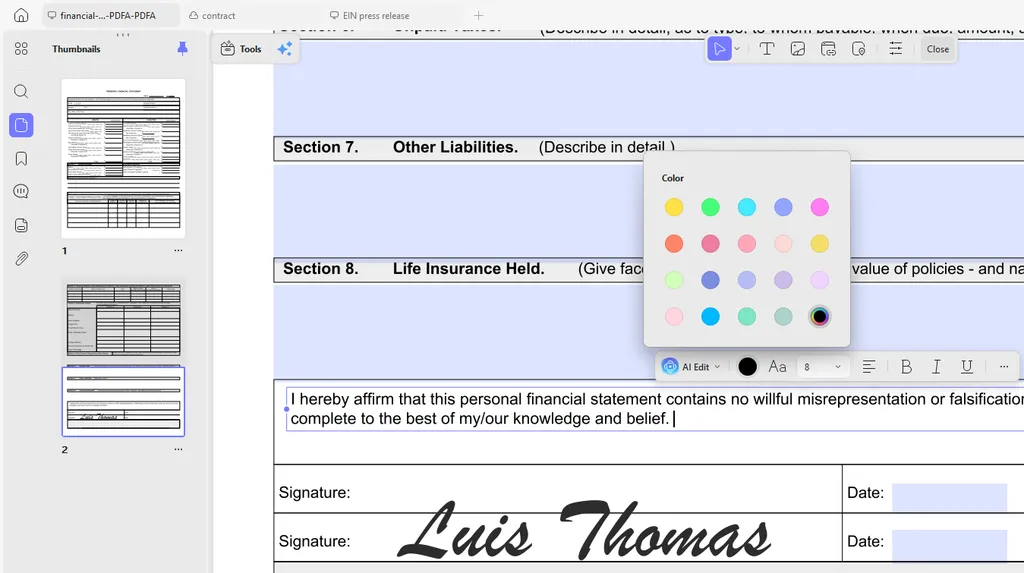
Meet UPDF: A Lightweight Adobe Alternative Built for the Agentic Era

PDFs sit at the end of almost every workflow. Contracts, invoices, research papers, scanned intake forms, manuals, and compliance filings all arrive as PDFs. The format is very good at freezing a layout. It is much worse at letting you change one number inside that layout. That gap has become more visible as language models have gotten better at reading documents. A model can summarize a 90-page master services agreement in seconds. It will not reliably rewrite the source file. It will not hold the table alignment. It will not hand back a clean, signable copy. UPDF is built for the second half of that problem. It is an all-in-one PDF editor for Windows, macOS, iOS, and Android, developed by Superace Software Technologies. It combines editing, annotation, conversion, compression, OCR, page organization, and an integrated AI assistant in one application. Two Different Problems Living in the Same Document It helps to separate document work into two categories: The first is interpretation. What does this clause mean? What is the argument in section four? Which of these three quotes is cheapest? Language models are now genuinely good at this class of work. The second is execution. Change this price from $4,200 to $3,850. Pull pages 7 through 12 out of a 300-page report. Convert this scanned invoice into a spreadsheet with the columns intact. Flatten the file and apply a certificate. These operations are deterministic. There is exactly one correct output, and a plausible-looking approximation is a failure. Most teams solve this by running two tools in parallel. A chatbot handles interpretation. A separate editor handles execution. UPDF’s premise is that both belong in the same window. Edit PDFs Like a Word Document With UPDF you can Edit an existing PDF directly, rather than rebuilding it from the original source file. Editable objects include text and font styling, images, links, and tables. Watermarks, backgrounds, headers and footers, form fields, and pages are also editable in place. The practical constraint is layout preservation. A brochure with an outdated price should not turn into a redesign project. Neither should a contract with one wrong date. UPDF keeps the original layout, fonts, tables, and formatting intact while the edit lands. Form work sits in the same place. You can fill fields and build interactive forms. Handwritten and image-based signatures are supported, and saved signatures sync across devices. Convert Without Losing the Layout Sometimes the PDF is only a starting point. A financial statement needs to become a spreadsheet. A deck needs to go back into PowerPoint. A supplier contract needs to reach a team that works in Word. UPDF can convert PDFs into 14 formats, including Word, Excel, PowerPoint, PNG, JPEG, HTML, and PDF/A. Conversion runs the other direction too. UPDF lists up to ten methods for creating a PDF. Sources include Word, Excel, PowerPoint, images, a blank page, and the clipboard. Two details matter for anyone doing this at volume. Page-range selection means you can export only the section you need. Batch conversion has no stated file-count ceiling. A folder of scanned statements can go through in one run. Check the Numbers Yourself Feature lists are easy to write and hard to verify. The console below carries the specifications UPDF publishes on its own product pages. Every answer links back to its source. Click a command, or type one. Turn Scans Into Text You Can Actually Use Scanned PDFs are the most common failure point in document automation. They look readable, so people assume they are searchable. They are not. Every downstream step — search, extraction, retrieval, diffing — silently breaks. UPDF’s OCR converts scanned documents and image-based PDFs into searchable, editable text. It recognizes 38 languages and handles pages that mix more than one language. UPDF states accuracy of up to 99%. The output layout options are the part worth knowing about. UPDF offers three: text and pictures only, text over the page image, and text under the page image. The third option matters most for audit work. The page still looks like the original scan, but the text underneath is searchable. There is also a reverse path. A searchable PDF can be flattened back into an image-only PDF. MRC-based compression keeps the file small and the page legible. That helps when a document goes out for distribution and should not be edited further. Recognized output exports straight to Word, Excel, PowerPoint, or TXT. On iPhone and iPad, live camera capture turns the device into a scanner. The AI Layer: Reading, Research, and Ten Agents UPDF’s AI feature sits inside the same window as the file. UPDF states that UPDF AI now runs on GPT-5.6.  The assistant handles several jobs against an open file: Chat with a single PDF, or across multiple files in one project Summarize a whole document, a selected page range, or highlighted text Translate the full document with the original layout preserved Explain unfamiliar terms, and discuss embedded images and charts Convert the PDF into a mind map Mind maps can be shared by link, downloaded, or inserted back into the document. Two features are more specific. Paper Search finds academic papers by topic and saves them to a personal library. Scholar Research breaks a broad question into sub-questions. It then gathers papers and produces a literature review you can export as a PDF. Version 2.5 shipped on March 31, 2026 and added ten AI agents: Bookmark generation and summary — builds a multi-level bookmark tree, then digests each chapter Semantic search — resolves synonyms, hyponyms, and related concepts instead of matching strings Watermark, stamp, sticker, and background generation — produced from a prompt AI editing suite — proofreads, expands, condenses, and changes tone Page management — flags blank and invalid pages, standardizes orientation and size UPDF Copilot — maps a natural-language request to the right tool Copilot is deliberately scoped. It identifies the tool; the user still authorizes and performs the action. For anyone handling contracts or regulated records, that boundary is the right one. On

Meet UPDF: A Lightweight Adobe Alternative Built for the Agentic Era Leer entrada »

AI, Committee, Noticias, Uncategorized

Meet S1-mini: Superwhisper’s 462 MB Open-Weights Text Normalizer That Turns Raw ASR Transcripts Into Clean Written Text

Superwhisper has released the S1 family of models: S1-Voice, S1-Language, and S1-mini. S1-Voice is a cloud speech-to-text model, and S1-Language is a cloud instruction-following model for cleanup and formatting. The one that is quite interesting outside the app is S1-mini, released with open weights on Hugging Face. S1-mini is a 0.6B text normalizer, not a transcriber and not a chat model. It sits after automatic speech recognition and rewrites raw transcripts as clean written text: fillers removed, self-corrections resolved to what the speaker landed on, punctuation and capitalization applied, and spoken numbers, dates, currency, and email addresses rendered in written form. It is fine-tuned from Qwen/Qwen3-0.6B, covers English only in release v1, and is steered entirely by a three-axis control line placed above the transcript. Superwhisper reports 94.8% token accuracy on a held-out set of 7,519 cases, measured greedy on the quantized build. Is it deployable? Yes, but only S1-mini. S1-mini is published on Hugging Face under Apache 2.0 plus a naming clause. S1-Voice and S1-Language are Superwhisper-hosted services, so they are consumable, not self-hostable. Company level: Any level. The Q4_K_M GGUF build is a 462 MB file that runs on a laptop CPU. Solo developers can ship it inside a desktop app. Enterprises can run it behind a VPC where audio transcripts cannot leave the network. Industries: Healthcare and clinical documentation, legal, financial services, customer support, developer tooling, accessibility and live captioning. Applications: Dictation apps, meeting-notes tools, live captioning, voice-driven editors, voice-to-CRM entry, and any pipeline that turns raw ASR output into text a human will read. What S1-mini does S1-mini is a text normalizer, not a transcriber and not a chat model. It sits after automatic speech recognition: audio → ASR (Whisper, Parakeet, …) → S1-mini → clean text It removes filler words, resolves false starts and self-corrections to the value the speaker landed on, applies punctuation and capitalization, and renders spoken numbers, dates, times, currency, and email addresses in written form. Say “support at superwhisper dot com” and you get support@superwhisper.com. The model is fine-tuned from Qwen/Qwen3-0.6B. It has 596M unique parameters (0.44B non-embedding), 28 layers, 16 query heads and 8 key/value heads with GQA, and BF16 weights. The Hub sidebar reports 0.8B because the tied embedding is stored twice; the card explains the discrepancy explicitly. Release v1 covers English only, and recommended input is roughly 1,000 tokens. The control line is the entire interface S1-mini takes a fixed system prompt, then a control line, then the raw transcript: Copy CodeCopiedUse a different Browser [Styling: <value>] [Structure: <value>] [Context: <value>] <raw transcript> Styling takes casual, semi-casual, semi-formal, or formal. Structure takes prose or lists. Context takes general or email. All three axes are independent, and every combination was trained. Send values outside those sets, or reword the system prompt, and output can degrade or garble. Note the small mismatch worth knowing: the Superwhisper app exposes a five-stop tone slider that adds a “balanced” preset, while the open weights document four trained Styling values. The model is also constrained by design. It does not add content you did not say, correct facts, soften profanity, or rewrite dialect. Filler-only input returns an empty string, and integrations should treat that as a valid result. Two settings that break most integrations First, enable_thinking=False is required. The chat template is Qwen3’s, unchanged, and Qwen3 defaults to thinking on. S1-mini was trained with thinking off, so the assistant turn must open with an empty <think> block. Omit the flag and you usually get no usable output at all. Second, decode greedily. generation_config.json ships do_sample: false. The GGUF builds still carry Qwen3’s inherited temp = 0.6, top_p = 0.95, and top_k = 20 metadata, so pass temperature 0 explicitly on every request. In llama.cpp, use –jinja with –chat-template-kwargs ‘{“enable_thinking”:false}’ rather than –reasoning-budget 0, which degrades output. Reported evaluation Superwhisper evaluated S1-mini on a held-out set of 7,519 cases across 104 transcripts. Token accuracy is 94.8%, measured greedy on the Q4_K_M build, with a text-edit error rate of 11.6%. On email-formatted text it identifies the greeting line 99.3% of the time and the sign-off 97.9%. It matches the correct output structure, list versus paragraph, 97.6% of the time, and produces exact email addresses in 92% of cases. Fewer than 1% of generations show looping or truncation, and the model correctly withholds output 98.6% of the time when nothing should be transcribed. These are vendor-reported numbers on an internal test set, not third-party results. The two cloud models S1-Voice is the hosted speech-to-text model. Superwhisper reports transcription up to 46x faster than speaking time, with most dictations under 30 seconds appearing 0.32 seconds after you stop. Across eight datasets including meeting audio and earnings calls, it averages 6.8% word error rate and drops to 2.2% on LibriSpeech. Superwhisper says that 6.8% average was the lowest of 15 models it tested, and that S1-Voice scored 83 out of 100 on its blended metric against WisprFlow’s 76. S1-Language is the hosted instruction-following model for cleanup, formatting, and summarization, and it appears in the model picker alongside models from Anthropic, OpenAI, and Groq. The recommended defaults are Cohere Transcribe plus S1-mini offline, or S1-Voice plus S1-Language in the cloud. Interactive explainer The embed below lets you switch each control-line axis and watch the output change. Every input/output pair is taken verbatim from the model card. Key Takeaways S1-mini is a 0.6B open-weights text normalizer for ASR output, not a transcriber or chat model. The Q4_K_M GGUF is 462 MB and runs on a laptop CPU, so on-device deployment is realistic. A fixed system prompt plus a three-axis control line is the only steering mechanism. enable_thinking=False and temperature 0 are mandatory; most integration bugs trace to these. Check out the Model Weights and Technical Details. Also, feel free to follow us on Twitter and don’t forget to join our 150k+ML SubReddit and Subscribe to our Newsletter. Wait! are you on telegram? now you can join us on telegram as well. Need to partner with us for promoting your GitHub Repo OR Hugging Face Page OR Product Release OR

Meet S1-mini: Superwhisper’s 462 MB Open-Weights Text Normalizer That Turns Raw ASR Transcripts Into Clean Written Text Leer entrada »

We use cookies to improve your experience and performance on our website. You can learn more at Política de privacidad and manage your privacy settings by clicking Settings.

Privacy Preferences

You can choose your cookie settings by turning on/off each type of cookie as you wish, except for essential cookies.

Allow All
Manage Consent Preferences
  • Always Active

Save
es_ES