Safely Deploying ML Models to Production: Four Controlled Strategies (A/B, Canary, Interleaved, Shadow Testing)
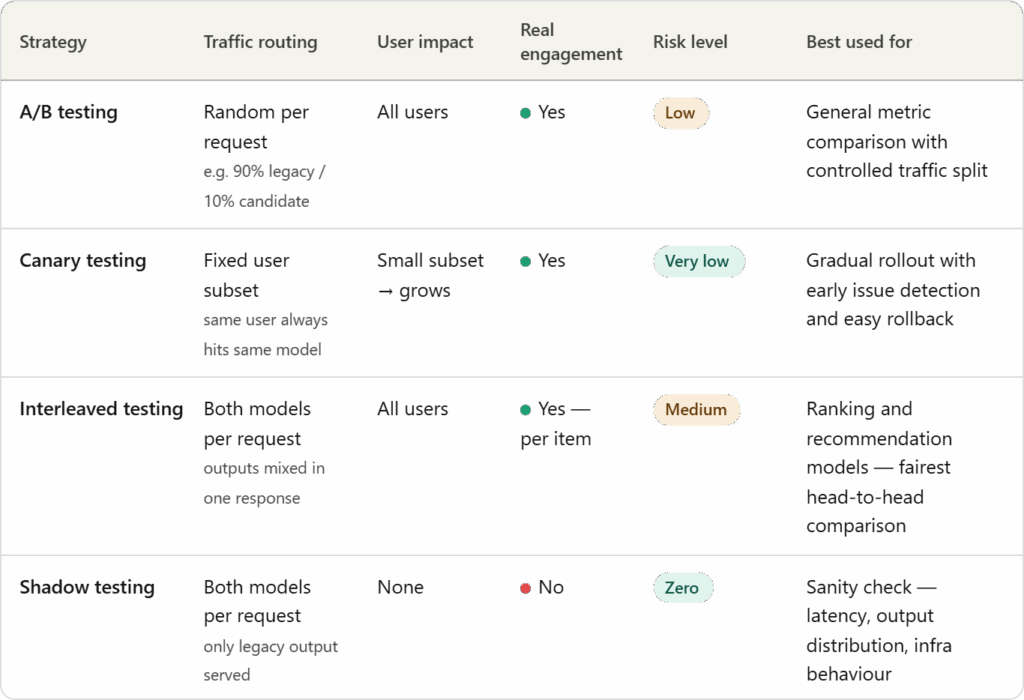
Deploying a new machine learning model to production is one of the most critical stages of the ML lifecycle. Even if a model performs well on validation and test datasets, directly replacing the existing production model can be risky. Offline evaluation rarely captures the full complexity of real-world environments—data distributions may shift, user behavior can change, and system constraints in production may differ from those in controlled experiments. As a result, a model that appears superior during development might still degrade performance or negatively impact user experience once deployed. To mitigate these risks, ML teams adopt controlled rollout strategies that allow them to evaluate new models under real production conditions while minimizing potential disruptions. In this article, we explore four widely used strategies—A/B testing, Canary testing, Interleaved testing, and Shadow testing—that help organizations safely deploy and validate new machine learning models in production environments. A/B Testing A/B testing is one of the most widely used strategies for safely introducing a new machine learning model in production. In this approach, incoming traffic is split between two versions of a system: the existing legacy model (control) and the candidate model (variation). The distribution is typically non-uniform to limit risk—for example, 90% of requests may continue to be served by the legacy model, while only 10% are routed to the candidate model. By exposing both models to real-world traffic, teams can compare downstream performance metrics such as click-through rate, conversions, engagement, or revenue. This controlled experiment allows organizations to evaluate whether the candidate model genuinely improves outcomes before gradually increasing its traffic share or fully replacing the legacy model. Canary Testing Canary testing is a controlled rollout strategy where a new model is first deployed to a small subset of users before being gradually released to the entire user base. The name comes from an old mining practice where miners carried canary birds into coal mines to detect toxic gases—the birds would react first, warning miners of danger. Similarly, in machine learning deployments, the candidate model is initially exposed to a limited group of users while the majority continue to be served by the legacy model. Unlike A/B testing, which randomly splits traffic across all users, canary testing targets a specific subset and progressively increases exposure if performance metrics indicate success. This gradual rollout helps teams detect issues early and roll back quickly if necessary, reducing the risk of widespread impact. Interleaved Testing Interleaved testing evaluates multiple models by mixing their outputs within the same response shown to users. Instead of routing an entire request to either the legacy or candidate model, the system combines predictions from both models in real time. For example, in a recommendation system, some items in the recommendation list may come from the legacy model, while others are generated by the candidate model. The system then logs downstream engagement signals—such as click-through rate, watch time, or negative feedback—for each recommendation. Because both models are evaluated within the same user interaction, interleaved testing allows teams to compare performance more directly and efficiently while minimizing biases caused by differences in user groups or traffic distribution. Shadow Testing Shadow testing, also known as shadow deployment or dark launch, allows teams to evaluate a new machine learning model in a real production environment without affecting the user experience. In this approach, the candidate model runs in parallel with the legacy model and receives the same live requests as the production system. However, only the legacy model’s predictions are returned to users, while the candidate model’s outputs are simply logged for analysis. This setup helps teams assess how the new model behaves under real-world traffic and infrastructure conditions, which are often difficult to replicate in offline experiments. Shadow testing provides a low-risk way to benchmark the candidate model against the legacy model, although it cannot capture true user engagement metrics—such as clicks, watch time, or conversions—since its predictions are never shown to users. Simulating ML Model Deployment Strategies Setting Up Before simulating any strategy, we need two things: a way to represent incoming requests, and a stand-in for each model. Each model is simply a function that takes a request and returns a score — a number that loosely represents how good that model’s recommendation is. The legacy model’s score is capped at 0.35, while the candidate model’s is capped at 0.55, making the candidate intentionally better so we can verify that each strategy actually detects the improvement. make_requests() generates 200 requests spread across 40 users, which gives us enough traffic to see meaningful differences between strategies while keeping the simulation lightweight. Copy CodeCopiedUse a different Browser import random import hashlib random.seed(42) def legacy_model(request): return {“model”: “legacy”, “score”: random.random() * 0.35} def candidate_model(request): return {“model”: “candidate”, “score”: random.random() * 0.55} def make_requests(n=200): users = [f”user_{i}” for i in range(40)] return [{“id”: f”req_{i}”, “user”: random.choice(users)} for i in range(n)] requests = make_requests() A/B Testing ab_route() is the core of this strategy — for every incoming request, it draws a random number and routes to the candidate model only if that number falls below 0.10, otherwise the request goes to legacy. This gives the candidate roughly 10% of traffic. We then collect the prediction scores from each model separately and compute the average at the end. In a real system, these scores would be replaced by actual engagement metrics like click-through rate or watch time — here the score just stands in for “how good was this recommendation.” Copy CodeCopiedUse a different Browser print(“── 1. A/B Testing ──────────────────────────────────────────”) CANDIDATE_TRAFFIC = 0.10 # 10 % of requests go to candidate def ab_route(request): return candidate_model if random.random() < CANDIDATE_TRAFFIC else legacy_model results = {“legacy”: [], “candidate”: []} for req in requests: model = ab_route(req) pred = model(req) results[pred[“model”]].append(pred[“score”]) for name, scores in results.items(): print(f” {name:12s} | requests: {len(scores):3d} | avg score: {sum(scores)/len(scores):.3f}”) Canary Testing The key function here is get_canary_users(), which uses an MD5 hash to deterministically assign users to the canary group. The important word is deterministic — sorting users by their hash means the