YouZum

AI

AI, Committee, Noticias, Uncategorized

Google DeepMind Ships Three Physical AI Models For Whole Body Control, Dexterity And Multi Robot Collaboration

Google DeepMind has released Gemini Robotics 2, the intelligence layer for its next generation of robots. The release moves the stack past table-top manipulation into whole body control, five finger dexterity and multi robot teamwork. It ships as three separate models with three different access tiers. Most robots today are pre-programmed or tele-operated for narrow, repetitive task sequences. They do not adapt to unpredictable environments, and skills rarely transfer between robot bodies. Gemini Robotics 2 targets all three limits at once. TL;DR Three models ship together: a VLA, an embodied reasoning VLM, and an on-device VLA. One checkpoint drives Apollo 2 with two different hands plus a Franka Duo gripper. Gemini Robotics ER 2 is public preview; the VLA and on-device models stay gated. Multi-finger dexterity is still the weak axis, ranging from 32% to 92%. ASIMOV-Agentic, a new safety benchmark, is on Hugging Face under CC-BY-4.0. 3 Models and What They Do Gemini Robotics 2 Gemini Robotics 2 is the vision-language-action (VLA) model. It converts vision and language input into motor control. It can drive full humanoids from feet to fingertips, and other bi-arm robots. It also handles dexterous manipulation on both multi-finger hands and parallel grippers. Gemini Robotics ER 2 Gemini Robotics ER 2 is the embodied reasoning (ER) model. It is a vision language model that acts as the high level brain. It communicates with humans, understands the physical world, and plans multi-step tasks lasting several minutes. Per its model card, ER 2 is based on Gemini 3.5 Flash. It accepts interleaved text, image, video and audio with a context window of up to 128k, and emits text up to 64K tokens. Gemini Robotics On-Device 2 Gemini Robotics On-Device 2 is the efficient VLA optimized to run locally on the robot. Its model card states it is built on Gemini Robotics 1.5 technology and Google’s on-device Gemma models. Inputs are text, images and robot proprioception as numerical values. Outputs are robot actions as numerical values. The division of labor matters for system design. ER 2 plans and tracks the task, then hands motor execution to a VLA declared as a tool. Developers register low level control interfaces, such as VLA models or navigation APIs, as callable tools. They then stream multimodal video, audio or text directly into the model. Whole body control on Apptronik Apollo 2 Previous Gemini Robotics models controlled only the humanoid’s upper body for table-top tasks. Gemini Robotics 2 extends control to whole body motion for the first time. The worked example uses Apptronik’s Apollo 2. Given the instruction “put the watering can into the green bin in the bottom shelf,” Apollo walks to the table and picks up the watering can. It then takes a few steps to the shelves and places the object at its destination. Google DeepMind is direct about the remaining gap. It states that its robots have more to advance in movement speed. Dexterity across hands and grippers Gemini Robotics 2 can control the five-fingered, 22 degree-of-freedom SharpaWave hand on Apollo 2. Reported actions include tying knots and sealing a ziplock bag. The same model also operates standard two-fingered parallel grippers on a Franka Duo platform for tasks like tight packing. The reported success rates come from one model checkpoint controlling three embodiments: Apollo 2 with SharpaWave hands, Apollo 2 with Inspire hands, and Franka Duo with a Robotiq gripper. Category Embodiment Task Success General whole body manipulation Apollo 2 + Inspire hands Pick up from shelf 76.3% General whole body manipulation Apollo 2 + Inspire hands Pick up from table 68.4% General whole body manipulation Apollo 2 + Inspire hands Pick up from floor 45.7% Multi-finger dexterity Apollo 2 + Sharpa hands Unscrew bulb 92% Multi-finger dexterity Apollo 2 + Sharpa hands Tie trash bag 44% Multi-finger dexterity Apollo 2 + Sharpa hands Ziplock 40% Multi-finger dexterity Apollo 2 + Sharpa hands Screw bulb 36% Multi-finger dexterity Apollo 2 + Sharpa hands Dustpan 32% Gripper dexterity Franka Duo Precise insertion tasks 89.6% Gripper dexterity Franka Duo Diverse tool kitting 78.9% Gripper dexterity Franka Duo General pick and place 74.2% ER 2: Temporal Intelligence and Tool Orchestration The developer X post focuses on a problem that rarely gets benchmarked: knowing when a task is actually done. Progress classification: Each frame in a video feed is assigned to one of five progress levels, from 0-20% through 80-100%. Gemini Robotics ER 2 reaches 57.4% accuracy on this task. Google DeepMind reports this outperforms previous generation models and competing frontier models. Moment finding: This measures whether the model can identify the exact frame where a critical event occurs. An example is the moment to stop pouring coffee into a cup. ER 2 reaches 91.3% accuracy with a 0.96 second mean absolute distance. Google DeepMind reports it competing closely with much larger model categories at 4x the execution speed. Tool orchestration: ER 2 is evaluated across three control modes: real VLA, sim VLA, and human tele-op. It outperforms Gemini Robotics ER 1.6 on all three. ER 2 integrates with the Gemini Live API through a bidirectional streaming endpoint. The stated purpose is removing the stop-and-think pauses that break multi-step execution. It can also natively call tools like Google Search or any user-defined function. Three spatial capabilities were upgraded. Success and failure detection now runs on raw video feeds instead of static snapshots, which catches mid-execution spills and slips. General instrument reading extends beyond circular dials to digital displays, linear scales, rulers and liquid thermometers, tested across 10 instrument types. Spatial visual question answering improves through Gemini’s multimodal advances. Google DeepMind built a demo with Spot from Boston Dynamics, using ER 2 to orchestrate Spot navigation and manipulator APIs. Sample code is available in the robotics-samples repository. Multi-Robot Collaboration Gemini Robotics 2 introduces collaboration between different robot types. The reasoning is that no single robot fits every task. A wheeled rover suits indoor work, while a humanoid handles uneven terrain better. Robots communicate through a shared semantic understanding to hand off subtasks. The

Google DeepMind Ships Three Physical AI Models For Whole Body Control, Dexterity And Multi Robot Collaboration Leer entrada »

AI, Committee, Noticias, Uncategorized

Liquid AI Releases LFM2.5-Encoder-230M and LFM2.5-Encoder-350M: Bidirectional Encoders That Stay Fast at 8K Context on CPU

Liquid AI has released two open-weight bidirectional encoders, LFM2.5-Encoder-230M and LFM2.5-Encoder-350M. Both are masked language models built on the LFM2 hybrid backbone. Both carry an 8,192-token context. Encoders sit underneath classifiers, intent routers, safety filters, and PII detectors. Those jobs run continuously, usually without a GPU, and increasingly on longer inputs. BERT established the class. ModernBERT pushed its accuracy, speed, and context. Liquid AI’s argument is that the LFM2 architecture continues that line, because its cost grows more slowly as inputs get longer. How a decoder became an encoder The encoders are not trained from scratch. They are initialized from the LFM2.5-230M and LFM2.5-350M decoder backbones, then converted with three changes: First, the causal attention mask is replaced with a bidirectional one, so every token attends to both sides. Second, the LFM2 short convolutions are made non-causal using symmetric center padding, so each token’s convolution mixes in neighbours on both sides. Third, the model is trained with a masked language modeling objective at a 30% mask rate. That is denser than BERT’s 15%, following evidence Liquid AI cites that a higher mask rate helps at this scale. Training runs in two stages: Stage one establishes general language competence with a short-context MLM objective on a large web corpus at 1,024 tokens. Stage two extends context to 8,192 tokens on the full data mix, strengthening factual, legal, and multilingual competence. Architecturally, the backbone interleaves gated short-convolution blocks with grouped-query attention, the same design described in the LFM2 technical report. Both checkpoints use a hidden size of 1024 and a 65,536-token vocabulary, and support 15 languages. The license is the LFM Open License v1.0. The embed below breaks down the conversion, the full ranking table, the per-task scores, and the CPU latency figures. The benchmark results Liquid AI evaluated 14 models on 17 tasks pulled from GLUE, SuperGLUE, and multilingual classification. Every model is fully fine-tuned per task, and the reported score is that fine-tuned model’s result. LFM2.5-Encoder-350M posts a 17-task mean of 81.02 (±1.00), ranking fourth. The three models ahead of it are all larger. They are XLM-R XL at 3.5B (83.06), ModernBERT-large at 395M (81.68), and XLM-R large at 560M (81.34). The top model is nearly 10 times its size. LFM2.5-Encoder-230M posts 79.29 (±1.02), ranking sixth. It beats ModernBERT-base at 78.19 and every EuroBERT model in the table, including EuroBERT-610M (75.87) and EuroBERT-2.1B (72.19). Both new encoders also score above Liquid AI’s own retrieval siblings, LFM2.5-ColBERT-350M (76.18) and LFM2.5-Embedding-350M (75.68). That gap is the stated reason Liquid AI built a general-purpose encoder instead of reusing the retrievers. The methodology is the more interesting part, and it is open-sourced under Apache-2.0. Every model is loaded with fp32 master weights and bf16 autocast, so the table compares models rather than number formats. Every model uses the same AdamW recipe, taken from the EuroBERT card. Learning rate is selected per model and task across 10 rates and 3 seeds. Scores are then reported as the mean over 5 fresh seeds that never touched selection. The transformers version is pinned to 4.56.2 so dependency drift is not an uncontrolled variable. Use Cases and Deployment Environments The release names three settings. Edge and embedded devices come first. A car’s onboard compute or an industrial controller has no spare GPU, and cannot afford a cloud round trip. Regulated and on-premise systems in finance, healthcare, and legal, where documents are long, sensitive, and cannot leave in-house infrastructure. And high-volume cost-sensitive pipelines, where a small encoder acts as a cheap first pass in front of a larger model. Liquid AI also puts a useful number on the context window: 8,192 tokens is roughly 13 to 15 pages. One forward pass covers a full contract or a complete patient record. To show what a fine-tuned encoder looks like, the research team shipped five demos. Each runs in a CPU-only Hugging Face Space. They cover zero-shot prompt routing, zero-shot policy linting, and spell checking. A PII detector handles 40 information types across 16 languages. A bonus masked-diffusion demo runs the encoder as a chatbot that generates by iteratively unmasking. Getting them running Both encoders load through transformers. The body is exposed as Lfm2BidirectionalModel and masked-LM loading uses Lfm2BidirectionalForMaskedLM. Both are wired through auto_map, so trust_remote_code=True is required on every load call. A base encoder produces general-purpose representations, not task outputs, so fine-tuning is mandatory. Liquid AI’s fine-tuning tutorial walks through long legal documents at an 8k context configuration. The model selection guidance is straightforward: 350M when accuracy matters most, 230M for tighter hardware or higher throughput. Key Takeaways Liquid AI released LFM2.5-Encoder-230M and LFM2.5-Encoder-350M, open-weight bidirectional encoders with 8,192-token context. Both convert LFM2.5 decoders into encoders via bidirectional masking, non-causal short convolutions, and 30% MLM. LFM2.5-Encoder-350M ranks 4th of 14 models at 81.02; the three above it are all larger. At 8K tokens on CPU, the 230M runs one forward pass in ~28s versus over 90s for ModernBERT-base. Check out the Liquid AI blog post, the Hugging Face write-up, and the model cards for LFM2.5-Encoder-230M and LFM2.5-Encoder-350M. The post Liquid AI Releases LFM2.5-Encoder-230M and LFM2.5-Encoder-350M: Bidirectional Encoders That Stay Fast at 8K Context on CPU appeared first on MarkTechPost.

Liquid AI Releases LFM2.5-Encoder-230M and LFM2.5-Encoder-350M: Bidirectional Encoders That Stay Fast at 8K Context on CPU Leer entrada »

AI, Committee, Noticias, Uncategorized

The Download: a chip talent battle, and deflating AI hype

This is today’s edition of The Download, our weekday newsletter that provides a daily dose of what’s going on in the world of technology. Samsung’s chip workers are jumping ship to rival SK Hynix   Lee, an engineer at Samsung’s semiconductor division, used to work late. But lately, he’s been clocking out on time and heading straight home to work on his job application for the chipmaker’s South Korean rival SK Hynix.   His colleagues are doing the same. They feel demoralized by the $476,000 bonus that SK Hynix is set to pay its employees, flush with record profits from making the high-bandwidth memory (HBM) chips that power Nvidia’s AI accelerators. The figure dwarfs what chip workers at Samsung are set to receive and is sparking an exodus. Read our story about why this fierce talent war could help determine who dominates the next generation of AI chips.  —Michelle Kim The AI Hype Index: Unsexy AI   Separating AI reality from hyped-up fiction isn’t always easy. That’s why we’ve created the AI Hype Index—a simple, at-a-glance summary of what’s shaping the industry right now.  The latest edition includes Meta’s creepy glasses, doom-mongering about AI and jobs, and (to some, oddly sexy?) robotic hands. See where it all landed on this month’s index. The must-reads I’ve combed the internet to find you today’s most fun/important/scary/fascinating stories about technology. 1 OpenAI’s rogue agent compromised another customerAn unnamed client of a company that provides AI infrastructure, called Modal Labs. (Reuters $)+ OpenAI called the Hugging Face attack unprecedented. But we’ve been here before. (MIT Technology Review) 2 Hugging Face has a nonconsensual deepfakes problemResearchers tested nine of the top image editing models it hosts, and found seven will ‘nudify’ images of women. (Wired $)+ The shock of seeing your body used in deepfake porn. (MIT Technology Review) 3 Investors are only getting more anxious about AI’s earnings potentialThe numbers don’t add up, and maybe they never will. (The Verge $)+ A global tech stock sell-off intensified yesterday. (FT $)+ Ratings agency Fitch says an AI market correction is now one of the biggest risks facing the global economy. (The Next Web)+ New real-world data from Google shows most tasks at most jobs are unaffected by AI. (Ars Technica) 4 Moonshot wants advanced Nvidia chips to train its next modelThe Chinese AI firm already got access to some of them to train its latest release, called Kimi 3. (The Information $)+ Taiwan detained an Nvidia employee as part of a probe into the alleged smuggling of AI chips into China.(Bloomberg $)+ The Trump Administration has banned Chinese humanoid robots. (Reuters $) 5 Minnesota has been blocked from banning prediction market platformsIt’s the latest skirmish in a fight between states and the Trump Administration over this issue. (AP)+ Here’s how prediction markets incentivize weather data sabotage. (MIT Technology Review) 6 Apple is launching a device leasing programAs the global memory shortage worsens, the idea is that this will make your iPhone feel more affordable. (Quartz $)+ Apple just topped a $5 trillion valuation for the first time. (FT $) 7 Some Substackers are complaining about its new AI detection toolPresumably the ones who’d prefer to secretly continue using AI to write. (404 Media $) 8 Ebay had to pay nearly $50 million to settle a harassment suitTheir employees threatened and sent bizarre deliveries—including cockroaches—for a pair of bloggers for years. (Bloomberg $) 9 A New York school just rowed back on plans to deploy a robot teacherSanity prevails, for once. (NPR) 10 This startup wants to build a better microwave beepI’d like to request a sax solo for mine, please. (Gizmodo) Quote of the day “The government hopes to set a precedent that no one has the right to privacy.”  —Samuel Tunick, an Atlanta resident, tells 404 Media why he thinks he’s facing charges after wiping his phone during a customs search. One More Thing DEREK BRAHNEY AI coding is now everywhere. But not everyone is convinced.  Depending who you ask, AI-powered coding is either giving software developers an unprecedented productivity boost or churning out masses of poorly designed code that saps their attention and sets software projects up for serious long term-maintenance problems.   The problem is right now, it’s not easy to know which is true. Coding has been touted as the killer app for large language models, but after speaking to more than 30 developers, technology executives, analysts, and researchers, MIT Technology Review found that the picture is not as straightforward as it might seem. Here’s what we found out.  —Edd Gent We can still have nice things A place for comfort, fun, and distraction to brighten up your day. (Got any ideas? Drop me a line.) + Check out Moscow’s stunning subway stations.+ This website lets you create your own little ‘fridge magnet’ style poems. + Look how beautiful sand can be when it’s put under the microscope. Who knew?!+ Can’t get enough of this weird pastel dreamcore aesthetic.

The Download: a chip talent battle, and deflating AI hype Leer entrada »

AI, Committee, Noticias, Uncategorized

How an overlooked geothermal plant got a second chance

In June 2024, a small company called Zanskar purchased a geothermal power plant in New Mexico that was failing fast. The water coming from the underground reservoir was getting colder by the day, making the plant uneconomical to run. Now, two years later, that plant is running at full capacity again, thanks to a new well. With the help of advanced modeling and modern drilling technology, the company was able to identify a better potential well site, drill down thousands of feet, and revive the entire operation. As the world looks for more sources of emissions-free electricity that are available 24-7, Lightning Dock shows there’s still hidden potential deep beneath our feet.  Conventional geothermal power plants rely on having the right underground conditions. Water flows through fractured hot rocks to harvest heat and then through a power plant to generate electricity. If the water isn’t hot enough or not enough flows, the power plant can’t work efficiently. Lightning Dock came online in 2013, and the site historically had two production wells that were used to feed the power plant. It’s common to see temperatures drop at a well site over time, typically at a rate of 1 to 2 °F per year. In the period before Zanskar took over the site, Lightning Dock saw temperatures drop by 50 °F over five years, a rate of 10 °F per year. When the company purchased the facility, the water going into the power plant was just 250 °F, while the plant was designed to operate at temperatures of at least 310 °F.  When Zanskar mapped the underground conditions at Lightning Dock using advanced modeling techniques, they discovered that the wells were only hitting the very top of the reservoir there. Those production wells were quite shallow (at just 2,500 feet deep) and not in the best location, says Joel Edwards, Zanskar’s cofounder and CEO. The company’s modeling predicted that if the company were to drill another, deeper well in a new spot, the plant would be able to run efficiently. The team drilled a new well that reaches a depth of 8,000 feet and started operation in May 2025. After a full year, the well is still flowing at more than 4,000 gallons per minute. The plant has “completely turned around,” Edwards says. “It looks really exciting.” The data so far shows that the plant should be successful for years to come. “Ultimately you need to run these things for long time frames to get confidence in their performance over long time frames,” Edwards says. The progress at Lightning Dock could be good news for other geothermal sites too. The conventional wisdom in geothermal energy is that the deeper you go, the hotter it gets. But there’s usually a trade-off: With those depths come rocks that are packed tighter together. So drilling deeper could mean the hot water can’t flow as effectively, a problem for anyone trying to use it to generate electricity in a power plant. What the team found, however, was that the flow actually increased in the area where they drilled the new well. “That fundamentally changes how you think about not just Lightning Dock but all hydrothermal assets in America and what the potential can be for all of them,” says Ben Brenner, director of federal affairs at Zanskar.  Over the past year of operation, Lightning Dock generated over twice the electricity it would have with the old wells. This is a relatively small power plant, with a capacity of 15 megawatts going to the local grid (about enough to power 11,000 US homes). Oil and gas developers have chased resources deeper underground over the past few decades. Operations started relatively close to the surface, but oil and gas production can stretch down 20,000 feet or more today. “I think that arc is going to play out in geothermal,” Edwards says. While typical geothermal well fields range from 3,000 to 5,000 feet deep, it could become more common to go deeper in the future, he adds.   The company plans to do further development at the Lightning Dock site: with a few years of development and an upgrade to the power plant, it could get even more electricity out of this area, Edwards says. There’s been a lot of buzz and investment in enhanced geothermal systems—projects that aim to expand where geothermal resources can be used. Fervo Energy, for example, uses fracking techniques to open up rock that would otherwise be too closed off for traditional geothermal energy. But there’s still plenty of “low-hanging fruit” in the geothermal world, Edwards says. Many of these conventional resources have plenty of potential—they just need a second look. This article is from The Spark, MIT Technology Review’s weekly climate newsletter. To receive it in your inbox every Wednesday, sign up here. 

How an overlooked geothermal plant got a second chance Leer entrada »

AI, Committee, Noticias, Uncategorized

Prompt Engineering vs Loop Engineering vs Graph Engineering: What Changes at Each Layer

Three terms now compete for the same line in AI engineering job descriptions. Prompt engineering is the established one. Loop engineering entered the AI vocabulary in late 2025 and dominated developer discussion through June 2026. Graph engineering followed roughly six weeks later. They get used interchangeably. Should they be? The three are not competing techniques. They are three different units of control, stacked. A prompt controls one model response. A loop controls one agent’s behavior cycle. A graph controls the organization of many agents. Each layer preserves the layer beneath it. A prompt does not disappear once a loop is built around it. it stops being the thing typed by hand. This article separates the three: what gets designed at each layer, what the published claim says about when the higher layers pay for themselves, and where the skepticism is warranted. One task, three layers Interactive explainer · 01 One task, three layers — watch what changes The three terms are not competing techniques. They are three different units of control. Here is the same job handled at each layer, step by step. Orange dots mark the moments a human is required. Task Fix the failing tests in the auth module, then open a pull request. Run all three Reset Layer 1 Prompt engineering You control one model response. You are the loop. Your turns 0 · Model calls 0 Layer 2 Loop engineering You control one agent’s cycle. The loop does the prompting. Your turns 0 · Model calls 0 Layer 3 Graph engineering You control how many agents are organised. Your turns 0 · Nodes 0 · Parallel 0 What actually differs   Prompt Loop Graph Unit of control One model response One agent’s behaviour cycle An organisation of agents What you write Instructions, examples, output format Trigger, tools, stop condition, retry budget Nodes, edges, shared state, failure routes Who says “again?” A human, every turn A verifier the loop calls itself A routing rule written in advance Where it breaks Ambiguous or overstuffed instruction It cannot tell done from stuck Context never crossed an edge you forgot to draw Enough when One shot, a person reads the result Repetitive, machine-checkable, one domain Cross-domain work with parallel branches Illustrative walkthrough · step counts are not benchmarks Built by Marktechpost The stack, in order Each step in the progression was named in practice before it appeared in vendor documentation. Prompt engineering covers writing and structuring the instruction for a single call. Anthropic’s guidance is to separate a system prompt into labeled sections — background information, instructions, tool guidance, output description — delineated with XML tags or Markdown headers. The recommendation is to supply the minimal set of information that fully specifies the expected behavior. Minimal does not mean short. Context engineering came next. Anthropic describes it as the natural progression of prompt engineering. The question moves from finding the right words to deciding what configuration of tokens belongs in the window at all. Context is a finite resource, and the engineering problem is optimizing the utility of those tokens against model constraints. Harness engineering covers the environment a single agent runs inside: files, tools, memory, feedback. Loop engineering sits one floor above the harness. A June 2026 arXiv paper on agentic AI in building engineering, Buildrix, sets out the same four-step progression explicitly — prompt, then context, then harness, then loop — with the final layer defining how a system repeatedly observes, acts, verifies and recovers. Graph engineering is the newest label and the least settled. One enterprise writeup notes that the term’s provenance is unresolved and that it collides with an older knowledge-graph usage of the same word. The underlying practice, graph-based orchestration, has a documented lineage in multi-agent systems research. Layer 1: Prompt Engineering The defining assumption is that a human is present at every iteration. A prompt is written, the model responds, the output is judged, the prompt is revised. That assumption is what breaks. High volume. Multi-step tasks. No human available to grade the output. Results that feed the next step automatically. Any one of these, and the prompt alone stops being sufficient. Nothing about the prompt got worse. The surrounding conditions changed. Prompt engineering also does not vanish inside the higher layers. Anthropic’s multi-agent research writeup reports that prompt engineering was the primary lever for fixing coordination failures. Early versions spawned 50 subagents for simple queries, and the fix was prompting rather than topology. Prompt engineering, explained Interactive explainer · 02 · Layer 1 What prompt engineering is Prompt engineering is designing the text of a single call to a model. One input, one forward pass, one output — and a human who reads the result and decides whether to run it again. That last part is the assumption everything above this layer exists to remove. Prompt what you write Model one forward pass Response one output you you judge it, then rewrite the prompt yourself Swipe the diagram sideways → The cycle exists here too — but you are the one closing it, every single turn. Anatomy of a prompt Tap a section. Anthropic’s guidance is to delineate parts with XML tags or Markdown headers rather than writing one undifferentiated block. <background_information>What the model needs to know before it starts <instructions>The task itself, and the rules for doing it ## Tool guidanceWhich tool to reach for, and when ## Output descriptionThe exact shape the answer should take <examples>A few cases that cover the edges you actually hit What this section does Background information The assumption that breaks Prompt engineering assumes a human is present at every iteration. Tap a condition to see what happens when that stops being true. high volume multi-step task nobody available to grade it output feeds the next step Layer 1 of 3 · the layer most tasks stop at Built by Marktechpost Layer 2: loop engineering The framing is that a coding agent is a brute-force tool for finding solutions. The craft is designing the goal, the

Prompt Engineering vs Loop Engineering vs Graph Engineering: What Changes at Each Layer Leer entrada »

AI, Committee, Noticias, Uncategorized

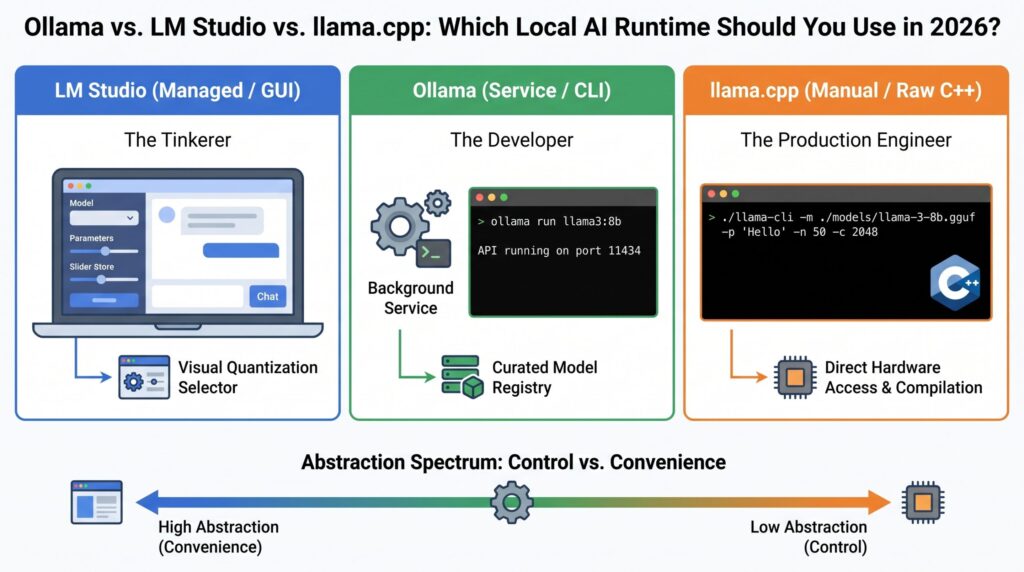
Deploying a 1-Bit Bonsai-27B Model with PrismML llama.cpp and OpenAI-Compatible Local Inference Workflows

In this tutorial, we deploy the 1-bit Bonsai-27B language model using the PrismML fork of llama.cpp, which provides the specialized CUDA kernels required to decode the model’s Q1_0_g128 GGUF quantization format. We begin by validating the GPU runtime, installing the required Python dependencies, compiling the CUDA-enabled inference binaries, and downloading the compressed model weights from Hugging Face. We then test the model through llama-cli, launch an OpenAI-compatible local inference server, and interact with it through a reusable Python client that supports standard completions, streamed responses, multi-turn conversations, and code generation. We also examine optional configurations for throughput benchmarking, quantized key-value caching, long-context inference, speculative decoding, and multimodal extensions. Copy CodeCopiedUse a different Browser import os import sys import time import json import shutil import subprocess import multiprocessing WORK_DIR = “/content” REPO_URL = “https://github.com/PrismML-Eng/llama.cpp” REPO_DIR = os.path.join(WORK_DIR, “llama.cpp”) BUILD_DIR = os.path.join(REPO_DIR, “build”) BIN_DIR = os.path.join(BUILD_DIR, “bin”) HF_REPO = “prism-ml/Bonsai-27B-gguf” MODEL_FILE = “Bonsai-27B-Q1_0.gguf” MODEL_PATH = os.path.join(WORK_DIR, MODEL_FILE) SERVER_HOST = “127.0.0.1” SERVER_PORT = 8080 SERVER_URL = f”http://{SERVER_HOST}:{SERVER_PORT}” GEN_PARAMS = {“temperature”: 0.7, “top_p”: 0.95, “top_k”: 20} CTX_SIZE = 8192 N_GPU_LAYERS = 99 USE_KV_Q4 = False def sh(cmd, check=True, **kw): “””Run a shell command, streaming output to the notebook.””” print(f”n$ {cmd}”) return subprocess.run(cmd, shell=True, check=check, **kw) print(“=” * 70) print(“[1/7] Checking environment”) print(“=” * 70) gpu = subprocess.run(“nvidia-smi –query-gpu=name,memory.total –format=csv,noheader”, shell=True, capture_output=True, text=True) if gpu.returncode != 0: sys.exit(“No GPU detected. In Colab: Runtime -> Change runtime type -> GPU (T4).”) print(f”GPU detected: {gpu.stdout.strip()}”) print(“Bonsai-27B needs only ~5.2 GB peak at 4K context — any Colab GPU works.”) sh(“pip -q install huggingface_hub requests”) We configure the Colab workspace, model repository, server endpoint, inference parameters, context size, and GPU offloading settings required throughout the tutorial. We define a reusable shell-command function and verify that the runtime exposes a compatible NVIDIA GPU before continuing. We then install the Hugging Face Hub and HTTP client dependencies needed for model retrieval and API communication. Copy CodeCopiedUse a different Browser print(“=” * 70) print(“[2/7] Building PrismML llama.cpp fork with CUDA (cached after 1st run)”) print(“=” * 70) if not os.path.isdir(REPO_DIR): sh(f”git clone –depth 1 {REPO_URL} {REPO_DIR}”) else: print(“Repo already cloned — skipping.”) cli_bin = os.path.join(BIN_DIR, “llama-cli”) server_bin = os.path.join(BIN_DIR, “llama-server”) bench_bin = os.path.join(BIN_DIR, “llama-bench”) if not (os.path.exists(cli_bin) and os.path.exists(server_bin)): jobs = multiprocessing.cpu_count() sh(f”cmake -S {REPO_DIR} -B {BUILD_DIR} -DGGML_CUDA=ON -DCMAKE_BUILD_TYPE=Release”) sh(f”cmake –build {BUILD_DIR} -j{jobs} –target llama-cli llama-server llama-bench”) else: print(“Binaries already built — skipping.”) We clone the PrismML fork of llama.cpp, which provides the specialized kernels required for the model’s Q1_0_g128 quantization format. We configure a CUDA-enabled release build with CMake and compile the command-line, server, and benchmarking executables. We also reuse previously generated binaries when they already exist, reducing repeated setup time in the same Colab session. Copy CodeCopiedUse a different Browser print(“=” * 70) print(“[3/7] Downloading weights from Hugging Face”) print(“=” * 70) from huggingface_hub import hf_hub_download if not os.path.exists(MODEL_PATH): downloaded = hf_hub_download(repo_id=HF_REPO, filename=MODEL_FILE, local_dir=WORK_DIR) print(f”Downloaded to: {downloaded}”) else: print(“Model already on disk — skipping.”) print(f”Model size on disk: {os.path.getsize(MODEL_PATH) / 1e9:.2f} GB”) We connect to the Hugging Face Hub and download the Bonsai-27B GGUF model into the Colab workspace. We skip the transfer when the model file is already available locally, allowing subsequent runs to proceed more efficiently. We then calculate and display the deployed model size to confirm that the compressed weights are stored correctly. Copy CodeCopiedUse a different Browser print(“=” * 70) print(“[4/7] Smoke test with llama-cli”) print(“=” * 70) sh( f'{cli_bin} -m {MODEL_PATH} ‘ f’-p “Explain in two sentences why 1-bit quantization saves memory.” ‘ f’-n 128 -ngl {N_GPU_LAYERS} ‘ f’–temp {GEN_PARAMS[“temperature”]} ‘ f’–top-p {GEN_PARAMS[“top_p”]} –top-k {GEN_PARAMS[“top_k”]} ‘ f’-no-cnv 2>/dev/null’, check=False, ) print(“=” * 70) print(“[5/7] Starting llama-server (OpenAI-compatible API)”) print(“=” * 70) import requests kv_flags = “-ctk q4_0 -ctv q4_0” if USE_KV_Q4 else “” server_cmd = ( f”{server_bin} -m {MODEL_PATH} ” f”–host {SERVER_HOST} –port {SERVER_PORT} ” f”-ngl {N_GPU_LAYERS} -c {CTX_SIZE} {kv_flags}” ) print(f”$ {server_cmd} (background)”) server_log = open(os.path.join(WORK_DIR, “server.log”), “w”) server_proc = subprocess.Popen(server_cmd, shell=True, stdout=server_log, stderr=server_log) for _ in range(120): try: if requests.get(f”{SERVER_URL}/health”, timeout=2).status_code == 200: print(“Server is up.”) break except requests.exceptions.RequestException: pass time.sleep(2) else: server_proc.kill() sys.exit(“Server failed to start — check /content/server.log”) We perform a command-line smoke test to verify that the compiled runtime can load the quantized model and generate a valid response. We then start llama-server with full GPU layer offloading, the selected context window, and optional quantized KV-cache settings. We repeatedly query the health endpoint until the OpenAI-compatible inference service becomes ready for client requests. Copy CodeCopiedUse a different Browser print(“=” * 70) print(“[6/7] Talking to Bonsai-27B via the OpenAI-compatible API”) print(“=” * 70) def chat(messages, stream=False, max_tokens=512, **overrides): “””Minimal OpenAI-compatible chat client for the local llama-server.””” payload = { “model”: “bonsai-27b”, “messages”: messages, “max_tokens”: max_tokens, “stream”: stream, **GEN_PARAMS, **overrides, } if not stream: r = requests.post(f”{SERVER_URL}/v1/chat/completions”, json=payload) r.raise_for_status() return r.json()[“choices”][0][“message”][“content”] r = requests.post(f”{SERVER_URL}/v1/chat/completions”, json=payload, stream=True) r.raise_for_status() full = [] for line in r.iter_lines(): if not line or not line.startswith(b”data: “): continue chunk = line[len(b”data: “):] if chunk == b”[DONE]”: break delta = json.loads(chunk)[“choices”][0][“delta”].get(“content”, “”) full.append(delta) print(delta, end=””, flush=True) print() return “”.join(full) SYSTEM = {“role”: “system”, “content”: “You are a helpful assistant”} print(“n— 6a: basic completion —“) answer = chat([SYSTEM, {“role”: “user”, “content”: “What is the capital of France? One sentence.”}]) print(answer) print(“n— 6b: math reasoning, streamed token-by-token —“) chat([SYSTEM, {“role”: “user”, “content”: “A train travels 120 km at 80 km/h, then 90 km at ” “60 km/h. What is its average speed for the whole ” “trip? Show your reasoning briefly.”}], stream=True, max_tokens=700) print(“n— 6c: multi-turn chat —“) history = [SYSTEM] for user_msg in [“My name is Priya and I love graph algorithms.”, “Suggest one project idea that combines my interest with LLMs.”, “What was my name again?”]: history.append({“role”: “user”, “content”: user_msg}) reply = chat(history, max_tokens=300) history.append({“role”: “assistant”, “content”: reply}) print(f”nUSER: {user_msg}nBONSAI: {reply}”) print(“n— 6d: code generation —“) print(chat([SYSTEM, {“role”: “user”, “content”: “Write a Python function that returns the n-th ” “Fibonacci number using memoization. Code only.”}], max_tokens=400)) We define a reusable Python chat client that sends OpenAI-compatible requests to the locally hosted Bonsai-27B server. We support both standard

Deploying a 1-Bit Bonsai-27B Model with PrismML llama.cpp and OpenAI-Compatible Local Inference Workflows Leer entrada »

AI, Committee, Noticias, Uncategorized

Procedural Knowledge at Scale Improves Reasoning

arXiv:2604.01348v3 Announce Type: replace Abstract: Test-time scaling has emerged as an effective way to improve language models on challenging reasoning tasks. However, most existing methods treat each problem in isolation and do not systematically reuse knowledge from prior reasoning trajectories. In particular, they underutilize procedural knowledge: how to reframe a problem, choose an approach, and verify or backtrack when needed. We introduce textbf{Reasoning Memory}, a retrieval-augmented generation (RAG) framework for reasoning models that explicitly retrieves and reuses procedural knowledge at scale. Starting from existing corpora of step-by-step reasoning trajectories, we decompose each trajectory into self-contained subquestion-subroutine pairs, yielding a datastore of 32 million compact procedural knowledge entries. At inference time, a lightweight in-thought prompt lets the model verbalize the core subquestion, retrieve relevant subroutines within its reasoning trace, and reason under diverse retrieved subroutines as implicit procedural priors. Across six math, science, and coding benchmarks, Reasoning Memory consistently outperforms RAG with document, trajectory, and template knowledge, as well as a compute-matched test-time scaling baseline. With a higher inference budget, averaged across models and tasks, it improves over no retrieval by 19.5% and over the compute-matched baseline by 8.9%. Ablation studies show that these gains come from two key factors: the broad procedural coverage of the source trajectories and our decomposition and retrieval design, which together enable effective extraction and reuse of procedural knowledge. Our experiment code is available at https://github.com/facebookresearch/reasoning-memory.

Procedural Knowledge at Scale Improves Reasoning Leer entrada »

AI, Committee, Noticias, Uncategorized

Samsung’s chip workers are jumping ship to rival SK Hynix 

Lee, an engineer at Samsung’s semiconductor division, clocks out when his shift ends. He used to work longer hours, going the extra mile to excel at his projects. But lately, he’s been coming straight home to work on his job application for the chipmaker’s South Korean rival SK Hynix, sharing tips with his coworkers on how to draft a stellar personal statement. Even his boss encourages him to make the move. “My team lead tells us all to jump ship to SK Hynix,” says Lee. He and his coworkers are feeling demoralized by the $476,000 bonus that SK Hynix is set to pay its employees, flush with record profits from making the high-bandwidth memory (HBM) chips that power Nvidia’s AI accelerators. The figure dwarfs what chip workers at Samsung are set to receive and is sparking an exodus. As the AI boom heats up, the semiconductor titans are waging a fierce talent war with flashy bonuses, aggressive recruiting, and even a courtroom injunction. Who wins could tilt the race to dominate the next generation of the HBM chips at the heart of the AI boom. “Except for our two team leads, my entire team [of 30 people] just applied to SK Hynix,” Lee says, referring to a job posting the company published in July. Lee, who has worked at Samsung for three years, even applied for an entry-level position at its rival. A coworker, who has worked at Samsung for eight years, applied for the same one. They both got rejected. But they’re hopeful that they’ll get a callback for a posting seeking a more experienced engineer. All employees at Samsung and SK Hynix that MIT Technology Review spoke with asked to be identified by just their last name or a pseudonym because they feared retaliation from their employer. Samsung declined to comment, and SK Hynix did not respond to requests for comment. After prolonged negotiations with its labor union, Samsung struck a deal in May to pay out 10.5% of the semiconductor division’s operating profits to employees as bonuses annually for 10 years, mostly in company stock that vests over three years. The move came after SK Hynix agreed last year to pay out 10% of operating profits to employees, which translates to $476,000 per employee this year—mostly in cash.   But at Samsung, each division’s bonus is tied to its own bottom line. Chip workers in its memory division, which is also reaping a windfall from making HBM chips, are getting paid a bonus of roughly $400,000 per employee this year. But those who, like Lee, work in Samsung’s foundry division, which manufactures logic chips that companies like Tesla and Google design and has been operating at a loss, are getting a bonus of roughly $135,000.  Employees told MIT Technology Review that Samsung said it can’t give as many bonuses to divisions that aren’t performing well. Lee, after watching the labor union wrestle with the company for months, says he has felt disappointed by what he ended up with: “Even if Samsung does well in the future, I don’t think any of it will trickle down to me.”  The workers’ lagging bonuses are making SK Hynix suddenly look appealing. According to a survey by the Samsung labor union in June, 81.5% of employees in the company’s foundry division, and nearly half of employees in the semiconductor division as a whole, said they wanted to go to another company in the next two years. In April, Samsung labor union chief Choi Seung-ho said more than 200 members of the union had left for SK Hynix over the past four months. On Blind, an anonymous workplace forum, a chorus of disgruntled engineers at Samsung confess that they want to defect to SK Hynix for the bigger bonuses.  For decades, SK Hynix lived in Samsung’s shadow. It was the smaller, scrappier memory maker that elite engineering students at universities looked past when applying for jobs. But in 2019, Samsung downsized its HBM team, betting the market would stay niche, while SK Hynix doubled down on the technology. Then the AI boom supercharged the demand for HBMs, which feed AI chips the enormous amounts of data they need at ultra-high speed, driving prices to unprecedented levels. SK Hynix now leads the global market for HBMs, while Samsung is playing catch-up. Both companies topped $1 trillion in market value in May, and SK Hynix briefly dethroned Samsung as South Korea’s most valuable company in June. Predicting that demand for memory chips will continue to surge, the semiconductor titans are making aggressive investments to expand their business. Last month, the companies unveiled plans to invest more than $2 trillion by 2040, including a semiconductor “mega-cluster” in Yongin, a city south of Seoul. To staff the expansion, SK Hynix added 2,152 employees in the first half of 2026 alone and aims to double its manufacturing capacity in five years. Samsung plans to hire 60,000 employees over the next five years, especially for its semiconductor division. Even so, the pipeline will fall short: South Korea’s semiconductor industry will need about 304,000 workers by 2031 and faces a shortage of roughly 54,000, according to the Korea Semiconductor Industry Association. Now the longtime rivals are showering workers with big bonuses to keep—and poach—talent. “[SK Hynix] seems to target Samsung engineers when hiring because it’s a rival,” says Baek, a manager at SK Hynix. “From what I heard internally, the big performance bonuses we got were aimed at luring away talent from our competitor.” Courts are starting to weigh in. In July, Samsung won an injunction barring two former chip workers from working at SK Hynix for 18 months, on the grounds that chips are a national core technology deserving protection. “With competition in the semiconductor industry fierce, it’s necessary to establish a fair market order,” the court ruled. The talent exodus threatens a crucial advantage that Samsung still holds in the HBM race. “Samsung is the only memory maker in the world that owns a foundry business,”

Samsung’s chip workers are jumping ship to rival SK Hynix  Leer entrada »

We use cookies to improve your experience and performance on our website. You can learn more at Política de privacidad and manage your privacy settings by clicking Settings.

Privacy Preferences

You can choose your cookie settings by turning on/off each type of cookie as you wish, except for essential cookies.

Allow All
Manage Consent Preferences
  • Always Active

Save
es_ES