YouZum

Uncategorized

AI, Committee, Nachrichten, Uncategorized

The Download: OpenAI is building a fully automated researcher, and a psychedelic trial blind spot

This is today’s edition of The Download, our weekday newsletter that provides a daily dose of what’s going on in the world of technology. OpenAI is throwing everything into building a fully automated researcher  OpenAI has a new grand challenge: building an AI researcher—a fully automated agent-based system capable of tackling large, complex problems by itself. The San Francisco firm said the new goal will be its “north star” for the next few years.   By September, the company plans to build “an autonomous AI research intern” that can take on a small number of specific research problems. The intern will be the precursor to the fully automated multi-agent system, which is slated to debut in 2028.  In an exclusive interview this week, OpenAI’s chief scientist, Jakub Pachocki, talked me through the plans. Find out what I discovered.  —Will Douglas Heaven  Mind-altering substances are (still) falling short in clinical trials  Over the last decade, we’ve seen scientific interest in psychedelic drugs explode. Compounds like psilocybin—which is found in magic mushrooms—are being explored for all sorts of health applications, including treatments for depression, PTSD, addiction, and even obesity. But two studies out earlier this week demonstrate just how difficult it is to study these drugs.   For me, they show just how overhyped these substances have become. Find out why here.  —Jessica Hamzelou  This story first appeared in The Checkup, MIT Technology Review’s weekly biotech newsletter. Sign up to receive it in your inbox every Wednesday.  Read more: What do psychedelic drugs do to our brains? AI could help us find out  The must-reads  I’ve combed the internet to find you today’s most fun/important/scary/fascinating stories about technology.  1 OpenAI is building a “super app”  It’s merging ChatGPT, a web browser, and a coding tool into a single app. (The Verge) + It’s also buying coding startup Astral to enhance its Codex model. (Ars Technica) + The moves come amid a cutback on side projects. (WSJ $) + OpenAI has lost ground to Anthropic in the enterprise market. (Axios)  2 The US has charged Super Micro’s co-founder with smuggling AI tech to China  Super Micro is third on Fortune’s list of the fastest-growing companies. (Reuters)  + GenAI is learning to spy for the US military. (MIT Technology Review) + The compute competition is shaping the China-US rivalry. (Politico)  3 The DoJ has taken down botnets behind the largest-ever DDoS attack They had infected more than 3 million devices. (Wired $) + The DoJ has also seized domains tied to Iranian “hacktivists.” (Axios)  4 The Pentagon says Anthropic’s foreign workers are a security risk It cited Chinese employees as a particular concern. (Axios) + Anthropic’s moral boundaries have incensed the DoD. (MIT Technology Review)  5 High oil prices could wreck the AI boom, the WTO has warned Fears are growing of a prolonged energy shock. (The Guardian) + We did the math on AI’s energy footprint. (MIT Technology Review)  6 Jeff Bezos is trying to raise $100 billion to use AI in manufacturing The funds would buy manufacturing firms and infuse them with AI. (WSJ $) + Here’s how to fine-tune AI for prosperity. (MIT Technology Review)  7 Signal’s creator is helping to encrypt Meta’s AI  Moxie Marlinspike is integrating his encrypted chatbot, Confer. (Wired $) + Meta is also ditching human moderators for AI again. (CNBC) + AI is making online crimes easier. (MIT Technology Review)  8 Prediction market Kalshi has raised $1 billion at a $22 billion valuation That’s double its valuation from December. (Bloomberg $) + Arizona’s AG has charged the company with “illegal gambling.” (NPR)  9 Meta isn’t killing Horizon Worlds for VR after all It’s canceled plans to dump the metaverse app (for now). (CNBC)  10 A US startup is recruiting an “AI bully”  The successful candidate must test the patience of leading chatbots. (The Guardian)  Quote of the day  “Imagine a sports bar… but just for situation monitoring — live X feeds, flight radar, Bloomberg terminals, and Polymarket screens.”  —Kalshi rival Polymarket unveils its hellish vision for a new bar.  One More Thing  SELMAN DESIGN How gamification took over the world  It’s a thought that occurs to every video-game player at some point: what if the weird, hyper-focused state I enter in virtual worlds could somehow be applied to the real one?  For a handful of consultants, startup gurus, and game designers in the late 2000s, this state of “blissful productivity” became the key to unlocking our true human potential. Their vision became the global phenomenon of gamification—but it didn’t live up to the hype.  Instead of liberating us, gamification became a tool for coercion, distraction, and control. Find out why we fell for it—and how we can recover.  —Bryan Gardiner  We can still have nice things  A place for comfort, fun and distraction to brighten up your day. (Got any ideas? Drop me a line.)  + In a landmark legal win for trolling, Afroman has won his diss track case against the police. + This LEGO artist remixes standard sets into completely different iconic objects. + Ease your search for aliens with these interactive estimates of advanced civilizations.  + A rare superbloom in Death Valley has been caught on camera. 
The Download: OpenAI is building a fully automated researcher, and a psychedelic trial blind spot Beitrag lesen »

AI, Committee, Nachrichten, Uncategorized

NVIDIA Releases Nemotron-Cascade 2: An Open 30B MoE with 3B Active Parameters, Delivering Better Reasoning and Strong Agentic Capabilities

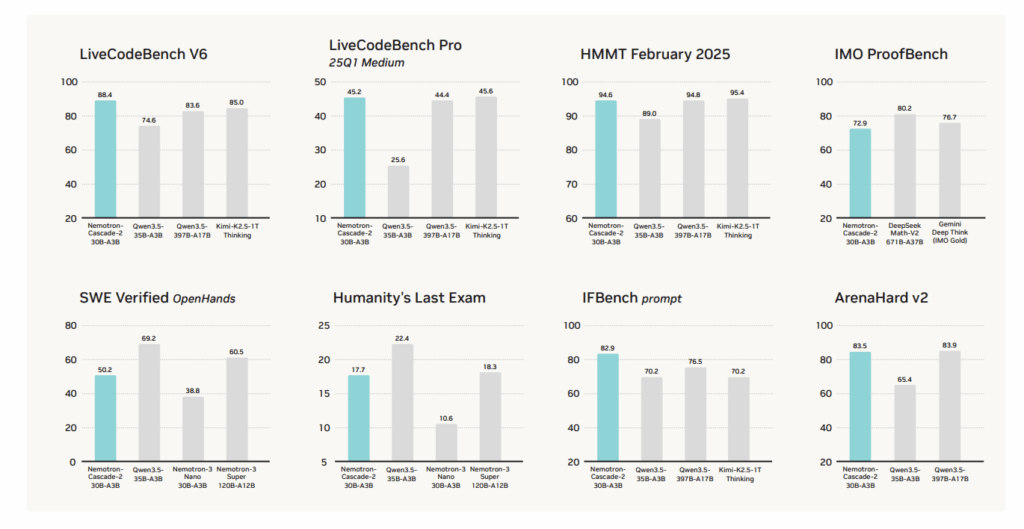
NVIDIA has announced the release of Nemotron-Cascade 2, an open-weight 30B Mixture-of-Experts (MoE) model with 3B activated parameters. The model focuses on maximizing ‘intelligence density,’ delivering advanced reasoning capabilities at a fraction of the parameter scale used by frontier models. Nemotron-Cascade 2 is the second open-weight LLM to achieve Gold Medal-level performance in the 2025 International Mathematical Olympiad (IMO), the International Olympiad in Informatics (IOI), and the ICPC World Finals. https://research.nvidia.com/labs/nemotron/files/Nemotron-Cascade-2.pdf Targeted Performance and Strategic Trade-offs The primary value proposition of Nemotron-Cascade 2 is its specialized performance in mathematical reasoning, coding, alignment, and instruction following. While it achieves state-of-the-art results in these key reasoning-intensive domains, it is surely not a ‘blanket win’ across all benchmarks. The model’s performance excels in several targeted categories compared to the recently released Qwen3.5-35B-A3B (February 2026) and the larger Nemotron-3-Super-120B-A12B: Mathematical Reasoning: Outperforms Qwen3.5-35B-A3B on AIME 2025 (92.4 vs. 91.9) and HMMT Feb25 (94.6 vs. 89.0). Coding: Leads on LiveCodeBench v6 (87.2 vs. 74.6) and IOI 2025 (439.28 vs. 348.6+). Alignment and Instruction Following: Scores significantly higher on ArenaHard v2 (83.5 vs. 65.4+) and IFBench (82.9 vs. 70.2). https://research.nvidia.com/labs/nemotron/files/Nemotron-Cascade-2.pdf Technical Architecture: Cascade RL and Multi-domain On-Policy Distillation (MOPD) The model’s reasoning capabilities stem from its post-training pipeline, starting from the Nemotron-3-Nano-30B-A3B-Base model. 1. Supervised Fine-Tuning (SFT) During SFT, NVIDIA research team utilized a meticulously curated dataset where samples were packed into sequences of up to 256K tokens. The dataset included: 1.9M Python reasoning traces and 1.3M Python tool-calling samples for competitive coding. 816K samples for mathematical natural language proofs. A specialized Software Engineering (SWE) blend consisting of 125K agentic and 389K agentless samples. 2. Cascade Reinforcement Learning Following SFT, the model underwent Cascade RL, which applies sequential, domain-wise training. This prevents catastrophic forgetting by allowing hyperparameters to be tailored to specific domains without destabilizing others. The pipeline includes stages for instruction-following (IF-RL), multi-domain RL, RLHF, long-context RL, and specialized Code and SWE RL. https://research.nvidia.com/labs/nemotron/files/Nemotron-Cascade-2.pdf 3. Multi-Domain On-Policy Distillation (MOPD) A critical innovation in Nemotron-Cascade 2 is the integration of MOPD during the Cascade RL process. MOPD assembly uses the best-performing intermediate ‘teacher’ models—already derived from the same SFT initialization—to provide a dense token-level distillation advantage. This advantage is defined mathematically as: $$a_{t}^{MOPD}=log~pi^{domain_{t}}(y_{t}|s_{t})-log~pi^{train}(y_{t}|s_{t})$$ The research team found that MOPD is substantially more sample-efficient than sequence-level reward algorithms like Group Relative Policy Optimization (GRPO). For instance, on AIME25, MOPD reached teacher-level performance (92.0) within 30 steps, while GRPO achieved only 91.0 after matching those steps. Inference Features and Agentic Interaction Nemotron-Cascade 2 supports two primary operating modes through its chat template: Thinking Mode: Initiated by a single <think> token, followed by a newline. This activates deep reasoning for complex math and code tasks. Non-Thinking Mode: Activated by prepending an empty <think></think> block for more efficient, direct responses. For agentic tasks, the model utilizes a structured tool-calling protocol within the system prompt. Available tools are listed within <tools> tags, and the model is instructed to perform tool calls wrapped in <tool_call> tags to ensure verifiable execution feedback. By focusing on ‘intelligence density,’ Nemotron-Cascade 2 demonstrates that specialized reasoning capabilities once thought to be the exclusive domain of frontier-scale models are achievable at a 30B scale through domain-specific reinforcement learning. Check out Paper and Model on HF. Also, feel free to follow us on Twitter and don’t forget to join our 120k+ ML SubReddit and Subscribe to our Newsletter. Wait! are you on telegram? now you can join us on telegram as well. The post NVIDIA Releases Nemotron-Cascade 2: An Open 30B MoE with 3B Active Parameters, Delivering Better Reasoning and Strong Agentic Capabilities appeared first on MarkTechPost.

NVIDIA Releases Nemotron-Cascade 2: An Open 30B MoE with 3B Active Parameters, Delivering Better Reasoning and Strong Agentic Capabilities Beitrag lesen »

AI, Committee, Nachrichten, Uncategorized

DeSTA2.5-Audio: Toward General-Purpose Large Audio Language Model with Self-Generated Cross-Modal Alignment

arXiv:2507.02768v2 Announce Type: replace-cross Abstract: We introduce DeSTA2.5-Audio, a general-purpose Large Audio Language Model (LALM) designed for robust auditory perception and instruction-following. Recent LALMs augment Large Language Models (LLMs) with auditory capabilities by training on large-scale audio-instruction datasets. However, existing LALMs have often suffered from the catastrophic forgetting of the LLM’s original abilities. Therefore, balancing knowledge retention and audio perception has become a critical challenge. To address this, we revisit the data construction pipeline and propose a self-generated cross-modal alignment strategy in which the backbone LLM generates its own training targets, named DeSTA. This approach aims at preserving the LLM’s native language proficiency thereby enabling zero-shot generalization without task-specific tuning. We construct DeSTA-AQA5M, a large-scale, task-agnostic dataset containing 5 million training samples derived from 7,000 hours of audio spanning 50 diverse datasets, including speech, environmental sounds, and music. DeSTA2.5-Audio achieves state-of-the-art or competitive performance across a wide range of audio-language benchmarks, including Dynamic-SUPERB, MMAU, SAKURA, Speech-IFEval, and VoiceBench. Comprehensive comparative studies demonstrate that our self-generated strategy outperforms existing training strategies. Our findings underscore the importance of carefully designed data construction in LALM development and offer practical insights for building robust, general-purpose LALMs.

DeSTA2.5-Audio: Toward General-Purpose Large Audio Language Model with Self-Generated Cross-Modal Alignment Beitrag lesen »

AI, Committee, Nachrichten, Uncategorized

UT-ACA: Uncertainty-Triggered Adaptive Context Allocation for Long-Context Inference

arXiv:2603.18446v1 Announce Type: new Abstract: Long-context inference remains challenging for large language models due to attention dilution and out-of-distribution degradation. Context selection mitigates this limitation by attending to a subset of key-value cache entries, yet most methods allocate a fixed context budget throughout decoding despite highly non-uniform token-level contextual demands. To address this issue, we propose Uncertainty-Triggered Adaptive Context Allocation (UT-ACA), an inference-time framework that dynamically adjusts the context window based on token-wise uncertainty. UT-ACA learns an uncertainty detector that combines semantic embeddings with logit-based confidence while accounting for uncertainty accumulation across decoding steps. When insufficient evidence is indicated, UT-ACA selectively rolls back, expands the context window, and regenerates the token with additional support. Experiments show that UT-ACA substantially reduces average context usage while preserving generation quality in long-context settings.

UT-ACA: Uncertainty-Triggered Adaptive Context Allocation for Long-Context Inference Beitrag lesen »

AI, Committee, Nachrichten, Uncategorized

LlamaIndex Releases LiteParse: A CLI and TypeScript-Native Library for Spatial PDF Parsing in AI Agent Workflows

In the current landscape of Retrieval-Augmented Generation (RAG), the primary bottleneck for developers is no longer the large language model (LLM) itself, but the data ingestion pipeline. For software developers, converting complex PDFs into a format that an LLM can reason over remains a high-latency, often expensive task. LlamaIndex has recently introduced LiteParse, an open-source, local-first document parsing library designed to address these friction points. Unlike many existing tools that rely on cloud-based APIs or heavy Python-based OCR libraries, LiteParse is a TypeScript-native solution built to run entirely on a user’s local machine. It serves as a ‘fast-mode’ alternative to the company’s managed LlamaParse service, prioritizing speed, privacy, and spatial accuracy for agentic workflows. The Technical Pivot: TypeScript and Spatial Text The most significant technical distinction of LiteParse is its architecture. While the majority of the AI ecosystem is built on Python, LiteParse is written in TypeScript (TS) and runs on Node.js. It utilizes PDF.js (specifically pdf.js-extract) for text extraction and Tesseract.js for local optical character recognition (OCR). By opting for a TypeScript-native stack, LlamaIndex team ensures that LiteParse has zero Python dependencies, making it easier to integrate into modern web-based or edge-computing environments. It is available as both a command-line interface (CLI) and a library, allowing developers to process documents at scale without the overhead of a Python runtime. The library’s core logic stands on Spatial Text Parsing. Most traditional parsers attempt to convert documents into Markdown. However, Markdown conversion often fails when dealing with multi-column layouts or nested tables, leading to a loss of context. LiteParse avoids this by projecting text onto a spatial grid. It preserves the original layout of the page using indentation and white space, allowing the LLM to use its internal spatial reasoning capabilities to ‘read’ the document as it appeared on the page. Solving the Table Problem Through Layout Preservation A recurring challenge for AI devs is extracting tabular data. Conventional methods involve complex heuristics to identify cells and rows, which frequently result in garbled text when the table structure is non-standard. LiteParse takes what the developers call a ‘beautifully lazy’ approach to tables. Rather than attempting to reconstruct a formal table object or a Markdown grid, it maintains the horizontal and vertical alignment of the text. Because modern LLMs are trained on vast amounts of ASCII art and formatted text files, they are often more capable of interpreting a spatially accurate text block than a poorly reconstructed Markdown table. This method reduces the computational cost of parsing while maintaining the relational integrity of the data for the LLM. Agentic Features: Screenshots and JSON Metadata LiteParse is specifically optimized for AI agents. In an agentic RAG workflow, an agent might need to verify the visual context of a document if the text extraction is ambiguous. To facilitate this, LiteParse includes a feature to generate page-level screenshots during the parsing process. When a document is processed, LiteParse can output: Spatial Text: The layout-preserved text version of the document. Screenshots: Image files for each page, allowing multimodal models (like GPT-4o or Claude 3.5 Sonnet) to visually inspect charts, diagrams, or complex formatting. JSON Metadata: Structured data containing page numbers and file paths, which helps agents maintain a clear ‘chain of custody’ for the information they retrieve. This multi-modal output allows engineers to build more robust agents that can switch between reading text for speed and viewing images for high-fidelity visual reasoning. Implementation and Integration LiteParse is designed to be a drop-in component within the LlamaIndex ecosystem. For developers already using VectorStoreIndex or IngestionPipeline, LiteParse provides a local alternative for the document loading stage. The tool can be installed via npm and offers a straightforward CLI: Copy CodeCopiedUse a different Browser npx @llamaindex/liteparse <path-to-pdf> –outputDir ./output This command processes the PDF and populates the output directory with the spatial text files and, if configured, the page screenshots. Key Takeaways TypeScript-Native Architecture: LiteParse is built on Node.js using PDF.js and Tesseract.js, operating with zero Python dependencies. This makes it a high-speed, lightweight alternative for developers working outside the traditional Python AI stack. Spatial Over Markdown: Instead of error-prone Markdown conversion, LiteParse uses Spatial Text Parsing. It preserves the document’s original layout through precise indentation and whitespace, leveraging an LLM’s natural ability to interpret visual structure and ASCII-style tables. Built for Multimodal Agents: To support agentic workflows, LiteParse generates page-level screenshots alongside text. This allows multimodal agents to ‘see’ and reason over complex elements like diagrams or charts that are difficult to capture in plain text. Local-First Privacy: All processing, including OCR, occurs on the local CPU. This eliminates the need for third-party API calls, significantly reducing latency and ensuring sensitive data never leaves the local security perimeter. Seamless Developer Experience: Designed for rapid deployment, LiteParse can be installed via npm and used as a CLI or library. It integrates directly into the LlamaIndex ecosystem, providing a ‘fast-mode’ ingestion path for production RAG pipelines. Check out Repo and Technical details. Also, feel free to follow us on Twitter and don’t forget to join our 120k+ ML SubReddit and Subscribe to our Newsletter. Wait! are you on telegram? now you can join us on telegram as well. The post LlamaIndex Releases LiteParse: A CLI and TypeScript-Native Library for Spatial PDF Parsing in AI Agent Workflows appeared first on MarkTechPost.

LlamaIndex Releases LiteParse: A CLI and TypeScript-Native Library for Spatial PDF Parsing in AI Agent Workflows Beitrag lesen »

AI, Committee, Nachrichten, Uncategorized

Adaptive Decoding via Test-Time Policy Learning for Self-Improving Generation

arXiv:2603.18428v1 Announce Type: new Abstract: Decoding strategies largely determine the quality of Large Language Model (LLM) outputs, yet widely used heuristics such as greedy or fixed temperature/top-p decoding are static and often task-agnostic, leading to suboptimal or inconsistent generation quality across domains that demand stylistic or structural flexibility. We introduce a reinforcement learning-based decoder sampler that treats decoding as sequential decision-making and learns a lightweight policy to adjust sampling parameters at test-time while keeping LLM weights frozen. We evaluated summarization datasets including BookSum, arXiv, and WikiHow using Granite-3.3-2B and Qwen-2.5-0.5B. Our policy sampler consistently outperforms greedy and static baselines, achieving relative gains of up to +88% (BookSum, Granite) and +79% (WikiHow, Qwen). Reward ablations show that overlap-only objectives underperform compared to composite rewards, while structured shaping terms (length, coverage, repetition, completeness) enable stable and sustained improvements. These findings highlight reinforcement learning as a practical mechanism for test-time adaptation in decoding, enabling domain-aware and user-controllable generation without retraining large models.

Adaptive Decoding via Test-Time Policy Learning for Self-Improving Generation Beitrag lesen »

AI, Committee, Nachrichten, Uncategorized

Mind-altering substances are (still) falling short in clinical trials

This week I want to look at where we are with psychedelics, the mind-altering substances that have somehow made the leap from counterculture to major focus of clinical research. Compounds like psilocybin—which is found in magic mushrooms—are being explored for all sorts of health applications, including treatments for depression, PTSD, addiction, and even obesity. Over the last decade, we’ve seen scientific interest in these drugs explode. But most clinical trials of psychedelics have been small and plagued by challenges. And a lot of the trial results have been underwhelming or inconclusive. Two studies out earlier this week demonstrate just how difficult it is to study these drugs. And to my mind, they also show just how overhyped these substances have become. To some in the field, the hype is not necessarily a bad thing. Let me explain. The two new studies both focus on the effectiveness of psilocybin in treating depression. And they both attempt to account for one of the biggest challenges in trialing psychedelics: what scientists call “blinding.” The best way to test the effectiveness of a new drug is to perform a randomized controlled trial. In these studies, some volunteers receive the drug while others get a placebo. For a fair comparison, the volunteers shouldn’t know whether they’re getting the drug or placebo. That is almost impossible to do with psychedelics. Almost anyone can tell whether they’ve taken a dose of psilocybin or a dummy pill. The hallucinations are a dead giveaway. Still, the authors behind the two new studies have tried to overcome this challenge. In one, a team based in Germany gave 144 volunteers with treatment-resistant depression either a high or low dose of psilocybin or an “active” placebo, which has its own physical (but not hallucinatory) effects, along with psychotherapy. In their trial, neither the volunteers nor the investigators knew who was getting the drug. The volunteers who got psilocybin did show some improvement—but it was not significantly any better than the improvement experienced by those who took the placebo. And while those who took psilocybin did have a bigger reduction in their symptoms six weeks later, “the divergence between [the two results] renders the findings inconclusive,” the authors write. Not great news so far. The authors of the second study took a different approach. Balázs Szigeti at UCSF and his colleagues instead looked at what are known as “open label” studies of both psychedelics and traditional antidepressants. In those studies, the volunteers knew when they were getting a psychedelic—but they also knew when they were getting an antidepressant. The team assessed 24 such trials to find that … psychedelics were no more effective than traditional antidepressants. Sad trombone. “When I set up the study, I wanted to be a really cool psychedelic scientist to show that even if you consider this blinding problem, psychedelics are so much better than traditional antidepressants,” says Szigeti. “But unfortunately, the data came out the other way around.” His study highlights another problem, too. In trials of traditional antidepressant drugs, the placebo effect is pretty strong. Depressive symptoms are often measured using a scale, and in trials, antidepressant drugs typically lower symptoms by around 10 points on that scale. Placebos can lower symptoms by around eight points. When a drug regulator looks at those results, the takeaway is that the antidepressant drug lowers symptoms by an additional two points on the scale, relative to a placebo. But with psychedelics, the difference between active drug and placebo is much greater. That’s partly because people who get the psychedelic drug know they’re getting it and are expecting the drug to improve their symptoms, says David Owens, emeritus professor of clinical psychiatry at the University of Edinburgh, UK. But it’s also partly because of the effect on those who know they’re not getting it. It’s pretty obvious when you’re getting a placebo, says Szigeti, and it can be disappointing. Scientists have long recognized the “nocebo” effect as placebo’s “evil twin”—essentially, when you expect to feel worse, you will. The disappointment of getting a placebo is slightly different, and Szigeti calls it the “knowcebo effect.” “It’s kind of like a negative psychedelic effect, because you have figured out that you’re taking the placebo,” he says. This phenomenon can distort the results of psychedelic drug trials. While a placebo in a traditional antidepressant drug trial improves symptoms by eight points, placebos in psychedelic trials improve symptoms by a mere four points, says Szigeti. If the active drug similarly improves symptoms by around 10 points, that makes it look as though the psychedelic is improving symptoms by around six points compared with a placebo. It “gives the illusion” of a huge effect, says Szigeti. So why have those smaller trials of the past received so much attention? Many have been published in high-end journals, accompanied by breathless press releases and media coverage. Even the inconclusive ones. I’ve often thought that those studies might not have seen the light of day if they’d been investigating any other drug. “Yeah, nobody would care,” Szigeti agrees. It’s partly because people who work in mental health are so desperate for new treatments, says Owens. There has been little innovation in the last 40 years or so, since the advent of selective serotonin reuptake inhibitors. “Psychiatry is hemmed in with old theories … and we don’t need another SSRI for depression,” he says. But it’s also because psychedelics are inherently fascinating, says Szigeti. “Psychedelics are cool,” he says. “Culturally, they are exciting.” I’ve often worried that psychedelics are overhyped—that people might get the mistaken impression they are cure-alls for mental-health disorders. I’ve worried that vulnerable people might be harmed by self-experimentation. Szigeti takes a different view. Given how effective we know the placebo effect can be, maybe hype isn’t a totally bad thing, he says. “The placebo response is the expectation of a benefit,” he says. “The better response patients are expecting, the better they’re going to get.” Tempering the hype might end up making those drugs less effective, he

Mind-altering substances are (still) falling short in clinical trials Beitrag lesen »

AI, Committee, Nachrichten, Uncategorized

LLM BiasScope: A Real-Time Bias Analysis Platform for Comparative LLM Evaluation

arXiv:2603.12522v1 Announce Type: new Abstract: As large language models (LLMs) are deployed widely, detecting and understanding bias in their outputs is critical. We present LLM BiasScope, a web application for side-by-side comparison of LLM outputs with real-time bias analysis. The system supports multiple providers (Google Gemini, DeepSeek, MiniMax, Mistral, Meituan, Meta Llama) and enables researchers and practitioners to compare models on the same prompts while analyzing bias patterns. LLM BiasScope uses a two-stage bias detection pipeline: sentence-level bias detection followed by bias type classification for biased sentences. The analysis runs automatically on both user prompts and model responses, providing statistics, visualizations, and detailed breakdowns of bias types. The interface displays two models side-by-side with synchronized streaming responses, per-model bias summaries, and a comparison view highlighting differences in bias distributions. The system is built on Next.js with React, integrates Hugging Face inference endpoints for bias detection, and uses the Vercel AI SDK for multi-provider LLM access. Features include real-time streaming, export to JSON/PDF, and interactive visualizations (bar charts, radar charts) for bias analysis. LLM BiasScope is available as an open-source web application, providing a practical tool for bias evaluation and comparative analysis of LLM behaviour.

LLM BiasScope: A Real-Time Bias Analysis Platform for Comparative LLM Evaluation Beitrag lesen »

AI, Committee, Nachrichten, Uncategorized

From XAI to Stories: A Factorial Study of LLM-Generated Explanation Quality

arXiv:2601.02224v2 Announce Type: replace Abstract: Explainable AI (XAI) methods like SHAP and LIME produce numerical feature attributions that remain inaccessible to non expert users. Prior work has shown that Large Language Models (LLMs) can transform these outputs into natural language explanations (NLEs), but it remains unclear which factors contribute to high-quality explanations. We present a systematic factorial study investigating how Forecasting model choice, XAI method, LLM selection, and prompting strategy affect NLE quality. Our design spans four models (XGBoost (XGB), Random Forest (RF), Multilayer Perceptron (MLP), and SARIMAX – comparing black-box Machine-Learning (ML) against classical time-series approaches), three XAI conditions (SHAP, LIME, and a no-XAI baseline), three LLMs (GPT-4o, Llama-3-8B, DeepSeek-R1), and eight prompting strategies. Using G-Eval, an LLM-as-a-judge evaluation method, with dual LLM judges and four evaluation criteria, we evaluate 660 explanations for time-series forecasting. Our results suggest that: (1) XAI provides only small improvements over no-XAI baselines, and only for expert audiences; (2) LLM choice dominates all other factors, with DeepSeek-R1 outperforming GPT-4o and Llama-3; (3) we observe an interpretability paradox: in our setting, SARIMAX yielded lower NLE quality than ML models despite higher prediction accuracy; (4) zero-shot prompting is competitive with self-consistency at 7-times lower cost; and (5) chain-of-thought hurts rather than helps.

From XAI to Stories: A Factorial Study of LLM-Generated Explanation Quality Beitrag lesen »

We use cookies to improve your experience and performance on our website. You can learn more at Datenschutzrichtlinie and manage your privacy settings by clicking Settings.

Privacy Preferences

You can choose your cookie settings by turning on/off each type of cookie as you wish, except for essential cookies.

Allow All
Manage Consent Preferences
  • Always Active

Save
de_DE