YouZum

Uncategorized

AI, Committee, Nachrichten, Uncategorized

The world is on track to miss its health targets

Every year the World Health Organization publishes a global health statistics report. It features the numbers behind world health trends and, importantly, assesses whether we’re on track to reach ambitious goals set in 2015. It’s a bit like a health grade. The 2026 report was published on Wednesday. And the results aren’t looking brilliant. While we are seeing some improvements, they are uneven, and they’re far too slow. The targets themselves are part of the United Nations’ Sustainable Development Goals, a sprawling and ambitious plan focused on improving life around the world. The 17 goals were set to tackle poverty and climate change and to boost education, gender equality, health, and well-being, among many other quality of life issues. Those targets were meant to be met by 2030. Perhaps they were a little too ambitious. Here are the numbers and statistics that stood out to me on this year’s world health report card. 1.3 million new cases of HIV in 2024 Before the SDGs, there were the Millennium Development Goals. One MDG target was to halt and reverse the spread of HIV—and that target was exceeded by 2015. Back then, we were considered on track to “end the AIDS epidemic by 2030.” How depressing, then, to see that in 2024 there were an estimated 1.3 million new cases of HIV. That’s 40% lower than the figure from 2010. But it’s still 1.3 million additional people with HIV. The SDG target is to reduce HIV incidence by 90% by 2030—we’re not likely to meet it. 10.7 million new cases of TB The picture is even bleaker for tuberculosis, which ranks 10th on the WHO’s list of top global causes of death. The goal was to reduce cases by 80% between 2015 and 2030. So far, cases have only fallen by a measly 12%. And when you break the change down by region, the Americas saw an increase of 13% An 8.5% rise in malaria cases And then there’s malaria, the mosquito-borne disease with a 7% fatality rate. The European region has been free of malaria since 2015, but the disease is a significant concern in many countries in the Global South, particularly in Africa. The goal was to lower rates by 90% between 2015 and 2030. In 2024, there were an estimated 282 million cases of malaria globally—representing an 8.5% increase in incidence rates. Antimalarial drug resistance is a major challenge here—forms of the malaria virus that are resistant to drugs have been confirmed or suspected in eight countries in Africa, according to a separate WHO report. Mosquitoes that are resistant to commonly used insecticides are present in nine African countries. And climate change, which can alter mosquito habitats, may be making things worse. 42.8 million children are wasting We’re not meeting child health targets, either. Take malnutrition, for example. As of 2024, the global prevalence of wasting in children was 6.6%—that’s a staggering 42.8 million children who are literally wasting away because of a lack of adequate food. On the other end of the spectrum, 5.5% of children are now considered overweight. Both figures were meant to be below 5% by 2030, which now seems unlikely. Vaccination rates are dropping in the Americas Progress in improving childhood vaccination coverage has stalled. Globally, an estimated 76% of children are getting their second dose of a measles vaccine—a figure far below the the approximately 95% needed to prevent outbreaks. The Americas currently has lower rates of vaccine coverage for three of the four “core” vaccines than it did in 2015. This is partly due to a lack of investment, says Goodarz Danaei, an epidemiologist at the Harvard T.H. Chan School of Public Health. “But now we have a misinformation campaign going around vaccines that makes it worse,” he adds. The covid-19 pandemic didn’t exactly help, either. The impact on health services led to millions of children missing out on routine vaccinations. 22.1 million pandemic-related deaths And of course the pandemic affected progress toward health goals in more direct ways: 7 million people died of covid-19. The WHO report estimates that, for each of these, there were an additional two “excess” deaths related to the pandemic, due to disruptions in health care, for example. That puts the total figure at 22.1 million pandemic-related deaths. A woman dies every two minutes from “maternal causes” Maternal mortality rates fell by about 40% between 2020 and 2023. But today’s rate equates to 712 maternal deaths every single day. That’s one every two minutes. The WHO report notes that we’d have to reduce the mortality rate by almost 15% per year in order to meet the 2030 target. This seems incredibly unlikely, particularly given the recent decimation of US funding for global aid programs, which is expected to result in thousands of additional maternal deaths. Progress has also slowed in reducing the risk of death from noninfectious diseases like cancer, diabetes and cardiovascular disease. “Overall, neither the world nor any WHO region is currently on track to meet the 2030 SDG target,” the report states. 2.1 billion people struggle to afford health care Despite plans to make health care more affordable, a significant chunk of the population is being pushed into poverty by health-care costs. In 2022, 2.1 billion people faced financial hardship due to health spending—and 1.6 billion of them were living in or had been pushed into poverty. Across the board, there have been some important improvements in global health. But the achievements have not gone far enough. “The good news is that there is progress,” says Danaei. “But as always, the glass is half empty.” This article first appeared in The Checkup, MIT Technology Review’s weekly biotech newsletter. To receive it in your inbox every Thursday, and read articles like this first, sign up here.

The world is on track to miss its health targets Beitrag lesen »

AI, Committee, Nachrichten, Uncategorized

Best AI Agents for Software Development Ranked: A Benchmark-Driven Look at the Current Field

The AI coding agent market looks almost unrecognizable compared to 2024 or even early 2025. What started as inline autocomplete has evolved into fully autonomous systems that read GitHub issues, navigate multi-file codebases, write fixes, execute tests, and open pull requests — without a human typing a single line of code. By early 2026, roughly 85% of developers reported regularly using some form of AI assistance for coding. The category has fractured into distinct archetypes: terminal agents, AI-native IDEs, cloud-hosted autonomous engineers, and open-source frameworks that let you swap in whatever model you prefer. The problem is that every tool claims to be the best, and the benchmarks used to justify those claims are not always measuring the same things — and in some cases are no longer credible measures at all. This article features the most important AI coding agents by the metrics that actually matter for production software development, while being honest about where those metrics have broken down. If you are an AI/ML engineer, software developer, or data scientist trying to decide where to invest your tooling budget in 2026, start here. How to Read These Benchmarks — Including Why the Most-Cited One Is Now Disputed Before the listing, an important calibration on the numbers — because one major benchmark shift happened mid-cycle and is not yet reflected in most tool comparison articles. SWE-bench Verified has been the industry’s standard coding benchmark since mid-2024. It presents agents with 500 real GitHub issues drawn from popular Python repositories and measures whether the agent can understand the problem, navigate the codebase, generate a fix, and verify that it passes tests — end-to-end, without human guidance. It was a credible proxy. In February 2026, that changed. On February 23, 2026, OpenAI’s Frontier Evals team published a detailed post explaining why it had stopped reporting SWE-bench Verified scores. Their auditors reviewed 138 of the hardest problems across 64 independent runs and found that 59.4% had fundamentally flawed or unsolvable test cases — tests that demanded exact function names not mentioned in the problem statement, or checked unrelated behavior pulled from upstream pull requests. More critically, they found evidence that every major frontier model — GPT-5.2, Claude Opus 4.5, and Gemini 3 Flash — could reproduce the gold-patch solutions verbatim from memory using only the task ID, confirming systematic training data contamination. OpenAI’s conclusion: “Improvements on SWE-bench Verified no longer reflect meaningful improvements in models’ real-world software development abilities.” OpenAI now recommends SWE-bench Pro as the replacement for frontier coding evaluation. This does not make SWE-bench Verified scores useless. Other major labs continue to report them, third-party evaluators continue to run them, and they remain useful for broad directional comparison. But any ranking that presents SWE-bench Verified scores as clean, objective measurements of real-world ability — without this caveat — is giving you an incomplete picture. All scores in this article are flagged accordingly. SWE-bench Pro is harder to interpret than Verified because published results vary significantly by split, scaffold, harness, and reporting source. The benchmark contains 1,865 total tasks divided into a 731-task public set, an 858-task held-out set, and a 276-task commercial/private set drawn from 18 proprietary startup codebases. When the original Scale AI paper measured frontier models using a unified SWE-Agent scaffold, top scores were below 25% — GPT-5 at 23.3% — reflecting a genuinely harder evaluation. However, current public leaderboard and vendor-reported runs now show substantially higher scores under newer models and optimized agent harnesses: OpenAI reports GPT-5.5 at 58.6% on SWE-bench Pro (Public), while Anthropic’s comparison table lists Claude Opus 4.7 at 64.3% and Gemini 3.1 Pro at 54.2%. These numbers should not be directly compared with the original sub-25% SWE-Agent results without noting the scaffold and split differences — the benchmark has not changed, but the evaluation conditions and model generations have. When you see a 60%+ SWE-bench Pro score alongside a sub-25% one, they are measuring the same benchmark under very different conditions, not two separate tests. Terminal-Bench 2.0 evaluates terminal-native workflows: shell scripting, file system operations, environment setup, and DevOps automation. As of April 23, 2026, GPT-5.5 leads at 82.7% on this benchmark — confirmed in OpenAI’s official release. Claude Opus 4.7 scores 69.4% (Anthropic/AWS-reported), and Gemini 3.1 Pro scores 68.5%. An important methodological caveat: different harnesses produce different numbers for the same model. Anthropic’s Opus 4.6 system card showed GPT-5.2-Codex scoring 57.5% on the independent Terminus-2 harness vs 64.7% on OpenAI’s own Codex CLI harness — a 7-point gap from harness alone. When comparing Terminal-Bench figures across sources, always check which execution environment was used. One final cross-benchmark caveat: agent scaffolding matters as much as the underlying model. In a February 2026 evaluation of 731 problems, three different agent frameworks running the same Opus 4.5 model scored 17 issues apart — a 2.3-point gap that changes relative rankings. A benchmark score labeled with a model name reflects the model and the specific scaffold wrapped around it, not the model in isolation. 10 AI Agents for Software Development A Note on Claude Mythos Preview The current leader on SWE-bench Verified among third-party trackers is Claude Mythos Preview at 93.9%, announced April 7, 2026 under Anthropic’s Project Glasswing. It is not generally available. Access is restricted to a limited set of platform partners; Anthropic has stated it does not plan broad release in the near term, in part due to elevated cybersecurity capability concerns. It sits outside the main comparison below because developers cannot access it through standard channels. Its existence does, however, signal that the practical capability ceiling sits substantially above what any publicly available tool currently delivers. #1. Claude Code (Anthropic) SWE-bench Verified (self-reported): 87.6% (Opus 4.7) / 80.8% (Opus 4.6) SWE-bench Pro (Anthropic internal variant): 64.3% (Opus 4.7, #1) / 53.4% (Opus 4.6) Terminal-Bench 2.0: 69.4% (Opus 4.7, Anthropic-reported) CursorBench: 70% (Opus 4.7, Cursor-reported) Claude Code subscription: $20–$200/month | Opus 4.7 API: $5/$25 per million tokens Claude Code is Anthropic’s terminal-native coding agent and the leader on code quality metrics across

Best AI Agents for Software Development Ranked: A Benchmark-Driven Look at the Current Field Beitrag lesen »

AI, Committee, Nachrichten, Uncategorized

How Chinese short dramas became AI content machines

In a dimly lit bedroom, a frightened young woman is thrown onto a bed by a tall, muscular man. He grabs her hand, and flame-like vines crawl across her body, fusing with her flesh. She levitates, then drops. A dragon-shaped tattoo appears across her chest. “Two months,” the man says. “Give me an heir, or I will eat you.” The scene is from Carrying the Dragon King’s Baby, one of the many hundreds of short dramas that appear on apps like DramaWave and ReelShort. There’s just something about this one that isn’t quite right. The lighting may be glossy and cinematic, but the show has an odd visual texture like something between a movie and a video game cutscene.  That’s because Carrying the Dragon King’s Baby is part of a new trend for making these shows entirely with AI: no actors, camera operators, cinematographers, or CGI specialists required. China’s short drama industry has boomed since its launch, in 2018. These ultrashort, melodramatic, and often smutty shows are designed for smartphone viewing, with episodes often running just one or two minutes long: Viewers can finish an entire series in as little as 30 minutes to an hour. The films are made for endless scrolling, packed with emotional confrontations and melodramatic plot twists. The trend’s growth is driven by apps that bombard TikTok, Instagram, and Facebook with cliffhanger-heavy ads designed to lure viewers into buying subscriptions. In 2024, China’s short drama market reached roughly $6.9 billion in revenue, surpassing the country’s annual box office earnings for the first time.  Since 2022, Chinese short drama companies have aggressively expanded overseas, translating existing hits and producing localized series featuring local actors. Globally, short drama apps have approached a billion cumulative downloads. The United States is the biggest market outside of China, providing around 50% of the revenue, according to research firm DataEye. Now the industry is reinventing itself. Chinese short drama companies—already masters of low-budget, algorithmically optimized entertainment—are embracing generative AI to produce content faster and cheaper than ever. An average of 470 AI-generated short dramas were released every day in January, according to DataEye. Short-drama companies like Kunlun Tech are ramping up AI productions, shrinking film crews, and reorganizing the labor pipeline from the ground up. For some studios, AI has moved from being a supporting tool to providing the backbone of production itself. Infinite stories, infinite tropes Short dramas are already famously low-budget. But AI has made them dramatically cheaper to mass-produce, helping to accelerate the entire process—and save money. Production timelines have collapsed. Conceptualization, script writing, casting, shooting, and editing used to take three to four months. With AI, the process can now take less than a month, says Tang Tang, vice president at short-drama platform FlexTV. Producing a short drama in North America once cost roughly $200,000, but AI can cut that cost by 80% to 90%, according to Tang. After expanding into the US market, Chinese short drama companies largely followed the same playbook they used in China: Buy traffic aggressively on TikTok, Facebook, and YouTube; offer a handful of free episodes; then charge viewers to unlock the rest inside the companies’ apps. Decisions about what to produce next are often driven less by creative instinct than by performance data. “We look at what themes, plotlines, and writers resonate with audiences, then quickly adjust,” says Tang. The industry operates at a relentless pace. “Everyone expects quick returns,” Tang says. “In China, if a series doesn’t break even within a month, the industry considers it a failure.”  As a result, screenwriters who spoke with MIT Technology Review said platforms often categorize projects using highly specific keywords that encompass everything from genre and setting to plot structure, such as “campus romance,” “gang rivalry,” “enemies to lovers,” or “rags to riches.” Recently, one of the most popular genres has been “reborn revenge,” a fantasy trope in which a wronged protagonist is miraculously reborn and given a chance to change their fate. “You kind of have to keep the emotional intensity extremely high throughout the show, using the same plot devices over and over again: sudden deaths, betrayals, physical violence, huge confrontations,” says Phoenix Zhu, a freelance short drama screenwriter based in Suzhou. “It’s common to sacrifice narrative logic for shock value, because otherwise people are more likely to scroll away.” Those simple tropes have made the format particularly compatible with AI-generated production. Earlier this year, FlexTV halted all traditionally shot productions and shifted entirely to AI-generated dramas. Kunlun Tech, the parent company of drama apps DramaWave and FreeReels, began producing AI-generated short dramas in 2025 and now offers more than 1,000 AI titles on its platforms. StoReels, another popular short drama company targeting a global audience, has said it aims to produce 100 AI-generated dramas per month. “People’s attention spans are getting shorter, and serialized drama naturally has to get shorter,” says Han “Daniel” Fang, the CEO of Kunlun Tech. Fang told MIT Technology Review that the company is not going to stop investing in traditionally shot short dramas with real actors. But the company is expanding AI-generated productions and gradually increasing their share on its platforms as a low-cost way to experiment with new genres, themes, and ideas. “We want to bring the amount of AI work to 20% of the platform,” Fang says. The format is also rapidly growing overseas. Research firm Omdia estimates that the global microdrama market reached $11 billion in 2025 and will grow to $14 billion by the end of 2026. The United States is expected to generate $1.5 billion in revenue in that market this year. “No one comes to short dramas expecting high art,” says investor Shangguan Hong, former partner of Legend Capital. “The short-drama industry already stands out from traditional TV and filmmaking by being real-time and data-driven. AI only furthers that logic. In a sense, short drama is perfectly compatible with AI.” Inside the content machine The industry’s AI revolution is already changing the type of roles required to make short

How Chinese short dramas became AI content machines Beitrag lesen »

AI, Committee, Nachrichten, Uncategorized

The Download: China’s AI drama factory and the WHO’s missing health targets

This is today’s edition of The Download, our weekday newsletter that provides a daily dose of what’s going on in the world of technology. How Chinese short dramas became AI content machines China’s short drama industry is fueled by bite-sized, melodramatic, and smutty shows built for smartphone scrolling. Now, many are being made entirely with AI: no actors, camera operators, cinematographers, or CGI specialists required. An average of 470 AI-generated short dramas were released every day in January. Production timelines have shrunk from months to weeks, while costs have dropped by up to 90%. Storytelling is also increasingly driven by performance data. The format is rapidly expanding overseas while reshaping the work of writers and production crews. Read the full story on AI’s dramatic impact on China’s short drama industry. —Caiwei Chen The world is on track to miss its health targets The World Health Organization’s latest global statistics report reads less like a progress update than a warning sign. Progress on some of the world’s biggest health threats is stalling, and in some cases reversing altogether. There were 1.3 million new HIV cases in 2024, malaria is resurging, vaccination rates are slipping in the Americas, and 42.8 million children are suffering from severe malnutrition. The world is now far off track from meeting many of the UN’s major health goals by 2030. Here’s what the numbers reveal about the state of global health. —Jessica Hamzelou This story is from The Checkup, our weekly newsletter giving you the inside track on all things biotech. Sign up to receive it in your inbox every Thursday. The must-reads I’ve combed the internet to find you today’s most fun/important/scary/fascinating stories about technology. 1 As their trial goes to the jury, Musk and Altman face lying accusationsLawyers hammered the rivals’ credibility in their closing arguments. (WSJ $) + Musk was accused of “selective amnesia.” (Reuters $) + The pair are in court over OpenAI’s future. (MIT Technology Review)+ And their trial has made everyone look bad. (Wired $)  2 AI data centers are straining America’s power gridNevada is redirecting electricity from Lake Tahoe to AI. (Ars Technica)+ Utah is getting a giant data center despite water shortage fears. (Guardian)+ No one wants a data center in their backyard. (MIT Technology Review) 3 OpenAI is mulling legal action against Apple over its ChatGPT integrationIt hasn’t got the expected benefits from its deal with Apple. (Bloomberg $)+ OpenAI is frustrated by the promotion of the ChatGPT integration. (NYT $) 4 Anthropic has agreed terms for a $30 billion funding dealAt a $900 billion valuation, which leapfrogs OpenAI’s. (The Information $)+ Dragoneer, Greenoaks, Sequoia, and Altimeter are leading the round. (FT $) 6 Washington and Beijing will hold formal talks on AI safetyThey’ll discuss guardrails on AI. (CNBC)+ And a protocol to stop nonstate actors getting powerful models. (NYT $) 5 Alphabet and Amazon are using “unprecedented” borrowing to fund AIThey’re tapping the foreign debt market at new levels. (FT $)+ People can’t agree on what the AI bubble is. (MIT Technology Review) 7 Big Tech has turned to Sesame Street to deflect scrutiny of screen useSparking accusations of encouraging children’s tech dependence. (Reuters $) 8 Anthropic’s feud with the White House threatens other businessesFigma and Tenable say it will harm their ability to sell software. (Bloomberg $) 9 Autonomous agents staged a digital crime spree during a safety testThe “AI Bonnie and Clyde” then deleted themselves. (Guardian) 10 A poop app analysis app offered to sell photos of users’ stoolsThe images were used for AI training. (404 Media) Quote of the day “It’s like we don’t exist.”  —Danielle Hughes, North Lake Tahoe resident and CEO of Tahoe Spark, tells Fortune that residents are being sidelined as their energy supplier prioritizes data centers. One More Thing LIZ ISLES/ALL TECH IS HUMAN The rise of the tech ethics congregation Just before Christmas, a pastor preached a gospel of morals over money to several hundred members of his flock. But the preacher wasn’t religious, and his congregation wasn’t a church. It was All Tech Is Human, a nonprofit devoted to ethics and responsibility in tech. Founded in 2018, the organization has built a fast-expanding community for people who believe technology should focus less on profits and more on the public interest. It’s also drawing people searching for meaning and connection in a digital world. Find out why thousands of people are turning to tech ethics communities for guidance and connection. —Greg M. Epstein We can still have nice things A place for comfort, fun, and distraction to brighten up your day. (Got any ideas? Drop me a line.) + Go behind the scenes of the new Lucas Museum of Narrative Art.+ Marvel at this robot folding and launching paper planes as quickly as possible.+ Watch the moving moments rescued animals reunite with the humans who saved them.+ Peer into the heart of a barred spiral galaxy in this stunning new capture from the James Webb Space Telescope.

The Download: China’s AI drama factory and the WHO’s missing health targets Beitrag lesen »

AI, Committee, Nachrichten, Uncategorized

The Tesla Semi could be a big deal for electric trucking

The Tesla Semi has officially arrived. The company recently released a photo of the first vehicle rolling off its new full-scale production line. This moment has been nearly a decade in the making: The company first announced the Tesla Semi in late 2017. And now we’ve got final battery specs, official prices, and big news about big orders. The Semi is a relatively affordable electric semitruck with pretty impressive performance. It also comes at a moment when Tesla has lost its grip on the global electric vehicle market. Let’s talk about what’s new with the Tesla Semi and why this could be a breakout moment for electric trucking. Medium- and heavy-duty vehicles, like buses and semitrucks, make up a small fraction of vehicles on the road but contribute an outsize fraction of pollution, including both carbon dioxide emissions and other pollutants like nitrogen oxides (NOx) and small particles. Globally, trucks and buses represent about 8% of total vehicles on the road, but they create 35% of carbon dioxide emissions from road transport. Tesla’s latest addition to its vehicle lineup, the Class 8 Semi, could be part of the solution to cleaning up this polluting sector. (I’ll note here that I briefly interned at Tesla in 2016. I don’t have any ties to or financial interest in the company today.)  In November 2017, Elon Musk took to the stage at a lavish event in LA to announce the Semi. At that event, Musk promised a truck that could go from zero to 60 miles per hour in five seconds, could achieve a range of 500 miles, and would come with thermonuclear-explosion-proof glass. (Remember the era before the Twitter takeover and DOGE, when this was what Musk was known for? A simpler time.) Soon after the unveiling, major corporations including Walmart put in early orders for Tesla Semis. Deliveries were expected in 2019. That deadline obviously didn’t work out. The date was pushed back several times, and Tesla did start delivering a small number of pilot trucks, beginning in 2022. But this year, things got more serious, with the company releasing its final production specifications in February and rolling its first Semi off its high-volume production line in late April.  And last week, WattEV announced an order of 370 Tesla Semis. WattEV offers electric freight operations, essentially providing trucks as a service to companies so they don’t have to purchase their own or supply their own charging infrastructure. The company will pay over $100 million for the new trucks, and the first 50 should be delivered this year, with the full fleet expected by the end of 2027. Those trucks will be supported by megawatt-charging systems located in Oakland, Fresno, Stockton, and Sacramento. With the factory up and running and a huge order on the books, it feels like the Tesla Semi has truly arrived. And some of Musk’s claims from 2017 ring true: The base model has a range of about 320 miles, and the long-range version about 480 miles (quite close to his 500-mile claim). Delivering this much range for this big truck means a whopping battery. The base model Tesla Semi battery pack has a usable capacity of 548 kilowatt-hours, according to a document filed with the California Air Resources Board (CARB). But the battery is even more massive in the long-range version, which boasts a whopping 822 kilowatt-hour battery. Compare these to the Tesla Model 3, which typically comes with a 64 kilowatt-hour pack. I reached out to Tesla to confirm the battery size and ask other questions for this article—the company didn’t respond. These trucks cost quite a bit more than they were expected to in 2017, though. At that time, the expected price was $150,000 for the base model and $180,000 for the long-range. Today, Tesla is pricing the trucks at $260,000 and $300,000, respectively, according to documentation filed with CARB. That’s considerably more expensive than the median diesel truck being sold today, which rang in at $172,500 for the 2025 model year, according to research from the International Council on Clean Transportation. But it’s much cheaper than similar battery-electric trucks available today, where the median is about $411,000. And in California, where companies can get vouchers that cover $120,000 towards the purchase price of an electric truck, the Tesla Semi is competitive right away, especially since electric trucks tend to be much cheaper to run and maintain than diesel ones. Over the years, it wasn’t always clear that the Tesla Semi would ever actually hit the roads. (At that same 2017 event, Musk announced a new Roadster sports car, and that’s nowhere to be seen.) So it’s encouraging to see the factory starting up, and a large order that looks like it could lend this project some commercial momentum. Tesla had a massive impact on the electric vehicle market, and if it can scale production and support charging infrastructure, it could help do the same for trucking. This article is from The Spark, MIT Technology Review’s weekly climate newsletter. To receive it in your inbox every Wednesday, sign up here. 

The Tesla Semi could be a big deal for electric trucking Beitrag lesen »

AI, Committee, Nachrichten, Uncategorized

The shock of seeing your body used in deepfake porn 

When Jennifer got a job doing research for a nonprofit in 2023, she ran her new professional headshot through a facial recognition program. She wanted to see if the tech would pull up the porn videos she’d made more than 10 years before, when she was in her early 20s. It did in fact return some of that content, and also something alarming that she’d never seen before: one of her old videos, but with someone else’s face on her body. “At first, I thought it was just a different person,” says Jennifer, who is being identified by a pseudonym to protect her privacy.  But then she recognized a distinctly garish background from a video she’d shot around 2013, and she realized: “Somebody used me in a deepfake.” Eerily, the facial recognition tech had identified her because the image still contained some of Jennifer’s features—her cheekbones, her brow, the shape of her chin. “It’s like I’m wearing somebody else’s face like a mask,” she says.  “It’s like I’m wearing somebody else’s face like a mask.” Conversations about sexualized deepfakes—which fall under the umbrella of nonconsensual intimate imagery, or NCII—most often center on the people whose faces are featured doing something they didn’t really do or on bodies that aren’t really theirs. These are often popular celebrities, though over the past few years more people (mostly women and sometimes youths) have been targeted, sparking alarm, fear, and even legislation. But these discussions and societal responses usually are not concerned with the bodies the faces are attached to in these images and videos. As Jennifer, now 37 and a psychotherapist working in New York City, says: “There’s never any discussion about Whose body is this?”  For years, the answer has generally been adult content creators. Deepfakes in fact earned their name back in November 2017, when someone with the Reddit username “deepfakes” uploaded videos showing faces of stars like Scarlett Johansson and Gal Gadot pasted onto porn actors’ bodies. The nonconsensual use of their bodies “happens all the time” in deepfakes, says Corey Silverstein, an attorney specializing in the adult industry.  But more recently, as generative AI has improved, and as “nudify” apps have begun to proliferate, the issue has grown far more complicated—and, arguably, more dangerous for creators’ futures.  Porn actors’ bodies aren’t necessarily being taken directly from sexual images and videos anymore, or at least not in an identifiable way. Instead, they are inevitably being used as training data to inform how new AI-generated bodies look, move, and perform. This threatens the livelihood and rights of porn actors as their work is used to train AI nudes that in turn could take away their business. And that’s not all: Advancements in AI have also made it possible for people to wholly re-create these performers’ likenesses without their consent, and the AI copycats may do things the performers wouldn’t do in real life. This could mean their digital doubles are participating in certain sex acts that they haven’t agreed to do, or even that they’re perpetrating scams against fans.  Adult content creators are already marginalized by a society that largely fails to protect their safety and rights, and these developments put them in an even more vulnerable position. After Jennifer found the deepfake featuring her body, she posted on social media about the psychological effects: “I’ve never seen anyone ask whether that might be traumatic for the person whose body was used without consent too. IT IS!” Several other creators I spoke with shared the mental toll that comes with knowing their bodies have been used nonconsensually, as well as the fear that they’ll suffer financially as other people pirate their work. Silverstein says he hears from adult actors every day who “are concerned that their content is being exploited via AI, and they’re trying to figure out how to protect it.”  One law professor and expert in violence against women calls these creators the “forgotten victims” of NCII deepfakes. And several of the people I spoke with worry that as the US develops a legal framework to combat nonconsensual sexual content online, adult actors are only at risk of further injury; instead of helping them, the crackdown on deepfakes may provide a loophole through which their content and careers could be stripped from the internet altogether. How deepfakes cause “embodied harms” During his preteen years in the 1970s, Spike Irons, now a porn actor and president of the adult content platform XChatFans, was “in love” with Farrah Fawcett. Though Fawcett did not pose nude, Jones managed to get his hands on what looked like pictures of her naked. “People were cutting out faces and pasting them on bodies,” Irons says. “Deepfakes, before AI, had been going around for quite a while. They just weren’t as prolific.” The early public internet was rife with websites capitalizing on the idea that you could use technology to “see” celebrities naked. “People would just use Microsoft Paint,” says Silverstein, the attorney. It was a simple way to mash up celebrities’ faces with porn.  People later used software like Adobe After Effects or FakeApp, which was designed to swap two individuals’ faces in images or videos. None of these programs required serious expertise to alter content, so there was a low barrier to entry. That, plus the wealth of porn performers’ videos online, helped make face-swap deepfakes that used real bodies prevalent by the 2010s. When, later in the decade, deepfakes of Gal Gadot and Emma Watson caused something of a broader panic, their faces were allegedly swapped onto the bodies of the porn actors Pepper XO and Mary Moody, respectively. But it wasn’t just high-profile actors like them whose bodies were being used. Jennifer was “a very minor performer,” she says. “If it happened to me, I feel like it could happen to anybody who’s shot porn.” Since he started his practice in 2006, Silverstein says, “numerous clients” have reached out to report “This is my body on so-and-so.”  Both people whose faces

The shock of seeing your body used in deepfake porn  Beitrag lesen »

AI, Committee, Nachrichten, Uncategorized

The Download: deepfake porn’s stolen bodies and AI sharing private numbers

This is today’s edition of The Download, our weekday newsletter that provides a daily dose of what’s going on in the world of technology. The shock of seeing your body used in deepfake porn When Jennifer got a research job in 2023, she ran her new professional headshot through a facial recognition program. She wanted to see whether it would pull up the porn videos she’d made more than a decade earlier. It did, but it also surfaced something she’d never seen before: one of her old videos, now featuring someone else’s face on her body. Conversations about sexualized deepfakes usually focus on the people whose faces are inserted into explicit content without consent. But another group often gets ignored: the people whose bodies those faces are attached to. Adult content creators say AI systems are training on their work, cloning their likenesses, and generating explicit content they never agreed to make, all with little legal protection or control.  Read the full story on the threat to their rights, livelihoods, and ownership of their own bodies. —Jessica Klein This story is part of our The Big Story series, the home for MIT Technology Review’s most important, ambitious reporting. You can read the rest here.  AI chatbots are giving out people’s real phone numbers Generative AI is exposing people’s personal contact information—and there’s no easy way to stop it. A software developer started receiving WhatsApp messages asking for help after Gemini surfaced his number. A university researcher got the chatbot to reveal a colleague’s private cell number. A Reddit user says Gemini sent a stream of callers looking for lawyers to his phone. Experts believe these privacy lapses stem from personally identifiable information in AI training data. Chatbots may now be making that information dramatically easier to find. Find out why these breaches are growing—and why there’s little that victims can do to stop them. —Eileen Guo The Tesla Semi could be a big deal for electric trucking Nearly a decade after Elon Musk first unveiled the Tesla Semi, the electric truck is finally rolling off the production line. It could be a breakout moment for battery-powered freight. Semitrucks produce an outsized share of road transport pollution, while electric alternatives have struggled with high prices, limited range, and charging challenges. Tesla is betting the Semi can overcome those problems. The truck reportedly travels up to 480 miles on a single charge and costs far less than many competing electric models. Here’s how the Tesla Semi could give electric trucking a vital boost. —Casey Crownhart This article is from The Spark, MIT Technology Review’s weekly climate newsletter. To receive it in your inbox every Wednesday, sign up here. The must-reads I’ve combed the internet to find you today’s most fun/important/scary/fascinating stories about technology. 1 The US has approved Nvidia chip sales to 10 Chinese firmsAlibaba, Tencent, and ByteDance are among those cleared to buy H200 chips. (Reuters $)+ The US will receive 25% of the revenue from the sales. (Engadget)+ But Beijing wants domestic firms to prioritize homegrown chips. (Nikkei Asia)+ Nvidia CEO Jensen Huang is in China with a White House delegation. (CNBC) 2 Beijing’s push for AI independence is weakening US leverageIt’s allowing China to resist pressure during the Beijing talks. (NYT $)+ The country has made a big bet on open-source. (MIT Technology Review)+ Here’s what’s at stake for tech at the Trump-Xi meeting. (Rest of World) 3 AI is “rotting the brains” of developersThey’re losing their previous abilities to do their jobs. (404 Media)+ A populist backlash is building against AI. (MIT Technology Review)+ It’s time to reset our expectations about AI. (MIT Technology Review) 4 Sam Altman has over $2 billion in companies that have dealt with OpenAIThe ties have triggered accusations of conflicts of interest. (The Times $)+ The GOP is scrutinizing Altman’s business dealings. (WSJ $) 5 Andreessen Horowitz has become the top political donor in the US A16z contributed $115.5 million to the midterm elections. (NYT)+ AI lobbying has reached a fever pitch. (NYT $)6 Microsoft feared being too dependent on OpenAI  CEO Satya Nadella was worried about OpenAI supplanting his company. (CNBC)+ Microsoft is eyeing startup deals for life after OpenAI. (Reuters $) 7 AI systems are forecasting wars and regime collapseOne estimates a 20% chance of regime change in Iran by 2026. (Economist $)+ AI has turned the Iran conflict into theater. (MIT Technology Review) 8 Anthropic says a model behaved badly due to training on dystopian sci-fiTraining on more positive stories could help. (Ars Technica) 9 Data centers now consume 6% of the electricity in the US and UKAI’s global energy consumption is up 15% globally in two years. (Guardian) 10 NASA has rescued Curiosity after its drill got stuck on MarsThe agency has just revealed how it freed the rover. (Wired $)  Quote of the day “Musk loves to be glazed, and this person is the doughnut factory.” —Joan Donovan, assistant professor of journalism and emerging media studies at Boston University, tells the Washington Post how Elon Musk has consistently amplified one anonymous X account. One More Thing YOSHI SODEOKA Inside the messy ethics of making war with machines In a near-future war—one that might begin tomorrow—a sniper’s computer vision system flags a potential target. Just over the horizon, a chatbot advises a commander to order an artillery strike. In both cases, an AI system recommends pulling the trigger while a human still has the final say. But how much of the decision is really theirs? When, if ever, is it ethical for that decision to kill? And who’s to blame when something goes wrong? This is how AI is reshaping decision-making on the battlefield. —Arthur Holland Michel We can still have nice things A place for comfort, fun, and distraction to brighten up your day. (Got any ideas? Drop me a line.) + The secrets behind how Shazam works have been revealed.+ For the first time in a decade, a rare “Cloud Jaguar” was caught on camera.+ Explore

The Download: deepfake porn’s stolen bodies and AI sharing private numbers Beitrag lesen »

AI, Committee, Nachrichten, Uncategorized

Establishing AI and data sovereignty in the age of autonomous systems

When generative AI first moved from research labs into real-world business applications, enterprises made a tacit bargain: “Capability now, control later.” Feed your proprietary data into third-party AI models, and you will get powerful results. But your data passes through systems you do not own, under governance you do not set. The protections you rely on are only as durable as the provider’s next policy update. Now, with generative AI established in everyday business operations and sophisticated new agentic AI systems advancing every day, companies are reevaluating the terms of that deal. “Data is really a new currency; it’s the IP for many companies,” says Kevin Dallas, CEO of EDB, echoing a recurrent anxiety from customers. “The big concern is, if you’re deploying an AI-infused application with a cloud-based large language model, are you losing your IP? Are you losing your competitive position?” DOWNLOAD THE REPORT That question is now fueling a movement toward reclaiming both the data and AI systems that have rapidly become part of core business infrastructure. AI and data sovereignty, which refers to breaking dependence on centralized providers and establishing genuine control over models and data estates, it is an urgent priority for many companies, says Dallas, citing internal EDB data: “70% of global executives believe they need a sovereign data and AI platform to be successful.” The idea of AI sovereignty is becoming a global policy conversation. NVIDIA CEO Jensen Huang recently spoke about the need for such a shift at the World Economic Forum’s annual meeting at Davos in January 2026: “I really believe that every country should get involved to build AI infrastructure, build your own AI, take advantage of your fundamental natural resource—which is your language and culture—develop your AI, continue to refine it, and have your national intelligence be part of your ecosystem.” This report explores how enterprises are pursuing sovereignty over their models and data estates in an era of rapid AI adoption. Drawing on a survey conducted by EDB of more than 2,050 senior executives and a series of interviews with industry experts, the research confirms that the sovereignty movement on the enterprise level is already well underway. Download the report. This content was produced by Insights, the custom content arm of MIT Technology Review. It was not written by MIT Technology Review’s editorial staff. It was researched, designed, and written by human writers, editors, analysts, and illustrators. This includes the writing of surveys and collection of data for surveys. AI tools that may have been used were limited to secondary production processes that passed thorough human review.

Establishing AI and data sovereignty in the age of autonomous systems Beitrag lesen »

AI, Committee, Nachrichten, Uncategorized

Data readiness for agentic AI in financial services

Financial services companies have unique needs when it comes to business AI. They operate in one of the most highly regulated sectors while responding to external events that are updated by the second. As a result, the success of agentic AI in financial services depends less on the sophistication of the system and more on the quality, security, and accessibility of the data it relies on.  “It all starts with the data,” says Steve Mayzak, global managing director of Search AI at Elastic. Agentic AI—systems that can independently plan and take actions to complete tasks, rather than simply generate responses—holds enormous potential for financial services due to its ability to incorporate real-time data and optimize complex workflows. Gartner has found that more than half of financial services teams have already implemented or plan to implement agentic AI.  However, introducing autonomous AI into any organization magnifies both the strengths and weaknesses of the underlying data it uses. To deploy agentic AI with speed, confidence, and control, financial services companies must first be able to search, secure, and contextualize their data at scale. “Agentic AI amplifies the weakest link in the chain: data availability and quality,” says Mayzak. “And your systems are only as good as their weakest link.” Financial services companies, therefore, require a trusted and centralized data store that is easy to access, dependable, and can be managed at scale. The high stakes of quality information Regulation in the financial services sector requires a high degree of accountability for all data tools. As Mayzak says, “You can’t just stop at explaining where the data came from and what it was transformed into: ‘Here’s the data that went in, and this is what came out.’ You need an auditable and governable way to explain what information the model found and the logic of why that data was right for the next step.” That is, you need to be able to see, understand, and describe the underlying processes. At the same time, financial services companies require speed and accuracy in order to meet customer expectations and stay ahead of competition. Markets are continually shifting, and risks and opportunities move along with them. If an AI model can parse natural language (unstructured data) from complex sources—in addition to structured data in spreadsheets that are easier to analyze—this gives users more relevant information.  In this environment, there is no tolerance for error, including the hallucinations that plagued early AI efforts. Agentic AI systems depend on rapid access to high-quality, well-governed data that is secure and accessible. In financial services, that data spans transactions, customer interactions, risk signals, policies, and historical context. The task of preparing that data for AI should not be underestimated. “Natural language is way more messy than structured data, and that makes the process of organizing and cleaning it up that much more important and also that much harder,” says Mayzak. The data must be well indexed and consolidated across different locations, not locked in the silos of separate systems across the organization. Otherwise, AI agents lag, provide inconsistent answers, and produce decisions that are harder to trace and explain, undermining confidence among regulators, customers, and internal stakeholders.  As Mayzak says, “There are many different ways to describe how to execute a trade at a bank. In an agent-powered world, we need those descriptions to be deterministic—to give the same results every time. Yet we’re building on powerful but non-deterministic models. That’s incredibly tricky, but not impossible.” For a financial services firm, managing this can be very challenging. A Forrester study found that 57% of financial organizations are still developing the necessary internal capabilities to fully leverage agentic AI. “The data exists in many different formats, created over the course of a bank’s history,” says Mayzak. “Take any bank that’s been around for 50 years: They might have 60 different types of PDFs for the exact same thing. And at the same time, we want the output of these systems to be 100% accurate. In many cases, there is no ‘good enough’.” That is, companies need to do it right, and the first time. Searching and securing results  An effective search platform is key to solving the problem of fragmented, poorly indexed, inaccessible data. Financial services companies that can readily sift through both their structured and unstructured data, keep it secure, and apply it in the right context will get the most value from agentic AI. This often requires designing AI systems with data access and utility in mind so they can work faster and yield more accurate results, as well as reduce risk. “Search is the foundational technology that makes AI accurate and grounded in real data,” Mayzak says. “Search platforms have become the authoritative context and memory stores that will power this AI revolution.” Once in place, these AI-enhanced searches and autonomous systems can serve financial services companies for a range of purposes. When monitoring client exposure, agentic AI can continuously scan transactions, market signals, and external data to detect emerging risks; platforms can then automatically flag or escalate issues in real time. In trade monitoring, AI agents can review trade workflows, identify discrepancies across different formats, and resolve exceptions step by step with minimal human intervention. In regulatory reporting, AI can gather data from across systems, generate required reports, and track how each output was produced. These applications of AI save time while supporting audit and compliance needs by being traceable and explainable. Although such capabilities already exist, they are often manual, fragmented, and difficult to scale. Agentic AI allows financial organizations to move toward more automated, efficient, and scalable processes while maintaining the accuracy and transparency required in their highly regulated environment. As Mayzak says, “It’s not that different from how humans operate today, just done at a much faster pace and at scale.”  Building an agentic AI ecosystem Launching agentic AI can be daunting, especially if other AI ventures have stalled internally. Mayzak’s recommendation is to choose a manageable use case and allow it to

Data readiness for agentic AI in financial services Beitrag lesen »

AI, Committee, Nachrichten, Uncategorized

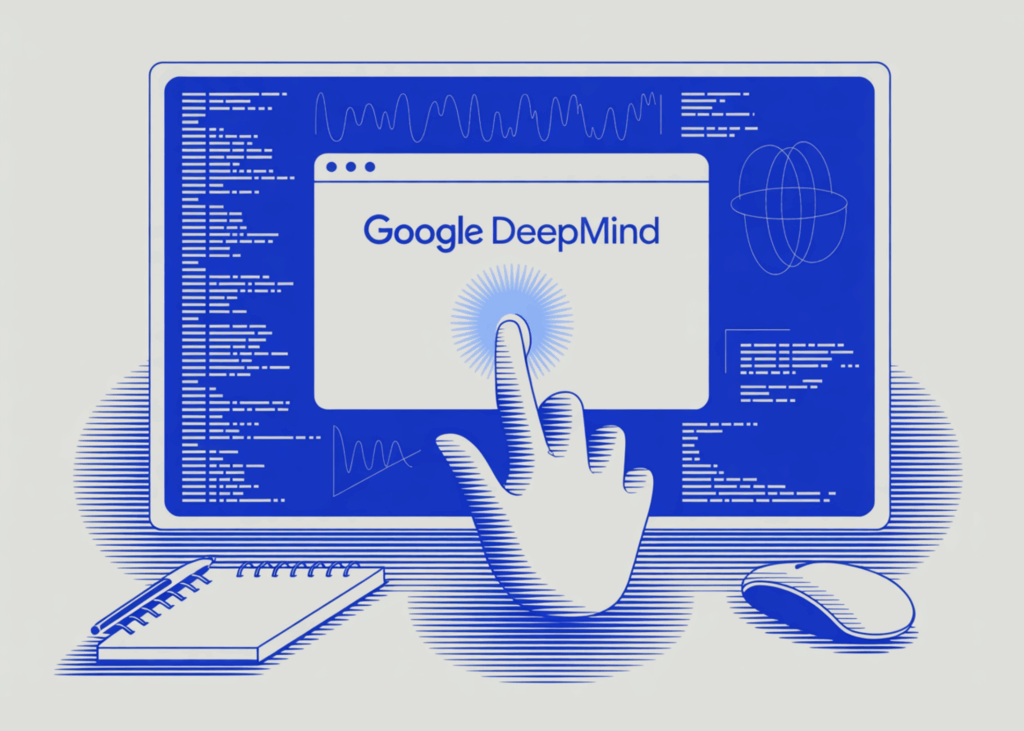
Google DeepMind Introduces an AI-Enabled Mouse Pointer Powered by Gemini That Captures Visual and Semantic Context Around the Cursor

The mouse pointer has sat at the center of personal computing for more than half a century. It tracks cursor position. It registers clicks. Beyond that, it does almost nothing. Google DeepMind researchers outlined a set of experimental principles and demos for an AI-enabled pointer that goes considerably further: one that understands not just where you are pointing, but what you are pointing at and why it matters. The system is powered by Gemini and is currently in the experimental stage. Two demos are live in Google AI Studio today: one for editing an image and one for finding places on a map, both operable by pointing and speaking. A deeper integration called Magic Pointer is also rolling out inside Chrome, and a further integration is planned for Googlebook, Google’s new line of Gemini-powered laptops announced this week. https://deepmind.google/blog/ai-pointer/ What DeepMind is Targeting The frustration DeepMind researchers are addressing is a familiar one for anyone who has tried to use an AI assistant while already in the middle of work. Because a typical AI tool lives in its own window, users need to drag their world into it. The research team wants the opposite — intuitive AI that meets users across all the tools they use, without interrupting their flow. In practice, today’s AI workflow often looks like this: you are working inside a document or a browser tab, you spot something you want to ask about, you switch to a chat interface, you re-describe what you were looking at, you run the query, and you paste the result back. This maps to a concrete technical gap: current LLM interfaces are largely text-in, text-out. They have no awareness of the screen state around them. The AI-enabled pointer is an attempt to close that gap by giving the model real-time visual and semantic context derived from cursor position and hover state — without requiring users to manually serialize that context into a written prompt. Four interaction principles DeepMind researchers have developed four principles that together shift the hard work of conveying context and intent from the user to the computer, replacing text-heavy prompts with simpler, more intuitive interactions. The first is Maintain the flow. AI capabilities should work across all apps, not force users into ‘AI detours’ between them. The prototype AI-enabled pointer is available wherever the user is working. For example, they could point at a PDF and request a bullet-point summary to paste directly into an email, hover over a table of statistics and request a pie chart version, or highlight a recipe and ask for all the ingredients doubled. This is a direct architectural stance: instead of building AI assistance as a sidecar application, the capability lives at the pointer level and is present in whichever tool the user is already working in. The second is Show and tell. Current AI models demand precise instructions. To get a good response, a user has to write a detailed prompt. An AI-enabled pointer would streamline this process by smoothly capturing the visual and semantic context around the pointer, letting the computer ‘see’ and understand what’s important to the user. In the experimental system, just point, and the AI knows exactly which word, paragraph, part of an image, or code block the user needs help with. From a technical standpoint, this means the system treats cursor hover state and the surrounding UI content as structured model inputs — comparable to how multimodal models process image and text together, except here the visual region is dynamically cropped and contextualized in real time around a moving cursor. The third is Embrace the power of ‘This’ and ‘That‘. In everyday interactions with each other, humans rarely speak in long, detailed paragraphs. We might say, ‘Fix this’, ‘Move that here’, or ‘What does this mean?’ — while relying on physical gestures and our shared context to fill in any gaps in understanding. An AI system that understands this combination of context, pointing and speech would allow users to make complex requests in natural shorthand, no fiddly prompting required. The name of the principle is deliberate: deictic language (words like ‘this’ and ‘that’ that depend on physical reference to carry meaning) is how humans naturally communicate when they can point at something. The AI-enabled pointer is designed to handle exactly that class of instruction without needing the user to spell out what “this” refers to. The fourth is Turn pixels into actionable entities. For decades, computers have only tracked where we are pointing. AI can now also understand what the user is pointing at. This transforms pixels into structured entities, such as places, dates, and objects, that users can interact with instantly. A photo of a scribbled note becomes an interactive to-do list; a paused frame in a travel video becomes a booking link for that cool-looking restaurant. For ML engineers, this is the most technically substantive of the four principles. It describes an entity extraction step that happens at inference time on whatever visual content is under the cursor — converting raw pixel regions into typed, actionable objects rather than leaving them as unstructured screen content. Where it is going Google DeepMind is now integrating these principles to reimagine pointing in Chrome and the new Googlebook laptop experience. Starting now, instead of writing a complex prompt, users can use their pointer to ask Gemini in Chrome about the part of the webpage they care about. For example, selecting a few products on a page and asking to compare them, or pointing to where they want to visualize a new couch in their living room. Key Takeaways Google DeepMind introduces experimental demos of an AI-enabled mouse pointer powered by Gemini that captures visual and semantic context around the cursor — no manual prompting required. The system is built on four principles: Maintain the flow, Show and tell, Embrace the power of “This” and “That”, and Turn pixels into actionable entities. “Turn pixels into actionable entities” is the key technical idea — the pointer converts on-screen

Google DeepMind Introduces an AI-Enabled Mouse Pointer Powered by Gemini That Captures Visual and Semantic Context Around the Cursor Beitrag lesen »

We use cookies to improve your experience and performance on our website. You can learn more at Datenschutzrichtlinie and manage your privacy settings by clicking Settings.

Privacy Preferences

You can choose your cookie settings by turning on/off each type of cookie as you wish, except for essential cookies.

Allow All
Manage Consent Preferences
  • Always Active

Save
de_DE