YouZum

Uncategorized

AI, Committee, Nachrichten, Uncategorized

Can We Trust LLM’s Logic? Quantifying Uncertainty, Coherence, and Robustness via a Graph-Based Framework

arXiv:2607.08017v1 Announce Type: new Abstract: Large-Language Models (LLMs) can be prone to flawed and unfaithful reasoning that decoding strategies like Self-Consistency (SC) fail to detect as they evaluate only final-answer agreement while ignoring the logical validity of intermediate steps. This raises three fundamental questions: How can we reliably quantify uncertainty in LLM reasoning? Can semantic, structural, and causal awareness select more faithful reasoning compared to na”ive majority voting? and How robust is reasoning topology under adversarial conditions? To address these questions, we introduce GRAPHEVAL, a graph-based reasoning framework that re-frames uncertainty quantification (UQ) as a holistic reasoning fidelity problem. We propose a novel UQ metric, Graph Reasoning Coherence Score (GRCS), that quantifies semantic-structural consensus of the reasoning space and captures pathological mode collapse and confident hallucinations. We find that GRCS is the only metric that is consistently negatively correlated with reasoning faithfulness across both more capable and smaller models. Additionally, we introduce Graph Self-Consistency (GSC), a medoid-based decoding strategy that trades nominal accuracy for reasoning fidelity, exposing the degree to which SC is inflated by unfaithful lucky guesses in smaller models, while preserving or improving accuracy in more capable ones. Finally, through adversarial medoid ablation, we demonstrate that the GSC-selected path acts as a “load-bearing path” and forcing models away from it degrades reasoning faithfulness and, in targeted cases, causes drops in accuracy.

Can We Trust LLM’s Logic? Quantifying Uncertainty, Coherence, and Robustness via a Graph-Based Framework Beitrag lesen »

AI, Committee, Nachrichten, Uncategorized

How to Leverage Synthetic Speech for LLM-Based ASR Systems?

arXiv:2606.29031v2 Announce Type: replace Abstract: In regulated domains such as banking and healthcare, where privacy constraints make real speech costly to collect and retain, synthetic speech from modern text-to-speech (TTS) is an appealing alternative for training automatic speech recognition (ASR) without exposing sensitive customer recordings. Yet a persistent distributional gap between synthetic and real data limits how far it can replace genuine recordings. Prior work largely treats this gap as a black box to be engineered around, but in our work, we instead examine its origin directly by probing a SLAM-ASR architecture. Then, we localise where its LLM backbone separates real from synthetic speech and find the discriminative signal concentrated in the early-to-middle layers, where temporal and prosodic perturbations disrupt it most. We further show that representation-level separability, help, but does not directly predict downstream ASR gains. On the other hand, convolving synthetic audio with room impulse responses (RIRs) narrows the gap not by making synthetic speech sound cleaner or more natural, but by reproducing the acoustic irregularities of real recordings. Translating these findings into the training procedure, by adding a layer-selection module combined with RIR augmentation matches a fully real-data baseline using only 25% of the real speech (13.6h) and surpasses it at all higher proportions.

How to Leverage Synthetic Speech for LLM-Based ASR Systems? Beitrag lesen »

AI, Committee, Nachrichten, Uncategorized

UtterTune: LoRA-Based Target-Language Pronunciation Edit and Control in Multilingual Text-to-Speech

arXiv:2508.09767v3 Announce Type: replace-cross Abstract: We propose UtterTune, a lightweight method for adapting a multilingual text-to-speech (TTS) system built on a large language model (LLM). It improves control of pronunciation in the target language while preserving performance in the others. Although LLM architectures have enabled TTS models to achieve remarkable naturalness, accurately modeling grapheme-to-phoneme (G2P) mapping and prosody remains challenging, especially when the model omits an explicit G2P module and directly processes minimally encoded text (e.g., byte-pair encoding). UtterTune leverages low-rank adaptation to enable the control of segmental pronunciation and pitch accent at the phoneme level for Japanese speech, the target language in this paper, while maintaining naturalness and speaker similarity in a zero-shot setting. Objective and subjective evaluations confirm its effectiveness.

UtterTune: LoRA-Based Target-Language Pronunciation Edit and Control in Multilingual Text-to-Speech Beitrag lesen »

AI, Committee, Nachrichten, Uncategorized

Ant Group’s Robbyant Unveils LingBot-VA 2.0: A Causal Video-Action Model Built Natively for Physical AI

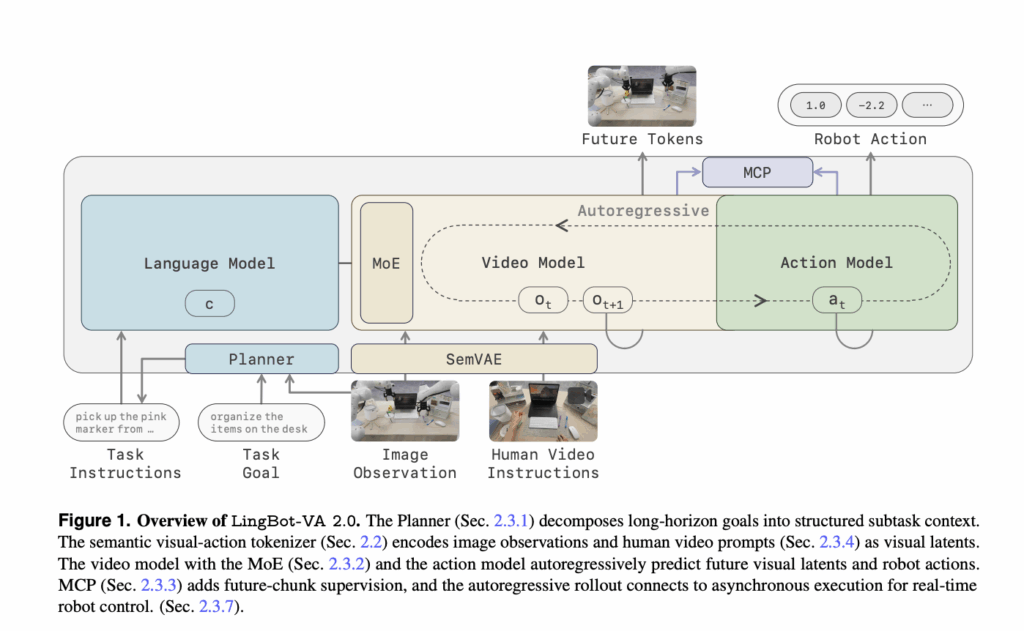
Robbyant, the embodied AI unit inside Ant Group, has released the LingBot-VA 2.0.The first embodied-native foundation model. It describes a video-action foundation model for generalist robot manipulation. The research team pretrains the whole stack for embodiment instead of fine-tuning a video generator. What is LingBot-VA 2.0? Most video-action models reuse two components built for digital content creation. One is a reconstruction-oriented VAE. The other is a bidirectional video-diffusion backbone, with an action module attached. This creates three limitations. Pixel-reconstruction latents preserve appearance but carry limited physical structure. Iterative denoising over video tokens is too slow for closed-loop control. Generic video objectives never teach how actions reshape the world. A fourth mismatch is structural. Backbones use bidirectional attention, while control unfolds strictly forward in time. LingBot VA Version 1.0 finetuned that stack into a causal model. Version 2.0 pretrains a causal DiT natively. https://github.com/Robbyant/lingbot-va/blob/main/LingBot_VA2_paper.pdf Version 1: The Semantic Visual-Action Tokenizer Building on that motivation, stage one replaces the compression-only VAE. Following RepWAM, the tokenizer adds two objectives to reconstruction. Semantic alignment pulls visual latents toward a frozen Perception Encoder teacher. A latent-action objective extracts compact transition variables between consecutive latents. An inverse dynamics model predicts each latent action. A forward dynamics model decodes it into a transport map plus residual. World states and actions now share one latent space. Unlabeled web video therefore carries action-relevant supervision. Version 2: A Causal DiT With a Sparse MoE Video Stream On top of that space, version 2 pretrains a causal DiT. It keeps the Mixture-of-Transformers layout of version 1.0. A video expert and an action expert share one causal self-attention. Each owns a separate feed-forward pathway. The two streams scale asymmetrically. The video expert replaces its dense FFN with a sparse MoE routed layer. That layer holds 128 routed SwiGLU experts, top-8 routing, one shared expert. Load balancing follows the auxiliary-loss-free Loss-Free Balancing strategy. The action expert keeps a dense FFN at hidden dimension 768. The video backbone is roughly 13.0B parameters, about 1.9B active. With the action expert and MCP heads, training covers about 15.3B parameters. Roughly 2.5B activate per token at inference. Training uses a rectified-flow objective with a hybrid Muon plus AdamW optimizer. Where the Training Signal Comes From Beyond architecture, two objectives shape what the model learns. Multi-chunk prediction (MCP) fixes myopic supervision. Teacher forcing supervises only the next chunk, so the model can cut loss by copying appearance. MCP attaches three lightweight modules predicting the next three chunks. In ablation it matched the baseline’s 45k-step accuracy in 20k steps, a 2.3x training speedup. Meanwhile, five objectives are co-trained rather than staged: T2I, T2V, TI2VA, ICL, and human-robot co-training. Sampling follows a coarse-to-fine schedule, from appearance grounding to video-action control. Keeping every objective alive avoids forgetting the earlier priors. Hierarchical Planning Chunk-level control cannot sequence long-horizon goals. Above the policy therefore sits a VLM planner, LoRA-finetuned with a frozen vision tower. It emits structured JSON: done, instruction, generation_instruction, local_scene_description. It runs at about 2 Hz behind an asynchronous shared buffer. The policy reads it at each chunk boundary, so planner latency never blocks execution. Foresight Reasoning Even with a sparse backbone, deployment hits a serial bottleneck. If the robot waits, model latency becomes control latency. Foresight Reasoning therefore runs prediction and execution as asynchronous streams. While the robot executes chunk a_t, the video expert imagines its outcome. The action expert decodes a_{t+1} from that. Running ahead risks drift. So each returning observation is encoded into the true latent z_{t+1}, overwriting the imagined one. A forward-dynamics grounding loss trains the video expert for this role. Copy CodeCopiedUse a different Browser # Pseudocode for the asynchronous rollout (Sec. 2.3.7, Eq. 29). # Not runnable: policy, executor and encode() are placeholders. C = init_kv_cache(encode(obs_0)) # feedback-grounded cache C_t a = policy.action_expert(C) # cold start: first action chunk a_0 while not done: executor.start(a) # execution stream, non-blocking C_tmp = C + [a] # prediction stream: C_t u {a_t} z_hat = policy.video_expert(C_tmp) # forward dynamics -> imagined z_{t+1} a_next = policy.action_expert(C_tmp + [z_hat]) obs = executor.wait() # real observation of a_t returns C = overwrite(C_tmp, z_hat, encode(obs)) # re-ground: z_hat <- true z_{t+1} a = a_next Performance Consequently, evaluation covers simulation and real hardware. On RoboTwin 2.0, every model trains on 2,500 clean plus 25,000 randomized demonstrations, across 50 tasks. https://technology.robbyant.com/lingbot-va-v2 Method Clean Randomized Avg. X-VLA 72.9 72.8 72.9 π0.5 82.7 76.8 79.8 Motus 88.7 87.0 87.9 LingBot-VA 92.9 91.6 92.2 LingBot-VA 2.0 93.8 93.4 93.6 Acceleration technique Inference time (ms/chunk) Async Hz BF16 PyTorch async rollout baseline 927 35 + Consistency distillation 466 69 + Low-precision compiled execution 369 87 + Long-horizon attention optimization 272 118 + Runtime overhead reduction 142 225 Distillation cuts the video sampler from 5 steps to 2, and the action sampler from 10 to 2. FP8 TensorRT engines, a paged/ragged KV cache with FlashInfer attention, and host-side overhead removal supply the rest. Copy CodeCopiedUse a different Browser # Reproduces Table 3 of the report exactly. Runnable as-is. K = 32 # low-level control steps inside one generated chunk stack = [(“BF16 PyTorch async rollout baseline”, 927), (“+ Consistency distillation”, 466), (“+ Low-precision compiled execution”, 369), (“+ Long-horizon attention optimization”, 272), (“+ Runtime overhead reduction”, 142)] for name, ms in stack: print(f”{name:40s} {ms:4d} ms {round(1000 / ms * K):4d} Hz”) print(“end-to-end speedup:”, round(927 / 142, 1), “x”) Version 1.0 vs Version 2.0 Dimension LingBot-VA LingBot-VA 2.0 Tokenizer Wan2.2 VAE (reconstruction) Semantic visual-action tokenizer, 96 latent channels Backbone origin Finetuned from a bidirectional generator Causal DiT pretrained from scratch Video FFN Dense Sparse MoE, 128 experts, top-8 Extra supervision Not used MCP, in-context learning, human-robot co-training Inference Async execution, KV cache Foresight Reasoning with observation re-grounding Peak async control Not reported in the version 2.0 report 225 Hz The tokenizer ablation isolates row one. Swapping the WAN2.2 VAE for the semantic tokenizer lifts a 1.3B model from 78.0 to 86.6. Use Cases and Examples Beyond benchmarks, four deployment shapes stand out. Few-shot onboarding: The report states the model adapts from

Ant Group’s Robbyant Unveils LingBot-VA 2.0: A Causal Video-Action Model Built Natively for Physical AI Beitrag lesen »

AI, Committee, Nachrichten, Uncategorized

Meet LingBot-World-Infinity: An Open Causal World Model With An Agentic Harness

Robbyant, Ant Group’s embodied-intelligence unit, has released LingBot-World-Infinity (LingBot-World 2.0). It is a causal video generation model that behaves as an interactive world simulator. It is how the team attacks two failure modes: long-horizon drift and interactive latency. What is LingBot-World-Infinity? An interactive world model generates video frame by frame, conditioned on a stream of user actions. Each state depends only on past frames and current input. The research team formalizes this as a causal factorization: Copy CodeCopiedUse a different Browser p_θ(x_1:T | a_1:T) = Π_t p_θ(x_t | x_<t, a_≤t) Here x_t is the visual state at time t. The action a_t combines a camera pose and a text prompt. Camera pose uses Plücker embeddings, injected through adaptive layer normalization (AdaLN). Text enters as chunk-wise prompts through cross-attention. The research team claims four upgrades over LingBot-World: An unbounded interaction horizon with consistent output quality. A distilled real-time variant sufficient to drive 720p video streams at 60 fps. A broader action space, including attacking, archery, spell-casting, and shooting. An agentic harness pairing a pilot agent with a director agent. The primary model is 14B. A lightweight 1.3B counterpart is described as deployable on a single GPU. The Architecture: MoBA and Two-Stage Training The core contribution is the Mixture of Bidirectional and Autoregressive (MoBA) Attention Mask. It explains the drift. Standard autoregressive video training uses a teacher forcing mask. Each noisy frame attends to itself and its clean context. The research team found a failure here. As context grows, the model leans on that context instead of predicting future frames. The result is overfitting and visual quality degradation. MoBA appends a bidirectional full-attention block to the teacher forcing mask. That block acts as a regularizer. It also helps the model handle flexible-length generation. The cross-attention mask mirrors the split. The autoregressive component attends to a background prompt along with chunk-wise prompts in a lower-triangular pattern. That prevents future semantics from leaking backward. The bidirectional component attends to one global prompt. Pre-training optimizes a conditional flow-matching objective with rectified-flow interpolation. Post-training then compresses the multi-step teacher into a few-step student: Consistency distillation: Latents on the same teacher probability-flow ODE (PF-ODE) trajectory must map to identical predictions. Distribution matching distillation (DMD): The generator follows the KL gradient between noised student and noised data distributions. The important detail sits in the DMD. The research team applies it over long self-rollout trajectories, not only teacher-forced states. The student is therefore optimized on the state distribution its own predictions induce. That is the stated mechanism behind anti-drift. The Agentic Harness: The Feature Worth Taking Seriously A frame predictor does not play itself. The Robbyant research team wraps the generator in a Director-Pilot Co-Simulation Framework. As described in the research paper, a Vision-Language Model is the Director. It governs macroscopic semantic rules and causal reasoning. The Diffusion Transformer video generator is the Pilot. It simulates low-level physical dynamics and renders transitions. The harness exposes two interaction modes: Mode A: Direct Semantic Interaction. The VLM reads the current frame and generates event cards. No object masks are required. Mode B: Tracking-Assisted Object Interaction. A SAM-based (Segment Anything Model) action-proposal loop tracks objects across chunks. Users select a tracked object and trigger actions. The research paper shows door-opening and ball-rotating rollouts. Users can also intervene textually. Global state shifts change time of day or weather. Local entity injection spawns creatures, and the VLM picks plausible entry points. The interface follows game conventions. WASD drives movement, IJKL controls view. Space triggers a jump; P triggers a wing glide. Keys U and O carry VLM-proposed character actions. Keys F and G carry environmental events. Numeric keys are user-registered event slots. Hands-On: What Ships and What Doesn’t Expectations need calibration here. The codebase is built on Wan2.2. Only lingbot-world-v2-14b-causal-fast is downloadable today. The causal-pretrained 14B, the bidirectional 14B, and both 1.3B variants are marked TODO. Copy CodeCopiedUse a different Browser git clone https://github.com/robbyant/lingbot-world-v2.git cd lingbot-world-v2 pip install -r requirements.txt # torch >= 2.4.0 pip install flash-attn –no-build-isolation huggingface-cli download robbyant/lingbot-world-v2-14b-causal-fast –local-dir ./lingbot-world-v2-14b-causal-fast The provided generate.py runs causal inference with KV caching. It processes frames chunk-by-chunk rather than all at once. The reference command is eight-GPU and 480P: Copy CodeCopiedUse a different Browser torchrun –nproc_per_node=8 generate.py –task i2v-A14B –size 480*832 –ckpt_dir lingbot-world-v2-14b-causal-fast –image examples/03/image.jpg –action_path examples/03 –dit_fsdp –t5_fsdp –ulysses_size 8 –frame_num 361 –local_attn_size 18 –sink_size 6 –prompt “A serene lakeside scene with a lone tree standing in calm water…” The released reference script is 480×832 across eight GPUs. The 60 fps figure describes the deployed stream, which passes a spatio-temporal refiner. That refiner upsamples decoded frames, then synthesizes intermediate frames for a higher frame rate. Both stages compile into TensorRT engines. A Diffusers checkpoint also exists: Copy CodeCopiedUse a different Browser import torch from diffusers import DiffusionPipeline from diffusers.utils import load_image, export_to_video pipe = DiffusionPipeline.from_pretrained( “robbyant/lingbot-world-v2-14b-causal-fast”, dtype=torch.bfloat16, device_map=”cuda”) frames = pipe(image=load_image(“seed.png”), prompt=”…”).frames[0] export_to_video(frames, “output.mp4″) For a hosted path, Reactor serves the model as reactor/lingbot-world-2. Its docs list 48 fps at 1664×960. Sessions are command-driven and stateful: Copy CodeCopiedUse a different Browser from reactor_sdk import Reactor, ReactorStatus reactor = Reactor(model_name=”reactor/lingbot-world-2”, api_key=KEY) @reactor.on_status(ReactorStatus.READY) async def on_ready(status): ref = await reactor.upload_file(“seed.jpg”) await reactor.send_command(“set_image”, {“image”: ref}) await reactor.send_command(“set_prompt”, {“prompt”: “A misty alpine valley.”}) await reactor.send_command(“start”, {}) Movement is persistent state, not a pulse. set_move_longitudinal: “forward” drives until you send “idle”. Commands land at the next chunk boundary.  Comparison The research paper’s comparison is qualitative. Every superiority claim rests on side-by-side frame grids. Property M-G 3.0 D-W LingBot-World HappyOyster Genie 3 LingBot-World-Infinity Generation duration Minutes Minutes Minutes Minutes Minutes Hours (Infinite) Semantic interaction None None None Few Few Infinite Domain Game General General General General General Dynamic degree Medium Medium High Medium Medium High Real-time Yes Yes Yes Yes Yes Yes Open-source Yes Yes Yes No No Yes Use Cases Game and level prototyping: Seed an image of a canal town. Hot-swap the prompt to summon a snowstorm. Iterate on mood before any asset pipeline exists. Embodied simulation: Generate first-person rollouts under scripted camera poses. Feed frames to

Meet LingBot-World-Infinity: An Open Causal World Model With An Agentic Harness Beitrag lesen »

AI, Committee, Nachrichten, Uncategorized

Tool-Making and Self-Evolving LLM Agents in Low-Latency Systems

arXiv:2607.08010v1 Announce Type: new Abstract: Production LLM agents often waste latency and reliability by regenerating code for the same procedural steps on every request. We replace this inference-time coding loop with an agentic tool-making pipeline that compiles repeated SOP steps into validated, versioned tools before deployment. The tool-maker grounds synthesis in the live environment as it collects execution traces, observes backend schemas and values, generates candidate tools, and repairs them against labeled cases. At runtime, the production agent calls these tools directly and falls back to code generation only when needed. We deploy the approach in a Fulfillment Center alarm-triage system, where an agent diagnoses alarms against a 44-node SOP over heterogeneous metric backends. In production, tool calls reduce p50 latency by 42%. On 1,500 historical alarms, they reduce end-to-end error rate by up to 53% by suppressing run-to-run variance in repeated steps. Because tools return compact structured verdicts, they also enable a simpler direct-call architecture, reducing p50 latency by a further 62% in a controlled ablation. Versioned tools also improve auditability and expose specification gaps and upstream data drift. Our results show that self-evolving agents can make industrial LLM systems faster, more reliable, and easier to operate.

Tool-Making and Self-Evolving LLM Agents in Low-Latency Systems Beitrag lesen »

AI, Committee, Nachrichten, Uncategorized

Sperm donors need limits, says a European fertility group

Ties van der Meer doesn’t know how many siblings he has. The 47-year-old was conceived at a private fertility clinic in the Netherlands using sperm provided by an anonymous donor. After the Netherlands banned anonymous donation in 2004, the doctor who ran the clinic destroyed records that might have identified those donors, he says. He describes the situation as “problematic.” Children have a right to know their biological parents, he says. While he did ultimately track down one sibling, who helped him identify his father along with other genetic relatives, he may have others he’ll never find. Other donor-conceived people who have been able to track down siblings have found they have tens or even hundreds of them. One donor-conceived woman who found 25 half-siblings over the course of seven years told the Guardian, “It does make you feel a bit mass-produced.” We need international limits on the number of children a single donor can contribute to, a European fertility organization argued yesterday. At a conference in London, members laid out plans to start with a Europe-wide limit. Today many countries, including the UK, have banned anonymous egg and sperm donation. But anonymity can’t be guaranteed even in places where it is technically allowed. Genetic tests offered by companies like Ancestry and 23andMe, along with genetic registries, have made it much easier for donor-conceived people to find parents and siblings who share their genes. And because sperm can be frozen and stored for years before it is eventually used, the current set-up can result in situations where donor-conceived people discover the identity of a genetic parent only after the person’s death. They might also find that they have siblings of very different ages, all around the world. Some people are finding hundreds of siblings. Sperm from Jonathan Meijer, a Dutch man who began donating in 2007, was used to conceive between 550 and 600 children. (Stichting Donorkind, a foundation and advocacy group for donor-conceived people that’s chaired by van der Meer, took him to court, and he was ordered to stop donating in 2023.) Stories like these can be distressing for donor-conceived people. And there are other reasons why limits are considered important. The offspring of a prolific donor might be at risk of unknowingly forming romantic or sexual relationships, for instance. And some people are concerned that a donor with a harmful genetic mutation might pass that down to many children. This is unlikely, given the level of screening that most donors undergo. But it has happened. A man who donated his sperm to a sperm bank in Denmark was found to have a genetic mutation that significantly increased the risk of multiple cancers. But his sperm had already been used to conceive at least 197 children across Europe. Some of those children developed cancer. Some died. Many countries already have legal limits for donors. In Malta and Cyprus, for example, both egg and sperm donors are allowed to contribute to the birth of just a single child, according to data presented at the European Society of Human Reproduction and Embryology (ESHRE) meeting in London on July 8. Other countries set limits based on the number of families a single donor can contribute to, allowing recipients to have children who share a genetic link. In the UK, that limit is set at 10 families per donor. But these limits are difficult to enforce, partly because donated gametes don’t necessarily stay in their original country. In Denmark, the national limit is set at 12 families. But the country is a major exporter of sperm. In the UK, for example, more than half of sperm donations in 2020 were imported—with most of those coming from either Denmark or the US. “The only thing that really makes sense is a transnational limit,” Jackson Kirkman-Brown, a professor of reproductive biology at the University of Birmingham, said at the meeting. Kirkman-Brown and his colleagues have spent months putting together a document that represents ESHRE’s position on these limits. After consulting with fertility specialists, clinics, sperm and egg banks, donors, and donor-conceived people, the team has developed a plan to start with a Europe-wide limit on sperm and egg donations. ESHRE is calling on sperm and egg banks, as well as fertility clinics, to respect an initial limit of 50 families per donor. That’s still very high, according to a handful of people I spoke to at the meeting. But at least it’s a start. Europe should move toward setting limits at 15 families per donor, Kirkman-Brown said. “We may find that 15 is also too high,” says Vasanti Jadva, who studies the psychological well-being of people conceived using donated eggs, sperm, and embryos at City St George’s in London. “We still don’t know what the right number is.” It will be difficult to enforce these limits, too. And if they end up limiting the supply of donor sperm, there’s a chance that some people will turn to unregulated sperm donations from people who do not undergo health screening. Unregulated donations can lead to other problems for prospective parents, including the possibility that donors will seek parental rights over the children conceived using their sperm. And it will be even harder to establish international limits. When I asked the American Society of Reproductive Medicine for its thoughts on ESHRE’s proposed limits, a representative directed me to a guidance document saying “it has been suggested” that for a population of 800,000, single donors should be limited to “no more than 25 births” in order to avoid the risk that relatives will have children together. (Considering the US has a population of over 340 million, the total figure could be pretty high, but many sperm banks opt to limit the number of families contributed to by a single donor at around 25.) Van der Meer thinks that even a limit of five families from a single donor would be high. International donation makes it even harder for donor-conceived people to connect with genetic relatives, so the limit for international contributions should be set at two

Sperm donors need limits, says a European fertility group Beitrag lesen »

AI, Committee, Nachrichten, Uncategorized

Google Research Introduces SensorFM: A Wearable Health Foundation Model Pretrained on One Trillion Minutes of Sensor Data

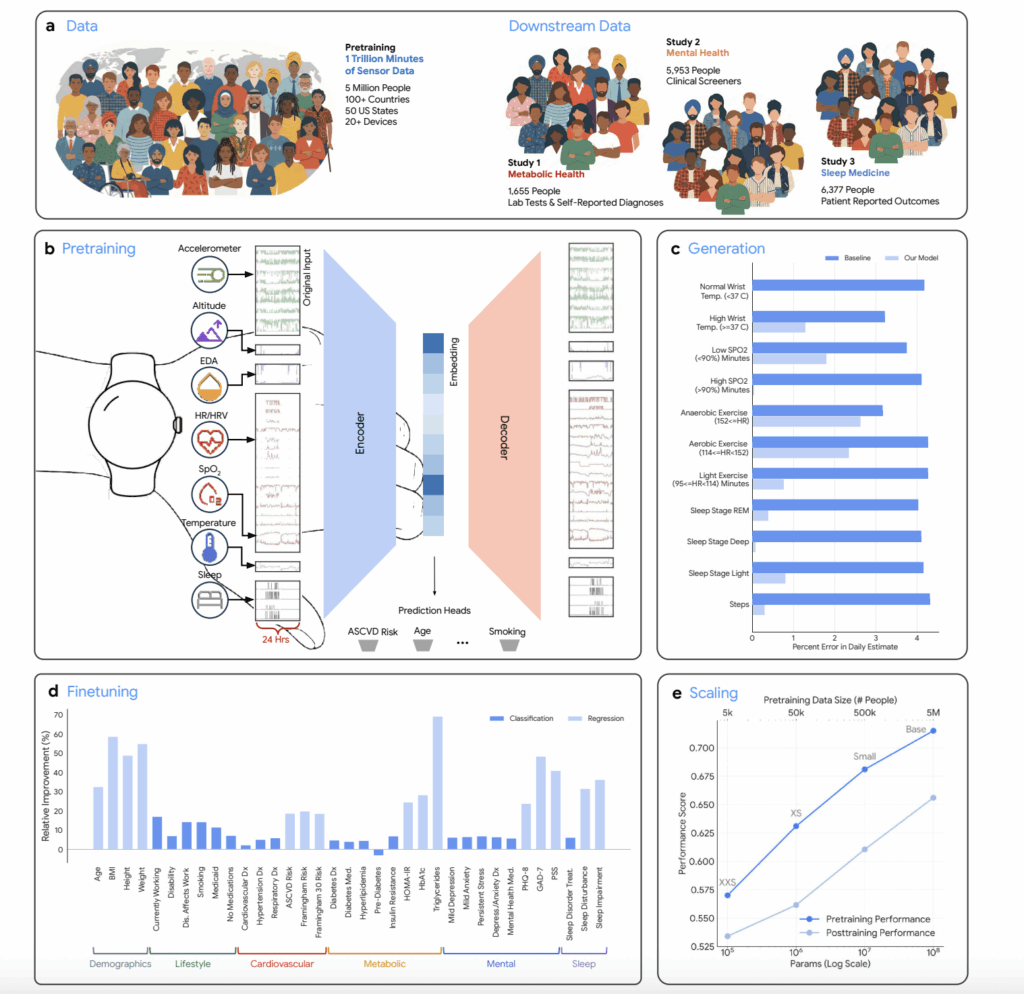
Most wearable health models are built one outcome at a time. That approach breaks down at thirty-five endpoints. Labels are expensive and retrospective annotation is infeasible. Google Research introduced SensorFM, a foundation model for wearable health pre-trained on more than 1 trillion minutes of sensor data from 5 million people. https://arxiv.org/pdf/2605.22759 What is SensorFM? SensorFM is a Large Sensor foundation Model for wearable time-series representation learning. It ingests 34 one-minute aggregate features drawn from five sensors: PPG, accelerometer, EDA, skin temperature, and altimeter. Those features are organized into seven categories, over a 24-hour context window. The backbone is a ViT-1D encoder trained with a masked-autoencoder objective and a patch size of [20, 1]. Pretraining used 5,000,000 consented participants, sampled between September 2024 and September 2025. That corpus spans 100+ countries, all 50 U.S. states, and 20+ Fitbit and Pixel Watch models. It totals over two billion hours, or more than one trillion minutes. Four variants exist, each paired with a proportional data volume. Variant Parameters Encoder hidden / layers Proportional data Sensor-hours XXS 138,740 64 / 2 5K subjects 2×10⁶ XS 933,204 128 / 4 50K subjects 2×10⁷ S 7,290,068 256 / 8 500K subjects 2×10⁸ B 110,763,412 768 / 12 5M subjects 2×10⁹ Evaluation uses separate data. It covers 13,985 subjects across three prospective IRB-approved studies. Those are metabolic, cardiac and respiratory health (N = 1,655), sleep (N = 6,377), and mental health (N = 5,953). The 35 tasks cover cardiovascular (6), metabolic (8), mental health (8), sleep (3), demographics (4), and lifestyle (6). The Scaling Case With that setup, the first question is whether scale buys anything measurable. The research team swept four model sizes against four data volumes. SensorFM-B on the 5M corpus cuts reconstruction validation loss by 31% versus SensorFM-XXS. Generative loss drops 28% on average. Downstream, it gains ΔAUC = 0.09 on classification and Δr = 0.21 on regression. Across variants, B wins 33 of 35 tasks, and XXS ranks last on 33 of 35. The failure case is equally informative. SensorFM-B trained on only 5K subjects posts a 1.082 validation loss. That is worse than every smaller variant at the same volume. Pretraining was stopped early because the model overfit. https://arxiv.org/pdf/2605.22759 Consequently, all headline results assume data volumes scaled proportionally to capacity. Along that co-scaled diagonal, mean ROC AUC moves .664, .681, .710, .752. Mean Pearson r moves .386, .435, .536, .612. The above figure shows the trend has not saturated. AIM: Handling Missing Data as Signal Scaling alone does not explain those numbers. Real streams fragment during charging, off-wrist periods, and power-saving modes. Conventional methods either impute the gaps, injecting bias, or drop the windows, discarding data. SensorFM instead uses Adaptive and Inherited Masking (AIM), introduced by Xu et al. in LSM-2. The applied mask is the union of the inherited missingness mask and the artificial mask. Loss is computed only on artificially masked patches that had ground truth. Two-stage token masking, using token dropout and attention masking, keeps this efficient. Because the decoder learns to reconstruct ablated observations, imputation and forecasting come for free. Generative task Mean fill NN fill Linear interp. SensorFM-B Random imputation, 80% 0.915 1.020 0.854 0.215 Temporal interpolation, 60 min 0.904 0.943 0.777 0.468 Temporal extrapolation, 60 min 0.937 1.102 1.102 0.563 Signal imputation, 12/26 channels 1.025 1.025 1.025 0.170 Reconstruction MSE on the held-out test set, lower is better. Against the best baseline, SensorFM improves random imputation by 74.8%. Sensor signal imputation improves by 83.7%. Hands-On: Adapting the Embeddings Turning that representation into predictions is straightforward. The encoder stays frozen. Embeddings are aggregated per person, using the mean and standard deviation across days. Those reduce to 50 principal components. A linear head then trains under five-fold, person-independent cross-validation. Copy CodeCopiedUse a different Browser import numpy as np from sklearn.decomposition import PCA from sklearn.linear_model import LogisticRegression from sklearn.model_selection import StratifiedKFold from sklearn.metrics import roc_auc_score def person_level(emb, pid): “””Collapse day-level embeddings into one vector per participant.””” people = np.unique(pid) feats = [] for p in people: e = emb[pid == p] # (n_days, d) feats.append(np.concatenate([e.mean(axis=0), e.std(axis=0)])) return np.nan_to_num(np.stack(feats)), people # pandas std() is NaN at 1 day X, people = person_level(emb, pid) # emb: frozen SensorFM embeddings y = labels[people] # one label per participant aucs = [] for tr, te in StratifiedKFold(5, shuffle=True, random_state=0).split(X, y): pca = PCA(n_components=50).fit(X[tr]) # PCA-50, fit on the train fold only clf = LogisticRegression(max_iter=400) # paper: AdamW, lr 5e-3, wd 1e-4, 400 steps clf.fit(pca.transform(X[tr]), y[tr]) p = clf.predict_proba(pca.transform(X[te]))[:, 1] aucs.append(roc_auc_score(y[te], p)) print(np.mean(aucs)) This linear probe beats a supervised feature-engineered baseline on 34 of 35 tasks. Selected results follow. Task Metric Demos. only Feat. Eng. SensorFM-B Age r – .662 .920 Mental Health Med. ROC .594 .773 .819 PHQ-8 r .303 .354 .450 Insulin Resistance ROC .717 .710 .761 Hypertension Dx ROC .762 .747 .786 Framingham 30 Risk r .782 .592 .714 The last row is not an outlier. ASCVD and Framingham scores are calculated from demographic features. Demographic-only models therefore win by construction. The research team reports SensorFM best on 31 of 35 tasks, not all of them. Two caveats sit in the same tables. Demographics still help SensorFM on 22 of 30 tasks, though the lift shrinks with scale. In very-low-label regimes, demographic priors alone remain strong. The Agentic Classroom Even a linear probe needs per-task tuning. To automate that, the research team ran a ‘classroom’ of five LLM student agents. These span gemini-2.5 flash through gemini-3.1 pro preview. Agents generate, execute, score, and refine Python heads over 20 cycles, using unreduced embeddings. In total they ran 30,516 experiments. Agent-found heads beat the linear probe on 16 of 20 classification tasks, measured by F1. They also raised Pearson correlation on 12 of 15 regression tasks. Solution quality tracked the Artificial Analysis Intelligence Index. The winning solutions are conservative. Almost all reduced the embedding space to 50–100 dimensions. Linear models outnumbered non-linear ones, and ensembles appeared in under a quarter. Grounding a Personal Health Agent The final experiment tests SensorFM as a

Google Research Introduces SensorFM: A Wearable Health Foundation Model Pretrained on One Trillion Minutes of Sensor Data Beitrag lesen »

AI, Committee, Nachrichten, Uncategorized

The Download: Claude’s inner workings and OpenAI’s “super app”

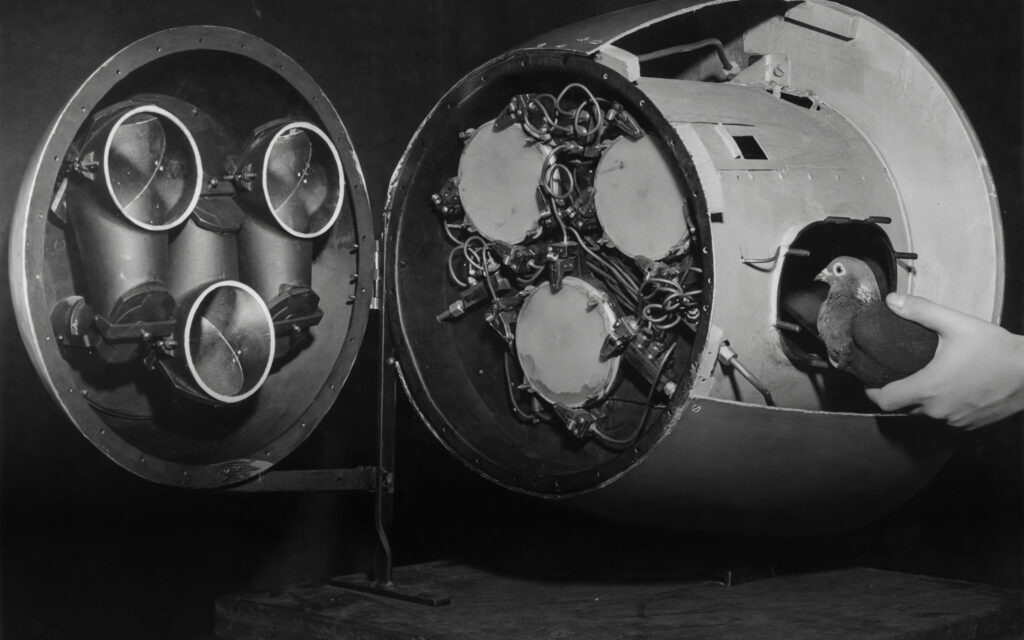
This is today’s edition of The Download, our weekday newsletter that provides a daily dose of what’s going on in the world of technology. Anthropic found a hidden space where Claude puzzles over concepts The AI firm Anthropic has got the clearest glimpse yet at what’s really going on inside large language models as they answer questions or carry out tasks. What they found ranges from the mundane to the unnerving.  Researchers at the company built a tool called the Jacobian lens (or J-lens) and used it to uncover a hidden area, which they named the J-space, inside its flagship LLM, Claude. The J-space contains words related to the response a model is working on but may not ultimately produce. If Claude were a person (which it is not), you might say these hidden words reveal what’s on its mind before it actually speaks.  Read the full story on what they found. —Will Douglas Heaven The must-reads I’ve combed the internet to find you today’s most fun/important/scary/fascinating stories about technology. 1 OpenAI has unveiled its long-awaited “super app” ChatGPT Work blends its chatbot, coding tool, and new models. (Reuters $)+ It’s designed to do your work for you and with you. (Ars Technica)+ And arrived the same day as OpenAI’s GPT 5.6 models. (NYT $)+ It’s also developing a fully automated researcher. (MIT Technology Review) 2  Humanoids have performed teleoperated surgery on living animalsIn the world-first, they removed gallbladders from pigs. (Ars Technica)+ The human work behind humanoids is hidden. (MIT Technology Review) 3 SK Hynix has landed the largest US listing by a foreign companyThe South Korean chip giant raised $26.5 billion. (CNN)+ Demand for AI data centres has led its profits to skyrocket. (Guardian)+ But its jumbo share sale may be a sign of overheated times. (FT $)+ South Korea’s hottest bachelors are chip workers. (MIT Technology Review) 4 Tencent is leading a deal to unwind Meta’s $2 billion Manus acquisitionIt’s in talks to become the Chinese AI startup’s largest shareholder. (FT $)+ Tencent will reportedly buy Manus for no less ​than $2 billion. (Reuters $)+ Beijing had ordered Meta to unwind the acquisition. (Bloomberg $) 5 Resuscitated human retinas responded to light 10 hours after deathIt’s a big step towards eye transplants that restore vision. (New Scientist $)+ As is a new device that revives dead eyeballs. (MIT Technology Review) 6 Meta has started charging for AI accessA new version of Muse Spark has a paid tier for developers. (Quartz) + Meta also plans to start producing an AI chip in September. (Reuters $) 7 OpenAI and Google have sold AI models to blacklisted China groupsVia Singapore-based subsidiaries of Alibaba, Baidu and Tencent. (FT $) 8 A daughter tested an AI “death bot” of her fatherThe technology provided both comfort and unease. (New Yorker $) 9 An astronomer says the hunt for alien life needs more statisticsHe wants to replace speculation with mathematical frameworks. (Quanta) 10 Pokémon Go players turned Times Square into a giant battlefieldMore than 1,500 fans finally fulfilled the game’s 2016 launch promise. (Wired $)+ Pokémon Go is also training world models. (MIT Technology Review) Quote of the day “When we’re talking about AI, we love the hype, we get excited about it. The damn thing never actually lands in practice.” —Vijay Janapa Reddi, an engineering professor at Harvard University, tells Wired why he’s skeptical about grand plans for AI. One More Thing B.F. SKINNER FOUNDATION Why we should thank pigeons for our AI breakthroughs In 1943, psychologist B.F. Skinner led a secret government project to make bombs more precise. His idea: teach pigeons to guide missiles by pecking at targets on a screen inside a warhead. To train them, Skinner rewarded the birds with food when they made the right decisions, using trial and error to shape their behavior. Unsurprisingly, the military never deployed Skinner’s kamikaze pigeons. Yet his experiments convinced him that pigeons were “an extremely reliable instrument” for studying learning.   Decades later, those same principles would help power reinforcement learning, the technology behind some of today’s most advanced AI systems. Discover how pigeons inspired one of AI’s most powerful techniques. —Ben Crair We can still have nice things A place for comfort, fun, and distraction to brighten up your day. (Got any ideas? Drop me a line.) + Here’s a splendid selection of this year’s NSW architecture award winners.+ Photographers have captured the Strawberry Moon’s golden glow in stunning detail.+ Idiocracy is the film that best exemplifies the “American experience,” according to a new poll. Look back at the prescient comedy with this Screen Junkies trailer.+ Get ready for the weekend with this psychedelic house journey from Jamie xx b2b Caribou.

The Download: Claude’s inner workings and OpenAI’s “super app” Beitrag lesen »

AI, Committee, Nachrichten, Uncategorized

Four nuclear reactors hit a big milestone in the US

I was really looking forward to July 4, and not just because I love a poolside barbecue. This year the American holiday also marked a big symbolic deadline for US nuclear power. Last year the Trump administration set a goal to see three new microreactors achieve criticality, a technical milestone establishing that a reactor can sustain a chain reaction, by the nation’s 250th birthday. And just in time, four reactors did so. It was a lofty goal, and seeing not just three but four companies meet it is certainly a positive sign for emerging nuclear technologies at a time when the world is facing increased need to increase electricity supply and address climate change with emissions-free technologies. But achieving criticality doesn’t mean a reactor is ready to provide electricity for the grid (or at all, for that matter). Let’s untangle what this program’s success could mean for nuclear power in the US, and where these companies might go from here. The Reactor Pilot Program essentially opened a special door for prototype reactors to fast-track development. In August, the US Department of Energy selected 11 reactor projects for the program and offered them land and support from the national labs system. These are all microreactors; the large light-water reactors that dominate the grid today are tens or even hundreds of times their size.  Antares Nuclear was the first to achieve criticality, reaching the milestone in June in its Mark-0 test reactor. Reactors from Valar Atomics, Deployable Energy, and Aalo Atomics followed. (Aalo hit the mark in the early hours of July 4—an inspiring example of just barely meeting a deadline.) The speed with which these companies hit this milestone is impressive, especially in an industry known for massive projects that frequently blow past deadlines and stated budgets. (Valar, Antares, and Aalo were all founded in 2023, and Deployable started in 2025.) But reaching criticality and running a reactor that can produce electricity are two totally different things. All these reactors reached what’s called zero-power criticality. Basically, it’s a test of whether you can start a nuclear chain reaction, with no meaningful power coming from the reactor. “A zero-power-criticality test can be achieved without making real engineering progress on fuel or design,” Kathryn Huff, a former assistant secretary for nuclear energy and chair of the Department of Nuclear Engineering and Engineering Physics of the University of Wisconsin–Madison, said on an episode of the Catalyst podcast earlier this year. Now, with the completion of this program, the companies will need to continue their work to make power, which could involve some big technical challenges. In some cases they’ll need to add significant equipment, like the cooling systems to transfer the heat out of the reactor core. The companies are projecting aggressive timelines moving forward. Aalo says it’s already begun work on the second reactor and plans to produce 10 megawatts of electricity to power an on-site data center in 2027. Deployable Energy says it plans to deploy commercial reactors by 2028.  I tend to take timelines from startups, especially in nuclear, with a grain of salt. Not only are these remarkably complex technical machines, but companies often run into problems outside their own control, like regulatory challenges—which these new projects could soon face.  The Nuclear Regulatory Commission is in charge of civilian and commercial nuclear use in the US, and historically, the process to get nuclear reactors approved has been quite slow. The agency did propose a new framework for microreactor approvals earlier this year, which is designed to speed up the process—but it’s yet to be seen how quickly things will move. (And it’s worth noting here that some nuclear experts have questioned whether the agency under the Trump administration is loosening nuclear rules too much.) Some nuclear supporters aren’t applauding the microreactor milestone. Federal focus on the program is an “unhelpful diversion” from goals to meaningfully increase nuclear capacity, according to one analysis by Third Way, a public policy think tank. “Artificially accelerating project timelines is a short-term solution, not a long-term fix,” the memo reads.  Criticality is a big first step, but a lot will still have to happen for any of these microreactors to come online, much less for these small reactors to be a significant source of electricity for the grid.  This article is from The Spark, MIT Technology Review’s weekly climate newsletter. To receive it in your inbox every Wednesday, sign up here. 

Four nuclear reactors hit a big milestone in the US Beitrag lesen »

We use cookies to improve your experience and performance on our website. You can learn more at Datenschutzrichtlinie and manage your privacy settings by clicking Settings.

Privacy Preferences

You can choose your cookie settings by turning on/off each type of cookie as you wish, except for essential cookies.

Allow All
Manage Consent Preferences
  • Always Active

Save
de_DE