YouZum

Committee

AI, Committee, Nachrichten, Uncategorized

GPZ: A Next-Generation GPU-Accelerated Lossy Compressor for Large-Scale Particle Data

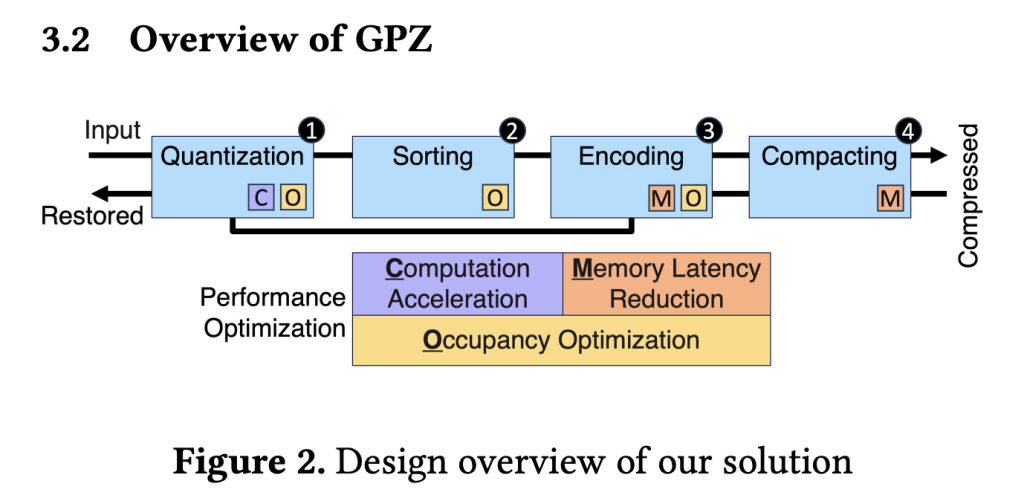
Particle-based simulations and point-cloud applications are driving a massive expansion in the size and complexity of scientific and commercial datasets, often leaping into the realm of billions or trillions of discrete points. Efficiently reducing, storing, and analyzing this data without bottlenecking modern GPUs is one of the emerging grand challenges in fields like cosmology, geology, molecular dynamics, and 3D imaging. Recently, a team of researchers from Florida State University, the University of Iowa, Argonne National Laboratory, the University of Chicago, and several other institutions introduced GPZ, a GPU-optimized, error-bounded lossy compressor that radically improves throughput, compression ratio, and data fidelity for particle data—outperforming five state-of-the-art alternatives by wide margins. Why Compress Particle Data? And Why is It So Hard? Particle (or point-cloud) data—unlike structured meshes—represents systems as irregular collections of discrete elements in multidimensional space. This format is essential for capturing complex physical phenomena, but has low spatial and temporal coherence and almost no redundancy, making it a nightmare for classical lossless or generic lossy compressors. Consider: The Summit supercomputer generated a single cosmological simulation snapshot of 70 TB using Nvidia V100 GPUs. The USGS 3D Elevation Program’s point clouds of U.S. terrain exceed 200 TB of storage. Traditional approaches—like downsampling or on-the-fly processing—throw away up to 90% of raw data or foreclose reproducibility through lack of storage. Moreover, generic mesh-focused compressors exploit correlations that simply don’t exist in particle data, yielding poor ratios and abysmal GPU throughput. GPZ: Architecture and Innovations GPZ comes equipped with a four-stage, parallel GPU pipeline—specially engineered for the quirks of particle data and the stringent demands of modern massively-parallel hardware. Source: https://arxiv.org/abs/2508.10305 Pipeline Stages: Spatial Quantization Particles’ floating-point positions are mapped to integer segment IDs and offsets, respecting user-specified error bounds while leveraging fast FP32 operations for maximum GPU arithmetic throughput. Segment sizes are tuned for optimal GPU occupancy. Spatial Sorting Within each block (mapped to a CUDA warp), particles are sorted by their segment ID to enhance subsequent lossless coding—using warp-level operations to avoid costly synchronization. Block-level sort balances compression ratio with shared memory footprint for best parallelism. Lossless Encoding Innovative parallel run-length and delta encoding strip redundancy from sorted segment IDs and quantized offsets. Bit-plane coding eliminates zero bits, with all steps heavily optimized for GPU memory access patterns. Compacting Compressed blocks are efficiently assembled into a contiguous output using a three-step device-level strategy that slashes synchronization overheads and maximizes memory throughput (809 GB/s on RTX 4090, near theoretical peak). Decompression is the reverse—extract, decode, and reconstruct positions within error bounds, enabling high-fidelity post-hoc analysis. Source: https://arxiv.org/abs/2508.10305 Hardware-Aware Performance Optimizations GPZ sets itself apart with a suite of hardware-centric optimizations: Memory coalescing: Reads and writes are carefully aligned to 4-byte boundaries maximizing DRAM bandwidth (up to 1.6x improvement over strided access). Register and shared memory management: Algorithms are designed to keep occupancy high. Precision is dropped to FP32 where possible, and excessive register use is avoided to prevent spills. Compute scheduling: One-warp-per-block mapping, explicit use of CUDA intrinsics like FMA operations, and loop unrolling where beneficial. Division/modulo elimination: Replacing slow division/modulo operations with precomputed reciprocals and bitwise masks where possible. Benchmarking: GPZ vs. State-of-the-Art GPZ was evaluated on six real-world datasets (from cosmology, geology, plasma physics, and molecular dynamics), spanning three GPU architectures: Consumer: RTX 4090, Data center: H100 SXM, Edge: Nvidia L4. Baselines included: cuSZp2 PFPL FZ-GPU cuSZ cuSZ-i Most of these tools, optimized for generic scientific meshes, failed or showed severe performance/quality drop-offs on particle datasets over 2 GB; GPZ remained robust throughout. Results: Speed: GPZ delivered compression throughputs up to 8x higher than the next-best competitor. Average throughputs hit 169 GB/s (L4), 598 GB/s (RTX 4090), and 616 GB/s (H100). Decompression scales even higher. Compression Ratio: GPZ consistently outperformed all baselines, yielding ratios as much as 600% higher in challenging settings. Even when runners-up edged slightly ahead, GPZ sustained a 3x-6x speed advantage. Data Quality: Rate-distortion plots confirmed superior preservation of scientific features (higher PSNR at lower bitrates), and visual inspection (especially in 10x magnified views) revealed GPZ’s reconstructions were nearly indistinguishable from the originals, whereas other compressions produced visible artifacts. Key Takeaways & Implications GPZ sets a new gold standard for real-time, large-scale particle data reduction on modern GPUs. Its design acknowledges the fundamental limits of generic compressors and delivers tailored solutions that exploit every ounce of GPU-parallelism and precision tuning. For researchers and practitioners working with immense scientific datasets, GPZ offers: Robust error-bounded compression suited for in-situ and post-hoc analysis Practical throughput and ratios across consumer and HPC-class hardware Near-perfect reconstruction for downstream analytics, visualization, and modeling tasks As data sizes continue to scale, solutions like GPZ will increasingly define the next era of GPU-oriented scientific computing and large-scale data management. Check out the Paper here. Feel free to check out our GitHub Page for Tutorials, Codes and Notebooks. Also, feel free to follow us on Twitter and don’t forget to join our 100k+ ML SubReddit and Subscribe to our Newsletter. The post GPZ: A Next-Generation GPU-Accelerated Lossy Compressor for Large-Scale Particle Data appeared first on MarkTechPost.


GPZ: A Next-Generation GPU-Accelerated Lossy Compressor for Large-Scale Particle Data Beitrag lesen »

AI, Committee, Nachrichten, Uncategorized

Huawei CloudMatrix: A Peer-to-Peer AI Datacenter Architecture for Scalable and Efficient LLM Serving

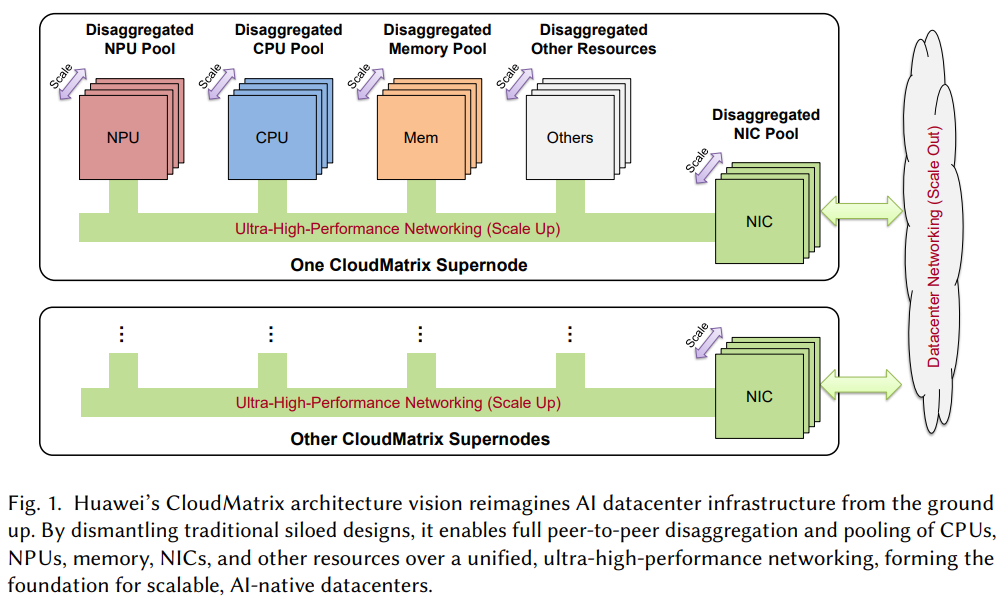
LLMs have rapidly advanced with soaring parameter counts, widespread use of mixture-of-experts (MoE) designs, and massive context lengths. Models like DeepSeek-R1, LLaMA-4, and Qwen-3 now reach trillions of parameters, demanding enormous compute, memory bandwidth, and fast inter-chip communication. MoE improves efficiency but creates challenges in expert routing, while context windows exceeding a million tokens strain attention and KV cache storage, which scales with concurrent users. In real-world deployments, unpredictable inputs, uneven expert activations, and bursty queries further complicate serving. Addressing these pressures requires a ground-up rethinking of AI infrastructure through hardware–software co-design, adaptive orchestration, and elastic resource management.  Recent progress in LLMs is shaped by three main trends: ever-growing parameter counts, sparse MoE architectures, and extended context windows. Models like Llama 4, DeepSeek-V3, and Google’s PaLM push scale into the trillions of parameters, while MoE designs activate only subsets of experts per token, balancing efficiency with capacity. Meanwhile, context windows now span hundreds of thousands to millions of tokens, enabling long-form reasoning but straining compute and memory through large key-value caches. These advances place immense pressure on datacenters, demanding higher compute, memory, and bandwidth while introducing challenges in parallelism, workload heterogeneity, data convergence, and storage performance.  Huawei researchers introduced CloudMatrix, a new AI datacenter architecture designed to handle the rising demands of large-scale LLMs. Its first implementation, CloudMatrix384, combines 384 Ascend 910C NPUs and 192 Kunpeng CPUs, all linked by a high-bandwidth, low-latency Unified Bus that enables fully peer-to-peer communication. This design allows flexible pooling of compute, memory, and network resources, making it ideal for MoE parallelism and distributed KV cache access. On top of this, CloudMatrix-Infer offers an optimized serving framework with peer-to-peer resource pools, large-scale expert parallelism, and hardware-aware optimizations like pipelining and INT8 quantization. Evaluations with DeepSeek-R1 show state-of-the-art throughput, efficiency, and scalability.  Huawei CloudMatrix is a new AI datacenter architecture built on peer-to-peer high-bandwidth interconnects and fine-grained resource disaggregation. Its first large-scale implementation, CloudMatrix384, integrates 384 Ascend 910C NPUs and 192 Kunpeng CPUs into a single supernode, all linked by a unified bus network that enables direct all-to-all communication. This design allows compute, memory, and network resources to be shared seamlessly and scaled independently, operating as one cohesive system. By avoiding the bottlenecks of traditional hierarchical setups, CloudMatrix384 is particularly effective for communication-heavy tasks such as large-scale MoE parallelism and distributed KV cache management, making it ideal for scalable LLM serving.  The researchers evaluate CloudMatrix-Infer on the DeepSeek-R1 model using the CloudMatrix384 supernode. The system achieves a prefill throughput of 6,688 tokens per second per NPU and a decode throughput of 1,943 tokens per second with latency kept under 50 ms, outperforming comparable systems such as SGLang on NVIDIA H100 and DeepSeek on H800. Even when constrained to stricter latency requirements of under 15 ms, it sustains 538 tokens per second in decoding. Moreover, INT8 quantization on the Ascend 910C preserves accuracy across 16 benchmarks, showing that efficiency improvements do not compromise model quality.  In conclusion, Huawei CloudMatrix is a next-generation AI datacenter architecture designed to overcome the scalability limits of conventional clusters. Its first production system, CloudMatrix384, combines 384 Ascend 910C NPUs and 192 Kunpeng CPUs in a fully peer-to-peer supernode connected through a high-bandwidth, low-latency Unified Bus. To exploit this design, the study proposes CloudMatrix-Infer, which separates prefill, decode, and caching into independent pools, supports large-scale expert parallelism, and applies hardware-aware optimizations like pipelining and INT8 quantization. Tested on DeepSeek-R1, it achieved superior throughput and latency performance compared to NVIDIA-based systems, while preserving accuracy, showcasing its potential for large-scale AI deployments.  Check out the Technical Paper. Feel free to check out our GitHub Page for Tutorials, Codes and Notebooks. Also, feel free to follow us on Twitter and don’t forget to join our 100k+ ML SubReddit and Subscribe to our Newsletter. The post Huawei CloudMatrix: A Peer-to-Peer AI Datacenter Architecture for Scalable and Efficient LLM Serving appeared first on MarkTechPost.

Huawei CloudMatrix: A Peer-to-Peer AI Datacenter Architecture for Scalable and Efficient LLM Serving Beitrag lesen »

AI, Committee, Nachrichten, Uncategorized

Native RAG vs. Agentic RAG: Which Approach Advances Enterprise AI Decision-Making?

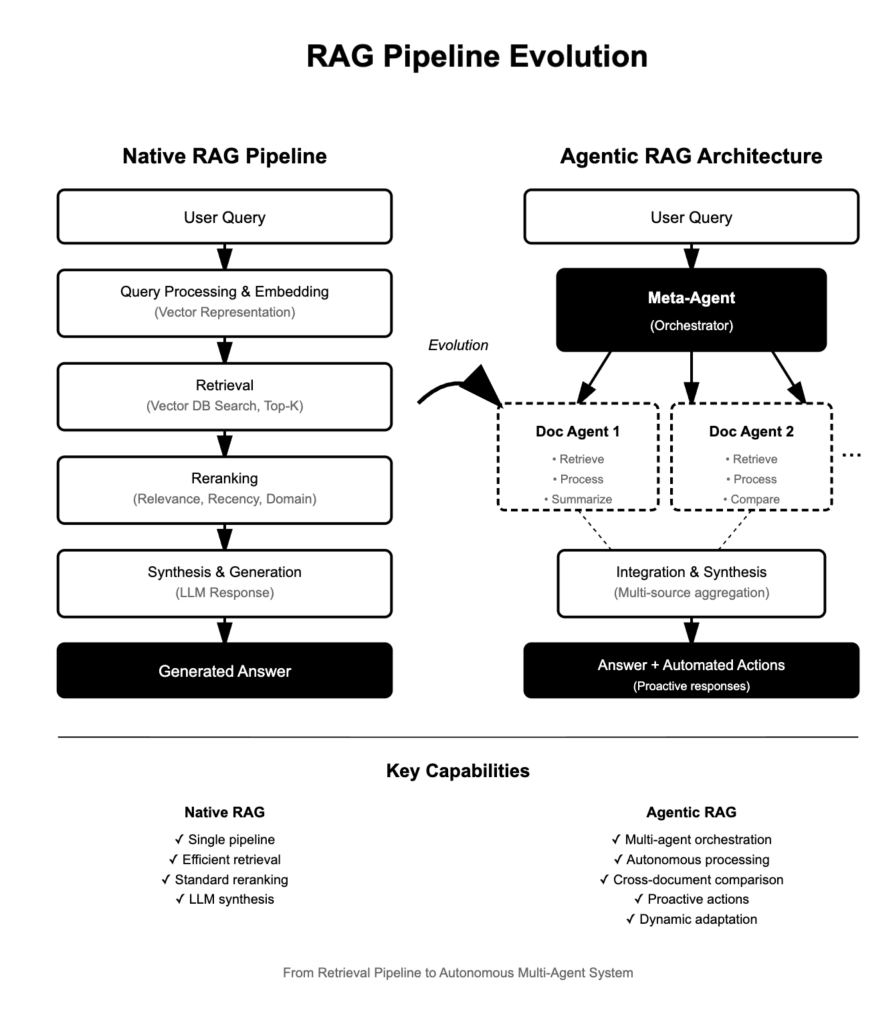
Retrieval-Augmented Generation (RAG) has emerged as a cornerstone technique for enhancing Large Language Models (LLMs) with real-time, domain-specific knowledge. But the landscape is rapidly shifting—today, the most common implementations are “Native RAG” pipelines, and a new paradigm called “Agentic RAG” is redefining what’s possible in AI-powered information synthesis and decision support. Native RAG: The Standard Pipeline Architecture A Native RAG pipeline harnesses retrieval and generation-based methods to answer complex queries while ensuring accuracy and relevance. The pipeline typically involves: Query Processing & Embedding: The user’s question is rewritten, if needed, embedded into a vector representation using an LLM or dedicated embedding model, and prepared for semantic search. Retrieval: The system searches a vector database or document store, identifying top-k relevant chunks using similarity metrics (cosine, Euclidean, dot product). Efficient ANN algorithms optimize this stage for speed and scalability. Reranking: Retrieved results are reranked based on relevance, recency, domain-specificity, or user preference. Reranking models—ranging from rule-based to fine-tuned ML systems—prioritize the highest-quality information. Synthesis & Generation: The LLM synthesizes the reranked information to generate a coherent, context-aware response for the user. Common Optimizations Recent advances include dynamic reranking (adjusting depth by query complexity), fusion-based strategies that aggregate rankings from multiple queries, and hybrid approaches that combine semantic partitioning with agent-based selection for optimal retrieval robustness and latency. Agentic RAG: Autonomous, Multi-Agent Information Workflows What Is Agentic RAG? Agentic RAG is an agent-based approach to RAG, leveraging multiple autonomous agents to answer questions and process documents in a highly coordinated fashion. Rather than a single retrieval/generation pipeline, Agentic RAG structures its workflow for deep reasoning, multi-document comparison, planning, and real-time adaptability. Key Components Component Description Document Agent Each document is assigned its own agent, able to answer queries about the document and perform summary tasks, working independently within its scope. Meta-Agent Orchestrates all document agents, managing their interactions, integrating outputs, and synthesizing a comprehensive answer or action. Features and Benefits Autonomy: Agents operate independently, retrieving, processing, and generating answers or actions for specific documents or tasks. Adaptability: The system dynamically adjusts its strategy (e.g., reranking depth, document prioritization, tool selection) based on new queries or changing data contexts. Proactivity: Agents anticipate needs, take preemptive steps towards goals (e.g., pulling additional sources or suggesting actions), and learn from previous interactions. Advanced Capabilities Agentic RAG goes beyond “passive” retrieval—agents can compare documents, summarize or contrast specific sections, aggregate multi-source insights, and even invoke tools or APIs for enriched reasoning. This enables: Automated research and multi-database aggregation Complex decision support (e.g., comparing technical features, summarizing key differences across product sheets) Executive support tasks that require independent synthesis and real-time action recommendation. Applications Agentic RAG is ideal for scenarios where nuanced information processing and decision-making are required: Enterprise Knowledge Management: Coordinating answers across heterogeneous internal repositories AI-Driven Research Assistants: Cross-document synthesis for technical writers, analysts, or executives Automated Action Workflows: Triggering actions (e.g., responding to invitations, updating records) after multi-step reasoning over documents or databases. Complex Compliance and Security Audits: Aggregating and comparing evidence from varied sources in real time. Conclusion Native RAG pipelines have standardized the process of embedding, retrieving, reranking, and synthesizing answers from external data, enabling LLMs to serve as dynamic knowledge engines. Agentic RAG pushes the boundaries even further—by introducing autonomous agents, orchestration layers, and proactive, adaptive workflows, it transforms RAG from a retrieval tool into a full-blown agentic framework for advanced reasoning and multi-document intelligence. Organizations seeking to move beyond basic augmentation—and into realms of deep, flexible AI orchestration—will find in Agentic RAG the blueprint for the next generation of intelligent systems. The post Native RAG vs. Agentic RAG: Which Approach Advances Enterprise AI Decision-Making? appeared first on MarkTechPost.

Native RAG vs. Agentic RAG: Which Approach Advances Enterprise AI Decision-Making? Beitrag lesen »

AI, Committee, Nachrichten, Uncategorized

Identifying and Answering Questions with False Assumptions: An Interpretable Approach

arXiv:2508.15139v1 Announce Type: new Abstract: People often ask questions with false assumptions, a type of question that does not have regular answers. Answering such questions require first identifying the false assumptions. Large Language Models (LLMs) often generate misleading answers because of hallucinations. In this paper, we focus on identifying and answering questions with false assumptions in several domains. We first investigate to reduce the problem to fact verification. Then, we present an approach leveraging external evidence to mitigate hallucinations. Experiments with five LLMs demonstrate that (1) incorporating retrieved evidence is beneficial and (2) generating and validating atomic assumptions yields more improvements and provides an interpretable answer by specifying the false assumptions.

Identifying and Answering Questions with False Assumptions: An Interpretable Approach Beitrag lesen »

AI, Committee, Nachrichten, Uncategorized

SDGO: Self-Discrimination-Guided Optimization for Consistent Safety in Large Language Models

arXiv:2508.15648v1 Announce Type: new Abstract: Large Language Models (LLMs) excel at various natural language processing tasks but remain vulnerable to jailbreaking attacks that induce harmful content generation. In this paper, we reveal a critical safety inconsistency: LLMs can more effectively identify harmful requests as discriminators than defend against them as generators. This insight inspires us to explore aligning the model’s inherent discrimination and generation capabilities. To this end, we propose SDGO (Self-Discrimination-Guided Optimization), a reinforcement learning framework that leverages the model’s own discrimination capabilities as a reward signal to enhance generation safety through iterative self-improvement. Our method does not require any additional annotated data or external models during the training phase. Extensive experiments demonstrate that SDGO significantly improves model safety compared to both prompt-based and training-based baselines while maintaining helpfulness on general benchmarks. By aligning LLMs’ discrimination and generation capabilities, SDGO brings robust performance against out-of-distribution (OOD) jailbreaking attacks. This alignment achieves tighter coupling between these two capabilities, enabling the model’s generation capability to be further enhanced with only a small amount of discriminative samples. Our code and datasets are available at https://github.com/NJUNLP/SDGO.

SDGO: Self-Discrimination-Guided Optimization for Consistent Safety in Large Language Models Beitrag lesen »

AI, Committee, Nachrichten, Uncategorized

Unplug and Play Language Models: Decomposing Experts in Language Models at Inference Time

arXiv:2404.11916v3 Announce Type: replace Abstract: Enabled by large-scale text corpora with huge parameters, pre-trained language models operate as multi-task experts using a single model architecture. However, recent studies have revealed that certain neurons play disproportionately important roles in solving specific tasks, suggesting that task-relevant substructures can be isolated and selectively activated for each task. Therefore, we introduce Decomposition of Experts (DoE), a novel framework that dynamically identifies and activates task-specific experts within a language model to reduce inference cost without sacrificing accuracy. We first define a task expert as a set of parameters that significantly influence the performance of a specific task and propose a four-step unplug-and-play process: (1) receiving a user request, (2) identifying the corresponding task expert, (3) performing inference using the expert-localized model, and (4) restoring the original model and waiting for the next task. Using attribution methods and prompt tuning, DoE isolates task-relevant neurons, minimizing computational overhead while maintaining task performance. We assume a setting where a language model receives user requests from five widely used natural language understanding benchmarks, processing one task at a time. In this setup, we demonstrate that DoE achieves up to a x1.73 inference speed-up with a 65% pruning rate, without compromising accuracy. Comparisons with various task expert localization methods reveal that DoE effectively identifies task experts, while ablation studies validate the importance of its components. Additionally, we analyze the effects of batch size, token count, and layer types on inference speed-up, providing practical insights for adopting DoE. The proposed framework is both practical and scalable, applicable to any transformer-based architecture, offering a robust solution for efficient task-specific inference.

Unplug and Play Language Models: Decomposing Experts in Language Models at Inference Time Beitrag lesen »

AI, Committee, Nachrichten, Uncategorized

Evaluation Agent: Efficient and Promptable Evaluation Framework for Visual Generative Models

arXiv:2412.09645v3 Announce Type: replace-cross Abstract: Recent advancements in visual generative models have enabled high-quality image and video generation, opening diverse applications. However, evaluating these models often demands sampling hundreds or thousands of images or videos, making the process computationally expensive, especially for diffusion-based models with inherently slow sampling. Moreover, existing evaluation methods rely on rigid pipelines that overlook specific user needs and provide numerical results without clear explanations. In contrast, humans can quickly form impressions of a model’s capabilities by observing only a few samples. To mimic this, we propose the Evaluation Agent framework, which employs human-like strategies for efficient, dynamic, multi-round evaluations using only a few samples per round, while offering detailed, user-tailored analyses. It offers four key advantages: 1) efficiency, 2) promptable evaluation tailored to diverse user needs, 3) explainability beyond single numerical scores, and 4) scalability across various models and tools. Experiments show that Evaluation Agent reduces evaluation time to 10% of traditional methods while delivering comparable results. The Evaluation Agent framework is fully open-sourced to advance research in visual generative models and their efficient evaluation.

Evaluation Agent: Efficient and Promptable Evaluation Framework for Visual Generative Models Beitrag lesen »

We use cookies to improve your experience and performance on our website. You can learn more at Datenschutzrichtlinie and manage your privacy settings by clicking Settings.

Privacy Preferences

You can choose your cookie settings by turning on/off each type of cookie as you wish, except for essential cookies.

Allow All
Manage Consent Preferences
  • Always Active

Save
de_DE