YouZum

Committee

AI, Committee, Nachrichten, Uncategorized

Language Models for Longitudinal Clinical Prediction

arXiv:2510.23884v1 Announce Type: new Abstract: We explore a lightweight framework that adapts frozen large language models to analyze longitudinal clinical data. The approach integrates patient history and context within the language model space to generate accurate forecasts without model fine-tuning. Applied to neuropsychological assessments, it achieves accurate and reliable performance even with minimal training data, showing promise for early-stage Alzheimer’s monitoring.

Language Models for Longitudinal Clinical Prediction Beitrag lesen »

AI, Committee, Nachrichten, Uncategorized

Exploring the Influence of Relevant Knowledge for Natural Language Generation Interpretability

arXiv:2510.24179v1 Announce Type: new Abstract: This paper explores the influence of external knowledge integration in Natural Language Generation (NLG), focusing on a commonsense generation task. We extend the CommonGen dataset by creating KITGI, a benchmark that pairs input concept sets with retrieved semantic relations from ConceptNet and includes manually annotated outputs. Using the T5-Large model, we compare sentence generation under two conditions: with full external knowledge and with filtered knowledge where highly relevant relations were deliberately removed. Our interpretability benchmark follows a three-stage method: (1) identifying and removing key knowledge, (2) regenerating sentences, and (3) manually assessing outputs for commonsense plausibility and concept coverage. Results show that sentences generated with full knowledge achieved 91% correctness across both criteria, while filtering reduced performance drastically to 6%. These findings demonstrate that relevant external knowledge is critical for maintaining both coherence and concept coverage in NLG. This work highlights the importance of designing interpretable, knowledge-enhanced NLG systems and calls for evaluation frameworks that capture the underlying reasoning beyond surface-level metrics.

Exploring the Influence of Relevant Knowledge for Natural Language Generation Interpretability Beitrag lesen »

AI, Committee, Nachrichten, Uncategorized

Liquid AI Releases LFM2-ColBERT-350M: A New Small Model that brings Late Interaction Retrieval to Multilingual and Cross-Lingual RAG

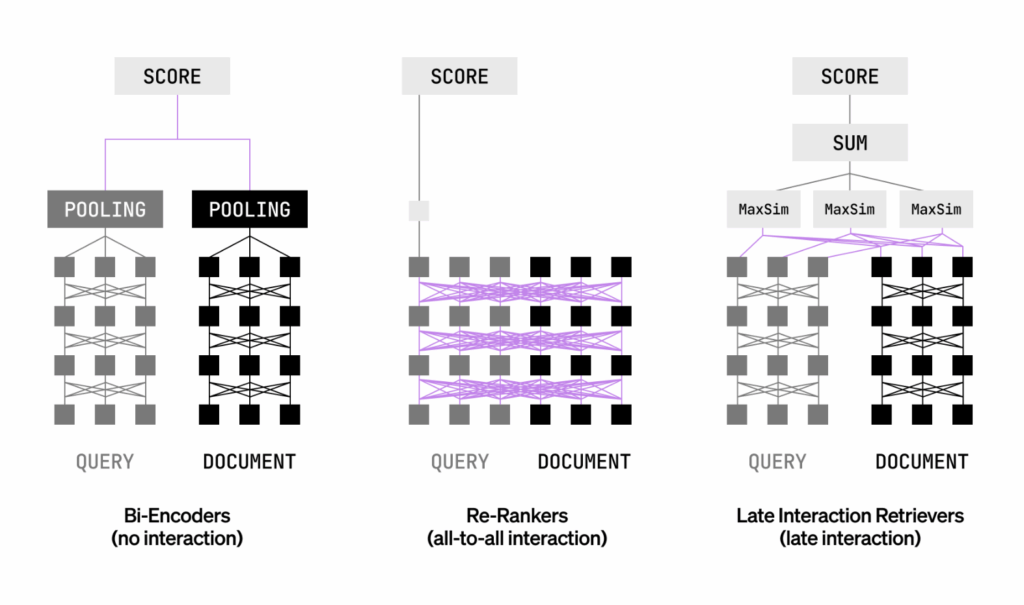
Can a compact late interaction retriever index once and deliver accurate cross lingual search with fast inference? Liquid AI released LFM2-ColBERT-350M, a compact late interaction retriever for multilingual and cross-lingual search. Documents can be indexed in one language, queries can be written in many languages, and the system retrieves with high accuracy. The Liquid AI team reports inference speed on par with models that are 2.3 times smaller, which is attributed to the LFM2 backbone. The model is available with a Hugging Face demo and a detailed model card for integration in retrieval augmented generation systems. https://www.liquid.ai/blog/lfm2-colbert-350m-one-model-to-embed-them-all What late interaction means and why it matters? Most production systems use bi-encoders for speed or cross encoders for accuracy. Late interaction aims to combine both advantages. Queries and documents are encoded separately at the token level. The system compares token vectors at query time using operations such as MaxSim. This preserves fine grained token interactions without the full cost of joint cross attention. It allows pre-computation for documents and improves precision at ranking time. It can serve as a first stage retriever and also as a ranker in one pass. Model specification LFM2-ColBERT-350M has 350 million total parameters. There are 25 layers, with 18 convolution blocks, 6 attention blocks, and 1 dense layer. The context length is 32k tokens. The vocabulary size is 65,536. The similarity function is MaxSim. The output dimensionality is 128. Training precision is BF16. The license is LFM Open License v1.0. https://huggingface.co/LiquidAI/LFM2-ColBERT-350M Languages, supported and evaluated The model supports 8 languages. These are English, Arabic, Chinese, French, German, Japanese, Korean, and Spanish. The evaluation adds Italian and Portuguese, which brings the matrix to 9 languages for cross comparisons of document and query languages. This distinction is relevant when planning deployments that must cover specific customer markets. https://www.liquid.ai/blog/lfm2-colbert-350m-one-model-to-embed-them-all Evaluation setup and key results Liquid AI extends the NanoBEIR benchmark with Japanese and Korean and publishes the extension for reproducibility. On this setup, LFM2-ColBERT-350M shows stronger multilingual capability than the baseline late interaction model in this class, which is GTE-ModernColBERT-v1 at 150M parameters. The largest gains appear in German, Arabic, Korean, and Japanese, while English performance is maintained. Key Takeaways Token-level scoring with MaxSim preserves fine-grained interactions while keeping separate encoders, so document embeddings can be precomputed and queried efficiently. Documents can be indexed in one language and retrieved in many. The model card lists 8 supported languages, while evaluations span 9 languages for cross-lingual pairs. On the NanoBEIR multilingual extension, LFM2-ColBERT-350M outperforms the prior late-interaction baseline (GTE-ModernColBERT-v1 at 150M) and maintains English performance. Inference speed is reported on par with models 2.3× smaller across batch sizes, attributed to the LFM2 backbone. Editorial Notes Liquid AI’s LFM2-ColBERT-350M applies late interaction ColBERT with MaxSim, it encodes queries and documents separately, then scores token vectors at query time, which preserves token level interactions and enables precomputed document embeddings for scale. It targets multilingual and cross lingual retrieval, index once and query in many languages, with evaluations described on a NanoBEIR multilingual extension. Liquid AI team reports inference speed on par with models 2.3 times smaller, attributed to the LFM2 backbone. Overall, late interaction at the nano scale looks production ready for multilingual RAG trials. Check out the Model Weights, Demo and Technical details. Feel free to check out our GitHub Page for Tutorials, Codes and Notebooks. Also, feel free to follow us on Twitter and don’t forget to join our 100k+ ML SubReddit and Subscribe to our Newsletter. Wait! are you on telegram? now you can join us on telegram as well. The post Liquid AI Releases LFM2-ColBERT-350M: A New Small Model that brings Late Interaction Retrieval to Multilingual and Cross-Lingual RAG appeared first on MarkTechPost.

Liquid AI Releases LFM2-ColBERT-350M: A New Small Model that brings Late Interaction Retrieval to Multilingual and Cross-Lingual RAG Beitrag lesen »

AI, Committee, Nachrichten, Uncategorized

ISA-Bench: Benchmarking Instruction Sensitivity for Large Audio Language Models

arXiv:2510.23558v1 Announce Type: cross Abstract: Large Audio Language Models (LALMs), which couple acoustic perception with large language models (LLMs) to extract and understand diverse information from audio, have attracted intense interest from both academic and industrial communities. However, existing LALMs are highly sensitive to how instructions are phrased, affecting both (i) instruction-following rates and (ii) task performance. Yet, no existing benchmarks offer a systematic and comprehensive evaluation of this sensitivity. We introduce ISA-Bench, a dynamic benchmark evaluating instruction sensitivity for LALMs along three axes: instruction description, output format, and task composition. We assess recent open-source and proprietary LALMs using ISA-Bench, profiling both compliance and accuracy under controlled instruction variations. Experimental results reveal that even state-of-the-art LALMs suffer significant instruction sensitivity, leading to degraded performance on fundamental audio understanding tasks. To mitigate this issue, we fine-tune Qwen2-Audio on a specifically constructed complex instruction-variant dataset, achieving a marked improvement in instruction-following performance. However, this also induces nontrivial catastrophic forgetting: the model loses some previously mastered task capabilities when exposed to new instruction styles. Our benchmark provides a standardized basis for assessing and improving instruction sensitivity in LALMs, underscoring the need for instruction-robust audio understanding in real-world pipelines.

ISA-Bench: Benchmarking Instruction Sensitivity for Large Audio Language Models Beitrag lesen »

AI, Committee, Nachrichten, Uncategorized

Every Step Evolves: Scaling Reinforcement Learning for Trillion-Scale Thinking Model

arXiv:2510.18855v2 Announce Type: replace Abstract: We present Ring-1T, the first open-source, state-of-the-art thinking model with a trillion-scale parameter. It features 1 trillion total parameters and activates approximately 50 billion per token. Training such models at a trillion-parameter scale introduces unprecedented challenges, including train-inference misalignment, inefficiencies in rollout processing, and bottlenecks in the RL system. To address these, we pioneer three interconnected innovations: (1) IcePop stabilizes RL training via token-level discrepancy masking and clipping, resolving instability from training-inference mismatches; (2) C3PO++ improves resource utilization for long rollouts under a token budget by dynamically partitioning them, thereby obtaining high time efficiency; and (3) ASystem, a high-performance RL framework designed to overcome the systemic bottlenecks that impede trillion-parameter model training. Ring-1T delivers breakthrough results across critical benchmarks: 93.4 on AIME-2025, 86.72 on HMMT-2025, 2088 on CodeForces, and 55.94 on ARC-AGI-1. Notably, it attains a silver medal-level result on the IMO-2025, underscoring its exceptional reasoning capabilities. By releasing the complete 1T parameter MoE model to the community, we provide the research community with direct access to cutting-edge reasoning capabilities. This contribution marks a significant milestone in democratizing large-scale reasoning intelligence and establishes a new baseline for open-source model performance.

Every Step Evolves: Scaling Reinforcement Learning for Trillion-Scale Thinking Model Beitrag lesen »

AI, Committee, Nachrichten, Uncategorized

FaithUn: Toward Faithful Forgetting in Language Models by Investigating the Interconnectedness of Knowledge

arXiv:2502.19207v2 Announce Type: replace Abstract: Various studies have attempted to remove sensitive or private knowledge from a language model to prevent its unauthorized exposure. However, prior studies have overlooked the complex and interconnected nature of knowledge, where related knowledge must be carefully examined. Specifically, they have failed to evaluate whether an unlearning method faithfully erases interconnected knowledge that should be removed, retaining knowledge that appears relevant but exists in a completely different context. To resolve this problem, we first define a new concept called superficial unlearning, which refers to the phenomenon where an unlearning method either fails to erase the interconnected knowledge it should remove or unintentionally erases irrelevant knowledge. Based on the definition, we introduce a new benchmark, FaithUn, to analyze and evaluate the faithfulness of unlearning in real-world knowledge QA settings. Furthermore, we propose a novel unlearning method, KLUE, which updates only knowledge-related neurons to achieve faithful unlearning. KLUE identifies knowledge neurons using an explainability method and updates only those neurons using selected unforgotten samples. Experimental results demonstrate that widely-used unlearning methods fail to ensure faithful unlearning, while our method shows significant effectiveness in real-world QA unlearning.

FaithUn: Toward Faithful Forgetting in Language Models by Investigating the Interconnectedness of Knowledge Beitrag lesen »

AI, Committee, Nachrichten, Uncategorized

Bootstrapping Referring Multi-Object Tracking

arXiv:2406.05039v2 Announce Type: replace-cross Abstract: Referring understanding is a fundamental task that bridges natural language and visual content by localizing objects described in free-form expressions. However, existing works are constrained by limited language expressiveness, lacking the capacity to model object dynamics in spatial numbers and temporal states. To address these limitations, we introduce a new and general referring understanding task, termed referring multi-object tracking (RMOT). Its core idea is to employ a language expression as a semantic cue to guide the prediction of multi-object tracking, comprehensively accounting for variations in object quantity and temporal semantics. Along with RMOT, we introduce a RMOT benchmark named Refer-KITTI-V2, featuring scalable and diverse language expressions. To efficiently generate high-quality annotations covering object dynamics with minimal manual effort, we propose a semi-automatic labeling pipeline that formulates a total of 9,758 language prompts. In addition, we propose TempRMOT, an elegant end-to-end Transformer-based framework for RMOT. At its core is a query-driven Temporal Enhancement Module that represents each object as a Transformer query, enabling long-term spatial-temporal interactions with other objects and past frames to efficiently refine these queries. TempRMOT achieves state-of-the-art performance on both Refer-KITTI and Refer-KITTI-V2, demonstrating the effectiveness of our approach. The source code and dataset is available at https://github.com/zyn213/TempRMOT.

Bootstrapping Referring Multi-Object Tracking Beitrag lesen »

AI, Committee, Nachrichten, Uncategorized

PerCoR: Evaluating Commonsense Reasoning in Persian via Multiple-Choice Sentence Completion

arXiv:2510.22616v1 Announce Type: new Abstract: We introduced PerCoR (Persian Commonsense Reasoning), the first large-scale Persian benchmark for commonsense reasoning. PerCoR contains 106K multiple-choice sentence-completion problems drawn from more than forty news, cultural, and other web sources. We introduce a novel conjunction-based segmentation strategy to generate coherent sentence-completion pairs, enabling broad topical and structural diversity. To create challenging distractors, we propose DRESS-AF (Distractor Ranking via Embedding Similarity Scoring and Adversarial Filtering), a generation-free adversarial filtering method that selects distractors from the pool of gold continuations while maximising model confusion. Human annotators score 89% on PerCoR, while OpenAI-o3 achieves the highest performance at 92.18%, followed closely by Claude-Sonnet-3.7 (91.17%). The strongest open-source model, DeepSeek-R1, reaches 82.51%, underscoring both the dataset’s difficulty and the remaining performance gap in Persian commonsense reasoning. We further show that DRESS-AF transfers to the English HellaSwag benchmark, increasing its difficulty without hurting human solvability. The dataset is available at https://huggingface.co/datasets/MCINext/PerCoR.

PerCoR: Evaluating Commonsense Reasoning in Persian via Multiple-Choice Sentence Completion Beitrag lesen »

AI, Committee, Nachrichten, Uncategorized

Reinforcement Learning for Reasoning in Large Language Models with One Training Example

arXiv:2504.20571v3 Announce Type: replace-cross Abstract: We show that reinforcement learning with verifiable reward using one training example (1-shot RLVR) is effective in incentivizing the math reasoning capabilities of large language models (LLMs). Applying RLVR to the base model Qwen2.5-Math-1.5B, we identify a single example that elevates model performance on MATH500 from 36.0% to 73.6% (8.6% improvement beyond format correction), and improves the average performance across six common mathematical reasoning benchmarks from 17.6% to 35.7% (7.0% non-format gain). This result matches the performance obtained using the 1.2k DeepScaleR subset (MATH500: 73.6%, average: 35.9%), which contains the aforementioned example. Furthermore, RLVR with only two examples even slightly exceeds these results (MATH500: 74.8%, average: 36.6%). Similar substantial improvements are observed across various models (Qwen2.5-Math-7B, Llama3.2-3B-Instruct, DeepSeek-R1-Distill-Qwen-1.5B), RL algorithms (GRPO and PPO), and different math examples. In addition, we identify some interesting phenomena during 1-shot RLVR, including cross-category generalization, increased frequency of self-reflection, and sustained test performance improvement even after the training accuracy has saturated, a phenomenon we term post-saturation generalization. Moreover, we verify that the effectiveness of 1-shot RLVR primarily arises from the policy gradient loss, distinguishing it from the “grokking” phenomenon. We also show the critical role of promoting exploration (e.g., by incorporating entropy loss with an appropriate coefficient) in 1-shot RLVR training. We also further discuss related observations about format correction, label robustness and prompt modification. These findings can inspire future work on RLVR efficiency and encourage a re-examination of recent progress and the underlying mechanisms in RLVR. All resources are open source at https://github.com/ypwang61/One-Shot-RLVR.

Reinforcement Learning for Reasoning in Large Language Models with One Training Example Beitrag lesen »

AI, Committee, Nachrichten, Uncategorized

Wisdom and Delusion of LLM Ensembles for Code Generation and Repair

arXiv:2510.21513v1 Announce Type: cross Abstract: Today’s pursuit of a single Large Language Model (LMM) for all software engineering tasks is resource-intensive and overlooks the potential benefits of complementarity, where different models contribute unique strengths. However, the degree to which coding LLMs complement each other and the best strategy for maximizing an ensemble’s potential are unclear, leaving practitioners without a clear path to move beyond single-model systems. To address this gap, we empirically compare ten individual LLMs from five families, and three ensembles of these LLMs across three software engineering benchmarks covering code generation and program repair. We assess the complementarity between models and the performance gap between the best individual model and the ensembles. Next, we evaluate various selection heuristics to identify correct solutions from an ensemble’s candidate pool. We find that the theoretical upperbound for an ensemble’s performance can be 83% above the best single model. Our results show that consensus-based strategies for selecting solutions fall into a “popularity trap,” amplifying common but incorrect outputs. In contrast, a diversity-based strategy realizes up to 95% of this theoretical potential, and proves effective even in small two-model ensembles, enabling a cost-efficient way to enhance performance by leveraging multiple LLMs.

Wisdom and Delusion of LLM Ensembles for Code Generation and Repair Beitrag lesen »

We use cookies to improve your experience and performance on our website. You can learn more at Datenschutzrichtlinie and manage your privacy settings by clicking Settings.

Privacy Preferences

You can choose your cookie settings by turning on/off each type of cookie as you wish, except for essential cookies.

Allow All
Manage Consent Preferences
  • Always Active

Save
de_DE