YouZum

Uncategorized

AI, Committee, News, Uncategorized

Breaking Language Barriers or Reinforcing Bias? A Study of Gender and Racial Disparities in Multilingual Contrastive Vision Language Models

arXiv:2505.14160v4 Announce Type: replace Abstract: Multilingual vision-language models (VLMs) promise universal image-text retrieval, yet their social biases remain underexplored. We perform the first systematic audit of four public multilingual CLIP variants: M-CLIP, NLLB-CLIP, CAPIVARA-CLIP, and the debiased SigLIP-2, covering ten languages that differ in resource availability and morphological gender marking. Using balanced subsets of FairFace and the PATA stereotype suite in a zero-shot setting, we quantify race and gender bias and measure stereotype amplification. Contrary to the intuition that multilinguality mitigates bias, every model exhibits stronger gender skew than its English-only baseline. CAPIVARA-CLIP shows its largest biases precisely in the low-resource languages it targets, while the shared encoder of NLLB-CLIP and SigLIP-2 transfers English gender stereotypes into gender-neutral languages; loosely coupled encoders largely avoid this leakage. Although SigLIP-2 reduces agency and communion skews, it inherits — and in caption-sparse contexts (e.g., Xhosa) amplifies — the English anchor’s crime associations. Highly gendered languages consistently magnify all bias types, yet gender-neutral languages remain vulnerable whenever cross-lingual weight sharing imports foreign stereotypes. Aggregated metrics thus mask language-specific hot spots, underscoring the need for fine-grained, language-aware bias evaluation in future multilingual VLM research.

Breaking Language Barriers or Reinforcing Bias? A Study of Gender and Racial Disparities in Multilingual Contrastive Vision Language Models Read Post »

AI, Committee, News, Uncategorized

Tomato, Tomahto, Tomate: Do Multilingual Language Models Understand Based on Subword-Level Semantic Concepts?

arXiv:2411.04530v2 Announce Type: replace Abstract: Human understanding of text depends on general semantic concepts of words rather than their superficial forms. To what extent does our human intuition transfer to language models? In this work, we study the degree to which current multilingual language models (mLMs) understand based on subword-level semantic concepts. To this end, we form “semantic tokens” by merging the semantically similar subwords and their embeddings, and evaluate the updated mLMs on five heterogeneous multilingual downstream tasks. Results show that the general shared semantics could get the models a long way in making the predictions on mLMs with different tokenizers and model sizes. Inspections of the grouped subwords show that they exhibit a wide range of semantic similarities, including synonyms and translations across many languages and scripts. Lastly, we find that the zero-shot results with semantic tokens are on par with or even better than the original models on certain classification tasks, suggesting that the shared subword-level semantics may serve as the anchors for cross-lingual transfer.

Tomato, Tomahto, Tomate: Do Multilingual Language Models Understand Based on Subword-Level Semantic Concepts? Read Post »

AI, Committee, News, Uncategorized

Assemble Your Crew: Automatic Multi-agent Communication Topology Design via Autoregressive Graph Generation

arXiv:2507.18224v4 Announce Type: replace-cross Abstract: Multi-agent systems (MAS) based on large language models (LLMs) have emerged as a powerful solution for dealing with complex problems across diverse domains. The effectiveness of MAS is critically dependent on its collaboration topology, which has become a focal point for automated design research. However, existing approaches are fundamentally constrained by their reliance on a template graph modification paradigm with a predefined set of agents and hard-coded interaction structures, significantly limiting their adaptability to task-specific requirements. To address these limitations, we reframe MAS design as a conditional autoregressive graph generation task, where both the system composition and structure are designed jointly. We propose ARG-Designer, a novel autoregressive model that operationalizes this paradigm by constructing the collaboration graph from scratch. Conditioned on a natural language task query, ARG-Designer sequentially and dynamically determines the required number of agents, selects their appropriate roles from an extensible pool, and establishes the optimal communication links between them. This generative approach creates a customized topology in a flexible and extensible manner, precisely tailored to the unique demands of different tasks. Extensive experiments across six diverse benchmarks demonstrate that ARG-Designer not only achieves state-of-the-art performance but also enjoys significantly greater token efficiency and enhanced extensibility. The source code of ARG-Designer is available at https://github.com/Shiy-Li/ARG-Designer.

Assemble Your Crew: Automatic Multi-agent Communication Topology Design via Autoregressive Graph Generation Read Post »

AI, Committee, News, Uncategorized

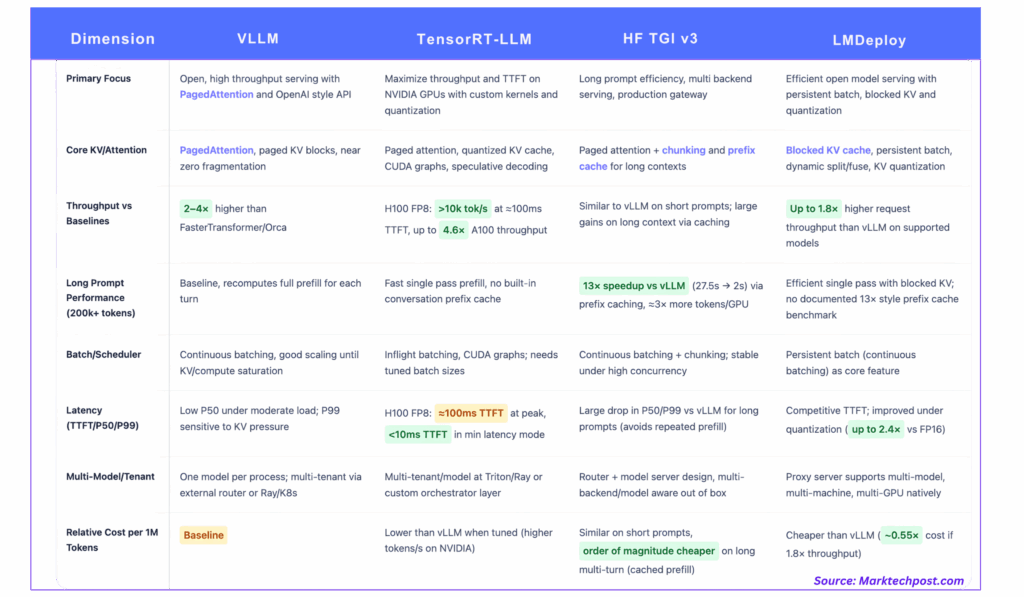
vLLM vs TensorRT-LLM vs HF TGI vs LMDeploy, A Deep Technical Comparison for Production LLM Inference

Production LLM serving is now a systems problem, not a generate() loop. For real workloads, the choice of inference stack drives your tokens per second, tail latency, and ultimately cost per million tokens on a given GPU fleet. This comparison focuses on 4 widely used stacks: vLLM NVIDIA TensorRT-LLM Hugging Face Text Generation Inference (TGI v3) LMDeploy 1. vLLM, PagedAttention as the open baseline Core idea vLLM is built around PagedAttention, an attention implementation that treats the KV cache like paged virtual memory rather than a single contiguous buffer per sequence. Instead of allocating one big KV region per request, vLLM: Divides KV cache into fixed size blocks Maintains a block table that maps logical tokens to physical blocks Shares blocks between sequences wherever prefixes overlap This reduces external fragmentation and lets the scheduler pack many more concurrent sequences into the same VRAM. Throughput and latency vLLM improves throughput by 2–4× over systems like FasterTransformer and Orca at similar latency, with larger gains for longer sequences. Key properties for operators: Continuous batching (also called inflight batching) merges incoming requests into existing GPU batches instead of waiting for fixed batch windows. On typical chat workloads, throughput scales close to linearly with concurrency until KV memory or compute saturates. P50 latency remains low for moderate concurrency, but P99 can degrade once queues are long or KV memory is tight, especially for prefill heavy queries. vLLM exposes an OpenAI compatible HTTP API and integrates well with Ray Serve and other orchestrators, which is why it is widely used as an open baseline. KV and multi tenant PagedAttention gives near zero KV waste and flexible prefix sharing within and across requests. Each vLLM process serves one model, multi tenant and multi model setups are usually built with an external router or API gateway that fans out to multiple vLLM instances. 2. TensorRT-LLM, hardware maximum on NVIDIA GPUs Core idea TensorRT-LLM is NVIDIA’s optimized inference library for their GPUs. The library provides custom attention kernels, inflight batching, paged KV caching, quantization down to FP4 and INT4, and speculative decoding. It is tightly coupled to NVIDIA hardware, including FP8 tensor cores on Hopper and Blackwell. Measured performance NVIDIA’s H100 vs A100 evaluation is the most concrete public reference: On H100 with FP8, TensorRT-LLM reaches over 10,000 output tokens/s at peak throughput for 64 concurrent requests, with ~100 ms time to first token. H100 FP8 achieves up to 4.6× higher max throughput and 4.4× faster first token latency than A100 on the same models. For latency sensitive modes: TensorRT-LLM on H100 can drive TTFT below 10 ms in batch 1 configurations, at the cost of lower overall throughput. These numbers are model and shape specific, but they give a realistic scale. Prefill vs decode TensorRT-LLM optimizes both phases: Prefill benefits from high throughput FP8 attention kernels and tensor parallelism Decode benefits from CUDA graphs, speculative decoding, quantized weights and KV, and kernel fusion The result is very high tokens/s across a wide range of input and output lengths, especially when the engine is tuned for that model and batch profile. KV and multi tenant TensorRT-LLM provides: Paged KV cache with configurable layout Support for long sequences, KV reuse and offloading Inflight batching and priority aware scheduling primitives NVIDIA pairs this with Ray based or Triton based orchestration patterns for multi tenant clusters. Multi model support is done at the orchestrator level, not inside a single TensorRT-LLM engine instance. 3. Hugging Face TGI v3, long prompt specialist and multi backend gateway Core idea Text Generation Inference (TGI) is a Rust and Python based serving stack that adds: HTTP and gRPC APIs Continuous batching scheduler Observability and autoscaling hooks Pluggable backends, including vLLM style engines, TensorRT-LLM, and other runtimes Version 3 focuses on long prompt processing through chunking and prefix caching. Long prompt benchmark vs vLLM The TGI v3 docs give a clear benchmark: On long prompts with more than 200,000 tokens, a conversation reply that takes 27.5 s in vLLM can be served in about 2 s in TGI v3. This is reported as a 13× speedup on that workload. TGI v3 is able to process about 3× more tokens in the same GPU memory by reducing its memory footprint and exploiting chunking and caching. The mechanism is: TGI keeps the original conversation context in a prefix cache, so subsequent turns only pay for incremental tokens Cache lookup overhead is on the order of microseconds, negligible relative to prefill compute This is a targeted optimization for workloads where prompts are extremely long and reused across turns, for example RAG pipelines and analytic summarization. Architecture and latency behavior Key components: Chunking, very long prompts are split into manageable segments for KV and scheduling Prefix caching, data structure to share long context across turns Continuous batching, incoming requests join batches of already running sequences PagedAttention and fused kernels in the GPU backends For short chat style workloads, throughput and latency are in the same ballpark as vLLM. For long, cacheable contexts, both P50 and P99 latency improve by an order of magnitude because the engine avoids repeated prefill. Multi backend and multi model TGI is designed as a router plus model server architecture. It can: Route requests across many models and replicas Target different backends, for example TensorRT-LLM on H100 plus CPU or smaller GPUs for low priority traffic This makes it suitable as a central serving tier in multi tenant environments. 4. LMDeploy, TurboMind with blocked KV and aggressive quantization Core idea LMDeploy from the InternLM ecosystem is a toolkit for compressing and serving LLMs, centered around the TurboMind engine. It focuses on: High throughput request serving Blocked KV cache Persistent batching (continuous batching) Quantization of weights and KV cache Relative throughput vs vLLM The project states: ‘LMDeploy delivers up to 1.8× higher request throughput than vLLM‘, with the support from persistent batch, blocked KV, dynamic split and fuse, tensor parallelism and optimized CUDA kernels. KV, quantization and latency LMDeploy includes: Blocked KV cache, similar to paged KV,

vLLM vs TensorRT-LLM vs HF TGI vs LMDeploy, A Deep Technical Comparison for Production LLM Inference Read Post »

AI, Committee, News, Uncategorized

SpecEdge: Scalable Edge-Assisted Serving Framework for Interactive LLMs

arXiv:2505.17052v2 Announce Type: replace Abstract: Large language models (LLMs) power many modern applications, but serving them at scale remains costly and resource-intensive. Current server-centric systems overlook consumer-grade GPUs at the edge. We introduce SpecEdge, an edge-assisted inference framework that splits LLM workloads between edge and server GPUs using a speculative decoding scheme, exchanging only token outputs over the network. SpecEdge employs proactive edge drafting to overlap edge token creation with server verification and pipeline-aware scheduling that interleaves multiple user requests to increase server-side throughput. Experiments show SpecEdge enhances overall cost efficiency by 1.91x through achieving 2.22x server throughput, and reduces inter token latency by 11.24% compared to a server-only baseline, introducing a scalable, cost-effective paradigm for LLM serving. The code is available at https://github.com/kaist-ina/specedge

SpecEdge: Scalable Edge-Assisted Serving Framework for Interactive LLMs Read Post »

AI, Committee, News, Uncategorized

A Method for Characterizing Disease Progression from Acute Kidney Injury to Chronic Kidney Disease

arXiv:2511.14603v1 Announce Type: new Abstract: Patients with acute kidney injury (AKI) are at high risk of developing chronic kidney disease (CKD), but identifying those at greatest risk remains challenging. We used electronic health record (EHR) data to dynamically track AKI patients’ clinical evolution and characterize AKI-to-CKD progression. Post-AKI clinical states were identified by clustering patient vectors derived from longitudinal medical codes and creatinine measurements. Transition probabilities between states and progression to CKD were estimated using multi-state modeling. After identifying common post-AKI trajectories, CKD risk factors in AKI subpopulations were identified through survival analysis. Of 20,699 patients with AKI at admission, 3,491 (17%) developed CKD. We identified fifteen distinct post-AKI states, each with different probabilities of CKD development. Most patients (75%, n=15,607) remained in a single state or made only one transition during the study period. Both established (e.g., AKI severity, diabetes, hypertension, heart failure, liver disease) and novel CKD risk factors, with their impact varying across these clinical states. This study demonstrates a data-driven approach for identifying high-risk AKI patients, supporting the development of decision-support tools for early CKD detection and intervention.

A Method for Characterizing Disease Progression from Acute Kidney Injury to Chronic Kidney Disease Read Post »

AI, Committee, News, Uncategorized

PRISM: Prompt-Refined In-Context System Modelling for Financial Retrieval

arXiv:2511.14130v1 Announce Type: cross Abstract: With the rapid progress of large language models (LLMs), financial information retrieval has become a critical industrial application. Extracting task-relevant information from lengthy financial filings is essential for both operational and analytical decision-making. The FinAgentBench dataset formalizes this problem through two tasks: document ranking and chunk ranking. We present PRISM, a training-free framework that integrates refined system prompting, in-context learning (ICL), and a lightweight multi-agent system. Each component is examined extensively to reveal their synergies: prompt engineering provides precise task instructions, ICL supplies semantically relevant few-shot examples, and the multi-agent system models coordinated scoring behaviour. Our best configuration achieves an NDCG@5 of 0.71818 on the restricted validation split. We further demonstrate that PRISM is feasible and robust for production-scale financial retrieval. Its modular, inference-only design makes it practical for real-world use cases. The source code is released at https://bit.ly/prism-ailens.

PRISM: Prompt-Refined In-Context System Modelling for Financial Retrieval Read Post »

AI, Committee, News, Uncategorized

Entropy-Guided Reasoning Compression

arXiv:2511.14258v1 Announce Type: new Abstract: Large reasoning models have demonstrated remarkable performance on complex reasoning tasks, yet the excessive length of their chain-of-thought outputs remains a major practical bottleneck due to high computation cost and poor deployability. Existing compression methods have achieved partial success but overlook a crucial phenomenon in the training process — the entropy conflict. During compression training, entropy decreases, leading to shorter reasoning but limited exploration, while accuracy-oriented objectives increase entropy, lengthening reasoning chains. This can cause the model to get stuck in a local dilemma. Our analysis further reveals the origin of the entropy conflict: many high-entropy tokens are logical connectors that receive larger gradients and are encouraged under the performance objective, while the compression objective simultaneously penalizes these potentially redundant connectors. This opposing pressure creates a direct source of entropy conflict. To address these issues, we adopt an entropy-guided training framework. As entropy descends, the model is guided toward efficient reasoning by encouraging concise thought steps; as entropy rises, exploration is reinforced under the compact reasoning mode to improve robustness. Experiments on six mathematical benchmarks show that our method compresses reasoning length to 20% of the original while maintaining or even surpassing baseline accuracy. Code and models will be released publicly.

Entropy-Guided Reasoning Compression Read Post »

AI, Committee, News, Uncategorized

Predicting the Performance of Black-box LLMs through Self-Queries

arXiv:2501.01558v3 Announce Type: replace-cross Abstract: As large language models (LLMs) are increasingly relied on in AI systems, predicting when they make mistakes is crucial. While a great deal of work in the field uses internal representations to interpret model behavior, these representations are inaccessible when given solely black-box access through an API. In this paper, we extract features of LLMs in a black-box manner by using follow-up prompts and taking the probabilities of different responses as representations to train reliable predictors of model behavior. We demonstrate that training a linear model on these low-dimensional representations produces reliable and generalizable predictors of model performance at the instance level (e.g., if a particular generation correctly answers a question). Remarkably, these can often outperform white-box linear predictors that operate over a model’s hidden state or the full distribution over its vocabulary. In addition, we demonstrate that these extracted features can be used to evaluate more nuanced aspects of a language model’s state. For instance, they can be used to distinguish between a clean version of GPT-4o-mini and a version that has been influenced via an adversarial system prompt that answers question-answering tasks incorrectly or introduces bugs into generated code. Furthermore, they can reliably distinguish between different model architectures and sizes, enabling the detection of misrepresented models provided through an API (e.g., identifying if GPT-3.5 is supplied instead of GPT-4o-mini).

Predicting the Performance of Black-box LLMs through Self-Queries Read Post »

We use cookies to improve your experience and performance on our website. You can learn more at Privacy Policy and manage your privacy settings by clicking Settings.

Privacy Preferences

You can choose your cookie settings by turning on/off each type of cookie as you wish, except for essential cookies.

Allow All
Manage Consent Preferences
  • Always Active

Save
en_US