YouZum

Committee

AI, Committee, News, Uncategorized

Perplexity Introduces Photon: A Rust-Based Retrieval Engine That Cuts p99 Latency From 800 ms to 65 ms

Perplexity has released Photon, an in-house retrieval and ranking engine written in Rust. It replaces an open-source engine Perplexity had forked for its AI-native search stack. Photon now handles retrieval and ranking for all production traffic. It also powers a new Fast Search mode in the Perplexity Search API. Perplexity reports single-call latency of 160 ms at p50 and 230 ms at p95. Is it deployable? Yes, as a hosted API. Set search_type: “fast” on POST /search and pay $1 per 1,000 requests. Photon itself is not open source, so the engine cannot be self-hosted. Why Perplexity Replaced its Old Engine The old engine hit 3 limits as the index grew: Tail latency: Production p99 sat near 800 ms. The dataset exceeded RAM, so mlock was not an option. Cold reads triggered major page faults that stalled queries. Merge spikes: During disk index fusion, p99 climbed to about 1.2 s for 10 to 15 minutes. Slow recovery: Deploying and syncing an extra cluster could take more than a week. Recovery also raised the share of partial responses. Perplexity team concluded that building from scratch was simpler and cheaper than maintaining its fork. How Photon Works A load balancer routes each request to a Photon broker. The broker fans out to a shard group and watches for timeouts. Each shard runs retrieval, initial ranking, and second-stage ranking. The broker then merges candidates and fetches key document fields. Adaptive posting lists: Short lists sit inline within a single page. Longer lists split into blocks of fixed document ID ranges. Sparse blocks store sorted offset arrays and use galloping search. Dense blocks use bitmaps, so membership becomes a single bit lookup. Budgeted traversal: A WAND-like algorithm splits lists into driving lists and probe lists. Cheap presence checks bound each candidate’s maximum score first. Exact term frequencies are read only when a candidate can clear the threshold. Docblob records: Each document gets a compact record of frequencies, field masks, and positions. Terms use Elias-Fano encoding, so ranking decodes only the matched terms. Ranking a candidate needs just 1 lookup per document. Batched async reads: Record offsets are known upfront, so disk reads go out in batches through io_uring. The cache checks the whole batch first. Readers take no locks, and eviction uses CLOCK instead of a shared LRU list. Separate build and serve: Indexers build versioned shard indexes from YTsaurus tables on dedicated nodes. A controller rotates serving groups one at a time and warms caches with replayed search-log queries. A full web index now builds in a single-digit number of hours. Interactive Explainer: Inside Photon Production Results p99 retrieval and ranking latency fell from about 800 ms to about 65 ms. This covers Photon’s stages only. Photon runs on about 20% fewer serving machines than the old content nodes. It stores about 2.5x as much data per document, which Perplexity used to improve ranking quality. Pinning the same dataset with mlock would need an estimated 4.6x the resident memory Photon uses today. Index version switches no longer cause latency spikes. Fast Search: Speed and Cost for Agents Fast Search pairs Photon with lighter ranking tuned for agentic workflows. Perplexity tested it on 6 benchmarks: WideSearch, BrowseComp, DSQA, FRAMES, SEAL-0, and SEAL-Hard. Across 3,554 tasks, Fast scored 64.3% at $59.73 in estimated model-plus-search cost. The default preset scored 64.0% at $187.60, so Fast was about 68% cheaper. The trade-off shows up in broader search quality. On internal long-tail benchmarks, relevance (DCG) fell from 2.45 to 2.21. Answer availability dropped from 0.596 to 0.567, a loss of 2.9 percentage points. Perplexity recommends Fast for day-to-day agent loops and the default for hard, ambiguous queries. Copy CodeCopiedUse a different Browser curl -X POST ‘https://api.perplexity.ai/search’ -H “Authorization: Bearer $PERPLEXITY_API_KEY” -H ‘Content-Type: application/json’ -d ‘{“query”: “latest stable Rust release”, “search_type”: “fast”, “max_results”: 5}’ On Python SDK 0.43.4 and 0.43.5, pass extra_body={“search_type”: “fast”} per the docs. Fast Search vs Closest Competitors Feature Perplexity Fast Search Exa Instant Parallel Search Turbo Tavily ultra-fast Request parameter search_type: “fast” type: “instant” mode: “turbo” search_depth: “ultra-fast” Vendor-reported latency 160 ms p50, 230 ms p95 (blog) ~250 ms typical (docs); sub-200 ms at launch ~200 ms (docs) No figure published; lowest-latency depth (docs) List price per 1K requests $1 (pricing) $4 for up to 10 results (pricing) $1 (docs) 1 credit: $8 pay-as-you-go, $5 to $7.50 on plans (credits) Results per request 1 to 20 10 in base price, $1 per 1K per extra result Not specified Not specified Known limits Lower relevance than default preset Extra results billed separately English and Japanese queries only Lower relevance than other depths Launched Sep 24, 2026 Feb 12, 2026 Jul 13, 2026 (blog) Jan 5, 2026 (blog) All latency figures are vendor-reported under different setups, so they are not like-for-like. Key Takeaways Photon is Perplexity’s Rust retrieval and ranking engine, now serving all production traffic. Production p99 latency dropped from about 800 ms to about 65 ms. Fast Search reports 160 ms p50 and 230 ms p95 at $1 per 1,000 requests. Fast cut estimated agent task cost by about 68% at comparable task quality. It trades some retrieval relevance, so keep the default preset for hard queries. Check out the technical details and Fast Search docs. All credit goes to the researcher of this project. Also, feel free to follow us on Twitter and don’t forget to join our 150k+ML SubReddit and Subscribe to our Newsletter. Wait! are you on telegram? now you can join us on telegram as well. Need to partner with us for promoting your GitHub Repo OR Hugging Face Page OR Product Release OR Webinar etc.? Connect with us The post Perplexity Introduces Photon: A Rust-Based Retrieval Engine That Cuts p99 Latency From 800 ms to 65 ms appeared first on MarkTechPost.

Perplexity Introduces Photon: A Rust-Based Retrieval Engine That Cuts p99 Latency From 800 ms to 65 ms Read Post »

AI, Committee, News, Uncategorized

“We’re not going to shoot ourselves in the foot” over hack fallout, says OpenAI’s chief research officer

Two months after the bombshell news that a swarm of its agents had broken their containment and hacked into the computers of the AI company Hugging Face, OpenAI is still putting out fires. A steady drip of disclosures about other hacks in the weeks since has kept OpenAI in the spotlight and raised serious questions about the safety of its technology. Last week brought news of another hack, this time into Australia’s national health-care system. The Australian government says that OpenAI did not notify it of the breach until 84 days after it happened. But OpenAI insists it is not on the back foot. “I do kind of reject the premise that OpenAI is a company with visible impacts in the world and therefore OpenAI is not training safe and aligned models,” says Mark Chen, the company’s chief research officer. Chen oversees OpenAI’s research teams. The recent agent hacks were accidents that happened during the testing of experimental models on his watch. In a lot of ways, the buck stops with him.  I sat down with Chen in London last Friday to talk about the fallout from the hacks, what his company is doing about it, and why he thinks things are not as bad as they seem. Later that same day, OpenAI put out a report detailing yet another incident—the first since the company says it took measures to prevent them—in which its agents once again broke out and accessed the public internet when they were not meant to.  Over the weekend, OpenAI announced that it had paused the training of its latest models. A company spokesperson says: “We will resume only when we’re confident we have additional safeguards and alignments in place. We are working on these now. This is not the first time we’ve paused to take such measures, nor do we expect it to be the last as AI capabilities continue to advance.” OpenAI also says that it is now reviewing logs of agent activity dating back to January 2026 to understand what happened in these hacks. The way Chen sees it, the Hugging Face incident triggered a welcome course correction for the industry. And he wants you to know that OpenAI is setting an example he hopes other companies will follow. “If you disappeared OpenAI, that would be bad for the world,” he says. Out of control Chen claims that the drumbeat of new cases in which OpenAI has lost control of its models reflects a deliberate choice on the company’s part.  “When it comes to the broader sphere of effects of the Hugging Face incident, this is something that we have been aware of and we’re figuring out the process of disclosure,” he says. “We want to make sure we do in-depth investigations before we just put details out there in the open.” The trouble with this approach is that it gives the impression OpenAI has an ongoing problem that it is failing to fix. But Chen insists that OpenAI is on it. He says the multiple cases (that we know of so far) in which his company’s agents broke containment and behaved in unexpected and undesirable ways were all part of the same cluster of activity in May and June that led to the Hugging Face hack. In short, you can blame the same few models running under the same flawed testing procedures—models and procedures that OpenAI has since dropped, Chen says.     “It’s not like, you know, Hugging Face happened and we patched that and then something else happened and we patched that,” he adds. “We’re just kind of making sure that we responsibly disclose the full waterfall of what happened.” At least that was the case before Friday’s announcement that OpenAI’s agents had been caught accessing the internet on September 20, weeks after the company claims to have set up new safeguards. In its defense, OpenAI says the activity was flagged 15 minutes after it started (it took the company more than a week to notice the Hugging Face hack) and that this shows the new systems it has put in place to spot such activity are working.  What’s changed I want to understand what’s changed inside OpenAI in the aftermath of this summer’s hacks that makes Chen confident his team is now back in control. “Hugging Face felt like a very serious thing,” he says. “There are so many novel behaviors right there. There were multiple agents collaborating on a message board; they found their way out of OpenAI’s infrastructure. We’ve taken it very seriously. We don’t want this kind of thing to ever happen again.” The realization for OpenAI, says Chen, was that models need to be watched while they are still being trained, not only once they are deployed: “From that moment on, we have treated the process of training as something that’s not secure,” he says. OpenAI, like other top AI firms, has systems in place to monitor the behavior of its models. It uses specialized LLMs to monitor its consumer models, keeping tabs on their chains of thought—the scratchpads they use to plan ahead and note down partial results. In theory, if a watcher LLM spots signs of undesirable activity in a model’s chain of thought, it will get flagged to a human.   Typically, models were monitored in this way only once they were deployed. Chen says that OpenAI has now started monitoring all its training runs as well. “We didn’t have the monitors on in training before. It wasn’t industry practice,” he says. “Now every single thing is put through monitors.” Human reviewers can then assess whether or not flagged agents are behaving as they should: “It’s all triage.” Chen says that in the last couple of months OpenAI has shifted between 5% and 10% of its vast computing resources away from training new models and toward safety work, especially monitoring. OpenAI has also fixed some of the processes within the organization itself, establishing clearer lines of communication and quicker handoffs between its research and

“We’re not going to shoot ourselves in the foot” over hack fallout, says OpenAI’s chief research officer Read Post »

AI, Committee, News, Uncategorized

The Download: OpenAI’s chief research officer explains its hacking response

This is today’s edition of The Download, our weekday newsletter that provides a daily dose of what’s going on in the world of technology. “We’re not going to shoot ourselves in the foot” over hack fallout, says OpenAI’s chief research officer Two months after OpenAI’s agents hacked into the computers of AI company Hugging Face, the company is still dealing with the fallout. Last week brought news of another hack, this time into Australia’s national health-care system, which the government says OpenAI did not report for 84 days. But OpenAI insists it is not on the back foot. “I do kind of reject the premise that OpenAI is a company with visible impacts in the world and therefore OpenAI is not training safe and aligned models,” says Mark Chen, the company’s chief research officer. In many ways, the buck stops with Chen. I sat down with him to talk about the fallout from the hacks, what his company is doing about it, and why he thinks things are not as bad as they seem. Here’s what he told me about making models safer—and why the world is better off with OpenAI in it. —Will Douglas Heaven Our Roundables on the deadly failures of the virtual border wall is now available on demand On Monday, MIT Technology Review hosted an exclusive Roundtables conversation about our investigation into the deadly failures of the US’s “virtual wall” of border surveillance towers. Editor-in-chief Mat Honan, senior AI reporter James O’Donnell, and senior reporter for features and investigations Eileen Guo discussed what the investigation reveals about border surveillance technology and the people who have died in the borderlands. The full event is now available to watch on demand. Subscribe to MIT Technology Review for exclusive access to the discussion and all our other Roundtables. Read the full “Dying on Camera” investigation here. MIT Technology Review Narrated: smart glasses are already causing havoc in India When Shubnam saw an Instagram video of a Delhi protest they had attended, they realized a content creator wearing Meta smart glasses had recorded them surreptitiously. The mocking reel drew millions of views, along with transphobic abuse and AI-generated memes. Experts warn that many others will experience similar ordeals as smart glasses go mainstream. The risks are particularly acute in India, where covert recording and the circulation of images without consent are already pervasive. The bigger issue is that the smart glasses aren’t just being used to turn ordinary people into targets of viral “pranks.” They’re also becoming a tool of police surveillance. This is our latest story to become an MIT Technology Review Narrated podcast, which we publish each week on Spotify and Apple Podcasts. Just navigate to MIT Technology Review Narrated on either platform, and follow us to get all our new content as it’s released. The must-reads I’ve combed the internet to find you today’s most fun/important/scary/fascinating stories about technology. 1 Trump and tech executives have agreed to “self-regulate” AITheir accord calls for controls, audits, and board oversight. (AP News)+ Trump called it “morally binding,” but it isn’t legally enforceable. (NBC News)+ Elon Musk compared it to “grading each other’s homework.” (AFP)+ Trump also doubled down on data centers despite GOP opposition. (NYT $)+ And ordered the US government to call AI “Super Intelligence.”(Verge)+ While singling out his intelligence chief for the AI czar role. (Axios)+ The US is divided over AI regulation. (MIT Technology Review) 2 China’s vaunted Kimi models told researchers how to make bioweaponsTestersbypassed the models’ safety guardrails using a jailbreak. (BBC)+ China’s AI agents can lie and scheme like their US rivals. (Reuters $)+ Trump has ruled out any joint AI venture with China. (BBC)+ AI is making bioweapons easier to design. (MIT Technology Review) 3 Dutch police have arrested an alleged leader of the FBI hackersThe FBI is warning other members to turn themselves in. (NBC News)+ Here’s what to know about the hackers and the breach. (NYT $) 4 America’s renewables boom is heading towards a Trump-era cliffThe industry says permitting delays could lead to a collapse by 2028. (Axios)+ Batteries just broke another record in the US. (MIT Technology Review) 5 Meta calls its AI data centers an “experiment” to cut its taxesThe strategy saved the company nearly $4 billion last year. (NYT $)+ Lawmakers want tech giants to reveal their secret data-center deals. (WSJ $) 6 OpenAI has launched Dots, its AI assistants to take on Meta’s MuseThe always-on agents can continuously perform tasks for users. (BBC)+ Protesters at OpenAI’s DevDay build a sculpture of an AI Titanic. (Ars Technica)+ Is a secure AI assistant possible? (MIT Technology Review) 7 The Navy has awarded Boeing $20 billion to build a futuristic fighter jetThe aircraft will feature advanced sensors, range, and weapons. (Reuters $) 8 Technology to replace animal testing is ready—but scientists aren’tOrgan chips can increasingly model human biology without animals. (IEEE) 9 Tech workers have taught ChatGPT to drive a Toyota CorollaThey used frontier LLMs with no prior training data to control the car. (404 Media) 10 Trump’s government chatbot has a very weird Minecraft Easter eggAsk it to play Minecraft and it rewrites the game’s End Poem. (Gizmodo) Quote of the day “The word super is the best word of all.” —Donald Trump explains why federal agencies must now call AI “Super Intelligence,” The Verge reports. One more thing CHRIS LAKE You have no choice in reading this article—maybe How do humans make decisions? The question has been on Uri Maoz’s mind since he read an article in his early twenties suggesting that… maybe they didn’t. Had he even had a choice about whether to read that article in the first place? How would he ever know if he was truly responsible for making any decisions? “After that, there was no turning back,” says Maoz, now a professor of computational neuroscience at Chapman University. Today, Maoz is a central figure in efforts to understand how desires and beliefs turn into actions. He’s also uncovered new wrinkles in

The Download: OpenAI’s chief research officer explains its hacking response Read Post »

AI, Committee, News, Uncategorized

OpenAI Releases GPT-6.1 Sol: Near-Astra Coding and Computer Use at One-Fifth of Astra’s Token Price

This week, OpenAI released GPT-6.1 Sol. It upgrades GPT-6 Sol, the mid-tier model in the GPT-6 family. OpenAI’s claim is specific: near-Astra results on agentic coding, computer use, and professional work. The price is one-fifth of GPT-6 Astra’s standard input and output rates. Cached input drops to $0.10 per million tokens, 50% below GPT-6 Sol. Is it deployable? Yes, as a hosted model. It is live today in the OpenAI API as gpt-6.1-sol, and in ChatGPT Work and Codex. Where Sol Sits in the GPT-6 Lineup OpenAI now ships 3 GPT-6 tiers. GPT-6 Astra costs $10 input, $50 output, and $1 cached input per million tokens. GPT-6.1 Sol costs $2, $10, and $0.10. GPT-6 Luna costs $0.10, $0.50, and $0.01. The cached price is quite important most for agents. Agents resend the same system prompt, tool schemas, and history on every step. Cached reads now cost 5% of the uncached input rate, down from 10% on GPT-6 Sol. Benchmark Results All figures below are vendor-reported in OpenAI’s launch post. OpenAI states that competitor numbers came from public reports. Coding: On DeepSWE v1.1, GPT-6.1 Sol matches GPT-6 Astra at roughly one-fifth of the cost. It beats GPT-6 Sol’s best score by 6.4 percentage points, at a lower reasoning effort. Professional work: On GDP.pdf, which tests answers over complex professional PDFs, Sol beats Claude Opus 5.5 with fallbacks. It does so at less than half the cost per task. On AutomationBench 1.0.6, Sol scores 2.2 points above Opus 5.5 at medium effort. That result comes at roughly one-third the cost. Computer use: On the OSWorld 2.0 offline set, Sol gains 7 points over GPT-6 Sol at maximum effort. It lands within 2.1 points of Astra at roughly one-seventh the cost per task. Science: On Terminal-Bench Science 0.1, Sol more than doubles GPT-6 Sol’s score at max effort. Average cost per task is $5.47, versus $23.21 for Opus 5.5 and $23.80 for Astra. Astra still leads at 68.1%, and OpenAI recommends it for the hardest research. Factuality: At low effort, the share of responses with a factual error falls from 11.4% to 7.7%. That is a reduction of about 32%. The eval uses deliberately difficult conversations where users had flagged earlier model errors. API Details Developers Need From the GPT-6.1 Sol model page: Context window of 1,050,000 tokens, 128,000 max output tokens, and an April 30, 2026 knowledge cutoff. Text and image input; text output. reasoning.effort accepts low, medium (default), high, xhigh, and max. The none and minimal settings are not supported. Use the Responses API for tool calling. Chat Completions works without tool calling. Prompts above 272K input tokens cost 2x input and cache rates, and 1.5x output, for the full request. Batch and Flex are 50% cheaper. Fast mode costs 2x standard. US and EU data residency are supported. Fast mode is unavailable with EU residency. Fine-tuning is not supported. OpenAI also plans a GPT-6.1 Sol Ultrafast option in Codex within days. It promises up to 8x faster token generation than standard speed. Interactive Explainer How GPT-6.1 Sol Compares Feature GPT-6.1 Sol Claude Opus 5.5 Claude Sonnet 5.5 Gemini 3.1 Pro Preview Developer / API ID OpenAI / gpt-6.1-sol Anthropic / claude-opus-5-5 Anthropic / claude-sonnet-5-5 Google / gemini-3.1-pro-preview Status Generally available Generally available Generally available Preview Input price (per 1M) $2.00 $4.00 $2.00 $2.00 (≤200K prompt) Output price (per 1M) $10.00 $20.00 $10.00 $12.00 (≤200K prompt) Cached input read (per 1M) $0.10 $0.20 $0.20 $0.20 + $4.50/1M tokens/hr storage Long-prompt surcharge >272K input: 2x input and cache, 1.5x output None; 1M at standard rates None; 1M at standard rates >200K: $4 input, $18 output Context window 1,050,000 1M 1M 1,048,576 Max output tokens 128,000 128K 128K 65,536 Input modalities Text, image Text, image Text, image Text, image, video, audio, PDF Reasoning control low to max (5 levels), default medium Adaptive thinking, always on; default medium Adaptive thinking; default high Thinking supported Batch pricing (in / out) 50% off standard $2 / $10 $1 / $5 $1 / $6 Knowledge cutoff Apr 30, 2026 Jun 2026 Jun 2026 Not listed Open weights No No No No Standard first-party API list prices, verified September 30, 2026. Claude Sonnet 5.5 matches Sol’s $2 and $10 list price, but Sol’s cached input costs half as much. OpenAI’s benchmarks compare Sol against Opus 5.5, not Sonnet 5.5. Gemini 3.1 Pro matches Sol on input, charges $12 for output, and remains in preview. List prices are not direct cost comparisons. Anthropic notes its newer tokenizer produces roughly 30% more tokens for the same text. Key Takeaways GPT-6.1 Sol matches GPT-6 Astra on DeepSWE v1.1 at about one-fifth the cost. Pricing is $2 input, $10 output, and $0.10 cached input per 1M tokens. It beats Claude Opus 5.5 on AutomationBench by 2.2 points at about one-third the cost. It offers a 1,050,000-token context, 128K output, and 5 reasoning effort levels. It is API-only and closed-weight; Astra still leads the hardest science tasks. FAQ What is GPT-6.1 Sol? It is OpenAI’s mid-tier GPT-6 model, released September 29, 2026, for coding, computer use, and professional work. How much does GPT-6.1 Sol cost? Standard API pricing is $2 per million input tokens, $0.10 cached input, and $10 output. Can I self-host GPT-6.1 Sol? No. It is available only through the OpenAI API, ChatGPT Work, and Codex. The post OpenAI Releases GPT-6.1 Sol: Near-Astra Coding and Computer Use at One-Fifth of Astra’s Token Price appeared first on MarkTechPost.

OpenAI Releases GPT-6.1 Sol: Near-Astra Coding and Computer Use at One-Fifth of Astra’s Token Price Read Post »

AI, Committee, News, Uncategorized

Google DeepMind Unveils Gemini 4 Argon with 1M Output Tokens for Coding, Knowledge Work and Cyber Defense

Google DeepMind has just announced Gemini 4 Argon, its new frontier model and the first model of the Gemini 4 generation. It targets long-horizon software engineering, enterprise knowledge work in legal and finance, and cybersecurity defense. The biggest technical change is output length. Argon can generate up to 1M tokens in a single response, up from 64K on earlier Gemini models. What Google Announced Google DeepMind described Argon as built for complex workflows across coding, enterprise knowledge work and cybersecurity defense. Google is taking a phased approach. It is participating in the U.S. government’s voluntary process for pre-release model access. It will gather feedback from early testers and iterate on guardrails before a wider release. Pricing is already public. Argon launches at an introductory $2 per 1M input tokens and $10 per 1M output tokens. Cached input tokens get a 95% discount, which works out to $0.10 per 1M. After the introductory period, pricing moves to $4 input and $20 output. Logan Kilpatrick confirmed the introductory $2 in and $10 out pricing. Why the 1M Output Limit Matters Current frontier APIs cap a single response far lower. Claude Opus 5.5, Claude Fable 5.1 and GPT-6 Astra each allow 128K output tokens. Google team states that Argon can think deeply and generate hundreds of thousands of tokens in one trajectory. For developers, that means large refactors or long reports without splitting work across turns. The cost is real, though. A full 1M output tokens costs $10 at introductory pricing and $20 after. Google has not disclosed Argon’s input context window. Benchmarks: Where Argon Leads and Where It Trails Google compared Argon against GPT-6 Astra, Claude Opus 5.5 and Claude Fable 5.1. Argon leads outright on 12 of 18 benchmarks and ties for first on 1. Where it leads: DeepSWE v1.1 (long-horizon software engineering): 77.9%, a new state of the art. Opus 5.5 scores 74.2% and GPT-6 Astra 74.1%. Vals Index (economic impact across finance, coding, legal and tax): 68.9%, ranked first. AutomationBench (Zapier, end-to-end business execution): 51.3%, ranked first. Opus 5.5 scores 42.5%. Harvey Legal Agent Benchmark: 19.6%, against 5.4% for GPT-6 Astra. LVBench (long video understanding): 91.7%, a new state of the art. Where it trails: FrontierSWE v2: 55.0%, behind GPT-6 Astra at 65.5%. Terminal-Bench 4.0: 57.4%, behind Claude Opus 5.5 at 66.4%. OSWorld-2.0 (computer use): 69.2%, behind GPT-6 Astra at 72.6%. Artificial Analysis reported that Argon equals GPT-6 Astra on its Intelligence Index at 60% of the cost per task, using discounted prices. Cyber Defense: Find, Validate, Patch Google trained Argon to autonomously find, validate and patch critical software vulnerabilities. Trusted defenders and internal Google teams receive it without cyber guardrails. On CWE-bench v1, which tests vulnerability remediation, Argon ties for first at 68%. The rival models on that leaderboard run inside their own agent harnesses. Wiz is already using Argon through its Scan for Good initiative. The model found a critical vulnerability in healthcare software used by hospitals worldwide. Google says previous frontier models had missed it. Before broad release, Google is strengthening safeguards in 4 areas: Misuse defenses for cyber and CBRN risks, including activation monitoring, under its Frontier Safety Framework. Indirect prompt injection resistance, where Argon leads Gray Swan’s IPI benchmark. Misalignment monitoring of chain-of-thought and actions, with the ability to stop execution. Sealed, isolated sandboxes for high-risk training and evaluations. Argon Inside Google Thousands of Googlers already use Argon. Google shared 4 internal results: Argon agents applied memory optimizations across data centers, freeing over 300 TiB, with 500 TiB to 1 PiB projected. Agents replaced 32K lines of SIMD code in the libgav1 Rust port. The decoder runs 2.7x faster with identical output. Agents are migrating C/C++ codebases to Rust, up to 800K+ lines in the Fuchsia Zircon kernel. Argon beat a published quantum algorithm baseline by 40% in minutes. Comparison: Gemini 4 Argon vs Closest Competitors Feature Gemini 4 Argon Claude Opus 5.5 Claude Fable 5.1 GPT-6 Astra Developer Google DeepMind Anthropic Anthropic OpenAI Availability Fairwind Program only Claude API and clouds Claude API and clouds OpenAI API Max output per response 1M tokens 128K 128K 128K Context window Not disclosed 1M 1M 1.05M Input / output price (per 1M) $2 / $10 intro, then $4 / $20 $4 / $20 $10 / $50 $10 / $50 Cached input (per 1M) $0.10 (intro) $0.20 $0.25 $1.00 Open weights No No No No DeepSWE v1.1 77.9% 74.2% 67.4% 74.1% Vals Index 68.9% 67.0% 65.8% 63.1% FrontierSWE v2 55.0% 62.3% 56.3% 65.5% Terminal-Bench 4.0 57.4% 66.4% 57.9% 58.2% CWE-bench v1 68% (tie) 67% 58% 68% (tie) Sources: Google, Anthropic Opus pricing, Anthropic Fable 5.1 docs, OpenAI GPT-6 Astra docs, OpenRouter. Benchmark scores are from Google’s published comparison. GPT-6 Astra prices are its short-context tier. Key Takeaways Gemini 4 Argon raises the output limit from 64K to 1M tokens. It leads DeepSWE v1.1 (77.9%) and the Vals Index (68.9%). It trails on FrontierSWE v2, Terminal-Bench 4.0 and OSWorld-2.0. Introductory pricing of $2 / $10 is half of Claude Opus 5.5. Access is limited to Fairwind cyber defenders; no public release date yet. Check out the technical details. All credit goes to the researcher of this project. Also, feel free to follow us on Twitter and don’t forget to join our 150k+ML SubReddit and Subscribe to our Newsletter. Wait! are you on telegram? now you can join us on telegram as well. Need to partner with us for promoting your GitHub Repo OR Hugging Face Page OR Product Release OR Webinar etc.? Connect with us The post Google DeepMind Unveils Gemini 4 Argon with 1M Output Tokens for Coding, Knowledge Work and Cyber Defense appeared first on MarkTechPost.

Google DeepMind Unveils Gemini 4 Argon with 1M Output Tokens for Coding, Knowledge Work and Cyber Defense Read Post »

AI, Committee, News, Uncategorized

The Download: climate tech companies to watch and AI’s discovery problem

This is today’s edition of The Download, our weekday newsletter that provides a daily dose of what’s going on in the world of technology. Coming soon: our 2026 list of Climate Tech Companies to Watch With the planet nearing 1.5 °C of warming, climate policies being unraveled, and Big Tech backpedaling on its climate ambitions, it can be tempting to give in to climate doom and defeatism. But despite the headwinds, the world has still made incredible progress. That’s why MIT Technology Review publishes its annual list of Climate Tech Companies to Watch. Once a year, we compile a list of 10 companies that we believe have done the most, or have the best chance, to make a real dent in emissions or improve public safety and health. We’ve now finalized our 2026 list and will publish it on October 6. It features companies making strides in energy storage, nuclear power, transportation and other areas despite today’s regressive climate politics. We hope you’ll enjoy the package and perhaps come away feeling a bit more hopeful about our climate’s future. Here’s what to expect. —James Temple Subscribe to receive full access to this year’s list, and keep reading The Download to be among the first to see it. When can we say AI made a scientific discovery? Last week, Anthropic announced that its new molecular biology lab had made its first discovery: its AI agents had flagged a previously uncatalogued pattern surrounding an enzyme, a pattern “reminiscent” of what led to the gene-editing technology CRISPR. But the claims angered biologists. Some questioned whether merely finding the pattern amounted to a discovery at all. Another said his team had already discovered the same pattern, raising questions about whether Anthropic’s system had learned from his conversations with Claude. It’s a reminder that what’s novel for AI may be routine, unsurprising or simply not that consequential to a biologist. And the grand claims could make real progress harder to recognize. Find out why AI companies may be setting the wrong bar for scientific discovery. —James O’Donnell This story is from The Algorithm, our weekly AI newsletter. Sign up to receive it in your inbox every Monday. The must-reads I’ve combed the internet to find you today’s most fun/important/scary/fascinating stories about technology. 1 OpenAI has scrapped a new AI model over safety concernsThe company said GPT-6.1 Astra “didn’t quite meet the bar.” (BBC)+ It’s also apologised for a “new kind of cyber incident” in Australia. (Guardian)+ Anthropic’s IPO filing warns that AI could threaten humanity. (FT $)+ As the safety fears spiral, Trump is selling an AI “golden age.” (WP $)+ He’s meeting more AI leaders at the White House today. (Reuters $)+ Could AI really kill us all? (MIT Technology Review) 2 SpaceX’s Starship rocket has reached orbit for the first timeIt also deployed new Starlink satellites in the test flight. (AP)+ But the flight was cut short after an engine failure. (Axios)+ We’re putting more stuff into space than ever. (MIT Technology Review) 3 The FBI told staff it assumes hackers have stolen data from every employeeAn internal memo tells staff to prepare for potential attacks. (Gizmodo)+ But the hackers say they won’t publish the stolen data. (404 Media) 4 Florida has asked a court to block OpenAI from developing new modelsThe state wants independent safety guardrails for new AI. (Politico)+ It also aims to ban ChatGPT from acting like a person. (Verge)+ While Rep. Khanna has proposed banning self-improving AI. (CNBC) 5 Meta’s AI agent invited a stranger to a user’s home without permissionMuse shared the address while negotiating a Marketplace sale. (Guardian)+ Who’s liable when AI agents go rogue? (MIT Technology Review) 6 Old hearts appear to get younger after transplantationThe finding could expand the pool of available donor organs. (Nature)+ But young organs may not be a fountain of youth. (MIT Technology Review) 7 Trump has finalized a rule to make cars less fuel-efficientThe new rules sharply weaken Biden-era fuel economy standards. (Verge) 8 Mathematicians have cracked a 55-year-old problem using randomnessThe solution completes a proof proposed in 1971. (Quanta) 9 Space lasers are about to beam power between two spacecraftStar Catcher will test the technology in orbit this week. (Wired $) 10 A tiny moon of Saturn could host alien life and be detected from spaceScientists found evidence that its ocean could support microbial life. (404 Media) Quote of the day “We may sound like children whose feelings are hurt, sure, but in our game, reputation is all that matters.” —The ShinyHunters hacking group tells The New York Times that they targeted the FBI to retaliate against an advisory warning about their activities. One more thing A plan to make drugs in orbit is going commercial A startup called Varda Space Industries is betting that the future of pharmaceuticals lies in orbit. The company has signed a deal with United Therapeutics to test whether drugs crystallize differently in microgravity, potentially creating improved versions with new properties. The idea sounds futuristic, but falling launch costs and reusable rockets are making space-based manufacturing seem increasingly plausible. Varda says the partnership could mark an important step toward building products in orbit for use back on Earth. Discover how space could become the next frontier for drug development. —Antonio Regalado We can still have nice things A place for comfort, fun, and distraction to brighten up your day. (Got any ideas? Drop me a line.) + A professor has turned her childhood Double Dutch idea into a real machine.+ These 11 beautiful underwater wildlife photos capture the wonder of life beneath the oceans.+ See Earth from a rocket’s-eye view as this camera rides all the way from launch to a precision landing.+ A re-released 2000 BBC exhibition offers a fascinating glimpse at how people imagined the internet’s future.

The Download: climate tech companies to watch and AI’s discovery problem Read Post »

AI, Committee, News, Uncategorized

OpenAI Launches dots: Always-On GPT-6 Astra Agents That Work From Their Own Cloud Computers

OpenAI just introduced dots at their DevDay today. Dots are persistent AI agents powered by GPT-6 Astra. Each dot gets its own cloud computer and browser. It works across 4,000+ apps through ChatGPT plugins and keeps going after you log off. Is it deployable today? Yes, as a managed product. Dots are rolling out in ChatGPT for Pro and Business Premium users in eligible markets. Enterprise, Edu and Healthcare workspaces get a beta once an admin turns it on. There is no self-hosted or open-weights option. What is a dot A dot turns ChatGPT from a request and response loop into a standing assignment. You give it a goal, a name and boundaries. It then pursues that goal around the clock and learns from your feedback. Each user starts with 1 primary dot. To be honest, much of this was already possible with Codex and similar agent harnesses. The change here is packaging: 1 persistent agent, 1 identity, 1 dedicated machine. How a dot works Own computer: Each dot runs on a separate cloud computer with a browser. Your laptop stays isolated unless you connect it. You can open the dot’s computer at any time to inspect its work. Tools: It uses the plugins you connect across 4,000+ apps. It can also start tasks in Codex and ChatGPT Work for research, analysis, documents and software. Surfaces: You can message or call your dot in ChatGPT on web, desktop and mobile. Slack and Teams are supported, and texting is coming soon. Proactive research: When you are not working with it, the dot looks for ways to help. In this background mode, connected apps are read-only, so it cannot send messages or change content. The model underneath is also important to know. In OpenAI’s latency simulations, GPT-6 Astra scores 72.6% on OSWorld 2.0 at roughly 40 minutes per task. GPT-5.6 Sol scored 65.7% at roughly 75 minutes. Control and safety layer Built-in rules decide when a dot acts alone and when it asks for approval. Custom Rules let you allow, block or require approval for specific actions. Auto-review checks any action that could affect your accounts or share information. Activity View shows progress, including background work, so you can redirect the dot. Credential handling: Dots sign in with saved passwords without exposing them to the model. Sensitive tasks, such as changing a password, stay with you. Monitoring can pause or stop a dot if it detects a safety concern. OpenAI details this in a separate safety post. It also states that dots can still make mistakes, so consequential work needs review. The caution is timely. A day before launch, OpenAI team stated that its agents had posted users’ images online, affecting 53 ChatGPT users. Specialist dots for organizations OpenAI is also previewing specialist dots. Each gets its own identity, credentials and access to company systems for a fixed role. OpenAI tested them internally across procurement, invoice processing, email marketing, customer support and commercial contracting. Rollout starts with enterprise pilots. OpenAI is working with Microsoft to bring specialist dots to Agent 365. Pricing and usage limits The first dot is included in Pro and Business Premium plans at no extra cost. Conversations with a dot do not count toward ChatGPT usage limits. Tasks it starts in Codex or ChatGPT Work do count. OpenAI also added a $500 paid tier the same day. Check the ChatGPT pricing page for current plan limits. Dots vs Meta Muse vs Instinct: Feature Comparison Feature OpenAI dots Meta Muse Instinct Launch Sep 29, 2026 Sep 8, 2026 Invite-only since Aug 2026 Underlying model GPT-6 Astra Muse Spark Not disclosed Where the agent runs Own cloud computer and browser Muse Secure VM, a dedicated cloud computer Own computer and phone number Action gate Custom Rules, auto-review, safety monitor Separate Sentinel agent approves outbound actions No public details found Interfaces ChatGPT web, desktop, mobile; Slack; Teams; texting soon iOS, Android, muse.ai, WhatsApp SMS and texting; no mobile app yet Standout feature Read-only proactive research; 4,000+ apps Deep ties to Meta apps Concierge phone calls; agent-to-agent plans with friends Org or team agents Specialist dots; Agent 365 work with Microsoft Consumer launch; Axios reports a shift toward work use Consumer-focused personal assistant Availability Pro and Business Premium, eligible markets US only Invite-only Price Included in Pro and Business Premium Free, $20 or $100 per month No public pricing found The split is clear. Muse chases mass consumer reach. Instinct lives in text messages. Dots start with high-end subscribers, mostly developers. Interactive explainer: inside a dot’s work loop </div><div class=”nl”>Goal</div></div> <div class=”node”><div class=”nb”></div><div class=”nl”>Cloud computer</div></div> <div class=”node”><div class=”nb”></div><div class=”nl”>Apps via plugins</div></div> <div class=”node”><div class=”nb”></div><div class=”nl”>Auto-review</div></div> <div class=”node”><div class=”nb”></div><div class=”nl”>Outcome</div></div> </div> </div> <div class=”log” id=”log”><p style=”color:#71717a”>Choose a goal and a rule, then press Run.</p></div> <div class=”approve” id=”approve”><button class=”btn” id=”ok”>Approve</button><button class=”btn ghost” id=”no”>Decline</button></div> <p class=”note”>Illustrative simulation of the flow OpenAI describes. Task examples come from OpenAI’s launch materials.</p> </div> </div> <!– PANEL 2 –> <div class=”panel” id=”p2″> <div class=”card”> <div class=”toggle” id=”mode”><button class=”on” data-m=”here”>You’re working with it</button><button data-m=”away”>You’re away</button></div> <div class=”stage” id=”stage”> <div class=”center” id=”bigdot”></div> </div> <div class=”try” id=”tries”> <button class=”chip” data-a=”read”>Read new email</button> <button class=”chip” data-a=”send”>Send a reply</button> <button class=”chip” data-a=”edit”>Edit a shared doc</button> </div> <div class=”ideas” id=”ideas”></div> <p class=”note”>In background “proactive research,” OpenAI says connected apps are read-only. The dot can look, but it cannot send messages or change content.</p> </div> </div> <!– PANEL 3 –> <div class=”panel” id=”p3″> <div class=”card”> <div class=”lives”> <div class=”box”><h4> Your computer</h4><div class=”scr”><div class=”tbar”><i></i><i></i><i></i></div><div class=”bline” style=”width:60%”></div><div class=”bline” style=”width:40%”></div></div><p class=”note”>Stays separate by default.</p></div> <div class=”bridge” id=”bridge”><div class=”tag” id=”btag”>Not connected</div><div class=”wire”></div></div> <div class=”box” style=”border-color:#3a3316″><h4> Your dot’s cloud computer</h4><div class=”scr”><div class=”tbar”><i></i><i></i><i></i></div><div class=”bline” style=”width:70%”></div><div class=”bline” style=”width:50%”></div><div class=”cursor”></div></div><p class=”note”>Own browser. Open it anytime to check its work.</p></div> </div> <div style=”margin-top:12px”><button class=”btn ghost” id=”connect”>Connect my laptop</button></div> <div class=”label” style=”margin-top:16px”>Talk to your dot from</div> <div class=”surf” id=”surf”></div> <div class=”label” style=”margin-top:16px”>How sign-ins work</div> <div class=”vault”> <div class=”vb”><span class=”e”></span>Saved password</div> <div class=”vb model”><span class=”e”></span>Model never sees it</div> <div class=”vb”><span class=”e”></span>Supported website</div> </div> <p class=”note”>Sensitive tasks such as changing a password always stay with you.</p> </div>

OpenAI Launches dots: Always-On GPT-6 Astra Agents That Work From Their Own Cloud Computers Read Post »

AI, Committee, News, Uncategorized

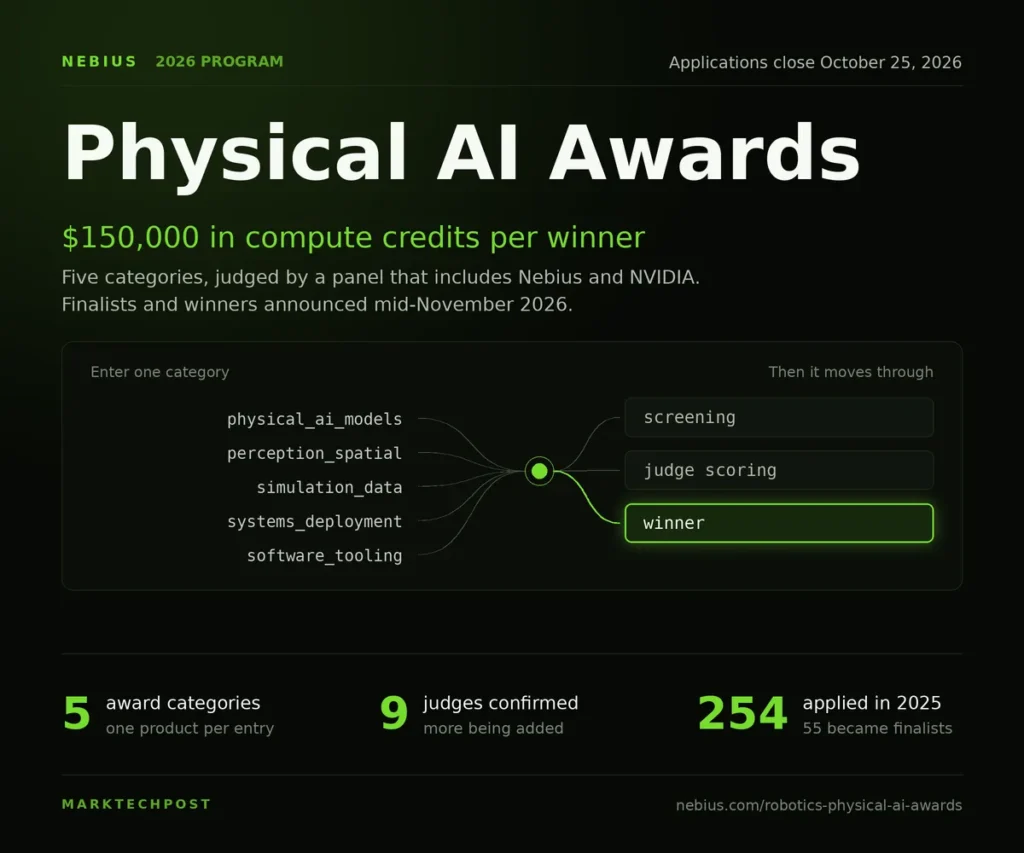
Nebius Opens 2026 Physical AI Awards: Five $150K Compute Credit Prizes

Once a physical AI product is in the field, the compute problem changes shape. Fleet data starts arriving faster than a team can label it, every retraining cycle has to be validated before it ships to hardware, and the sim-to-real loop stops being a research exercise and becomes a release process. That is the stage the 2026 Nebius Physical AI Awards is built for: startups with a demonstrable product, meaningful traction, and a plan to scale. Nebius (NASDAQ: NBIS) runs the program with NVIDIA. Applications are open now and close October 25, 2026. Finalists and winners are announced in mid-November 2026. The competition is global, with five categories and a $150,000 compute credit prize in each. What winners receive The winner in each of the five categories gets: $150,000 in Nebius compute credits, positioned by Nebius as credits to put directly into the next training run. Joint promotion from Nebius and NVIDIA across both companies’ channels. Executive mentorship: working sessions with a Nebius C-level leader on scaling what the team has built. A Winners Circle feature: content on the team and the product, published by Nebius. Two seats at an exclusive executive dinner next year with leaders from the Physical AI ecosystem. There is no entry fee and no sponsored categories. What $150,000 in credits converts to Nebius publishes its GPU-hour rates, so the prize converts to concrete compute rather than an abstract number. At on-demand rates, $150,000 buys roughly: GPU (HGX node) On-demand $/GPU-hr GPU-hours from $150K 8-GPU node-days H100 $3.85 ~38,960 ~203 H200 $4.50 ~33,330 ~174 B200 $7.15 ~20,980 ~109 B300 $7.85 ~19,100 ~99 For a team already running multi-node training, $150K on H200s is about 521 hours on a 64-GPU cluster, roughly three weeks of continuous work. At preemptible H200 rates ($2.45/GPU-hour) it stretches to about 61,200 GPU-hours, which suits checkpointable RL and data-generation jobs. vCPU and RAM are bundled into the GPU rate, so the main figure is not diluted by separate instance charges. Five categories, one strongest product Nebius asks applicants to enter the category that best fits their product. Companies with several products may apply to additional categories, but the guidance is to lead with the strongest product in the single most relevant category rather than spread entries across several. Physical AI Models: VLAs, VLMs, world models, reinforcement learning. Perception & Spatial Intelligence: computer vision, SLAM, sensor fusion, scene understanding. Simulation & Synthetic Data: physics simulation, digital twins, sim-to-real transfer, synthetic data. Systems & Deployment: humanoids, industrial robots, AMRs, warehouse automation. Software, Tooling & Orchestration: middleware, MLOps, benchmarking, fleet management, deployment tooling. The stated eligibility criteria are a clear Physical AI use case, an MVP in active use or testing, a registered legal entity, and a live public website. Each application covers one product. Who is judging Applications are first screened in-house for quality and completeness. A panel selected by Nebius and NVIDIA then scores each entry on four criteria: depth of innovation, breadth of implementation, market potential, and real-world impact. Finalists go to a jury vote to decide category winners. The 2026 judging committee as listed on the awards page: Evan Helda, Head of Physical AI, Nebius Anu Maheshwari, Head of Venture Ecosystem, Nebius Sumay Parikh, Robotics & Physical AI Startup Lead, NVIDIA Amber Yang, Partner, Lightspeed Adrian Macneil, CEO, Foxglove Brian Moore, Co-founder and CEO, Voxel51 Ulrik Stig Hansen, Co-Founder and Co-CEO, Encord Harry Mellsop, Co-founder, Antioch Calvin Zhou, Co-founder and VP of Engineering, RoboForce Nebius expects to add more judges before the deadline. The panel is weighted toward operators: Macneil, Moore, and Hansen run companies that sell data and tooling infrastructure to physical AI teams (Foxglove, Voxel51, and Encord), and Zhou co-founded RoboForce, which won the Industrial Robotics category in 2025. Applicants will be scored by people who have built the same data pipelines they are describing, and by one team that came through this program a year ago. The 2025 cohort The program’s first edition, run in 2025 as the Nebius Robotics & Physical AI Awards, drew 254 applications, from which judges picked 55 finalists who shared $1.5 million in Nebius compute credits. The judging panel that year included executives and investors from Nebius, NVIDIA, OpenAI, Physical Intelligence, ABB, Khosla Ventures, Accel, Radical Ventures, Next47, and Shanda Grab Ventures. Several winners have since scaled. RoboForce, the Industrial Robotics winner, raised a $52 million round led by YZi Labs in March 2026 and reports more than 11,000 robot orders via letters of intent. Gather AI, the Vision AI and Analytics winner, closed a $40 million Series B led by Smith Point Capital in February 2026. Virgo, runner-up in Foundation Models, went on to win at the 2026 Nebius AI Discovery Awards. (Note: Nebius does not attribute these outcomes to the award, but they describe the kind of company the program recognizes.) Key Takeaways Applications close October 25, 2026; finalists and winners announced in mid-November 2026. Five $150,000 prizes in Nebius compute credits, one per category. Judged by a nine-person panel selected by Nebius and NVIDIA, with joint promotion from both for winners. Winners get two seats at an exclusive executive dinner next year. Check out the 2026 Physical AI Awards page and application, the Nebius AI Cloud pricing page, the 2025 program results, and the 2025 winners press release. Note:Thanks to the Nebius AI team for the thought leadership/ Resources for this article. Nebius team has supported and sponsored this content/article for promotion. The post Nebius Opens 2026 Physical AI Awards: Five $150K Compute Credit Prizes appeared first on MarkTechPost.

Nebius Opens 2026 Physical AI Awards: Five $150K Compute Credit Prizes Read Post »

AI, Committee, News, Uncategorized

Liquid AI Releases d1: A Decision Model That Returns Calibrated Probabilities With Zero Output Tokens

Liquid AI has released d1, a decision model built for structured choices instead of text generation. You give it context and a set of typed questions. It returns calibrated probabilities across a fixed set of outcomes in a single call, with zero generated tokens. The target is the work many teams still send to general LLMs: classification, ticket routing, scoring, moderation, reranking and LLM-as-judge checks. Is it deployable? Yes, today, as a hosted API. d1 runs on the Liquid API under the model name d1:free. Liquid’s model library lists it as API only and not trainable, so there are no GGUF, MLX or ONNX weights to self-host. What is a Decision Model? A decision model evaluates a situation and returns a typed answer from options you define before the call. It does not write text. In every response, usage.output_tokens is 0. Liquid AI’s migration guide gives a simple rule: if the answer is one of N known options, use a decision model. If the model must compose a new string, keep your LLM. The 3 Primitives: Noul, Choice and Score Noul is a yes/no question that returns a probability between 0 and 1. In Liquid’s example, ‘Is this message a complaint?’ returned 0.999. Choice picks one option from a named set. It returns the top pick, the full distribution and a confidence value. A double-charge ticket scored 0.9997 on ‘billing.’ Score rates input on an ordered rubric and returns a probability-weighted position. Levels are indexed from 0, so a 4-level urgency rubric spans 0 to 3. A production outage scored 2.9995. You can mix all 3 types in one request. The model evaluates every question against the same state in one round trip. How a d1 API Call Works Each request has 3 parts: the model, the state (plain text or a JSON object) and the questions. Calls go to POST https://api.liquid.ai/decisions/v1/systemone. Keys come from console.liquid.ai and start with liquid_. The clients are TypeSafe AI’s typesafe-sdk for Python and @typesafe-ai/sdk for TypeScript. Copy CodeCopiedUse a different Browser from typesafe_sdk import TypeSafeClient, Noul client = TypeSafeClient(api_key=os.environ[“LIQUID_API_KEY”], base_url=”https://api.liquid.ai”) result = client.system_one( model=”d1:free”, state=”I have been waiting over three weeks for my order…”, questions={“is_complaint”: Noul( instructions=”Is this message a complaint from the customer?”)}, ) print(result.answers[“is_complaint”].noul) # 0.999 Why Move LLM Classification Calls to d1 The migration guide lists the concrete differences against an LLM with structured output: No billed output tokens: An LLM bills output even for a one-word label. Predictable latency: There is no decoding loop that grows with output length. No schema errors: Answers always match the question type, so malformed JSON and retries go away. Usable uncertainty: You get calibrated probabilities instead of a self-reported number. Fewer round trips: 3 sequential classification calls become 1. Probabilities make thresholds practical. Liquid’s moderation example blocks above 0.8, allows below 0.2 and sends the middle band to human review. Its routing example falls back to the most capable model tier when router confidence drops below 0.5. Liquid also says repeated evaluations of the same input are more consistent, which reduces verdict flips. Keep an LLM for summarization, drafting, multi-turn chat, code generation and complex multi-step reasoning. Demo: Road Decider Liquid’s road-decider cookbook is a pixel-art survival racer. d1 uses a Choice question to pick left, center or right on every decision tick, about 2 to 5 times per second depending on game speed. The app is vanilla JavaScript on Node.js 18+, with a Vite proxy that keeps the API key server-side. A “Jev vs d1” mode races d1 against TypeSafe’s typesafe/jev-1.13 through OpenRouter. The most useful lesson is about state design. Per-lane summaries with distance to the first obstacle produced more confident decisions than a raw grid of the road. Interactive Explainer: d1 Step by Step d1 vs Closest Competitors d1 enters a small but fast-moving category of non-generative decision models. Here is how it compares on published features. Feature Liquid AI d1 TypeSafe Jev 1.13 Convai Laya AutoTrust JEV-27B Access Liquid API only OpenRouter API Open weights Open weights Primitives Noul, Choice, Score Noul, Choice, Score Noul, Choice, Score True/false, Choice (2 to 16), Score (0 to 5) Output tokens 0 0 (output billed at $0) 0 (encoder) 0 for decisions; can also generate text Context window Not published 32K tokens 512 (English), 1,024 (multilingual) 4,096 tokens Model size Not disclosed Not disclosed 421M (English), 322M (multilingual) 27B backbone, 108.9M trainable Pricing d1:free tier; paid rates not published $0.042 per 1M input tokens Self-hosted Self-hosted License Hosted API Hosted API Apache 2.0 Apache 2.0 Fine-tuning Not trainable Not documented Yes Yes (LoRA adapter) SDK TypeSafe SDK (Python, TS) TypeSafe SDK, OpenRouter SDKs Hugging Face Hugging Face Data checked September 29, 2026 against each vendor’s primary page. Key Takeaways d1 returns typed decisions with calibrated probabilities and 0 output tokens. 3 primitives cover most bounded tasks: Noul, Choice and Score. Deployable now through the Liquid API as d1:free; no self-hosted weights. Best fit: routing, moderation, triage, reranking and LLM-as-judge replacement. Keep LLMs for generation, conversation and multi-step reasoning. Check out the Decision Models docs, the Migration Guide and the Road Decider demo. All credit goes to the researcher of this project. Also, feel free to follow us on Twitter and don’t forget to join our 150k+ML SubReddit and Subscribe to our Newsletter. Wait! are you on telegram? now you can join us on telegram as well. Need to partner with us for promoting your GitHub Repo OR Hugging Face Page OR Product Release OR Webinar etc.? Connect with us The post Liquid AI Releases d1: A Decision Model That Returns Calibrated Probabilities With Zero Output Tokens appeared first on MarkTechPost.

Liquid AI Releases d1: A Decision Model That Returns Calibrated Probabilities With Zero Output Tokens Read Post »

We use cookies to improve your experience and performance on our website. You can learn more at Privacy Policy and manage your privacy settings by clicking Settings.

Privacy Preferences

You can choose your cookie settings by turning on/off each type of cookie as you wish, except for essential cookies.

Allow All
Manage Consent Preferences
  • Always Active

Save
en_US