YouZum

Committee

AI, Committee, ข่าว, Uncategorized

An experimental surgery is helping cancer survivors give birth

This week I want to tell you about an experimental surgical procedure that’s helping people have babies. Specifically, it’s helping people who have had treatment for bowel or rectal cancer. Radiation and chemo can have pretty damaging side effects that mess up the uterus and ovaries. Surgeons are pioneering a potential solution: simply stitch those organs out of the way during cancer treatment. Once the treatment has finished, they can put the uterus—along with the ovaries and fallopian tubes—back into place. It seems to work! Last week, a team in Switzerland shared news that a baby boy had been born after his mother had the procedure. Baby Lucien was the fifth baby to be born after the surgery and the first in Europe, says Daniela Huber, the gyno-oncologist who performed the operation. Since then, at least three others have been born, adds Reitan Ribeiro, the surgeon who pioneered the procedure. They told me the details. Huber’s patient was 28 years old when a four-centimeter tumor was discovered in her rectum. Doctors at Sion Hospital in Switzerland, where Huber works, recommended a course of treatment that included multiple medications and radiotherapy—the use of beams of energy to shrink a tumor—before surgery to remove the tumor itself. This kind of radiation can kill tumor cells, but it can also damage other organs in the pelvis, says Huber. That includes the ovaries and uterus. People who undergo these treatments can opt to freeze their eggs beforehand, but the harm caused to the uterus will mean they’ll never be able to carry a pregnancy, she adds. Damage to the lining of the uterus could make it difficult for a fertilized egg to implant there, and the muscles of the uterus are left unable to stretch, she says. In this case, the woman decided that she did want to freeze her eggs. But it would have been difficult to use them further down the line—surrogacy is illegal in Switzerland. Huber offered her an alternative. She had been following the work of Ribeiro, a gynecologist oncologist formerly at the Erasto Gaertner Hospital in Curitiba, Brazil. There, Ribeiro had pioneered a new type of surgery that involved moving the uterus, fallopian tubes, and ovaries from their position in the pelvis and temporarily tucking them away in the upper abdomen, below the ribs. Ribeiro and his colleagues published their first case report in 2017, describing a 26-year-old with a rectal tumor. (Ribeiro, who is now based at McGill University in Montreal, says the woman had been told by multiple doctors that her cancer treatment would destroy her fertility and had pleaded with him to find a way to preserve it.) Huber remembers seeing Ribeiro present the case at a conference at the time. She immediately realized that her own patient was a candidate for the surgery, and that, as a surgeon who had performed many hysterectomies, she’d be able to do it herself. The patient agreed. Huber’s colleagues at the hospital were nervous, she says. They’d never heard of the procedure before. “When I presented this idea to the general surgeon, he didn’t sleep for three days,” she tells me. After watching videos from Ribeiro’s team, however, he was convinced it was doable. So before the patient’s cancer treatment was started, Huber and her colleagues performed the operation. The team literally stitched the organs to the abdominal wall. “It’s a delicate dissection,” says Huber, but she adds that “it’s not the most difficult procedure.” The surgery took two to three hours, she says. The stitches themselves were removed via small incisions around a week later. By that point, scar tissue had formed to create a lasting attachment. The woman had two weeks to recover from the surgery before her cancer treatment began. That too was a success—within months, her tumor had shrunk so significantly that it couldn’t be seen on medical scans. As a precaution, the medical team surgically removed the affected area of her colon. At the same time, they cut away the scar tissue holding the uterus, tubes, and ovaries in their new position and transferred the organs back into the pelvis. Around eight months later, the woman stopped taking contraception. She got pregnant without IVF and had a mostly healthy pregnancy, says Huber. Around seven months into the pregnancy, there were signs that the fetus was not growing as expected. This might have been due to problems with the blood supply to the placenta, says Huber. Still, the baby was born healthy, she says. Ribeiro says he has performed the surgery 16 times, and that teams in countries including the US, Peru, Israel, India, and Russia have performed it as well. Not every case has been published, but he thinks there may be around 40. Since Baby Lucien was born last year, a sixth birth has been announced in Israel, says Huber. Ribeiro says he has heard of another two births since then, too. The most recent was to the first woman who had the procedure. She had a little girl a few months ago, he tells me. No surgery is risk-free, and Huber points out there’s a chance that organs could be damaged during the procedure, or that a more developed cancer could spread. The uterus of one of Ribeiro’s patients failed following the surgery. Doctors are “still in the phase of collecting data to [create] a standardized procedure,” Huber says, but she hopes the surgery will offer more options to young people with some pelvic cancers. “I hope more young women could benefit from this procedure,” she says. Ribeiro says the experience has taught him not to accept the status quo. “Everyone was saying … there was nothing to be done [about the loss of fertility in these cases],” he tells me. “We need to keep evolving and looking for different answers.” This article first appeared in The Checkup, MIT Technology Review’s weekly biotech newsletter. To receive it in your inbox every Thursday, and read articles like this first, sign up here.

An experimental surgery is helping cancer survivors give birth Read Post »
AI, Committee, ข่าว, Uncategorized

Position: The Real Barrier to LLM Agent Usability is Agentic ROI

arXiv:2505.17767v2 Announce Type: replace Abstract: Large Language Model (LLM) agents represent a promising shift in human-AI interaction, moving beyond passive prompt-response systems to autonomous agents capable of reasoning, planning, and goal-directed action. While LLM agents are technically capable of performing a broad range of tasks, not all of these capabilities translate into meaningful usability. This position paper argues that the central question for LLM agent usability is no longer whether a task can be automated, but whether it delivers sufficient Agentic Return on Investment (Agentic ROI). Agentic ROI reframes evaluation from raw performance to a holistic, utility-driven perspective, guiding when, where, and for whom LLM agents should be deployed. Despite widespread application in high-ROI tasks like coding and scientific research, we identify a critical usability gap in mass-market, everyday applications. To address this, we propose a zigzag developmental trajectory: first scaling up to improve information gain and time savings, then scaling down to reduce cost. We present a strategic roadmap across these phases to make LLM agents truly usable, accessible, and scalable in real-world applications.

Position: The Real Barrier to LLM Agent Usability is Agentic ROI Read Post »

AI, Committee, ข่าว, Uncategorized

EBPO: Empirical Bayes Shrinkage for Stabilizing Group-Relative Policy Optimization

arXiv:2602.05165v1 Announce Type: cross Abstract: Reinforcement Learning with Verifiable Rewards (RLVR) has proven effective for enhancing the reasoning capabilities of Large Language Models (LLMs). However, dominant approaches like Group Relative Policy Optimization (GRPO) face critical stability challenges: they suffer from high estimator variance under computational constraints (small group sizes) and vanishing gradient signals in saturated failure regimes where all responses yield identical zero rewards. To address this, we propose Empirical Bayes Policy Optimization (EBPO), a novel framework that regularizes local group-based baselines by borrowing strength from the policy’s accumulated global statistics. Instead of estimating baselines in isolation, EBPO employs a shrinkage estimator that dynamically balances local group statistics with a global prior updated via Welford’s online algorithm. Theoretically, we demonstrate that EBPO guarantees strictly lower Mean Squared Error (MSE), bounded entropy decay, and non-vanishing penalty signals in failure scenarios compared to GRPO. Empirically, EBPO consistently outperforms GRPO and other established baselines across diverse benchmarks, including AIME and OlympiadBench. Notably, EBPO exhibits superior training stability, achieving high-performance gains even with small group sizes, and benefits significantly from difficulty-stratified curriculum learning.

EBPO: Empirical Bayes Shrinkage for Stabilizing Group-Relative Policy Optimization Read Post »

AI, Committee, ข่าว, Uncategorized

CoSteer: Collaborative Decoding-Time Personalization via Local Delta Steering

arXiv:2507.04756v3 Announce Type: replace Abstract: Personalization has become crucial for adapting models to the diverse and evolving needs of users across cultural, temporal, and contextual dimensions. While existing methods often rely on centralized fine-tuning or static preference alignment within a single model, they struggle to achieve both real-time and high-quality personalization under the resource and privacy constraints of personal devices. To address this challenge, we propose CoSteer, a collaborative framework that enables tuning-free, real-time personalization via decoding-time adaptation. By leveraging logit differences between context-aware and context-agnostic local small models, CoSteer steers cloud-based large models, ensuring effective personalization while preserving the large model’s capabilities. Personalization is handled locally, with only final tokens sent to the cloud, maintaining both user context and system efficiency. Through extensive experiments across a wide range of tasks, we demonstrate that CoSteer generates high-quality personalized content, ensuring both effectiveness and computational efficiency. Our results highlight its robustness across models and environments, confirming its practical applicability in real-world scenarios.

CoSteer: Collaborative Decoding-Time Personalization via Local Delta Steering Read Post »

AI, Committee, ข่าว, Uncategorized

When Shared Knowledge Hurts: Spectral Over-Accumulation in Model Merging

arXiv:2602.05536v1 Announce Type: cross Abstract: Model merging combines multiple fine-tuned models into a single model by adding their weight updates, providing a lightweight alternative to retraining. Existing methods primarily target resolving conflicts between task updates, leaving the failure mode of over-counting shared knowledge unaddressed. We show that when tasks share aligned spectral directions (i.e., overlapping singular vectors), a simple linear combination repeatedly accumulates these directions, inflating the singular values and biasing the merged model toward shared subspaces. To mitigate this issue, we propose Singular Value Calibration (SVC), a training-free and data-free post-processing method that quantifies subspace overlap and rescales inflated singular values to restore a balanced spectrum. Across vision and language benchmarks, SVC consistently improves strong merging baselines and achieves state-of-the-art performance. Furthermore, by modifying only the singular values, SVC improves the performance of Task Arithmetic by 13.0%. Code is available at: https://github.com/lyymuwu/SVC.

When Shared Knowledge Hurts: Spectral Over-Accumulation in Model Merging Read Post »

AI, Committee, ข่าว, Uncategorized

Three questions about next-generation nuclear power, answered

Nuclear power continues to be one of the hottest topics in energy today, and in our recent online Roundtables discussion about next-generation nuclear power, hyperscale AI data centers, and the grid, we got dozens of great audience questions. These ran the gamut, and while we answered quite a few (and I’m keeping some in mind for future reporting), there were a bunch we couldn’t get to, at least not in the depth I would have liked. So let’s answer a few of your questions about advanced nuclear power. I’ve combined similar ones and edited them for clarity. How are the fuel needs for next-generation nuclear reactors different, and how are companies addressing the supply chain? Many next-generation reactors don’t use the low-enriched uranium used in conventional reactors. It’s worth looking at high-assay low-enriched uranium, or HALEU, specifically. This fuel is enriched to higher concentrations of fissile uranium than conventional nuclear fuel, with a proportion of the isotope U-235 that falls between 5% and 20%. (In conventional fuel, it’s below 5%.) HALEU can be produced with the same technology as low-enriched uranium, but the geopolitics are complicated. Today, Russia basically has a monopoly on HALEU production. In 2024, the US banned the import of Russian nuclear fuel through 2040 in an effort to reduce dependence on the country. Europe hasn’t taken the same measures, but it is working to move away from Russian energy as well. That leaves companies in the US and Europe with the major challenge of securing the fuel they need when their regular Russian supply has been cut off or restricted. The US Department of Energy has a stockpile of HALEU, which the government is doling out to companies to help power demonstration reactions. In the longer term, though, there’s still a major need to set up independent HALEU supply chains to support next-generation reactors. How is safety being addressed, and what’s happening with nuclear safety regulation in the US? There are some ways that next-generation nuclear power plants could be safer than conventional reactors. Some use alternative coolants that would prevent the need to run at the high pressure required in conventional water-cooled reactors. Many incorporate passive safety shutoffs, so if there are power supply issues, the reactors shut down harmlessly, avoiding risk of meltdown. (These can be incorporated in newer conventional reactors, too.) But some experts have raised concerns that in the US, the current administration isn’t taking nuclear safety seriously enough. A recent NPR investigation found that the Trump administration had secretly rewritten nuclear rules, stripping environmental protections and loosening safety and security measures. The government shared the new rules with companies that are part of a program building experimental nuclear reactors, but not with the public. I’m reminded of a talk during our EmTech MIT event in November, where Koroush Shirvan, an MIT professor of nuclear engineering, spoke on this issue. “I’ve seen some disturbing trends in recent times, where words like ‘rubber-stamping nuclear projects’ are being said,” Shirvan said during that event.   During the talk, Shirvan shared statistics showing that nuclear power has a very low rate of injury and death. But that’s not inherent to the technology, and there’s a reason injuries and deaths have been low for nuclear power, he added: “It’s because of stringent regulatory oversight.”   Are next-generation reactors going to be financially competitive? Building a nuclear power plant is not cheap. Let’s consider the up-front investment needed to build a power plant.   Plant Vogtle in Georgia hosts the most recent additions to the US nuclear fleet—Units 3 and 4 came online in 2023 and 2024. Together, they had a capital cost of $15,000 per kilowatt, adjusted for inflation, according to a recent report from the US Department of Energy. (This wonky unit I’m using divides the total cost to build the reactors by their expected power output, so we can compare reactors of different sizes.) That number’s quite high, partly because those were the first of their kind built in the US, and because there were some inefficiencies in the planning. It’s worth noting that China builds reactors for much less, somewhere between $2,000/kW and $3,000/kW, depending on the estimate. The up-front capital cost for first-of-a-kind advanced nuclear plants will likely run between $6,000 and $10,000 per kilowatt, according to that DOE report. That could come down by up to 40% after the technologies are scaled up and mass-produced. So new reactors will (hopefully) be cheaper than the ultra-over-budget and behind-schedule Vogtle project, but they aren’t necessarily significantly cheaper than efficiently built conventional plants, if you normalize by their size. It’ll certainly be cheaper to build new natural-gas plants (setting aside the likely equipment shortages we’re likely going to see for years.) Today’s most efficient natural-gas plants cost just $1,600/kW on the high end, according to data from Lazard. An important caveat: Capital cost isn’t everything—running a nuclear plant is relatively inexpensive, which is why there’s so much interest in extending the lifetime of existing plants or reopening shuttered ones. Ultimately, by many metrics, nuclear plants of any type are going to be more expensive than other sources, like wind and solar power. But they provide something many other power sources don’t: a reliable, stable source of electricity that can run for 60 years or more. This article is from The Spark, MIT Technology Review’s weekly climate newsletter. To receive it in your inbox every Wednesday, sign up here.

Three questions about next-generation nuclear power, answered Read Post »

AI, Committee, ข่าว, Uncategorized

This is the most misunderstood graph in AI

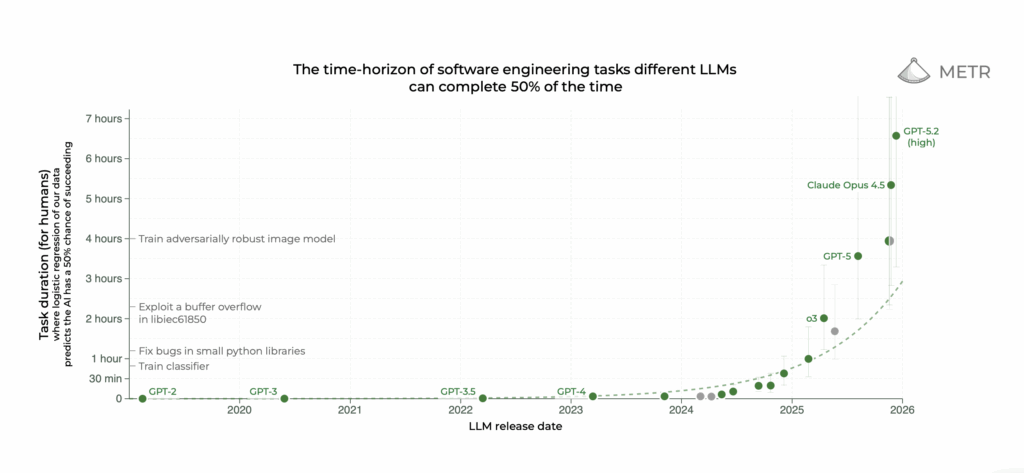
MIT Technology Review Explains: Let our writers untangle the complex, messy world of technology to help you understand what’s coming next. You can read more from the series here. Every time OpenAI, Google, or Anthropic drops a new frontier large language model, the AI community holds its breath. It doesn’t exhale until METR, an AI research nonprofit whose name stands for “Model Evaluation & Threat Research,” updates a now-iconic graph that has played a major role in the AI discourse since it was first released in March of last year. The graph suggests that certain AI capabilities are developing at an exponential rate, and more recent model releases have outperformed that already impressive trend. That was certainly the case for Claude Opus 4.5, the latest version of Anthropic’s most powerful model, which was released in late November. In December, METR announced that Opus 4.5 appeared to be capable of independently completing a task that would have taken a human about five hours—a vast improvement over what even the exponential trend would have predicted. One Anthropic safety researcher tweeted that he would change the direction of his research in light of those results; another employee at the company simply wrote, “mom come pick me up i’m scared.” Credit: METR.ORG But the truth is more complicated than those dramatic responses would suggest. For one thing, METR’s estimates of the abilities of specific models come with substantial error bars. As METR explicitly stated on X, Opus 4.5 might be able to regularly complete only tasks that take humans about two hours, or it might succeed on tasks that take humans as long as 20 hours. Given the uncertainties intrinsic to the method, it was impossible to know for sure.  “There are a bunch of ways that people are reading too much into the graph,” says Sydney Von Arx, a member of METR’s technical staff. More fundamentally, the METR plot does not measure AI abilities writ large, nor does it claim to. In order to build the graph, METR tests the models primarily on coding tasks, evaluating the difficulty of each by measuring or estimating how long it takes humans to complete it—a metric that not everyone accepts. Claude Opus 4.5 might be able to complete certain tasks that take humans five hours, but that doesn’t mean it’s anywhere close to replacing a human worker. METR was founded to assess the risks posed by frontier AI systems. Though it is best known for the exponential trend plot, it has also worked with AI companies to evaluate their systems in greater detail and published several other independent research projects, including a widely covered July 2025 study suggesting that AI coding assistants might actually be slowing software engineers down.  But the exponential plot has made METR’s reputation, and the organization appears to have a complicated relationship with that graph’s often breathless reception. In January, Thomas Kwa, one of the lead authors on the paper that introduced it, wrote a blog post responding to some criticisms and making clear its limitations, and METR is currently working on a more extensive FAQ document. But Kwa isn’t optimistic that these efforts will meaningfully shift the discourse. “I think the hype machine will basically, whatever we do, just strip out all the caveats,” he says. Nevertheless, the METR team does think that the plot has something meaningful to say about the trajectory of AI progress. “You should absolutely not tie your life to this graph,” says Von Arx. “But also,” she adds, “I bet that this trend is gonna hold.” Part of the trouble with the METR plot is that it’s quite a bit more complicated than it looks. The x-axis is simple enough: It tracks the date when each model was released. But the y-axis is where things get tricky. It records each model’s “time horizon,” an unusual metric that METR created—and that, according to Kwa and Von Arx, is frequently misunderstood. To understand exactly what model time horizons are, it helps to know all the work that METR put into calculating them. First, the METR team assembled a collection of tasks ranging from quick multiple-choice questions to detailed coding challenges—all of which were somehow relevant to software engineering. Then they had human coders attempt most of those tasks and evaluated how long it took them to finish. In this way, they assigned the tasks a human baseline time. Some tasks took the experts mere seconds, whereas others required several hours. When METR tested large language models on the task suite, they found that advanced models could complete the fast tasks with ease—but as the models attempted tasks that had taken humans more and more time to finish, their accuracy started to fall off. From a model’s performance, the researchers calculated the point on the time scale of human tasks at which the model would complete about 50% of the tasks successfully. That point is the model’s time horizon.  All that detail is in the blog post and the academic paper that METR released along with the original time horizon plot. But the METR plot is frequently passed around on social media without this context, and so the true meaning of the time horizon metric can get lost in the shuffle. One common misapprehension is that the numbers on the plot’s y-axis—around five hours for Claude Opus 4.5, for example—represent the length of time that the models can operate independently. They do not. They represent how long it takes humans to complete tasks that a model can successfully perform.  Kwa has seen this error so frequently that he made a point of correcting it at the very top of his recent blog post, and when asked what information he would add to the versions of the plot circulating online, he said he would include the word “human” whenever the task completion time was mentioned. As complex and widely misinterpreted as the time horizon concept might be, it does make some basic sense: A model with a one-hour time

This is the most misunderstood graph in AI Read Post »

AI, Committee, ข่าว, Uncategorized

Mistral AI Launches Voxtral Transcribe 2: Pairing Batch Diarization And Open Realtime ASR For Multilingual Production Workloads At Scale

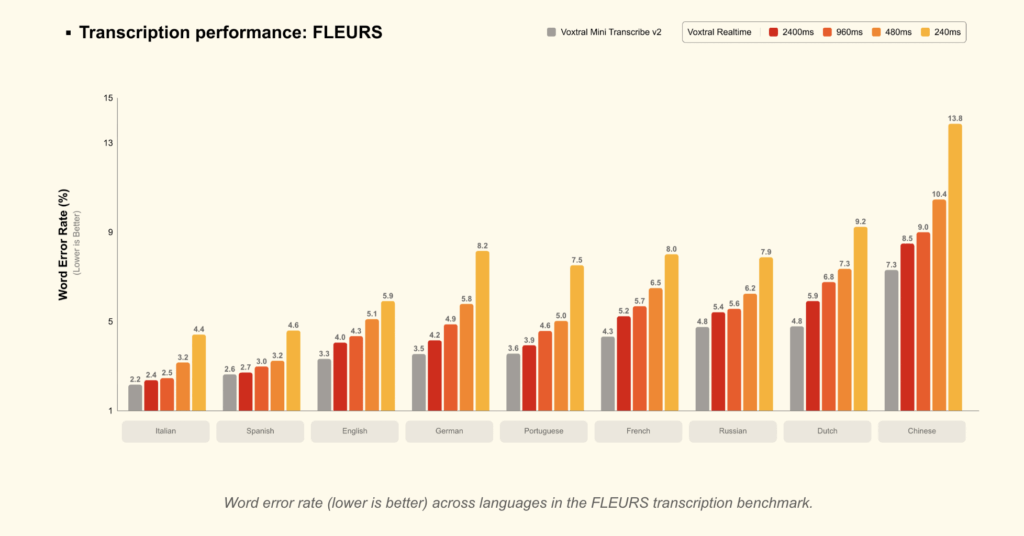
Automatic speech recognition (ASR) is becoming a core building block for AI products, from meeting tools to voice agents. Mistral’s new Voxtral Transcribe 2 family targets this space with 2 models that split cleanly into batch and realtime use cases, while keeping cost, latency, and deployment constraints in focus. The release includes: Voxtral Mini Transcribe V2 for batch transcription with diarization. Voxtral Realtime (Voxtral Mini 4B Realtime 2602) for low-latency streaming transcription, released as open weights. Both models are designed for 13 languages: English, Chinese, Hindi, Spanish, Arabic, French, Portuguese, Russian, German, Japanese, Korean, Italian, and Dutch. Model family: batch and streaming, with clear roles Mistral positions Voxtral Transcribe 2 as ‘two next-generation speech-to-text models’ with state-of-the-art transcription quality, diarization, and ultra-low latency. Voxtral Mini Transcribe V2 is the batch model. It is optimized for transcription quality and diarization across domains and languages and exposed as an efficient audio input model in the Mistral API. Voxtral Realtime is the streaming model. It is built with a dedicated streaming architecture and is released as an open-weights model under Apache 2.0 on Hugging Face, with a recommended vLLM runtime. A key detail: speaker diarization is provided by Voxtral Mini Transcribe V2, not by Voxtral Realtime. Realtime focuses strictly on fast, accurate streaming transcription. Voxtral Realtime: 4B-parameter streaming ASR with configurable delay Voxtral Mini 4B Realtime 2602 is a 4B-parameter multilingual realtime speech-transcription model. It is among the first open-weights models to reach accuracy comparable to offline systems with a delay under 500 ms. Architecture: ≈3.4B-parameter language model. ≈0.6B-parameter audio encoder. The audio encoder is trained from scratch with causal attention. Both encoder and LM use sliding-window attention, enabling effectively “infinite” streaming. Latency vs accuracy is explicitly configurable: Transcription delay is tunable from 80 ms to 2.4 s via a transcription_delay_ms parameter. The Mistral describes latency as “configurable down to sub-200 ms” for live applications. At 480 ms delay, Realtime matches leading offline open-source transcription models and realtime APIs on benchmarks such as FLEURS and long-form English. At 2.4 s delay, Realtime matches Voxtral Mini Transcribe V2 on FLEURS, which is appropriate for subtitling tasks where slightly higher latency is acceptable. From a deployment standpoint: The model is released in BF16 and is designed for on-device or edge deployment. It can run in realtime on a single GPU with ≥16 GB memory, according to the vLLM serving instructions in the model card. The main control knob is the delay setting: Lower delays (≈80–200 ms) for interactive agents where responsiveness dominates. Around 480 ms as the recommended “sweet spot” between latency and accuracy. Higher delays (up to 2.4 s) when you need accuracy as close as possible to the batch model. Voxtral Mini Transcribe V2: batch ASR with diarization and context biasing Voxtral Mini Transcribe V2 is a closed-weights audio input model optimized only for transcription. It is exposed in the Mistral API as voxtral-mini-2602 at $0.003 per minute. On benchmarks and pricing: Around 4% word error rate (WER) on the FLEURS transcription benchmark, averaged over the top 10 languages. “Best price-performance of any transcription API” at $0.003/min. Outperforms GPT-4o mini Transcribe, Gemini 2.5 Flash, Assembly Universal, and Deepgram Nova on accuracy in their comparisons. Processes audio ≈3× faster than ElevenLabs’ Scribe v2 while matching quality at one-fifth the cost. Enterprise-oriented features are concentrated in this model: Speaker diarization Outputs speaker labels with precise start and end times. Designed for meetings, interviews, and multi-party calls. For overlapping speech, the model typically emits a single speaker label. Context biasing Accepts up to 100 words or phrases to bias transcription toward specific names or domain terms. Optimized for English, with experimental support for other languages. Word-level timestamps Per-word start and end timestamps for subtitles, alignment, and searchable audio workflows. Noise robustness Maintains accuracy in noisy environments such as factory floors, call centers, and field recordings. Longer audio support Handles up to 3 hours of audio in a single request. Language coverage mirrors Realtime: 13 languages, with Mistral noting that non-English performance “significantly outpaces competitors” in their evaluation. https://mistral.ai/news/voxtral-transcribe-2 APIs, tooling, and deployment options The integration paths are straightforward and differ slightly between the two models: Voxtral Mini Transcribe V2 Served via the Mistral audio transcription API (/v1/audio/transcriptions) as an efficient transcription-only service. Priced at $0.003/min. (Mistral AI) Available in Mistral Studio’s audio playground and in Le Chat for interactive testing. Voxtral Realtime Available via the Mistral API at $0.006/min. Released as open weights on Hugging Face (mistralai/Voxtral-Mini-4B-Realtime-2602) under Apache 2.0, with official vLLM Realtime support. The audio playground in Mistral Studio lets users: Upload up to 10 audio files (.mp3, .wav, .m4a, .flac, .ogg) up to 1 GB each. Toggle diarization, choose timestamp granularity, and configure context bias terms. Key Takeaways Two-model family with clear roles: Voxtral Mini Transcribe V2 targets batch transcription and diarization, while Voxtral Realtime targets low-latency streaming ASR, both across 13 languages. Realtime model- 4B parameters with tunable delay: Voxtral Realtime uses a 4B architecture (≈3.4B LM + ≈0.6B encoder) with sliding-window and causal attention, and supports configurable transcription delay from 80 ms to 2.4 s. Latency vs accuracy trade-off is explicit: Around 480 ms delay, Voxtral Realtime reaches accuracy comparable to strong offline and realtime systems, and at 2.4 s it matches Voxtral Mini Transcribe V2 on FLEURS. Batch model adds diarization and enterprise features: Voxtral Mini Transcribe V2 provides diarization, context biasing with up to 100 phrases, word-level timestamps, noise robustness, and supports up to 3 hours of audio per request at $0.003/min. Deployment- closed batch API, open realtime weights: Mini Transcribe V2 is served via Mistral’s audio transcription API and playground, while Voxtral Realtime is priced at $0.006/min and also available as Apache 2.0 open weights with official vLLM Realtime support. Check out the Technical details and Model Weights. Also, feel free to follow us on Twitter and don’t forget to join our 100k+ ML SubReddit and Subscribe to our Newsletter. Wait! are you on telegram? now you can join us on telegram as well. The post Mistral AI Launches Voxtral Transcribe 2: Pairing Batch Diarization And

Mistral AI Launches Voxtral Transcribe 2: Pairing Batch Diarization And Open Realtime ASR For Multilingual Production Workloads At Scale Read Post »

AI, Committee, ข่าว, Uncategorized

No One-Size-Fits-All: Building Systems For Translation to Bashkir, Kazakh, Kyrgyz, Tatar and Chuvash Using Synthetic And Original Data

arXiv:2602.04442v1 Announce Type: new Abstract: We explore machine translation for five Turkic language pairs: Russian-Bashkir, Russian-Kazakh, Russian-Kyrgyz, English-Tatar, English-Chuvash. Fine-tuning nllb-200-distilled-600M with LoRA on synthetic data achieved chrF++ 49.71 for Kazakh and 46.94 for Bashkir. Prompting DeepSeek-V3.2 with retrieved similar examples achieved chrF++ 39.47 for Chuvash. For Tatar, zero-shot or retrieval-based approaches achieved chrF++ 41.6, while for Kyrgyz the zero-shot approach reached 45.6. We release the dataset and the obtained weights.

No One-Size-Fits-All: Building Systems For Translation to Bashkir, Kazakh, Kyrgyz, Tatar and Chuvash Using Synthetic And Original Data Read Post »

AI, Committee, ข่าว, Uncategorized

DeepAgent: A General Reasoning Agent with Scalable Toolsets

arXiv:2510.21618v2 Announce Type: replace-cross Abstract: Large reasoning models have demonstrated strong problem-solving abilities, yet real-world tasks often require external tools and long-horizon interactions. Existing agent frameworks typically follow predefined workflows, which limit autonomous and global task completion. In this paper, we introduce DeepAgent, an end-to-end deep reasoning agent that performs autonomous thinking, tool discovery, and action execution within a single, coherent reasoning process. To address the challenges of long-horizon interactions, particularly the context length explosion from multiple tool calls and the accumulation of interaction history, we introduce an autonomous memory folding mechanism that compresses past interactions into structured episodic, working, and tool memories, reducing error accumulation while preserving critical information. To teach general-purpose tool use efficiently and stably, we develop an end-to-end reinforcement learning strategy, namely ToolPO, that leverages LLM-simulated APIs and applies tool-call advantage attribution to assign fine-grained credit to the tool invocation tokens. Extensive experiments on eight benchmarks, including general tool-use tasks (ToolBench, API-Bank, TMDB, Spotify, ToolHop) and downstream applications (ALFWorld, WebShop, GAIA, HLE), demonstrate that DeepAgent consistently outperforms baselines across both labeled-tool and open-set tool retrieval scenarios. This work takes a step toward more general and capable agents for real-world applications. The code and demo are available at https://github.com/RUC-NLPIR/DeepAgent.

DeepAgent: A General Reasoning Agent with Scalable Toolsets Read Post »

We use cookies to improve your experience and performance on our website. You can learn more at นโยบายความเป็นส่วนตัว and manage your privacy settings by clicking Settings.

ตั้งค่าความเป็นส่วนตัว

You can choose your cookie settings by turning on/off each type of cookie as you wish, except for essential cookies.

ยอมรับทั้งหมด
จัดการความเป็นส่วนตัว
  • เปิดใช้งานตลอด

บันทึกการตั้งค่า
th