YouZum

Actualités

AI, Committee, Actualités, Uncategorized

Multi-Step Reasoning with Large Language Models, a Survey

arXiv:2407.11511v2 Announce Type: replace-cross Abstract: Language models with billions of parameters exhibit in-context learning abilities, enabling few-shot learning on tasks that the model was not specifically trained for. Traditional models achieve breakthrough performance on language tasks, but do not perform well on basic reasoning benchmarks. However, a new in-context learning approach, Chain-of-thought, has demonstrated strong multi-step reasoning abilities on these benchmarks. The research on LLM reasoning abilities started with the question whether LLMs can solve grade school math word problems, and has expanded to other tasks in the past few years. This paper reviews the field of multi-step reasoning with LLMs. We propose a taxonomy that identifies different ways to generate, evaluate, and control multi-step reasoning. We provide an in-depth coverage of core approaches and open problems, and we propose a research agenda for the near future. We find that multi-step reasoning approaches have progressed beyond math word problems, and can now successfully solve challenges in logic, combinatorial games, and robotics, sometimes by first generating code that is then executed by external tools. Many studies in multi-step methods are using reinforcement learning for finetuning, external optimization loops, in context reinforcement learning, and self-reflection.

Multi-Step Reasoning with Large Language Models, a Survey Lire l’article »

AI, Committee, Actualités, Uncategorized

Microsoft Releases POML (Prompt Orchestration Markup Language): Bringing Modularity and Scalability to LLM Prompts

Prompt engineering has become foundational in the development of advanced applications powered by Large Language Models (LLMs). As prompts have grown in complexity—incorporating dynamic components, multiple roles, structured data, and varied output formats—the limitations of unstructured text approaches have become evident. Microsoft released Prompt Orchestration Markup Language (POML), a novel open-source framework designed to bring order, modularity, and extensibility to prompt engineering for LLMs. What is POML? POML is an HTML/XML-inspired markup language tailored for creating sophisticated, maintainable, and reusable AI prompts. It provides a systematic approach to: Defining prompt structure using semantic components and roles. Integrating diverse data types and external resources. Decoupling content from presentation with stylesheets. Enabling advanced templating and variable logic for dynamic prompt generation. Supporting developers with an ecosystem of robust tooling. Core Features 1. Structured Prompt Markup POML uses clear, semantic elements—such as <role>, <task>, and <example>—to define the various logical sections of a prompt. This modular design makes prompts readable, maintainable, and highly reusable. Copy CodeCopiedUse a different Browser xml<poml> <role>You are a science teacher.</role> <task>Explain gravity using the image below.</task> <img src="”gravity_diagram.png”" alt="”Diagram" of gravity” /> <output-format> Use simple language and keep your answer under 50 words. </output-format> </poml> This approach eliminates the brittle formatting problems often seen with “prompt spaghetti” and encourages clean separation of responsibilities. 2. Comprehensive Data Handling POML natively enables embedding or referencing external data of various types: Text documents (<document>) Spreadsheets and Tables (<table>) Images (<img>) Other formats, as needed This allows seamless integration of reference materials, instructional datasets, and visual aids, all within the prompt. 3. Decoupled Presentation Styling Inspired by CSS, POML supports a style system that separates content from formatting and output constraints. Styles can be specified in <stylesheet> blocks or with inline attributes, enabling easy modifications without touching the prompt’s logical structure. For example: Copy CodeCopiedUse a different Browser xml<output-format style="”verbose”"> Please provide a detailed, step-by-step explanation suitable for adults. </output-format> This minimizes the risk of LLM output instability caused by inadvertent format tweaks, and makes A/B testing different presentation layers effortless. 4. Integrated Templating Engine POML includes a powerful built-in templating engine supporting: Variables: {{ username }} Loops: for x in data Conditionals: if … else Definitions: <let> This dynamic system empowers developers to generate prompts programmatically and manage complex variations at scale. 5. Rich Tooling Ecosystem The language is backed by a suite of developer tools: VS Code Extension: Provides syntax highlighting, auto-completion, hover documentation, diagnostics, and live preview of prompt formatting and logic—greatly simplifying debugging and iterative development. SDKs: POML offers libraries for Node.js (TypeScript/JavaScript) and Python, enabling easy integration with existing workflows and popular LLM frameworks. Configuration with your preferred LLM provider (e.g., OpenAI, Azure) is also straightforward, allowing rapid testing and deployment. Example: Prompt with Image Reference A sample prompt for teaching photosynthesis to a child could look like: Copy CodeCopiedUse a different Browser xml<poml> <role>You are a patient teacher explaining concepts to a 10-year-old.</role> <task>Explain the concept of photosynthesis using the provided image.</task> <img src="”photosynthesis_diagram.png”" alt="”Diagram" of photosynthesis”> <output-format> Start with “Hey there, future scientist!” and keep the explanation under 100 words. </output-format> </poml> This example demonstrates how easily POML integrates visual context and constrains output style in a reusable template. Technical Architecture & Philosophy POML is architected to embody the “view layer” concept found in traditional frontend development (MVC architecture). The markup defines the presentation, not the business logic or data access—enabling clean separation and making it easy to refactor prompts, test variations, and ensure consistency across agent workflows and automated testing. Installation & Getting Started POML is open-source (MIT License) and available on GitHub. You can: Install the VS Code extension from the marketplace Use the Node.js (npm install pomljs) or Python (pip install poml) SDKs Refer to the detailed POML documentation for syntax, examples, and integration guides. Conclusion Prompt Orchestration Markup Language (POML) brings much-needed structure, scalability, and maintainability to prompt engineering for AI developers. Its modular syntax, comprehensive data handling, decoupled styling, dynamic templating, and rich integration ecosystem position it as a promising standard for orchestrating advanced LLM applications. Whether you’re building a multi-agent workflow, debugging complex prompt logic, or developing reusable AI modules for production, POML offers a powerful new foundation that’s rapidly gaining traction in the LLM ecosystem. Check out the GitHub Page here. Feel free to check out our GitHub Page for Tutorials, Codes and Notebooks. Also, feel free to follow us on Twitter and don’t forget to join our 100k+ ML SubReddit and Subscribe to our Newsletter. Star us on GitHub Sponsorship Details The post Microsoft Releases POML (Prompt Orchestration Markup Language): Bringing Modularity and Scalability to LLM Prompts appeared first on MarkTechPost.

Microsoft Releases POML (Prompt Orchestration Markup Language): Bringing Modularity and Scalability to LLM Prompts Lire l’article »

AI, Committee, Actualités, Uncategorized

Decoding Neural Emotion Patterns through Natural Language Processing Embeddings

arXiv:2508.09337v1 Announce Type: new Abstract: Understanding how emotional expression in language relates to brain function is a challenge in computational neuroscience and affective computing. Traditional neuroimaging is costly and lab-bound, but abundant digital text offers new avenues for emotion-brain mapping. Prior work has largely examined neuroimaging-based emotion localization or computational text analysis separately, with little integration. We propose a computational framework that maps textual emotional content to anatomically defined brain regions without requiring neuroimaging. Using OpenAI’s text-embedding-ada-002, we generate high-dimensional semantic representations, apply dimensionality reduction and clustering to identify emotional groups, and map them to 18 brain regions linked to emotional processing. Three experiments were conducted: i) analyzing conversational data from healthy vs. depressed subjects (DIAC-WOZ dataset) to compare mapping patterns, ii) applying the method to the GoEmotions dataset and iii) comparing human-written text with large language model (LLM) responses to assess differences in inferred brain activation. Emotional intensity was scored via lexical analysis. Results showed neuroanatomically plausible mappings with high spatial specificity. Depressed subjects exhibited greater limbic engagement tied to negative affect. Discrete emotions were successfully differentiated. LLM-generated text matched humans in basic emotion distribution but lacked nuanced activation in empathy and self-referential regions (medial prefrontal and posterior cingulate cortex). This cost-effective, scalable approach enables large-scale analysis of naturalistic language, distinguishes between clinical populations, and offers a brain-based benchmark for evaluating AI emotional expression.

Decoding Neural Emotion Patterns through Natural Language Processing Embeddings Lire l’article »

AI, Committee, Actualités, Uncategorized

DefenderBench: A Toolkit for Evaluating Language Agents in Cybersecurity Environments

arXiv:2506.00739v3 Announce Type: replace Abstract: Large language model (LLM) agents have shown impressive capabilities in human language comprehension and reasoning, yet their potential in cybersecurity remains underexplored. We introduce DefenderBench, a practical, open-source toolkit for evaluating language agents across offense, defense, and cybersecurity knowledge-based tasks. DefenderBench includes environments for network intrusion, malicious content detection, code vulnerability analysis, and cybersecurity knowledge assessment. It is intentionally designed to be affordable and easily accessible for researchers while providing fair and rigorous assessment. We benchmark several state-of-the-art (SoTA) and popular LLMs, including both open- and closed-weight models, using a standardized agentic framework. Our results show that Claude-3.7-sonnet performs best with a DefenderBench score of 81.65, followed by Claude-3.7-sonnet-think with 78.40, while the best open-weight model, Llama 3.3 70B, is not far behind with a DefenderBench score of 71.81. DefenderBench’s modular design allows seamless integration of custom LLMs and tasks, promoting reproducibility and fair comparisons. An anonymized version of DefenderBench is available at https://github.com/microsoft/DefenderBench.

DefenderBench: A Toolkit for Evaluating Language Agents in Cybersecurity Environments Lire l’article »

AI, Committee, Actualités, Uncategorized

TEN: Table Explicitization, Neurosymbolically

arXiv:2508.09324v1 Announce Type: new Abstract: We present a neurosymbolic approach, TEN, for extracting tabular data from semistructured input text. This task is particularly challenging for text input that does not use special delimiters consistently to separate columns and rows. Purely neural approaches perform poorly due to hallucinations and their inability to enforce hard constraints. TEN uses Structural Decomposition prompting – a specialized chain-of-thought prompting approach – on a large language model (LLM) to generate an initial table, and thereafter uses a symbolic checker to evaluate not only the well-formedness of that table, but also detect cases of hallucinations or forgetting. The output of the symbolic checker is processed by a critique-LLM to generate guidance for fixing the table, which is presented to the original LLM in a self-debug loop. Our extensive experiments demonstrate that TEN significantly outperforms purely neural baselines across multiple datasets and metrics, achieving significantly higher exact match accuracy and substantially reduced hallucination rates. A 21-participant user study further confirms that TEN’s tables are rated significantly more accurate (mean score: 5.0 vs 4.3; p = 0.021), and are consistently preferred for ease of verification and correction, with participants favoring our method in over 60% of the cases.

TEN: Table Explicitization, Neurosymbolically Lire l’article »

AI, Committee, Actualités, Uncategorized

Sacred or Synthetic? Evaluating LLM Reliability and Abstention for Religious Questions

arXiv:2508.08287v1 Announce Type: new Abstract: Despite the increasing usage of Large Language Models (LLMs) in answering questions in a variety of domains, their reliability and accuracy remain unexamined for a plethora of domains including the religious domains. In this paper, we introduce a novel benchmark FiqhQA focused on the LLM generated Islamic rulings explicitly categorized by the four major Sunni schools of thought, in both Arabic and English. Unlike prior work, which either overlooks the distinctions between religious school of thought or fails to evaluate abstention behavior, we assess LLMs not only on their accuracy but also on their ability to recognize when not to answer. Our zero-shot and abstention experiments reveal significant variation across LLMs, languages, and legal schools of thought. While GPT-4o outperforms all other models in accuracy, Gemini and Fanar demonstrate superior abstention behavior critical for minimizing confident incorrect answers. Notably, all models exhibit a performance drop in Arabic, highlighting the limitations in religious reasoning for languages other than English. To the best of our knowledge, this is the first study to benchmark the efficacy of LLMs for fine-grained Islamic school of thought specific ruling generation and to evaluate abstention for Islamic jurisprudence queries. Our findings underscore the need for task-specific evaluation and cautious deployment of LLMs in religious applications.

Sacred or Synthetic? Evaluating LLM Reliability and Abstention for Religious Questions Lire l’article »

AI, Committee, Actualités, Uncategorized

A Survey on Training-free Alignment of Large Language Models

arXiv:2508.09016v1 Announce Type: new Abstract: The alignment of large language models (LLMs) aims to ensure their outputs adhere to human values, ethical standards, and legal norms. Traditional alignment methods often rely on resource-intensive fine-tuning (FT), which may suffer from knowledge degradation and face challenges in scenarios where the model accessibility or computational resources are constrained. In contrast, training-free (TF) alignment techniques–leveraging in-context learning, decoding-time adjustments, and post-generation corrections–offer a promising alternative by enabling alignment without heavily retraining LLMs, making them adaptable to both open-source and closed-source environments. This paper presents the first systematic review of TF alignment methods, categorizing them by stages of pre-decoding, in-decoding, and post-decoding. For each stage, we provide a detailed examination from the viewpoint of LLMs and multimodal LLMs (MLLMs), highlighting their mechanisms and limitations. Furthermore, we identify key challenges and future directions, paving the way for more inclusive and effective TF alignment techniques. By synthesizing and organizing the rapidly growing body of research, this survey offers a guidance for practitioners and advances the development of safer and more reliable LLMs.

A Survey on Training-free Alignment of Large Language Models Lire l’article »

AI, Committee, Actualités, Uncategorized

Putnam-AXIOM: A Functional and Static Benchmark

arXiv:2508.08292v1 Announce Type: new Abstract: Current mathematical reasoning benchmarks for large language models (LLMs) are approaching saturation, with some achieving > 90% accuracy, and are increasingly compromised by training-set contamination. We introduce Putnam-AXIOM, a benchmark of 522 university-level competition problems drawn from the prestigious William Lowell Putnam Mathematical Competition, and Putnam-AXIOM Variation, an unseen companion set of 100 functional variants generated by programmatically perturbing variables and constants. The variation protocol produces an unlimited stream of equally difficult, unseen instances — yielding a contamination-resilient test bed. On the Original set, OpenAI’s o1-preview — the strongest evaluated model — scores 41.9%, but its accuracy drops by 19.6% (46.8% relative decrease) on the paired Variations. The remaining eighteen models show the same downward trend, ten of them with non-overlapping 95% confidence intervals. These gaps suggest memorization and highlight the necessity of dynamic benchmarks. We complement “boxed” accuracy with Teacher-Forced Accuracy (TFA), a lightweight metric that directly scores reasoning traces and automates natural language proof evaluations. Putnam-AXIOM therefore provides a rigorous, contamination-resilient evaluation framework for assessing advanced mathematical reasoning of LLMs. Data and evaluation code are publicly available at https://github.com/brando90/putnam-axiom.

Putnam-AXIOM: A Functional and Static Benchmark Lire l’article »

AI, Committee, Actualités, Uncategorized

Mistral AI Unveils Mistral Medium 3.1: Enhancing AI with Superior Performance and Usability

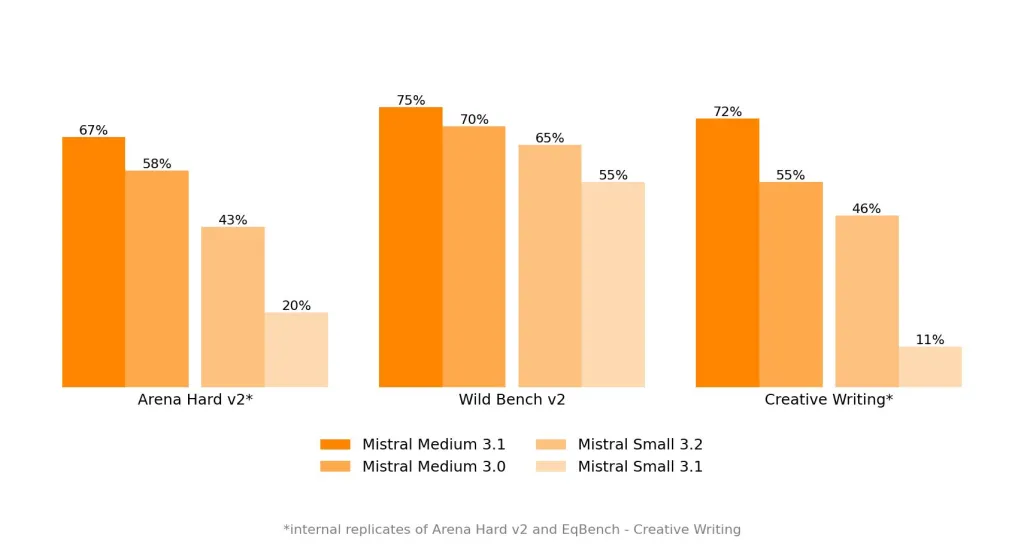
Mistral AI has introduced Mistral Medium 3.1, setting new standards in multimodal intelligence, enterprise readiness, and cost-efficiency for large language models (LLMs). Building on its rapidly expanding AI, Mistral continues to position itself as a European leader, pushing forward with frontier-class capabilities while breaking cost and deployment barriers. Recommended Article: NVIDIA AI Released DiffusionRenderer: An AI Model for Editable, Photorealistic 3D Scenes from a Single Video Key Technical Features of Mistral Medium 3.1 Overall Performance Boost:Mistral Medium 3.1 introduces major improvements in core reasoning, coding abilities, and multimodal competence. Users benefit from more accurate code generation and enhanced understanding across diverse content (text, images, and more). Enhanced Multimodal Capabilities:The model natively processes both textual and visual inputs, excelling in tasks such as programming, STEM reasoning, document understanding, and image analysis. Benchmarks reveal top-tier scores in long-context and multimodal tasks—often matching or beating flagship models like Llama 4 Maverick, Claude Sonnet 3.7, and GPT-4o. Improved Tone and Consistency:Mistral Medium 3.1 delivers a seamless and consistent conversational tone, whether system prompts and tools are used or not. This improvement ensures more natural and coherent interactions, crucial for both consumer and enterprise deployments. Smarter Web Searches:The model comes equipped with optimized algorithms for retrieving and synthesizing information from the web, leading to more accurate, complete, and contextually relevant search results in chat-based and API interfaces. Low Operational Costs:One of Mistral Medium 3’s standout attributes is its efficiency: it offers 8× lower cost than traditional large models. With pricing as low as $0.40 per million input tokens and $2 per million output tokens, businesses can scale intelligent services affordably. Enterprise-Grade Adaptability:Built for flexibility, Mistral Medium 3.1 supports hybrid, on-premises, and in-VPC deployment. Enterprise clients can run the model on self-hosted setups with as few as four GPUs—making it highly accessible and reducing infrastructure friction. Language and Coding Support:The model supports dozens of human languages and over 80 coding languages, making it a powerhouse for multilingual applications, global enterprises, and developer tooling. It offers advanced function calling and agentic workflows for complex automation. Integration and Customization:Mistral Medium 3.1 allows custom post-training, full fine-tuning, and deep integration into enterprise knowledge bases. It’s engineered for adaptive, domain-specific intelligence, continuous learning, and evolving business requirements. Enterprise Impact Mistral Medium 3.1 is tailored for demanding professional use: Coding Assistants: Top-of-class accuracy and code generation for developer workflows. Document Intelligence: Advanced reasoning over long, complex documents—ideal for legal, finance, and medical sectors. Customer Engagement: Personalized dialogue with deep contextual awareness. Secure, Custom Deployments: Hybrid and on-prem options for data-sensitive industries. Summary With Mistral Medium 3.1, Mistral AI advances its technical advancements for innovation—delivering a model that rivals giants in performance while maintaining radical cost-efficiency and deployment simplicity. Its multimodal prowess, enterprise customization, and robust benchmark scores make it not only a technological milestone, but also an accessible solution for organizations seeking advanced AI without prohibitive costs. For engineers, enterprises, and developers looking for a European alternative in the LLM arena, Mistral Medium 3.1 is a game-changing option that balances power, price, and practical deployability. Check out the Model here. Feel free to check out our GitHub Page for Tutorials, Codes and Notebooks. Also, feel free to follow us on Twitter and don’t forget to join our 100k+ ML SubReddit and Subscribe to our Newsletter. Star us on GitHub Sponsor us The post Mistral AI Unveils Mistral Medium 3.1: Enhancing AI with Superior Performance and Usability appeared first on MarkTechPost.

Mistral AI Unveils Mistral Medium 3.1: Enhancing AI with Superior Performance and Usability Lire l’article »

AI, Committee, Actualités, Uncategorized

Nebius AI Advances Open-Weight LLMs Through Reinforcement Learning for Capable SWE Agents

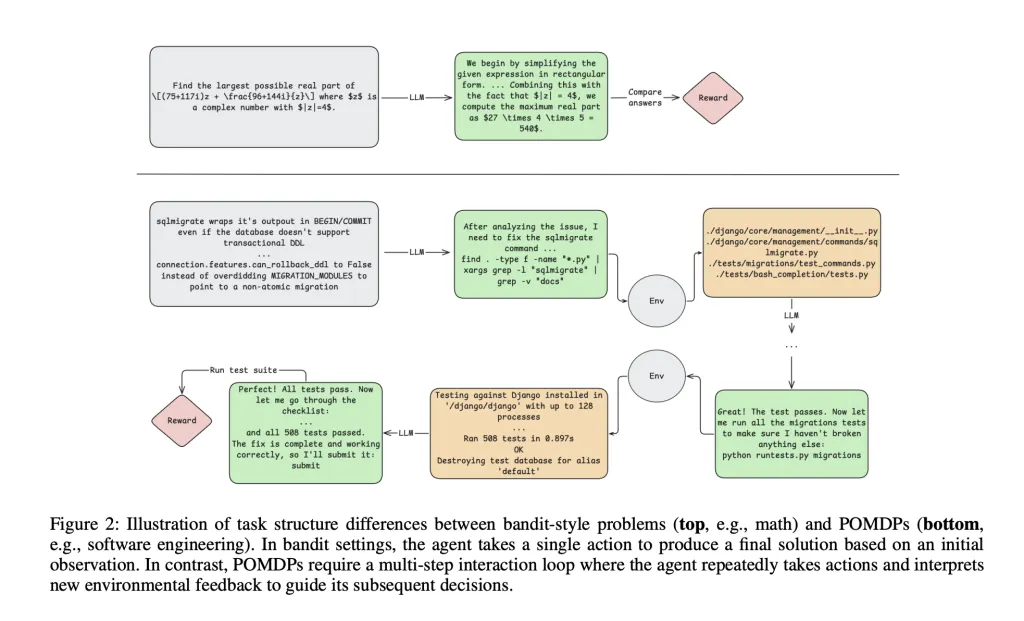
The landscape of software engineering automation is evolving rapidly, driven by advances in Large Language Models (LLMs). However, most approaches to training capable agents rely on proprietary models or costly teacher-based methods, leaving open-weight LLMs with limited capabilities in real-world scenarios. A team of researchers from Nebius AI and Humanoid introduced a reinforcement learning framework for training long-context, multi-turn software engineering agents using a modified Decoupled Advantage Policy Optimization (DAPO) algorithm. The research explains a technical breakthrough in applying reinforcement learning (RL) to open-source LLMs for genuine, multi-turn software engineering tasks—moving beyond the single-turn, bandit-style settings that dominate RL for LLMs today. Beyond Single-Turn Reinforcement Learning RL Most RL methods for LLMs optimize for tasks such as mathematical reasoning or one-shot code generation, where agent actions are rewarded only at the conclusion and environments do not provide intermediate feedback. However, software engineering (SWE) is fundamentally different: it requires agents to operate over long sequences of actions, interpret rich feedback (compiler errors, test logs), and maintain context over hundreds of thousands of tokens—far exceeding typical single-step interaction loops. Core Challenges in RL for SWE Long-Horizon Reasoning: Agents must sustain logical coherence across many steps, often requiring context windows beyond 100k tokens. Stateful Environment Feedback: Actions yield meaningful, non-trivial observations (e.g., shell command outputs, test suite results) that guide subsequent decisions. Sparse/Delayed Rewards: Success signals typically emerge only at the end of complex interactions, complicating credit assignment. Evaluation Complexity: Measuring progress requires full trajectory unrolling and can be noisy due to test flakiness. The Technical Recipe: Modified DAPO and Agent Design The research team demonstrates a two-stage learning pipeline for training a Qwen2.5-72B-Instruct agent: 1. Rejection Fine-Tuning (RFT) The journey begins with supervised fine-tuning. The agent is run across 7,249 rigorously filtered SWE tasks (from the SWE-REBENCH dataset). Successful interaction traces—where the agent passes the environmental test suite—are used to fine-tune the model, particularly masking invalid environment-formatting actions during training. This alone boosts baseline accuracy from 11% to 20% on the SWE-bench Verified benchmark. 2. Reinforcement Learning Using Modified DAPO Building on Decoupled Advantage Policy Optimization (DAPO), several key modifications are introduced for scalability and stability: Asymmetric Clipping: Prevents collapse in policy entropy, maintaining exploration. Dynamic Sample Filtering: Focuses optimization on trajectories with actual learning signal. Length Penalties: Discourages excessive episode length, helping the agent avoid getting stuck in loops. Token-Level Averaging: Every token in every trajectory contributes equally to the gradient, empowering longer trajectories to influence updates. The agent utilizes a ReAct-style loop, which lets it combine reasoning steps with tool usage. Its supported toolkit includes arbitrary shell commands, precise code edits, navigation/search utilities, and a submit action to signal episode completion. Each interaction is grounded in a robust sandboxed environment, initialized from real repository snapshots and backed by a GitHub-style issue prompt. Scaling to Long Contexts and Real Benchmarks Initially trained with a context length of 65k tokens (already double that of most open models), performance stalls at 32%. A second RL phase expands the context to 131k tokens and doubles the episode length ceiling, focusing subsequent training on only the most beneficial tasks from the pool. This enables scaling to longer stack traces and diff histories inherent to real-world debugging and patching tasks. Results: Closing the Gap with Baselines The final RL-trained agent attains 39% Pass@1 accuracy on the SWE-bench Verified benchmark, doubling the rejection fine-tuned baseline, and matching the performance of cutting-edge open-weight models such as DeepSeek-V3-0324, all without teacher-based supervision. On held-out SWE-rebench splits, scores remain competitive (35% for May, 31.7% for June), indicating the method’s robustness. When compared head-to-head with top open baselines and specialized SWE agents, the RL agent matches or outperforms several models, confirming the effectiveness of the RL methodology in this domain. Pass@1 SWE-bench Verified Pass@10 Pass@1 SWE-rebench May Pass@10 Qwen2.5-72B-Instruct (RL, final) 39.04% 58.4% 35.0% 52.5% DeepSeek-V3-0324 39.56% 62.2% 36.75% 60.0% Qwen3-235B no-thinking 25.84% 54.4% 27.25% 57.5% Llama4 Maverick 15.84% 47.2% 19.0% 50.0% Pass@1 scores are averaged over 10 runs and reported as mean ± standard error. Key Insights Credit Assignment: RL in this sparse-reward regime remains fundamentally challenging. The paper suggests future work with reward shaping, step-level critics, or prefix-based rollouts for more granular feedback. Uncertainty Estimation: Real-world agents need to know when to abstain or express confidence. Techniques like output entropy or explicit confidence scoring are next steps. Infrastructure: Training utilized context parallelism (splitting long sequences over GPUs) on 16 H200 nodes, with distributed orchestration via Kubernetes and Tracto AI, and vLLM for fast inference. Conclusion This research validates RL as a potent paradigm for building autonomous software engineers using open-weight LLMs. By conquering long-horizon, multi-turn, real-environment tasks, the methodology paves the way for scalable, teacher-free agent development—directly leveraging the power of interaction rather than static instruction. With further refinements, such RL pipelines promise efficient, reliable, and versatile automation for the future of software engineering. Check out the Paper here. Feel free to check out our GitHub Page for Tutorials, Codes and Notebooks. Also, feel free to follow us on Twitter and don’t forget to join our 100k+ ML SubReddit and Subscribe to our Newsletter. Star us on GitHub Sponsor us The post Nebius AI Advances Open-Weight LLMs Through Reinforcement Learning for Capable SWE Agents appeared first on MarkTechPost.

Nebius AI Advances Open-Weight LLMs Through Reinforcement Learning for Capable SWE Agents Lire l’article »

We use cookies to improve your experience and performance on our website. You can learn more at Politique de confidentialité and manage your privacy settings by clicking Settings.

Privacy Preferences

You can choose your cookie settings by turning on/off each type of cookie as you wish, except for essential cookies.

Allow All
Manage Consent Preferences
  • Always Active

Save
fr_FR