YouZum

Actualités

AI, Committee, Actualités, Uncategorized

The Download: Taiwan’s silicon shield, and ChatGPT’s personality misstep

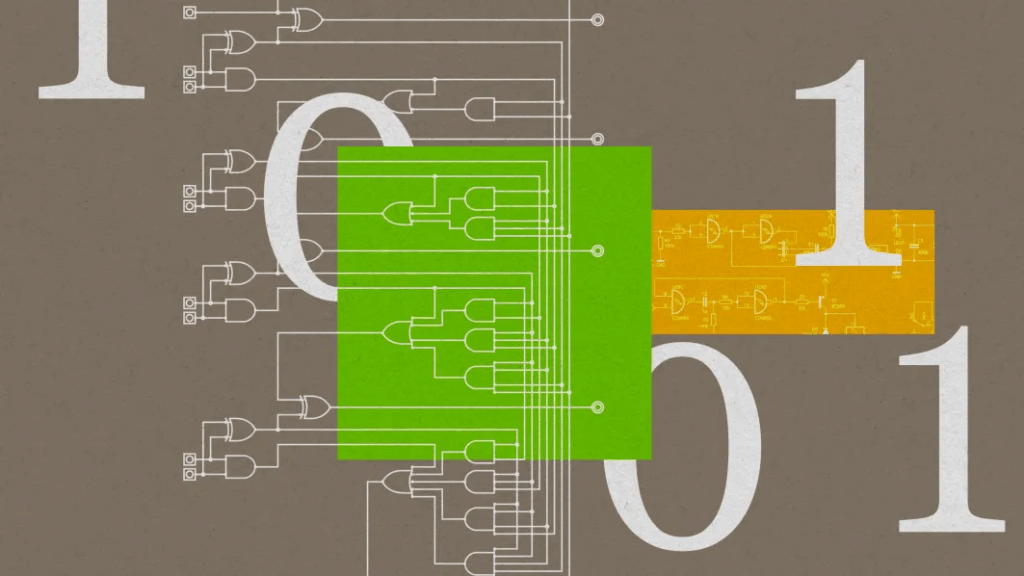
This is today’s edition of The Download, our weekday newsletter that provides a daily dose of what’s going on in the world of technology. Taiwan’s “silicon shield” could be weakening Taiwanese politics increasingly revolves around one crucial question: Will China invade? China’s ruling party has wanted to seize Taiwan for more than half a century. But in recent years, China’s leader, Xi Jinping, has placed greater emphasis on the idea of “taking back” the island (which the Chinese Communist Party, or CCP, has never controlled). Many in Taiwan and elsewhere think one major deterrent has to do with the island’s critical role in semiconductor manufacturing. Taiwan produces the majority of the world’s semiconductors and more than 90% of the most advanced chips needed for AI applications. But now some Taiwan specialists and some of the island’s citi­zens are worried that this “silicon shield,” if it ever existed, is cracking. Read the full story. —Johanna M. Costigan This story is from our forthcoming print issue, which is all about security. If you haven’t already, subscribe now to receive future issues once they land. Why there’s a big backlash against ChatGPT’s new ‘personality’ When OpenAI made the switch to its new GPT-5 model last week, a number of people reacted with shock, frustration, sadness, or anger to previous model 4o’s sudden disappearance from ChatGPT. Despite its awareness that people are developing emotional bonds with the model, OpenAI appears to have been caught flat-footed by the fervor of users’ pleas for its return. Within a day, the company made 4o available again to its paying customers (free users are stuck with GPT-5). MIT Technology Review spoke with several ChatGPT users who were deeply affected by the loss of 4o. All are women between the ages of 20 and 40, and all bar one considered 4o to be a romantic partner. Read the full story. —Grace Huckins Why US federal health agencies are abandoning mRNA vaccines This time five years ago, we were in the throes of the covid-19 pandemic. Then came the vaccines. The first mRNA vaccines for covid were authorized for use in December 2020. The US government played an important role in the introduction of these vaccines, providing $18 billion to support their development. But now, that government is turning its back on the technology. Funding is being withdrawn. Partnerships are being canceled. Leaders of US health agencies are casting doubt on the vaccines’ effectiveness and safety. And this week, the director of the National Institutes of Health implied that the reversal was due to a lack of public trust in the technology. Plenty of claims are being thrown about. So let’s consider the evidence. Read the full story. —Jessica Hamzelou This article first appeared in The Checkup, MIT Technology Review’s weekly biotech newsletter. To receive it in your inbox every Thursday, and read articles like this first, sign up here. The must-reads I’ve combed the internet to find you today’s most fun/important/scary/fascinating stories about technology. 1 The Trump administration is in talks to buy a stake in Intel Just weeks after Trump called for the CEO to step down. (Bloomberg $)+ It’s part of its plan to increase US market share in chip manufacturing. (WSJ $)+ Intel is probably hoping such a deal could help its beleaguered Ohio factory. (TechCrunch) 2 Meta’s AI rules allowed its chatbots to flirt with childrenAnd it only recently amended the guidelines after being questioned about it. (Reuters)+ We don’t know how long the policies were in place. (The Verge)+ An AI companion site is hosting sexually charged conversations with underage celebrity bots. (MIT Technology Review) 3 Erin is America’s first real test of hurricane readiness under TrumpIt looks like it’ll become the season’s first hurricane. (Vox)+ Trackers are uncertain about where the storm will head. (NYT $)+ Here’s what we know about hurricanes and climate change. (MIT Technology Review) 4 xAI lost a major US government contract after Grok praised HitlerLeaving the government to partner with OpenAI, Anthropic, and Gemini instead. (Wired $)+ xAI’s ‘Grok for Government’ site doesn’t appear to reflect this. (Ars Technica) 5 Tech leaders are upping their securityAs public hostility towards corporate executives deepens. (FT $) 6 These TikTokers are documenting their lives after deportationThey’re sharing their realities and creating new communities. (NY Mag $)+ ICE added a random person to a highly sensitive group chat. (404 Media) 7 We may soon be able to hear some patients’ inner voicesNew research has successfully guessed words imagined by people unable to speak. (NYT $)+ Motor neuron diseases took their voices. AI is bringing them back. (MIT Technology Review) 8 China’s plug-in hybrids are everywhereAnd they’re likely to dominate exports for the next three years at least. (Rest of World)+ China’s EV giants are betting big on humanoid robots. (MIT Technology Review) 9 The UK is working with TikTok influencers to tackle medical tourismIt’s a bid to raise awareness of the risks of undertaking cosmetic surgery abroad. (BBC) 10 AI may experience the passage of time differently to usWhat does this mean for our future? (IEEE Spectrum)+ What is AI? (MIT Technology Review) Quote of the day “We’ve realized the best way to get them is when they’re scrolling social media.” —Ryan Odendahl, president and CEO of construction company Kwest Group, tells the Washington Post how his company is getting young people interested in learning traditional trades. One more thing The next generation of neural networks could live in hardware Networks programmed directly into computer chip hardware can identify images faster, and use much less energy, than the traditional neural networks that underpin most modern AI systems.  Neural networks, from GPT-4 to Stable Diffusion, are built by wiring together perceptrons, which are highly simplified simulations of the neurons in our brains. In very large numbers, perceptrons are powerful, but they also consume enormous volumes of energy. Part of the trouble is that perceptrons are just software abstractions—running a perceptron network on a GPU requires translating that network into the language of hardware, which takes

The Download: Taiwan’s silicon shield, and ChatGPT’s personality misstep Lire l’article »

AI, Committee, Actualités, Uncategorized

Salesforce AI Releases Moirai 2.0: Salesforce’s Latest Time Series Foundation Model Built on a Decoder‑only Transformer Architecture

Salesforce AI Research has unveiled Moirai 2.0, the latest advancement in the world of time series foundation models. Built atop a decoder-only transformer architecture, Moirai 2.0 sets a new bar for performance and efficiency, claiming the #1 spot on the GIFT-Eval benchmark-the gold standard for time-series forecasting model evaluation. Not only is it 44% faster in inference and 96% smaller in size compared to its predecessor, but this substantial leap comes without sacrificing accuracy—making it a game-changer for both research and enterprise environments. What Makes Moirai 2.0 Special? Architecture Innovations Decoder-only Transformer: The switch from a masked encoder to a decoder-only transformer empowers Moirai 2.0 to better model autoregressive forecast generation, enhancing scalability and performance on larger, more complex datasets. Efficient Multi-Token Prediction: By predicting multiple tokens at a time (rather than just one), the model achieves greater efficiency and stability during forecasting. Advanced Data Filtering: Low-quality, non-forecastable time series are automatically filtered out during training, improving robustness. Patch Token Embedding & Random Masking: New techniques in encoding missing value information and robustness to incomplete data during inference. Expanded Dataset for Pretraining Moirai 2.0 leverages a richer mix of training data: Real-world sets like GIFT-Eval Pretrain and Train Chronos mixup: Synthetic time series blending for diversity KernelSynth procedures from Chronos research Internal operational data from Salesforce IT systems This broad data foundation enables Moirai 2.0 to generalize across countless forecasting tasks and domains. Performance: Breaking New Ground Moirai 2.0 is a leap beyond its predecessors: Best MASE Score on GIFT-Eval for non-data-leaking models (industry-accepted metric for forecast accuracy) CRPS Performance matches previous state-of-the-art Compared to Moirai_large: 16% better on MASE 13% better on CRPS 44% faster in inference 96% smaller parameter size https://www.salesforce.com/blog/moirai-2-0/ These results make high-performance, scalable forecasting more accessible to a broader audience. Why Moirai 2.0 Matters for Practitioners Moirai 2.0’s capabilities extend beyond academic benchmarks into enterprise-critical domains such as: IT Operations: Proactive capacity scaling, anomaly detection Sales Forecasting: Accurate, scalable revenue predictions Demand Forecasting: Optimized inventory management Supply Chain Planning: Better scheduling, reduced waste And many more data-driven business processes With dramatically reduced model size and improved speed, high-quality forecasting can now be applied at scale—empowering businesses to make smarter, faster decisions regardless of their data infrastructure. Getting Started: Moirai 2.0 in Practice Integration is seamless for developers and data scientists. Here’s a typical workflow, leveraging open-source modules available on Hugging Face: Sample Python Workflow Import Libraries Copy CodeCopiedUse a different Browser import matplotlib.pyplot as plt from gluonts.dataset.repository import dataset_recipes from uni2ts.eval_util.data import get_gluonts_test_dataset from uni2ts.model.moirai2 import Moirai2Forecast, Moirai2Module Load Moirai 2.0 Copy CodeCopiedUse a different Browser model = Moirai2Forecast( module=Moirai2Module.from_pretrained(“Salesforce/moirai-2.0-R-small”), prediction_length=100, context_length=1680, target_dim=1, feat_dynamic_real_dim=0, past_feat_dynamic_real_dim=0 ) Load Dataset & Generate Forecasts Copy CodeCopiedUse a different Browser test_data, metadata = get_gluonts_test_dataset(“electricity”, prediction_length=None, regenerate=False) predictor = model.create_predictor(batch_size=32) forecasts = predictor.predict(test_data.input) Visualize Results Copy CodeCopiedUse a different Browser # Example visualization fig, axes = plt.subplots(nrows=2, ncols=3, figsize=(25, 10)) # Use Moirai plotting utility to display forecasts Full examples and notebook links are provided by Salesforce for deeper experimentation. Universal, Scalable, Robust By democratizing access to cutting-edge, general-purpose forecasting technology, Moirai 2.0 is poised to reshape the landscape of time series modeling. With flexibility across domains, better robustness, faster inference, and lower computational demands, Salesforce AI Research’s model paves the way for businesses and researchers globally to harness the power of forecasting for transformative decision making. Check out the Technical details and Hugging Face (Model). Feel free to check out our GitHub Page for Tutorials, Codes and Notebooks. Also, feel free to follow us on Twitter and don’t forget to join our 100k+ ML SubReddit and Subscribe to our Newsletter. The post Salesforce AI Releases Moirai 2.0: Salesforce’s Latest Time Series Foundation Model Built on a Decoder‑only Transformer Architecture appeared first on MarkTechPost.

Salesforce AI Releases Moirai 2.0: Salesforce’s Latest Time Series Foundation Model Built on a Decoder‑only Transformer Architecture Lire l’article »

AI, Committee, Actualités, Uncategorized

This researcher turned OpenAI’s open weights model gpt-oss-20b into a non-reasoning ‘base’ model with less alignment, more freedom

Morris found it could also reproduce verbatim passages from copyrighted works, including three out of six book excerpts he tried.Read More

This researcher turned OpenAI’s open weights model gpt-oss-20b into a non-reasoning ‘base’ model with less alignment, more freedom Lire l’article »

AI, Committee, Actualités, Uncategorized

R-Zero: A Fully Autonomous AI Framework that Generates Its Own Training Data from Scratch

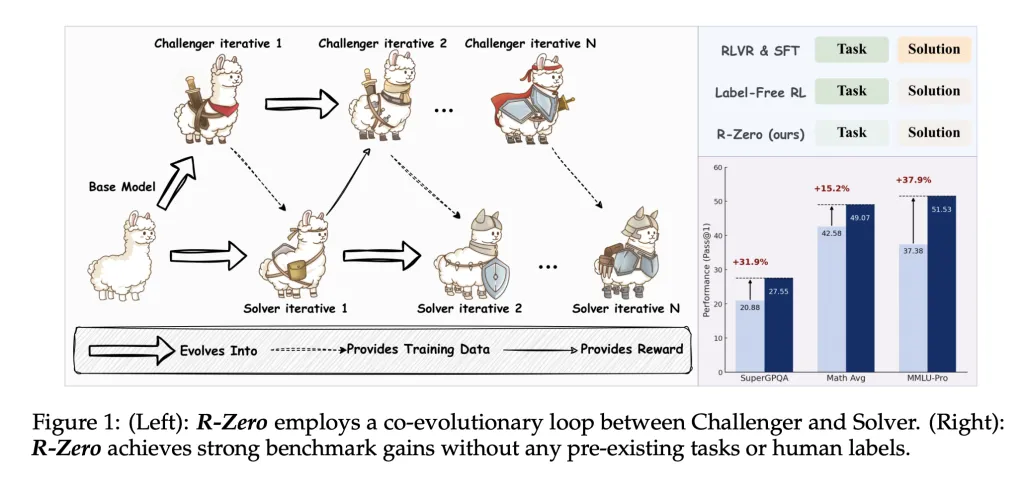
Large Language Models (LLMs) have revolutionized fields from natural language understanding to reasoning and code generation. However, pushing their reasoning ability to truly superhuman levels has been limited by the need for massive, high-quality, human-annotated datasets. A team of researchers from Tencent AI Seattle Lab, Washington University, the University of Maryland, and the University of Texas have proposed R-Zero, a framework designed to train reasoning LLMs that can self-evolve without relying on external data labels. Beyond Human-Curated Data Most progress in LLM reasoning is tethered to datasets laboriously curated by humans, an approach that is resource-intensive and fundamentally limited by human knowledge. Even label-free methods using LLMs’ own outputs for reward signals still depend on existing collections of unsolved tasks or problems. These dependencies bottleneck scalability and hinder the dream of open-ended AI reasoning beyond human capabilities. R-Zero: Self-Evolution from Zero Data R-Zero forges a novel path by entirely removing the reliance on external tasks and labels. Instead, it introduces a co-evolutionary dynamic between two instances of a base model: Challenger: Responsible for creating new, challenging reasoning tasks near the edge of the Solver’s capability. Solver: Trained to solve increasingly difficult problems posed by the Challenger, improving iteratively. This synergy enables the curriculum—the set of training data—to be self-generated and adapted continuously to the model’s evolving strengths and weaknesses. The process works as follows: Challenger Training: Trained via reinforcement learning (specifically Group Relative Policy Optimization [GRPO]), it generates diverse, hard-to-solve questions. The reward signal for each question is based on the Solver’s uncertainty: highest when Solver’s answers are maximally inconsistent (empirical accuracy approaches 50%). Solver Training: Solver is fine-tuned on the Challenger’s curated problems. Pseudo-labels (answers) are determined by majority vote among Solver’s own responses. Only questions with answers neither too consistent nor too scattered (i.e., in an informative band) are used for training. Iterative Loop: Challenger and Solver alternate roles, co-evolving over several rounds, progressively improving reasoning abilities without human intervention. Key Technical Innovations Group Relative Policy Optimization (GRPO)GRPO is a reinforcement learning algorithm that normalizes the reward for each generated answer relative to the group of responses for the same prompt. This method efficiently fine-tunes policy LLMs without a separate value function. Uncertainty-Driven CurriculumThe Challenger is rewarded for generating problems at the Solver’s frontier—neither too easy nor impossible. The reward function peaks for tasks where the Solver achieves 50% accuracy, maximizing learning efficiency per theoretical analysis. Repetition Penalty and Format ChecksTo guarantee diverse and well-structured training data, a repetition penalty discourages similar questions within a batch, and strict format checks ensure data quality. Pseudo-Label Quality ControlOnly question-answer pairs with intermediate answer consistency are used for training, filtering out ambiguous or ill-posed problems and calibrating label accuracy. Empirical Performance Mathematical Reasoning Benchmarks R-Zero was evaluated using seven rigorous mathematical benchmarks, including AMC, Minerva, MATH-500, GSM8K, Olympiad-Bench, and AIME competitions. Compared with the base model and non-trained Challenger baseline, three iterations of R-Zero led to substantial improvements in reasoning accuracy across all model sizes and architectures (e.g., Qwen3-8B-Base improved from 49.18 to 54.69 average score after three iterations). General Reasoning Benchmarks Crucially, R-Zero’s improvements generalize beyond math. Benchmarks including MMLU-Pro, SuperGPQA, and BIG-Bench Extra Hard (BBEH) show significant gains in general-domain reasoning accuracy (e.g., Qwen3-8B-Base’s overall average jumps from 34.49 to 38.73), demonstrating strong transfer effects. Conclusion R-Zero marks a major milestone toward self-sufficient, superhuman reasoning LLMs. Its fully autonomous co-evolutionary training pipeline offers not only strong empirical gains in reasoning but a new lens through which to view scalable, data-free AI development. Researchers and practitioners can experiment with this framework today, leveraging open-source tools to pioneer the next era of reasoning-centric language models. Check out the Paper and GitHub Page. Feel free to check out our GitHub Page for Tutorials, Codes and Notebooks. Also, feel free to follow us on Twitter and don’t forget to join our 100k+ ML SubReddit and Subscribe to our Newsletter. The post R-Zero: A Fully Autonomous AI Framework that Generates Its Own Training Data from Scratch appeared first on MarkTechPost.

R-Zero: A Fully Autonomous AI Framework that Generates Its Own Training Data from Scratch Lire l’article »

AI, Committee, Actualités, Uncategorized

NVIDIA AI Just Released the Largest Open-Source Speech AI Dataset and State-of-the-Art Models for European Languages

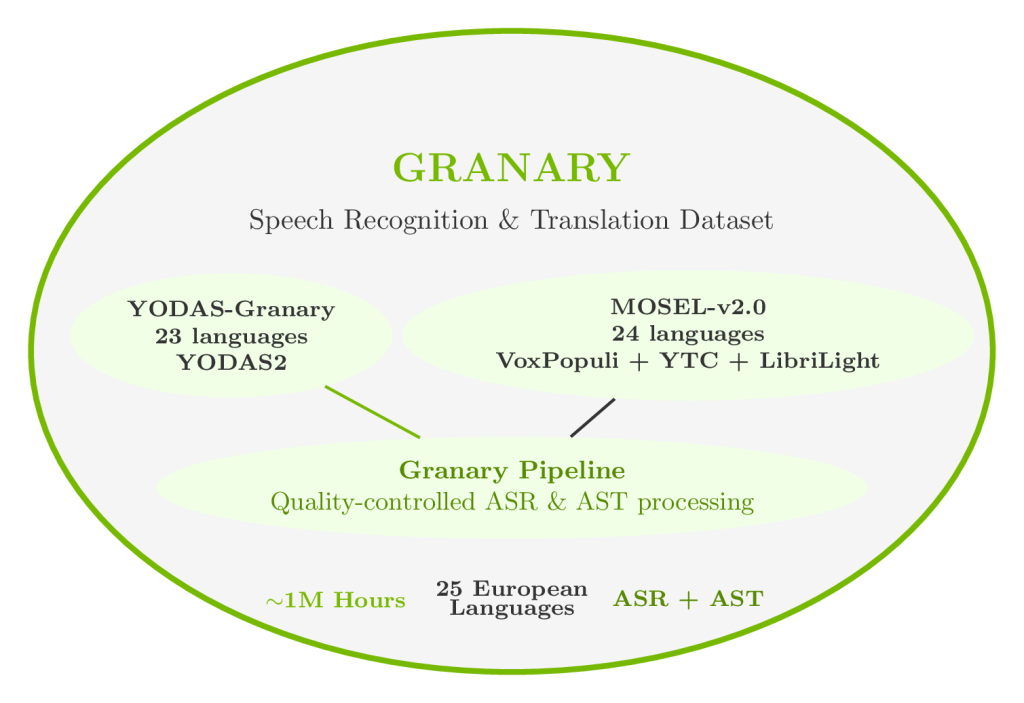
Nvidia has taken a major leap in the development of multilingual speech AI, unveiling Granary, the largest open-source speech dataset for European languages, and two state-of-the-art models: Canary-1b-v2 and Parakeet-tdt-0.6b-v3. This release sets a new standard for accessible, high-quality resources in automatic speech recognition (ASR) and speech translation (AST), especially for underrepresented European languages. Granary: The Foundation of Multilingual Speech AI Granary is a massive, multilingual corpus developed in collaboration with Carnegie Mellon University and Fondazione Bruno Kessler. It delivers around one million hours of audio, with 650,000 hours for speech recognition and 350,000 for speech translation. The dataset covers 25 European languages—representing nearly all official EU languages, plus Russian and Ukrainian—with a critical focus on languages with limited annotated data, such as Croatian, Estonian, and Maltese. Key features: Largest open-source speech dataset for 25 European languages. Pseudo-labeling pipeline: Unlabeled public audio data is processed using Nvidia NeMo’s Speech Data Processor, which adds structure and enhances quality, reducing the need for resource-intensive manual annotation. Supports both ASR and AST: Designed for transcription and translation tasks. Open access: Available to the global developer community for flexible, production-scale model training. By leveraging clean, high-quality data, Granary enables significantly faster model convergence. Research demonstrates that developers need half as much Granary data to reach target accuracies compared to competing datasets, making it especially valuable for resource-constrained languages and rapid prototyping. Canary-1b-v2: Multilingual ASR + Translation (En 24 Languages) Canary-1b-v2 is a billion-parameter Encoder-Decoder model trained on Granary, delivering high-quality transcription and translation between English and 24 supported European languages. It’s architected for accuracy and multitask capabilities: Languages supported: 25 European languages, doubling Canary’s coverage from 4. State-of-the-art performance: Comparable accuracy to models three times larger, but up to 10× faster inference. Multitask capability: Robust across both ASR and AST tasks. Features: Automatic punctuation, capitalization, word and segment-level timestamps—even timestamped translated outputs. Architecture: FastConformer Encoder with Transformer Decoder; unified vocabulary for all languages via SentencePiece tokenizer. Robustness: Maintains strong performance under noisy conditions and resists output hallucinations. Evaluation highlights: ASR Word Error Rate (WER): 7.15% (AMI dataset), 10.82% (LibriSpeech Clean). AST COMET Scores: 79.3 (X→English), 84.56 (English→X). Deployment: Available under CC BY 4.0 license; optimized for Nvidia GPU-accelerated systems, enabling fast training and inference for scalable production use. Parakeet-tdt-0.6b-v3: Real-Time Multilingual ASR Parakeet-tdt-0.6b-v3 is a 600-million-parameter multilingual ASR model designed for high-throughput or large-volume transcription in all 25 supported languages. It extends the Parakeet family (previously English-centric) to full European coverage. Automatic language detection: Transcribes input audio without needing extra prompts. Real-time capability: Efficiently transcribes up to 24-minute audio segments in a single inference pass. Fast, scalable, and commercial-ready: Prioritizes low latency, batch processing, and accurate outputs, with word-level timestamps, punctuation, and capitalization. Robustness: Reliable even on complex content (numbers, lyrics) and challenging audio conditions. Impact on Speech AI Development Nvidia’s Granary dataset and model suite accelerate the democratization of speech AI for Europe, enabling scalable development of: Multilingual chatbots Customer service voice agents Near-real-time translation services Developers, researchers, and businesses can now build inclusive, high-quality applications supporting linguistic diversity, with open access to these super cool models and datasets Check out the Granary, NVIDIA Canary-1b-v2 and NVIDIA Parakeet-tdt-0.6b-v3. Feel free to check out our GitHub Page for Tutorials, Codes and Notebooks. Also, feel free to follow us on Twitter and don’t forget to join our 100k+ ML SubReddit and Subscribe to our Newsletter. The post NVIDIA AI Just Released the Largest Open-Source Speech AI Dataset and State-of-the-Art Models for European Languages appeared first on MarkTechPost.

NVIDIA AI Just Released the Largest Open-Source Speech AI Dataset and State-of-the-Art Models for European Languages Lire l’article »

AI, Committee, Actualités, Uncategorized

Large Language Models Show Signs of Alignment with Human Neurocognition During Abstract Reasoning

arXiv:2508.10057v1 Announce Type: cross Abstract: This study investigates whether large language models (LLMs) mirror human neurocognition during abstract reasoning. We compared the performance and neural representations of human participants with those of eight open-source LLMs on an abstract-pattern-completion task. We leveraged pattern type differences in task performance and in fixation-related potentials (FRPs) as recorded by electroencephalography (EEG) during the task. Our findings indicate that only the largest tested LLMs (~70 billion parameters) achieve human-comparable accuracy, with Qwen-2.5-72B and DeepSeek-R1-70B also showing similarities with the human pattern-specific difficulty profile. Critically, every LLM tested forms representations that distinctly cluster the abstract pattern categories within their intermediate layers, although the strength of this clustering scales with their performance on the task. Moderate positive correlations were observed between the representational geometries of task-optimal LLM layers and human frontal FRPs. These results consistently diverged from comparisons with other EEG measures (response-locked ERPs and resting EEG), suggesting a potential shared representational space for abstract patterns. This indicates that LLMs might mirror human brain mechanisms in abstract reasoning, offering preliminary evidence of shared principles between biological and artificial intelligence.

Large Language Models Show Signs of Alignment with Human Neurocognition During Abstract Reasoning Lire l’article »

AI, Committee, Actualités, Uncategorized

Latent Fusion Jailbreak: Blending Harmful and Harmless Representations to Elicit Unsafe LLM Outputs

arXiv:2508.10029v1 Announce Type: new Abstract: Large language models (LLMs) demonstrate impressive capabilities in various language tasks but are susceptible to jailbreak attacks that circumvent their safety alignments. This paper introduces Latent Fusion Jailbreak (LFJ), a representation-based attack that interpolates hidden states from harmful and benign query pairs to elicit prohibited responses. LFJ begins by selecting query pairs with high thematic and syntactic similarity, then performs gradient-guided interpolation at influential layers and tokens, followed by optimization to balance attack success, output fluency, and computational efficiency. Evaluations on models such as Vicuna and LLaMA-2 across benchmarks like AdvBench and MaliciousInstruct yield an average attack success rate (ASR) of 94.01%, outperforming existing methods. To mitigate LFJ, we propose an adversarial training defense that fine-tunes models on interpolated examples, reducing ASR by over 80% without degrading performance on benign inputs. Ablation studies validate the importance of query pair selection, hidden state interpolation components, and optimization strategies in LFJ’s effectiveness.

Latent Fusion Jailbreak: Blending Harmful and Harmless Representations to Elicit Unsafe LLM Outputs Lire l’article »

AI, Committee, Actualités, Uncategorized

An Audit and Analysis of LLM-Assisted Health Misinformation Jailbreaks Against LLMs

arXiv:2508.10010v1 Announce Type: new Abstract: Large Language Models (LLMs) are a double-edged sword capable of generating harmful misinformation — inadvertently, or when prompted by “jailbreak” attacks that attempt to produce malicious outputs. LLMs could, with additional research, be used to detect and prevent the spread of misinformation. In this paper, we investigate the efficacy and characteristics of LLM-produced jailbreak attacks that cause other models to produce harmful medical misinformation. We also study how misinformation generated by jailbroken LLMs compares to typical misinformation found on social media, and how effectively it can be detected using standard machine learning approaches. Specifically, we closely examine 109 distinct attacks against three target LLMs and compare the attack prompts to in-the-wild health-related LLM queries. We also examine the resulting jailbreak responses, comparing the generated misinformation to health-related misinformation on Reddit. Our findings add more evidence that LLMs can be effectively used to detect misinformation from both other LLMs and from people, and support a body of work suggesting that with careful design, LLMs can contribute to a healthier overall information ecosystem.

An Audit and Analysis of LLM-Assisted Health Misinformation Jailbreaks Against LLMs Lire l’article »

AI, Committee, Actualités, Uncategorized

Layer-Wise Perturbations via Sparse Autoencoders for Adversarial Text Generation

arXiv:2508.10404v1 Announce Type: new Abstract: With the rapid proliferation of Natural Language Processing (NLP), especially Large Language Models (LLMs), generating adversarial examples to jailbreak LLMs remains a key challenge for understanding model vulnerabilities and improving robustness. In this context, we propose a new black-box attack method that leverages the interpretability of large models. We introduce the Sparse Feature Perturbation Framework (SFPF), a novel approach for adversarial text generation that utilizes sparse autoencoders to identify and manipulate critical features in text. After using the SAE model to reconstruct hidden layer representations, we perform feature clustering on the successfully attacked texts to identify features with higher activations. These highly activated features are then perturbed to generate new adversarial texts. This selective perturbation preserves the malicious intent while amplifying safety signals, thereby increasing their potential to evade existing defenses. Our method enables a new red-teaming strategy that balances adversarial effectiveness with safety alignment. Experimental results demonstrate that adversarial texts generated by SFPF can bypass state-of-the-art defense mechanisms, revealing persistent vulnerabilities in current NLP systems.However, the method’s effectiveness varies across prompts and layers, and its generalizability to other architectures and larger models remains to be validated.

Layer-Wise Perturbations via Sparse Autoencoders for Adversarial Text Generation Lire l’article »

AI, Committee, Actualités, Uncategorized

Echoes of Automation: The Increasing Use of LLMs in Newsmaking

arXiv:2508.06445v2 Announce Type: replace Abstract: The rapid rise of Generative AI (GenAI), particularly LLMs, poses concerns for journalistic integrity and authorship. This study examines AI-generated content across over 40,000 news articles from major, local, and college news media, in various media formats. Using three advanced AI-text detectors (e.g., Binoculars, Fast-Detect GPT, and GPTZero), we find substantial increase of GenAI use in recent years, especially in local and college news. Sentence-level analysis reveals LLMs are often used in the introduction of news, while conclusions usually written manually. Linguistic analysis shows GenAI boosts word richness and readability but lowers formality, leading to more uniform writing styles, particularly in local media.

Echoes of Automation: The Increasing Use of LLMs in Newsmaking Lire l’article »

We use cookies to improve your experience and performance on our website. You can learn more at Politique de confidentialité and manage your privacy settings by clicking Settings.

Privacy Preferences

You can choose your cookie settings by turning on/off each type of cookie as you wish, except for essential cookies.

Allow All
Manage Consent Preferences
  • Always Active

Save
fr_FR