Tools vs. Subagents: Building Effective AI Agents Without Over-Engineering
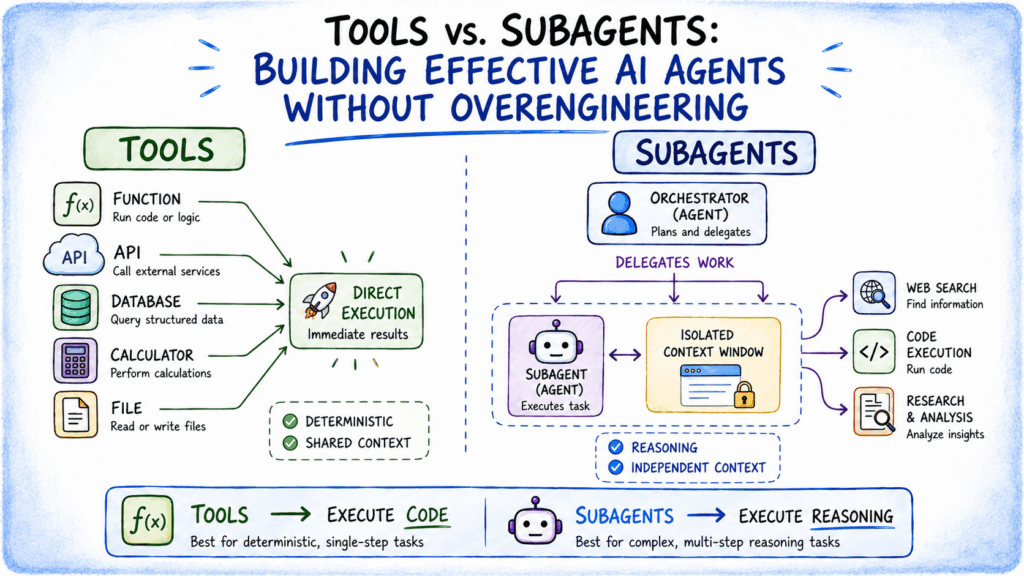
Tools execute code.
Tools vs. Subagents: Building Effective AI Agents Without Over-Engineering Lire l’article »
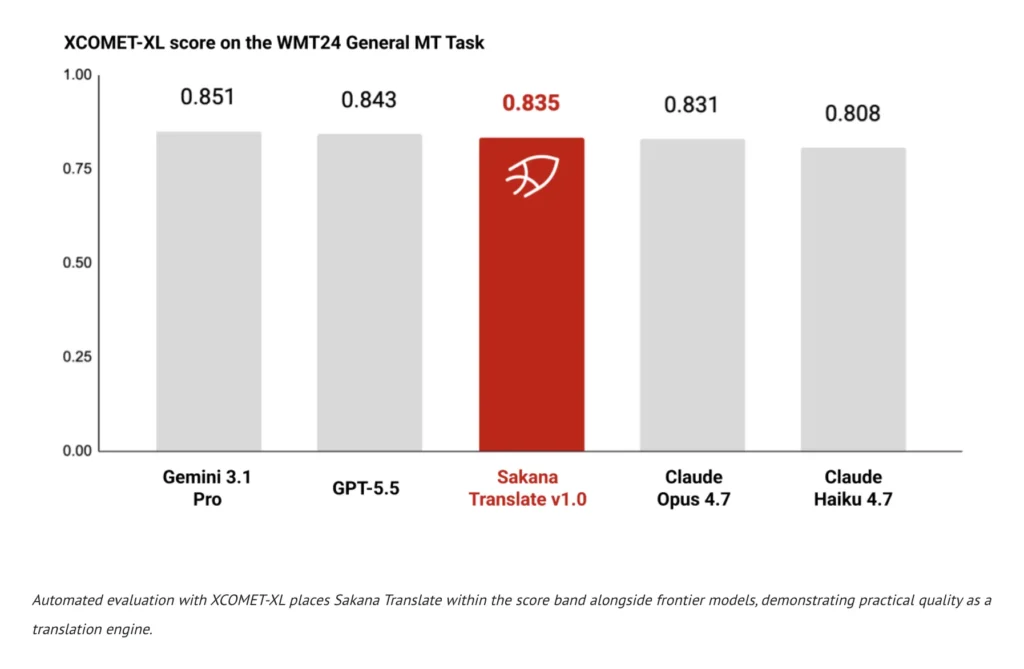
Sakana AI has added a new feature called Sakana Translate to its chat service, Sakana Chat. It handles bidirectional translation across Japanese, English, and Chinese. The translation engine is Namazu, the company’s model series adapted for Japanese. Sakana Translate ships as a free web app. A single account unlocks all three of its modes. What is Sakana Translate Sakana Translate is a browser-based translation product, not a new base model. It runs on Namazu, Sakana AI’s Japan-adapted model series. The concept Sakana AI states is ‘deep translation for Japan.’ The goal goes beyond swapping words and sentence structures. It aims to carry context, tone, and register between languages. That focus targets a specific gap. Sakana AI argues that general tools often miss what makes Japanese distinctive. Examples include business honorifics, culturally specific concepts, abbreviations, and internet slang. Grammar may stay correct while interpersonal tone gets lost. The product bundles three functions into one screen: Translate, Proofread, and Ask. The Three Modes, Explained Each mode targets a different everyday task. The table below summarizes them. Mode What it does Key detail Best for Translate Converts pasted text between the three languages Up to ~5,000 Japanese characters, streaming output, history saved automatically Emails, slide decks, articles, web pages Proofread Refines a draft into a more natural version Changes shown with diff highlighting; adjusts tone, politeness, and formality Business email and English writing checks Ask Answers follow-up questions about a result Clarifies nuance, suggests alternatives, explains grammar in the same context Learning why a translation reads the way it does A few terms are worth unpacking for engineers new to this space. Streaming output means the translation appears progressively, token by token. You do not wait for the full result before reading. This mirrors how chat models return text. Diff highlighting shows exactly what changed. Additions and removals are marked inline, like a version-control diff. Proofread goes past grammar. It also tunes naturalness, politeness, and the register a reader expects. Ask removes the tool-switching problem. You no longer jump between a translator and a dictionary. Nuance questions get answered against the same source and output. You can try all three modes in the interactive demo below How Namazu Powers It Namazu is the engine, so its design matters here. Sakana AI is a Tokyo lab founded in 2023 by David Ha and Llion Jones. Namazu is not trained from scratch. It applies post-training to existing open-weight foundation models. Reported base models include DeepSeek-V3.1-Terminus, Llama 3.1 405B, and gpt-oss-120B. Post-training means adapting an already-trained model with further tuning. It is cheaper and faster than pre-training a model from zero. Sakana AI uses it to fit models to Japanese language and culture. Sakana AI first announced the Namazu series on March 24, 2026. Sakana Translate applies that same adaptation work to the translation problem. Benchmark and Performance Sakana AI team evaluated translation quality with a standard setup. It used XCOMET-XL on the WMT 2024 General Translation task data. Here is what those two names means: WMT 2024 General Translation is a shared task from the Conference on Machine Translation. Systems translate test sets drawn from several domains across many language pairs. It is a common yardstick for machine translation research. XCOMET-XL is a neural evaluation metric from Unbabel, with roughly 3.5B parameters. It is a learned model that scores translation quality. It outputs a score and also flags specific error spans. Scores run from 0 to 1, where higher is better. By the reported results, Sakana Translate landed in a score band close behind the leading models. Sakana AI describes this as competitive quality for a translation engine. Sakana AI also ran a qualitative check on everyday Japanese texts. It reports strengths in honorifics, cultural concepts, place names, proper nouns, and everyday context. https://sakana.ai/translate-release/ Use Cases With Examples Sakana AI published two concrete outputs. Both show the tone-preservation goal in action. 1. Business email (Japanese → English). The source is a polite, indirect request. It uses set business phrases such as o-mitsumori haiken shimashita and katte na onegai desu ga. Source: お見積り拝見しました。勝手なお願いですが、もう少しご相談できますか?ご予算あれば社内で調整しますので、お聞かせください。 Sakana Translate: I saw your quote. This is a bit of a selfish request, but could we talk a bit more? If you have a budget in mind, I can work on it internally, so please let me know. Sakana AI notes the polite tone is preserved. A flatter translation would drop that register. 2. Internet slang (English → Japanese). The source uses casual shorthand from a group chat. Source: Iykyk, honestly. It’s an inside joke from the group chat. Sakana Translate: まあ、わかる人にはわかるよね。グループチャットの内輪ネタだから。 The output keeps the same casual temperature in conversational Japanese. Beyond these, practical scenarios follow naturally. A support agent can translate a long client thread in one paste. A developer can proofread an English release note before publishing. A learner can ask why a phrase carries a certain tone. Comparison: What Sakana Translate Targets The table below frames Sakana AI’s stated design focus. The left column describes common behavior in general-purpose tools. The right column reflects Sakana AI’s own claims, not a head-to-head benchmark. Dimension Typical general-purpose MT Sakana Translate’s stated focus Honorifics Grammar correct, tone often flattened Preserves polite and humble registers Cultural concepts Literal or generic renderings Adapted to Japanese context Slang and abbreviations Frequently mistranslated Matched to the original tone Workflow Separate translator and dictionary Translate, proofread, and ask in one screen Access Varies Free web app, single account, three languages A Look at the Evaluation Metric Sakana Translate has no public API yet. Sakana AI lists API access as a future, enterprise-focused plan. You can still reproduce the evaluation method it used. XCOMET-XL is open and runnable. The snippet below scores one translation with it. Copy CodeCopiedUse a different Browser # pip install “unbabel-comet>=2.2.0” # XCOMET-XL is gated on Hugging Face: accept its license, # then run `huggingface-cli login` before download_model(). from comet import download_model, load_from_checkpoint model_path = download_model(“Unbabel/XCOMET-XL”) # ~3.5B params model = load_from_checkpoint(model_path) data = [{ “src”: “お見積り拝見しました。”, “mt”: “I saw your quote.”,
Baek, a 35-year-old manager at the South Korean semiconductor titan SK Hynix, was enrolled in Sunoo, a matchmaking company based in Seoul, a year ago. In a move typical of anxious South Korean parents, his mother signed him up, hoping to find a good wife for her son. Lately, says Baek (who asked to be referred to by his last name to protect his privacy), he and his coworkers are having better luck finding dates than they used to, perhaps because of the dazzling bonuses they just got. Flush with eye-popping profits from the AI chip boom, SK Hynix struck a landmark deal last year with its labor union to pay out 10% of operating profits to employees, which translates to an extra $476,000 per employee this year. A similar agreement and sizable lump sum followed for Samsung workers this May. With their newfound wealth, chip workers like Baek have become the most sought-after bachelors and bachelorettes in South Korea. “I have a coworker who’s perpetually going on blind dates, and he’s been getting so many recently,” says Baek. “For the past few months, I’ve been getting many blind dates too, perhaps because of the bonuses I got.” Lately, young South Koreans joke online that the best outfit to wear on a blind date is an SK Hynix uniform. The AI chip boom is changing the social fabric of South Korea by minting a new elite of “silicon-collar” workers earning about 20 times as much as the average South Korean. Although it’s helping some chip workers to find relationships, it’s also fueling fears of a deepening wealth disparity—and a loud public debate about inequality. Love in the time of chips South Korea is the epicenter of the chip boom fueling the AI race. Samsung and SK Hynix supply the vast majority of the world’s high-bandwidth memory (HBM) chips, which power Nvidia’s AI accelerators—the GPUs used to train AI models. As AI companies spend hundreds of billions of dollars on building data centers around the world, demand for HBMs is rising beyond what suppliers can keep up with, driving their prices to unprecedented levels. Samsung and SK Hynix are raking in record profits as a result. South Korea’s economy now orbits the two chip giants. In May, both companies topped $1 trillion in market value. And chip exports helped fuel a 1.7% surge in South Korea’s gross domestic product in the first quarter of 2026. South Korea’s main equity index, Kospi, has nearly tripled over the past year, becoming the best-performing market in the world. Swimming in cash, chip workers are going on shopping sprees in department stores near the “semicon belt” fabs—splurging on everything from lavish furniture and electronic appliances to jewelry and watches. They’re also snapping up homes near the commuter-shuttle routes that ferry workers to campus. And they’re shelling out for matchmakers. “Quite a lot of people ask me if I can introduce them to chip workers,” says Lee Sung-mi, a matchmaker at Sunoo, who has been playing Cupid for chip workers for years. “In fact, people who once rejected them are asking to be matched with them again, now that their salaries and bonuses have shot so far above what everyone else earns.” One woman who lives in Gangnam, a ritzy district in Seoul lined with luxury high-rises and designer boutiques, previously turned down a chip worker at SK Hynix because his fab was too far out in Icheon, a rural city about 50 miles southeast of Seoul that’s dotted with rice farms and manufacturing plants. But in May, she asked her matchmaker to set them up again. They’ve now been dating for a month. In South Korea, matchmaking companies evaluate their clients on a long list of criteria such as education, job, income, looks, and family background, including whether their aging parents have saved enough for retirement. In an economy where housing prices and child care costs are soaring, competition for jobs is fierce, and the social safety net is thin, a good job is the ultimate dating credential—all the more coveted at a time when many young South Koreans are forgoing marriage and children altogether, seeing family life as an unaffordable dream. Every client at Sunoo gets a spouse rating, determined by an algorithm that assigns scores for each criterion. Since their hefty bonuses were announced, the job ratings of Samsung employees have risen from 80 to 84, while those of SK Hynix employees climbed from 78 to 82. Scores above 90 are reserved for doctors and lawyers. Long prized as paragons of prestige and wealth, they’re now close to being overtaken by chip workers. A score of 99, the highest possible rating, is earmarked for heads of state. Their new status is reshaping how chip workers themselves approach dating. “Chip workers from Samsung and SK Hynix are enrolling in our services because they feel more financially ready,” says Lee. “They’re also becoming pickier, as they feel like they’re now in a good position. The women want to meet men with higher incomes and better jobs, and the men want to meet younger and better-looking women with better jobs.” An SK Hynix engineer in her 40s, who was once desperate to get married as soon as possible, started turning down men she would’ve dated before the chip boom. Lately, showered with more matches, she’s been sifting through her suitors more carefully. “She now has peace of mind and wants to take her time to meet someone better,” says Lee. A mixed blessing While chip workers enjoy the fruits of their labor, the bonus bonanza is stoking anxieties among other South Koreans. “When wealth disparity is no longer a mere difference of income but, rather, a difference in identity … it can fuel social conflict,” says Se-eun Jung, an economist at Inha University. Earlier this month, the Bank of Korea warned that the chip boom will create a “K-shaped” economy, where a handful of workers race ahead while everyone else falls behind. The windfall, the
South Korea’s hottest new bachelors are chip workers Lire l’article »
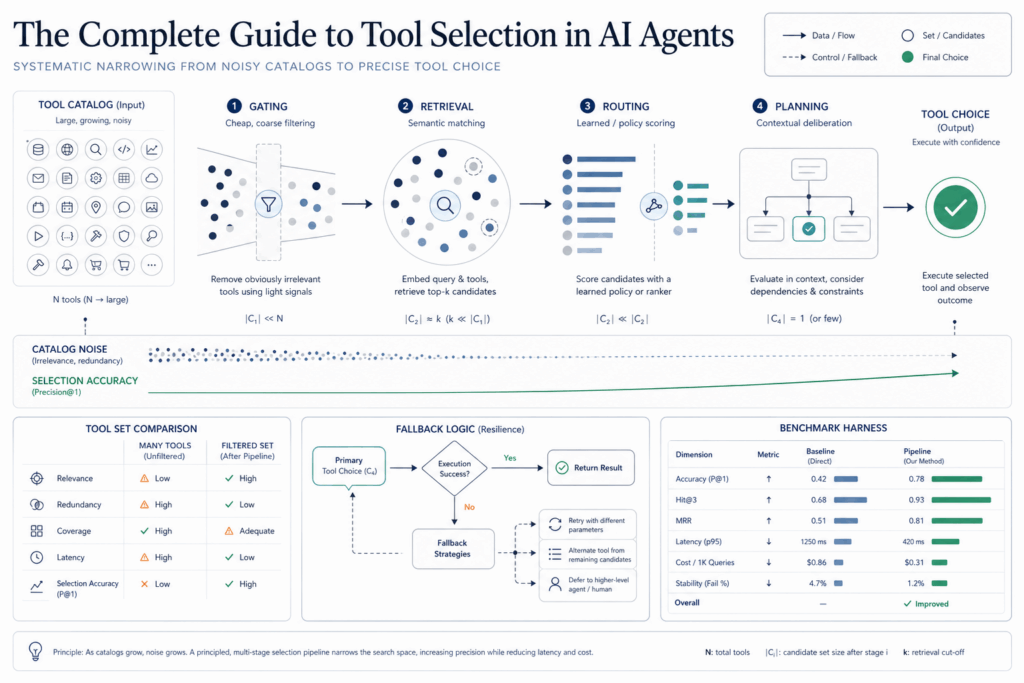
You build an agent with five tools.
The Complete Guide to Tool Selection in AI Agents Lire l’article »
This is today’s edition of The Download, our weekday newsletter that provides a daily dose of what’s going on in the world of technology. South Korea’s hottest new bachelors are chip workers Baek, a 35-year-old manager at the South Korean semiconductor titan SK Hynix, was enrolled in a matchmaking company a year ago. In a move typical of anxious South Korean parents, his mother signed him up, hoping to find a good wife for her son. Lately, says Baek, he and his coworkers are having better luck finding dates—perhaps because of the dazzling bonuses they just got. Flush with eye-popping profits from the AI chip boom, SK Hynix agreed to pay 10% of operating profits to employees, which translates to an extra $476,000 per employee this year. Samsung workers received a similar deal this May. With their newfound wealth, chip workers like Baek have become the most sought-after bachelors and bachelorettes in South Korea. Discover how AI chip profits are transforming South Korea’s dating market—and stoking anxieties. —Michelle Kim A device that revives eyeballs from dead donors could make eye transplants possible It’s not easy to transplant a whole human eye. The surgery is difficult, and eyes start to degenerate as soon as they’ve left the body. When surgeons attempted it a few years ago, the newly transplanted eye couldn’t see. But researchers believe they might have a solution: a device that maintains and revives freshly removed eyeballs using a technique called perfusion. Treated eyes don’t degrade as quickly and appear to retain the ability to transmit electrical signals—and potentially see. The device could one day make whole-eye transplants a viable possibility. Here’s how it works. —Jessica Hamzelou The must-reads I’ve combed the internet to find you today’s most fun/important/scary/fascinating stories about technology. 1 The UN’s chief has warned that AI is outpacing global rulesHe’s called for globally harmonised guardrails. (Reuters $)+ The UN also said AI could worsen global inequality. (Guardian) 2 An Israeli battlefield system identified 850,000 targets in Gaza and LebanonElbit Systems says it detected targets in real time. (Guardian)+ Congress wants to permanently integrate US and Israeli defence tech. (Intercept) + How AI turned the Iran conflict into theater. (MIT Technology Review) 3 EU transparency rules have exposed Microsoft’s tax haven tacticsA new report shows how it shifts profits around to reduce tax bills. (NYT $)+ Other US companies will soon need to provide similar reports. (Engadget) 4 A spacecraft has launched an audacious mission to rescue a NASA telescopeLINK will try to tug the SWIFT observatory to a higher orbit. (New Scientist $)+ It will attempt to grab the telescope with three robotic arms. (BBC)+ The observatory studies gamma-ray bursts. (NBC News)+ We’re putting more stuff into space than ever. (MIT Technology Review) 5 Chinese tech giants are disabling humanlike AI due to new regulationsByteDance and Alibaba have shut down the features. (SCMP)+ Beijing is tightening its AI regulations. (Nikkei Asia) 6 Anthropic wants to develop its own drugsThe company says it will pursue treatments for “neglected” diseases. (Verge)+ It’s also got a new AI for science product. (MIT Technology Review) 7 India is testing an alternative to Silicon Valley’s AI playbookIt’s based on small, offline, multilingual, open-source AI. (Rest of World)+ India’s AI infrastructure is also attracting investors. (CNBC) 8 Big Tech has suddenly flipped on the AI jobs wipeout scenarioNegative public opinion has sparked a more optimistic public stance. (WSJ $)+ The AI jobs hysteria needs a reality check. (MIT Technology Review) 9 Midjourney has accused Hollywood studios of covertly using AIIt’s escalated its legal fight with Disney, Universal, and Warner. (Gizmodo) 10 A martian rock has lots of carbon on it, and it’s not clear whyScientists cannot yet tell whether biology played a role. (Ars Technica) Quote of the day “It’s just his AI and my AI going back and forth.” —An anonymous employee explains why she’s struggling to develop a good working relationship with her boss, Fortune reports. One More Thing The AI relationship revolution is already here AI is everywhere, and it’s starting to alter our relationships with our spouses, kids, colleagues, friends—and even ourselves. Although the technology remains unpredictable and sometimes baffling, individuals from all across the world and from all walks of life are finding it useful, supportive, and comforting too. People are using large language models to seek validation, mediate marital arguments, and help navigate interactions with their community. They’re using it for parenting support, self-care, and even to fall in love. Explore how AI is changing our relationships. —Rhiannon Williams We can still have nice things A place for comfort, fun, and distraction to brighten up your day. (Got any ideas? Drop me a line.) + Radiohead’s seminal album “OK Computer” has been reimagined as a Nintendo 64 soundtrack.+ Graphic design history meets stamp collecting in this beautifully curated archive of postage stamp design.+ As Lionel Messi lights up another World Cup, his former coach breaks down his style of play in this fascinating analysis.+ Armchair engineers will enjoy the brilliant product teardowns of everyday items like clicky pens and lighters on Mechanical Pencil.
The Download: South Korea’s hottest bachelors, and advancing eye transplants Lire l’article »
This story originally appeared in The Algorithm, our weekly newsletter on AI. To get stories like this in your inbox first, sign up here. OpenAI CEO Sam Altman’s oft-discussed promise that Americans will share in the wealth AI creates was in the news again last week. On Thursday, the Financial Times reported that Altman is in talks with President Trump about giving the US government a 5% stake in OpenAI. In some ways, Altman’s plan is old news. He wrote about a more radical version of this back in 2021, proposing that all companies above a certain valuation (not just AI companies) pay 2.5% of their market value each year into a fund that sends Americans annual disbursements. In April this year, OpenAI described a narrower proposal that closely resembles what Altman is reportedly discussing with Trump now. And the notion has broad political appeal: Senator Bernie Sanders has proposed giving Americans a 50% stake in top AI companies. What’s the logic here? For would-be recipients, it’s twofold. First, AI learns directly from human-generated work—books, movies, art—but AI companies generally never pay the authors of that work. A free equity stake could serve as a form of belated compensation. Second, the payout could mitigate the widespread anxiety that AI will cause a collapse of the labor market (even if economists disagree) by providing a safety net. How large a safety net is up for debate. Details of OpenAI’s latest proposal are sparse, but let’s say the government were to distribute this equity stake directly to Americans. After its funding round in March the company was valued at $852 billion, making a 5% stake in OpenAI worth about $42.6 billion today (the company is reportedly delaying its IPO until it can reach a $1 trillion evaluation, a tall order given that it’s spending heavily on data centers and still has not turned a profit). Distributing that $42.6 billion equally among the roughly 133 million American households would give each about $320 in equity. But if it were to operate like other wealth funds, the government would not give equity directly to Americans but rather let the fund grow and then share a portion of the returns with everyone, perhaps delivering a bigger payout, if and when AI companies can ever start sustainably turning a profit. If this dividend does materialize, what’s in it for tech companies? Altman might hope the promise of payouts could help swing public opinion a bit more back toward AI companies. (A majority of Americans don’t trust companies to use AI responsibly and oppose construction of data centers in their area, and half are more concerned than excited about the increased creep of AI into their daily lives.) But the bigger prize for OpenAI might be that the Trump administration loves making tech deals—like its equity stake in Intel and its share of Nvidia’s sales to China, among others. Staying on the administration’s good side is pretty essential for AI companies right now (just ask Anthropic). It could mean not having your models deemed a supply chain risk, or getting more help from the White House in stopping your rivals from China. My main takeaway is that these plans currently function more as a story than a policy. Altman has been talking about some version of this idea for five years and reportedly pitched it to President Trump soon after he took office, yet there is still little indication that a concrete plan is taking shape. The more ambitious proposal from Sanders is even less likely to gain traction. But what these plans do reveal is just how up for debate the future of AI still is. Altman drew inspiration for his plan from the Alaska Permanent Fund, which was set up in the 1970s to give Alaskans a share in oil profits. The idea was based on two premises: that oil is a shared resource, and that eventually it will run out. Altman seems happy to concede the first claim about AI. But he’d balk at the second, having promised that AI will generate extraordinary wealth for decades to come. Whether Americans ever receive a check is beside the point; the proposal’s real purpose may be to convince them that the AI boom will be large enough to share.
Your family’s $300 stake in OpenAI Lire l’article »
Most enterprise data still sits inside PDFs, scans, and slide decks. Large language models and agents cannot use that data until it becomes structured JSON. Open-source document extraction has become the standard way to do that conversion on your own hardware. Two different problems hide under the phrase ‘PDF to JSON.’ The first is schema-driven extraction: you define fields, and a model fills them with values. The second is document parsing: a model reconstructs the page into structured JSON or Markdown. Most teams need one, sometimes both. Choosing the wrong category costs real time. Open weights matter here for cost and privacy. Proprietary APIs can cost thousands of dollars per million pages, and they require sending documents off-premise. Local models remove both constraints. Below are the models and toolkits worth evaluating, grouped by what they actually do. Two categories, one phrase Schema-driven extraction takes a document and a JSON schema, then returns values for your fields. Use it for invoices, forms, contracts, and receipts, where you know the fields in advance. Document parsing reconstructs the document itself. It detects layout, reading order, tables, formulas, and code, then exports JSON or Markdown. Use it to prepare clean corpora for retrieval-augmented generation (RAG) and agents. Category 1: Schema-driven structured extraction Datalab lift lift is a 9B vision model from Datalab, the team behind Marker and Surya. You pass a JSON schema, and lift returns JSON that matches it. Schema-constrained decoding guarantees the output is valid JSON. The model is built on Qwen 3.5 and runs locally through Hugging Face or remotely through a vLLM server. It handles multi-page documents in a single pass, including values that span pages. It ships a CLI, a Python API, and a Streamlit ‘Schema Studio’ for building and testing schemas. Copy CodeCopiedUse a different Browser pip install lift-pdf # Start the vLLM server, then extract to your schema lift_vllm lift_extract input.pdf ./output –schema schema.json Copy CodeCopiedUse a different Browser from lift import extract result = extract(“document.pdf”, “schema.json”) if result.extraction is not None: data = result.extraction # dict matching your schema On Datalab’s 225-document benchmark, lift reaches 90.2% field accuracy at 9.5s median latency. It leads NuExtract3 (81.5%) and Qwen3.5-9B (76.3%) on field accuracy. It trails Gemini Flash 3.5 (91.3%) and the hosted Datalab API (95.9%). Note that full-document accuracy stays low for all local models, with lift at 20.9%. Getting every field right in one document remains hard. The code is Apache-2.0. The weights use a modified OpenRAIL-M license, free for research, personal use, and startups under $5M in funding or revenue. Commercial self-hosting needs a license, and the weights cannot be used competitively with the Datalab API. NuMind NuExtract 3 NuExtract 3 is a 4B vision-language model from NuMind. It unifies two tasks in one model: structured extraction (document to JSON) and content extraction (OCR to Markdown). You provide an input and a JSON template describing the fields you need. The model is trained with reinforcement learning to add extraction-specific reasoning, which you can switch on or off per request. NuExtract 3 is multimodal, multilingual, and based on a Qwen backbone. It serves through vLLM with an OpenAI-compatible API, and a Python SDK is available via pip install numind. NuMind positions it as a reference open model for both structured and content extraction at its size. Check the model card for exact license terms before commercial use. Category 2: Document parsing to structured JSON and Markdown IBM Docling Docling started at IBM Research and is now hosted by the LF AI & Data Foundation. It parses PDF, DOCX, PPTX, XLSX, HTML, images, and more. Output formats include Markdown, HTML, lossless JSON, and DocTags. Its core is the DoclingDocument representation, which preserves layout, reading order, tables, and formulas as LaTeX. Docling runs locally for air-gapped environments. It integrates with LangChain, LlamaIndex, Crew AI, and Haystack, and ships an MCP server and a Docling Serve mode. The project carries a permissive MIT license. IBM also offers a managed version through watsonx. IBM Granite-Docling-258M Granite-Docling-258M is a compact 258M vision-language model from IBM. It performs one-shot document conversion inside Docling pipelines. Despite its size, it handles OCR, layout, tables, code, and equations, and outputs DocTags. On an A100 GPU, it averages roughly 0.35 seconds per page. The model builds on the Idefics3 architecture, with a SigLIP2 encoder and a Granite 165M language backbone. It is released under Apache 2.0. IBM states it is built for document conversion, not general image understanding. OpenDataLab MinerU MinerU, from OpenDataLab and Shanghai AI Laboratory, converts PDF, image, DOCX, PPTX, and XLSX inputs into Markdown and JSON. It pairs a processing pipeline with a vision-language model. The current model, MinerU2.5-Pro, targets high-resolution parsing of complex layouts, including cross-page tables and charts. MinerU recently changed its license. It moved from AGPL-3.0 to the “MinerU Open Source License,” a custom license based on Apache 2.0 with additional conditions. That change lowers friction for commercial deployment. Datalab Marker Marker is Datalab’s pipeline for converting documents into Markdown, JSON, chunks, and HTML. It supports PDF, image, PPTX, DOCX, XLSX, HTML, and EPUB. It formats tables, forms, equations, inline math, links, and code. An optional –use_llm flag adds a language model to improve tables and forms. On the third-party olmOCR-Bench suite, Marker scores around 76.1. Its code is GPL-3.0, and its model weights use a modified AI Pubs OpenRAIL-M license. That weight license is free for research, personal use, and startups under $2M in funding or revenue. Datalab’s managed platform now runs a newer OCR model, Chandra, which is Apache-2.0 and outputs HTML, Markdown, and JSON. Ai2 olmOCR 2 olmOCR 2 is a 7B OCR-specialized vision-language model from the Allen Institute for AI (Ai2). It converts PDFs into clean text and Markdown while preserving reading order. It handles tables, equations, and handwriting across complex multi-column layouts. The model is trained with reinforcement learning from verifiable rewards, using synthetic unit tests as the reward signal. olmOCR 2 scores 82.4 on its own olmOCR-Bench, among the higher published results on
Structured PDF-to-JSON: A Guide to Open-Source Extraction Models in 2026 Lire l’article »
LlamaIndex has published legal-kb, a public reference application on GitHub. It is described as a knowledge base for legal documents, powered by LlamaIndex Index v2 (the LlamaParse Platform). The project demonstrates a pattern the team calls a Retrieval Harness for agentic retrieval. The approach differs from single-shot retrieval. Instead of one embedding search per query, an agent is given filesystem-style tools. It can then crawl a large, evolving knowledge base to solve a task. The tools mirror operations engineers already know: semantic and keyword search, regex grep, file search, and read. What is legal-kb? legal-kb is a working TanStack Start web app, not a library. You sign in, create a project, upload files, and chat with an agent. Each project is mirrored as a managed LlamaCloud Index v2. Uploaded files are parsed and indexed automatically in the background. The chat agent then queries that index live during each turn. The Retrieval Harness, in plain terms The harness provides a persistent data pipeline over your documents. It connects to a data source, indexes it, and keeps it updated. On top of that pipeline, it exposes a set of tools to the agent. Those tools are deliberately close to filesystem operations. An agent can list files, read a file, grep inside a file, or run hybrid search. Because the tools are generic, you can plug the harness into your own agents. The four agent tools The agent in src/lib/agent.ts is given four tools. Each maps to an Index v2 retrieval API. The table below lists them as implemented. Tool Backing API Key parameters What it does retrieve beta.retrieval.retrieve query, top_k, score_threshold, rerank_top_n, file_name, file_version Runs hybrid semantic search; optional reranking; returns chunks plus citations findFiles beta.retrieval.find file_name, file_name_contains Searches files by exact name or substring; paginates automatically readFile beta.retrieval.read file_id, offset, max_length Reads raw file content, with offset and length windows grepFile beta.retrieval.grep file_id, pattern, context_chars, limit Matches a pattern in one file; returns character positions The system prompt enforces an order. The agent must call findFiles first to establish the document inventory. It then narrows with retrieve, and confirms exact wording with readFile or grepFile before citing. How it works under the hood Uploads follow a clear pipeline in src/lib/files.ts. Bytes are pushed to the project’s LlamaCloud source directory. A File and ProjectFile row are written to PostgreSQL via Prisma. An index sync is triggered but not awaited; the UI polls status until ready. Versioning is scoped to the (project, filename) pair. Re-uploading nda.pdf to the same project produces v1, v2, v3 side by side. The retrieval layer filters on the version metadata field. This gives version control over the knowledge base itself. The agent uses the ToolLoopAgent from Vercel AI SDK 6. You pick OpenAI or Anthropic per turn and bring your own keys. Reasoning is streamed: Claude models use extended thinking; OpenAI reasoning models use a medium reasoning effort. Here is a condensed but faithful view of the retrieve tool and the agent. Copy CodeCopiedUse a different Browser import { LlamaCloud } from ‘@llamaindex/llama-cloud’ import { tool, ToolLoopAgent } from ‘ai’ import { z } from ‘zod’ import { makeCitationId } from ‘./citations’ // One tool closure per index. Wraps Index v2 retrieval APIs. function createLlamaParseTools(apiKey: string, projectId: string, indexId: string) { const client = new LlamaCloud({ apiKey }) const retrieve = tool({ description: ‘Run a semantic retrieval query against an index.’, inputSchema: z.object({ query: z.string(), top_k: z.number().nullable(), score_threshold: z.number().nullable(), rerank_top_n: z.number().nullable(), // set to enable reranking file_name: z.string().nullable(), // metadata filter file_version: z.number().nullable(), }), execute: async ({ query, top_k, score_threshold, rerank_top_n, file_name }) => { const custom_filters = file_name ? { file_name: { operator: ‘eq’ as const, value: file_name } } : undefined const response = await client.beta.retrieval.retrieve({ index_id: indexId, project_id: projectId, query, top_k, score_threshold, rerank: rerank_top_n != null ? { enabled: true, top_n: rerank_top_n } : undefined, custom_filters, }) // Return a model-readable list plus citations that drive the UI chips. const citations = response.results.map((r) => ({ id: makeCitationId(), // e.g. “c7f2qa” fileName: r.metadata?.file_name, score: r.rerank_score ?? r.score ?? null, preview: r.content.slice(0, 500), })) const formatted = response.results .map((r, i) => `### Result #${i + 1}nn${r.content.slice(0, 600)}`) .join(‘nn—nn’) return { formatted, citations } }, }) // findFiles / readFile / grepFile follow the same shape, backed by // client.beta.retrieval.find / .read / .grep return { retrieve /* , findFiles, readFile, grepFile */ } } export function buildAgent(model, apiKey: string, projectId: string, indexId: string) { return new ToolLoopAgent({ model, tools: createLlamaParseTools(apiKey, projectId, indexId), instructions: ‘Always call findFiles first, ground every answer in the documents, ‘ + ‘and cite ids inline as `cite:<id>`.’, }) } Answers carry visual citations. Each retrieved chunk gets a short id, such as cite:c7f2qa. The agent references that id inline, and the UI renders a clickable citation chip. Clicking it opens the source page screenshot with bounding-box rectangles over the cited text. Naive RAG vs the agentic Retrieval Harness The harness is a different execution model from single-shot RAG. The comparison below focuses on behavior. Dimension Naive / single-shot RAG Agentic Retrieval Harness (Index v2) Retrieval flow One vector search per query Multi-step tool loop: find → retrieve → read/grep Search modes Vector similarity only Hybrid semantic search, keyword, and regex grep Context Fixed top-k chunks Agent reads full files or windows on demand Freshness Static index Persistent pipeline with sync and versioning Precision control Mostly hidden top_k, score_threshold, rerank_top_n exposed Citations Chunk ids Visual citations with page screenshots and bboxes Best fit Short question answering Long-horizon document tasks Use cases, with examples The design targets domains where agents navigate large document sets. Legal and fintech are the stated examples. Consider a contract question: ‘What notice is needed to terminate the MSA?’ The agent lists files, runs retrieve, then greps the exact clause. It answers with a citation to the specific page. Consider due diligence across a data room: An agent can findFiles by name, then readFile each candidate. It cross-checks clauses without a human opening every PDF. Consider a versioned policy base:
In this tutorial, we build an end-to-end accounts-payable extraction pipeline with lift-pdf, using synthetic invoice PDFs as controlled test documents and a structured JSON schema as the target output format. Instead of treating invoice parsing as a simple OCR task, we frame it as schema-guided document understanding: we generate realistic invoices, define fields such as vendor identity, billing party, PO number, line items, tax, total amount, balance due, and payment status, and then ask the model to extract those values directly from the rendered PDF layout. We also include practical extraction traps that appear in real finance workflows, such as distinguishing bill-to from ship-to, separating subtotal from after-tax total, returning null for absent values, and correctly marking partially paid invoices as unpaid when a balance remains. Through GPU-aware model loading, optional 4-bit quantization, PDF generation and extraction, scoring, and ledger construction, we turn this tutorial into a compact yet realistic demonstration of document intelligence for invoice mining. Copy CodeCopiedUse a different Browser N_DOCS = 3 FORCE_FULL_PRECISION = False FORCE_4BIT = False SHOW_FIRST_PAGE = True RUN_ON_REAL_PDF = False REAL_PDF_URL = “” REAL_PDF_PAGES = “0-1” PIN_PILLOW = True PILLOW_VERSION = “11.3.0” import os, sys, subprocess, json, re, time, warnings warnings.filterwarnings(“ignore”) os.environ[“TOKENIZERS_PARALLELISM”] = “false” def pip(*pkgs, upgrade=False): “””Install without invoking a shell (so ‘[hf]’ is never glob-expanded).””” args = [sys.executable, “-m”, “pip”, “install”, “-q”] + ([“-U”] if upgrade else []) + list(pkgs) print(” pip install”, *pkgs) subprocess.run(args, check=False) print(“STEP 1/7 · Installing lift + light dependencies (first run is the slow one)…”) pip(“reportlab”, “pypdfium2”, “pandas”, “matplotlib”) pip(“lift-pdf[hf]”) pip(“bitsandbytes”, “accelerate”, upgrade=True) if PIN_PILLOW: pip(f”pillow=={PILLOW_VERSION}”) if “PIL” in sys.modules: import PIL if getattr(PIL, “__version__”, “”) != PILLOW_VERSION: print(f” Pinned Pillow {PILLOW_VERSION} on disk, but a stale ” f”{getattr(PIL, ‘__version__’, ‘?’)} is loaded in memory — restarting runtime.”) print(” Just re-run the cell(s) after Colab reconnects.”) os.kill(os.getpid(), 9) print(” …install finished.n”) import torch We begin by defining the runtime controls that decide how many invoices we process, whether we use 4-bit loading, whether we preview the generated PDF, and whether we later test a real invoice. We install the core dependencies for PDF generation, rendering, tabular analysis, plotting, and lift-pdf inference. We also pin Pillow to a stable version because the tutorial addresses a known Colab compatibility issue among Pillow, torchvision, and Transformers. This setup gives us a reproducible environment before we load any model or generate any document. Copy CodeCopiedUse a different Browser def detect_gpu(): if not torch.cuda.is_available(): raise SystemExit( “n✗ No CUDA GPU found. In Colab: Runtime ▸ Change runtime type ▸ GPU ” “(A100 is best; L4/T4 also work).n” ) p = torch.cuda.get_device_properties(0) cc = torch.cuda.get_device_capability(0) return p.name, p.total_memory / 1e9, cc def enable_4bit(compute_dtype): “””Load lift’s weights in 4-bit NF4 whatever transformers Auto* class it uses internally.””” import inspect, functools, transformers from transformers import BitsAndBytesConfig bnb = BitsAndBytesConfig( load_in_4bit=True, bnb_4bit_quant_type=”nf4″, bnb_4bit_use_double_quant=True, bnb_4bit_compute_dtype=compute_dtype, ) def patch(cls): try: cm = inspect.getattr_static(cls, “from_pretrained”) orig = cm.__func__ if isinstance(cm, (classmethod, staticmethod)) else cm except Exception: return @functools.wraps(orig) def inner(cls_, *args, **kwargs): kwargs.setdefault(“quantization_config”, bnb) kwargs.setdefault(“device_map”, {“”: 0}) model = orig(cls_, *args, **kwargs) try: model.to = lambda *a, **k: model model.cuda = lambda *a, **k: model except Exception: pass return model cls.from_pretrained = classmethod(inner) for name in [“AutoModelForImageTextToText”, “AutoModelForMultimodalLM”, “AutoModelForVision2Seq”, “AutoModelForCausalLM”, “AutoModel”]: c = getattr(transformers, name, None) if c is not None: patch(c) try: from transformers.modeling_utils import PreTrainedModel patch(PreTrainedModel) except Exception: pass print(“STEP 2/7 · Preparing the model backend…”) gpu_name, vram, cc = detect_gpu() use_4bit = FORCE_4BIT or (vram < 34 and not FORCE_FULL_PRECISION) compute_dtype = torch.bfloat16 if cc[0] >= 8 else torch.float16 print(f” GPU: {gpu_name} | ~{vram:.0f} GB | compute capability {cc[0]}.{cc[1]}”) print(f” Load mode: {‘4-bit NF4’ if use_4bit else ‘full bf16’} (compute dtype {compute_dtype})”) os.environ.setdefault(“TORCH_DEVICE”, “cuda:0”) os.environ.setdefault(“MODEL_CHECKPOINT”, “datalab-to/lift”) if use_4bit: enable_4bit(compute_dtype) from lift import extract from lift.model import InferenceManager print(” Loading lift weights (≈20 GB download on first run)…”) _t = time.time() MODEL = InferenceManager(method=”hf”) print(f” ✓ model ready in {time.time() – _t:.0f}sn”) def run_lift(pdf_path, schema, page_range=None): kw = {“model”: MODEL} if page_range: kw[“page_range”] = page_range result = extract(pdf_path, schema, **kw) return getattr(result, “extraction”, None) We prepare the GPU-aware inference backend and decide whether the model should run in full precision or 4-bit NF4 quantization based on available VRAM. We patch the Hugging Face model-loading path so lift can transparently load the checkpoint with a BitsAndBytes quantization configuration when needed. We initialize the InferenceManager once and reuse it across all invoices, avoiding repeated model-loading overhead. Finally, we wrap lift.extract() inside a small helper so each PDF can be mined with the same schema and optional page range. Copy CodeCopiedUse a different Browser DOCS = [ dict( invoice_number=”INV-2026-0412″, invoice_date=”2026-05-04″, due_date=”2026-06-03″, vendor_name=”Cloudworks Inc.”, vendor_address=”500 Market St, Suite 900, San Francisco, CA 94105, USA”, bill_to_name=”Acme Robotics LLC”, bill_to_address=”12 Foundry Rd, Pittsburgh, PA 15222, USA”, ship_to_name=”Acme Robotics — Warehouse 4″, ship_to_address=”88 Dockside Blvd, Newark, NJ 07114, USA”, po_number=None, discount_amount=None, currency_code=”USD”, currency_symbol=”$”, tax_rate=0.085, amount_paid=0.00, line_items=[ (“Cloud Compute — Standard tier (monthly)”, 3, 240.00), (“Object Storage — 2 TB”, 1, 46.00), (“Priority Support add-on”, 1, 99.00), ], notes=”Payment due within 30 days. Late payments accrue 1.5% monthly interest.”, ), dict( invoice_number=”INV-ND-2026-118″, invoice_date=”2026-04-18″, due_date=”2026-05-18″, vendor_name=”Nordic Design Studio Oy”, vendor_address=”Eteläranta 12, 00130 Helsinki, Finland”, bill_to_name=”Helsinki Media Oy”, bill_to_address=”Mannerheimintie 4, 00100 Helsinki, Finland”, ship_to_name=None, ship_to_address=None, po_number=”PO-HM-5589″, discount_amount=785.00, currency_code=”EUR”, currency_symbol=”€”, tax_rate=0.24, amount_paid=8760.60, line_items=[ (“Brand identity design package”, 1, 4200.00), (“Web UI design — 12 screens”, 12, 180.00), (“Custom illustration set”, 1, 850.00), (“Design-system documentation”, 1, 640.00), ], notes=”Paid in full — thank you. All amounts in EUR.”, ), dict( invoice_number=”INV-BR-4471″, invoice_date=”2026-06-01″, due_date=”2026-07-15″, vendor_name=”BuildRight Contractors Inc.”, vendor_address=”740 Industrial Way, Austin, TX 78744, USA”, bill_to_name=”Sunrise Property Group”, bill_to_address=”9 Lakeview Terrace, Austin, TX 78703, USA”, ship_to_name=”Sunrise Property Group — Lot 14 site office”, ship_to_address=”Parcel 14, Mesa Ridge Development, Austin, TX 78737, USA”, po_number=”PO-SPG-2211″, discount_amount=None, currency_code=”USD”, currency_symbol=”$”, tax_rate=0.07, amount_paid=15000.00, line_items=[ (“Site preparation and grading”, 1, 18500.00), (“Foundation concrete pour (Phase 1)”, 1, 27400.00), ], notes=”A 15,000 USD deposit has been received. Remaining balance due by the date above.”, ), ][:N_DOCS] def compute(d): “””Derive every money figure once, so PDF text and ground truth are guaranteed identical.””” items = [(desc, q,
Today, Mistral AI released Leanstral 1.5. It is a code agent model built for Lean 4. The release targets automated theorem proving and proof engineering. Weights are open under Apache 2.0. A free API endpoint, leanstral-1-5, is now live. Leanstral 1.5 updates the earlier Leanstral-2603 model. It belongs to the Mistral Small 4 family. What is Leanstral 1.5 Leanstral 1.5 is a code agent model for Lean 4, a proof assistant. A proof assistant checks every logical step mechanically. Lean 4 can express objects like perfectoid spaces and properties of Rust fragments. The architecture is a mixture-of-experts, or MoE. An MoE routes each token to a few specialized sub-networks. This keeps compute low while total capacity stays large. Leanstral uses 128 experts, with 4 active per token. Total size is 119B parameters, with 6.5B activated per token. Context length is 256k tokens. Input is multimodal, accepting text and image. Output is text only. How Mistral Trained Leanstral 1.5 Training runs in three stages. These are mid-training, supervised fine-tuning, then reinforcement learning with CISPO. Two reinforcement-learning environments shaped the model’s agentic behavior. In the multiturn environment, the model receives a theorem statement. It must prove or disprove it. It submits a proof, then reads Lean compiler feedback. It refines across attempts until it succeeds or exhausts its budget. In the code agent environment, Leanstral works inside a raw filesystem. It edits files, runs bash commands, and uses the Lean language server. That server exposes goals, errors, and type information in real time. This lets it complete partial proofs, build auxiliary lemmas, and persist through context compaction. Compaction compresses earlier context so long tasks still fit the window. Correctness is verified by Mistral’s fork of SafeVerify against target theorems. Benchmarks and Performance Mistral team reports that Leanstral 1.5 saturates miniF2F. It reaches 100% on both the validation and test sets. It solves 587 of 672 PutnamBench problems. The model sets a new state-of-the-art on the FATE-H and FATE-X algebra benchmarks. Mistral lists 87% on FATE-H and 34% on FATE-X. On FLTEval, pass@1 rises from 21.9 to 28.9. Pass@8 rises from 31.9 to 43.2. FLTEval is built from real pull requests to the Fermat’s Last Theorem repository. On it, Leanstral surpasses Opus 4.6’s 39.6 at one-seventh the cost. It also widens its lead over open-source models three to ten times larger. Pass@8 means eight attempts are allowed per problem. Benchmark Leanstral 1.5 Detail miniF2F (val + test) 100% Saturated, per Mistral PutnamBench 587 / 672 ~$4 per problem FATE-H 87% New state-of-the-art FATE-X 34% New state-of-the-art FLTEval pass@1 28.9 Up from 21.9 FLTEval pass@8 43.2 Beats Opus 4.6’s 39.6 On PutnamBench, Leanstral edges Seed-Prover 1.5 high by 7 problems. It does so at about $4 per problem. Mistral estimates Seed-Prover’s high setting near $300 or more per problem. That setting runs a budget of 10 H20-days per problem. Mistral also compares against Goedel-Architect and AxProverBase. It notes Aleph Prover costs roughly $54 to $68 per problem. Test-time scaling is the model’s defining behavior. Raising the token budget per attempt lifts PutnamBench Pass@8. Mistral team reports 44 solved at 50k, 244 at 200k, 493 at 1M, and 587 at 4M. The interactive explorer below lets you scrub across that same curve. Case Studies and Use Cases Leanstral trained mainly on mathematics, but it also verifies code. Mistral team documents two case studies that matter for engineers. First, Leanstral proved O(log n) time complexity for a real AVL tree implementation. AVL trees are self-balancing binary search trees. The proof used structural induction and monadic time tracking via the TimeM monad. It ran over 2.7 million tokens across 22 compactions. It established a bound near 48 steps per height unit, plus a constant. Second, Leanstral found real bugs in open-source code. An automated pipeline used Aeneas to translate Rust into Lean. Leanstral inferred user intent and generated correctness properties. It attempted each property in four tries, then the negation in four more. Across 57 repositories, it flagged 47 violated properties and 11 genuine bugs. Five were previously unreported on GitHub. One bug sat in the sign function for zigzag decoding in datrs/varinteger. On input Std.U64.MAX, the expression (value + 1) overflowed. That caused crashes in debug mode and silent corruption in release. Practical use cases follow directly from these examples. Dev teams can complete partial proofs inside a repository. They can generate correctness properties for a function automatically. They can stress-test Rust code by proving or disproving inferred invariants. Getting Started: Code and Deployment The simplest path is Mistral Vibe, Mistral’s agent CLI. Leanstral runs on Mistral’s free plan. Enable ‘Labs models’ in your account, then create an API key. Install Vibe, add the Lean agent, then launch it: Copy CodeCopiedUse a different Browser # 1. Set up Mistral Vibe uv tool install mistral-vibe uv tool update mistral-vibe vibe –setup # 2. Inside vibe, install Leanstral, then leave vibe /leanstall exit # 3. Launch the Lean agent vibe –agent lean For self-hosting, install vLLM 0.24.0 or newer, then serve the weights: Copy CodeCopiedUse a different Browser # Installs mistral_common >= 1.11.5 automatically uv pip install -U vllm –torch-backend=auto vllm serve mistralai/Leanstral-1.5-119B-A6B –max-model-len 200000 –tensor-parallel-size 4 –attention-backend FLASH_ATTN_MLA –tool-call-parser mistral –enable-auto-tool-choice –reasoning-parser mistral Call the server through the OpenAI-compatible client. Set reasoning_effort to high for complex prompts, or none for speed: Copy CodeCopiedUse a different Browser from openai import OpenAI # Point the OpenAI client at your vLLM server client = OpenAI(api_key=”EMPTY”, base_url=”<your-host-url>”) TEMP = 1.0 MAX_TOK = 32000 REASONING = “high” # switch to ‘none’ for faster answers model = client.models.list().data[0].id messages = [ {“role”: “user”, “content”: [ {“type”: “text”, “text”: “Define the transition rules as an inductive proposition in Lean 4.”} ]}, ] response = client.chat.completions.create( model=model, messages=messages, temperature=TEMP, max_tokens=MAX_TOK, reasoning_effort=REASONING, ) print(response.choices[0].message.content) print(response.choices[0].message.reasoning) Leanstral also supports OpenAI-style tool calling. You can expose a function such as lean_run_code to compile snippets. Mistral further recommends the lean-lsp-mcp server for tighter Lean integration. Key Takeaways Leanstral 1.5 is a free, Apache-2.0 Lean 4 proof-engineering model. It
We use cookies to improve your experience and performance on our website. You can learn more at Politique de confidentialité and manage your privacy settings by clicking Settings.