YouZum

Uncategorized

AI, Committee, Noticias, Uncategorized

TII Releases Falcon Perception: A 0.6B-Parameter Early-Fusion Transformer for Open-Vocabulary Grounding and Segmentation from Natural Language Prompts

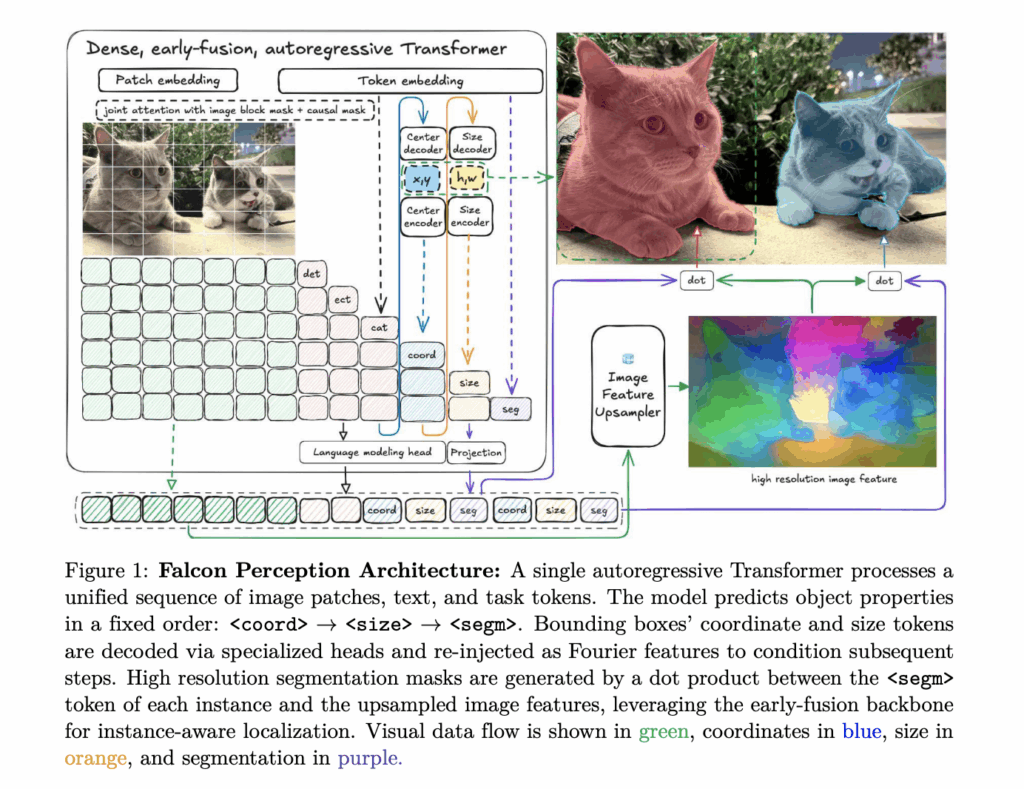
In the current landscape of computer vision, the standard operating procedure involves a modular ‘Lego-brick’ approach: a pre-trained vision encoder for feature extraction paired with a separate decoder for task prediction. While effective, this architectural separation complicates scaling and bottlenecks the interaction between language and vision. The Technology Innovation Institute (TII) research team is challenging this paradigm with Falcon Perception, a 600M-parameter unified dense Transformer. By processing image patches and text tokens in a shared parameter space from the very first layer, TII research team has developed an early-fusion stack that handles perception and task modeling with extreme efficiency. https://arxiv.org/pdf/2603.27365 The Architecture: A Single Stack for Every Modality The core design of Falcon Perception is built on the hypothesis that a single Transformer can simultaneously learn visual representations and perform task-specific generation. Hybrid Attention and GGROPE Unlike standard language models that use strict causal masking, Falcon Perception employs a hybrid attention strategy. Image tokens attend to each other bidirectionally to build a global visual context, while text and task tokens attend to all preceding tokens (causal masking) to enable autoregressive prediction. To maintain 2D spatial relationships in a flattened sequence, the research team uses 3D Rotary Positional Embeddings. This decomposes the head dimension into a sequential component and a spatial component using Golden Gate ROPE (GGROPE). GGROPE allows attention heads to attend to relative positions along arbitrary angles, making the model robust to rotation and aspect ratio variations. Minimalist Sequence Logic The basic architectural sequence follows a Chain-of-Perception format: [Image] [Text] <coord> <size> <seg> … <eos>. This ensures that the model resolves spatial ambiguity (position and size) as a conditioning signal before generating the final segmentation mask. Engineering for Scale: Muon, FlexAttention, and Raster Ordering TII research team introduced several optimizations to stabilize training and maximize GPU utilization for these heterogeneous sequences. Muon Optimization: The research team report that employing the Muon optimizer for specialized heads (coordinates, size, and segmentation) led to lower training losses and improved performance on benchmarks compared to standard AdamW. FlexAttention and Sequence Packing: To process images at native resolutions without wasting compute on padding, the model uses a scatter-and-pack strategy. Valid patches are packed into fixed-length blocks, and FlexAttention is used to restrict self-attention within each image sample’s boundaries. Raster Ordering: When multiple objects are present, Falcon Perception predicts them in raster order (top-to-bottom, left-to-right). This was found to converge faster and produce lower coordinate loss than random or size-based ordering. The Training Recipe: Distillation to 685GT The model uses multi-teacher distillation for initialization, distilling knowledge from DINOv3 (ViT-H) for local features and SigLIP2 (So400m) for language-aligned features. Following initialization, the model undergoes a three-stage perception training pipeline totaling approximately 685 Gigatokens (GT): In-Context Listing (450 GT): Learning to ‘list’ the scene inventory to build global context. Task Alignment (225 GT): Transitioning to independent-query tasks using Query Masking to ensure the model grounds each query solely on the image. Long-Context Finetuning (10 GT): Short adaptation for extreme density, increasing the mask limit to 600 per expression. During these stages, the task-specific serialization is used: <image>expr1<present><coord><size><seg> <eoq>expr2<absent> <eoq> <eos>. The <present> and <absent> tokens force the model to commit to a binary decision on an object’s existence before localization. PBench: Profiling Capabilities Beyond Saturated Baselines To measure progress, TII research team introduced PBench, a benchmark that organizes samples into five levels of semantic complexity to disentangle model failure modes. Main Results: Falcon Perception vs. SAM 3 (Macro-F1) Benchmark Split SAM 3 Falcon Perception (600M) L0: Simple Objects 64.3 65.1 L1: Attributes 54.4 63.6 L2: OCR-Guided 24.6 38.0 L3: Spatial Understanding 31.6 53.5 L4: Relations 33.3 49.1 Dense Split 58.4 72.6 Falcon Perception significantly outperforms SAM 3 on complex semantic tasks, particularly showing a +21.9 point gain on spatial understanding (Level 3). https://arxiv.org/pdf/2603.27365 FalconOCR: The 300M Document specialist TII team also extended this early-fusion recipe to FalconOCR, a compact 300M-parameter model initialized from scratch to prioritize fine-grained glyph recognition. FalconOCR is competitive with several larger proprietary and modular OCR systems: olmOCR: Achieves 80.3% accuracy, matching or exceeding Gemini 3 Pro (80.2%) and GPT 5.2 (69.8%). OmniDocBench: Reaches an overall score of 88.64, ahead of GPT 5.2 (86.56) and Mistral OCR 3 (85.20), though it trails the top modular pipeline PaddleOCR VL 1.5 (94.37). Key Takeaways Unified Early-Fusion Architecture: Falcon Perception replaces modular encoder-decoder pipelines with a single dense Transformer that processes image patches and text tokens in a shared parameter space from the first layer. It utilizes a hybrid attention mask—bidirectional for visual tokens and causal for task tokens—to act simultaneously as a vision encoder and an autoregressive decoder. Chain-of-Perception Sequence: The model serializes instance segmentation into a structured sequence (⟨coord⟩→⟨size⟩→⟨seg⟩)(langle coordrangle rightarrow langle sizerangle rightarrow langle segrangle), which forces it to resolve spatial position and size as a conditioning signal before generating the pixel-level mask. Specialized Heads and GGROPE: To manage dense spatial data, the model uses Fourier Feature encoders for high-dimensional coordinate mapping and Golden Gate ROPE (GGROPE) to enable isotropic 2D spatial attention. The Muon optimizer is employed for these specialized heads to balance learning rates against the pre-trained backbone. Semantic Performance Gains: On the new PBench benchmark, which disentangles semantic capabilities (Levels 0-4), the 600M model demonstrates significant gains over SAM 3 in complex categories, including a +13.4 point lead in OCR-guided queries and a +21.9 point lead in spatial understanding. High-Efficiency OCR Extension: The architecture scales down to Falcon OCR, a 300M-parameter model that achieves 80.3% on olmOCR and 88.64 on OmniDocBench. It matches or exceeds the accuracy of much larger systems like Gemini 3 Pro and GPT 5.2 while maintaining high throughput for large-scale document processing. Check out the Paper, Model Weight, Repo and Technical details.  Also, feel free to follow us on Twitter and don’t forget to join our 120k+ ML SubReddit and Subscribe to our Newsletter. Wait! are you on telegram? now you can join us on telegram as well. The post TII Releases Falcon Perception: A 0.6B-Parameter Early-Fusion Transformer for Open-Vocabulary Grounding and Segmentation from Natural Language Prompts appeared first on MarkTechPost.

TII Releases Falcon Perception: A 0.6B-Parameter Early-Fusion Transformer for Open-Vocabulary Grounding and Segmentation from Natural Language Prompts Leer entrada »

AI, Committee, Noticias, Uncategorized

Revision or Re-Solving? Decomposing Second-Pass Gains in Multi-LLM Pipelines

arXiv:2604.01029v1 Announce Type: cross Abstract: Multi-LLM revision pipelines, in which a second model reviews and improves a draft produced by a first, are widely assumed to derive their gains from genuine error correction. We question this assumption with a controlled decomposition experiment that uses four matched conditions to separate second-pass gains into three additive components: re-solving, scaffold, and content. We evaluate this design across two model pairs on three benchmarks spanning knowledge-intensive MCQ and competitive programming. Our results show that the gains of multi-LLM revision are not monolithic, but depend on task structure, draft quality, and the type of draft information. On MCQ tasks, where the answer space is constrained and drafts provide little structural guidance, most gains are consistent with stronger-model re-solving, and directly routing queries to the stronger model can be more effective than revising a weak draft. On code generation tasks, however, two-stage prompting remains useful because even semantically null drafts can provide substantial structural scaffolding, while weak draft content can be harmful. Finally, role-reversed experiments show that strong drafts clearly benefit weak reviewers. Ultimately, our findings demonstrate that the utility of multi-LLM revision is dynamically bottlenecked by task structure and draft quality, necessitating more targeted pipeline designs rather than blanket revision strategies.

Revision or Re-Solving? Decomposing Second-Pass Gains in Multi-LLM Pipelines Leer entrada »

AI, Committee, Noticias, Uncategorized

CARE: Privacy-Compliant Agentic Reasoning with Evidence Discordance

arXiv:2604.01113v1 Announce Type: new Abstract: Large language model (LLM) systems are increasingly used to support high-stakes decision-making, but they typically perform worse when the available evidence is internally inconsistent. Such a scenario exists in real-world healthcare settings, with patient-reported symptoms contradicting medical signs. To study this problem, we introduce MIMIC-DOS, a dataset for short-horizon organ dysfunction worsening prediction in the intensive care unit (ICU) setting. We derive this dataset from the widely recognized MIMIC-IV, a publicly available electronic health record dataset, and construct it exclusively from cases in which discordance between signs and symptoms exists. This setting poses a substantial challenge for existing LLM-based approaches, with single-pass LLMs and agentic pipelines often struggling to reconcile such conflicting signals. To address this problem, we propose CARE: a multi-stage privacy-compliant agentic reasoning framework in which a remote LLM provides guidance by generating structured categories and transitions without accessing sensitive patient data, while a local LLM uses these categories and transitions to support evidence acquisition and final decision-making. Empirically, CARE achieves stronger performance across all key metrics compared to multiple baseline settings, showing that CARE can more robustly handle conflicting clinical evidence while preserving privacy.

CARE: Privacy-Compliant Agentic Reasoning with Evidence Discordance Leer entrada »

AI, Committee, Noticias, Uncategorized

Fuel prices are soaring. Plastic could be next.

As the war in Iran continues to engulf the Middle East and the Strait of Hormuz stays closed, one of the most visible global economic ripple effects has been fossil-fuel prices. In particular, you can’t get away from news about the price of gasoline, which just topped an average of $4 a gallon in the US, its highest level since 2022. But looking ahead, further consequences for the global economy could be looming in plastics. Plastics are made using petrochemicals, and the supply chain impacts of the oil bottleneck near Iran are starting to build up.  Plastic production accounts for roughly 5% of global carbon dioxide emissions today. And our current moment shows just how embedded oil and gas products are in our lives. It goes far beyond their use for energy.  As I write this, I’m wearing clothes that contain plastic fibers, typing on a plastic keyboard, and looking through the plastic lenses of my glasses. It’s hard to imagine what our world looks like without plastic. And in some ways, moving away from fossil-derived plastic could prove even more complicated than decarbonizing our energy system.  Crude oil prices have been on a roller-coaster in recent weeks, and prices have recently topped $100 a barrel. Crude oil contains a huge range of hydrocarbons, and it’s typically refined by putting it through a distillation unit that separates the raw material into different fractions according to their boiling point. Those fractions then go on to be further processed into everything from jet fuel to asphalt binder. We’ve already seen the price spikes for some materials pulled out of crude oil, like gasoline and jet fuel. Let’s zoom in on another component, naphtha. It can be added to gasoline and jet fuel to improve performance. It can also be used as a solvent or as a raw material to make plastics. The Middle East currently accounts for about 20% of global naphtha production­ and supplies about 40% of the market in Asia, where prices are already up by 50% over the last month. We’re starting to see these effects trickle down already. The price of polypropylene (which is made from naphtha and used for food containers, bottle caps, and even automotive parts) is climbing, especially in Asia.   Typically, manufacturers have a bit of stock built up, but that’ll be exhausted soon, likely in the coming weeks. The largest supplier of water bottles in India recently announced that it would raise prices by 11% after its packaging costs went up by over 70%, according to reporting from Reuters. Toys could be more expensive this holiday season as manufacturers grapple with supply chain concerns. Americans will likely feel these ripples especially hard if disruptions continue. The average US resident used over 250 kilograms of new plastics in 2019, according to a 2022 report from the Organization for Economic Cooperation and Development. That’s an absolutely massive number—the global average is just 60 kilograms. The effects of higher prices for both fuels and feedstocks could compound and multiply, and alternatives aren’t widely available. Bio-based plastics made with materials like plant sugars exist, but they still make up a vanishingly tiny portion of the market. As of 2025, global plastics production totaled over 431 million metric tons per year. Bio-based and bio-degradable plastics made up about 0.5% of that, a share that could reach 1% by 2030. Bio-based plastics are much more expensive than their fossil-derived counterparts. And many are made using agricultural raw materials, so scaling them up too much could be harmful for the environment and might compete with other industries like food production. Recycling isn’t the easy answer either. Mechanical recycling is the current standard method used for materials like the plastics that make up water bottles and disposable coffee cups. But that degrades the materials over time, so they can’t be used infinitely. Chemical recycling has its own host of issues—the facilities that do it can be highly polluting, and today plastics that go into advanced recycling plants largely don’t actually go into new plastics. There’s been a lot of talk in recent weeks about how this energy crisis is going to push the world more toward renewable energy. Solar panels, electric vehicles, and batteries could suddenly become more attractive as we face the drastic consequences of a disruption in the global fossil-fuel supply. But when it comes to plastic, the future looks far more complicated. Even though the plastics industry is facing much the same disruptions as the energy sector, there aren’t the same obvious alternatives available for a transition. Our lives are tied up in plastic, with uses ranging from the essential (like medical equipment) to the mundane (my to-go coffee cup). Soon, our economy could feel the effects of just how much we rely on fossil-derived plastics, and how hard it’s going to be to replace them.  This article is from The Spark, MIT Technology Review’s weekly climate newsletter. To receive it in your inbox every Wednesday, sign up here. 

Fuel prices are soaring. Plastic could be next. Leer entrada »

AI, Committee, Noticias, Uncategorized

IBM Releases Granite 4.0 3B Vision: A New Vision Language Model for Enterprise Grade Document Data Extraction

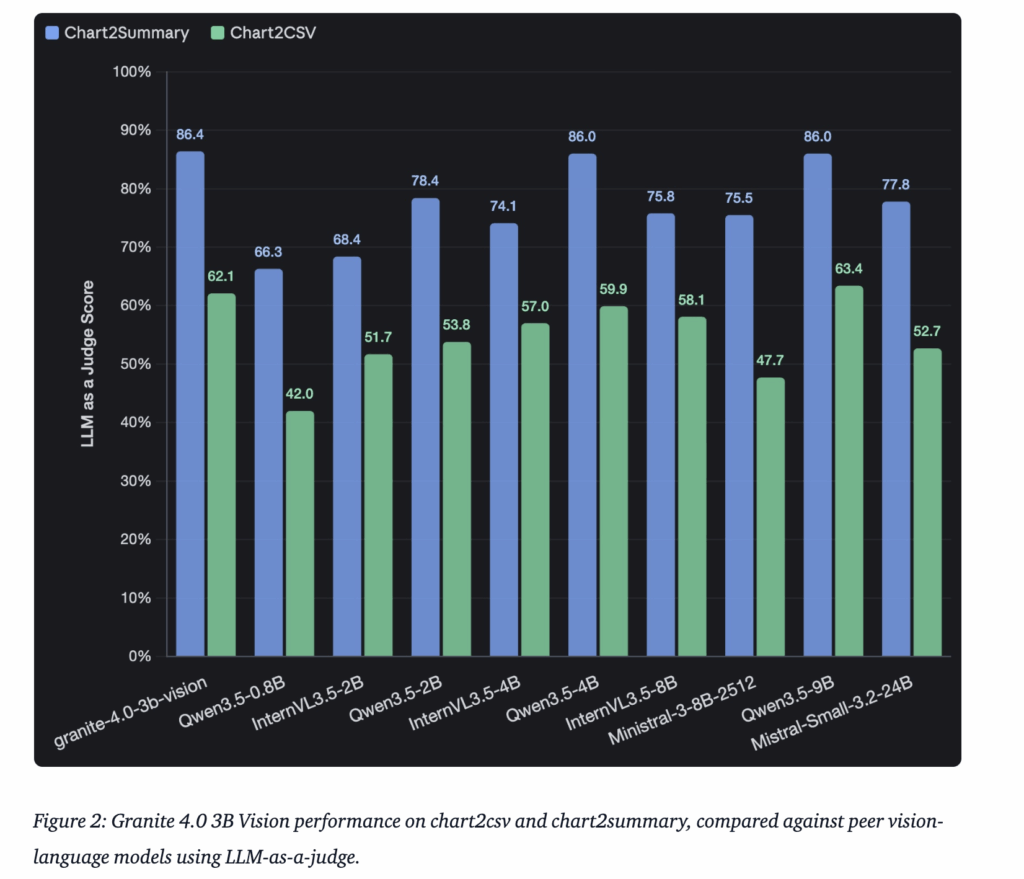
IBM has announced the release of Granite 4.0 3B Vision, a vision-language model (VLM) engineered specifically for enterprise-grade document data extraction. Departing from the monolithic approach of larger multimodal models, the 4.0 Vision release is architected as a specialized adapter designed to bring high-fidelity visual reasoning to the Granite 4.0 Micro language backbone. This release represents a transition toward modular, extraction-focused AI that prioritizes structured data accuracy—such as converting complex charts to code or tables to HTML—over general-purpose image captioning. Architecture: Modular LoRA and DeepStack Integration The Granite 4.0 3B Vision model is delivered as a LoRA (Low-Rank Adaptation) adapter with approximately 0.5B parameters. This adapter is designed to be loaded on top of the Granite 4.0 Micro base model, a 3.5B parameter dense language model. This design allows for a ‘dual-mode’ deployment: the base model can handle text-only requests independently, while the vision adapter is activated only when multimodal processing is required. Vision Encoder and Patch Tiling The visual component utilizes the google/siglip2-so400m-patch16-384 encoder. To maintain high resolution across diverse document layouts, the model employs a tiling mechanism. Input images are decomposed into 384×384 patches, which are processed alongside a downscaled global view of the entire image. This approach ensures that fine details—such as subscripts in formulas or small data points in charts—are preserved before they reach the language backbone. The DeepStack Backbone To bridge the vision and language modalities, IBM utilizes a variant of the DeepStack architecture. This involves deeply stacking visual tokens into the language model across 8 specific injection points. By routing visual features into multiple layers of the transformer, the model achieves a tighter alignment between the ‘what’ (semantic content) and the ‘where’ (spatial layout), which is critical for maintaining structure during document parsing. Training Curriculum: Focused on Chart and Table Extraction The training of Granite 4.0 3B Vision reflects a strategic shift toward specialized extraction tasks. Rather than relying solely on general image-text datasets, IBM utilized a curated mixture of instruction-following data focused on complex document structures. ChartNet Dataset: The model was refined using ChartNet, a million-scale multimodal dataset designed for robust chart understanding. Code-Guided Pipeline: A key technical highlight of the training involves a “code-guided” approach for chart reasoning. This pipeline uses aligned data consisting of the original plotting code, the resulting rendered image, and the underlying data table, allowing the model to learn the structural relationship between visual representations and their source data. Extraction Tuning: The model was fine-tuned on a mixture of datasets focusing on Key-Value Pair (KVP) extraction, table structure recognition, and converting visual charts into machine-readable formats like CSV, JSON, and OTSL. Performance and Evaluation Benchmarks In technical evaluations, Granite 4.0 3B Vision has been benchmarked against several industry-standard suites for document understanding. It is important to note that datasets like PubTables-v2 and OmniDocBench are utilized as evaluation benchmarks to verify the model’s zero-shot performance in real-world scenarios. Task Evaluation Benchmark Metric KVP Extraction VAREX 85.5% Exact Match (Zero-Shot) Chart Reasoning ChartNet (Human-Verified Test Set) High Accuracy in Chart2Summary Table Extraction TableVQA-Bench & OmniDocBench Evaluated via TEDS and HTML extraction The model currently ranks 3rd among models in the 2–4B parameter class on the VAREX leaderboard (as of March 2026), demonstrating its efficiency in structured extraction despite its compact size. https://huggingface.co/blog/ibm-granite/granite-4-vision https://huggingface.co/blog/ibm-granite/granite-4-vision Key Takeaways Modular LoRA Architecture: The model is a 0.5B parameter LoRA adapter that operates on the Granite 4.0 Micro (3.5B) backbone. This design allows a single deployment to handle text-only workloads efficiently while activating vision capabilities only when needed. High-Resolution Tiling: Utilizing the google/siglip2-so400m-patch16-384 encoder, the model processes images by tiling them into 384×384 patches alongside a global downscaled view, ensuring that fine details in complex documents are preserved. DeepStack Injection: To improve layout awareness, the model uses a DeepStack approach with 8 injection points. This routes semantic features to earlier layers and spatial details to later layers, which is critical for accurate table and chart extraction. Specialized Extraction Training: Beyond general instruction following, the model was refined using ChartNet and a ‘code-guided’ pipeline that aligns plotting code, images, and data tables to help the model internalize the logic of visual data structures. Developer-Ready Integration: The release is Apache 2.0 licensed and features native support for vLLM (via a custom model implementation) and Docling, IBM’s tool for converting unstructured PDFs into machine-readable JSON or HTML. Check out the Technical details and Model Weight.  Also, feel free to follow us on Twitter and don’t forget to join our 120k+ ML SubReddit and Subscribe to our Newsletter. Wait! are you on telegram? now you can join us on telegram as well. The post IBM Releases Granite 4.0 3B Vision: A New Vision Language Model for Enterprise Grade Document Data Extraction appeared first on MarkTechPost.

IBM Releases Granite 4.0 3B Vision: A New Vision Language Model for Enterprise Grade Document Data Extraction Leer entrada »

AI, Committee, Noticias, Uncategorized

The Download: plastic’s problem with fuel prices, and SpaceX’s blockbuster IPO

This is today’s edition of The Download, our weekday newsletter that provides a daily dose of what’s going on in the world of technology. Fuel prices are soaring. Plastic could be next.  As the war in Iran continues, one of the most visible global economic ripple effects has been fossil-fuel prices. But looking ahead, further consequences could be looming for plastics.  Plastics are made from petrochemicals, and the supply chain impacts from the conflict are starting to build up. Americans will likely feel the ripples.   Read the full story to grasp the unpredictable impacts.  —Casey Crownhart  This story is from The Spark, our weekly climate newsletter. Sign up to get it in your inbox every Wednesday.  The must-reads  I’ve combed the internet to find you today’s most fun/important/scary/fascinating stories about technology.  1 SpaceX has filed for an IPO It’s set to be the largest ever, targeting a $1.75 trillion valuation. (NYT $)  + Which would make Elon Musk the world’s first trillionaire. (Al Jazeera) + But the IPO could hinge on the success of Moon missions. (LA Times $) + And the conflicts of interest are staggering. (The Next Web) + Meanwhile, rivals are rising to challenge SpaceX. (MIT Technology Review)   2 Artemis II is on its way to the Moon NASA successfully launched the four astronauts on its rocket yesterday. (Axios) + The lunar plans could violate international law. (The Verge) + But the potential scientific advances are tremendous. (Nature)  + Check out our roundtable on the next era of space exploration. (MIT Technology Review)   3 Iran has struck Amazon’s cloud business in Bahrain again It promised to hit US companies only yesterday. (FT $) + Other targets include Google, Microsoft, Apple, and Nvidia. (CNBC) + AWS data centers in Bahrain were also hit last month. (Reuters $)  4 OpenAI was secretly behind a child safety campaign group It pushed for age verification requirements for AI. (The San Francisco Standard $) + OpenAI had backed the legislation as a compromise measure. (WSJ $) + Coincidentally, Sam Altman heads a company providing age verification. (Engadget)  5 Anthropic is scrambling to limit the Claude Code leak It’s trying to remove 8,000 copies of the exposed code from GitHub. (Gizmodo) + An executive blamed the leak on “process errors.” (Bloomberg $) + Here’s what it reveals about Anthropic’s plans. (Ars Technica) + AI is making online crimes easier—and it could get much worse. (MIT Technology Review)  6 A new Russian “super-app” aims to emulate China’s WeChat And give the Kremlin new surveillance powers. (WSJ $)  7 America’s AI boom is leaving the rest of the world behind  And it’s concentrating power and wealth in a handful of companies. (Rest of World)  8 Chinese chipmakers have claimed nearly half the country’s market Nvidia’s lead is shrinking rapidly. (Reuters $)  9 The first quantum computer to break encryption is imminent  New research reveals how it could happen. (New Scientist)  10 The world’s oldest tortoise has been embroiled in a crypto scam Reports that Jonathan died at just 194 years old are thankfully false. (Guardian)  Quote of the day  “Starlink is the only reason this valuation is defensible.”  —Shay Boloor, chief market strategist at Futurum Equities, tells Reuters why SpaceX has such high hopes for its IPO.  One More Thing  These companies are creating food out of thin air  Dried cells—it’s what’s for dinner. At least that’s what a new crop of biotech startups, armed with carbon-guzzling bacteria and plenty of capital, are hoping to convince us.   Their claims sound too good to be true: they say they can make food out of thin air. But that’s exactly how certain soil-dwelling bacteria work.  Startups are replicating the process to turn abundant carbon dioxide into nutritious “air protein.” They believe it could dramatically lower farming emissions—and even disrupt agriculture altogether. Read the full story.  —Claire L. Evans  We can still have nice things  A place for comfort, fun and distraction to brighten up your day. (Got any ideas? Drop me a line.)  + Need more Artemis II in your life? This site takes you inside the flight. + Here’s a fascinating look at the recording errors that improved songs. + Good news: the elusive Nightjar bird is making a comeback. + Finally, a master chef has baked clam chowder donuts. 

The Download: plastic’s problem with fuel prices, and SpaceX’s blockbuster IPO Leer entrada »

AI, Committee, Noticias, Uncategorized

Liquid AI Released LFM2.5-350M: A Compact 350M Parameter Model Trained on 28T Tokens with Scaled Reinforcement Learning

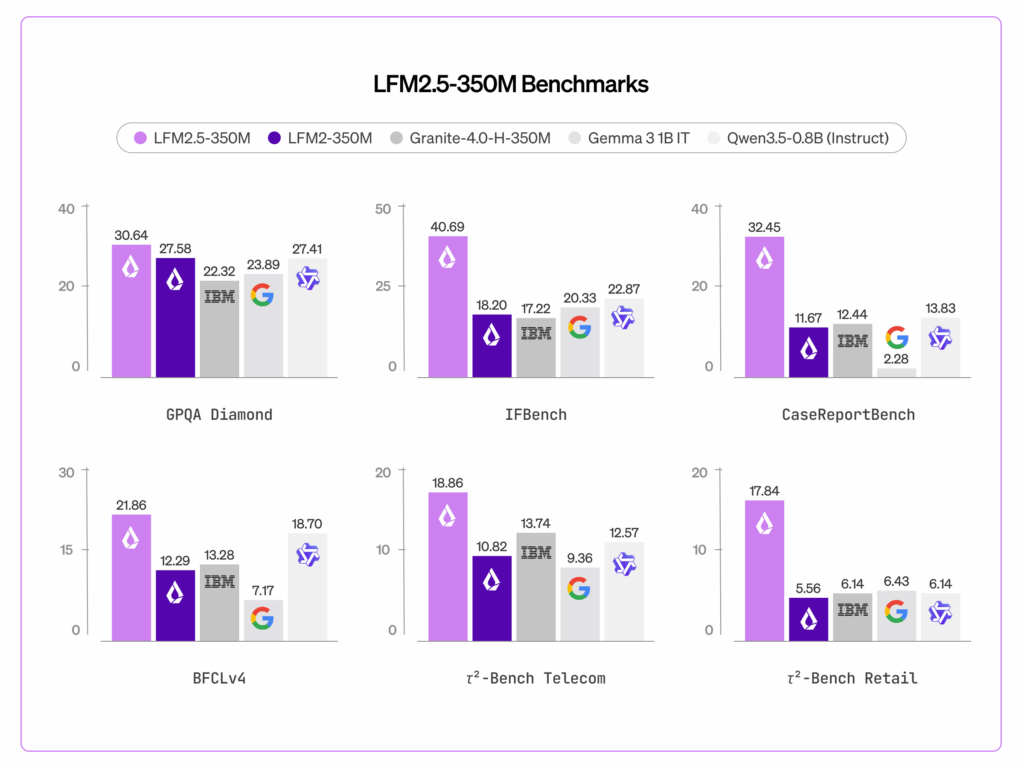
In the current landscape of generative AI, the ‘scaling laws’ have generally dictated that more parameters equal more intelligence. However, Liquid AI is challenging this convention with the release of LFM2.5-350M. This model is actually a technical case study in intelligence density with additional pre-training (from 10T to 28T tokens) and large-scale reinforcement learning The significance of LFM2.5-350M lies in its architecture and training efficiency. While the most AI companies has been focused on frontier models, Liquid AI is targeting the ‘edge’—devices with limited memory and compute—by proving that a 350-million parameter model can outperform models more than twice its size on several evaluated benchmarks. https://www.liquid.ai/blog/lfm2-5-350m-no-size-left-behind Architecture: The Hybrid LIV Backbone The core technical differentiator of the LFM2.5-350M is its departure from the pure Transformer architecture. It utilizes a hybrid structure built on Linear Input-Varying Systems (LIVs). Traditional Transformers rely entirely on self-attention mechanisms, which suffer from quadratic scaling issues: as the context window grows, the memory and computational requirements for the Key-Value (KV) cache increase. Liquid AI addresses this by using a hybrid backbone consisting of: 10 Double-Gated LIV Convolution Blocks: These handle the majority of the sequence processing. LIVs function similarly to advanced Recurrent Neural Networks (RNNs) but are designed to be more parallelizable and stable during training. They maintain a constant-state memory, reducing the I/O overhead. 6 Grouped Query Attention (GQA) Blocks: By integrating a small number of attention blocks, the model retains high-precision retrieval and long-range context handling without the full memory overhead of a standard Transformer. This hybrid approach allows the LFM2.5-350M to support a 32k context window (32,768 tokens) while maintaining an extremely lean memory footprint. Performance and Intelligence Density The LFM2.5-350M was pre-trained on 28 trillion tokens with an extremely high training-to-parameter ratio. This ensures that the model’s limited parameter count is utilized to its maximum potential, resulting in high ‘intelligence density.’ Benchmarks and Use Cases The LFM2.5-350M is a specialist model designed for high-speed, agentic tasks rather than general-purpose reasoning. Benchmark Score IFEval (Instruction Following) 76.96 GPQA Diamond 30.64 MMLU-Pro 20.01 The high IFEval score indicates the model is efficient at following complex, structured instructions, making it suitable for tool use, function calling, and structured data extraction (e.g., JSON). However, the documentation explicitly states that LFM2.5-350M is not recommended for mathematics, complex coding, or creative writing. For those tasks, the reasoning capabilities of larger parameter counts remain necessary. https://www.liquid.ai/blog/lfm2-5-350m-no-size-left-behind Hardware Optimization and Inference Efficiency A major hurdle for AI devs is the ‘memory wall’—the bottleneck created by moving data between the processor and memory. Because the LFM2.5-350M utilizes LIVs and GQA, it drastically reduces KV cache size, boosting throughput. On a single NVIDIA H100 GPU, the model can reach a throughput of 40.4K output tokens per second at high concurrency. Liquid AI team reports device-specific low-memory inference results that make local deployment viable: Snapdragon 8 Elite NPU: 169MB peak memory using RunAnywhere Q4. Snapdragon GPU: 81MB peak memory using RunAnywhere Q4. Raspberry Pi 5: 300MB using Cactus Engine int8. Key Takeaways Extreme Intelligence Density: By training a 350M parameter model on 28 trillion tokens, Liquid AI team achieved an super high 80,000:1 token-to-parameter ratio, allowing it to outperform models more than twice its size on several benchmarks. Hybrid LIV Architecture: The model departs from pure Transformers by using Linear Input-Varying Systems (LIVs) combined with a small number of Grouped Query Attention (GQA) blocks, significantly reducing the memory overhead of the KV cache. Edge-First Efficiency: It is designed for local deployment with a 32k context window and a remarkably low memory footprint—reaching as low as 81MB on mobile GPUs and 169MB on NPUs via specialized inference engines. Specialized Agentic Capability: The model is highly optimized for instruction following (IFEval: 76.96) and tool use, though it is explicitly not recommended for complex coding, mathematics, or creative writing. Massive Throughput: The architectural efficiency enables high-speed utility, processing up to 40.4K output tokens per second on a single H100, making it ideal for high-volume data extraction and real-time classification. Check out the Technical details and Model Weight. Also, feel free to follow us on Twitter and don’t forget to join our 120k+ ML SubReddit and Subscribe to our Newsletter. Wait! are you on telegram? now you can join us on telegram as well. The post Liquid AI Released LFM2.5-350M: A Compact 350M Parameter Model Trained on 28T Tokens with Scaled Reinforcement Learning appeared first on MarkTechPost.

Liquid AI Released LFM2.5-350M: A Compact 350M Parameter Model Trained on 28T Tokens with Scaled Reinforcement Learning Leer entrada »

AI, Committee, Noticias, Uncategorized

The gig workers who are training humanoid robots at home

When Zeus, a medical student living in a hilltop city in central Nigeria, returns to his studio apartment from a long day at the hospital, he turns on his ring light, straps his iPhone to his forehead, and starts recording himself. He raises his hands in front of him like a sleepwalker and puts a sheet on his bed. He moves slowly and carefully to make sure his hands stay within the camera frame.  Zeus is a data recorder for Micro1, a US company based in Palo Alto, California that collects real-world data to sell to robotics companies. As companies like Tesla, Figure AI, and Agility Robotics race to build humanoids—robots designed to resemble and move like humans in factories and homes—videos recorded by gig workers like Zeus are becoming the hottest new way to train them.  Micro1 has hired thousands of contract workers in more than 50 countries, including India, Nigeria, and Argentina, where swathes of tech-savvy young people are looking for jobs. They’re mounting iPhones on their heads and recording themselves folding laundry, washing dishes, and cooking. The job pays well by local standards and is boosting local economies, but it raises thorny questions around privacy and informed consent. And the work can be challenging at times—and weird. Zeus found the job in November, when people started talking about it everywhere on LinkedIn and YouTube. “This would be a real nice opportunity to set a mark and give data that will be used to train robots in the future,” he thought.  Zeus is paid $15 an hour, which is good income in Nigeria’s strained economy with high unemployment rates. But as a bright-eyed student dreaming of becoming a doctor, he finds ironing his clothes for hours every day boring.  “I really [do] not like it so much,” he says. “I’m the kind of person that requires … a technical job that requires me to think.”  Zeus, and all the workers interviewed by MIT Technology Review, asked to be referred to only by pseudonyms because they were not authorized to talk about their work. Humanoid robots are notoriously hard to build because manipulating physical objects is a difficult skill to master. But the rise of large language models underlying chatbots like ChatGPT has inspired a paradigm shift in robotics. Just as large language models learned to generate words by being trained on vast troves of text scraped from the internet, many researchers believe that humanoid robots can learn to interact with the world by being trained on massive amounts of movement data.  Editor’s note: In a recent poll, MIT Technology Review readers selected humanoid robots as the 11th breakthrough for our 2026 list of 10 Breakthrough Technologies. Robotics requires far more complex data about the physical world, though, and that is much harder to find. Virtual simulations can train robots to perform acrobatics, but not how to grasp and move objects, because simulations struggle to model physics with perfect accuracy. For robots to work in factories and serve as housekeepers, real-world data, however time-consuming and expensive to collect, may be what we need.  Investors are pouring money feverishly into solving this challenge, spending over $6 billion on humanoid robots in 2025. And at-home data recording is becoming a booming gig economy around the world. Data companies like Scale AI and Encord are recruiting their own armies of data recorders, while DoorDash pays delivery drivers to film themselves doing chores. And in China, workers in dozens of state-owned robot training centers wear virtual-reality headsets and exoskeletons to teach humanoid robots how to open a microwave and wipe down the table.  “There is a lot of demand, and it’s increasing really fast,” says Ali Ansari, CEO of Micro1. He estimates that robotics companies are now spending more than $100 million each year to buy real-world data from his company and others like it. A day in the life Workers at Micro1 are vetted by an AI agent named Zara that conducts interviews and reviews samples of chore videos. Every week, they submit videos of themselves doing chores around their homes, following a list of instructions about things like keeping their hands visible and moving at natural speed. The videos are reviewed by both AI and a human and are either accepted or rejected. They’re then annotated by AI and a team of hundreds of humans who label the actions in the footage. “There is a lot of demand, and it’s increasing really fast.” Ali Ansari, CEO of Micro1  Because this approach to training robots is in its infancy, it’s not clear yet what makes good training data. Still, “you need to give lots and lots of variations for the robot to generalize well for basic navigation and manipulation of the world,” says Ansari. But many workers say that creating a variety of “chore content” in their tiny homes is a challenge. Zeus, a scrappy student living in a humble studio, struggles to record anything beyond ironing his clothes every day. Arjun, a tutor in Delhi, India, takes an hour to make a 15-minute video because he spends so much time brainstorming new chores. “How much content [can be made] in the home? How much content?” he says.  There’s also the sticky question of privacy. Micro1 asks workers not to show their faces to the camera or reveal personal information such as names, phone numbers, and birth dates. Then it uses AI and human reviewers to remove anything that slips through.  But even without faces, the videos capture an intimate slice of workers’ lives: the interiors of their homes, their possessions, their routines. And understanding what kind of personal information they might be recording while they’re busy doing chores on camera can be tricky. Reviews of such footage might not filter out sensitive information beyond the most obvious identifiers. For workers with families, keeping private life off camera is a constant negotiation. Arjun, a father of two daughters, has to wrangle his chaotic two-year-old out of frame. “Sometimes it’s very difficult to

The gig workers who are training humanoid robots at home Leer entrada »

AI, Committee, Noticias, Uncategorized

Hugging Face Releases TRL v1.0: A Unified Post-Training Stack for SFT, Reward Modeling, DPO, and GRPO Workflows

Hugging Face has officially released TRL (Transformer Reinforcement Learning) v1.0, marking a pivotal transition for the library from a research-oriented repository to a stable, production-ready framework. For AI professionals and developers, this release codifies the Post-Training pipeline—the essential sequence of Supervised Fine-Tuning (SFT), Reward Modeling, and Alignment—into a unified, standardized API. In the early stages of the LLM boom, post-training was often treated as an experimental ‘dark art.’ TRL v1.0 aims to change that by providing a consistent developer experience built on three core pillars: a dedicated Command Line Interface (CLI), a unified Configuration system, and an expanded suite of alignment algorithms including DPO, GRPO, and KTO. The Unified Post-Training Stack Post-training is the phase where a pre-trained base model is refined to follow instructions, adopt a specific tone, or exhibit complex reasoning capabilities. TRL v1.0 organizes this process into distinct, interoperable stages: Supervised Fine-Tuning (SFT): The foundational step where the model is trained on high-quality instruction-following data to adapt its pre-trained knowledge to a conversational format. Reward Modeling: The process of training a separate model to predict human preferences, which acts as a ‘judge’ to score different model responses. Alignment (Reinforcement Learning): The final refinement where the model is optimized to maximize preference scores. This is achieved either through “online” methods that generate text during training or “offline” methods that learn from static preference datasets. Standardizing the Developer Experience: The TRL CLI One of the most significant updates for software engineers is the introduction of a robust TRL CLI. Previously, engineers were required to write extensive boilerplate code and custom training loops for every experiment. TRL v1.0 introduces a config-driven approach that utilizes YAML files or direct command-line arguments to manage the training lifecycle. The trl Command The CLI provides standardized entry points for the primary training stages. For instance, initiating an SFT run can now be executed via a single command: Copy CodeCopiedUse a different Browser trl sft –model_name_or_path meta-llama/Llama-3.1-8B –dataset_name openbmb/UltraInteract –output_dir ./sft_results This interface is integrated with Hugging Face Accelerate, which allows the same command to scale across diverse hardware configurations. Whether running on a single local GPU or a multi-node cluster utilizing Fully Sharded Data Parallel (FSDP) or DeepSpeed, the CLI manages the underlying distribution logic. TRLConfig and TrainingArguments Technical parity with the core transformers library is a cornerstone of this release. Each trainer now features a corresponding configuration class—such as SFTConfig, DPOConfig, or GRPOConfig—which inherits directly from transformers.TrainingArguments. Alignment Algorithms: Choosing the Right Objective TRL v1.0 consolidates several reinforcement learning methods, categorizing them based on their data requirements and computational overhead. Algorithm Type Technical Characteristic PPO Online Requires Policy, Reference, Reward, and Value (Critic) models. Highest VRAM footprint. DPO Offline Learns from preference pairs (chosen vs. rejected) without a separate Reward model. GRPO Online An on-policy method that removes the Value (Critic) model by using group-relative rewards. KTO Offline Learns from binary “thumbs up/down” signals instead of paired preferences. ORPO (Exp.) Experimental A one-step method that merges SFT and alignment using an odds-ratio loss. Efficiency and Performance Scaling To accommodate models with billions of parameters on consumer or mid-tier enterprise hardware, TRL v1.0 integrates several efficiency-focused technologies: PEFT (Parameter-Efficient Fine-Tuning): Native support for LoRA and QLoRA enables fine-tuning by updating a small fraction of the model’s weights, drastically reducing memory requirements. Unsloth Integration: TRL v1.0 leverages specialized kernels from the Unsloth library. For SFT and DPO workflows, this integration can result in a 2x increase in training speed and up to a 70% reduction in memory usage compared to standard implementations. Data Packing: The SFTTrainer supports constant-length packing. This technique concatenates multiple short sequences into a single fixed-length block (e.g., 2048 tokens), ensuring that nearly every token processed contributes to the gradient update and minimizing computation spent on padding. The trl.experimental Namespace Hugging Face team has introduced the trl.experimental namespace to separate production-stable tools from rapidly evolving research. This allows the core library to remain backward-compatible while still hosting cutting-edge developments. Features currently in the experimental track include: ORPO (Odds Ratio Preference Optimization): An emerging method that attempts to skip the SFT phase by applying alignment directly to the base model. Online DPO Trainers: Variants of DPO that incorporate real-time generation. Novel Loss Functions: Experimental objectives that target specific model behaviors, such as reducing verbosity or improving mathematical reasoning. Key Takeaways TRL v1.0 standardizes LLM post-training with a unified CLI, config system, and trainer workflow. The release separates a stable core from experimental methods such as ORPO and KTO. GRPO reduces RL training overhead by removing the separate critic model used in PPO. TRL integrates PEFT, data packing, and Unsloth to improve training efficiency and memory usage. The library makes SFT, reward modeling, and alignment more reproducible for engineering teams. Check out the Technical details.  Also, feel free to follow us on Twitter and don’t forget to join our 120k+ ML SubReddit and Subscribe to our Newsletter. Wait! are you on telegram? now you can join us on telegram as well. The post Hugging Face Releases TRL v1.0: A Unified Post-Training Stack for SFT, Reward Modeling, DPO, and GRPO Workflows appeared first on MarkTechPost.

Hugging Face Releases TRL v1.0: A Unified Post-Training Stack for SFT, Reward Modeling, DPO, and GRPO Workflows Leer entrada »

AI, Committee, Noticias, Uncategorized

Google AI Releases Veo 3.1 Lite: Giving Developers Low Cost High Speed Video Generation via The Gemini API

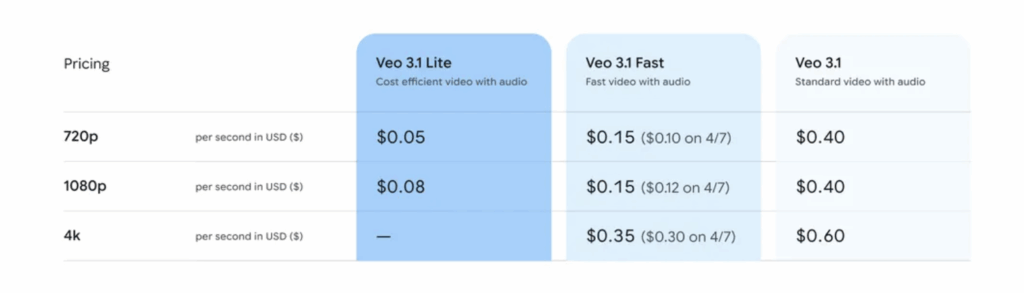
Google has announced the release of Veo 3.1 Lite, a new model tier within its generative video portfolio designed to address the primary bottleneck for production-scale deployments: pricing. While the generative video space has seen rapid progress in visual fidelity, the cost per second of generated content has remained high, often prohibitive for developers building high-volume applications. Veo 3.1 Lite is now available via the Gemini API and Google AI Studio for users in the paid tier. By offering the same generation speed as the existing Veo 3.1 Fast model at approximately half the cost, Google is positioning this model as the standard for developers focused on programmatic video generation and iterative prototyping. https://blog.google/innovation-and-ai/technology/ai/veo-3-1-lite/ Technical Architecture: The Diffusion Transformer (DiT) The most significant aspect of the Veo 3.1 family is its underlying Diffusion Transformer (DiT) architecture. Traditional generative video models often relied on U-Net-based diffusion, which can struggle with high-dimensional data and long-range temporal dependencies. Veo 3.1 Lite utilizes a transformer-based backbone that operates on spatio-temporal patches. In this architecture, video frames are not processed as static 2D images but as a continuous sequence of tokens in a latent space. By applying self-attention across these patches, the model maintains better temporal consistency. This ensures that objects, lighting, and textures remain coherent across the duration of the clip, reducing the artifacts commonly seen in earlier models. The model performs its computation in a compressed latent space rather than pixel space. This allows the model to handle the high computational demands of video generation while maintaining a lower memory footprint. For developers, this translates to a model that can generate high-definition content without the exponential increase in compute time that usually accompanies resolution scaling. Performance and Output Specifications Veo 3.1 Lite provides specific parameters for resolution and duration, allowing AI devs to integrate it into structured workflows. Unlike the flagship Veo 3.1 model, which supports 4K resolution, the Lite version is optimized for high-definition (HD) outputs. Supported Resolutions: 720p and 1080p. Aspect Ratios: Native support for both landscape (16:9) and portrait (9:16) orientations. Clip Durations: Developers can specify generation lengths of 4, 6, or 8 seconds. Prompt Adherence: The model is optimized for ‘Cinematic Control,’ recognizing technical directives such as ‘pan,’ ’tilt,’ and specific lighting instructions. The ‘Lite’ tag does not refer to a reduction in generation speed compared to the ‘Fast’ tier. Instead, it refers to an optimized parameter set that allows Google team to offer the model at a significantly lower price point while maintaining the same low-latency performance characteristics of Veo 3.1 Fast. The Pricing Shift: Democratizing Video Inference The core value proposition of Veo 3.1 Lite is its cost structure. In the current market, high-quality video inference often costs several dollars per minute of footage, making it difficult to justify for applications like dynamic ad generation or social media automation. Veo 3.1 Lite pricing is structured as follows: 720p: $0.05 per second. 1080p: $0.08 per second. Deployment via Gemini API and AI Studio The accessibility is handled through the Gemini API. This allows for the integration of video generation into existing Python or Node.js applications using standard REST or gRPC calls. One critical technical feature for enterprise developers is the inclusion of SynthID. Developed by Google DeepMind, SynthID is a tool for watermarking and identifying AI-generated content. It embeds a digital watermark directly into the pixels of the video that is imperceptible to the human eye but detectable by specialized software. This is a mandatory component for developers concerned with safety, compliance, and distinguishing synthetic media from captured footage. Key Takeaways Half the Cost, Same Speed: Offers the same low-latency performance as the ‘Fast’ tier at less than 50% of the price ($0.05/sec for 720p). Scalable HD Output: Supports 720p and 1080p resolutions in 4, 6, or 8-second clips with native 16:9 and 9:16 aspect ratios. Architecture: Built on a Diffusion Transformer (DiT) using spatio-temporal patches for superior motion and physical consistency. Developer Ready: Available now via Gemini API (paid tier) and Google AI Studio, featuring built-in SynthID digital watermarking. Check out the Technical details. You can access the model via paid tier on the Gemini API and Google AI Studio. Also, feel free to follow us on Twitter and don’t forget to join our 120k+ ML SubReddit and Subscribe to our Newsletter. Wait! are you on telegram? now you can join us on telegram as well. The post Google AI Releases Veo 3.1 Lite: Giving Developers Low Cost High Speed Video Generation via The Gemini API appeared first on MarkTechPost.

Google AI Releases Veo 3.1 Lite: Giving Developers Low Cost High Speed Video Generation via The Gemini API Leer entrada »

We use cookies to improve your experience and performance on our website. You can learn more at Política de privacidad and manage your privacy settings by clicking Settings.

Privacy Preferences

You can choose your cookie settings by turning on/off each type of cookie as you wish, except for essential cookies.

Allow All
Manage Consent Preferences
  • Always Active

Save
es_ES