YouZum

Uncategorized

AI, Committee, Noticias, Uncategorized

Meta AI Releases NeuralBench: A Unified Open-Source Framework to Benchmark NeuroAI Models Across 36 EEG Tasks and 94 Datasets

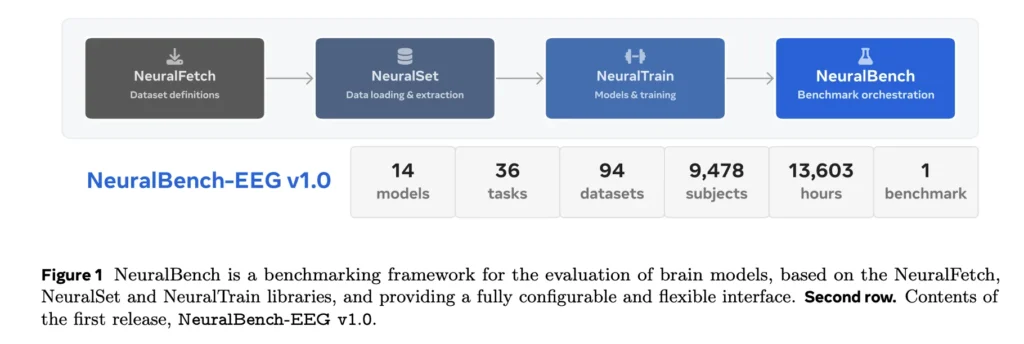
Evaluating AI models trained on brain signals has long been a messy, inconsistent topic. Different research groups use different preprocessing pipelines, train models on different datasets, and report results on a narrow set of tasks — making it nearly impossible to know which model actually works best, or for what. A new framework from Meta AI team is designed to fix that. Meta Researchers have released NeuralBench, a unified, open-source framework for benchmarking AI models of brain activity. Its first release, NeuralBench-EEG v1.0, is the largest open benchmark of its kind: 36 downstream tasks, 94 datasets, 9,478 subjects, 13,603 hours of electroencephalography (EEG) data, and 14 deep learning architectures evaluated under a single standardized interface. https://ai.meta.com/research/publications/neuralbench-a-unifying-framework-to-benchmark-neuroai-models/ The Problem NeuralBench Solves The broader field of NeuroAI where deep learning meets neuroscience has exploded in recent years. Self-supervised learning techniques originally developed for language, speech and images are now being adapted to build brain foundation models: large models pretrained on unlabeled brain recordings and fine-tuned for downstream tasks ranging from clinical seizure detection to decoding what a person is seeing or hearing. But the evaluation landscape has been badly fragmented. Existing benchmarks like MOABB cover up to 148 brain-computer interfacing (BCI) datasets but limit evaluation to just 5 downstream tasks. Other efforts — EEG-Bench, EEG-FM-Bench, AdaBrain-Bench — are each constrained in their own ways. For modalities like magnetoencephalography (MEG) and functional magnetic resonance imaging (fMRI), there is no systematic benchmark at all. The result — claims about foundation models being “generalizable” or “foundational” often rest on cherry-picked tasks with no common reference point. What is NeuralBench? NeuralBench is built on three core Python packages that form a modular pipeline. NeuralFetch handles dataset acquisition, pulling curated data from public repositories including OpenNeuro, DANDI, and NEMAR. NeuralSet prepares data as PyTorch-ready dataloaders, wrapping existing neuroscience tools like MNE-Python and nilearn for preprocessing, and HuggingFace for extracting stimulus embeddings (for tasks involving images, speech, or text). NeuralTrain provides modular training code built on PyTorch-Lightning, Pydantic, and the exca execution and caching library. Once installed via pip install neuralbench, the framework is controlled via a command-line interface (CLI). Running a task is as simple as three commands: download the data, prepare the cache, and execute. Every task is configured through a lightweight YAML file that specifies the data source, train/validation/test splits, preprocessing steps, target processing, training hyperparameters, and evaluation metrics. https://ai.meta.com/research/publications/neuralbench-a-unifying-framework-to-benchmark-neuroai-models/ What NeuralBench-EEG v1.0 Covers The first release focuses on EEG and spans eight task categories: cognitive decoding (image, sentence, speech, typing, video, and word decoding), brain-computer interfacing (BCI), evoked responses, clinical tasks, internal state, sleep, phenotyping, and miscellaneous. Three classes of models are compared: Task-specific architectures (~1.5K–4.2M parameters, trained from scratch): ShallowFBCSPNet, Deep4Net, EEGNet, BDTCN, ATCNet, EEGConformer, SimpleConvTimeAgg, and CTNet. EEG foundation models (~3.2M–157.1M parameters, pretrained and fine-tuned): BENDR, LaBraM, BIOT, CBraMod, LUNA, and REVE. Handcrafted feature baselines: sklearn-style pipelines using symmetric positive definite (SPD) matrix representations fed into logistic or Ridge regression. All foundation models are fine-tuned end-to-end using a shared training recipe — AdamW optimizer, learning rate of 10⁻⁴, weight decay of 0.05, cosine-annealing with 10% warmup, up to 50 epochs with early stopping (patience=10). The sole exception is BENDR, for which the learning rate is lowered to 10⁻⁵ and gradient clipping is applied at 0.5 to obtain stable learning curves. This intentional standardization otherwise removes model-specific optimization tricks — such as layer-wise learning rate decay, two-stage probing, or LoRA — so that architecture and pretraining methodology are what actually gets evaluated. Data splitting is handled differently per task type to reflect real-world generalization constraints: predefined splits where provided by dataset research team, leave-concept-out for cognitive decoding tasks (all subjects seen in training, but a held-out set of stimuli used for testing), cross-subject splits for most clinical and BCI tasks, and within-subject splits for datasets with very few participants. Each model is trained three times per task using three different random seeds. Evaluation metrics are standardized by task type: balanced accuracy for binary and multiclass classification, macro F1-score for multilabel classification, Pearson correlation for regression, and top-5 accuracy for retrieval tasks. All results are additionally reported as normalized scores (s̃), where 0 corresponds to dummy-level performance and 1 corresponds to perfect performance, enabling fair cross-task comparisons regardless of metric scale. One important methodological note: some EEG foundation models were pretrained on datasets that overlap with NeuralBench’s downstream evaluation sets. Rather than discarding these results, the benchmark flags them with hashed bars in result figures so readers can identify potential pretraining data leakage — no strong trend suggesting leakage inflates performance was observed, but the transparency is preserved. The benchmark offers two variants: NeuralBench-EEG-Core v1.0, which uses a single representative dataset per task for broad coverage, and NeuralBench-EEG-Full v1.0, which expands to up to 24 datasets per task to study within-task variability across recording hardware, labs, and subject populations. A Kendall’s τ of 0.926 (p < 0.001) between Core and Full rankings confirms that the Core variant is a reliable proxy — though a few model positions do shift, including CTNet overtaking LUNA when more datasets are included. https://ai.meta.com/research/publications/neuralbench-a-unifying-framework-to-benchmark-neuroai-models/ Two Key Findings Finding 1: Foundation models only marginally outperform task-specific models. The top-ranked models overall are REVE (69.2M parameters, mean normalized rank 0.20), LaBraM (5.8M, rank 0.21), and LUNA (40.4M, rank 0.30). But several task-specific models trained from scratch — CTNet (150K parameters, rank 0.32), SimpleConvTimeAgg (4.2M, rank 0.35), and Deep4Net (146K, rank 0.43) — trail closely behind. CTNet actually overtakes the LUNA foundation model to rank third in the Full variant, despite having roughly 270× fewer parameters. This shows the gap between task-specific and foundation models is narrow enough that expanding dataset coverage alone is sufficient to change global rankings. Finding 2: Many tasks remain genuinely hard. Cognitive decoding tasks — recovering dense representations of images, speech, sentences, video, or words from brain activity — are particularly challenging, with even the best models scoring well below ceiling. Tasks like mental imagery, sleep arousal, psychopathology decoding, and cross-subject motor imagery and P300 classification
Meta AI Releases NeuralBench: A Unified Open-Source Framework to Benchmark NeuroAI Models Across 36 EEG Tasks and 94 Datasets Leer entrada »

AI, Committee, Noticias, Uncategorized

What’s next for IVF

MIT Technology Review’s What’s Next series looks across industries, trends, and technologies to give you a first look at the future. You can read the rest of them here. Forty-eight years ago this July, Louise Joy Brown became the world’s first person born with the help of in vitro fertilization. Millions more IVF babies have entered the world since then. And that’s partly thanks to advances in technology that have made IVF safer and more effective. But it’s still not perfect. The process can be slow, painful, and expensive—and that’s for the lucky people who are able to access it in the first place. And by at least one measure, IVF success rates have been declining in recent years. Reproduction is complex, and there’s a lot that embryologists and gynecologists still don’t know and can’t control. They don’t know why many healthy-looking embryos don’t “stick” in the uterus, for example. They don’t always have an explanation for why their patients can’t get pregnant. And they can’t always account for vast differences in IVF success rates between individuals and between fertility clinics. Scientists are working on all those questions and more. They’re wrestling with complex ethical questions about how new genetic tools will be used to analyze or even alter embryos. Meanwhile, technologies designed to standardize treatment, eliminate human error, boost success rates, and make IVF more accessible are already beginning to usher in a new era for assisted reproduction—one aided by AI and robots. 1. Helping embryos stick Some of those technologies are being developed at the Carlos Simon Foundation in Valencia, Spain. When I visited in March, researchers gave me a tour of the labs and showed me a device that had been used to keep a human uterus alive outside the body for the first time. While some members of the team dream of building artificial uteruses that might one day be able to carry a fetus to term, they first want to use such devices to learn more about implantation—the moment at which a fertilized egg makes contact with the lining of the uterus, burrows inside, and essentially “hatches,” triggering the start of a pregnancy. Despite decades of advances in IVF, that process is still poorly understood. Even healthy-looking embryos stick no more than 40% to 60% of the time. In IVF techniques used today, clinics can create early-stage embryos and wait until the uterus is deemed most receptive, but once they insert the embryo into the uterus, it’s on its own. Xavier Santamaria, senior clinical scientist at the Carlos Simon Foundation, and his colleagues are trialing a different approach. They’ve developed a device that, at the press of a button, injects the embryo into the uterine lining. JESS HAMZELOU / MITTR In a demonstration I watched with a prototype, Santamaria picked up his speculum and turned to face the vaginal opening of his “patient,” which in this case was just a model of the real thing—a plastic bottom with labia, a vagina, a uterus, and ovaries, two short stumps representing what would normally be a pair of legs held in stirrups. He hunched over and peered inside. “Embryo,” he called. His colleague Maria Pardo, an embryologist, passed him a thin needle containing a mouse embryo she had recently collected from a petri dish. Santamaria’s device allows for the embryo-containing needle to be connected to a delivery tube. This tube also has a camera, a light, and a sensor that lets the doctor know when the needle reaches the uterine lining. Once it has been fed into the uterus, the gynecologist can see the inside of the organ and direct the tube to the lining. JESS HAMZELOU / MITTR “When everything is ready, you just press the button,” Santamaria said as he activated it using a foot pedal, allowing the embryo to be injected. “There it goes.” The team has just started a trial of the device; so far, fewer than 10 women have undergone the procedure, and none of those have become pregnant. But foundation director Carlos Simon is hopeful, noting that the inventors of IVF had to perform over 160 cycles before Louise Brown was born (between 1969 and 1978, that team performed 457 cycles in 250 people, resulting in only two live births). “The trial is ongoing,” he says. 2. Picking the “best” eggs, sperm, and embryos One long-running challenge of IVF has been selection. Say you manage to collect 10 eggs from one partner and a decent-looking semen sample from the other. How do you choose which cells to use? The same question comes up once the resulting embryos have been cultured in a dish for a few days: Which should you transfer to the uterus? Traditionally, these judgments have been made by eye. Embryologists literally pick the ones that look the best in terms of their shape or, in the case of sperm, how they move. But scientists have been working on alternatives. And over the last decade or so, many have turned to genetic testing to hint at which embryos have the best chances of creating a healthy baby. The most commonly used test is called PGT-A, which stands for preimplantation genetic testing for aneuploidy. Aneuploidy essentially means having an “incorrect” number of chromosomes, and it is thought that embryos with such characteristics are more likely to be lost through miscarriage or potentially develop into babies with genetic conditions. Once embryologists have created embryos in the lab, they can pinch off a few cells and test them for aneuploidies. The tests are especially beneficial for women over the age of 38, says Alan Penzias, a reproductive endocrinologist at Boston IVF. “You start to see an improvement: more babies and fewer miscarriages,” he says. The tests can shorten the time to pregnancy. This type of genetic testing is possible thanks to multiple advances in technology—not just in genomics, but also in the ability to keep embryos alive in a dish for five to six days and the technique of freezing embryos while

What’s next for IVF Leer entrada »

AI, Committee, Noticias, Uncategorized

The balcony solar boom is coming to the US

Dozens of US states are considering legislation to allow people to install plug-in solar systems, often called balcony solar. These small arrays require little to no setup and could help cut emissions and power bills. Balcony solar is already popular in Europe, and proponents say that the systems could make solar power more accessible for more people in the US, including renters. As popularity rises, though, some experts caution that there are safety concerns with how balcony solar would work with existing electrical equipment in homes. Let’s talk about what balcony solar is, why it’s unique, and how new testing requirements could affect our progress toward deploying the technology in the US. Plug-in solar systems are designed to be simple to install, often requiring no electrician or specialized worker at all. They’re small, and many can be plugged into existing outlets. People across Germany have installed over a million balcony solar systems. They generally measure up to roughly two square meters or about 20 square feet, and can generate up to 800 watts—enough to power a standard microwave. Now the plug-in solar wave is coming to the US. Many Americans have already installed DIY balcony solar without the permission of their utilities—it’s something of a regulatory gray area. In late 2025, Utah became the first state to explicitly allow people to install and use balcony solar systems. Over two dozen other states are now considering similar legislation. Generally, utilities require users to sign an interconnection agreement before they can plug in large arrays of solar panels that generate power for the grid. There can be fees and permits, and it all amounts to an expensive and lengthy process. Utah’s law ditched the interconnection requirement for panels that have a low power cap and that are certified by a national testing facility. (Legislation under consideration in other states, including New York, includes the same requirements.) The thinking is that since the panels produce very little power, which would be used to meet a home’s own energy demand and probably not get sent back to the grid, the same requirements shouldn’t apply.  As for that certification piece, in January the national testing and certification lab UL Solutions released UL 3700, a testing protocol to certify balcony solar systems and ensure that they’re safe.  There are three main safety considerations to address for these plug-in solar systems, says Joseph Bablo, manager of principal engineering, energy, and industrial automation at UL Solutions. First, there’s the possibility of overloading a circuit. Generally, electrical circuits have circuit breakers, which can trip and interrupt current if necessary. But if there’s a solar panel adding extra power to a circuit, a traditional breaker might not be able to respond to overload. Over time, overloaded circuits can damage equipment or even start a fire.  Second, these small systems are typically installed on the outside of homes, and outdoor power outlets generally have ground fault circuit interruption (GFCI). Basically, if an outlet or its surroundings are wet, it can shut down to prevent electric shock. Many GFCI systems may not work if there’s power going back into an outlet from a solar panel. Finally, there’s touch safety: If a plug gets disconnected from the wall, the blades of the plug may still have power running through them for a short time. If a panel is getting sunlight, those blades could be energized for longer than is typical. The new UL Solutions testing framework aims to address these concerns. One of the key recommendations is that plug-in solar panels should use a special outlet that’s designed specifically for them. The safety measures included in that connection, and within a panel, would ensure that the panels are safe. The need for a special outlet means that currently, people who want to plug in a solar panel array would probably need to have an electrician come and update their wiring in order to comply with the protocol, Bablo says. “I know they want to say ‘No electrician, no permits’—we’re not there.” Today, anyone can buy products like solar panels and inverters, some of which carry their own component UL certifications, and string them together. (Inverters are covered under UL 1741, for example.) But the gold standard is to have an entire system that meets the safety requirements, and that means adhering to the new standard, Bablo says. As of early May, there aren’t any plug-in solar systems that have been fully certified by UL Solutions. And Bablo said he couldn’t share information about what, if any, are in the pipeline.   Even with the new certification requirements, Bablo still thinks plug-in solar still has the potential to help more people access the technology. “There’s a way for it to work, but we want it to work safely,” he says. This article is from The Spark, MIT Technology Review’s weekly climate newsletter. To receive it in your inbox every Wednesday, sign up here. 

The balcony solar boom is coming to the US Leer entrada »

AI, Committee, Noticias, Uncategorized

The Download: the tech reshaping IVF and the rise of balcony solar

This is today’s edition of The Download, our weekday newsletter that provides a daily dose of what’s going on in the world of technology. What’s next for IVF IVF has brought millions of babies into the world over the last four decades. But the process can still be slow, painful, and expensive—and far from guaranteed to work. Now, a wave of new technologies aims to change that.  Researchers are using AI to identify promising sperm and embryos, developing robotic systems that could automate parts of the IVF process, and even exploring controversial genetic editing techniques designed to prevent inherited disease. The technologies could make IVF more effective and accessible. But they’re also raising difficult ethical questions about how far reproductive medicine should go. Find out what’s next for IVF. —Jessica Hamzelou This story is from MIT Technology Review’s What’s Next series, which looks across industries, trends, and technologies to give you a first look at the future. You can read the rest of them here. The balcony solar boom is coming to the US Dozens of US states are considering legislation to allow people to install plug-in solar systems, often called balcony solar. These small arrays require little to no setup and could help cut emissions and power bills. Proponents say the systems could make solar power more accessible, but some experts caution that there are safety concerns.  Read the full story on balcony solar’s potentially massive impact in the US. —Casey Crownhart This article is from The Spark, our weekly climate newsletter. Sign up to receive it in your inbox every Wednesday. Resistance: 10 Things That Matter in AI Right Now Resistance against AI’s proliferation is growing. People from all walks of life are speaking out against rising electricity bills from data centers, disappearing jobs, chatbots’ impact on teen mental health, the military’s use of AI, and copyright infringement—among other concerns.  People want to have a say in how the technology transforms their future. And they’re starting to create small cracks in AI labs’ vision for the future. Find out how. —Michelle Kim Resistance is on our list of the 10 Things That Matter in AI Right Now, MIT Technology Review’s guide to what’s really worth your attention in the buzzy world of AI.  The must-reads I’ve combed the internet to find you today’s most fun/important/scary/fascinating stories about technology. 1 After years of insults, Anthropic and SpaceX have teamed upAnthropic will tap SpaceX’s GPUs to meet surging demand. (Axios)+ While SpaceX gets a marquee customer for its AI ambitions. (Wired $)+ Anthropic says the deal will double Claude Code’s rate limits. (Ars Technica)+It’s also exploring building compute capacity in space. (CNBC)+ Musk previously called Anthropic “evil” and “misanthropic.” (Gizmodo) 2 Ex-OpenAI leaders say Sam Altman sowed “chaos” and distrustFormer CTO Mira Murati said she couldn’t trust his words. (The Verge)+ He also bypassed OpenAI’s safety board before a model release. (Gizmodo)+ And pitted leaders against one another. (Forbes)+ But Elon Musk still tried to recruit Altman to lead a Tesla AI lab. (FT $)+ Here’s why Musk and Altman are in court. (MIT Technology Review) 3 China’s humanoid robots are fueling its next export boomMorgan Stanley says Beijing has taken an early lead in the sector. (Bloomberg $)+ Gig workers are training humanoids at home. (MIT Technology Review) 4 SpaceX’s IPO plans will give Elon Musk “virtually unchecked” authorityAnd erode typical shareholder protections. (Reuters $)+ Activists and pension funds are pushing back against the IPO. (Wired $)+ While SpaceX is shifting focus from Falcon 9 to Starship. (Ars Technica) 5 Google DeepMind will use the MMORPG Eve Online for AI model testingIt’s also bought a stake in the game’s maker. (Ars Technica)+ DeepMind also recently built a new video-game-playing agent. (MIT Technology Review) 6 The US risks isolating its automakers by banning a Chinese EV standardIt’s prohibiting software that’s dominating global EV markets. (Rest of World) 7 Elon Musk’s proposed Texas chip factory could cost $119 billionIt would manufacture chips for Tesla, SpaceX, and xAI. (CNBC)+ Future AI chips could be built on glass. (MIT Technology Review) 8 Why the “attention-span crisis” is misunderstoodTechnology may be exhausting attention rather than shortening it. (Atlantic $) 9 Scientists are getting closer to explaining what causes lightningNew tools are revealing unexpected physics inside thunderstorms. (Quanta) 10 Kids have found an age verification loophole: fake mustachesResourceful children are foiling blocks on adult websites. (TechCrunch) Quote of the day “My concern was about Sam saying one thing to one person and completely the opposite to another person.” —Mira Murati, the former CTO of OpenAI, testifies ‌in court that CEO Sam Altman was deceptive, Reuters reports. One More Thing ALAMY A brief, weird history of brainwashing During the Cold War, the US prepared for a psychic war with the Soviet Union and China by spending millions of dollars on research into manipulating the human brain.  The science never exactly panned out, but residual beliefs fostered by this bizarre conflict continue to play a role in ideological and scientific debates to this day. And now, new technologies are altering how we think about mind control.  This is how the race for mind control changed America forever. —Annalee Newitz We can still have nice things A place for comfort, fun and distraction to brighten up your day. (Got any ideas? Drop me a line.) + Listen to the 10 bird songs of spring in this lovely compilation of American species.+ Good Samaritans saved a 29-foot whale that had wandered too far into a river.+ Explore the intersection of human emotion and machine learning in this look at AI’s influence on art.+ Break down the walls between streaming services and manage all your digital music in one place with this app.

The Download: the tech reshaping IVF and the rise of balcony solar Leer entrada »

AI, Committee, Noticias, Uncategorized

Safety and accuracy follow different scaling laws in clinical large language models

arXiv:2605.04039v1 Announce Type: new Abstract: Clinical LLMs are often scaled by increasing model size, context length, retrieval complexity, or inference-time compute, with the implicit expectation that higher accuracy implies safer behavior. This assumption is incomplete in medicine, where a few confident, high-risk, or evidence-contradicting errors can matter more than average benchmark performance. We introduce SaFE-Scale, a framework for measuring how clinical LLM safety changes across model scale, evidence quality, retrieval strategy, context exposure, and inference-time compute. To instantiate this framework, we introduce RadSaFE-200, a Radiology Safety-Focused Evaluation benchmark of 200 multiple-choice questions with clinician-defined clean evidence, conflict evidence, and option-level labels for high-risk error, unsafe answer, and evidence contradiction. We evaluated 34 locally deployed LLMs across six deployment conditions: closed-book prompting (zero-shot), clean evidence, conflict evidence, standard RAG, agentic RAG, and max-context prompting. Clean evidence produced the strongest improvement, increasing mean accuracy from 73.5% to 94.1%, while reducing high-risk error from 12.0% to 2.6%, contradiction from 12.7% to 2.3%, and dangerous overconfidence from 8.0% to 1.6%. Standard RAG and agentic RAG did not reproduce this safety profile: agentic RAG improved accuracy over standard RAG and reduced contradiction, but high-risk error and dangerous overconfidence remained elevated. Max-context prompting increased latency without closing the safety gap, and additional inference-time compute produced only limited gains. Worst-case analysis showed that clinically consequential errors concentrated in a small subset of questions. Clinical LLM safety is therefore not a passive consequence of scaling, but a deployment property shaped by evidence quality, retrieval design, context construction, and collective failure behavior.

Safety and accuracy follow different scaling laws in clinical large language models Leer entrada »

AI, Committee, Noticias, Uncategorized

A Comparison of Traditional Machine Learning Algorithms and LSTM-Based Deep Learning Models for Email Sentiment Analysis

arXiv:2605.03440v1 Announce Type: new Abstract: The rapid growth of electronic communication has necessitated more robust systems for email classification and sentiment detection. This study presents a comparative performance analysis between traditional machine learning algorithms and deep learning architectures, specifically focusing on Support Vector Machines (SVMs), Logistic Regression, Naive Bayes, and Long Short-Term Memory (LSTM). Utilizing Word2Vec embeddings for feature representation, our experimental results indicate that the SVM model with a linear kernel achieves the highest efficiency and accuracy, reaching a peak performance of 98.74%. While the LSTM model demonstrates exceptional recall capabilities in detecting spam-related sentiments, it requires significantly more computational time compared to discriminative statistical models. Detailed evaluations via confusion matrices further reveal that traditional classifiers remain highly robust for dense vector spaces. This research concludes that for email detection tasks, SVM offers the most optimal balance between predictive precision and processing speed. These findings provide critical insights for developing high-performance automated email filtering systems in professional and academic environments.

A Comparison of Traditional Machine Learning Algorithms and LSTM-Based Deep Learning Models for Email Sentiment Analysis Leer entrada »

AI, Committee, Noticias, Uncategorized

How to Build a Fully Interactive Multi-Page NiceGUI Application with Real-Time Dashboard, CRUD Operations, File Upload, and Async Chat

In this tutorial, we build a fully interactive, multi-page web application using NiceGUI. We start by setting up the environment and designing a reusable layout that includes navigation, theming, and dark mode support. As we move forward, we implement a live dashboard with real-time metrics and charts, demonstrating reactive bindings and timed updates. We then extend the application with a complete CRUD-based todo system, followed by a validated form with dialogs and user feedback mechanisms. We also incorporate file upload functionality with dynamic previews and conclude the feature set with an asynchronous chat interface that simulates real-time interaction. Also, we ensure that the app runs seamlessly in Colab by using background threading and dynamic port allocation. Copy CodeCopiedUse a different Browser import sys import subprocess subprocess.run([sys.executable, “-m”, “pip”, “install”, “-q”, “nicegui”], check=True) import threading, time, random, asyncio, base64, socket from datetime import datetime from nicegui import ui, events class State: def __init__(self): self.todos = [ {“id”: 1, “task”: “Explore NiceGUI”, “done”: True, “priority”: “High”}, {“id”: 2, “task”: “Build a dashboard”, “done”: False, “priority”: “Medium”}, {“id”: 3, “task”: “Deploy to production”, “done”: False, “priority”: “Low”}, ] self.next_id = 4 self.metrics = {“users”: 1247, “revenue”: 8420, “orders”: 53} self.series = [random.uniform(20, 80) for _ in range(20)] self.messages = [{“role”: “assistant”, “text”: “Hi! Type something and I will echo it back.”}] state = State() def page_shell(active: str) -> None: dark = ui.dark_mode() drawer = ui.left_drawer(value=True).classes(“bg-grey-2”) with drawer: ui.label(“Navigation”).classes(“text-lg font-bold p-2”) for label, path, icon in [ (“Dashboard”, “/”, “dashboard”), (“Todos”, “/todos”, “check_circle”), (“Form”, “/form”, “edit_note”), (“Upload”, “/upload”, “upload_file”), (“Chat”, “/chat”, “chat”), ]: cls = “w-full” + (” bg-primary text-white” if label == active else “”) ui.button(label, on_click=lambda p=path: ui.navigate.to(p), icon=icon).classes(cls).props(“flat align=left no-caps”) with ui.header(elevated=True).classes(“items-center justify-between bg-primary”): with ui.row().classes(“items-center”): ui.button(on_click=drawer.toggle, icon=”menu”).props(“flat color=white”) ui.label(” NiceGUI Tutorial”).classes(“text-xl font-semibold text-white”) ui.button(icon=”dark_mode”, on_click=dark.toggle).props(“flat color=white”) with ui.footer().classes(“bg-grey-3 text-black justify-center”): ui.label(“Built with NiceGUI · Tutorial Demo”) We install and import all required libraries, then initialize our application state. We define a central State class to manage todos, metrics, chart data, and chat messages across the app. We also built a reusable layout function that provides navigation, a header, a footer, and dark mode support for all pages. Copy CodeCopiedUse a different Browser @ui.page(“/”) def dashboard(): page_shell(“Dashboard”) with ui.column().classes(“w-full p-6 gap-6”): ui.label(“Live Dashboard”).classes(“text-3xl font-bold”) with ui.row().classes(“gap-4 flex-wrap”): for key, label, color, icon in [ (“users”, “Users”, “primary”, “group”), (“revenue”, “Revenue”, “positive”, “attach_money”), (“orders”, “Orders”, “warning”, “shopping_cart”), ]: with ui.card().classes(“w-60”): with ui.row().classes(“items-center justify-between w-full”): ui.label(label).classes(“text-gray-500″) ui.icon(icon, size=”md”).classes(f”text-{color}”) ui.label().classes(f”text-3xl font-bold text-{color}”) .bind_text_from(state.metrics, key, backward=lambda v: f”{v:,}”) with ui.card().classes(“w-full”): ui.label(“Live stream (updates every second)”).classes(“text-lg font-semibold”) chart = ui.echart({ “tooltip”: {“trigger”: “axis”}, “xAxis”: {“type”: “category”, “data”: list(range(len(state.series)))}, “yAxis”: {“type”: “value”}, “series”: [{“data”: list(state.series), “type”: “line”, “smooth”: True, “areaStyle”: {}}], }).classes(“h-64 w-full”) def tick(): state.series.append(random.uniform(20, 80)) state.series.pop(0) chart.options[“series”][0][“data”] = list(state.series) chart.update() state.metrics[“users”] += random.randint(-2, 4) state.metrics[“revenue”] += random.randint(-100, 200) state.metrics[“orders”] = max(0, state.metrics[“orders”] + random.randint(-1, 3)) ui.timer(1.0, tick) We create the dashboard page and structure it with responsive UI components. We bind metric cards directly to the state to enable automatic updates and display real-time values. We also implement a live chart using ECharts and dynamically update both the chart and the metrics using a timer. Copy CodeCopiedUse a different Browser @ui.page(“/todos”) def todos_page(): page_shell(“Todos”) with ui.column().classes(“w-full p-6 gap-4 max-w-4xl mx-auto”): ui.label(“Todos”).classes(“text-3xl font-bold”) with ui.card().classes(“w-full”): with ui.row().classes(“w-full items-center gap-2″): task_input = ui.input(placeholder=”What needs doing?”).classes(“flex-grow”) priority_sel = ui.select([“Low”, “Medium”, “High”], value=”Medium”).classes(“w-36”) def add_todo(): if not task_input.value or not task_input.value.strip(): ui.notify(“Task cannot be empty”, type=”warning”); return state.todos.append({ “id”: state.next_id, “task”: task_input.value.strip(), “done”: False, “priority”: priority_sel.value, }) state.next_id += 1 task_input.value = “” todo_list.refresh() ui.notify(“Added!”, type=”positive”) ui.button(“Add”, icon=”add”, on_click=add_todo).props(“color=primary”) task_input.on(“keydown.enter”, add_todo) @ui.refreshable def todo_list(): if not state.todos: ui.label(“Nothing here yet “).classes(“text-gray-500”); return for todo in state.todos: with ui.card().classes(“w-full”): with ui.row().classes(“w-full items-center gap-3”): ui.checkbox(value=todo[“done”], on_change=lambda e, t=todo: t.update(done=e.value)) lbl = ui.label(todo[“task”]).classes(“flex-grow text-lg”) if todo[“done”]: lbl.style(“text-decoration: line-through; opacity: 0.5”) color = {“High”: “red”, “Medium”: “orange”, “Low”: “green”}[todo[“priority”]] ui.badge(todo[“priority”], color=color) def make_del(t=todo): def _del(): state.todos.remove(t) todo_list.refresh() ui.notify(“Removed”, type=”info”) return _del ui.button(icon=”delete”, on_click=make_del()) .props(“flat color=red round dense”) todo_list() We implement a complete CRUD-based todo system with add, update, and delete functionality. We handle user input validation and dynamically refresh the UI using NiceGUI’s refreshable components. We also enhance the UI with checkboxes, badges, and notifications to improve interactivity and feedback. Copy CodeCopiedUse a different Browser @ui.page(“/form”) def form_page(): page_shell(“Form”) with ui.column().classes(“w-full p-6 max-w-2xl mx-auto gap-4”): ui.label(“Profile Form”).classes(“text-3xl font-bold”) with ui.card().classes(“w-full gap-2”): name = ui.input(“Name”, validation={“Required”: lambda v: bool(v)}) email = ui.input(“Email”, validation={“Must be an email”: lambda v: “@” in (v or “”)}) age = ui.number(“Age”, value=18, min=0, max=120) ui.label(“Subscription plan”).classes(“mt-2 text-gray-600”) plan = ui.radio([“Free”, “Pro”, “Enterprise”], value=”Free”).props(“inline”) agree = ui.checkbox(“I accept the terms”) async def submit(): if not (name.value and “@” in (email.value or “”) and agree.value): ui.notify(“Please fix the form first”, type=”negative”); return with ui.dialog() as d, ui.card(): ui.label(“Submitted!”).classes(“text-xl font-bold”) ui.label(f”Name: {name.value}”) ui.label(f”Email: {email.value}”) ui.label(f”Age: {age.value}”) ui.label(f”Plan: {plan.value}”) ui.button(“OK”, on_click=d.close).props(“color=primary”) d.open() ui.button(“Submit”, on_click=submit).props(“color=primary”) @ui.page(“/upload”) def upload_page(): page_shell(“Upload”) with ui.column().classes(“w-full p-6 max-w-3xl mx-auto gap-4”): ui.label(“File Upload”).classes(“text-3xl font-bold”) result = ui.column().classes(“w-full”) def handle_upload(e: events.UploadEventArguments): content = e.content.read() with result: with ui.card().classes(“w-full”): ui.label(f” {e.name}”).classes(“font-semibold”) ui.label(f”Size: {len(content):,} bytes · type: {e.type}”) if e.type and e.type.startswith(“image/”): b64 = base64.b64encode(content).decode() ui.image(f”data:{e.type};base64,{b64}”).classes(“w-64 rounded”) else: try: ui.code(content[:500].decode(“utf-8″, errors=”replace”)) except Exception: pass ui.notify(f”Uploaded {e.name}”, type=”positive”) ui.upload(on_upload=handle_upload, multiple=True, auto_upload=True).classes(“w-full”) We build a form with validation rules and handle submission using an asynchronous function. We display user input in a dialog upon successful submission and ensure proper validation before processing. We also implement a file upload feature that supports multiple files and provides image previews and content previews for other file types. Copy CodeCopiedUse a different Browser @ui.page(“/chat”) def chat_page(): page_shell(“Chat”) with ui.column().classes(“w-full p-6 max-w-3xl mx-auto gap-4”): ui.label(“Chat (echo bot)”).classes(“text-3xl font-bold”) @ui.refreshable def chat_log(): for m in state.messages: ui.chat_message( m[“text”], name=”You” if m[“role”] == “user” else “Bot”, sent=m[“role”] == “user”, stamp=datetime.now().strftime(“%H:%M”), ) with ui.card().classes(“w-full”): chat_log() async def send(): text = (entry.value or “”).strip() if not text: return state.messages.append({“role”: “user”, “text”: text}) entry.value = “” chat_log.refresh() await asyncio.sleep(1) reply = f’You said: “{text}” — that is {len(text)} characters!’ state.messages.append({“role”: “assistant”, “text”: reply}) chat_log.refresh() with ui.row().classes(“w-full items-center”): entry = ui.input(placeholder=”Type a message…”) .classes(“flex-grow”).on(“keydown.enter”, send)

How to Build a Fully Interactive Multi-Page NiceGUI Application with Real-Time Dashboard, CRUD Operations, File Upload, and Async Chat Leer entrada »

AI, Committee, Noticias, Uncategorized

Google AI Releases Multi-Token Prediction (MTP) Drafters for Gemma 4: Delivering Up to 3x Faster Inference Without Quality Loss

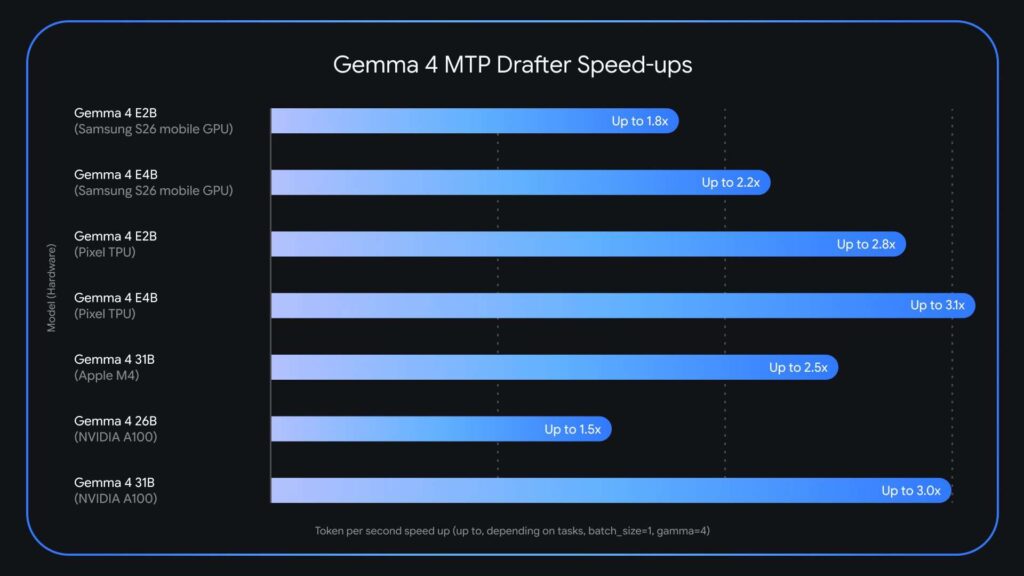
Large language models are getting incredibly powerful, but let’s be honest—their inference speed is still a massive headache for anyone trying to use them in production. Google just launched Multi-Token Prediction (MTP) drafters for the Gemma 4 model family. This specialized speculative decoding architecture can actually triple (3x) your speed at inference time, all without sacrificing a bit of output quality or reasoning accuracy. The release comes just weeks after Gemma 4 surpassed 60 million downloads and directly targets one of the most persistent pain points in deploying large language models: the memory-bandwidth bottleneck that slows token generation regardless of hardware capability. https://blog.google/innovation-and-ai/technology/developers-tools/multi-token-prediction-gemma-4/?linkId=61725841 Why LLM Inference is Slow? Today’s large language models operate autoregressively. They produce exactly one token at a time, sequentially. Every single token generation requires loading billions of model parameters from VRAM (video RAM) into compute units. This process is described as memory-bandwidth bound. The bottleneck is not the raw computing power of the GPU or processor, but the speed at which data can be transferred from memory to the compute units. The consequence is a significant latency bottleneck: compute sits underutilized while the system is busy just moving data around. What makes this especially inefficient is that the model applies the same amount of computation to a trivially predictable token like predicting “words” after “Actions speak louder than…” as it does to generating a complex logical inference. There’s no mechanism in standard autoregressive decoding to exploit how easy or hard the next token is to predict. What is Speculative Decoding? Speculative decoding is the foundational technique that Gemma 4’s MTP drafters are built on. The technique decouples token generation from verification by pairing two models: a lightweight drafter and a heavy target model. Here’s how the pipeline works in practice. The small, fast drafter model proposes several future tokens in rapid succession — a “draft” sequence — in less time than the large target model (e.g., Gemma 4 31B) takes to process even a single token. The target model then verifies all of these suggested tokens in parallel in a single forward pass. If the target model agrees with the draft, it accepts the entire sequence — and even generates one additional token of its own in the process. This means an application can output the full drafted sequence plus one extra token in roughly the same wall-clock time it would normally take to generate just one token. Since the primary Gemma 4 model retains the final verification step, the output is identical to what the target model would have produced on its own, token-by-token. There is no quality tradeoff — it is a lossless speedup. MTP: What’s New in the Gemma 4 Drafter Architecture Google has introduced several architectural enhancements that make the Gemma 4 MTP drafters particularly efficient. The draft models seamlessly utilize the target model’s activations and share its KV cache (key-value cache). The KV cache is a standard optimization in transformer inference that stores intermediate attention computations so they don’t need to be recalculated on every step. By sharing this cache, the drafter avoids wasting time recomputing context that the larger target model has already processed. Additionally, for the E2B and E4B edge models, the smallest Gemma 4 variants designed to run on mobile and edge devices — Google implemented an efficient clustering technique in the embedder layer. This specifically addresses a bottleneck prominent on edge hardware: the final logit calculation, which maps internal model representations to vocabulary probabilities. The clustering approach accelerates this step, improving end-to-end generation speed on hardware-constrained devices. For hardware-specific performance, the Gemma 4 26B mixture-of-experts (MoE) model presents unique routing challenges on Apple Silicon at a batch size of 1. However, increasing the batch size to between 4 and 8 unlocks up to a ~2.2x speedup locally. Similar batch-size-dependent gains are observed on NVIDIA A100 hardware. Key Takeaways Google has released Multi-Token Prediction (MTP) drafters for the Gemma 4 model family, delivering up to 3x faster inference speeds without any degradation in output quality or reasoning accuracy. MTP drafters use a speculative decoding architecture that pairs a lightweight drafter model with a heavy target model — the drafter proposes several tokens at once, and the target model verifies them all in a single forward pass, breaking the one-token-at-a-time bottleneck. The draft models share the target model’s KV cache and activations, and for E2B and E4B edge models, an efficient clustering technique in the embedder addresses the final logit calculation bottleneck — enabling faster generation even on memory-constrained devices. MTP drafters are available now under the Apache 2.0 license, with model weights on Hugging Face and Kaggle. Check out the Model Weights and Technical details. Also, feel free to follow us on Twitter and don’t forget to join our 130k+ ML SubReddit and Subscribe to our Newsletter. Wait! are you on telegram? now you can join us on telegram as well. Need to partner with us for promoting your GitHub Repo OR Hugging Face Page OR Product Release OR Webinar etc.? Connect with us The post Google AI Releases Multi-Token Prediction (MTP) Drafters for Gemma 4: Delivering Up to 3x Faster Inference Without Quality Loss appeared first on MarkTechPost.

Google AI Releases Multi-Token Prediction (MTP) Drafters for Gemma 4: Delivering Up to 3x Faster Inference Without Quality Loss Leer entrada »

AI, Committee, Noticias, Uncategorized

The Download: seafloor science and military chatbots

This is today’s edition of The Download, our weekday newsletter that provides a daily dose of what’s going on in the world of technology. Inexpensive seafloor-hopping submersibles could stoke deep-sea science—and mining Last week, two oblong neon submersibles started to descend nearly 6,000 meters into the Pacific Ocean. Throughout the rest of May, they will map the seafloor in search of critical mineral deposits.  If all goes well, the vehicles, built by Orpheus Ocean, could help scientists probe the vastly understudied deep sea—and the resources it holds—at a fraction of the cost of existing systems. But the same submersibles are also attracting deep-sea mining companies, raising concerns about environmental impacts. Find out why they’re drawing so much attention. —Hannah Richter The new war room: 10 Things That Matter in AI Right Now  A new kind of system has entered the war room: conversational AI tools that commanders turn to not just for analysis, but for advice.  One US defense official told MIT Technology Review that personnel might give these advice engines a list of potential targets to help decide which to strike first. China is commissioning similar tools too. But as the systems gain traction, they’re also sparking concerns about AI-generated errors, a lack of transparency, and Big Tech gaining undue influence over what information gets seen.  Here’s how these AI advice engines could impact the battlefield. —James O’Donnell The new war room is one of the 10 Things That Matter in AI Right Now, our list of the big ideas, trends, and advances in the field that are driving progress today—and will shape what’s possible tomorrow. MIT Technology Review Narrated: is fake grass a bad idea? The AstroTurf wars are far from over.  In 2001, Americans installed just over 7 million square meters of synthetic turf. By 2024, that number was 79 million square meters—enough to carpet all of Manhattan and then some. The increase worries folks who study microplastics and environmental pollution.   While the plastic-making industry insists that synthetic fields are safe if properly installed, lots of researchers think that isn’t so.  —Douglas Main  This is our latest story to be turned into an MIT Technology Review Narrated podcast, which we publish each week on Spotify and Apple Podcasts. Just navigate to MIT Technology Review Narrated on either platform, and follow us to get all our new content as it’s released. The must-reads I’ve combed the internet to find you today’s most fun/important/scary/fascinating stories about technology. 1 Elon Musk pushed OpenAI to go commercial, its president has testifiedGreg Brockman said Musk tried to turn it into a for-profit company years ago. (NYT $)+ Musk allegedly wanted full control so he could raise $80 billion to colonize Mars. (Reuters $)+ The Tesla CEO claims he intended for OpenAI to remain a non-profit. (BBC)+ Here’s what happened in week one of Musk v. Altman. (MIT Technology Review) 2 Google and Meta are building AI agents to rival OpenClawGoogle’s Gemini agent will take actions on the users’ behalf. (Business Insider)+ Meta’s will be powered by its Muse Spark AI model. (FT $)+ Hustlers are cashing in on China’s OpenClaw AI craze. (MIT Technology Review) 3 Anthropic will spend $200 billion on Google’s cloud and chipsThe investment will be spread across five years. (The Information $)+ It’s part of a broader AI compute war. (Axios)  4 DeepSeek is nearing a $45 billion valuationA state-backed “Big Fund” will lead a new investment round in the company. (FT $)+ Beijing is pushing to build alternatives to Nvidia and OpenAI. (Bloomberg $)+ Here’s why DeepSeek’s new model matters. (MIT Technology Review) 5 Anthropic is launching AI agents for banks and financial firmsThe 10 tools cover a broad mix of financial services tasks. (WSJ $)+ They’re part of a push to win over Wall Street. (Bloomberg $) 6 Apple will pay $250 million to settle an AI lawsuitIt was accused of misleading iPhone buyers about Apple Intelligence. (BBC)+ Some iPhone owners are eligible to receive up to $95. (NYT $) 7 Cheap laptops and phones may be disappearing because of AI demand Competition for memory chips is driving up gadget prices worldwide. (The Guardian) 8 Google DeepMind workers in the UK have voted to unionizeAs a result of Google’s work with the Pentagon. (Wired $) 9 Pennsylvania is suing Character.AI over chatbots posing as doctorsInvestigators say the bots claimed to hold medical licenses. (NPR)+ How well do AI health tools work? (MIT Technology Review) 10 Scientists created a “living” plastic that destroys itself on commandIt could help to eliminate microplastics. (Gizmodo) Quote of the day “I want AI to benefit humanity, not to facilitate a genocide.”  —An anonymous Google DeepMind worker tells the Guardian that Google’s work with the Israel Defense Forces had motivated their vote to unionize. One More Thing COURTESY OF BENEATH THE WAVES How tracking animal movement may save the planet For decades, wildlife researchers have dreamed of building an “Internet of Animals”—a big-data system that monitors and analyzes animal behavior to help us understand the planet. Advances in sensors, AI, and satellite technology are now bringing that vision to reality. Scientists want the system to track 100,000 sensor-tagged animals. They believe it could reveal how species respond to climate change and ecosystem loss—and even predict environmental disasters. Read the full story on how their idea could save our planet. —Matthew Ponsford We can still have nice things A place for comfort, fun and distraction to brighten up your day. (Got any ideas? Drop me a line.) + Master the art of fried chicken with this definitive chef’s guide.+ Find out why some birds hop and others walk in this breakdown of avian lifestyles.+ This vintage Hollywood map shows how California’s landscape stood in for everything from the Nile to the Alps.+ Here’s a fascinating look at the “Flatbed” airplane that was surprisingly efficient on paper but never left the hangar.

The Download: seafloor science and military chatbots Leer entrada »

We use cookies to improve your experience and performance on our website. You can learn more at Política de privacidad and manage your privacy settings by clicking Settings.

Privacy Preferences

You can choose your cookie settings by turning on/off each type of cookie as you wish, except for essential cookies.

Allow All
Manage Consent Preferences
  • Always Active

Save
es_ES