Why worms (and microbes) are catching on as a manure pollution solution
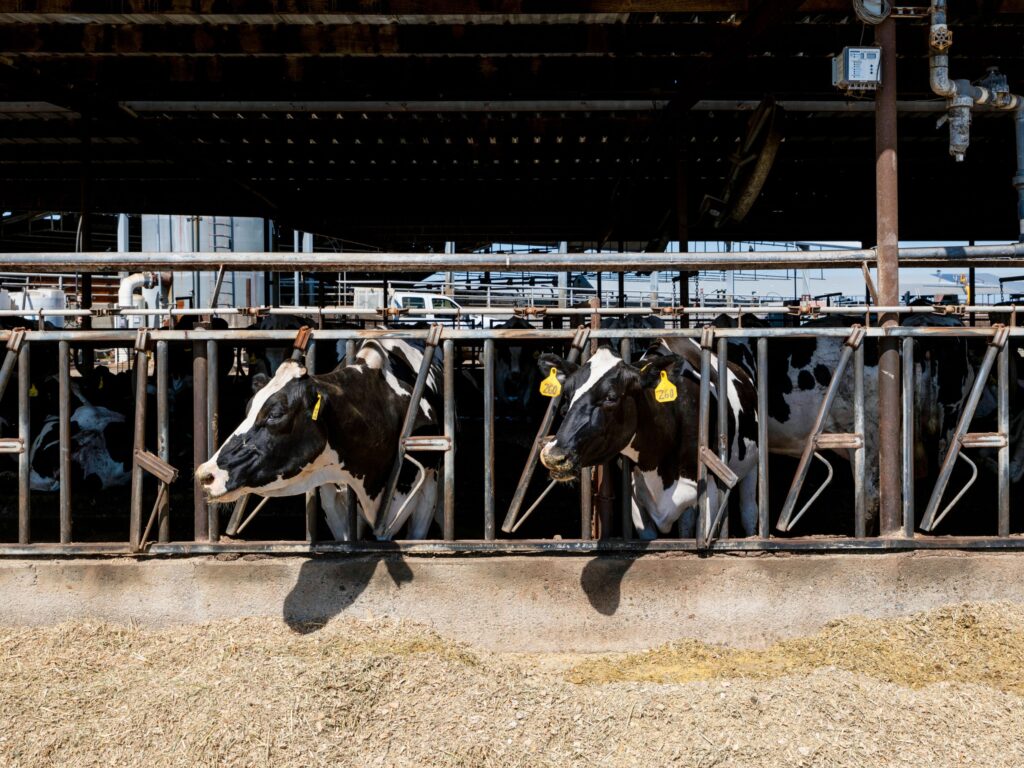
Anthony Agueda, a third-generation California dairy farmer, pulls a rake through a bed of dark, wet wood chips on his family’s land in Hickman, a tiny town in the state’s agricultural heartland. He reaches down with both hands and pulls up a clump of muck, turning it over to reveal a half-dozen squirming red earthworms. There are likely hundreds of thousands more wriggling just under the surface of the three-foot mound of wood and crushed river rock before us, which stretches across the equivalent of six football fields. These natural materials form a biofilter that may dramatically cut the methane, nitrous oxide, and water pollution generated by the massive amounts of manure that hundreds of Holstein cows produce each day. Agueda’s family business, the Alberto Dairy, was one of the first cattle operations in California to adopt this approach to manure treatment, developed and patented by the Chilean company BioFiltro. Eight more of these so-called vermifiltration systems are already operating on US dairies, according to the company, while another 16 are under construction or set to be next year, nearly all of them in California. Vermifiltration is just one of a variety of methods that farmers, companies, and scientists are employing to drive down manure pollution as the livestock industry faces growing pressure to address the environmental harms from one of the smelliest parts of the business. California, easily the nation’s largest milk producer, has established a handful of programs to promote their adoption, including one initiative that has funneled more than a billion dollars to farms. Researchers stress that much more work needs to be done to determine the most effective approaches, the trade-offs between them, and their success over the long term, under actual farm conditions. Agueda says that he and his family recognized the need to adopt new practices as environmental rules tightened. They were drawn to vermifiltration because it’s simple and relatively cheap compared with other, higher-tech options. “California daily farmers are constantly facing more and more regulation,” says Agueda, standing alongside one of the farm’s free-stall barns. “This makes me excited, because it shows how we are part of the solution.” The growing manure problem Manure is responsible for a significant portion of the climate pollution from livestock operations. The World Resources Institute estimates that manure management on dairy and swine farms accounts for 1.6% of the US’s greenhouse-gas emissions. Globally, manure storage and processing makes up about 10% of the livestock industry’s contributions to climate change. “Farms have become larger in the past two decades or so, so there’s much more manure—and that has to be stored somewhere,” says Swati Hegde, the organization’s global manager of agricultural methane. Typically, cattle and swine farms spray manure into lagoons or tanks, creating a foul-smelling, low-oxygen slurry in which microorganisms known as methanogens thrive. They gobble up hydrogen, carbon dioxide, and other compounds and produce methane as a by-product. Other microbes in the mix produce smaller amounts of nitrous oxide. A pair of Holstein cows poke their heads through the rails of a free-stall barn at the Alberto Dairy.JOE PROUDMAN/UC DAVIS Both are particularly potent greenhouse gases, with as much as 30 to nearly 275 times the warming power of carbon dioxide, respectively, over a century. The slurry is often spread onto fields to add nutrients to the soil. When it’s done excessively or improperly, this part of the practice can pollute soil or groundwater with drug residues, pathogens like salmonella and E. coli, and nitrates. Nitrates that leach into drinking water have been linked to a variety of human health risks. And those that flow into rivers, lakes, and coastal waters can spawn algae blooms that poison fish, block sunlight, suck up oxygen, or form large coastal dead zones devoid of marine life. Policy drivers A number of regions, nations, and states have passed regulations or offered subsidies designed to limit the pollution from livestock manure, but so far, most of the major initiatives have focused on water contamination rather than greenhouse-gas emissions. The European Union, for instance, restricts the amount of manure that farmers can apply to fields and requires member nations to monitor nitrate levels in ground and surface water. The US’s Clean Water Act requires large livestock operations to obtain permits and develop manure management plans that limit pollution. But California has arguably done the most to use government policy specifically to drive down the methane emissions from livestock. The dairy industry accounts for about 45% of the state’s pollution from the potent greenhouse gas, and more than half of that comes from manure, according to the government’s estimates. In 2016, the state enacted a law that requires dairies, landfills, and other businesses to cut methane emissions 40% below 2013 levels by 2030, as part of a broader effort to reduce pollution from powerful but short-lived greenhouse gases. The measure directed the California Air Resources Board, the state’s main climate regulatory agency, to set up various incentive programs to encourage these industries to shift to cleaner practices. “In terms of bang for your buck, short-term benefits, methane can go a long way toward reaching climate goals,” says Tawny Mata, director of California’s Office of Agricultural Resilience and Sustainability. Between these various programs—and falling livestock numbers in the state—the dairy sector is on track to reduce annual methane emissions by the equivalent of 5 million metric tons of carbon dioxide by 2030, the state estimates. That would still fall about 4 million tons short of the target under the 2016 law. The downsides of dairy digesters Excluding the decline in herd populations—which has been driven by growing international competition and rising costs—the vast majority of California’s estimated methane reductions come from the use of what are known as anaerobic digesters. This technology entails covering the slurry lagoons to prevent methane from leaking into the air and then piping the biogas into separate vessels, where it’s cleaned and converted into natural gas. Under California’s Low Carbon Fuel Standard program, dairies that use digesters to produce
Why worms (and microbes) are catching on as a manure pollution solution Leer entrada »