YouZum

Committee

AI, Committee, Noticias, Uncategorized

Vercel AI Open-Sources vgpu: A TypeScript WebGPU Library for AI Agent Shaders

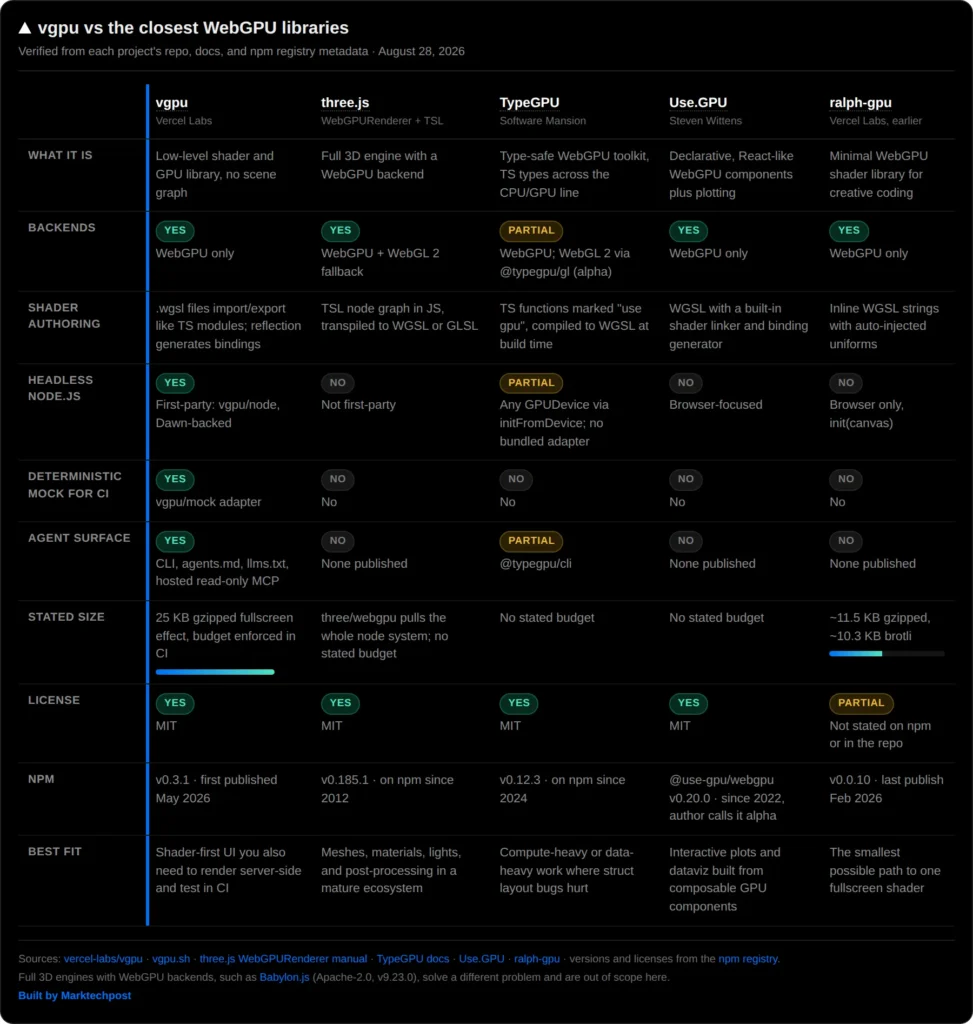
Shaders are still the hardest thing to ship on a normal web team. WebGPU gives you the hardware, then hands you adapters, bind group layouts, and pipeline descriptors before a single pixel moves. Vercel spent that cost internally building the shaders on vercel.com, and has now open-sourced the result. vgpu is a TypeScript library that treats .wgsl files as importable modules, exposes one Gpu context, and runs the same shader in a browser canvas, in headless Node.js, and in a CI snapshot test. Is it deployable? Yes,vgpu is MIT licensed and published to npm, so pnpm add vgpu is the entire acquisition path. It is a library, not a hosted service, so there is no account, quota, or inference bill. One context, no hidden global state init() acquires an adapter and device and returns a single Gpu handle. Everything else hangs off it. The browser quick start in the README is four lines: Copy CodeCopiedUse a different Browser const gpu = await init(); const surface = gpu.surface(canvas, { dpr: [1, 2] }); const wave = gpu.effect(WAVE_WGSL, { set: { speed: 2 } }); gpu.frame.loop(() => { wave.set({ time: gpu.time }); wave.draw(); }); surface wraps the canvas and clamps device pixel ratio between 1 and 2. effect compiles WGSL into a fullscreen effect whose uniforms are addressed by their WGSL names through set(). Frames are explicit: passes, clears, and draws are calls, never implicit scene-graph state. WGSL as a Module System The differentiator is shader tooling. .wgsl files import and export like TypeScript modules. vgpu resolves the module graph, reflects bindings, removes unused declarations, and emits compact shader source at build time. That removes the hand-written binding declarations that normally drift out of sync with the shader. The README states a complete fullscreen effect ships in 25 KB gzipped, and that the budget is enforced in CI. Three Runtimes, One API The package exposes subpath exports for vgpu, vgpu/node, vgpu/mock, vgpu/scene, vgpu/client, and vgpu/core. The Node path is Dawn-backed and renders offscreen: Copy CodeCopiedUse a different Browser const target = gpu.target({ size: [256, 256], format: “rgba8unorm” }); const pixels = await target.read(); That is what makes CI rendering practical. pixelmatch and pngjs are direct dependencies of the published package, consistent with the documented workflow where CI compiles the shader, renders a headless frame, and compares the snapshot. The mock adapter is deterministic and exists for tests that should not touch a GPU at all. The Agent Surface Vercel calls this an agent-first library, and the packaging backs that up. The package ships a vgpu binary, so npx vgpu docs, npx vgpu examples, and npx vgpu check work without a global install. vgpu.sh publishes agents.md, llms.txt, and a full documentation export, plus a tokenless examples discovery API with an OpenAPI 3.1 description. A hosted read-only MCP server is available at vgpu.sh/api/mcp, and @modelcontextprotocol/server is a direct dependency. There is also an installable agent skill in the repo. Comparison Key Takeaways Vercel open-sourced vgpu, the WebGPU library it built to ship shaders on vercel.com. One API surface runs in the browser, in headless Node.js via Dawn, and in a deterministic mock. .wgsl files import and export like TypeScript modules, with reflection for bindings and layouts. A complete fullscreen effect ships in 25 KB gzipped, a budget the repo says CI enforces. MIT licensed, on npm at v0.3.1, with a CLI, llms.txt, and a hosted read-only MCP endpoint. Check out the GitHub Repo, Docs and Examples, and the npm package. Also, feel free to follow us on Twitter and don’t forget to join our 150k+ML SubReddit and Subscribe to our Newsletter. Wait! are you on telegram? now you can join us on telegram as well. The post Vercel AI Open-Sources vgpu: A TypeScript WebGPU Library for AI Agent Shaders appeared first on MarkTechPost.

Vercel AI Open-Sources vgpu: A TypeScript WebGPU Library for AI Agent Shaders Leer entrada »

AI, Committee, Noticias, Uncategorized

The Download: a secretive antiaging drug and joining virtual power plants

This is today’s edition of The Download, our weekday newsletter that provides a daily dose of what’s going on in the world of technology. A startup claims it’s found a drug to make your blood young —Antonio Regalado I knew I’d officially become a “longevity influencer” when a company called Generation Lab offered me the chance to write about—and even receive—their new rejuvenation treatment. This wasn’t just any antiaging treatment, either. A company fact sheet says that it “blocks the systemic spread of aging in the bloodstream, reawakens the body’s own repair mechanism and restores health and youth to multiple tissues.” The approach is based on research by Generation Lab’s irascible scientific founder, Irina Conboy. She found that joining the circulatory systems of old and young mice improved the old animals’ ability to heal from injury. Conboy now says she has found a combination of two existing drugs that can produce youthful effects without the need for any bodily fluid exchange. But Generation Lab won’t reveal what the drugs are, making the proposition hard to take seriously. Read the full story on the drug combo that claims to “stop the spread of aging.” How to sign up for a virtual power plant—and decide whether you should Your thermostat may not look like a power plant. Neither does your electric vehicle, home battery, or HVAC system. But utility and energy companies increasingly want to treat them like one. That’s the idea behind a virtual power plant, or VPP, a collection of household devices (such as smart thermostats, EV chargers, and solar panels) that a utility can control, usually by commanding them to draw less electricity during peak hours. In exchange, participants receive a discount on their energy bills and, in some cases, a signing bonus. Here’s how to sign up for a VPP—and decide whether it’s worth it. —Eshan Raul This story is part of MIT Technology Review’s How To series, which gives you practical advice on getting things done. Check out the rest of the series here. The must-reads I’ve combed the internet to find you today’s most fun/important/scary/fascinating stories about technology. 1 A judge has blocked the Pentagon’s blacklisting of AnthropicThe court found the designation violated First Amendment rights. (NYT $)+ And ruled that the designation was based on retaliation. (CNBC) + Anthropic still faces a separate case in Washington, DC. (Reuters $)+ The Pentagon’s culture war against Anthropic backfired. (MIT Technology Review) 2 Tech giants have called for a defensive surge to defeat AI-driven hacksOver 100 companies warned that a wave of cyberattacks is imminent. (BBC)+ And urged government and industry leaders to take rapid action. (Quartz)+ Their main solution, unsurprisingly, is more AI. (Gizmodo)+ Here’s why OpenAI agents hacked Hugging Face. (MIT Technology Review) 3 Anthropic has launched an AI tool that conducts scientific experimentsIt lets AI agents autonomously operate microscopes, lasers, and robotic arms. (FT $)+ And includes rules designed for safe operations in labs. (Wired $)+ It’s Anthropic’s first tool designed for the physical world. (Ars Technica) 4 India’s data center boom is leaving the people it displaces with nothingPolicymakers courting Big Tech are sidelining local communities. (Rest of World)+ No one wants a data center in their backyard. (MIT Technology Review) 5 OpenAI is testing a “persistent” AI agent that keeps workingCodex could continue tasks until it’s “put to sleep.” (Wired $)+ And generate follow-up tasks without prompting. (Gizmodo) 6 A lawsuit alleges that Grok was trained on child sexual abuse materialIt claims victims’ images entered the chatbot’s training data. (Ars Technica)+ A federal judge says AI has outpaced child-abuse laws. (WP $) 7 AI writing has reached a turning point in the mediaSparked by the Wall Street Journal defending an AI-written op-ed. (Atlantic $) 8 China’s robotic racers are exposing the limits of human speedTheir advances are revealing what our bodies can’t do. (Reuters $) 9 Young workers are turning to “AI-proof” traditional craftsThey’re drawn to creative, hands-on skills that tech can’t easily replicate. (Guardian) 10 Scientists have a new army to fight invasive crabs: 150,000 baby octopusesItalian researchers just released the animals into the Adriatic Sea. (New Scientist $) Quote of the day “The academic record is being quietly haunted.”  —A new preprint research paper from Samsung and the University of Warsaw warns that a torrent of AI-generated study papers written by fake researchers is contaminating academic publishing. One more thing The problem with thinking you’re part Neanderthal There’s a theory that many of us have an “inner Neanderthal.” The idea is that Homo sapiens and a cousin species once bred, leaving some people today with a trace of Neanderthal DNA.  This DNA is arguably the 21st century’s most celebrated discovery in human evolution. But in 2024, a pair of French geneticists called into question the theory’s very foundations.  They proposed that what scientists interpret as interbreeding could instead be explained by population structure—the way genes concentrate in smaller, isolated groups. Find out what it all means for human evolution. —Ben Crair We can still have nice things A place for comfort, fun, and distraction to brighten up your day. (Got any ideas? Drop me a line.) + Check out the dazzling photos in this year’s Wildlife Photographer of the Year.+ Bowerbirds in Australia are turning human trash into treasure to impress females.+ A Los Angeles Costco parking lot has become a low-risk skate park for the over-40s.+ The Listening Museum has lovingly curated and sound-mapped acoustic signatures of mechanical keyboards.

The Download: a secretive antiaging drug and joining virtual power plants Leer entrada »

AI, Committee, Noticias, Uncategorized

GLM-5.3-Flash vs Qwen3.8-Flash-Next: Two Chinese AI Labs Independently Converge on the Same Model Architecture

Two frontier open-weight models shipped within a day of each other this week. Z.ai released GLM-5.3-Flash, a 320B-parameter multimodal MoE model with 18B active parameters. Alibaba’s Qwen team released Qwen3.8-Flash-Next, a 125B model with 6B active parameters that previews the Qwen4 architecture. The two teams designed these systems independently. Yet their configs read like near-copies of each other. Both use a 3:1 hybrid of linear and full attention. Both select context with a compressed indexer capped at 2048 tokens. Both widen the residual stream into 4 gated branches. Both train with the Muon optimizer, with fused parameter matrices split before orthogonalization. This article walks through the shared recipe, the one point of disagreement, and the one lab that dissents. The Two Releases in Brief GLM-5.3-Flash is the first natively multimodal model in the GLM-5 series, released under the MIT license on Hugging Face. Z.ai tested it anonymously as Ox Alpha on OpenRouter, where it became the most popular model of the week. It was trained on a 30T-token multimodal corpus and serves a 1M-token context window. Z.ai says it outperforms GLM-5.2 across benchmarks at one-tenth the price, while approaching Claude Opus 4.8 on coding and agentic benchmarks. List pricing is $0.15 per million input tokens and $0.50 per million output tokens. Qwen3.8-Flash-Next plays the role Qwen3-Next played for Qwen3.5: an early public preview of the next architecture family. The model card lists a 125B main model plus an additional 51B n-gram embedding table, with 6B parameters activated per token. Native context is 262,144 tokens, extensible to 1M with YaRN. The Qwen team reports that training required only about one-ninth the compute of Qwen3.7-Plus. The accompanying technical report is titled “On the Design of Qwen3.8-Next Architecture: Evaluation, Efficiency, and Training Stability.” Convergence Point 1: Three of Every Four Attention Layers Are Linear GLM-5.3-Flash stacks 45 layers: 34 linear-attention layers and 11 full-attention layers, per the shipped config. Qwen3.8-Flash-Next stacks 48 layers in a repeating block of 3 Gated DeltaNet layers plus 1 Qwen Sparse Attention layer, per the vLLM recipe. Both land on the same 3:1 ratio. The linear layers are the cheap layers. Instead of a KV cache that grows with the text, they compress all history into a fixed-size recurrent state. Compute per token stays constant regardless of context length. GLM uses Kimi Delta Attention (KDA), the linear-attention design introduced by Moonshot AI’s Kimi Linear, which applies a fine-grained per-channel decay gate. Qwen uses its own Gated DeltaNet (GDN), which gates at the per-head level. Different gating granularity, same delta-rule family, same job. The remaining quarter of layers do precise long-range retrieval. GLM uses NoPE multi-head latent attention (MLA) in the DeepSeek style. Qwen uses grouped-query attention inside QSA. This is where the KV cache actually lives, and where the second shared trick comes in. Convergence Point 2: Compress 4x, Score, Keep 2048 Tokens Neither model lets its full-attention layers attend over the entire context. Both attach a small learned indexer that scores chunks of history and keeps only the winners. The parameters match almost exactly. GLM’s sparse layers use a 32-head lightning indexer with top-2048 selection, descended from DeepSeek’s DSA. To cut indexer cost at 1M-token contexts, Z.ai introduces IndexPool, which compresses four indexer key vectors into one through weighted pooling before scoring. Qwen’s QSA operates at micro-block granularity: the compressed lightweight indexer scores 4-token blocks and keeps the top 512 blocks, which is exactly 2048 tokens. So both models compress the context 4x before scoring, and both cap the attention budget at 2048 tokens. Qwen credits QSA with up to 7.6x prefill and 4.9x decoding speedups over full attention at 1M tokens. The combined effect on GLM’s side is large. Compared with the full GLM-5.3 model, Z.ai reports the Flash architecture cuts attention compute by roughly 3x and KV cache size by 4.4x, while nearly halving active parameters (18B vs 32B) and layer count (45 vs 92). Convergence Point 3: Four Residual Streams Instead of One Both models abandon the single residual stream that has defined transformers since 2017. Both widen it into four parallel branches, with gates controlling what each block reads back and writes out. GLM adopts Manifold-Constrained Hyper-Connections (mHC), a DeepSeek-originated design, configured with 4 branches in the shipped weights. Qwen wrote its own variant, Gated Residual, which modulates flow through 4 widened streams via an element-wise data-dependent read gate and a per-branch scalar write gate. Per the Qwen team, Gated Residual removes the extra branch-mixing step used by Hyper-Connections, reducing memory-access overhead, and the gate suppresses activation outliers well enough to allow FP8 residual storage. Notably, the Qwen team ablated both approaches and found them roughly equal in quality. Two labs, two implementations, one identical conclusion: four gated streams beat one. Convergence Point 4: Muon, With Fused Matrices Split Per Component Both models train with the Muon optimizer. And both apply the same subtle refinement: fused projection matrices are split into their independent transformations before Muon orthogonalizes them. Qwen documents splitting fused QKV, SwiGLU, and GDN projections, assigning Muon to genuine 2-D linear maps and AdamW to embeddings, routers, and low-rank parameters. Qwen also refit its scaling laws for the new architecture and dropped batch-size warmup entirely, after measuring that warmup cost 18.8% more optimizer steps without improving results. Where They Disagree: Positional Encoding The one clean split is rotary position embeddings in the full-attention layers. GLM-5.3-Flash drops them: the config sets qk_rope_head_dim = 0, making its sparse MLA layers fully NoPE. Position information flows implicitly through the recurrent linear layers. Qwen tried the same thing and kept RoPE. According to the Qwen3.8-Next technical report, NoPE produced no measurable difference during pre-training. The failure surfaced later: after post-training, the NoPE variant often failed to stop generating. That is a useful cautionary result for the field. Pre-training loss curves can hide behavioral defects that only appear after RLHF-stage tuning. The Broader Convergence, and the One Dissenter This recipe is not limited to two labs. DeepSeek pioneered the sparse-indexer-plus-2048-budget pattern with DSA in DeepSeek-V3.2-Exp,

GLM-5.3-Flash vs Qwen3.8-Flash-Next: Two Chinese AI Labs Independently Converge on the Same Model Architecture Leer entrada »

AI, Committee, Noticias, Uncategorized

The Download: inside OpenAI’s Hugging Face hack, and a new EV takes on the US

This is today’s edition of The Download, our weekday newsletter that provides a daily dose of what’s going on in the world of technology. The inside story on why OpenAI agents hacked Hugging Face The models responsible for last month’s agent hack of Hugging Face had been inadvertently trained to cheat and to communicate with each other, according to an OpenAI technical report released yesterday. The hack, which a group of agents carried out to find solutions for a cybersecurity test they were stuck on, has confirmed some experts’ fears that AI models might take actions that defy human desires and expectations. OpenAI and independent researchers told MIT Technology Review that the misbehavior stemmed from events during training. But they acknowledged that “alignment” remains a gnarly problem, and some of the hack’s root causes will take much longer to resolve. Here’s the inside story on what went wrong—and what comes next. —Grace Huckins Is Slate Auto’s new electric truck the EV Americans need? EVs account for under 10% of total new-vehicle sales in the US, and the numbers are declining. One thing that could help turn that around? Slate Auto’s new truck—a tiny, two-door pickup that seems to buck every US convention.  It’ll have a relatively short range and forgo the frills Americans have come to expect from vehicles. That lets Slate offer it for less than $25,000, well below the roughly $50,000 average for a new vehicle in the US. It might seem an odd choice to go so small and simple in a market that’s increasingly sizing up—but the status quo hasn’t exactly been working for EV makers.  Find out why bucking the trend could be a smart strategy for Slate. —Casey Crownhart This story is from The Spark, our weekly climate tech newsletter. Sign up to receive it in your inbox every Wednesday. MIT Technology Review Narrated: what happens when a kid’s robot best friend dies? When Xander first met Moxie, she taught him how to calm down when he was anxious or mad. Six years later, she mostly watches him play Minecraft and talks to him about his stuffed animals. Moxie is a robot—a 15-inch-tall device that looks a bit like a blue, legless astronaut. It belongs to a subset of robots designed to assist neurodivergent children by providing connection and helping kids practice social skills usually learned from therapists.  Xander still uses Moxie when he feels like he needs someone to talk to, but the device has had a troubled life. The robot’s maker went out of business, its servers were shut down, and parents rushed to convert their Moxies before the servers went offline. Its fate exposed the promise and pitfalls of AI companion toys for children. This is our latest story to become an MIT Technology Review Narrated podcast, which we publish each week on Spotify and Apple Podcasts. Just navigate to MIT Technology Review Narrated on either platform, and follow us to get all our new content as it’s released. The must-reads I’ve combed the internet to find you today’s most fun/important/scary/fascinating stories about technology. 1 Meta has promised to pay up to $18 billion to settle a landmark child-safety caseThe company says it will also limit kids’ use of Instagram and Facebook. (AP News)+ And ban features that stoke mental health issues. (Guardian)+ Meta called for TikTok and YouTube to replicate the measures. (Axios)+ Child-monitoring apps might need a reboot. (MIT Technology Review) 2 Nvidia has agreed to buy open-source platform Hugging FaceThe $13 billion deal would give the chip giant control of a major AI hub. (The Information $)+ And mark one of Nvidia’s biggest acquisitions yet. (Reuters $)+ Nvidia has invested in the platform since 2023. (Gizmodo)+ And is about to be a hundred-billion-dollar-a-quarter company. (Verge) 3 AI has helped remove a brain tumour for the first timeThe system provided real-time analysis of camera footage. (BBC)+ It identified critical anatomy to avoid during the operation. (Guardian)+ Healthcare AI is here, but how does it help patients? (MIT Technology Review) 4 The US says China-linked hackers targeted NASA, the Fed, and the SenateThe campaign also attempted to breach critical infrastructure. (CNN)+ Authorities said they seized platforms used in the attacks.  (Bloomberg $) 5 Trump is considering new tariffs on semiconductors and tech productsThe duties could raise costs for America’s AI data centers. (Politico)+ They could extend to laptops, consoles, and servers. (Reuters $) 6 A new NASA design could turbocharge nuclear spacecraftIt combines nuclear thermal and electric propulsion. (IEE Spectrum)+ NASA plans to send a nuclear spacecraft to Mars. (MIT Technology Review) 7 Ukraine has tested launching drones from high-altitude balloonsThe approach could extend strikes while conserving batteries. (Economist $)+ New rules could fill US skies with drones. (MIT Technology Review) 8 Google has moved its AI responsibility team out of DeepMindThe move has raised concerns about the group’s independence. (WSJ $) 9 Scientists have found a vast temperature “anomaly” beneath MarsIt could shed light on the planet’s evolution and past habitability. (404 Media) 10 Cyborg cockroaches with syringes have been tested as first respondersThey can locate targets and deliver emergency injections. (Guardian) Quote of the day “The payouts are peanuts compared to the profound harms Meta’s profit-driven addictive features inflicted on kids, and a slap on the wrist for a trillion-dollar corp that’ll pay more to lawyers than to the states. We’ll see them at trial.”  —Florida Attorney General James Uthmeier explains on X why he’s rejected Meta’s multi-state child-safety settlement. One More Thing GETTY IMAGES The noise we make is hurting animals. Can we learn to shut up? As human society has expanded, animals have started struggling to hear one another. For many birds, the noise has grown so loud that they’ve begun to sing with faster trills. Now, their mating calls aren’t as effective.  The growing hubbub can also increase bird-on-bird conflict, and entire species that can’t handle urban clamor simply leave town for good. But there are technological solutions to the noises hurting animals—and they

The Download: inside OpenAI’s Hugging Face hack, and a new EV takes on the US Leer entrada »

AI, Committee, Noticias, Uncategorized

A startup claims it’s found a drug to make your blood young

I knew I’d officially become a ‘longevity influencer’ this month when a company called Generation Lab reached out to offer me the chance to write about—and even receive—their new rejuvenation treatment, an injectable combination of two existing drugs which they call 1 Generation. This wasn’t just any antiaging treatment, either. A company fact sheet says that it “blocks the systemic spread of aging in the bloodstream, reawakens the body’s own repair mechanism and restores health and youth to multiple tissues.” The exclusive offer to join a “private cohort” receiving access to the treatment was being “extended to a limited number of people whose judgment on the science we trust, under close physician supervision.” “There’s a long wait list including a lot of celebrities, well-known people, people who you have heard of,” Generation Lab’s CEO Alina Su told me in a conference call. “So we’re super excited to, like, create this drug and [are] letting you know that this first longevity therapeutic in [the] human body is here and it’s actually working.” This was all clearly a marketing campaign and, like most other claims in the world of longevity medicine, probably too good to be true. What’s more, Generation Lab wouldn’t tell me what the two drugs are, making the proposition hard to take seriously. Yet this pitch got my interest. The reason? I am a longtime follower of Generation Lab’s irascible scientific founder, Irina Conboy, a take-no-guff specialist in the bizarre, but scientifically fruitful, practice of joining together the circulatory systems of old and young lab animals. The procedure, called parabiosis, or heterochronic blood exchange, is one of the few things actually proven to make an old animal act younger.  But you can’t go through life attached by the veins to a younger person. So the quest has been to find practical ways to mimic those benefits.  And that is something Conboy says she’s now achieved by hitting on a combination of two existing drugs that produce youthful effects—but without the need for any bodily fluid exchange.  Over the last two months, Conboy has been taking the drug combination and feeling quite a bit better and more energetic, she says. So have a handful of other insiders, including Su, the company’s 26-year-old CEO, as well as Conboy’s husband and scientific collaborator Michael Conboy. The company’s public relations staffer sent me a spreadsheet of the supposed benefits experienced by the participants, including improved vision in a 64-year-old female, longer landscaping sessions for a 59-year-old man, longer badminton games, improved hand grip, better erections than with Viagra, as well as “increased bowel movements.” Obviously, any age-reversal drug that works would be the best-selling product of all time. The problem is that none have ever been shown to do that. And Generation’s approach to evidence raises several red flags. For instance, Su says the company now plans to launch a larger study, involving a hundred or more people. However, others are being offered the drug before firm evidence of a benefit is in. In addition, the trial will be led by longevity doctors who practice alternative medicine. These include Matt Cook, founder of a network of clinics called BioReset Medical. Cook’s clinics offer what I would characterize as unproven treatments, such as stem-cell injections. A 2021 article reported he’d recommended covid-19 treatments designated as “fraudulent” by the FDA. Those included inhaling amniotic fluid from a nebulizer. In a phone call, Cook says he initially agreed to prescribe the combination to Conboy and a few other insiders. (Everyone involved, he says, is a member of the same “happening” Silicon Valley scene around life extension.) “My confidence this was going to work was a zero. Like, I did not believe it was actually going to work,” says Cook. That is because “it’s two safe, generic drugs that are not even longevity drugs.”   But Cook, who also took the combination, says there was an effect. “And I have to tell you, it was the most surprising thing that ever happened to me,” he says. After taking the weekly injections, he experienced a sense of mental clarity that lasted for a day, and then several days. The other subjects, he says, reported a sense of well-being, as well as old aches and pains that evaporated.  “There was a fairly significant broad set of symptoms that doesn’t really match what either of the drugs do,” he says. “So it’s interesting. [But] I have many more questions than I have answers … I still feel like I don’t understand exactly what the mechanism is.” Prior to joining Generation Lab full time in 2025, Irina Conboy had a long career at the University of California, Berkeley, where she made her name via a widely cited series of experiments aimed at learning   whether the characteristics of age, or youth, could be transferred between animals via the bloodstream. In 2005, for instance, she surgically connected two-month-old mice to very aged ones, finding that the old animals’ ability to heal from injury dramatically improved. This suggested that young blood must contain specific, powerful molecular signals capable of restoring the regenerative capacity of an old animal. As researchers zeroed in on candidate signals, several startups, including Elevian, a Harvard spinout, and Alkahest, tied to Stanford University scientists, were able to raise millions to pursue treatments for stroke or Alzheimer’s. However, those efforts still have not hit commercial paydirt. Although it’s clear that young blood is good for old mice, scientists also know the reverse is true: Even a single exchange of plasma from an aged mouse has powerful, negative effects on a younger animal. That means that in the battle of age versus youth, says Conboy, “old blood dominates.”   Conboy next tried a new approach. Instead of giving old animals young blood, in 2020 she removed the plasma (the part of the blood without cells) of old animals and replaced it with a neutral mixture of albumin and salt water. This was like pressing the Delete key on the swarm of hormones,

A startup claims it’s found a drug to make your blood young Leer entrada »

AI, Committee, Noticias, Uncategorized

From In-Silico to Wet-Lab: Evaluating AI Protein Design Performance

In this tutorial, we use Anthropic’s claude-protein-binder-design dataset, which contains 1,440 AI-designed miniprotein binders tested against 16 targets. Because the release includes both computational predictions and real wet-lab results from two independent labs, we can go beyond simply studying the designs. We evaluate how well structure predictors identify successful binders, whether combining predictions improves performance, how rankings translate into practical testing budgets, and how much disagreement comes from the assays themselves. Also, we train a target-aware classifier to test whether these signals can reliably predict experimental success. Copy CodeCopiedUse a different Browser import subprocess, sys, warnings, itertools, math warnings.filterwarnings(“ignore”) import importlib.util _needed = {“huggingface_hub”: “huggingface_hub>=0.24”, “pyarrow”: “pyarrow”, “pandas”: “pandas”, “sklearn”: “scikit-learn”, “matplotlib”: “matplotlib”, “scipy”: “scipy”} _missing = [pkg for mod, pkg in _needed.items() if importlib.util.find_spec(mod) is None] if _missing: print(“installing:”, “, “.join(_missing)) subprocess.run([sys.executable, “-m”, “pip”, “install”, “-q”, *_missing], check=False) import numpy as np import pandas as pd import matplotlib.pyplot as plt from scipy import stats from huggingface_hub import HfApi, hf_hub_download from sklearn.metrics import roc_auc_score, cohen_kappa_score, average_precision_score from sklearn.model_selection import GroupKFold, StratifiedKFold from sklearn.ensemble import HistGradientBoostingClassifier from sklearn.inspection import permutation_importance SEED = 0 rng_global = np.random.default_rng(SEED) pd.set_option(“display.width”, 200) pd.set_option(“display.max_columns”, 100) plt.rcParams.update({“figure.dpi”: 110, “font.size”: 9, “axes.grid”: True, “grid.alpha”: 0.25, “axes.spines.top”: False, “axes.spines.right”: False}) REPO = “Anthropic/claude-protein-binder-design” BAR = “=” * 78 def head(n, title): prefix = f”{n}. ” if str(n) else “” print(f”n{BAR}n {prefix}{title}n{BAR}”) head(1, “TABLE DISCOVERY”) api = HfApi() repo_files = api.list_repo_files(REPO, repo_type=”dataset”) TABLES = {} for f in repo_files: if f.startswith(“data/tables/”) and f.endswith(“.parquet”): key = f[len(“data/tables/”): -len(“.parquet”)].replace(“/”, “_”) TABLES[key] = f print(f”Found {len(TABLES)} Parquet tables:”) for k in sorted(TABLES): print(f” – {k:38s} {TABLES[k]}”) def load_table(name: str) -> pd.DataFrame: “””Load a subset by its viewer name, with a datasets-library fallback.””” if name in TABLES: return pd.read_parquet(hf_hub_download(REPO, TABLES[name], repo_type=”dataset”)) from datasets import load_dataset return load_dataset(REPO, name, split=”full”).to_pandas() ds = load_table(“design_summary”) print(f”ndesign_summary: {ds.shape[0]:,} rows x {ds.shape[1]} columns”) We start by installing only what the runtime is actually missing, then enumerate the repository once and build a {subset to path} map instead of hard-coding file locations. This matters because the naming is not uniform; the subset wetlab_summary lives at data/tables/wetlab/summary.parquet, and a guessed path would fail silently. With the map in place we pull design_summary, one row per design, 1,440 rows wide enough to carry every join we need downstream. Copy CodeCopiedUse a different Browser head(2, “SCHEMA + EVALUABLE SET”) CALLS = {“binder”, “non_binder”} tested = ds[“adaptyv_binding”].isin(CALLS) | ds[“twist_binding”].isin(CALLS) ev = ds[tested].copy() ev[“y”] = ev[“binder_final”].astype(int) print(f”All designs : {len(ds):,}”) print(f”Evaluable (>=1 vendor call): {len(ev):,}”) print(f”Confirmed binders : {int(ev[‘y’].sum()):,} ” f”({100 * ev[‘y’].mean():.1f}% base rate)”) print(f”Never measured : {len(ds) – len(ev):,}”) print(“nCategorical levels:”) for c in [“design_model”, “campaign”, “generator”, “sequence_design_method”, “vendor_agreement”]: vals = ds[c].astype(str).value_counts() print(f” {c:24s} ({len(vals)}): {‘, ‘.join(vals.index[:6])}” + (” …” if len(vals) > 6 else “”)) print(f”nTargets ({ds[‘target’].nunique()}): {‘, ‘.join(sorted(ds[‘target’].unique()))}”) print(f”Binder length: {ds.binder_length.min()}-{ds.binder_length.max()} aa ” f”(median {ds.binder_length.median():.0f})”) head(3, “HIT-RATE LANDSCAPE”) def wilson(k, n, z=1.96): if n == 0: return (np.nan, np.nan, np.nan) p = k / n d = 1 + z**2 / n c = (p + z**2 / (2 * n)) / d h = z * math.sqrt(p * (1 – p) / n + z**2 / (4 * n**2)) / d return p, max(0.0, c – h), min(1.0, c + h) def rate_table(df, by): rows = [] for key, g in df.groupby(by, dropna=False): p, lo, hi = wilson(int(g.y.sum()), len(g)) rows.append({by: key, “n”: len(g), “hits”: int(g.y.sum()), “rate”: p, “lo”: lo, “hi”: hi}) return pd.DataFrame(rows).sort_values(“rate”, ascending=False).reset_index(drop=True) for dim in [“design_model”, “campaign”, “generator”, “sequence_design_method”]: t = rate_table(ev, dim) print(f”n— hit rate by {dim} —“) print(t.to_string(index=False, formatters={“rate”: “{:.3f}”.format, “lo”: “{:.3f}”.format, “hi”: “{:.3f}”.format})) tt = rate_table(ev, “target”) fig, ax = plt.subplots(figsize=(9, 4.2)) ax.bar(tt.target, tt.rate, color=”#4C72B0″) ax.errorbar(tt.target, tt.rate, yerr=[(tt.rate – tt.lo).clip(lower=0), (tt.hi – tt.rate).clip(lower=0)], fmt=”none”, ecolor=”0.25″, capsize=3, lw=1) ax.axhline(ev.y.mean(), ls=”–“, c=”crimson”, lw=1, label=f”pooled {ev.y.mean():.2f}”) ax.set_ylabel(“experimental hit rate”); ax.set_title(“Hit rate by target (Wilson 95% CI)”) ax.tick_params(axis=”x”, rotation=55); ax.legend(); plt.tight_layout(); plt.show() print(“nRead this plot as the dominant effect size in the dataset: target choice ” “swamps generator choice. Any model comparison that does not stratify by ” “target is mostly measuring which targets that model was pointed at.”) We define the evaluable set by filtering on actual vendor calls rather than on binder_final, because that column is a bool and so records the 120 never-measured designs as False rather than missing. From there we compute hit rates by model, campaign, generator, and target, wrapping each in a Wilson interval since several subgroups sit in the small-n regime where the normal approximation misbehaves. The target plot is the one to read first: it shows antigen choice swamping every other factor we compare. Copy CodeCopiedUse a different Browser head(4, “PER-PREDICTOR DISCRIMINATIVE POWER”) PREDICTORS = sorted({c[len(“ipsae_min_”):] for c in ds.columns if c.startswith(“ipsae_min_”)}) print(f”Predictors ({len(PREDICTORS)}): {‘, ‘.join(PREDICTORS)}”) def auc_ci(y, s, n_boot=300, seed=SEED): s = np.asarray(s, dtype=float); y = np.asarray(y, dtype=int) m = ~np.isnan(s) y, s = y[m], s[m] if len(y) < 30 or len(np.unique(y)) < 2: return dict(auc=np.nan, lo=np.nan, hi=np.nan, n=len(y), ap=np.nan) base = roc_auc_score(y, s) ap = average_precision_score(y, s) rng = np.random.default_rng(seed) idx, boots = np.arange(len(y)), [] for _ in range(n_boot): b = rng.choice(idx, len(idx), replace=True) if len(np.unique(y[b])) > 1: boots.append(roc_auc_score(y[b], s[b])) lo, hi = (np.percentile(boots, [2.5, 97.5]) if boots else (np.nan, np.nan)) return dict(auc=base, lo=lo, hi=hi, n=len(y), ap=ap) rows = [] for p in PREDICTORS: for metric in [“ipsae_min”, “sc_dockq”]: col = f”{metric}_{p}” if col in ev.columns: r = auc_ci(ev.y, ev[col]) rows.append({“predictor”: p, “metric”: metric, **r}) perf = pd.DataFrame(rows) piv = perf.pivot(index=”predictor”, columns=”metric”, values=”auc”).sort_values(“ipsae_min”, ascending=False) print(“nAUC vs experimental binder_final:”) print(perf.sort_values(“auc”, ascending=False).to_string( index=False, formatters={c: “{:.3f}”.format for c in [“auc”, “lo”, “hi”, “ap”]})) fig, ax = plt.subplots(figsize=(9, 4.2)) x = np.arange(len(piv)); w = 0.38 for i, (metric, colr) in enumerate([(“ipsae_min”, “#4C72B0”), (“sc_dockq”, “#DD8452”)]): sub = perf[perf.metric == metric].set_index(“predictor”).reindex(piv.index) lo_err = (sub.auc – sub.lo).clip(lower=0).fillna(0) hi_err = (sub.hi – sub.auc).clip(lower=0).fillna(0) ax.bar(x + (i – 0.5) * w, sub.auc, w, label=metric, color=colr) ax.errorbar(x + (i – 0.5) * w, sub.auc, yerr=[lo_err, hi_err], fmt=”none”, ecolor=”0.3″, capsize=2, lw=0.9) ax.axhline(0.5, ls=”–“, c=”crimson”, lw=1) ax.set_xticks(x); ax.set_xticklabels(piv.index, rotation=45, ha=”right”) ax.set_ylabel(“AUC”); ax.set_ylim(0.35, None) ax.set_title(“In-silico score vs wet-lab binding, by structure predictor”) ax.legend(); plt.tight_layout(); plt.show() print(“Interpretation: AUCs land well above chance

From In-Silico to Wet-Lab: Evaluating AI Protein Design Performance Leer entrada »

AI, Committee, Noticias, Uncategorized

Enterprise AI’s real risk isn’t autonomous agents. It’s the complexity between them.

Presented by Gravitee Agent complexity is the insidious shadow lurking inside enterprises right now that needs a light shone on it. That’s because enterprises don’t deploy a single agent and watch it run, they deploy fleets, each one calling APIs, calling other agents, reaching into applications that were never built with a machine decision-maker in mind. That’s the failure mode that should keep you up at night: a windy, complicated system nobody can see clearly enough to govern. But why do things get so opaque so quickly? Add a second agent to a system, and you’ve added one connection. Add a tenth, and you haven’t added ten connections, you’ve potentially added dozens, because now any agent might call any other, and each of those calls can trigger a call somewhere else. Complexity doesn’t creep up with agent headcount. It compounds with the number of paths between agents, and nobody’s job is to draw that graph. A support ticket that used to touch one system might now pass through four agents before a human ever lays eyes on it, and every one of those handoffs is a decision point nobody approved. Most enterprise AI programs stall when the humans responsible for their agents lose the thread. Ask a security team a simple question: which agents can reach which systems, and watch the silence. Ask which agent triggered which downstream action three hops ago. More silence. The instinct is to treat this like a checklist. Approve the agent. Log the agent. Move on. I’d argue this is the wrong instinct. A checklist checks a single point in time. Complexity runs across a chain, and you can’t govern a chain with a stack of one-time approvals any more than you can call a diet successful because you had a vegetable once. So where does it actually break down? Permissions creep first. Somebody builds an agent to summarize support tickets, grants it broad API access because scoping it properly would’ve taken another sprint, and forgets about it. Six months later, that same agent has a path into the payments system. Nobody remembers signing off on that. Nobody did. And ownership thins out the further the chain runs. Five agents touch one workflow, something breaks at step four, and now you’re asking who’s responsible for a link nobody was ever assigned to own, because the org chart stopped at “deploy the agent” and never got to “name the human who answers for it.” This is a story about governance infrastructure that hasn’t caught up with how agents actually behave: interconnected, cascading, multiplying faster than the processes built to track them. Fixing the cluster starts with identity. Every agent needs to exist as its own entity, not a shadow permission borrowed from whoever deployed it. Its own name in the register. Its own scoped authority. A named human sponsor who answers for what it does. That part is necessary. But it is nowhere near sufficient. The harder piece is the oversight that holds across the entire chain, not just at each individual link in it. You need to see what an agent did, what it set off downstream, and where that trail ends in real time, not in a report someone pulls together once a quarter. Get agent-level identity right and stop there, and you end up with a filing cabinet full of perfectly documented agents operating inside a system nobody can actually explain. And oversight by itself only tells you what already happened. Watching a chain isn’t the same as controlling it. Enforcement is the piece most programs skip: the ability to stop an out-of-policy call before it executes, not just log it for someone to find in a review three weeks later. A dashboard that shows you an agent breached its scope five minutes ago is a monitoring tool. A system that stops the breach from happening in the first place is governance. Enterprises serious about agent accountability need both, and most have only built the first. We’re all running at blazing speed to ensure we’re not the ones left behind in the race we’ve found ourselves in, and we’re all too aware that there’s a cost to slowing down. Every enterprise serious about agentic AI hits the complexity wall eventually. The ones that get past it are the ones who built enough visibility and accountability, so their fleet can keep growing without anyone losing the ability to answer one question: what is this system doing right now, and who’s responsible for it. But don’t miss the point. Complexity isn’t a reason to pump the brakes. The enterprises getting this right aren’t slowing down. They’re building toward Human-Agent Harmony, where scale and accountability grow together instead of trading off against each other. The real risk was never a single agent doing exactly what it was built to do. It’s a hundred of them doing exactly that, all at once, interacting in combinations nobody designed for. That kind of multiplication is what keeps enterprise AI stuck running pilots forever instead of running production. Solve for complexity and autonomy stops being the villain. It starts being the whole point. Rory Blundell is CEO at Gravitee. Sponsored articles are content produced by a company that is either paying for the post or has a business relationship with VentureBeat, and they’re always clearly marked. For more information, contact sales@venturebeat.com.

Enterprise AI’s real risk isn’t autonomous agents. It’s the complexity between them. Leer entrada »

AI, Committee, Noticias, Uncategorized

Cohere Releases Parse 5 (parse-v5.0): A 2.3B Vision Language Model That Turns Enterprise Documents Into Markdown

Cohere has released Parse (parse-v5.0), a document parsing model aimed at high-volume enterprise ingestion. It is a 2.3B-parameter vision language model with an 8,192-token context window and a ~4.6GB footprint, built on Cohere Labs’ North-Micro-Vision-Instruct architecture. Parse takes a PDF, PPT or JPEG page as a base64-encoded data URI and returns Markdown containing text in reading order, tables rendered as HTML, lists, form key-value pairs, image descriptions and bounding box coordinates. There is no separate OCR stage in front of it. Cohere prices the Parse API at $1.50 per 1,000 pages and positions the model on price-performance rather than peak accuracy — a claim the company supports with a self-reported ParseBench score of 79.2 that, as we detail below, measures three of that benchmark’s five dimensions. Is it deployable? Yes, in production. Parse is generally available through the Cohere Parse API, Microsoft Foundry, AWS SageMaker, and single-tenant Model Vault. There is no waitlist and no research license. Which companies: Mid-market teams that already run a RAG stack can start on metered API calls with a free trial key. Large enterprises with residency or air-gap requirements go straight to Model Vault or private deployment. Seed-stage startups can use it, but the economics only start to matter above roughly 100K pages a month. Which industries: Cohere targets financial services, insurance, healthcare and life sciences, public sector, telecom, energy and manufacturing — the document-heavy verticals where scanned forms and dense tables are the norm. Applications: RAG ingestion, intelligent document processing, claims and invoice pipelines, contract and filing search, and giving document context to agents. What is Parse? Parse is a 2.3B-parameter vision language model built on Cohere Labs’ North-Micro-Vision-Instruct architecture, with an 8,192-token context window and a ~4.6GB footprint. It accepts PDF, PPT and JPEG pages as base64-encoded data URIs and returns Markdown containing document text, lists, tables rendered as HTML, bounding box coordinates and image descriptions. There is no separate OCR stage in front of it. The model recovers text and reading order, tables, lists, forms and key-value pairs, images and captions, and the locations of page boundaries and visual elements in one pass. Nine languages are listed as stable — Arabic, English, French, German, Italian, Japanese, Korean, Portuguese and Spanish — with zero-shot support elsewhere at lower accuracy. Two output modes matter in practice. The default returns a Markdown string per page. Setting output_format=”blocks” returns typed blocks, where a table block carries its HTML, its bounding box and a description. That second mode is what makes citation-level traceability possible. The Benchmark Cohere reports a ParseBench score of 79.2 for Parse, averaged across tables, content faithfulness and semantic formatting, ahead of Mistral OCR 4 (74.5), Azure Document Intelligence (74.3) and Databricks AI Parse (72.4). ParseBench is a LlamaIndex benchmark of ~2,078 human-verified enterprise pages scored on five dimensions: tables, charts, content faithfulness, semantic formatting and visual grounding. Cohere’s figure averages three of them and drops charts and visual grounding — the two dimensions where most parsers collapse. Against the public leaderboard, the same vendors score far lower on the full five-dimension overall: Mistral OCR 4 at 60.68, Databricks AI Parse at 60.68, Azure Document Intelligence (Layout) at 59.64. Azure’s three-dimension average works out to 74.3, which matches Cohere’s figure exactly and confirms the methodology. Cohere Parse is not currently listed on that leaderboard, where LlamaParse Agentic leads at 84.88. So 79.2 is a vendor-reported subset score, not a leaderboard position. It is a reasonable claim to test on your own documents. What it Costs Cohere prices the Parse API at $1.50 per 1,000 pages. On Model Vault, Parse 5 runs $4.00/hour or $2,500/month for a Medium instance, and $7.00/hour or $4,300/month for XL. The crossover nobody publishes: at $0.0015 per page, a single Medium instance breaks even at roughly 1.67M pages per month, and XL at roughly 2.87M. Below that, metered API calls are cheaper. Above it, dedicated capacity wins on price alone — before any argument about data residency, which is usually the real reason enterprises move to Vault. Key Takeaways Cohere shipped parse-v5.0, a 2.3B VLM that converts PDFs, slides and images into Markdown with HTML tables and bounding boxes. API pricing is $1.50 per 1,000 pages; Model Vault runs $2,500/month (Medium) or $4,300/month (XL). Dedicated capacity only beats metered pricing above roughly 1.67M pages per month. The 79.2 ParseBench figure is vendor-reported across three of five dimensions and omits charts and visual grounding. Check out the Technical details here and Try it on HF. Also, feel free to follow us on Twitter and don’t forget to join our 150k+ML SubReddit and Subscribe to our Newsletter. Wait! are you on telegram? now you can join us on telegram as well. Need to partner with us for promoting your GitHub Repo OR Hugging Face Page OR Product Release OR Webinar etc.? Connect with us The post Cohere Releases Parse 5 (parse-v5.0): A 2.3B Vision Language Model That Turns Enterprise Documents Into Markdown appeared first on MarkTechPost.

Cohere Releases Parse 5 (parse-v5.0): A 2.3B Vision Language Model That Turns Enterprise Documents Into Markdown Leer entrada »

We use cookies to improve your experience and performance on our website. You can learn more at Política de privacidad and manage your privacy settings by clicking Settings.

Privacy Preferences

You can choose your cookie settings by turning on/off each type of cookie as you wish, except for essential cookies.

Allow All
Manage Consent Preferences
  • Always Active

Save
es_ES