YouZum

Committee

AI, Committee, Noticias, Uncategorized

Optimizing Assembly Code with LLMs: Reinforcement Learning Outperforms Traditional Compilers

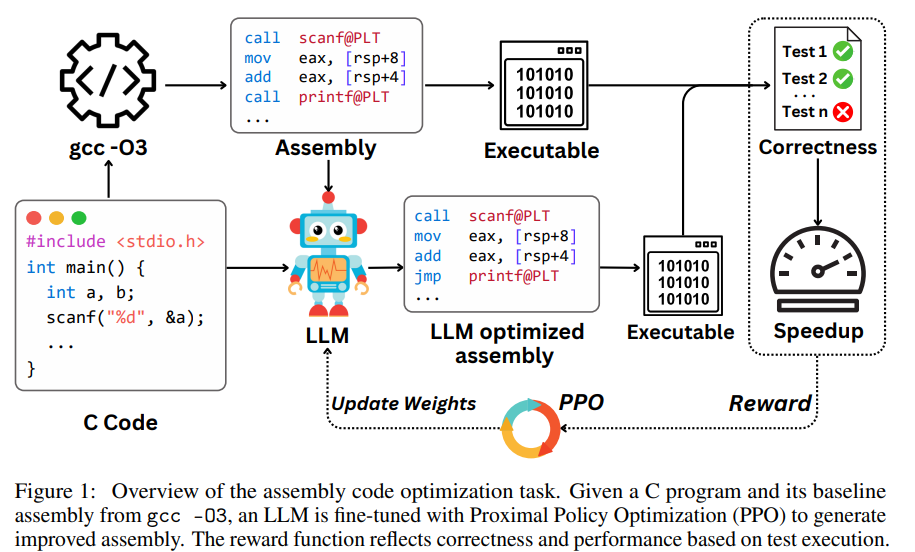
LLMs have shown impressive capabilities across various programming tasks, yet their potential for program optimization has not been fully explored. While some recent efforts have used LLMs to enhance performance in languages like C++ and Python, the broader application of LLMs to optimize code, especially in low-level programming contexts, remains limited. Existing LLM benchmarks largely focus on code generation from natural language or solving GitHub issues, as seen in HumanEval, MBPP, APPS, SWE-bench, and SWE-agent. Moreover, models such as Codex, AlphaCode, and Code Llama primarily aim to improve code generation quality rather than performance. However, select research has begun addressing optimization, including parallelization and code efficiency improvements, though many of these approaches are constrained by the need for formal verification, limiting scalability. In contrast, some newer methods embrace test-based validation, allowing optimization of more complex programs with loops. Learning-based strategies in compiler optimization—like AutoPhase, which uses reinforcement learning for pass sequencing, and Coreset, which applies graph neural networks—have shown promise in improving performance. Superoptimization techniques aim to find the most efficient version of a program but are typically restricted to small-scale problems. Additionally, frameworks like AutoTVM and Ansor have focused on optimizing GPU kernel code through statistical modeling and search. Recently, LLM-driven optimization has gained attention, with reinforcement learning approaches guiding LLMs using feedback from test cases. Techniques like CodeRL and PPOCoder leverage policy optimization methods to fine-tune models for better performance, even across resource-constrained programming languages like Verilog.  Stanford, UIUC, CMU, and Visa Research researchers explore using LLMs to optimize assembly code performance—an area traditionally handled by compilers like GCC. They introduce a reinforcement learning framework using Proximal Policy Optimization (PPO), guided by a reward balancing correctness and speedup over the gcc -O3 baseline. Using a dataset of 8,072 real-world programs, their model, Qwen2.5-Coder-7B-PPO, achieves a 96.0% test pass rate and a 1.47× average speedup, outperforming 20 other models, including Claude-3.7-sonnet. Their results show that with RL training, LLMs can effectively outperform conventional compiler optimizations.  The methodology involves optimizing compiled C programs for performance using an RL approach. Given a C program C, it is compiled to assembly P using gcc -O3. The goal is to generate a new assembly program P’ that is functionally equivalent but faster. Correctness is verified using a test set, and speedup is measured by execution time improvement. Using CodeNet as the dataset, the authors apply PPO to train a language model that generates improved code. Two reward functions—Correctness-Guided Speedup and Speedup-Only—are used to guide training based on program validity, correctness, and performance gains.  The study evaluates various language models on optimizing assembly code, revealing that most models struggle with low test pass rates and minimal speedups. However, Qwen2.5-Coder-7B-PPO, trained with reinforcement learning, significantly outperforms others, achieving 96% accuracy and a 1.47× average speedup. Ablation studies show that using gcc -O3 as a reference aids performance, while removing it leads to sharp declines. Notably, models like Claude-3.7-sonnet can surpass compilers by identifying hardware-specific optimizations, such as replacing loops with a single popcnt instruction, demonstrating their ability to perform semantic-level code transformations beyond traditional compiler capabilities.  In conclusion, the study explores using LLMs to optimize assembly code, a domain where traditional compilers struggle due to the complexity of low-level performance tuning. The authors fine-tune Qwen2.5-Coder-7B using PPO, rewarding both correctness (via test cases) and speedup over gcc -O3. They introduce a benchmark of 8,072 real-world C programs to evaluate performance. The model achieves a 96.0% test pass rate and a 1.47× average speedup, outperforming 20 other models, including Claude-3.7-sonnet. While effective, limitations include a lack of formal correctness guarantees and variability in hardware performance across systems.  Check out the Paper. All credit for this research goes to the researchers of this project. Also, feel free to follow us on Twitter and don’t forget to join our 95k+ ML SubReddit and Subscribe to our Newsletter. The post Optimizing Assembly Code with LLMs: Reinforcement Learning Outperforms Traditional Compilers appeared first on MarkTechPost.


Optimizing Assembly Code with LLMs: Reinforcement Learning Outperforms Traditional Compilers Leer entrada »

AI, Committee, Noticias, Uncategorized

Encoders and Decoders in Transformer Models

This article is divided into three parts; they are: • Full Transformer Models: Encoder-Decoder Architecture • Encoder-Only Models • Decoder-Only Models The original transformer architecture, introduced in “Attention is All You Need,” combines an encoder and decoder specifically designed for sequence-to-sequence (seq2seq) tasks like machine translation.

Encoders and Decoders in Transformer Models Leer entrada »

AI, Committee, Noticias, Uncategorized

This AI Paper Introduces Group Think: A Token-Level Multi-Agent Reasoning Paradigm for Faster and Collaborative LLM Inference

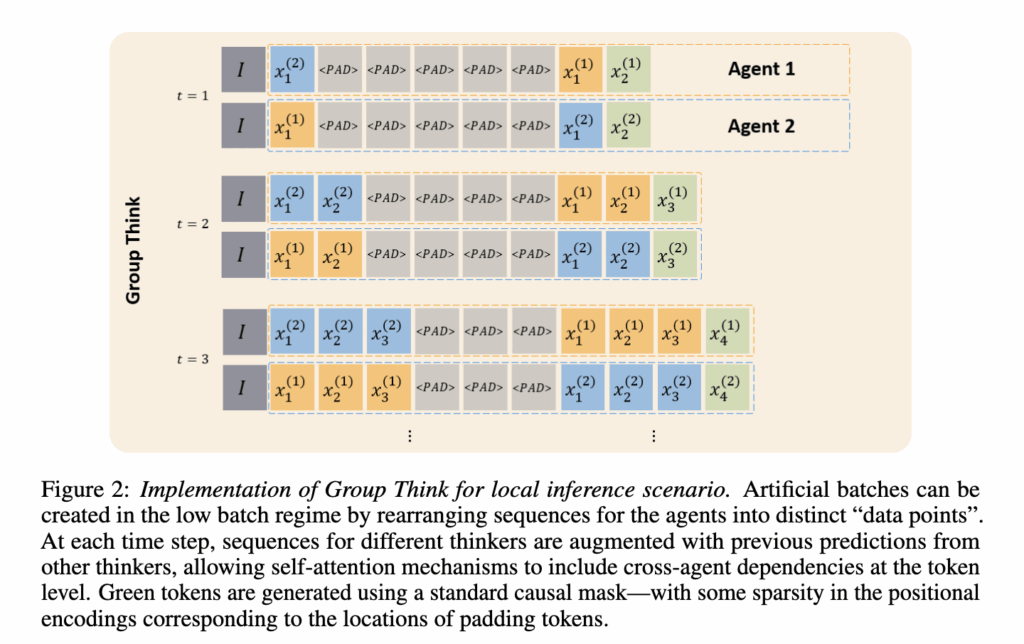
A prominent area of exploration involves enabling large language models (LLMs) to function collaboratively. Multi-agent systems powered by LLMs are now being examined for their potential to coordinate challenging problems by splitting tasks and working simultaneously. This direction has gained attention due to its potential to increase efficiency and reduce latency in real-time applications. A common issue in collaborative LLM systems is agents’ sequential, turn-based communication. In such systems, each agent must wait for others to complete their reasoning steps before proceeding. This slows down processing, especially in situations demanding rapid responses. Moreover, agents often duplicate efforts or generate inconsistent outputs, as they cannot see the evolving thoughts of their peers during generation. This latency and redundancy reduce the practicality of deploying multi-agent LLMs, particularly when time and computation are constrained, such as edge devices. Most current solutions have relied on sequential or independently parallel sampling techniques to improve reasoning. Methods like Chain-of-Thought prompting help models to solve problems in a structured way but often come with increased inference time. Approaches such as Tree-of-Thoughts and Graph-of-Thoughts expand on this by branching reasoning paths. However, these approaches still do not allow for real-time mutual adaptation among agents. Multi-agent setups have explored collaborative methods, but mostly through alternating message exchanges, which again introduces delays. Some advanced systems propose complex dynamic scheduling or role-based configurations, which are not optimized for efficient inference. Research from MediaTek Research introduced a new method called Group Think. This approach enables multiple reasoning agents within a single LLM to operate concurrently, observing each other’s partial outputs at the token level. Each reasoning thread adapts to the evolving thoughts of the others mid-generation. This mechanism reduces duplication and enables agents to shift direction if another thread is better positioned to continue a specific line of reasoning. Group Think is implemented through a token-level attention mechanism that lets each agent attend to previously generated tokens from all agents, supporting real-time collaboration. The method works by assigning each agent its own sequence of token indices, allowing their outputs to be interleaved in memory. These interleaved tokens are stored in a shared cache accessible to all agents during generation. This design allows efficient attention across reasoning threads without architectural changes to the transformer model. The implementation works both on personal devices and in data centers. On local devices, it effectively uses idle compute by batching multiple agent outputs, even with a batch size of one. In data centers, Group Think allows multiple requests to be processed together, interleaving tokens across agents while maintaining correct attention dynamics. Performance tests demonstrate that Group Think significantly improves latency and output quality. In enumeration tasks, such as listing 100 distinct names, it achieved near-complete results more rapidly than conventional Chain-of-Thought approaches. The acceleration was proportional to the number of thinkers; for example, four thinkers reduced latency by a factor of about four. In divide-and-conquer problems, using the Floyd–Warshall algorithm on a graph of five nodes, four thinkers reduced the completion time to half that of a single agent. Group Think solved code generation challenges in programming tasks more effectively than baseline models. With four or more thinkers, the model produced correct code segments much faster than traditional reasoning models. This research shows that existing LLMs, though not explicitly trained for collaboration, can already demonstrate emergent group reasoning behaviors under the Group Think setup. In experiments, agents naturally diversified their work to avoid redundancy, often dividing tasks by topic or focus area. These findings suggest that Group Think’s efficiency and sophistication could be enhanced further with dedicated training on collaborative data. Check out the Paper. All credit for this research goes to the researchers of this project. Also, feel free to follow us on Twitter and don’t forget to join our 95k+ ML SubReddit and Subscribe to our Newsletter. The post This AI Paper Introduces Group Think: A Token-Level Multi-Agent Reasoning Paradigm for Faster and Collaborative LLM Inference appeared first on MarkTechPost.
This AI Paper Introduces Group Think: A Token-Level Multi-Agent Reasoning Paradigm for Faster and Collaborative LLM Inference Leer entrada »

AI, Committee, Noticias, Uncategorized

The FDA plans to limit access to covid vaccines. Here’s why that’s not all bad.

This week, two new leaders at the US Food and Drug Administration announced plans to limit access to covid vaccines, arguing that there is not much evidence to support the value of annual shots in healthy people. New vaccines will be made available only to the people who are most vulnerable—namely, those over 65 and others with conditions that make them more susceptible to severe disease. Anyone else will have to wait. Covid vaccines will soon be required to go through more rigorous trials to ensure that they really are beneficial for people who aren’t at high risk. The plans have been met with fear and anger in some quarters. But they weren’t all that shocking to me. In the UK, where I live, covid boosters have been offered only to vulnerable groups for a while now. And the immunologists I spoke to agree: The plans make sense. They are still controversial. Covid hasn’t gone away. And while most people are thought to have some level of immunity to the virus, some of us still stand to get very sick if infected. The threat of long covid lingers, too. Given that people respond differently to both the virus and the vaccine, perhaps individuals should be able to choose whether they get a vaccine or not. I should start by saying that covid vaccines have been a remarkable success story. The drugs were developed at record-breaking speed—they were given to people in clinical trials just 69 days after the virus had been identified. They are, on the whole, very safe. And they work remarkably well. They have saved millions of lives. And they rescued many of us from lockdowns. But while many of us have benefited hugely from covid vaccinations in the past, there are questions over how useful continuing annual booster doses might be. That’s the argument being made by FDA head Marty Makary and Vinay Prasad, director of the agency’s Center for Biologics Evaluation and Research. Both men have been critical of the FDA in the past. Makary has long been accused of downplaying the benefits of covid vaccines. He made incorrect assumptions about the coronavirus responsible for covid-19 and predicted that the disease would be “mostly gone” by April 2021. Most recently, he also testified in Congress that the theory that the virus came from a lab in China was a “no-brainer.” (The strongest evidence suggests the virus jumped from animals to humans in a market in Wuhan.) Prasad has said “the FDA is a failure” and has called annual covid boosters “a public health disaster the likes of which we’ve never seen before,” because of a perceived lack of clinical evidence to support their use. Makary and Prasad’s plans, which were outlined in the New England Journal of Medicine on Tuesday, don’t include such inflammatory language or unfounded claims, thankfully. In fact, they seem pretty measured: Annual covid booster shots will continue to be approved for vulnerable people but will have to be shown to benefit others before people outside the approved groups can access them. There are still concerns being raised, though. Let’s address a few of the biggest ones. Shouldn’t I get an annual covid booster alongside my flu vaccine? At the moment, a lot of people in the US opt to get a covid vaccination around the time they get their annual flu jab. Each year, a flu vaccine is developed to protect against what scientists predict will be the dominant strain of virus circulating come flu season, which tends to run from October through March. But covid doesn’t seem to stick to the same seasonal patterns, says Susanna Dunachie, a clinical doctor and professor of infectious diseases at the University of Oxford in the UK. “We seem to be getting waves of covid year-round,” she says. And an annual shot might not offer the best protection against covid anyway, says Fikadu Tafesse, an immunologist and virologist at Oregon Health & Science University in Portland. His own research suggests that leaving more than a year between booster doses could enhance their effectiveness. “One year is really a random time,” he says. It might be better to wait five or 10 years between doses instead, he adds. “If you are at risk [of a serious covid infection] you may actually need [a dose] every six months,” says Tafesse. “But for healthy individuals, it’s a very different conversation.” What about children—shouldn’t we be protecting them? There are reports that pediatricians are concerned about the impact on children, some of whom can develop serious cases of covid. “If we have safe and effective vaccines that prevent illness, we think they should be available,” James Campbell, vice chair of the committee on infectious diseases at the American Academy of Pediatrics, told STAT. This question has been on my mind for a while. My two young children, who were born in the UK, have never been eligible for a covid vaccine in this country. I found this incredibly distressing when the virus started tearing through child-care centers—especially given that at the time, the US was vaccinating babies from the age of six months. My kids were eventually offered a vaccine in the US, when we temporarily moved there a couple of years ago. But by that point, the equation had changed. They’d both had covid by then. I had a better idea of the general risks of the virus to children. I turned it down. I was relieved to hear that Tafesse had made the same decision for his own children. “There are always exceptions, but in general, [covid] is not severe in kids,” he says. The UK’s Joint Committee on Vaccination and Immunology found that the benefits of vaccination are much smaller for children than they are for adults. “Of course there are children with health problems who should definitely have it,” says Dunachie. “But for healthy children in healthy households, the benefits probably are quite marginal.” Shouldn’t healthy people get vaccinated to help protect more vulnerable

The FDA plans to limit access to covid vaccines. Here’s why that’s not all bad. Leer entrada »

We use cookies to improve your experience and performance on our website. You can learn more at Política de privacidad and manage your privacy settings by clicking Settings.

Privacy Preferences

You can choose your cookie settings by turning on/off each type of cookie as you wish, except for essential cookies.

Allow All
Manage Consent Preferences
  • Always Active

Save
es_ES