YouZum

Committee

AI, Committee, Noticias, Uncategorized

Black Forest Labs Releases FLUX.2: A 32B Flow Matching Transformer for Production Image Pipelines

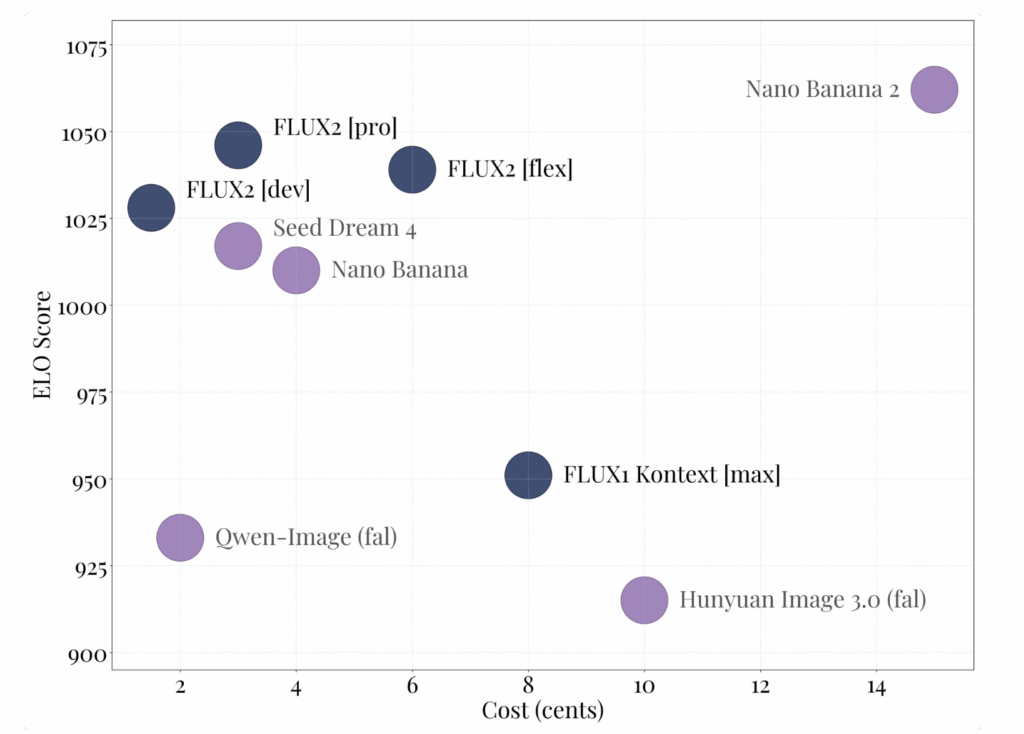
Black Forest Labs has released FLUX.2, its second generation image generation and editing system. FLUX.2 targets real world creative workflows such as marketing assets, product photography, design layouts, and complex infographics, with editing support up to 4 megapixels and strong control over layout, logos, and typography. FLUX.2 product family and FLUX.2 [dev] The FLUX.2 family spans hosted APIs and open weights: FLUX.2 [pro] is the managed API tier. It targets state of the art quality relative to closed models, with high prompt adherence and low inference cost, and is available in the BFL Playground, BFL API, and partner platforms. FLUX.2 [flex] exposes parameters such as number of steps and guidance scale, so developers can trade off latency, text rendering accuracy, and visual detail. FLUX.2 [dev] is the open weight checkpoint, derived from the base FLUX.2 model. It is described as the most powerful open weight image generation and editing model, combining text to image and multi image editing in one checkpoint, with 32 billion parameters. FLUX.2 [klein] is a coming open source Apache 2.0 variant, size distilled from the base model for smaller setups, with many of the same capabilities. All variants support image editing from text and multiple references in a single model, which removes the need to maintain separate checkpoints for generation and editing. Architecture, latent flow, and the FLUX.2 VAE FLUX.2 uses a latent flow matching architecture. The core design couples a Mistral-3 24B vision language model with a rectified flow transformer that operates on latent image representations. The vision language model provides semantic grounding and world knowledge, while the transformer backbone learns spatial structure, materials, and composition. The model is trained to map noise latents to image latents under text conditioning, so the same architecture supports both text driven synthesis and editing. For editing, latents are initialized from existing images, then updated under the same flow process while preserving structure. A new FLUX.2 VAE defines the latent space. It is designed to balance learnability, reconstruction quality, and compression, and is released separately on Hugging Face under an Apache 2.0 license. This autoencoder is the backbone for all FLUX.2 flow models and can also be reused in other generative systems. https://bfl.ai/blog/flux-2 Capabilities for production workflows The FLUX.2 Docs and Diffusers integration highlight several key capabilities: Multi reference support: FLUX.2 can combine up to 10 reference images to maintain character identity, product appearance, and style across outputs. Photoreal detail at 4MP: the model can edit and generate images up to 4 megapixels, with improved textures, skin, fabrics, hands, and lighting suitable for product shots and photo like use cases. Robust text and layout rendering: it can render complex typography, infographics, memes, and user interface layouts with small legible text, which is a common weakness in many older models. World knowledge and spatial logic: the model is trained for more grounded lighting, perspective, and scene composition, which reduces artifacts and the synthetic look. https://bfl.ai/blog/flux-2 Key Takeaways FLUX.2 is a 32B latent flow matching transformer that unifies text to image, image editing, and multi reference composition in a single checkpoint. FLUX.2 [dev] is the open weight variant, paired with the Apache 2.0 FLUX.2 VAE, while the core model weights use the FLUX.2-dev Non Commercial License with mandatory safety filtering. The system supports up to 4 megapixel generation and editing, robust text and layout rendering, and up to 10 visual references for consistent characters, products, and styles. Full precision inference requires more than 80GB VRAM, but 4 bit and FP8 quantized pipelines with offloading make FLUX.2 [dev] usable on 18GB to 24GB GPUs and even 8GB cards with sufficient system RAM. Editorial Notes FLUX.2 is an important step for open weight visual generation, since it combines a 32B rectified flow transformer, a Mistral 3 24B vision language model, and the FLUX.2 VAE into a single high fidelity pipeline for text to image and editing. The clear VRAM profiles, quantized variants, and strong integrations with Diffusers, ComfyUI, and Cloudflare Workers make it practical for real workloads, not only benchmarks. This release pushes open image models closer to production grade creative infrastructure. Check out the Technical details, Model weight and Repo. Feel free to check out our GitHub Page for Tutorials, Codes and Notebooks. Also, feel free to follow us on Twitter and don’t forget to join our 100k+ ML SubReddit and Subscribe to our Newsletter. Wait! are you on telegram? now you can join us on telegram as well. The post Black Forest Labs Releases FLUX.2: A 32B Flow Matching Transformer for Production Image Pipelines appeared first on MarkTechPost.

Black Forest Labs Releases FLUX.2: A 32B Flow Matching Transformer for Production Image Pipelines Leer entrada »

AI, Committee, Noticias, Uncategorized

Prompt Optimization as a State-Space Search Problem

arXiv:2511.18619v1 Announce Type: new Abstract: Language Models are extremely susceptible to performance collapse with even small changes to input prompt strings. Libraries such as DSpy (from Stanford NLP) avoid this problem through demonstration-based prompt optimisation. Inspired by this, I propose an alternative approach that treats prompt optimisation as a classical state-space search problem. I model the prompt space as a graph where nodes represent prompt states and edges correspond to deliberate transformations such as shortening, adding examples, or re- ordering content. Using beam search and random walk algorithms, I systematically explore this space, evaluating candidates on development sets and pruning unpromising branches. Across five NLP tasks (sentiment classification, question answering, summarisation, reason- ing, and natural language inference), I find that even shallow search configurations (beam width=2, depth=2) improve upon seed prompts on development sets. For instance, beam search achieves development accuracy gains from 0.40 to 0.80 on reasoning tasks, though test set improvements are more modest (0.20 to 0.50), indicating overfitting to the develop- ment heuristic. Analysis of successful optimisation paths reveals that transformations that make prompts concise appear most frequently, while verbosity operators are never selected. My results validate prompt optimization as a search problem and suggest that with greater computational resources and improved evaluation metrics, deeper exploration could yield more robust prompts that generalize beyond development sets. Code and implementation are available at [https://github.com/MaanasTaneja/PromptOptimiser].

Prompt Optimization as a State-Space Search Problem Leer entrada »

AI, Committee, Noticias, Uncategorized

GEM: Gaussian Embedding Modeling for Out-of-Distribution Detection in GUI Agents

arXiv:2505.12842v4 Announce Type: replace-cross Abstract: Graphical user interface (GUI) agents have recently emerged as an intriguing paradigm for human-computer interaction, capable of automatically executing user instructions to operate intelligent terminal devices. However, when encountering out-of-distribution (OOD) instructions that violate environmental constraints or exceed the current capabilities of agents, GUI agents may suffer task breakdowns or even pose security threats. Therefore, effective OOD detection for GUI agents is essential. Traditional OOD detection methods perform suboptimally in this domain due to the complex embedding space and evolving GUI environments. In this work, we observe that the in-distribution input semantic space of GUI agents exhibits a clustering pattern with respect to the distance from the centroid. Based on the finding, we propose GEM, a novel method based on fitting a Gaussian mixture model over input embedding distances extracted from the GUI agent that reflect its capability boundary. Evaluated on eight datasets spanning smartphones, computers, and web browsers, our method achieves an average accuracy improvement of 23.70% over the best-performing baseline while only increasing training time by 4.9% and testing time by 6.5%. We also experimentally demonstrate that GEM can improve the step-wise success rate by 9.40% by requesting assistance from the cloud model when encountering OOD samples. Analysis verifies the generalization ability of our method through experiments on nine different backbones. The codes are available at https://github.com/Wuzheng02/GEM-OODforGUIagents.

GEM: Gaussian Embedding Modeling for Out-of-Distribution Detection in GUI Agents Leer entrada »

AI, Committee, Noticias, Uncategorized

OpenGloss: A Synthetic Encyclopedic Dictionary and Semantic Knowledge Graph

arXiv:2511.18622v1 Announce Type: new Abstract: We present OpenGloss, a synthetic encyclopedic dictionary and semantic knowledge graph for English that integrates lexicographic definitions, encyclopedic context, etymological histories, and semantic relationships in a unified resource. OpenGloss contains 537K senses across 150K lexemes, on par with WordNet 3.1 and Open English WordNet, while providing more than four times as many sense definitions. These lexemes include 9.1M semantic edges, 1M usage examples, 3M collocations, and 60M words of encyclopedic content. Generated through a multi-agent procedural generation pipeline with schema-validated LLM outputs and automated quality assurance, the entire resource was produced in under one week for under $1,000. This demonstrates that structured generation can create comprehensive lexical resources at cost and time scales impractical for manual curation, enabling rapid iteration as foundation models improve. The resource addresses gaps in pedagogical applications by providing integrated content — definitions, examples, collocations, encyclopedias, etymology — that supports both vocabulary learning and natural language processing tasks. As a synthetically generated resource, OpenGloss reflects both the capabilities and limitations of current foundation models. The dataset is publicly available on Hugging Face under CC-BY 4.0, enabling researchers and educators to build upon and adapt this resource.

OpenGloss: A Synthetic Encyclopedic Dictionary and Semantic Knowledge Graph Leer entrada »

AI, Committee, Noticias, Uncategorized

How to Build a Neuro-Symbolic Hybrid Agent that Combines Logical Planning with Neural Perception for Robust Autonomous Decision-Making

In this tutorial, we demonstrate how to combine the strengths of symbolic reasoning with neural learning to build a powerful hybrid agent. We focus on creating a neuro-symbolic architecture that uses classical planning for structure, rules, and goal-directed behavior, while neural networks handle perception and action refinement. As we walk through the code, we see how both layers interact in real time, allowing us to navigate an environment, overcome uncertainty, and adapt intelligently. At last, we understand how neuro-symbolic systems bring interpretability, robustness, and flexibility together in a single agentic framework. Check out the FULL CODES here. Copy CodeCopiedUse a different Browser import numpy as np import matplotlib.pyplot as plt from dataclasses import dataclass, field from typing import List, Dict, Tuple, Set, Optional from collections import deque import warnings warnings.filterwarnings(‘ignore’) @dataclass class State: robot_pos: Tuple[int, int] holding: Optional[str] = None visited: Set[Tuple[int, int]] = field(default_factory=set) objects_collected: Set[str] = field(default_factory=set) def __hash__(self): return hash((self.robot_pos, self.holding)) class SymbolicPlanner: def __init__(self, grid_size: int = 8): self.grid_size = grid_size self.actions = [‘up’, ‘down’, ‘left’, ‘right’, ‘pickup’, ‘drop’] def get_successors(self, state: State, obstacles: Set[Tuple[int, int]], objects: Dict[str, Tuple[int, int]]) -> List[Tuple[str, State]]: successors = [] x, y = state.robot_pos moves = {‘up’: (x, y-1), ‘down’: (x, y+1), ‘left’: (x-1, y), ‘right’: (x+1, y)} for action, new_pos in moves.items(): nx, ny = new_pos if (0 <= nx < self.grid_size and 0 <= ny < self.grid_size and new_pos not in obstacles): new_state = State(new_pos, state.holding, state.visited | {new_pos}, state.objects_collected.copy()) successors.append((action, new_state)) if state.holding is None: for obj_name, obj_pos in objects.items(): if state.robot_pos == obj_pos and obj_name not in state.objects_collected: new_state = State(state.robot_pos, obj_name, state.visited.copy(), state.objects_collected.copy()) successors.append((‘pickup’, new_state)) if state.holding is not None: new_state = State(state.robot_pos, None, state.visited.copy(), state.objects_collected | {state.holding}) successors.append((‘drop’, new_state)) return successors def heuristic(self, state: State, goal: Tuple[int, int]) -> float: return abs(state.robot_pos[0] – goal[0]) + abs(state.robot_pos[1] – goal[1]) def a_star_plan(self, start_state: State, goal: Tuple[int, int], obstacles: Set[Tuple[int, int]], objects: Dict[str, Tuple[int, int]]) -> List[str]: counter = 0 frontier = [(self.heuristic(start_state, goal), counter, 0, start_state, [])] visited = set() while frontier: frontier.sort() _, _, cost, state, plan = frontier.pop(0) counter += 1 if state.robot_pos == goal and len(state.objects_collected) >= len(objects): return plan state_key = (state.robot_pos, state.holding) if state_key in visited: continue visited.add(state_key) for action, next_state in self.get_successors(state, obstacles, objects): new_cost = cost + 1 new_plan = plan + [action] priority = new_cost + self.heuristic(next_state, goal) frontier.append((priority, counter, new_cost, next_state, new_plan)) counter += 1 return [] We lay the foundation for our symbolic reasoning system and define how states, actions, and transitions work. We implement classical planning logic using A* search to generate goal-directed, interpretable action sequences. As we build this part, we establish the rule-based backbone that guides the agent’s high-level decisions. Check out the FULL CODES here. Copy CodeCopiedUse a different Browser class NeuralPerception: def __init__(self, grid_size: int = 8): self.grid_size = grid_size self.W1 = np.random.randn(grid_size * grid_size, 64) * 0.1 self.b1 = np.zeros(64) self.W2 = np.random.randn(64, 32) * 0.1 self.b2 = np.zeros(32) self.W3 = np.random.randn(32, grid_size * grid_size) * 0.1 self.b3 = np.zeros(grid_size * grid_size) def relu(self, x): return np.maximum(0, x) def sigmoid(self, x): return 1 / (1 + np.exp(-np.clip(x, -500, 500))) def perceive(self, noisy_grid: np.ndarray) -> np.ndarray: x = noisy_grid.flatten() h1 = self.relu(x @ self.W1 + self.b1) h2 = self.relu(h1 @ self.W2 + self.b2) out = self.sigmoid(h2 @ self.W3 + self.b3) return out.reshape(self.grid_size, self.grid_size) class NeuralPolicy: def __init__(self, state_dim: int = 4, action_dim: int = 4): self.W = np.random.randn(state_dim, action_dim) * 0.1 self.b = np.zeros(action_dim) self.action_map = [‘up’, ‘down’, ‘left’, ‘right’] def softmax(self, x): exp_x = np.exp(x – np.max(x)) return exp_x / exp_x.sum() def get_action_probs(self, state_features: np.ndarray) -> np.ndarray: logits = state_features @ self.W + self.b return self.softmax(logits) def select_action(self, state_features: np.ndarray, symbolic_action: str) -> str: probs = self.get_action_probs(state_features) if symbolic_action in self.action_map: sym_idx = self.action_map.index(symbolic_action) probs[sym_idx] += 0.7 probs = probs / probs.sum() return np.random.choice(self.action_map, p=probs) We introduce the neural components that allow our agent to sense and adapt. We design a lightweight neural network to denoise the environment and a simple policy network to refine actions based on features. As we integrate these elements, we ensure that our agent can handle uncertainty and adjust behavior dynamically. Check out the FULL CODES here. Copy CodeCopiedUse a different Browser class NeuroSymbolicAgent: def __init__(self, grid_size: int = 8): self.grid_size = grid_size self.planner = SymbolicPlanner(grid_size) self.perception = NeuralPerception(grid_size) self.policy = NeuralPolicy() self.obstacles = {(3, 3), (3, 4), (4, 3), (5, 5), (6, 2)} self.objects = {‘key’: (2, 6), ‘gem’: (6, 6)} self.goal = (7, 7) def create_noisy_observation(self, true_grid: np.ndarray) -> np.ndarray: noise = np.random.randn(*true_grid.shape) * 0.2 return np.clip(true_grid + noise, 0, 1) def extract_state_features(self, pos: Tuple[int, int], goal: Tuple[int, int]) -> np.ndarray: return np.array([pos[0]/self.grid_size, pos[1]/self.grid_size, goal[0]/self.grid_size, goal[1]/self.grid_size]) def execute_mission(self, verbose: bool = True) -> Tuple[List, List]: start_state = State(robot_pos=(0, 0), visited={(0, 0)}) symbolic_plan = self.planner.a_star_plan(start_state, self.goal, self.obstacles, self.objects) if verbose: print(f” Symbolic Plan Generated: {len(symbolic_plan)} steps”) print(f” Plan: {symbolic_plan[:10]}{‘…’ if len(symbolic_plan) > 10 else ”}n”) true_grid = np.zeros((self.grid_size, self.grid_size)) for obs in self.obstacles: true_grid[obs[1], obs[0]] = 1.0 noisy_obs = self.create_noisy_observation(true_grid) perceived_grid = self.perception.perceive(noisy_obs) if verbose: print(f” Neural Perception: Denoised obstacle map”) print(f” Perception accuracy: {np.mean((perceived_grid > 0.5) == true_grid):.2%}n”) trajectory = [(0, 0)] current_pos = (0, 0) actions_taken = [] for i, sym_action in enumerate(symbolic_plan[:30]): features = self.extract_state_features(current_pos, self.goal) refined_action = self.policy.select_action(features, sym_action) if sym_action in [‘up’,’down’,’left’,’right’] else sym_action actions_taken.append(refined_action) if refined_action == ‘up’: current_pos = (current_pos[0], max(0, current_pos[1]-1)) elif refined_action == ‘down’: current_pos = (current_pos[0], min(self.grid_size-1, current_pos[1]+1)) elif refined_action == ‘left’: current_pos = (max(0, current_pos[0]-1), current_pos[1]) elif refined_action == ‘right’: current_pos = (min(self.grid_size-1, current_pos[0]+1), current_pos[1]) if current_pos not in self.obstacles: trajectory.append(current_pos) return trajectory, actions_taken We bring the symbolic and neural layers together into a unified agent. We generate a symbolic plan, perceive the environment through neural processing, and refine each planned action using the neural policy. As we execute the mission loop, we observe how both systems interact seamlessly to produce robust behavior. Check out the FULL CODES here. Copy CodeCopiedUse a different Browser def visualize_execution(agent: NeuroSymbolicAgent, trajectory: List, title: str = “Neuro-Symbolic Agent Execution”): fig, axes = plt.subplots(1, 2, figsize=(14, 6)) ax = axes[0] grid

How to Build a Neuro-Symbolic Hybrid Agent that Combines Logical Planning with Neural Perception for Robust Autonomous Decision-Making Leer entrada »

AI, Committee, Noticias, Uncategorized

Agent0: A Fully Autonomous AI Framework that Evolves High-Performing Agents without External Data through Multi-Step Co-Evolution

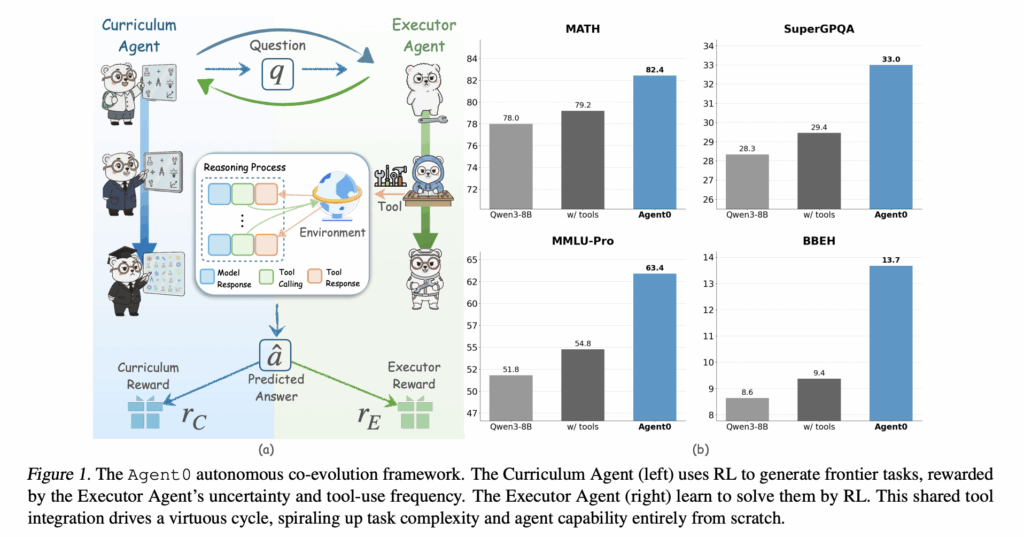
Large language models need huge human datasets, so what happens if the model must create all its own curriculum and teach itself to use tools? A team of researchers from UNC-Chapel Hill, Salesforce Research and Stanford University introduce ‘Agent0’, a fully autonomous framework that evolves high-performing agents without external data through multi-step co-evolution and seamless tool integration Agent0 targets mathematical and general reasoning. It shows that careful task generation and tool integrated rollouts can push a base model beyond its original capabilities, across ten benchmarks. https://arxiv.org/pdf/2511.16043 Two agents from one base model Agent0 starts from a base policy π_base, for example Qwen3 4B Base or Qwen3 8B Base. It clones this policy into: a Curriculum Agent πθ that generates tasks, an Executor Agent πϕ that solves those tasks with a Python tool. Training proceeds in iterations with two stages per iteration: Curriculum evolution: The curriculum agent generates a batch of tasks. For each task, the executor samples multiple responses. A composite reward measures how uncertain the executor is, how often it uses the tool and how diverse the batch is. πθ is updated with Group Relative Policy Optimization (GRPO) using this reward. Executor evolution: The trained curriculum agent is frozen. It generates a large pool of tasks. Agent0 filters this pool to keep only tasks near the executor’s capability frontier, then trains the executor on these tasks using an ambiguity aware RL objective called Ambiguity Dynamic Policy Optimization (ADPO). This loop creates a feedback cycle. As the executor becomes stronger by using the code interpreter, the curriculum must generate more complex, tool reliant problems to keep its reward high. https://arxiv.org/pdf/2511.16043 How the curriculum agent scores tasks? The curriculum reward combines three signals: Uncertainty reward: For each generated task x, the executor samples k responses and majority votes a pseudo answer. Self consistency p̂(x) is the fraction of responses that agree with this majority. The reward is maximal when p̂ is close to 0.5 and low when tasks are too easy or too hard. This encourages tasks that are challenging but still solvable for the current executor. Tool use reward: The executor can trigger a sandboxed code interpreter using python tags and receives results tagged as output. Agent0 counts the number of tool calls in a trajectory and gives a scaled, capped reward, with a cap C set to 4 in experiments. This favors tasks that actually require tool calls rather than pure mental arithmetic. Repetition penalty: Within each curriculum batch, Agent0 measures pairwise similarity between tasks using a BLEU based distance. Tasks are clustered, and a penalty term increases with cluster size. This discourages the curriculum from generating many near duplicates. A composite reward multiplies a format check with a weighted sum of uncertainty and tool rewards minus the repetition penalty. This composite value feeds into GRPO to update πθ. How the executor learns from noisy self labels? The executor is also trained with GRPO but on multi turn, tool integrated trajectories and pseudo labels instead of ground truth answers. Frontier dataset construction: After curriculum training in an iteration, the frozen curriculum generates a large candidate pool. For each task, Agent0 computes self consistency p̂(x) with the current executor and keeps only tasks where p̂ lies in an informative band, for example between 0.3 and 0.8. This defines a challenging frontier dataset that avoids trivial or impossible problems. Multi turn tool integrated rollouts: For each frontier task, the executor generates a trajectory that can interleave: natural language reasoning tokens, python code segments, output tool feedback. Generation pauses when a tool call appears, executes the code in a sandboxed interpreter built on VeRL Tool, then resumes conditioned on the result. The trajectory terminates when the model produces a final answer inside {boxed …} tags. A majority vote across sampled trajectories defines a pseudo label and a terminal reward for each trajectory. ADPO, ambiguity aware RL: Standard GRPO treats all samples equally, which is unstable when labels come from majority voting on ambiguous tasks. ADPO modifies GRPO in two ways using p̂ as an ambiguity signal. It scales the normalized advantage with a factor that increases with self consistency, so trajectories from low confidence tasks contribute less. It sets a dynamic upper clipping bound for the importance ratio, which depends on self consistency. Empirical analysis shows that fixed upper clipping mainly affects low probability tokens. ADPO relaxes this bound adaptively, which improves exploration on uncertain tasks, as visualized by the up clipped token probability statistics. https://arxiv.org/pdf/2511.16043 Results on mathematical and general reasoning Agent0 is implemented on top of VeRL and evaluated on Qwen3 4B Base and Qwen3 8B Base. It uses a sandboxed Python interpreter as the single external tool. The research team evaluate on ten benchmarks: Mathematical reasoning: AMC, Minerva, MATH, GSM8K, Olympiad Bench, AIME24, AIME25. General reasoning: SuperGPQA, MMLU Pro, BBEH. They report pass@1 for most datasets and mean@32 for AMC and AIME tasks. For Qwen3 8B Base, Agent0 reaches: math average 58.2 versus 49.2 for the base model, overall general average 42.1 versus 34.5 for the base model. Agent0 also improves over strong data free baselines such as R Zero, Absolute Zero, SPIRAL and Socratic Zero, both with and without tools. On Qwen3 8B, it surpasses R Zero by 6.4 percentage points and Absolute Zero by 10.6 points on the overall average. It also beats Socratic Zero, which relies on external OpenAI APIs. Across three co evolution iterations, average math performance on Qwen3 8B increases from 55.1 to 58.2 and general reasoning also improves per iteration. This confirms stable self improvement rather than collapse. Qualitative examples show that curriculum tasks evolve from basic geometry questions to complex constraint satisfaction problems, while executor trajectories mix reasoning text with Python calls to reach correct answers. Key Takeaways Fully data free co evolution: Agent0 eliminates external datasets and human annotations. Two agents, a curriculum agent and an executor agent, are initialized from the same base LLM and co evolve only via reinforcement learning and a Python tool. Frontier curriculum from self

Agent0: A Fully Autonomous AI Framework that Evolves High-Performing Agents without External Data through Multi-Step Co-Evolution Leer entrada »

AI, Committee, Noticias, Uncategorized

Selective Rotary Position Embedding

arXiv:2511.17388v1 Announce Type: new Abstract: Position information is essential for language modeling. In softmax transformers, Rotary Position Embeddings (textit{RoPE}) encode positions through textit{fixed-angle} rotations, while in linear transformers, order is handled via input-dependent (selective) gating that decays past key-value associations. Selectivity has generally been shown to improve language-related tasks. Inspired by this, we introduce textit{Selective RoPE}, an textit{input-dependent} rotary embedding mechanism, that generalizes textit{RoPE}, and enables rotation in textit{arbitrary angles} for both linear and softmax transformers. We show that softmax attention already performs a hidden form of these rotations on query-key pairs, uncovering an implicit positional structure. We further show that in state-space models and gated linear transformers, the real part manages forgetting while the imaginary part encodes positions through rotations. We validate our method by equipping gated transformers with textit{Selective RoPE}, demonstrating that its input-dependent rotations improve performance in language modeling and on difficult sequence tasks like copying, state tracking, and retrieval.

Selective Rotary Position Embedding Leer entrada »

AI, Committee, Noticias, Uncategorized

An Efficient Computational Framework for Discrete Fuzzy Numbers Based on Total Orders

arXiv:2511.17080v1 Announce Type: cross Abstract: Discrete fuzzy numbers, and in particular those defined over a finite chain $L_n = {0, ldots, n}$, have been effectively employed to represent linguistic information within the framework of fuzzy systems. Research on total (admissible) orderings of such types of fuzzy subsets, and specifically those belonging to the set $mathcal{D}_1^{L_nrightarrow Y_m}$ consisting of discrete fuzzy numbers $A$ whose support is a closed subinterval of the finite chain $L_n = {0, 1, ldots, n}$ and whose membership values $A(x)$, for $x in L_n$, belong to the set $Y_m = { 0 = y_1

An Efficient Computational Framework for Discrete Fuzzy Numbers Based on Total Orders Leer entrada »

AI, Committee, Noticias, Uncategorized

Cognitive BASIC: An In-Model Interpreted Reasoning Language for LLMs

arXiv:2511.16837v1 Announce Type: cross Abstract: Cognitive BASIC is a minimal, BASIC-style prompting language and in-model interpreter that structures large language model (LLM) reasoning into explicit, stepwise execution traces. Inspired by the simplicity of retro BASIC, we repurpose numbered lines and simple commands as an interpretable cognitive control layer. Modern LLMs can reliably simulate such short programs, enabling transparent multi-step reasoning inside the model. A natural-language interpreter file specifies command semantics, memory updates, and logging behavior. Our mental-model interpreter extracts declarative and procedural knowledge, detects contradictions, and produces resolutions when necessary. A comparison across three LLMs on a benchmark of knowledge extraction, conflict detection, and reasoning tasks shows that all models can execute Cognitive BASIC programs, with overall strong but not uniform performance.

Cognitive BASIC: An In-Model Interpreted Reasoning Language for LLMs Leer entrada »

We use cookies to improve your experience and performance on our website. You can learn more at Política de privacidad and manage your privacy settings by clicking Settings.

Privacy Preferences

You can choose your cookie settings by turning on/off each type of cookie as you wish, except for essential cookies.

Allow All
Manage Consent Preferences
  • Always Active

Save
es_ES