YouZum

Committee

AI, Committee, Noticias, Uncategorized

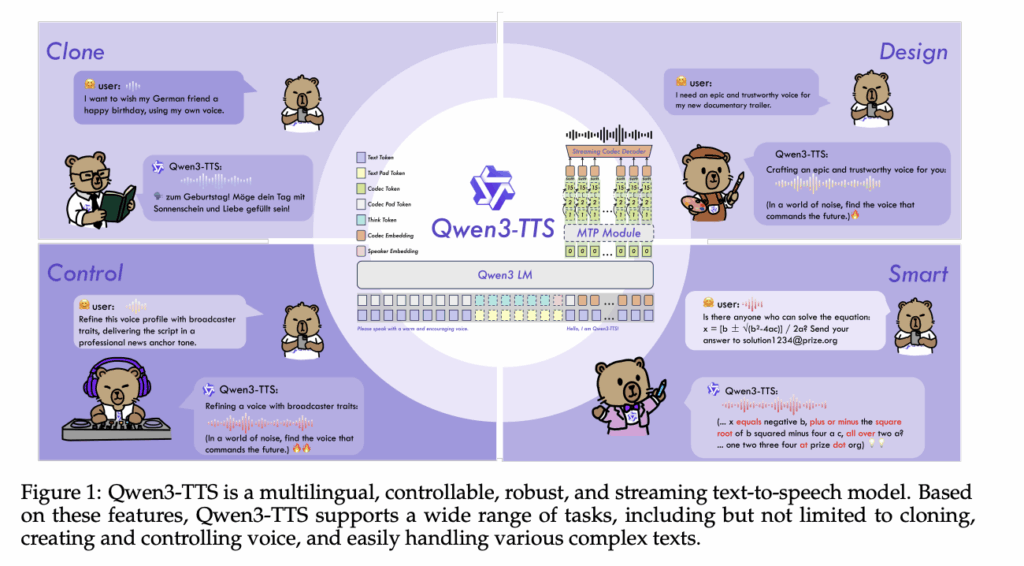
Qwen Researchers Release Qwen3-TTS: an Open Multilingual TTS Suite with Real-Time Latency and Fine-Grained Voice Control

Alibaba Cloud’s Qwen team has open-sourced Qwen3-TTS, a family of multilingual text-to-speech models that target three core tasks in one stack, voice clone, voice design, and high quality speech generation. https://arxiv.org/pdf/2601.15621v1 Model family and capabilities Qwen3-TTS uses a 12Hz speech tokenizer and 2 language model sizes, 0.6B and 1.7B, packaged into 3 main tasks. The open release exposes 5 models, Qwen3-TTS-12Hz-0.6B-Base and Qwen3-TTS-12Hz-1.7B-Base for voice cloning and generic TTS, Qwen3-TTS-12Hz-0.6B-CustomVoice and Qwen3-TTS-12Hz-1.7B-CustomVoice for promptable preset speakers, and Qwen3-TTS-12Hz-1.7B-VoiceDesign for free form voice creation from natural language descriptions, along with the Qwen3-TTS-Tokenizer-12Hz codec. All models support 10 languages, Chinese, English, Japanese, Korean, German, French, Russian, Portuguese, Spanish, and Italian. CustomVoice variants ship with 9 curated timbres, such as Vivian, a bright young Chinese female voice, Ryan, a dynamic English male voice, and Ono_Anna, a playful Japanese female voice, each with a short description that encodes timbre and speaking style. The VoiceDesign model maps text instructions directly to new voices, for example ‘speak in a nervous teenage male voice with rising intonation’ and can then be combined with the Base model by first generating a short reference clip and reusing it via create_voice_clone_prompt. https://arxiv.org/pdf/2601.15621v1 Architecture, tokenizer, and streaming path Qwen3-TTS is a dual track language model, one track predicts discrete acoustic tokens from text, the other handles alignment and control signals. The system is trained on more than 5 million hours of multilingual speech in 3 pre training stages that move from general mapping, to high quality data, to long context support up to 32,768 tokens. A key component is the Qwen3-TTS-Tokenizer-12Hz codec. It operates at 12.5 frames per second, about 80 ms per token, and uses 16 quantizers with a 2048 entry codebook. On LibriSpeech test clean it reaches PESQ wideband 3.21, STOI 0.96, and UTMOS 4.16, outperforming SpeechTokenizer, XCodec, Mimi, FireredTTS 2 and other recent semantic tokenizers, while using a similar or lower frame rate. The tokenizer is implemented as a pure left context streaming decoder, so it can emit waveforms as soon as enough tokens are available. With 4 tokens per packet, each streaming packet carries 320 ms of audio. The non-DiT decoder and BigVGAN free design reduces decode cost and simplifies batching. On the language model side, the research team reports end to end streaming measurements on a single vLLM backend with torch.compile and CUDA Graph optimizations. For Qwen3-TTS-12Hz-0.6B-Base and Qwen3-TTS-12Hz-1.7B-Base at concurrency 1, the first packet latency is around 97 ms and 101 ms, with real time factors of 0.288 and 0.313 respectively. Even at concurrency 6, first packet latency stays around 299 ms and 333 ms. https://arxiv.org/pdf/2601.15621v1 Alignment and control Post training uses a staged alignment pipeline. First, Direct Preference Optimization aligns generated speech with human preferences on multilingual data. Then GSPO with rule based rewards improves stability and prosody. A final speaker fine tuning stage on the Base model yields target speaker variants while preserving the core capabilities of the general model. Instruction following is implemented in a ChatML style format, where text instructions about style, emotion or tempo are prepended to the input. This same interface powers VoiceDesign, CustomVoice style prompts, and fine grained edits for cloned speakers. Benchmarks, zero shot cloning, and multilingual speech On the Seed-TTS test set, Qwen3-TTS is evaluated as a zero-shot voice cloning system. The Qwen3-TTS-12Hz-1.7B-Base model reaches a Word Error Rate of 0.77 on test-zh and 1.24 on test-en. The research team highlights the 1.24 WER on test-en as state of the art among the compared systems, while the Chinese WER is close to, but not lower than, the best CosyVoice 3 score. https://arxiv.org/pdf/2601.15621v1 On a multilingual TTS test set covering 10 languages, Qwen3-TTS achieves the lowest WER in 6 languages, Chinese, English, Italian, French, Korean, and Russian, and competitive performance on the remaining 4 languages, while also obtaining the highest speaker similarity in all 10 languages compared to MiniMax-Speech and ElevenLabs Multilingual v2. Cross-lingual evaluations show that Qwen3-TTS-12Hz-1.7B-Base reduces mixed error rate for several language pairs, such as zh-to-ko, where the error drops from 14.4 for CosyVoice3 to 4.82, about a 66 percent relative reduction. On InstructTTSEval, the Qwen3TTS-12Hz-1.7B-VD VoiceDesign model sets new state of the art scores among open source models on Description-Speech Consistency and Response Precision in both Chinese and English, and is competitive with commercial systems like Hume and Gemini on several metrics. Key Takeaways Full open source multilingual TTS stack: Qwen3-TTS is an Apache 2.0 licensed suite that covers 3 tasks in one stack, high quality TTS, 3 second voice cloning, and instruction based voice design across 10 languages using the 12Hz tokenizer family. Efficient discrete codec and real time streaming: The Qwen3-TTS-Tokenizer-12Hz uses 16 codebooks at 12.5 frames per second, reaches strong PESQ, STOI and UTMOS scores, and supports packetized streaming with about 320 ms of audio per packet and sub 120 ms first packet latency for the 0.6B and 1.7B models in the reported setup. Task specific model variants: The release offers Base models for cloning and generic TTS, CustomVoice models with 9 predefined speakers and style prompts, and a VoiceDesign model that generates new voices directly from natural language descriptions which can then be reused by the Base model. Strong alignment and multilingual quality: A multi stage alignment pipeline with DPO, GSPO and speaker fine tuning gives Qwen3-TTS low word error rates and high speaker similarity, with lowest WER in 6 of 10 languages and the best speaker similarity in all 10 languages among the evaluated systems, and state of the art zero shot English cloning on Seed TTS. Check out the Model Weights, Repo and Playground. Also, feel free to follow us on Twitter and don’t forget to join our 100k+ ML SubReddit and Subscribe to our Newsletter. Wait! are you on telegram? now you can join us on telegram as well. The post Qwen Researchers Release Qwen3-TTS: an Open Multilingual TTS Suite with Real-Time Latency and Fine-Grained Voice Control appeared first on MarkTechPost.

Qwen Researchers Release Qwen3-TTS: an Open Multilingual TTS Suite with Real-Time Latency and Fine-Grained Voice Control Leer entrada »

AI, Committee, Noticias, Uncategorized

Measles is surging in the US. Wastewater tracking could help.

This week marked a rather unpleasant anniversary: It’s a year since Texas reported a case of measles—the start of a significant outbreak that ended up spreading across multiple states. Since the start of January 2025, there have been over 2,500 confirmed cases of measles in the US. Three people have died. As vaccination rates drop and outbreaks continue, scientists have been experimenting with new ways to quickly identify new cases and prevent the disease from spreading. And they are starting to see some success with wastewater surveillance. After all, wastewater contains saliva, urine, feces, shed skin, and more. You could consider it a rich biological sample. Wastewater analysis helped scientists understand how covid was spreading during the pandemic. It’s early days, but it is starting to help us get a handle on measles. Globally, there has been some progress toward eliminating measles, largely thanks to vaccination efforts. Such efforts led to an 88% drop in measles deaths between 2000 and 2024, according to the World Health Organization. It estimates that “nearly 59 million lives have been saved by the measles vaccine” since 2000. Still, an estimated 95,000 people died from measles in 2024 alone—most of them young children. And cases are surging in Europe, Southeast Asia, and the Eastern Mediterranean region. Last year, the US saw the highest levels of measles in decades. The country is on track to lose its measles elimination status—a sorry fate that met Canada in November after the country recorded over 5,000 cases in a little over a year. Public health efforts to contain the spread of measles—which is incredibly contagious—typically involve clinical monitoring in health-care settings, along with vaccination campaigns. But scientists have started looking to wastewater, too. Along with various bodily fluids, we all shed viruses and bacteria into wastewater, whether that’s through brushing our teeth, showering, or using the toilet. The idea of looking for these pathogens in wastewater to track diseases has been around for a while, but things really kicked into gear during the covid-19 pandemic, when scientists found that the coronavirus responsible for the disease was shed in feces. This led Marlene Wolfe of Emory University and Alexandria Boehm of Stanford University to establish WastewaterSCAN, an academic-led program developed to analyze wastewater samples across the US. Covid was just the beginning, says Wolfe. “Over the years we have worked to expand what can be monitored,” she says. Two years ago, for a previous edition of the Checkup, Wolfe told Cassandra Willyard that wastewater surveillance of measles was “absolutely possible,” as the virus is shed in urine. The hope was that this approach could shed light on measles outbreaks in a community, even if members of that community weren’t able to access health care and receive an official diagnosis. And that it could highlight when and where public health officials needed to act to prevent measles from spreading. Evidence that it worked as an effective public health measure was, at the time, scant. Since then, she and her colleagues have developed a test to identify measles RNA. They trialed it at two wastewater treatment plants in Texas between December 2024 and May 2025. At each site, the team collected samples two or three times a week and tested them for measles RNA. Over that period, the team found measles RNA in 10.5% of the samples they collected, as reported in a preprint paper published at medRxiv in July and currently under review at a peer-reviewed journal. The first detection came a week before the first case of measles was officially confirmed in the area. That’s promising—it suggests that wastewater surveillance might pick up measles cases early, giving public health officials a head start in efforts to limit any outbreaks. There are more promising results from a team in Canada. Mike McKay and Ryland Corchis-Scott at the University of Windsor in Ontario and their colleagues have also been testing wastewater samples for measles RNA. Between February and November 2025, the team collected samples from a wastewater treatment facility serving over 30,000 people in Leamington, Ontario.  These wastewater tests are somewhat limited—even if they do pick up measles, they won’t tell you who has measles, where exactly infections are occurring, or even how many people are infected. McKay and his colleagues have begun to make some progress here. In addition to monitoring the large wastewater plant, the team used tampons to soak up wastewater from a hospital lateral sewer. They then compared their measles test results with the number of clinical cases in that hospital. This gave them some idea of the virus’s “shedding rate.” When they applied this to the data collected from the Leamington wastewater treatment facility, the team got estimates of measles cases that were much higher than the figures officially reported.  Their findings track with the opinions of local health officials (who estimate that the true number of cases during the outbreak was around five to 10 times higher than the confirmed case count), the team members wrote in a paper published on medRxiv a couple of weeks ago. There will always be limits to wastewater surveillance. “We’re looking at the pool of waste of an entire community, so it’s very hard to pull in information about individual infections,” says Corchis-Scott. Wolfe also acknowledges that “we have a lot to learn about how we can best use the tools so they are useful.” But her team at WastewaterSCAN has been testing wastewater across the US for measles since May last year. And their findings are published online and shared with public health officials. In some cases, the findings are already helping inform the response to measles. “We’ve seen public health departments act on this data,” says Wolfe. Some have issued alerts, or increased vaccination efforts in those areas, for example. “[We’re at] a point now where we really see public health departments, clinicians, [and] families using that information to help keep themselves and their communities safe,” she says. McKay says his team has stopped testing for measles

Measles is surging in the US. Wastewater tracking could help. Leer entrada »

AI, Committee, Noticias, Uncategorized

America’s coming war over AI regulation

MIT Technology Review’s What’s Next series looks across industries, trends, and technologies to give you a first look at the future. You can read the rest of them here. In the final weeks of 2025, the battle over regulating artificial intelligence in the US reached a boiling point. On December 11, after Congress failed twice to pass a law banning state AI laws, President Donald Trump signed a sweeping executive order seeking to handcuff states from regulating the booming industry. Instead, he vowed to work with Congress to establish a “minimally burdensome” national AI policy, one that would position the US to win the global AI race. The move marked a qualified victory for tech titans, who have been marshaling multimillion-dollar war chests to oppose AI regulations, arguing that a patchwork of state laws would stifle innovation. In 2026, the battleground will shift to the courts. While some states might back down from passing AI laws, others will charge ahead, buoyed by mounting public pressure to protect children from chatbots and rein in power-hungry data centers. Meanwhile, dueling super PACs bankrolled by tech moguls and AI-safety advocates will pour tens of millions into congressional and state elections to seat lawmakers who champion their competing visions for AI regulation.  Trump’s executive order directs the Department of Justice to establish a task force that sues states whose AI laws clash with his vision for light-touch regulation. It also directs the Department of Commerce to starve states of federal broadband funding if their AI laws are “onerous.” In practice, the order may target a handful of laws in Democratic states, says James Grimmelmann, a law professor at Cornell Law School. “The executive order will be used to challenge a smaller number of provisions, mostly relating to transparency and bias in AI, which tend to be more liberal issues,” Grimmelmann says. For now, many states aren’t flinching. On December 19, New York’s governor, Kathy Hochul, signed the Responsible AI Safety and Education (RAISE) Act, a landmark law requiring AI companies to publish the protocols used to ensure the safe development of their AI models and report critical safety incidents. On January 1, California debuted the nation’s first frontier AI safety law, SB 53—which the RAISE Act was modeled on—aimed at preventing catastrophic harms such as biological weapons or cyberattacks. While both laws were watered down from earlier iterations to survive bruising industry lobbying, they struck a rare, if fragile, compromise between tech giants and AI safety advocates. If Trump targets these hard-won laws, Democratic states like California and New York will likely take the fight to court. Republican states like Florida with vocal champions for AI regulation might follow suit. Trump could face an uphill battle. “The Trump administration is stretching itself thin with some of its attempts to effectively preempt [legislation] via executive action,” says Margot Kaminski, a law professor at the University of Colorado Law School. “It’s on thin ice.” But Republican states that are anxious to stay off Trump’s radar or can’t afford to lose federal broadband funding for their sprawling rural communities might retreat from passing or enforcing AI laws. Win or lose in court, the chaos and uncertainty could chill state lawmaking. Paradoxically, the Democratic states that Trump wants to rein in—armed with big budgets and emboldened by the optics of battling the administration—may be the least likely to budge. In lieu of state laws, Trump promises to create a federal AI policy with Congress. But the gridlocked and polarized body won’t be delivering a bill this year. In July, the Senate killed a moratorium on state AI laws that had been inserted into a tax bill, and in November, the House scrapped an encore attempt in a defense bill. In fact, Trump’s bid to strong-arm Congress with an executive order may sour any appetite for a bipartisan deal.  The executive order “has made it harder to pass responsible AI policy by hardening a lot of positions, making it a much more partisan issue,” says Brad Carson, a former Democratic congressman from Oklahoma who is building a network of super PACs backing candidates who support AI regulation. “It hardened Democrats and created incredible fault lines among Republicans,” he says.  While AI accelerationists in Trump’s orbit—AI and crypto czar David Sacks among them—champion deregulation, populist MAGA firebrands like Steve Bannon warn of rogue superintelligence and mass unemployment. In response to Trump’s executive order, Republican state attorneys general signed a bipartisan letter urging the FCC not to supersede state AI laws. With Americans increasingly anxious about how AI could harm mental health, jobs, and the environment, public demand for regulation is growing. If Congress stays paralyzed, states will be the only ones acting to keep the AI industry in check. In 2025, state legislators introduced more than 1,000 AI bills, and nearly 40 states enacted over 100 laws, according to the National Conference of State Legislatures. Efforts to protect children from chatbots may inspire rare consensus. On January 7, Google and Character Technologies, a startup behind the companion chatbot Character.AI, settled several lawsuits with families of teenagers who killed themselves after interacting with the bot. Just a day later, the Kentucky attorney general sued Character Technologies, alleging that the chatbots drove children to suicide and other forms of self-harm. OpenAI and Meta face a barrage of similar suits. Expect more to pile up this year. Without AI laws on the books, it remains to be seen how product liability laws and free speech doctrines apply to these novel dangers. “It’s an open question what the courts will do,” says Grimmelmann.  While litigation brews, states will move to pass child safety laws, which are exempt from Trump’s proposed ban on state AI laws. On January 9, OpenAI inked a deal with a former foe, the child-safety advocacy group Common Sense Media, to back a ballot initiative in California called the Parents & Kids Safe AI Act, setting guardrails around how chatbots interact with children. The measure proposes requiring AI companies to

America’s coming war over AI regulation Leer entrada »

AI, Committee, Noticias, Uncategorized

Seer Self-Consistency: Advance Budget Estimation for Adaptive Test-Time Scaling

arXiv:2511.09345v2 Announce Type: replace Abstract: Test-time scaling improves the inference performance of Large Language Models (LLMs) but also incurs substantial computational costs. Although recent studies have reduced token consumption through dynamic self-consistency, they remain constrained by the high latency of sequential requests. In this paper, we propose SeerSC, a dynamic self-consistency framework that simultaneously improves token efficiency and latency by integrating System 1 and System 2 reasoning. Specifically, we utilize the rapid System 1 to compute the answer entropy for given queries. This score is then used to evaluate the potential of samples for scaling, enabling dynamic self-consistency under System 2. Benefiting from the advance and accurate estimation provided by System 1, the proposed method can reduce token usage while simultaneously achieving a significant decrease in latency through parallel generation. It outperforms existing methods, achieving up to a 47% reduction in token consumption and a 43% reduction in inference latency without significant performance loss.

Seer Self-Consistency: Advance Budget Estimation for Adaptive Test-Time Scaling Leer entrada »

AI, Committee, Noticias, Uncategorized

Reading Between the Lines: Towards Reliable Black-box LLM Fingerprinting via Zeroth-order Gradient Estimation

arXiv:2510.06605v2 Announce Type: replace-cross Abstract: The substantial investment required to develop Large Language Models (LLMs) makes them valuable intellectual property, raising significant concerns about copyright protection. LLM fingerprinting has emerged as a key technique to address this, which aims to verify a model’s origin by extracting an intrinsic, unique signature (a “fingerprint”) and comparing it to that of a source model to identify illicit copies. However, existing black-box fingerprinting methods often fail to generate distinctive LLM fingerprints. This ineffectiveness arises because black-box methods typically rely on model outputs, which lose critical information about the model’s unique parameters due to the usage of non-linear functions. To address this, we first leverage Fisher Information Theory to formally demonstrate that the gradient of the model’s input is a more informative feature for fingerprinting than the output. Based on this insight, we propose ZeroPrint, a novel method that approximates these information-rich gradients in a black-box setting using zeroth-order estimation. ZeroPrint overcomes the challenge of applying this to discrete text by simulating input perturbations via semantic-preserving word substitutions. This operation allows ZeroPrint to estimate the model’s Jacobian matrix as a unique fingerprint. Experiments on the standard benchmark show ZeroPrint achieves a state-of-the-art effectiveness and robustness, significantly outperforming existing black-box methods.

Reading Between the Lines: Towards Reliable Black-box LLM Fingerprinting via Zeroth-order Gradient Estimation Leer entrada »

AI, Committee, Noticias, Uncategorized

Why 2026 is a hot year for lithium

In 2026, I’m going to be closely watching the price of lithium. If you’re not in the habit of obsessively tracking commodity markets, I certainly don’t blame you. (Though the news lately definitely makes the case that minerals can have major implications for global politics and the economy.) But lithium is worthy of a close look right now. The metal is crucial for lithium-ion batteries used in phones and laptops, electric vehicles, and large-scale energy storage arrays on the grid. Prices have been on quite the roller coaster over the last few years, and they’re ticking up again after a low period. What happens next could have big implications for mining and battery technology. Before we look ahead, let’s take a quick trip down memory lane. In 2020, global EV sales started to really take off, driving up demand for the lithium used in their batteries. Because of that growing demand and a limited supply, prices shot up dramatically, with lithium carbonate going from under $10 per kilogram to a high of roughly $70 per kilogram in just two years. And the tech world took notice. During those high points, there was a ton of interest in developing alternative batteries that didn’t rely on lithium. I was writing about sodium-based batteries, iron-air batteries, and even experimental ones that were made with plastic. Researchers and startups were also hunting for alternative ways to get lithium, including battery recycling and processing methods like direct lithium extraction (more on this in a moment). But soon, prices crashed back down to earth. We saw lower-than-expected demand for EVs in the US, and developers ramped up mining and processing to meet demand. Through late 2024 and 2025, lithium carbonate was back around $10 a kilogram again. Avoiding lithium or finding new ways to get it suddenly looked a lot less crucial. That brings us to today: lithium prices are ticking up again. So far, it’s nowhere close to the dramatic rise we saw a few years ago, but analysts are watching closely. Strong EV growth in China is playing a major role—EVs still make up about 75% of battery demand today. But growth in stationary storage, batteries for the grid, is also contributing to rising demand for lithium in both China and the US. Higher prices could create new opportunities. The possibilities include alternative battery chemistries, specifically sodium-ion batteries, says Evelina Stoikou, head of battery technologies and supply chains at BloombergNEF. (I’ll note here that we recently named sodium-ion batteries to our 2026 list of 10 Breakthrough Technologies.) It’s not just batteries, though. Another industry that could see big changes from a lithium price swing: extraction. Today, most lithium is mined from rocks, largely in Australia, before being shipped to China for processing. There’s a growing effort to process the mineral in other places, though, as countries try to create their own lithium supply chains. Tesla recently confirmed that it’s started production at its lithium refinery in Texas, which broke ground in 2023. We could see more investment in processing plants outside China if prices continue to climb. This could also be a key year for direct lithium extraction, as Katie Brigham wrote in a recent story for Heatmap. That technology uses chemical or electrochemical processes to extract lithium from brine (salty water that’s usually sourced from salt lakes or underground reservoirs), quickly and cheaply. Companies including Lilac Solutions, Standard Lithium, and Rio Tinto are all making plans or starting construction on commercial facilities this year in the US and Argentina.  If there’s anything I’ve learned about following batteries and minerals over the past few years, it’s that predicting the future is impossible. But if you’re looking for tea leaves to read, lithium prices deserve a look.  This article is from The Spark, MIT Technology Review’s weekly climate newsletter. To receive it in your inbox every Wednesday, sign up here.

Why 2026 is a hot year for lithium Leer entrada »

AI, Committee, Noticias, Uncategorized

Yann LeCun’s new venture is a contrarian bet against large language models  

Yann LeCun is a Turing Award recipient and a top AI researcher, but he has long been a contrarian figure in the tech world. He believes that the industry’s current obsession with large language models is wrong-headed and will ultimately fail to solve many pressing problems.  Instead, he thinks we should be betting on world models—a different type of AI that accurately reflects the dynamics of the real world. He is also a staunch advocate for open-source AI and criticizes the closed approach of frontier labs like OpenAI and Anthropic.  Perhaps it’s no surprise, then, that he recently left Meta, where he had served as chief scientist for FAIR (Fundamental AI Research), the company’s influential research lab that he founded. Meta has struggled to gain much traction with its open-source AI model Llama and has seen internal shake-ups, including the controversial acquisition of ScaleAI.  LeCun sat down with MIT Technology Review in an exclusive online interview from his Paris apartment to discuss his new venture, life after Meta, the future of artificial intelligence, and why he thinks the industry is chasing the wrong ideas.  Both the questions and answers below have been edited for clarity and brevity. You’ve just announced a new company, Advanced Machine Intelligence (AMI).  Tell me about the big ideas behind it. It is going to be a global company, but headquartered in Paris. You pronounce it “ami”—it means “friend” in French. I am excited. There is a very high concentration of talent in Europe, but it is not always given a proper environment to flourish. And there is certainly a huge demand from the industry and governments for a credible frontier AI company that is neither Chinese nor American. I think that is going to be to our advantage. So an ambitious alternative to the US-China binary we currently have. What made you want to pursue that third path? Well, there are sovereignty issues for a lot of countries, and they want some control over AI. What I’m advocating is that AI is going to become a platform, and most platforms tend to become open-source. Unfortunately, that’s not really the direction the American industry is taking. Right? As the competition increases, they feel like they have to be secretive. I think that is a strategic mistake. It’s certainly true for OpenAI, which went from very open to very closed, and Anthropic has always been closed. Google was sort of a little open. And then Meta, we’ll see. My sense is that it’s not going in a positive direction at this moment. Simultaneously, China has completely embraced this open approach. So all leading open-source AI platforms are Chinese, and the result is that academia and startups, outside of the US, have basically embraced Chinese models. There’s nothing wrong with that—you know, Chinese models are good. Chinese engineers and scientists are great. But you know, if there is a future in which all of our information diet is being mediated by AI assistance, and the choice is either English-speaking models produced by proprietary companies always close to the US or Chinese models which may be open-source but need to be fine-tuned so that they answer questions about Tiananmen Square in 1989—you know, it’s not a very pleasant and engaging future.  They [the future models] should be able to be fine-tuned by anyone and produce a very high diversity of AI assistance, with different linguistic abilities and value systems and political biases and centers of interests. You need high diversity of assistance for the same reason that you need high diversity of press.  That is certainly a compelling pitch. How are investors buying that idea so far? They really like it. A lot of venture capitalists are very much in favor of this idea of open-source, because they know for a lot of small startups, they really rely on open-source models. They don’t have the means to train their own model, and it’s kind of dangerous for them strategically to embrace a proprietary model. You recently left Meta. What’s your view on the company and Mark Zuckerberg’s leadership? There’s a perception that Meta has fumbled its AI advantage. I think FAIR [LeCun’s lab at Meta] was extremely successful in the research part. Where Meta was less successful is in picking up on that research and pushing it into practical technology and products. Mark made some choices that he thought were the best for the company. I may not have agreed with all of them. For example, the robotics group at FAIR was let go, which I think was a strategic mistake. But I’m not the director of FAIR. People make decisions rationally, and there’s no reason to be upset. So, no bad blood? Could Meta be a future client for AMI? Meta might be our first client! We’ll see. The work we are doing is not in direct competition. Our focus on world models for the physical world is very different from their focus on generative AI and LLMs. You were working on AI long before LLMs became a mainstream approach. But since ChatGPT broke out, LLMs have become almost synonymous with AI. Yes, and we are going to change that. The public face of AI, perhaps, is mostly LLMs and chatbots of various types. But the latest ones of those are not pure LLMs. They are LLM plus a lot of things, like perception systems and code that solves particular problems. So we are going to see LLMs as kind of the orchestrator in systems, a little bit. Beyond LLMs, there is a lot of AI that is behind the scenes that runs a big chunk of our society. There are assistance driving programs in a car, quick-turn MRI images, algorithms that drive social media—that’s all AI.  You have been vocal in arguing that LLMs can only get us so far. Do you think LLMs are overhyped these days? Can you summarize to our readers why you believe that LLMs are not enough? There is a sense

Yann LeCun’s new venture is a contrarian bet against large language models   Leer entrada »

AI, Committee, Noticias, Uncategorized

What Makes AI Research Replicable? Executable Knowledge Graphs as Scientific Knowledge Representations

arXiv:2510.17795v2 Announce Type: replace Abstract: Replicating AI research is a crucial yet challenging task for large language model (LLM) agents. Existing approaches often struggle to generate executable code, primarily due to insufficient background knowledge and the limitations of retrieval-augmented generation (RAG) methods, which fail to capture latent technical details hidden in referenced papers. Furthermore, previous approaches tend to overlook valuable implementation-level code signals and lack structured knowledge representations that support multi-granular retrieval and reuse. To overcome these challenges, we propose Executable Knowledge Graphs (xKG), a pluggable, paper-centric knowledge base that automatically integrates code snippets and technical insights extracted from scientific literature. When integrated into three agent frameworks with two different LLMs, xKG shows substantial performance gains (10.9% with o3-mini) on PaperBench, demonstrating its effectiveness as a general and extensible solution for automated AI research replication. Code is available at https://github.com/zjunlp/xKG.

What Makes AI Research Replicable? Executable Knowledge Graphs as Scientific Knowledge Representations Leer entrada »

AI, Committee, Noticias, Uncategorized

How AutoGluon Enables Modern AutoML Pipelines for Production-Grade Tabular Models with Ensembling and Distillation

In this tutorial, we build a production-grade tabular machine learning pipeline using AutoGluon, taking a real-world mixed-type dataset from raw ingestion through to deployment-ready artifacts. We train high-quality stacked and bagged ensembles, evaluate performance with robust metrics, perform subgroup and feature-level analysis, and then optimize the model for real-time inference using refit-full and distillation. Throughout the workflow, we focus on practical decisions that balance accuracy, latency, and deployability. Check out the FULL CODES here. Copy CodeCopiedUse a different Browser !pip -q install -U “autogluon==1.5.0” “scikit-learn>=1.3” “pandas>=2.0” “numpy>=1.24” import os, time, json, warnings warnings.filterwarnings(“ignore”) import numpy as np import pandas as pd from sklearn.model_selection import train_test_split from sklearn.metrics import roc_auc_score, log_loss, accuracy_score, classification_report, confusion_matrix from autogluon.tabular import TabularPredictor We set up the environment by installing the required libraries and importing all core dependencies used throughout the pipeline. We configure warnings to keep outputs clean and ensure numerical, tabular, and evaluation utilities are ready. Check out the FULL CODES here. Copy CodeCopiedUse a different Browser from sklearn.datasets import fetch_openml df = fetch_openml(data_id=40945, as_frame=True).frame target = “survived” df[target] = df[target].astype(int) drop_cols = [c for c in [“boat”, “body”, “home.dest”] if c in df.columns] df = df.drop(columns=drop_cols, errors=”ignore”) df = df.replace({None: np.nan}) print(“Shape:”, df.shape) print(“Target positive rate:”, df[target].mean().round(4)) print(“Columns:”, list(df.columns)) train_df, test_df = train_test_split( df, test_size=0.2, random_state=42, stratify=df[target], ) We load a real-world mixed-type dataset and perform light preprocessing to prepare a clean training signal. We define the target, remove highly leaky columns, and validate the dataset structure. We then create a stratified train–test split to preserve class balance. Check out the FULL CODES here. Copy CodeCopiedUse a different Browser def has_gpu(): try: import torch return torch.cuda.is_available() except Exception: return False presets = “extreme” if has_gpu() else “best_quality” save_path = “/content/autogluon_titanic_advanced” os.makedirs(save_path, exist_ok=True) predictor = TabularPredictor( label=target, eval_metric=”roc_auc”, path=save_path, verbosity=2 ) We detect hardware availability to dynamically select the most suitable AutoGluon training preset. We configure a persistent model directory and initialize the tabular predictor with an appropriate evaluation metric. Check out the FULL CODES here. Copy CodeCopiedUse a different Browser start = time.time() predictor.fit( train_data=train_df, presets=presets, time_limit=7 * 60, num_bag_folds=5, num_stack_levels=2, refit_full=False ) train_time = time.time() – start print(f”nTraining done in {train_time:.1f}s with presets='{presets}'”) We train a high-quality ensemble using bagging and stacking within a controlled time budget. We rely on AutoGluon’s automated model search to efficiently explore strong architectures. We also record training time to understand computational cost. Check out the FULL CODES here. Copy CodeCopiedUse a different Browser lb = predictor.leaderboard(test_df, silent=True) print(“n=== Leaderboard (top 15) ===”) display(lb.head(15)) proba = predictor.predict_proba(test_df) pred = predictor.predict(test_df) y_true = test_df[target].values if isinstance(proba, pd.DataFrame) and 1 in proba.columns: y_proba = proba[1].values else: y_proba = np.asarray(proba).reshape(-1) print(“n=== Test Metrics ===”) print(“ROC-AUC:”, roc_auc_score(y_true, y_proba).round(5)) print(“LogLoss:”, log_loss(y_true, np.clip(y_proba, 1e-6, 1 – 1e-6)).round(5)) print(“Accuracy:”, accuracy_score(y_true, pred).round(5)) print(“nClassification report:n”, classification_report(y_true, pred)) We evaluate the trained models using a held-out test set and inspect the leaderboard to compare performance. We compute probabilistic and discrete predictions and derive key classification metrics. It gives us a comprehensive view of model accuracy and calibration. Check out the FULL CODES here. Copy CodeCopiedUse a different Browser if “pclass” in test_df.columns: print(“n=== Slice AUC by pclass ===”) for grp, part in test_df.groupby(“pclass”): part_proba = predictor.predict_proba(part) part_proba = part_proba[1].values if isinstance(part_proba, pd.DataFrame) and 1 in part_proba.columns else np.asarray(part_proba).reshape(-1) auc = roc_auc_score(part[target].values, part_proba) print(f”pclass={grp}: AUC={auc:.4f} (n={len(part)})”) fi = predictor.feature_importance(test_df, silent=True) print(“n=== Feature importance (top 20) ===”) display(fi.head(20)) We analyze model behavior through subgroup performance slicing and permutation-based feature importance. We identify how performance varies across meaningful segments of the data. It helps us assess robustness and interpretability before deployment. Check out the FULL CODES here. Copy CodeCopiedUse a different Browser t0 = time.time() refit_map = predictor.refit_full() t_refit = time.time() – t0 print(f”nrefit_full completed in {t_refit:.1f}s”) print(“Refit mapping (sample):”, dict(list(refit_map.items())[:5])) lb_full = predictor.leaderboard(test_df, silent=True) print(“n=== Leaderboard after refit_full (top 15) ===”) display(lb_full.head(15)) best_model = predictor.get_model_best() full_candidates = [m for m in predictor.get_model_names() if m.endswith(“_FULL”)] def bench_infer(model_name, df_in, repeats=3): times = [] for _ in range(repeats): t1 = time.time() _ = predictor.predict(df_in, model=model_name) times.append(time.time() – t1) return float(np.median(times)) small_batch = test_df.drop(columns=[target]).head(256) lat_best = bench_infer(best_model, small_batch) print(f”nBest model: {best_model} | median predict() latency on 256 rows: {lat_best:.4f}s”) if full_candidates: lb_full_sorted = lb_full.sort_values(by=”score_test”, ascending=False) best_full = lb_full_sorted[lb_full_sorted[“model”].str.endswith(“_FULL”)].iloc[0][“model”] lat_full = bench_infer(best_full, small_batch) print(f”Best FULL model: {best_full} | median predict() latency on 256 rows: {lat_full:.4f}s”) print(f”Speedup factor (best / full): {lat_best / max(lat_full, 1e-9):.2f}x”) try: t0 = time.time() distill_result = predictor.distill( train_data=train_df, time_limit=4 * 60, augment_method=”spunge”, ) t_distill = time.time() – t0 print(f”nDistillation completed in {t_distill:.1f}s”) except Exception as e: print(“nDistillation step failed”) print(“Error:”, repr(e)) lb2 = predictor.leaderboard(test_df, silent=True) print(“n=== Leaderboard after distillation attempt (top 20) ===”) display(lb2.head(20)) predictor.save() reloaded = TabularPredictor.load(save_path) sample = test_df.drop(columns=[target]).sample(8, random_state=0) sample_pred = reloaded.predict(sample) sample_proba = reloaded.predict_proba(sample) print(“n=== Reloaded predictor sanity-check ===”) print(sample.assign(pred=sample_pred).head()) print(“nProbabilities (head):”) display(sample_proba.head()) artifacts = { “path”: save_path, “presets”: presets, “best_model”: reloaded.get_model_best(), “model_names”: reloaded.get_model_names(), “leaderboard_top10″: lb2.head(10).to_dict(orient=”records”), } with open(os.path.join(save_path, “run_summary.json”), “w”) as f: json.dump(artifacts, f, indent=2) print(“nSaved summary to:”, os.path.join(save_path, “run_summary.json”)) print(“Done.”) We optimize the trained ensemble for inference by collapsing bagged models and benchmarking latency improvements. We optionally distill the ensemble into faster models and validate persistence through save-reload checks. Also, we export structured artifacts required for production handoff. In conclusion, we implemented an end-to-end workflow with AutoGluon that transforms raw tabular data into production-ready models with minimal manual intervention, while maintaining strong control over accuracy, robustness, and inference efficiency. We performed systematic error analysis and feature importance evaluation, optimized large ensembles through refitting and distillation, and validated deployment readiness using latency benchmarking and artifact packaging. This workflow enables the deployment of high-performing, scalable, interpretable, and well-suited tabular models for real-world production environments. Check out the FULL CODES here. Also, feel free to follow us on Twitter and don’t forget to join our 100k+ ML SubReddit and Subscribe to our Newsletter. Wait! are you on telegram? now you can join us on telegram as well. The post How AutoGluon Enables Modern AutoML Pipelines for Production-Grade Tabular Models with Ensembling and Distillation appeared first on MarkTechPost.

How AutoGluon Enables Modern AutoML Pipelines for Production-Grade Tabular Models with Ensembling and Distillation Leer entrada »

AI, Committee, Noticias, Uncategorized

Trustworthy Data-driven Chronological Age Estimation from Panoramic Dental Images

arXiv:2601.12960v1 Announce Type: new Abstract: Integrating deep learning into healthcare enables personalized care but raises trust issues due to model opacity. To improve transparency, we propose a system for dental age estimation from panoramic images that combines an opaque and a transparent method within a natural language generation (NLG) module. This module produces clinician-friendly textual explanations about the age estimations, designed with dental experts through a rule-based approach. Following the best practices in the field, the quality of the generated explanations was manually validated by dental experts using a questionnaire. The results showed a strong performance, since the experts rated 4.77+/-0.12 (out of 5) on average across the five dimensions considered. We also performed a trustworthy self-assessment procedure following the ALTAI checklist, in which it scored 4.40+/-0.27 (out of 5) across seven dimensions of the AI Trustworthiness Assessment List.

Trustworthy Data-driven Chronological Age Estimation from Panoramic Dental Images Leer entrada »

We use cookies to improve your experience and performance on our website. You can learn more at Política de privacidad and manage your privacy settings by clicking Settings.

Privacy Preferences

You can choose your cookie settings by turning on/off each type of cookie as you wish, except for essential cookies.

Allow All
Manage Consent Preferences
  • Always Active

Save
es_ES