YouZum

Uncategorized

AI, Committee, News, Uncategorized

Link Prediction for Event Logs in the Process Industry

arXiv:2508.09096v2 Announce Type: replace Abstract: In the era of graph-based retrieval-augmented generation (RAG), link prediction is a significant preprocessing step for improving the quality of fragmented or incomplete domain-specific data for the graph retrieval. Knowledge management in the process industry uses RAG-based applications to optimize operations, ensure safety, and facilitate continuous improvement by effectively leveraging operational data and past insights. A key challenge in this domain is the fragmented nature of event logs in shift books, where related records are often kept separate, even though they belong to a single event or process. This fragmentation hinders the recommendation of previously implemented solutions to users, which is crucial in the timely problem-solving at live production sites. To address this problem, we develop a record linking (RL) model, which we define as a cross-document coreference resolution (CDCR) task. RL adapts the task definition of CDCR and combines two state-of-the-art CDCR models with the principles of natural language inference (NLI) and semantic text similarity (STS) to perform link prediction. The evaluation shows that our RL model outperformed the best versions of our baselines, i.e., NLP and STS, by 28% (11.43 p) and 27.4% (11.21 p), respectively. Our work demonstrates that common NLP tasks can be combined and adapted to a domain-specific setting of the German process industry, improving data quality and connectivity in shift logs.

Link Prediction for Event Logs in the Process Industry Read Post »

AI, Committee, News, Uncategorized

ACE-Brain-0: Spatial Intelligence as a Shared Scaffold for Universal Embodiments

arXiv:2603.03198v1 Announce Type: cross Abstract: Universal embodied intelligence demands robust generalization across heterogeneous embodiments, such as autonomous driving, robotics, and unmanned aerial vehicles (UAVs). However, existing embodied brain in training a unified model over diverse embodiments frequently triggers long-tail data, gradient interference, and catastrophic forgetting, making it notoriously difficult to balance universal generalization with domain-specific proficiency. In this report, we introduce ACE-Brain-0, a generalist foundation brain that unifies spatial reasoning, autonomous driving, and embodied manipulation within a single multimodal large language model~(MLLM). Our key insight is that spatial intelligence serves as a universal scaffold across diverse physical embodiments: although vehicles, robots, and UAVs differ drastically in morphology, they share a common need for modeling 3D mental space, making spatial cognition a natural, domain-agnostic foundation for cross-embodiment transfer. Building on this insight, we propose the Scaffold-Specialize-Reconcile~(SSR) paradigm, which first establishes a shared spatial foundation, then cultivates domain-specialized experts, and finally harmonizes them through data-free model merging. Furthermore, we adopt Group Relative Policy Optimization~(GRPO) to strengthen the model’s comprehensive capability. Extensive experiments demonstrate that ACE-Brain-0 achieves competitive and even state-of-the-art performance across 24 spatial and embodiment-related benchmarks.

ACE-Brain-0: Spatial Intelligence as a Shared Scaffold for Universal Embodiments Read Post »

AI, Committee, News, Uncategorized

Faster, Cheaper, More Accurate: Specialised Knowledge Tracing Models Outperform LLMs

arXiv:2603.02830v1 Announce Type: new Abstract: Predicting future student responses to questions is particularly valuable for educational learning platforms where it enables effective interventions. One of the key approaches to do this has been through the use of knowledge tracing (KT) models. These are small, domain-specific, temporal models trained on student question-response data. KT models are optimised for high accuracy on specific educational domains and have fast inference and scalable deployments. The rise of Large Language Models (LLMs) motivates us to ask the following questions: (1) How well can LLMs perform at predicting students’ future responses to questions? (2) Are LLMs scalable for this domain? (3) How do LLMs compare to KT models on this domain-specific task? In this paper, we compare multiple LLMs and KT models across predictive performance, deployment cost, and inference speed to answer the above questions. We show that KT models outperform LLMs with respect to accuracy and F1 scores on this domain-specific task. Further, we demonstrate that LLMs are orders of magnitude slower than KT models and cost orders of magnitude more to deploy. This highlights the importance of domain-specific models for education prediction tasks and the fact that current closed source LLMs should not be used as a universal solution for all tasks.

Faster, Cheaper, More Accurate: Specialised Knowledge Tracing Models Outperform LLMs Read Post »

AI, Committee, News, Uncategorized

HSSBench: Benchmarking Humanities and Social Sciences Ability for Multimodal Large Language Models

arXiv:2506.03922v3 Announce Type: replace Abstract: Multimodal Large Language Models (MLLMs) have demonstrated significant potential to advance a broad range of domains. However, current benchmarks for evaluating MLLMs primarily emphasize general knowledge and vertical step-by-step reasoning typical of STEM disciplines, while overlooking the distinct needs and potential of the Humanities and Social Sciences (HSS). Tasks in the HSS domain require more horizontal, interdisciplinary thinking and a deep integration of knowledge across related fields, which presents unique challenges for MLLMs, particularly in linking abstract concepts with corresponding visual representations. Addressing this gap, we present HSSBench, a dedicated benchmark designed to assess the capabilities of MLLMs on HSS tasks in multiple languages, including the six official languages of the United Nations. We also introduce a novel data generation pipeline tailored for HSS scenarios, in which multiple domain experts and automated agents collaborate to generate and iteratively refine each sample. HSSBench contains over 13,000 meticulously designed samples, covering six key categories. We benchmark more than 20 mainstream MLLMs on HSSBench and demonstrate that it poses significant challenges even for state-of-the-art models. We hope that this benchmark will inspire further research into enhancing the cross-disciplinary reasoning abilities of MLLMs, especially their capacity to internalize and connect knowledge across fields.

HSSBench: Benchmarking Humanities and Social Sciences Ability for Multimodal Large Language Models Read Post »

AI, Committee, News, Uncategorized

Physical Intelligence Team Unveils MEM for Robots: A Multi-Scale Memory System Giving Gemma 3-4B VLAs 15-Minute Context for Complex Tasks

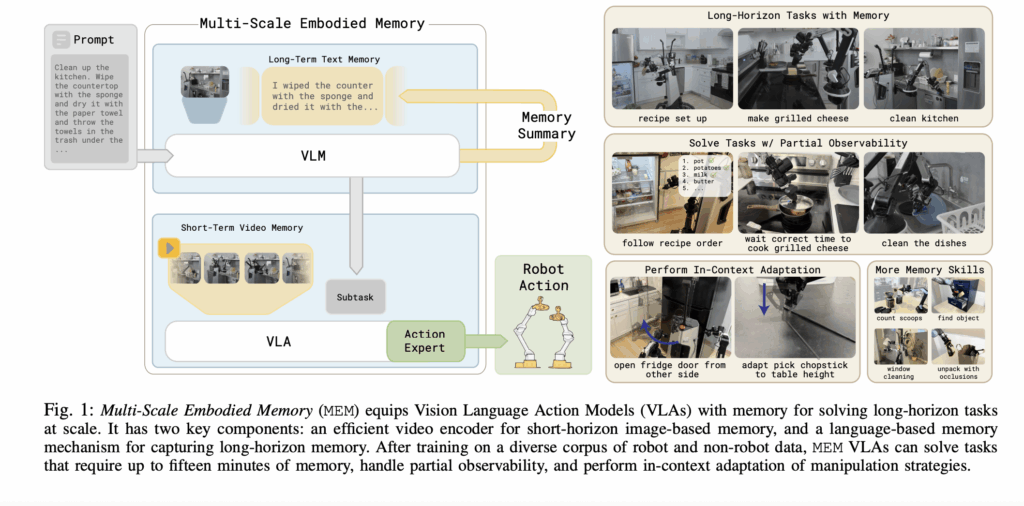
Current end-to-end robotic policies, specifically Vision-Language-Action (VLA) models, typically operate on a single observation or a very short history. This ‘lack of memory’ makes long-horizon tasks, such as cleaning a kitchen or following a complex recipe, computationally intractable or prone to failure. To address this, researchers from Physical Intelligence, Stanford, UC Berkeley, and MIT have introduced Multi-Scale Embodied Memory (MEM). https://www.pi.website/download/Mem.pdf The Dual-Scale Memory Architecture MEM factorizes robotic memory into two distinct scales to balance semantic context with real-time control constraints. (1) Short-Term Video Memory For tasks requiring fine-grained spatial awareness—like resolving self-occlusions or adapting a grasp—dense visual data is required. MEM utilizes an efficient video encoder that extends standard Vision Transformers (ViTs). To maintain real-time inference (the 380ms ‘real-time barrier’), the architecture avoids joint attention over all patches. Instead, it uses Space-Time Separable Attention, interleaving spatial attention within frames with causal-temporal attention across frames every fourth layer. The computational complexity is reduced from O(n2K2) to O(Kn2+nK2), where n is the number of spatial patches and K is the number of timesteps. By dropping tokens from past timesteps in upper layers, the model passes only the current observation’s representation to the VLA backbone, keeping the token count invariant compared to single-frame models. (2) Long-Term Language Memory To handle tasks spanning up to 15 minutes, MEM uses a language-based representation for semantic events. The system decomposes the action prediction as: $$pi(a_{t:t+H},l_{t+1},m_{t+1}|o_{t-T:t},m_{t},g) approxpi_{LL}(a_{t:t+H}|o_{t-K:t},l_{t+1},g)pi_{HL}(l_{t+1},m_{t+1}|o_{t},m_{t},g)$$ Here, a high-level policy (πHL) maintains a running language summary (mt) of past events and generates subtask instructions (lt+1) for a low-level policy (πLL). This language memory is trained using LLM-generated summaries that compress information (e.g., ‘I placed three bowls’ instead of individual attributes), reducing the risk of training-inference distribution shifts. https://www.pi.website/download/Mem.pdf Implementation and Performance The research team integrated MEM into the π0.6 VLA, which is initialized from a pre-trained Gemma 3-4B model. The model was pre-trained on a diverse mixture of robot demonstrations, vision-language tasks, and internet video data. Key Results: In-Context Adaptation: MEM enables robots to adapt manipulation strategies based on recent failures. In evaluation, this led to a +62% success rate increase in opening refrigerators with unknown hinge directions and a +11% increase in picking up chopsticks at variable heights. Long-Horizon Tasks: The model successfully performed 15-minute tasks like ‘Recipe Setup’ (retrieving ingredients from multiple locations) and ‘Kitchen Cleaning’ (washing dishes and wiping counters). Memory-less VLAs failed these tasks significantly more often. Efficiency: The video encoder allows the model to process up to 16 observation frames (spanning ~1 minute) while remaining under critical real-time inference thresholds on a single NVIDIA H100 GPU. MEM demonstrates that combining dense, short-term visual tokens with compressed, long-term language summaries allows VLAs to scale their ‘working memory’ without incurring prohibitive computational costs. Check out the Paper and Technical details. Also, feel free to follow us on Twitter and don’t forget to join our 120k+ ML SubReddit and Subscribe to our Newsletter. Wait! are you on telegram? now you can join us on telegram as well. The post Physical Intelligence Team Unveils MEM for Robots: A Multi-Scale Memory System Giving Gemma 3-4B VLAs 15-Minute Context for Complex Tasks appeared first on MarkTechPost.

Physical Intelligence Team Unveils MEM for Robots: A Multi-Scale Memory System Giving Gemma 3-4B VLAs 15-Minute Context for Complex Tasks Read Post »

AI, Committee, News, Uncategorized

NFT: Bridging Supervised Learning and Reinforcement Learning in Math Reasoning

arXiv:2505.18116v3 Announce Type: replace-cross Abstract: Reinforcement Learning (RL) has played a central role in the recent surge of LLMs’ math abilities by enabling self-improvement through binary verifier signals. In contrast, Supervised Learning (SL) is rarely considered for such verification-driven training, largely due to its heavy reliance on reference answers and inability to reflect on mistakes. In this work, we challenge the prevailing notion that self-improvement is exclusive to RL and propose Negative-aware Fine-Tuning (NFT) — a supervised approach that enables LLMs to reflect on their failures and improve autonomously with no external teachers. In online training, instead of throwing away self-generated negative answers, NFT constructs an implicit negative policy to model them. This implicit policy is parameterized with the same positive LLM we target to optimize on positive data, enabling direct policy optimization on all LLMs’ generations. We conduct experiments on 7B and 32B models in math reasoning tasks. Results consistently show that through the additional leverage of negative feedback, NFT significantly improves over SL baselines like Rejection sampling Fine-Tuning, matching or even surpassing leading RL algorithms like GRPO and DAPO. Furthermore, we demonstrate that NFT and GRPO are actually equivalent in strict-on-policy training, even though they originate from entirely different theoretical foundations. Our experiments and theoretical findings bridge the gap between SL and RL methods in binary-feedback learning systems.

NFT: Bridging Supervised Learning and Reinforcement Learning in Math Reasoning Read Post »

AI, Committee, News, Uncategorized

GenDB: The Next Generation of Query Processing — Synthesized, Not Engineered

arXiv:2603.02081v1 Announce Type: cross Abstract: Traditional query processing relies on engines that are carefully optimized and engineered by many experts. However, new techniques and user requirements evolve rapidly, and existing systems often cannot keep pace. At the same time, these systems are difficult to extend due to their internal complexity, and developing new systems requires substantial engineering effort and cost. In this paper, we argue that recent advances in Large Language Models (LLMs) are starting to shape the next generation of query processing systems. We propose using LLMs to synthesize execution code for each incoming query, instead of continuously building, extending, and maintaining complex query processing engines. As a proof of concept, we present GenDB, an LLM-powered agentic system that generates instance-optimized and customized query execution code tailored to specific data, workloads, and hardware resources. We implemented an early prototype of GenDB that uses Claude Code Agent as the underlying component in the multi-agent system, and we evaluate it on OLAP workloads. We use queries from the well-known TPC-H benchmark and also construct a new benchmark designed to reduce potential data leakage from LLM training data. We compare GenDB with state-of-the-art query engines, including DuckDB, Umbra, MonetDB, ClickHouse, and PostgreSQL. GenDB achieves significantly better performance than these systems. Finally, we discuss the current limitations of GenDB and outline future extensions and related research challenges.

GenDB: The Next Generation of Query Processing — Synthesized, Not Engineered Read Post »

AI, Committee, News, Uncategorized

Alibaba Releases OpenSandbox to Provide Software Developers with a Unified, Secure, and Scalable API for Autonomous AI Agent Execution

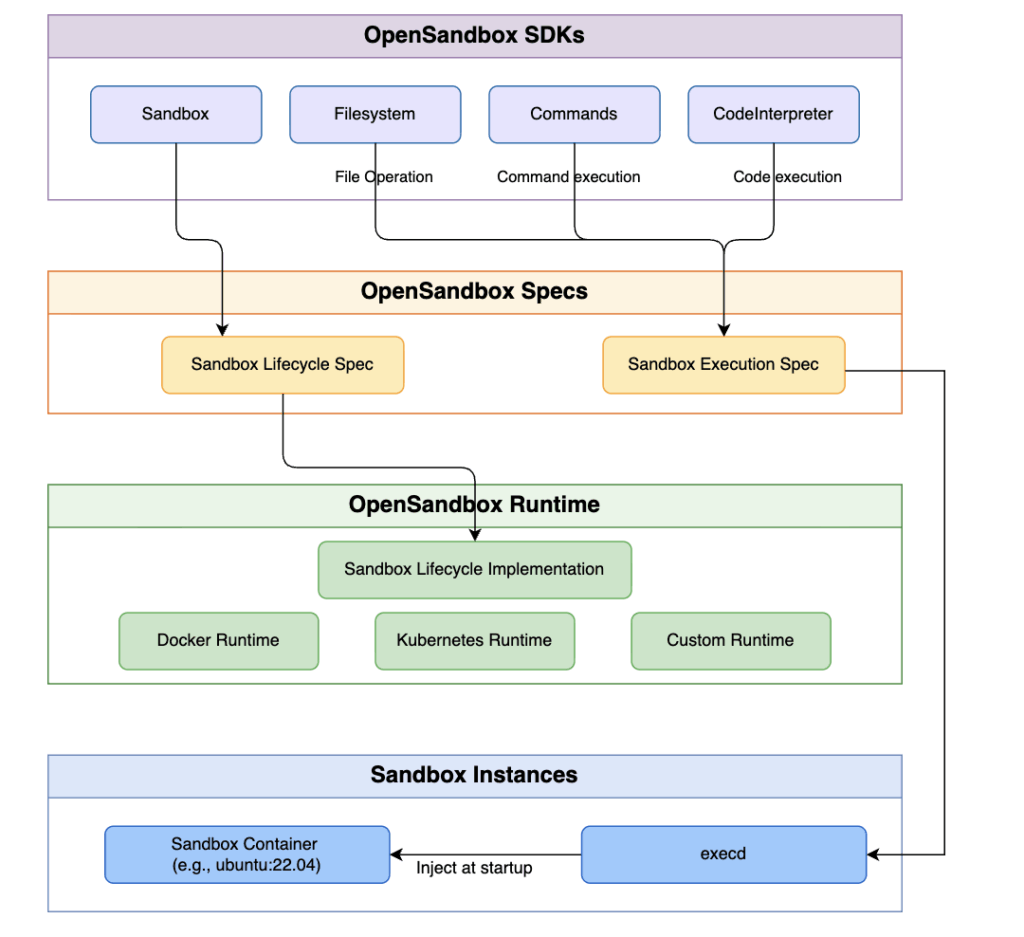
Alibaba has released OpenSandbox, an open-source tool designed to provide AI agents with secure, isolated environments for code execution, web browsing, and model training. Released under the Apache 2.0 license, the proposed system targets to standardize the ‘execution layer’ of the AI agent stack, offering a unified API that functions across various programming languages and infrastructure providers. The tool is built on the same internal infrastructure Alibaba utilizes for large-scale AI workloads. The Technical Gap in Agentic Workflows Building an autonomous agent typically involves two components: the ‘brain’ (usually a Large Language Model) and the ‘tools’ (code execution, web access, or file manipulation). Providing a safe environment for these tools has required developers to manually configure Docker containers, manage complex network isolation, or rely on third-party APIs. OpenSandbox addresses this by providing a standardized, secure environment where agents can execute arbitrary code or interact with interfaces without risking the host system’s integrity. It abstracts the underlying infrastructure, allowing developers to move from local development to production-scale deployments using a single API. Architecture The architecture of OpenSandbox is built on a modular four-layer stack—comprising the SDKs Layer, Specs Layer, Runtime Layer, and Sandbox Instances Layer—designed to decouple client logic from execution environments. At its core, the system utilizes a FastAPI-based server to manage the lifecycle of sandboxes via the Docker or Kubernetes runtimes, while communication is standardized through OpenAPI specifications (the Sandbox Lifecycle and Execution Specs). Within each isolated container, OpenSandbox injects a high-performance Go-based execution daemon (execd) that interfaces with internal Jupyter kernels to provide stateful code execution, real-time output streaming via Server-Sent Events (SSE), and comprehensive filesystem management, ensuring a ‘protocol-first’ approach that remains consistent across any base container image. https://open-sandbox.ai/overview/architecture Core Technical Capabilities OpenSandbox is designed to be environment-agnostic. It supports Docker for local development and Kubernetes for distributed, production-grade runs. The platform provides four primary types of sandboxes: Coding Agents: Environments optimized for software development tasks, where agents can write, test, and debug code. GUI Agents: Supports full VNC desktops, enabling agents to interact with graphical user interfaces. Code Execution: High-performance runtimes for executing specific scripts or computational tasks. RL Training: Isolated environments tailored for Reinforcement Learning (RL) workloads, allowing for safe iterative training. The system utilizes a Unified API, which ensures that the interaction patterns remain consistent regardless of the underlying language or runtime. Currently, OpenSandbox provides SDKs for Python, TypeScript, and Java/Kotlin, with C# and Go listed on the development roadmap. Integration and Ecosystem Support A significant feature of OpenSandbox is its native compatibility with existing AI frameworks and developer tools. By providing a secure execution layer, it allows agents built on various platforms to perform ‘real-world’ actions. The integrations currently supported include: Model Interfaces: Claude Code, Gemini CLI, and OpenAI Codex. Orchestration Frameworks: LangGraph and Google ADK (Agent Development Kit). Automation Tools: Chrome and Playwright for browser-based tasks. Visualization: Full VNC support for visual monitoring and interaction. This means that an agent can be tasked with ‘scraping a website and training a linear regression model’ within a single, isolated session. The agent uses Playwright to navigate the web, downloads data to the sandbox’s local file system, and executes Python code to process that data—all without leaving the secured OpenSandbox environment. Deployment and Configuration The project prioritizes a streamlined developer experience (DX). Setting up a local execution server requires three primary commands through the command-line interface: pip install opensandbox-server — Installs the server components. opensandbox-server init-config — Generates the necessary configuration files for the environment. opensandbox-server — Launches the server and exposes the API for agent interaction. Once the server is running, developers can use the provided SDKs to create, manage, and terminate sandboxes programmatically. This reduces the operational overhead of ‘stitching together’ multiple tools for file management, process isolation, and network proxying. Key Takeaways Unified, Language-Agnostic Execution: OpenSandbox provides a consistent API for AI agents to execute code, browse the web, and interact with GUIs. While it currently supports Python, TypeScript, and Java/Kotlin, SDKs for C# and Go are on the roadmap. Infrastructure Flexibility (Docker & Kubernetes): The tool is designed to scale seamlessly from a developer’s local machine to enterprise-grade production. It utilizes Docker for local isolation and Kubernetes for distributed, large-scale deployments, eliminating the ‘environment drift’ often found when moving agents from dev to cloud. Broad Ecosystem Integration: It is engineered to plug directly into leading AI frameworks and tools, including LangGraph, Claude Code, Gemini CLI, OpenAI Codex, and Google ADK, as well as automation libraries like Playwright and Chrome. Elimination of ‘Sandbox Dependency’: By providing a free, open-source alternative under the Apache 2.0 license, Alibaba removes the dependency on expensive, managed sandbox services that charge per-minute fees or impose vendor lock-in. High-Fidelity Interaction (VNC & Web): Beyond simple script execution, OpenSandbox supports full VNC desktops and browser automation. This allows agents to perform complex, multi-modal tasks—such as navigating web interfaces or using desktop applications—within a secure, ‘blast-resistant’ environment. Check out the Repo, Docs and Examples. Also, feel free to follow us on Twitter and don’t forget to join our 120k+ ML SubReddit and Subscribe to our Newsletter. Wait! are you on telegram? now you can join us on telegram as well. The post Alibaba Releases OpenSandbox to Provide Software Developers with a Unified, Secure, and Scalable API for Autonomous AI Agent Execution appeared first on MarkTechPost.

Alibaba Releases OpenSandbox to Provide Software Developers with a Unified, Secure, and Scalable API for Autonomous AI Agent Execution Read Post »

AI, Committee, News, Uncategorized

This startup claims it can stop lightning and prevent catastrophic wildfires

On June 1, 2023, as a sweltering heat wave baked Quebec, thousands of lightning strikes flashed across the province, setting off more than 120 wildfires. The blazes ripped through parched forests and withered grasslands, burned for weeks, and compounded what was rapidly turning into Canada’s worst fire year on record. In the end, nearly 7,000 fires scorched tens of millions of acres across the country, generated nearly 500 millions tons of carbon emissions, and forced hundreds of thousands of people to flee their homes. Lightning sparked almost 60% of the wildfires—and those blazes accounted for 93% of the total area burned. Now a Vancouver-based weather modification startup, Skyward Wildfire, says it can prevent such catastrophic fires in the future—by stopping the lightning strikes that ignite them. It just raised millions of dollars in a funding round that it plans to use to accelerate its product development and expand its operations. Until last week the company, which highlights the role lightning played in the 2023 infernos, stated on its website that it has demonstrated technology capable of preventing “up to 100% of lightning strikes.” It was an eye-catching claim that went well beyond the confidence level of researchers who have studied the potential for humans to suppress lightning—and the company took it down following inquiries from MIT Technology Review. “While the statement reflected an observed result under specific conditions, it was not intended to suggest uniform outcomes and has been removed,” Nicholas Harterre, who oversees government partnerships at Skyward, said in an email. “In complex atmospheric systems, consistent 100% outcomes are not realistic, as the experts you spoke to rightly pointed out.”  The company now states it demonstrated that it “can prevent the majority of cloud-to-ground lightning strikes in targeted storm cells.” So far, Skyward hasn’t publicly revealed how it does so, and in response to our questions Harterre said only that the materials are “inert and selected in accordance with regulatory standards.”  But online documents suggest the company is relying on an approach that US government agencies began evaluating in the early 1960s: seeding clouds with metallic chaff, or narrow fiberglass strands coated with aluminum.  The military uses the material to disrupt radar signals; fighter jets, for example, deploy it during dogfights to throw off guided missile systems. Field trials conducted decades ago by US agencies suggest it could help reduce lightning strikes, at least to some degree and under certain conditions. If Skyward could employ it reliably on significant scales, it might offer a powerful tool for countering rising fire risks as climate change drives up temperatures, dries out forests, and likely increases the frequency of lightning strikes. “Preventing lightning on high-risk days saves lives, billions in wildfire costs, and is one of the highest-leverage and most immediate climate solutions available,” Sam Goldman, Skyward’s founder and chief executive, said in a statement posted on LinkedIn last year. But researchers and environmental observers say there are plenty of remaining uncertainties, including how well the seeding may work under varying weather and climate conditions, how much material would need to be released, how frequently it would have to be done, and what sorts of secondary environmental impacts might result from lighting suppression on commercial scales. Some observers are also concerned that the company appears to have moved ahead with weather modification field trials in parts of Canada without providing wide public notice or openly discussing what materials it’s putting into the clouds. Given the escalating fire dangers, it’s “reasonable” to evaluate the potential for new technologies to mitigate them, says Keith Brooks, programs director at Environmental Defence, a Canadian advocacy organization. “But we should be doing so cautiously and really transparently, with a robust scientific methodology that’s open to scrutiny,” he says. Seeding the clouds Skyward’s website offers few technical details, but the company says it worked with Canadian wildfire agencies in 2024 and 2025 to demonstrate its technology. The company also says it has developed AI tools to predict lightning strikes that could set off fires. Skyward announced last month that it raised $7.9 million in Canadian dollars ($5.7 million), in an extension of a seed round initially closed early last year. Investors included Climate Innovation Capital, Active Impact Investments, and Diagram Ventures. “Our first season demonstrated that prevention is possible at scale,” Goldman said in a statement. “This funding allows us to expand into new regions and support partners who need reliable, operational tools to reduce wildfire risk before emergencies begin.” The company doesn’t use the term “cloud seeding” on its site or in its recent announcements. But a press release highlighting its selection as a finalist last year in a conservation group’s Fire Grand Challenge states that it suppresses lightning “by cloud seeding with safe, non-toxic materials to neutralize storm charges,” as The Narwhal previously reported. In addition, Unorthodox Philanthropy, a foundation that provided a grant to support Skyward’s efforts “to test and deploy” the technology, offered more detail in an awardee write-up about Goldman. It states: “The Skyward team … settled on an inert substance consisting of aluminum covered glass fibers, which is regularly used in military operations to intercept and confuse enemy radar and can also dis-charge clouds.” Additional details were disclosed in a document marked “Proprietary and Confidential,” which the World Bank nonetheless released within a package of materials from companies developing means of addressing fire risks. Skyward’s diagrams show planes dropping particles into clouds to prevent cloud-to-ground lightning strikes in “high risk areas.” The company also notes in the document that it uses artificial intelligence for a number of purposes, including forecasting lightning storms, prioritizing treatments, targeting storm cells, and optimizing flight paths.   Harterre stressed that the company would deploy the technology judiciously and reserve it for storm events with elevated wildfire risk, adding that such storms account for less than 0.1% of lightning activity in a given area. “Our objective is to reduce the probability of ignition on the limited number of extreme-risk days when fires threaten lives, critical infrastructure, and ecosystems,

This startup claims it can stop lightning and prevent catastrophic wildfires Read Post »

We use cookies to improve your experience and performance on our website. You can learn more at Privacy Policy and manage your privacy settings by clicking Settings.

Privacy Preferences

You can choose your cookie settings by turning on/off each type of cookie as you wish, except for essential cookies.

Allow All
Manage Consent Preferences
  • Always Active

Save
en_US