YouZum

Uncategorized

AI, Committee, News, Uncategorized

LangChain Releases Deep Agents: A Structured Runtime for Planning, Memory, and Context Isolation in Multi-Step AI Agents

Most LLM agents work well for short tool-calling loops but start to break down when the task becomes multi-step, stateful, and artifact-heavy. LangChain’s Deep Agents is designed for that gap. The project is described by LangChain as an ‘agent harness‘: a standalone library built on top of LangChain’s agent building blocks and powered by the LangGraph runtime for durable execution, streaming, and human-in-the-loop workflows. The important point is that Deep Agents does not introduce a new reasoning model or a new runtime separate from LangGraph. Instead, it packages a set of defaults and built-in tools around the standard tool-calling loop. LangChain team positions it as the easier starting point for developers who need agents that can plan, manage large context, delegate subtasks, and persist information across conversations, while still keeping the option to move to simpler LangChain agents or custom LangGraph workflows when needed. What Deep Agents Includes by Default The Deep Agents GitHub repository lists the core components directly. These include a planning tool called write_todos, filesystem tools such as read_file, write_file, edit_file, ls, glob, and grep, shell access through execute with sandboxing, the task tool for spawning subagents, and built-in context management features such as auto-summarization and saving large outputs to files. That framing matters because many agent systems leave planning, intermediate storage, and subtask delegation to the application developer. Deep Agents moves those pieces into the default runtime. Planning and Task Decomposition Deep Agents includes a built-in write_todos tool for planning and task decomposition. The purpose is explicit: the agent can break a complex task into discrete steps, track progress, and update the plan as new information appears. Without a planning layer, the model tends to improvise each step from the current prompt. With write_todos, the workflow becomes more structured, which is more useful for research tasks, coding sessions, or analysis jobs that unfold over several steps. Filesystem-Based Context Management A second core feature is the use of filesystem tools for context management. These tools allow the agent to offload large context into storage rather than keeping everything inside the active prompt window. LangChain team explicitly notes that this helps prevent context window overflow and supports variable-length tool results. This is a more concrete design choice than vague claims about ‘memory.’ The agent can write notes, generated code, intermediate reports, or search outputs into files and retrieve them later. That makes the system more suitable for longer tasks where the output itself becomes part of the working state. Deep Agents also supports multiple backend types for this virtual filesystem. The customization docs list StateBackend, FilesystemBackend, LocalShellBackend, StoreBackend, and CompositeBackend. By default, the system uses StateBackend, which stores an ephemeral filesystem in LangGraph state for a single thread. Subagents and Context Isolation Deep Agents also includes a built-in task tool for subagent spawning. This tool allows the main agent to create specialized subagents for context isolation, keeping the main thread cleaner while letting the system go deeper on specific subtasks. This is one of the cleaner answers to a common failure mode in agent systems. Once a single thread accumulates too many objectives, tool outputs, and temporary decisions, model quality often drops. Splitting work into subagents reduces that overload and makes the orchestration path easier to debug. Long-Term Memory and LangGraph Integration The Deep Agents GitHub repository also describe long-term memory as a built-in capability. Deep Agents can be extended with persistent memory across threads using LangGraph’s Memory Store, allowing the agent to save and retrieve information from previous conversations. On the implementation side, Deep Agents stays fully inside the LangGraph execution model. The customization docs specify that create_deep_agent(…) returns a CompiledStateGraph. The resulting graph can be used with standard LangGraph features such as streaming, Studio, and checkpointers. Deep Agents is not a parallel abstraction layer that blocks access to runtime features; it is a prebuilt graph with defaults. Deployment Details For deployment, the official quickstart shows a minimal Python setup: install deepagents plus a search provider such as tavily-python, export your model API key and search API key, define a search tool, and then create the agent with create_deep_agent(…) using a tool-calling model. The docs note that Deep Agents requires tool calling support, and the example workflow is to initialize the agent with your tools and system_prompt, then run it with agent.invoke(…). LangChain team also points developers toward LangGraph deployment options for production, which fits because Deep Agents runs on the LangGraph runtime and supports built-in streaming for observing execution. Copy CodeCopiedUse a different Browser # pip install -qU deepagents from deepagents import create_deep_agent def get_weather(city: str) -> str: “””Get weather for a given city.””” return f”It’s always sunny in {city}!” agent = create_deep_agent( tools=[get_weather], system_prompt=”You are a helpful assistant”, ) # Run the agent agent.invoke( {“messages”: [{“role”: “user”, “content”: “what is the weather in sf”}]} ) Key Takeaways Deep Agents is an agent harness built on LangChain and the LangGraph runtime. It includes built-in planning through the write_todos tool for multi-step task decomposition. It uses filesystem tools to manage large context and reduce prompt-window pressure. It can spawn subagents with isolated context using the built-in task tool. It supports persistent memory across threads through LangGraph’s Memory Store. Check out Repo and Docs. Also, feel free to follow us on Twitter and don’t forget to join our 120k+ ML SubReddit and Subscribe to our Newsletter. Wait! are you on telegram? now you can join us on telegram as well. The post LangChain Releases Deep Agents: A Structured Runtime for Planning, Memory, and Context Isolation in Multi-Step AI Agents appeared first on MarkTechPost.

LangChain Releases Deep Agents: A Structured Runtime for Planning, Memory, and Context Isolation in Multi-Step AI Agents Read Post »

AI, Committee, News, Uncategorized

Why physical AI is becoming manufacturing’s next advantage

For decades, manufacturers have pursued automation to drive efficiency, reduce costs, and stabilize operations. That approach delivered meaningful gains, but it is no longer enough. Today’s manufacturing leaders face a different challenge: how to grow amid labor constraints, rising complexity, and increasing pressure to innovate faster without sacrificing safety, quality, or trust. The next phase of transformation will not be defined by isolated AI tools or individual robots, but by intelligence that can operate reliably in the physical world. This is where physical AI—intelligence that can sense, reason, and act in the real world—marks a decisive shift. And it is why Microsoft and NVIDIA are working together to help manufacturers move from experimentation to production at industrial scale. The industrial frontier: Intelligence and trust, not just automation Most early AI adoption focused on narrow optimization: automating tasks, improving utilization, and cutting costs. While valuable, that phase often created new friction, including skills gaps, governance concerns, and uncertainty about long‑term impact. Furthermore, the use cases were plentiful but not as strategic. The industrial frontier represents a different approach. Rather than asking how much work machines can replace, frontier manufacturers ask how AI can expand human capability, accelerate innovation, and unlock new forms of value while remaining trustworthy and controllable. Across industries, companies that successfully move into this frontier phase share two non‑negotiables: Intelligence: AI systems must understand how the business actually handles its data, workflows, and institutional knowledge. Trust: As AI begins to act in high‑stakes environments, organizations must retain security, governance, and observability at every layer. Without intelligence, AI becomes generic. Without trust, adoption stalls. Why manufacturing is the proving ground for physical AI Manufacturing is uniquely positioned at the center of this shift. AI is no longer confined to planning or analytics. It is moving into physical execution: coordinating machines, adapting to real‑world variability, and working alongside people on the factory floor. Robotics, autonomous systems, and AI agents must now perceive, reason, and act in dynamic environments. This transition exposes a critical gap. Traditional automation excels at repetition but struggles with adaptability. Human workers bring judgment and context but are constrained by scale. Physical AI closes that gap by enabling human‑led, AI‑operated systems, where people set intent and intelligent systems execute, learn, and improve over time. Humans are essential for scaled success. Microsoft and NVIDIA: Accelerating physical AI at scale Physical AI cannot be delivered through point solutions. It requires agentic-driven, enterprise-grade development, deployment, and operations toolchains and workflows that connect simulation, data, AI models, robotics, and governance into a coherent system. NVIDIA is building the AI infrastructure that makes physical AI possible, including accelerated computing, open models, simulation libraries, and robotics frameworks and blueprints that enable the ecosystem to build autonomous robotics systems that can perceive, reason, plan, and take action in the physical world. Microsoft complements this with a cloud and data platform designed to operate physical AI securely, at scale, and across the enterprise. Together, Microsoft and NVIDIA are enabling manufacturers to move beyond pilots toward production‑ready physical AI systems that can be developed, tested, deployed, and continuously improved across heterogeneous environments spanning the product lifecycle, factory operations, and supply chain. From intelligence to action: Human-agent teams in the factory At the industrial frontier, AI is not a standalone system, but a digital teammate. When AI agents are grounded in the proper operational data, embedded in human workflows, and governed end to end, they can assist with tasks such as: Optimizing production lines in real time Coordinating maintenance and quality decisions Adapting operations to supply or demand disruptions Accelerating engineering and product lifecycle decisions For example, manufacturers are beginning to use simulation‑grounded AI agents to evaluate production changes virtually before deploying them on the factory floor, reducing risk while accelerating decision‑making. Crucially, frontier manufacturers design these systems so humans remain in control. AI executes, monitors, and recommends, while people provide intent, oversight, and judgment. This balance allows organizations to move faster without losing confidence or control. The role of trust in scaling physical AI As physical AI systems scale, trust becomes the limiting factor. Manufacturers must ensure that AI systems are secure, observable, and operating within policy, especially when they influence safety‑critical or mission‑critical processes. Governance cannot be an afterthought; It must be engineered into the platform itself. This is why frontier manufacturers treat trust as a first‑class requirement, pairing innovation with visibility, compliance, and accountability. Only then can physical AI move from promising demonstrations to enterprise‑wide deployment. Why this moment matters—and what’s next The convergence of AI agents, robotics, simulation, and real‑time data marks an inflection point for manufacturing. What was once experimental is becoming operational. What was once siloed is becoming connected. At NVIDIA GTC 2026, Microsoft and NVIDIA will demonstrate how this collaboration supports physical AI systems that manufacturers can deploy today and scale responsibly tomorrow. From simulation‑driven development to real‑world execution, the focus is on helping manufacturers cross the industrial frontier with confidence. For manufacturing leaders, the question is no longer whether physical AI will reshape operations, but how quickly they can adopt it responsibly, at scale, and with trust built in from the start. Discover more with Microsoft at NVIDIA GTC 2026. This content was produced by Microsoft. It was not written by MIT Technology Review’s editorial staff.

Why physical AI is becoming manufacturing’s next advantage Read Post »

AI, Committee, News, Uncategorized

Measuring Intent Comprehension in LLMs

arXiv:2506.16584v2 Announce Type: replace Abstract: People judge interactions with large language models (LLMs) as successful when outputs match what they want, not what they type. Yet LLMs are trained to predict the next token solely from text input, not underlying intent. Because written language is an imperfect proxy for intent, and correlations between phrasing and desired outcomes can break down in training data, models that rely too heavily on surface cues may respond inconsistently to semantically equivalent prompts. This makes it essential to evaluate whether LLMs can reliably infer user intent-especially in high-stakes settings where robustness and generalization are critical. We introduce a formal framework for assessing intent comprehension in LLMs: whether a model demonstrates robust understanding of user intent by producing consistent outputs across semantically equivalent prompts while differentiating between prompts with distinct intents. Our evaluation approach is based on a variance decomposition of model responses into three components: variability due to user intent, user articulation, and model uncertainty. Models that understand what users want, and are not overly sensitive to textual cues, should attribute most output variance to intent differences, rather than articulation style. Applying this framework across diverse domains, we find that, within the five LLaMA and Gemma models we evaluate, larger models typically assign a greater share of variance to intent, indicating stronger comprehension of intent, although gains are uneven and often modest with increasing model size. These results motivate moving beyond accuracy-only benchmarks toward semantic diagnostics that directly assess whether models understand what users intend.

Measuring Intent Comprehension in LLMs Read Post »

AI, Committee, News, Uncategorized

Speak or Stay Silent: Context-Aware Turn-Taking in Multi-Party Dialogue

arXiv:2603.11409v1 Announce Type: cross Abstract: Existing voice AI assistants treat every detected pause as an invitation to speak. This works in dyadic dialogue, but in multi-party settings, where an AI assistant participates alongside multiple speakers, pauses are abundant and ambiguous. An assistant that speaks on every pause becomes disruptive rather than useful. In this work, we formulate context-aware turn-taking: at every detected pause, given the full conversation context, our method decides whether the assistant should speak or stay silent. We introduce a benchmark of over 120K labeled conversations spanning three multi-party corpora. Evaluating eight recent large language models, we find that they consistently fail at context-aware turn-taking under zero-shot prompting. We then propose a supervised fine-tuning approach with reasoning traces, improving balanced accuracy by up to 23 percentage points. Our findings suggest that context-aware turn-taking is not an emergent capability; it must be explicitly trained.

Speak or Stay Silent: Context-Aware Turn-Taking in Multi-Party Dialogue Read Post »

AI, Committee, News, Uncategorized

Google AI Introduces ‘Groundsource’: A New Methodology that Uses Gemini Model to Transform Unstructured Global News into Actionable, Historical Data

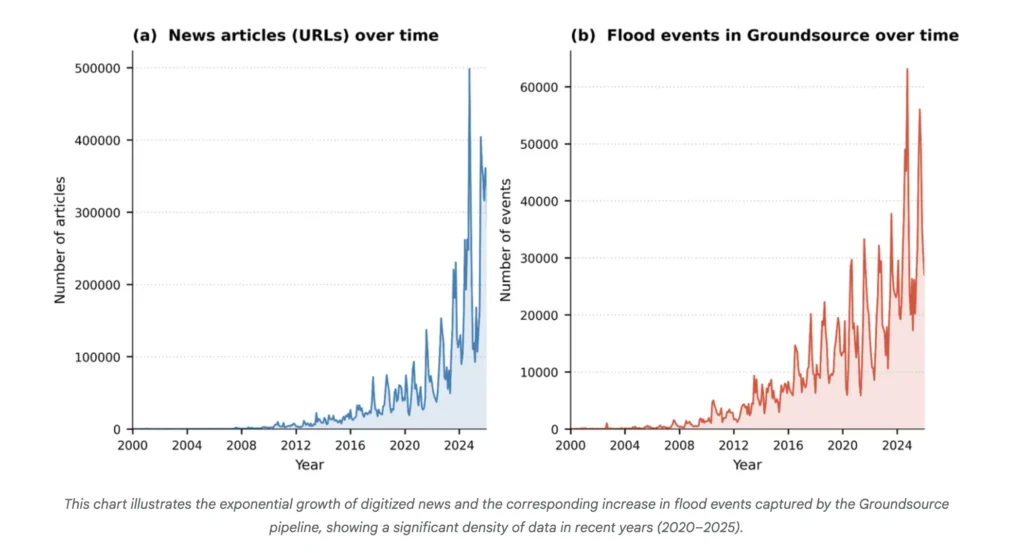
Google AI Research team recently released Groundsource, a new methodology that uses Gemini model to extract structured historical data from unstructured public news reports. The project addresses the lack of historical data for rapid-onset natural disasters. Its first output is an open-source dataset containing 2.6 million historical urban flash flood events across more than 150 countries. The Hydro-Meteorological Data Gap Machine learning models for early warning systems (EWS) require extensive historical baselines for training and validation. However, hydro-meteorological hazards like flash floods lack standardized, global observation networks. The Impact of Flash Floods: According to the World Meteorological Organization (WMO), flash floods cause approximately 85% of flood-related fatalities, resulting in over 5,000 deaths annually. Limitations of Existing Data: Satellite-based databases, such as the Global Flood Database (GFD) and the Dartmouth Flood Observatory (DFO), are limited by cloud cover, satellite revisit times, and a bias toward long-lasting events. Scale of the Deficit: The Global Disaster Alert and Coordination System (GDACS) provides an inventory of roughly 10,000 high-impact events. This volume is insufficient for training global-scale predictive models. The Groundsource Methodology To build a larger training corpus, Google’s research team developed a pipeline that processes decades of localized news reports to synthesize a historical baseline. Semantic Parsing with Gemini: The LLM is deployed for entity extraction. It processes unstructured, multilingual text to identify specific hazard events, classify their severity, and filter out irrelevant noise. Geospatial Mapping: The extracted text descriptions of flood locations are integrated with Google Maps APIs to assign precise geographic coordinates and polygonal boundaries to each event. This pipeline successfully converts qualitative journalistic reporting into a highly structured, machine-readable dataset. https://research.google/blog/introducing-groundsource-turning-news-reports-into-data-with-gemini/ Application: Flash Flood Forecasting Historically, Google’s Flood Forecasting Initiative focused on riverine floods, which develop slowly and are easier to track. Flash floods require distinct predictive approaches due to their rapid onset. Using the 2.6-million-record Groundsource dataset, the research team trained a new AI model to predict urban flash flood risks up to 24 hours in advance. Empirical studies note that even a 12-hour lead time can reduce flash flood damage by 60%. These forecasts are now live on Google’s Flood Hub platform. The underlying dataset has been open-sourced to allow the broader data science community to train their own localized predictive models. Key Takeaways LLM-Driven Data Pipeline: Groundsource uses the Gemini model for semantic parsing to extract structured historical disaster data from unstructured, multilingual public news reports. Massive Dataset Generation: The pipeline successfully produced an open-source dataset containing 2.6 million historical urban flash flood records across more than 150 countries. Overcoming Sensor Limitations: This NLP-based approach addresses the historical ‘data desert,’ bypassing the physical constraints of remote sensing (such as cloud cover or satellite revisit times) and the limited volume of existing traditional databases like GDACS. Geospatial Integration: Extracted natural language descriptions of hazard locations are integrated with Google Maps APIs to assign precise geographic coordinates and polygonal boundaries to each event. Predictive Model Deployment: The resulting dataset was utilized to train a new AI model capable of predicting urban flash flood risks up to 24 hours in advance, which is now actively deployed on Google’s Flood Hub platform. Check out Dataset, Pre-Print Paper and Technical details. Also, feel free to follow us on Twitter and don’t forget to join our 120k+ ML SubReddit and Subscribe to our Newsletter. Wait! are you on telegram? now you can join us on telegram as well. The post Google AI Introduces ‘Groundsource’: A New Methodology that Uses Gemini Model to Transform Unstructured Global News into Actionable, Historical Data appeared first on MarkTechPost.

Google AI Introduces ‘Groundsource’: A New Methodology that Uses Gemini Model to Transform Unstructured Global News into Actionable, Historical Data Read Post »

AI, Committee, News, Uncategorized

Future AI chips could be built on glass

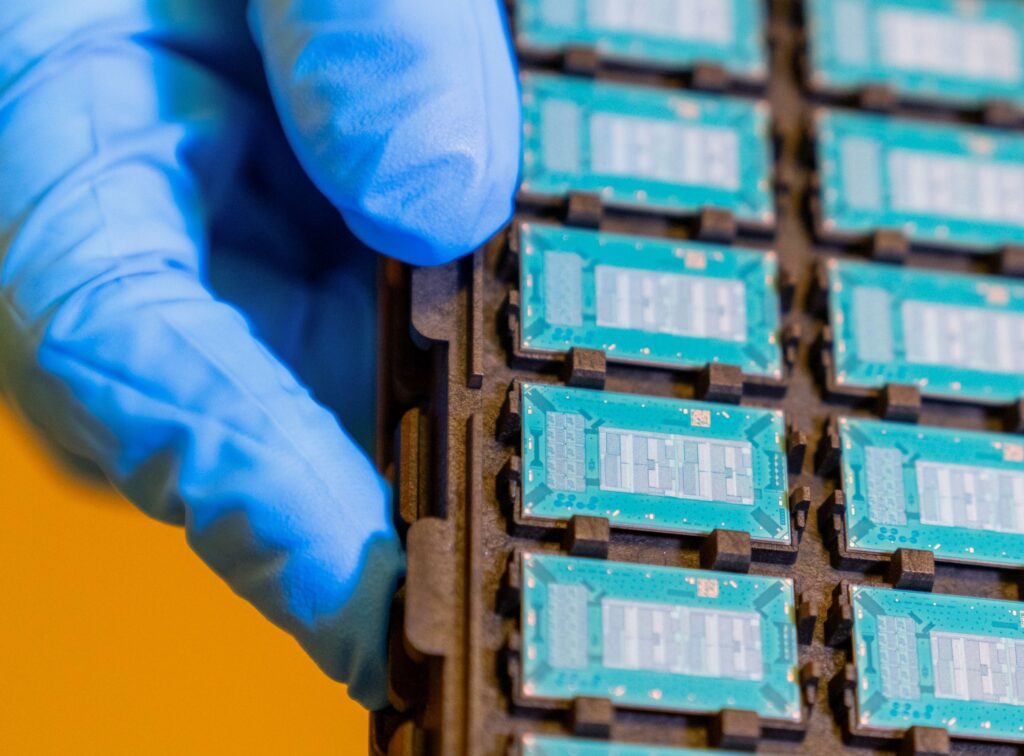
Human-made glass is thousands of years old. But it’s now poised to find its way into the AI chips used in the world’s newest and largest data centers. This year, a South Korean company called Absolics is planning to start commercial production of special glass panels designed to make next-generation computing hardware more powerful and energy efficient. Other companies, including Intel, are also pushing forward in this area. If all goes well, such glass technology could reduce the energy demands of the sorts of high-performance computing chips used in AI data centers—and it could eventually do the same for consumer laptops and mobile devices if production costs fall. The idea is to use glass as the substrate, or layer, on which multiple silicon chips are connected. This form of “packaging” is an increasingly popular way to build computing hardware, because it lets engineers combine specialized chips designed for specific functions into a single system. But it presents challenges, including the fact that hardworking chips can run so hot they physically warp the substrate they’re built on. This can lead to misaligned components and may reduce how efficiently the chips can be cooled, leading to damage or premature failure.  “As AI workloads surge and package sizes expand, the industry is confronting very real mechanical constraints that impact the trajectory of high-performance computing,” says Deepak Kulkarni, a senior fellow at the chip design company Advanced Micro Devices (AMD). “One of the most fundamental is warpage.” That’s where glass comes in. It can handle the added heat better than existing substrates, and it will let engineers keep shrinking chip packages—which will make them faster and more energy efficient. It “unlocks the ability to keep scaling package footprints without hitting a mechanical wall,” says Kulkarni.  Momentum is building behind the shift. Absolics has finished building a factory in the US that is dedicated to producing glass substrates for advanced chips and expects to begin commercial manufacturing this year. The US semiconductor manufacturer Intel is working toward incorporating glass in its next-generation chip packages, and its research has spurred other companies in the chip packaging supply chain to invest in it as well. South Korean and Chinese companies are among the early adopters. “Historically, this is not the first attempt to adopt glass in semiconductor packaging,” says Bilal Hachemi, senior technology and market analyst at the market research firm Yole Group. “But this time, the ecosystem is more solid and wider; the need for glass-based [technology] is sharper.”  Fragile but mighty Chip packaging has relied on organic substrates such as fiberglass-reinforced epoxy since the 1990s, says Rahul Manepalli, vice president of advanced packaging at Intel. But electrochemical complications limit how closely designers can place drilled holes to create copper-coated signal and power connections between the chips and the rest of the system. Chip designers must also account for the unpredictable shrinkage and distortion that organic substrates undergo as chips heat up and cool down. “We realized about a decade ago that we are going to have some limitations with organic substrates,” says Manepalli. These glass substrate test units were photographed at an Intel facility in Chandler, Arizona, in 2023.INTEL CORPORATION Glass may help overcome a lot of these limitations. Its thermal stability could allow engineers to create 10 times more connections per millimeter than organic substrates, says Manepalli. With denser connections, Intel’s designers can then stuff 50% more silicon chips into the same package area, improving computational capability. The denser connections also enable more efficient routing for the copper wires that deliver power to the chip. And the fact that glass dissipates heat more efficiently allows for chip designs that reduce overall power consumption.  “The benefits of glass core substrates are undeniable,” says Manepalli. “It’s clear that the benefits will drive the industry to make this happen sooner rather than later, and we want to be one of the first ones who do it.”  However, working with glass creates its own challenges. For one thing, it’s fragile. Glass substrates for data center chip packages are made from panels that are only about 700 micrometers to 1.4 millimeters thick, which leaves them susceptible to cracking or even shattering, says Manepalli. Researchers at Intel and other organizations have spent years figuring out how to use other materials and special tools to integrate the glass panels safely into semiconductor manufacturing processes.  Now, Manepalli says, Intel’s research and development teams are reliably fabricating glass panels and churning out test chip packages that incorporate glass—and in early 2025 they demonstrated that a functional device with a glass core substrate could boot up the Windows operating system. It’s a significant improvement from the early testing days, when hundreds of glass panels got cracked every couple of days, he says. Semiconductor manufacturers already use glass for more limited purposes, such as temporary support structures for silicon wafers. But the independent market research firm IDTechEx estimates there’s a big market for glass substrates, one that could boost the semiconductor market for glass from $1 billion in 2025 to as much as $4.4 billion by 2036.  The material could have additional benefits if it takes off. Glass can be made astoundingly smooth—5,000 times smoother than organic substrates. This would eliminate defects that can arise as metal gets layered onto semiconductors, says Xiaoxi He, a research analyst at IDTechEx. Defects in these layers can worsen chips’ performance or even render them unusable.   Glass could also help speed the movement of data. The material can guide light, which means chip designers could use it to build high-speed signal pathways directly into the substrate. Glass “holds enormous potential for the future of energy-efficient AI compute,” says Kulkarni at AMD, because a light-based system could move signals around with far less energy than the “power-hungry” copper pathways that are currently used to carry signals between chips in a package. A panel pivot Early research on glass packaging started at the 3D Systems Packaging Research Center at the Georgia Institute of Technology in 2009. The university eventually partnered with

Future AI chips could be built on glass Read Post »

AI, Committee, News, Uncategorized

The Download: how AI is used for military targeting, and the Pentagon’s war on Claude

This is today’s edition of The Download, our weekday newsletter that provides a daily dose of what’s going on in the world of technology. Defense official reveals how AI chatbots could be used for targeting decisions  The US military might use generative AI systems to rank targets and recommend which to strike first, according to a Defense Department official.  A list of possible targets could first be fed into a generative AI system that the Pentagon is fielding for classified settings. Humans might then ask the system to analyze the information and prioritize the targets. They would then be responsible for checking and evaluating the results and recommendations.  OpenAI’s ChatGPT and xAI’s Grok could soon be at the center of exactly these sorts of high-stakes military decisions. Read the full story.  —James O’Donnell  The must-reads  I’ve combed the internet to find you today’s most fun/important/scary/fascinating stories about technology.  1 The Pentagon’s CTO claims Claude would “pollute” the defense supply chain He blamed a “policy preference” that’s baked into the model. (CNBC) + Anthropic is reeling from OpenAI’s “compromise” with the DoD. (MIT Technology Review)  2 An ex-DOGE staffer has been accused of stealing social security data Then taking the information to his new job in the IT division of a government contractor. (Wired) + He allegedly used a thumb drive to steal the data. (Washington Post)  3 Ukraine is offering its battlefield data for AI training Allies can access the data to train drones and other UAVs. (Reuters)  + Europe has a drone-filled vision for the future of war. (MIT Technology Review)   4 Meta has postponed its latest AI launch over performance issues It fell short of rival models from Google, OpenAI, and Anthropic. (NYT $) + The company’s former AI chief is betting against LLMs. (MIT Technology Review).  5 X could be breaching sanctions on Iran An account for Iran’s new supreme leader may break US rules. (Engadget) + Hacker group Handala has become the face of Iranian cyberwarfare. (Wired) + AI is turning the conflict into theater. (MIT Technology Review)   6 A landmark social media addiction trial is wrapping up It’ll decide whether the platforms are liable for harms caused to children. (The Guardian)  + AI companions are the next stage of digital addiction. (MIT Technology Review)  7 Western AI models have “failed spectacularly” on agriculture in the Global South The biggest problem? They’re not trained on local data. (Rest of World)  8 Internet outages in Moscow are sparking surging sales of pagers The disruptions have been blamed on new tests of web controls. (Bloomberg $)  9 Why is China obsessed with OpenClaw? Lobster-mania is spreading to the general public. (SCMP) + Tech-savvy “tinkerers” are cashing in on the craze. (MIT Technology Review)  10 Hollywood has soured on Silicon Valley Movies and TV shows have swapped eccentric founders for megalomaniac moguls. (NYT $)  Quote of the day  “We see a future where intelligence is a utility, like electricity or water, and people buy it from us on a meter.”  —OpenAI CEO Sam Altman makes a new pitch to investors at a BlackRock event, Gizmodo reports.  One More Thing  How the Ukraine-Russia war is reshaping the tech sector in Eastern Europe  Latvia’s annual national defense exercises took place in September and October, as the Ukraine-Russia war nears its third anniversary.GATIS INDRēVICS/ LATVIAN MINISTRY OF DEFENSE When Latvian startup Global Wolf Motors first pitched the idea of a military scooter, it was met with skepticism—and a wall of bureaucracy. Then Russia launched its full-scale invasion of Ukraine in February 2022, and everything changed.   Suddenly, Ukrainian combat units wanted any equipment they could get their hands on, and they were willing to try out ideas that might not have made the cut in peacetime.  Within weeks, the scooters were on the front line—and even behind it, being used on daring reconnaissance missions. It signaled that a new product category for companies along Ukraine’s borders had opened: civilian technologies repurposed for military needs. Read the full story.  —Peter Guest  We can still have nice things  A place for comfort, fun and distraction to brighten up your day. (Got any ideas? Drop me a line.)  + A new mini magnet could slash the costs of MRIs and nuclear fusion.  + This interactive map of Earth offers new routes to facts about our planet. + Escape the news cycle with this deep dive into the power of fantasy and nature. (Big thanks to reader and MIT alum Vicki for the find!) + Reports of reading’s death are greatly exaggerated. 

The Download: how AI is used for military targeting, and the Pentagon’s war on Claude Read Post »

AI, Committee, News, Uncategorized

EvoSchema: Towards Text-to-SQL Robustness Against Schema Evolution

arXiv:2603.10697v1 Announce Type: cross Abstract: Neural text-to-SQL models, which translate natural language questions (NLQs) into SQL queries given a database schema, have achieved remarkable performance. However, database schemas frequently evolve to meet new requirements. Such schema evolution often leads to performance degradation for models trained on static schemas. Existing work either mainly focuses on simply paraphrasing some syntactic or semantic mappings among NLQ, DB and SQL, or lacks a comprehensive and controllable way to investigate the model robustness issue under the schema evolution, which is insufficient when facing the increasingly complex and rich database schema changes in reality, especially in the LLM era. To address the challenges posed by schema evolution, we present EvoSchema, a comprehensive benchmark designed to assess and enhance the robustness of text-to-SQL systems under real-world schema changes. EvoSchema introduces a novel schema evolution taxonomy, encompassing ten perturbation types across columnlevel and table-level modifications, systematically simulating the dynamic nature of database schemas. Through EvoSchema, we conduct an in-depth evaluation spanning different open source and closed-source LLMs, revealing that table-level perturbations have a significantly greater impact on model performance compared to column-level changes. Furthermore, EvoSchema inspires the development of more resilient text-to-SQL systems, in terms of both model training and database design. The models trained on EvoSchema’s diverse schema designs can force the model to distinguish the schema difference for the same questions to avoid learning spurious patterns, which demonstrate remarkable robustness compared to those trained on unperturbed data on average. This benchmark offers valuable insights into model behavior and a path forward for designing systems capable of thriving in dynamic, real-world environments.

EvoSchema: Towards Text-to-SQL Robustness Against Schema Evolution Read Post »

AI, Committee, News, Uncategorized

Fusing Semantic, Lexical, and Domain Perspectives for Recipe Similarity Estimation

arXiv:2603.09688v2 Announce Type: replace Abstract: This research focuses on developing advanced methods for assessing similarity between recipes by combining different sources of information and analytical approaches. We explore the semantic, lexical, and domain similarity of food recipes, evaluated through the analysis of ingredients, preparation methods, and nutritional attributes. A web-based interface was developed to allow domain experts to validate the combined similarity results. After evaluating 318 recipe pairs, experts agreed on 255 (80%). The evaluation of expert assessments enables the estimation of which similarity aspects–lexical, semantic, or nutritional–are most influential in expert decision-making. The application of these methods has broad implications in the food industry and supports the development of personalized diets, nutrition recommendations, and automated recipe generation systems.

Fusing Semantic, Lexical, and Domain Perspectives for Recipe Similarity Estimation Read Post »

AI, Committee, News, Uncategorized

A Systematic Study of Pseudo-Relevance Feedback with LLMs

arXiv:2603.11008v1 Announce Type: cross Abstract: Pseudo-relevance feedback (PRF) methods built on large language models (LLMs) can be organized along two key design dimensions: the feedback source, which is where the feedback text is derived from and the feedback model, which is how the given feedback text is used to refine the query representation. However, the independent role that each dimension plays is unclear, as both are often entangled in empirical evaluations. In this paper, we address this gap by systematically studying how the choice of feedback source and feedback model impact PRF effectiveness through controlled experimentation. Across 13 low-resource BEIR tasks with five LLM PRF methods, our results show: (1) the choice of feedback model can play a critical role in PRF effectiveness; (2) feedback derived solely from LLM-generated text provides the most cost-effective solution; and (3) feedback derived from the corpus is most beneficial when utilizing candidate documents from a strong first-stage retriever. Together, our findings provide a better understanding of which elements in the PRF design space are most important.

A Systematic Study of Pseudo-Relevance Feedback with LLMs Read Post »

We use cookies to improve your experience and performance on our website. You can learn more at Privacy Policy and manage your privacy settings by clicking Settings.

Privacy Preferences

You can choose your cookie settings by turning on/off each type of cookie as you wish, except for essential cookies.

Allow All
Manage Consent Preferences
  • Always Active

Save
en_US