YouZum

Uncategorized

AI, Committee, News, Uncategorized

smol-audio: A Colab-Friendly Notebook Collection for Fine-Tuning Whisper, Parakeet, Voxtral, Granite Speech, and Audio Flamingo 3

Audio AI has had a breakout year. Automatic speech recognition has gotten dramatically better with models like OpenAI’s Whisper variants, NVIDIA’s Parakeet, and Mistral’s Voxtral. Audio understanding stepped forward with models like NVIDIA’s Audio Flamingo 3. Dialogue-grade text-to-speech arrived via Nari Labs’ Dia-1.6B. And Meta shipped the Perception Encoder Audiovisual (PE-AV), a multimodal encoder capable of learning a shared embedding space across audio, video, and text. The frontier has never moved faster. The catch? The practical knowledge required to actually work with these models — how to fine-tune them, adapt them to new languages, or run efficient inference — is scattered across GitHub issues, research blogs, and private notebooks that never see the light of day. If you are an ML engineer who just wants to fine-tune Whisper on a new domain or run zero-shot video classification with PE-AV, you are often starting from scratch. That is the gap smol-audio is designed to close. What is smol-audio ? Released under the Apache-2.0 license by the Deep-unlearning team, smol-audio is a flat repository of self-contained Jupyter notebooks, each focused on a single practical audio AI task. Every notebook is designed to be opened directly in Google Colab, requires no local GPU setup, and is built entirely on the Hugging Face ecosystem — specifically transformers, datasets, peft, and accelerate. Most recipes fit within a 16 GB Colab runtime, which means a free or standard Colab tier is sufficient for the majority of tasks. The “flat repo” design is a deliberate choice. Rather than wrapping recipes inside a framework or hiding complexity behind convenience functions, smol-audio exposes every step. You can read the training loop, understand the data pipeline, and modify the configuration without reverse-engineering a library. For early-career engineers, that transparency is genuinely educational. ASR Fine-Tuning: Whisper, Parakeet, Voxtral, and Granite Speech The largest category in the repo today covers ASR fine-tuning across four distinct model families. Each requires meaningfully different handling. The Whisper notebook covers fine-tuning using transformers and datasets, making it straightforward to adapt the encoder-decoder architecture to a custom language or narrow domain. Whisper uses a sequence-to-sequence approach, generating transcripts token by token — familiar territory for anyone who has worked with language models. NVIDIA’s Parakeet uses a CTC (Connectionist Temporal Classification) architecture rather than a sequence-to-sequence setup. CTC is faster and lighter for inference but requires alignment between audio frames and output tokens rather than autoregressive decoding. The smol-audio notebook covers both full fine-tuning and LoRA (Low-Rank Adaptation) for Parakeet, which is important because full fine-tuning large CTC models can be memory-intensive. Mistral’s Voxtral is architecturally distinct from both Whisper and Parakeet. Rather than a traditional ASR encoder-decoder, Voxtral is built on a large language model backbone — Ministral 3B for Voxtral Mini and Mistral Small 3.1 24B for Voxtral Small — making it an LLM-based speech understanding model. The smol-audio notebook handles fine-tuning for ASR with prompt masking, supporting both full fine-tuning and LoRA. Prompt masking is important here precisely because of this LLM architecture: when a model accepts text prompts alongside audio input, you typically do not want to compute loss on the prompt tokens themselves — only on the generated transcription. Getting this wrong leads to degraded training dynamics, so having a working reference implementation saves significant debugging time. IBM’s Granite Speech gets its own notebook focused on Italian ASR using the YODAS-Granary dataset. This is a useful example beyond just the model: it demonstrates domain- and language-specific fine-tuning on a real multilingual speech corpus, a common production scenario. Audio Understanding with NVIDIA’s Audio Flamingo 3 Audio Flamingo 3, developed by NVIDIA, is a Large Audio Language Model (LALM) for reasoning and understanding across speech, sound, and music. The smol-audio notebook fine-tunes it specifically for the audio captioning task — generating a natural language description of an audio clip, which is useful for accessibility tooling, content indexing, and retrieval systems. The notebook covers both full fine-tuning and LoRA-based fine-tuning, giving practitioners the choice between maximum performance and memory efficiency. LoRA, for those newer to parameter-efficient fine-tuning, works by freezing the original model weights and injecting small trainable rank-decomposition matrices into specific layers. For large multimodal models like Audio Flamingo 3, LoRA can reduce GPU memory requirements by an order of magnitude compared to full fine-tuning, enabling iteration on commodity hardware. Dialogue TTS with Dia-1.6B The Dia-1.6B notebook covers dialogue-style text-to-speech, where the goal is not just synthesizing a single speaker but generating natural conversational exchanges. Dia is a 1.6-billion-parameter TTS model by Nari Labs capable of producing multi-speaker dialogue, making it relevant for anyone building voice agents, podcast generation tools, or conversational interfaces. Multimodal Inference with Meta’s PE-AV Perhaps the most forward-looking notebook in the current release covers inference with Meta’s Perception Encoder Audiovisual (PE-AV). PE-AV is a multimodal encoder that learns a single shared embedding space across audio, video, and text — enabling zero-shot video classification without any task-specific fine-tuning, and audiotext retrieval on benchmarks like AudioCaps. Because all three modalities map into the same embedding space, cross-modal queries such as retrieving an audio clip from a text description work via simple dot-product similarity. The notebook demonstrates how to run these inference pipelines directly, which is valuable because multimodal models with joint audio-visual-text encoders are architecturally more complex than single-modality models and typically require careful preprocessing of multiple input modalities. Check out the Repo here. Also, feel free to follow us on Twitter and don’t forget to join our 130k+ ML SubReddit and Subscribe to our Newsletter. Wait! are you on telegram? now you can join us on telegram as well. Need to partner with us for promoting your GitHub Repo OR Hugging Face Page OR Product Release OR Webinar etc.? Connect with us The post smol-audio: A Colab-Friendly Notebook Collection for Fine-Tuning Whisper, Parakeet, Voxtral, Granite Speech, and Audio Flamingo 3 appeared first on MarkTechPost.
smol-audio: A Colab-Friendly Notebook Collection for Fine-Tuning Whisper, Parakeet, Voxtral, Granite Speech, and Audio Flamingo 3 Read Post »

AI, Committee, News, Uncategorized

Meta FAIR Releases NeuralSet: A Python Package for Neuro-AI That Supports fMRI, M/EEG, Spikes, and HuggingFace Embeddings

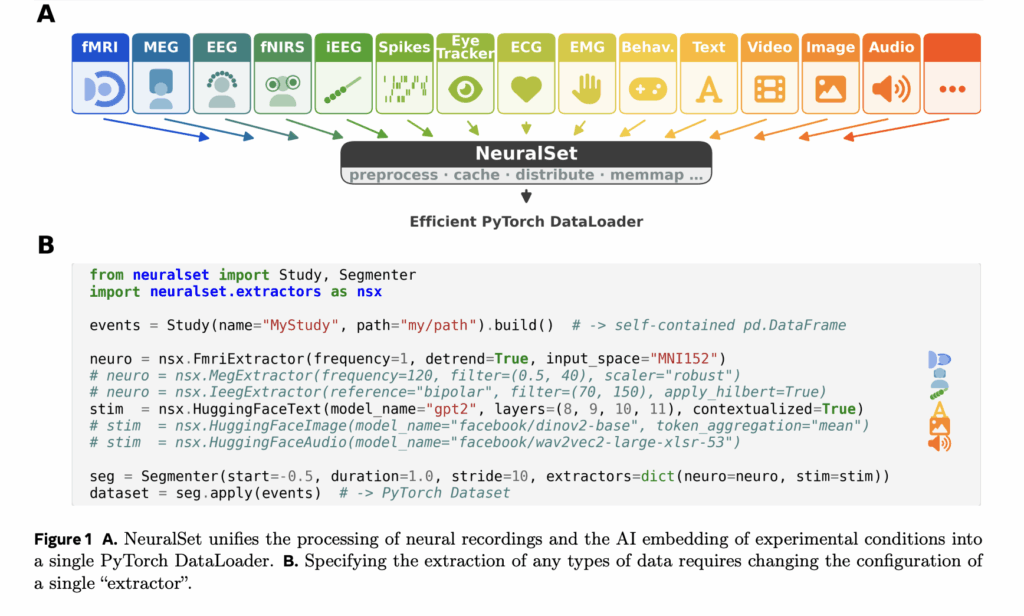
Researchers at Meta’s FAIR lab have released NeuralSet, a Python framework designed to eliminate one of the most persistent bottlenecks in Neuro-AI research: the painful, fragmented process of getting brain data into a deep learning pipeline. https://kingjr.github.io/files/neuralset.pdf The Problem: Neuroscience Data Is Stuck in the Pre-Deep-Learning Era Neuroscience already has excellent, battle-tested software. Tools like MNE-Python, EEGLAB, FieldTrip, Brainstorm, Nilearn, and fMRIPrep are the gold standard for signal processing across electrophysiology and neuroimaging. The trouble is that these tools were designed for a pre-deep-learning world: they rely on eager loading, assuming entire datasets fit into RAM, and they lack native abstractions to temporally align neural time series with high-dimensional embeddings from modern AI frameworks like HuggingFace Transformers. The result? Researchers spend enormous effort building ad-hoc pipelines that require manual data wrangling, manual caching, and complex backend configurations — just to get brain signals paired with, say, GPT-2 text embeddings for a single experiment. As public datasets on platforms like OpenNeuro now reach the terabyte scale, and experimental protocols increasingly incorporate continuous speech and video stimuli, this infrastructure gap is no longer just inconvenient — it is a scientific bottleneck. What NeuralSet Actually Does NeuralSet’s core design principle is structure–data decoupling. Instead of loading raw signals upfront, NeuralSet represents the logical structure of any experiment as lightweight, event-driven metadata — completely separate from the memory- and compute-intensive extraction of actual signals. The framework is organized around five core abstractions: Events, Extractors, Segments, Batch Data, and a Backend layer. In practice, everything in an experiment — an fMRI run, a word spoken during a task, a video stimulus — is modeled as an Event: a lightweight Python dictionary defined by a type, a start time, a duration, and a timeline (a unique identifier for a continuous recording session). A Study object assembles all events in an entire dataset into a single pandas DataFrame. Importantly, NeuralSet supports BIDS-compliant datasets, though it is not restricted to them. Because the DataFrame contains only lightweight metadata — not the raw signals themselves — engineers can filter, explore, and recombine massive datasets using standard pandas operations without loading a single byte of raw data into memory. Composable EventsTransform operations can then be chained to enrich or filter events — for example, annotating words with their sentence context, assigning cross-validation splits, or chunking long audio and video events into shorter segments. Multiple Study and Transform steps can also be composed together using a Chain, which creates a single reproducible, cacheable pipeline object. https://kingjr.github.io/files/neuralset.pdf Extractors: From Metadata to Tensors When it’s actually time to work with data, NeuralSet uses Extractors to bridge the gap between the metadata layer and numerical arrays required by machine learning models. For neural recordings, NeuralSet wraps the preprocessing stacks of domain-specific libraries directly: an FmriExtractor delegates to Nilearn for signal cleaning, spatial smoothing, and surface or atlas-based projection, while a MegExtractor or EegExtractor delegates to MNE-Python for filtering, re-referencing, and resampling. The same unified interface covers iEEG, fNIRS, EMG, and spike recordings — switching modalities requires only changing a configuration parameter, not rewriting a pipeline. For experimental stimuli, NeuralSet provides native integration with the HuggingFace ecosystem. A single HuggingFaceImage extractor can embed stimulus frames through DINOv2 or CLIP; analogous extractors exist for audio (Wav2Vec, Whisper), text (GPT-2, LLaMA), and video (VideoMAE). Critically, NeuralSet can expand a static embedding — say, a single vector per image — into a time series at an arbitrary frequency, so that stimulus representations are always temporally aligned with neural recordings. Extractors follow a three-phase execution model: configure (parameter validation at construction time), prepare (pre-compute and cache heavy outputs for all events), and extract (lazy retrieval from cache during model training). This means expensive computations — like running a large language model over every word in a corpus — are performed once and reused across experiments. The output of an Extractor for a single segment is Batch Data: a dictionary of tensors keyed by extractor name, along with the corresponding segments. Segmenter, DataLoader, and Cluster-Ready Infrastructure A Segmenter slices the events DataFrame into Segments — contiguous temporal windows representing single training examples — either on a sliding window grid or anchored to specific trigger events such as image or word onsets. The resulting SegmentDataset is a standard PyTorch Dataset, directly compatible with DataLoader, PyTorch Lightning, or any PyTorch-based framework. NeuralSet is built on the exca package, which handles deterministic, hash-based caching, full computational provenance, and hardware-agnostic execution. Changing a single preprocessing parameter invalidates only the affected downstream cache, leaving independent branches untouched. Full provenance is maintained, meaning any processed tensor can be traced back to the exact version of the raw data and the specific preprocessing chain used to generate it. Researchers can prototype on a single subject on their laptop, then dispatch 100 subjects to a SLURM-based HPC cluster by changing a single configuration flag — no infrastructure-specific code required. NeuralSet uses Pydantic to enforce strict schema validation at initialization time across every configurable object — Events, Studies, Extractors, Segmenters, and Transforms are all Pydantic BaseModel subclasses. This means a misconfigured parameter (for example, a negative filter frequency or an invalid BIDS directory path) raises a clear error immediately, before any job is submitted, rather than failing hours into a processing run. How It Stacks Up Against Existing Tools In the research paper, the research team presents a detailed comparison of NeuralSet against 18 existing neuroscience software packages across neural devices (fMRI, EEG, MEG, iEEG, spikes, and more), experimental task types (image, video, sound, text), and infrastructure features (Python support, memmap, batching, caching, cluster execution). NeuralSet is the only package in the comparison that achieves full support across all categories. Key Takeaways NeuralSet unifies brain data and AI in one pipeline. Researchers at Meta FAIR built NeuralSet to bridge the gap between diverse neural recordings (fMRI, M/EEG, spikes) and modern deep learning frameworks, delivering a single PyTorch-ready DataLoader for both. Structure–data decoupling eliminates memory bottlenecks. NeuralSet separates lightweight event metadata from heavy signal extraction, so AI devs and

Meta FAIR Releases NeuralSet: A Python Package for Neuro-AI That Supports fMRI, M/EEG, Spikes, and HuggingFace Embeddings Read Post »

AI, Committee, News, Uncategorized

It’s time to make a plan for nuclear waste

Today, nuclear energy enjoys a rare moment of support across the political spectrum in the US. Interest from tech companies that are scrambling to meet demand for massive data centers has sparked a resurgence of money and attention in the industry. That newfound interest is exactly why it’s time to talk about an old problem: nuclear waste.  In the US alone, nuclear reactors produce about 2,000 metric tons of high-level waste each year. And there’s nowhere to put it. Though newly popular, the nuclear program in the US is nothing new. The US hosts more reactors and production capacity than any other country in the world. And yet nearly seven decades after the first permanent nuclear facility in the US went online, there’s still not a long-term solution for nuclear waste.  Used fuel is largely stored onsite at operating and shut-down reactors, in pools and casks made of steel and concrete. Experts generally agree that these methods are safe, but they’re not designed to be permanent. The leading strategy around the world for long-term storage of this high-level radioactive waste is to house it in a deep geological repository—dig a hole, put radioactive material down there, and fill it up with concrete. These holes, hundreds of meters underground, are designed to be a permanent home. There aren’t any operating geological repositories for spent fuel yet, but some countries are well on their way. Finland is the furthest along; as of 2026, the country is testing its facility. Final approvals are expected soon, and operations could start later this year. Some other countries aren’t far behind. France is home to over 50 nuclear reactors, and its grid gets more of its power from nuclear than any other. The country also has the world’s most established program for reprocessing spent fuel. The process separates out the plutonium and uranium to create a type of fuel known as mixed oxide (MOX) fuel. But reprocessing isn’t a perfect recycling loop, so the leftovers from this process still need somewhere to go. The country currently stores waste onsite at the La Hague reprocessing plant, but it plans to build a repository. Initial approvals could come later this decade, and pilot operations could start up by 2035. Technically, the US also has a destination for its spent fuel: Yucca Mountain in Nevada. The site, which is on federal land, was designated by Congress in 1987. However, progress has entirely stalled out because of political opposition. In 2011, the federal government stopped providing funding for the site, and for roughly a decade, there’s been no activity to speak of. In the meantime, waste continues to pile up. The nuclear industry is kicking into a new gear around the world. China is home to the world’s fastest–growing nuclear energy program, and countries including Bangladesh and Turkey are building their first reactors. Even the long-established US program is seeing growth: Interest in and approval for nuclear energy have spiked, and Big Tech is throwing money around to meet rising electricity demand. Companies are proposing (and beginning to receive regulatory approval for) next-generation reactors, which employ different coolants, fuels, and designs. Given all this new interest, and the impending arrival of new types of nuclear waste, it’s time for nuclear companies, as well as their powerful customers, to push for progress on building geological storage facilities. As the richest country on the planet and home to a large chunk of the activity in next-generation reactors, the US should aim to join the leaders rather than continue to lag behind.  Directing even a small fraction of the recent surge in funding and attention to progress on waste could make a difference. Some experts are calling for a new organization in the US to manage nuclear waste rather than leaving it to the Department of Energy. This organization would mirror programs in Finland, Canada, and France. The process of planning, building, and commissioning a permanent solution for nuclear waste is a long one. Finland started planning in the 1980s and selected its site in the early 2000s, and it’s nearly ready to start accepting waste. For countries that don’t have a permanent storage solution sorted, the best time to start was decades ago. But the second-best time is now.  This article is from The Spark, MIT Technology Review’s weekly climate newsletter. To receive it in your inbox every Wednesday, sign up here. 

It’s time to make a plan for nuclear waste Read Post »

AI, Committee, News, Uncategorized

The Download: storing nuclear waste and orchestrating agents

This is today’s edition of The Download, our weekday newsletter that provides a daily dose of what’s going on in the world of technology. It’s time to make a plan for nuclear waste Today, nuclear energy enjoys rare support across the political spectrum. Public approval has spiked, and Big Tech is throwing money around to meet rising electricity demand. That newfound interest is exactly why it’s time to talk about an old problem: nuclear waste. In the US, nuclear reactors produce about 2,000 metric tons of high-level waste each year—and there’s nowhere to put it. Now, the need for a permanent storage solution is becoming urgent. Here’s what’s at stake. —Casey Crownhart This article is from The Spark, MIT Technology Review’s weekly climate newsletter. Sign up to receive it in your inbox every Wednesday. Orchestrated agents are coming for white-collar work When people say AI will transform industries, what they have in mind—whether they know it or not—are AI agents. ChatGPT showed AI can talk. But to change the world, it needs to do stuff. The real power comes when agents work as teams, coordinating multiple roles to tackle complex tasks. Apps like Codex and Claude Cowork offer a glimpse of this shift, bringing multi-agent general-purpose productivity tools. In theory, networks of AI agents could do to white-collar knowledge work what assembly lines did to manufacturing. That’s the vision. But as agents move into real-world systems, the risks grow too. Read the full story. —Will Douglas Heaven Agent Orchestration is one of the 10 Things That Matter in AI Right Now, MIT Technology Review’s guide to what’s really worth your attention in the busy, buzzy world of AI. We’re unpacking one item from the list each day here in The Download, so stay tuned. MIT Technology Review Narrated: no one’s sure if synthetic mirror life will kill us all In February 2019, a group of scientists proposed a high-risk, cutting-edge, irresistibly exciting idea that the National Science Foundation should fund: making “mirror” bacteria. These lab-created microbes would be organized like ordinary bacteria, but their proteins and sugars would be mirror images of those found in nature. Researchers believed they could reveal new insights into building cells, designing drugs, and even the origins of life. But now, many of them have reversed course. They’ve become convinced that mirror organisms could trigger a catastrophic event threatening every form of life on Earth. Find out why. —Stephen Ornes This is our latest story to be turned into an MIT Technology Review Narrated podcast, which we publish each week on Spotify and Apple Podcasts. Just navigate to MIT Technology Review Narrated on either platform, and follow us to get all our new content as it’s released. The must-reads I’ve combed the internet to find you today’s most fun/important/scary/fascinating stories about technology. 1 Elon Musk says Sam Altman “stole a charity” at the OpenAI trialMusk testified for the first time yesterday in the landmark legal showdown. (FT $)+ He said OpenAI was founded as a non-profit to avoid a “Terminator outcome.” (Wired $)+ And claimed he came up with the idea for the company. (Reuters $)+ The trial could upend the global AI race. (MIT Technology Review) 2 The White House has plans to bypass Anthropic’s blacklistingIt’s drafting guidance to sidestep the supply-chain risk designation. (Axios)+ The White House is also meeting other tech firms to discuss AI risks. (Politico)+ The Pentagon’s culture war against Anthropic has backfired. (MIT Technology Review) 3 OpenAI is tightening ties with Amazon after retreating from MicrosoftAWS customers are getting extra access to OpenAI systems. (NBC News)+ While OpenAI gets new users and cloud-computing capabilities. (CNBC) 4 AI bots told scientists how to create biological weaponsAnd unleash them in public spaces. (NYT $)+ AI will change war forever. (MIT Technology Review) 5 China has suspended robotaxi licenses after a scary outageDozens of Baidu vehicles suddenly stopped last month. (The Verge)+ Chinese robotaxi firms are planning global expansions. (Guardian) 6 Meta has been found in breach of EU rules on protecting childrenAfter failing to block access to Facebook and Instagram. (Guardian)+ Parents are forcing schools to roll back classroom tech use. (NYT $) 7 AI is spotting pancreatic cancer years before symptoms appear A study found it could catch the tumor early enough to treat. (Bloomberg) 8 The Iran war is disrupting data center rolloutsOaktree-owned Pure DC is the latest firm to pause investments. (CNBC) 9 SpaceX is tying Elon Musk’s pay to Mars colonization goalsIt’s set lofty goals for his jaw-dropping compensation. (Reuters $) 10 AI has reconstructed the face of an ancient Pompeii victim Technology is reshaping our understanding of the distant past (NPR) Quote of the day “Overnight, without you even knowing it, your own life chances, the life chances of your children, will be dependent on people continuing to prop up Musk’s visions of how the world should look.” —Elon Musk biographer Michel Martin tells NPR how the Tesla tycoon is shaping our lives. One More Thing NEIL WEBB Inside Clear’s ambitions to manage your identity beyond the airport If you’ve ever been through a large US airport, you’re probably aware of Clear, the identity verification service that uses biometric scans to whisk travelers past standard security checks. Now Clear wants to expand that “face-first” experience from airports to just about everywhere, from retailers and banks to even your doctor’s office. Its CEO has designs on making Clear the “identity layer of the internet” and the “universal identity platform” of the physical world. All you have to do is show up—and show your face. But as biometric identity systems go mainstream, concerns about privacy, security, and control are becoming harder to ignore. And the cost of convenience may not be shared equally. Discover what’s at stake.  —Eileen Guo We can still have nice things A place for comfort, fun and distraction to brighten up your day. (Got any ideas? Drop me a line.) + Discover why the eight-hour night is a modern invention.+ This artist creates masterpieces using

The Download: storing nuclear waste and orchestrating agents Read Post »

AI, Committee, News, Uncategorized

How to Build a Lightweight Vision-Language-Action-Inspired Embodied Agent with Latent World Modeling and Model Predictive Control

In this tutorial, we build an embodied simulation vision agent that learns to perceive, plan, predict, and replan directly from pixel observations. We create a fully NumPy-rendered grid world in which the agent observes RGB frames rather than symbolic state variables, enabling us to simulate a simplified Vision-Language-Action-style pipeline. We train a lightweight world model that encodes visual input into a latent representation, predicts future states conditioned on actions and goals, and reconstructs the next frame. Using model predictive control in latent space, we enable the agent to sample possible action sequences, evaluate predicted outcomes, and execute the best action in a closed loop. Copy CodeCopiedUse a different Browser import random, numpy as np, torch, torch.nn as nn, torch.nn.functional as F import matplotlib.pyplot as plt from dataclasses import dataclass from typing import Tuple, Dict, List from torch.utils.data import Dataset, DataLoader try: from tqdm.auto import tqdm except Exception: def tqdm(x, **kwargs): return x SEED = 7 random.seed(SEED); np.random.seed(SEED); torch.manual_seed(SEED) if device.type == “cuda”: torch.backends.cudnn.benchmark = True @dataclass class WorldConfig: grid_size: int = 8 cell_px: int = 14 max_steps: int = 45 n_obstacles: int = 8 spawn_margin: int = 1 class GridWorldRGBNoPIL: ACTIONS = {0:(0,-1),1:(0,1),2:(-1,0),3:(1,0),4:(0,0)} ACTION_NAMES = {0:”UP”,1:”DOWN”,2:”LEFT”,3:”RIGHT”,4:”STAY”} def __init__(self, cfg: WorldConfig): self.cfg = cfg self.reset() def reset(self) -> Dict: g = self.cfg.grid_size self.steps = 0 def sample_empty(exclude=set()): while True: x = random.randint(self.cfg.spawn_margin, g-1-self.cfg.spawn_margin) y = random.randint(self.cfg.spawn_margin, g-1-self.cfg.spawn_margin) if (x,y) not in exclude: return (x,y) self.obstacles = set() ax, ay = sample_empty() gx, gy = sample_empty(exclude={(ax,ay)}) used = {(ax,ay),(gx,gy)} for _ in range(self.cfg.n_obstacles): ox, oy = sample_empty(exclude=used) self.obstacles.add((ox,oy)) used.add((ox,oy)) self.agent = (ax,ay) self.goal = (gx,gy) return {“image”: self._render_u8()} def _in_bounds(self, x, y): return 0 <= x < self.cfg.grid_size and 0 <= y < self.cfg.grid_size def _dist_to_goal(self, pos: Tuple[int,int]) -> float: x,y = pos; gx,gy = self.goal return abs(x-gx)+abs(y-gy) def _state_vector(self) -> np.ndarray: g = self.cfg.grid_size – 1 ax,ay = self.agent; gx,gy = self.goal return np.array([ax/g, ay/g, gx/g, gy/g], dtype=np.float32) def step(self, action: int): self.steps += 1 dx, dy = self.ACTIONS[int(action)] x,y = self.agent nx, ny = x+dx, y+dy if self._in_bounds(nx,ny) and (nx,ny) not in self.obstacles: self.agent = (nx,ny) done = (self.agent == self.goal) or (self.steps >= self.cfg.max_steps) d_prev = self._dist_to_goal((x,y)) d_now = self._dist_to_goal(self.agent) reward = 0.1*(d_prev – d_now) + (1.0 if self.agent == self.goal else 0.0) obs = {“image”: self._render_u8()} info = {“state”: self._state_vector()} return obs, float(reward), bool(done), info def _render_u8(self) -> np.ndarray: g, s = self.cfg.grid_size, self.cfg.cell_px H = W = g*s bg = np.array([245,245,245], np.uint8) gridline = np.array([220,220,220], np.uint8) obstacle_c = np.array([220,70,70], np.uint8) goal_c = np.array([60,180,75], np.uint8) agent_c = np.array([65,105,225], np.uint8) img = np.empty((H,W,3), np.uint8); img[…] = bg img[::s,:,:] = gridline img[:,::s,:] = gridline def paint_cell(x,y,color): y0,y1 = y*s,(y+1)*s x0,x1 = x*s,(x+1)*s img[y0+1:y1-1, x0+1:x1-1] = color for (ox,oy) in self.obstacles: paint_cell(ox,oy, obstacle_c) gx,gy = self.goal; paint_cell(gx,gy, goal_c) ax,ay = self.agent; paint_cell(ax,ay, agent_c) return img cfg = WorldConfig() env = GridWorldRGBNoPIL(cfg) plt.figure(figsize=(3,3)) plt.imshow(env.reset()[“image”]); plt.axis(“off”); plt.title(“No-Pillow observation”); plt.show() def to_tensor_img_u8(img_u8: np.ndarray) -> torch.Tensor: return torch.from_numpy(img_u8).permute(2,0,1).float() / 255.0 We initialize the environment, set deterministic seeds, and define the lightweight grid-world configuration. We implement a fully NumPy-based RGB renderer so that the agent perceives raw pixel observations without relying on external libraries. We also define the state transition dynamics and prepare image-to-tensor conversion for model training. Copy CodeCopiedUse a different Browser class TransitionDataset(Dataset): def __init__(self, items): self.items = items def __len__(self): return len(self.items) def __getitem__(self, i): return self.items[i] def collect_transitions(n_episodes=120): items = [] e = GridWorldRGBNoPIL(cfg) for _ in tqdm(range(n_episodes), desc=”Collect”): obs = e.reset() img_t = to_tensor_img_u8(obs[“image”]) for _ in range(cfg.max_steps): a = random.randint(0,4) obs2, r, done, info = e.step(a) img_tp1 = to_tensor_img_u8(obs2[“image”]) st = torch.from_numpy(info[“state”]).float() goal = st[2:4].clone() items.append({ “img_t”: img_t, “action”: torch.tensor(a, dtype=torch.long), “img_tp1”: img_tp1, “state_tp1”: st, “goal”: goal }) img_t = img_tp1 if done: break return items items = collect_transitions(n_episodes=120) print(“Transitions:”, len(items)) H, W = items[0][“img_t”].shape[1], items[0][“img_t”].shape[2] dl = DataLoader(TransitionDataset(items), batch_size=64, shuffle=True, num_workers=0, drop_last=True) We collect rollout data by allowing the agent to interact randomly with the environment. We construct transitions that map the current image and action to the next image and state representation. We then wrap this data into a PyTorch Dataset and DataLoader to enable efficient mini-batch training. Copy CodeCopiedUse a different Browser class Encoder(nn.Module): def __init__(self, H, W, zdim=64): super().__init__() self.net = nn.Sequential( nn.Conv2d(3, 24, 5, stride=2, padding=2), nn.ReLU(), nn.Conv2d(24, 48, 5, stride=2, padding=2), nn.ReLU(), nn.Conv2d(48, 64, 3, stride=2, padding=1), nn.ReLU(), ) with torch.no_grad(): f = self.net(torch.zeros(1,3,H,W)) self.feat_shape = f.shape[1:] self.fc = nn.Linear(int(np.prod(self.feat_shape)), zdim) def forward(self, x): return self.fc(self.net(x).flatten(1)) class Decoder(nn.Module): def __init__(self, feat_shape, zdim=64): super().__init__() C,h,w = feat_shape self.C,self.h,self.w = C,h,w self.fc = nn.Linear(zdim, C*h*w) self.net = nn.Sequential( nn.ConvTranspose2d(C, 48, 4, stride=2, padding=1), nn.ReLU(), nn.ConvTranspose2d(48, 24, 4, stride=2, padding=1), nn.ReLU(), nn.ConvTranspose2d(24, 16, 4, stride=2, padding=1), nn.ReLU(), nn.Conv2d(16, 3, 3, padding=1), nn.Sigmoid() ) def forward(self, z): x = self.fc(z).view(z.size(0), self.C, self.h, self.w) return self.net(x) class VLASimLite(nn.Module): def __init__(self, H, W, zdim=64, adim=5): super().__init__() self.enc = Encoder(H,W,zdim) self.dec = Decoder(self.enc.feat_shape, zdim) self.aemb = nn.Embedding(adim, 16) self.gnet = nn.Sequential(nn.Linear(2,16), nn.ReLU(), nn.Linear(16,16)) self.dyn = nn.Sequential( nn.Linear(zdim+16+16, 128), nn.ReLU(), nn.Linear(128, zdim) ) self.state = nn.Sequential( nn.Linear(zdim, 64), nn.ReLU(), nn.Linear(64, 4), nn.Sigmoid() ) def encode(self, img): return self.enc(img) def predict_next_latent(self, z, a, goal): return self.dyn(torch.cat([z, self.aemb(a), self.gnet(goal)], dim=-1)) def decode(self, z): return self.dec(z) def forward(self, img_t, a, goal): z = self.encode(img_t) z_next = self.predict_next_latent(z, a, goal) return z_next, self.decode(z_next), self.state(z_next) model = VLASimLite(H,W,zdim=64,adim=5).to(device) opt = torch.optim.Adam(model.parameters(), lr=2e-3) We define the compact Vision-Language-Action-inspired world model. We build a CNN encoder to compress visual input into a latent space and condition latent dynamics on actions and goals. We also add a decoder and a state-prediction head so the model can reconstruct future frames and predict structured state variables. Copy CodeCopiedUse a different Browser def train(epochs=4): model.train() for ep in range(1, epochs+1): losses = [] for b in tqdm(dl, desc=f”Train {ep}/{epochs}”): img_t = b[“img_t”].to(device) a = b[“action”].to(device) img_tp1 = b[“img_tp1”].to(device) st_tp1 = b[“state_tp1”].to(device) goal = b[“goal”].to(device) z_next, img_pred, st_pred = model(img_t, a, goal) loss = F.l1_loss(img_pred, img_tp1) + 3.0*F.mse_loss(st_pred, st_tp1) + 1e-4*z_next.pow(2).mean() opt.zero_grad(set_to_none=True) loss.backward() nn.utils.clip_grad_norm_(model.parameters(), 2.0) opt.step() losses.append(loss.item()) print(“Epoch”, ep, “loss”, float(np.mean(losses))) train(epochs=4) We train the world model using a combination of image reconstruction

How to Build a Lightweight Vision-Language-Action-Inspired Embodied Agent with Latent World Modeling and Model Predictive Control Read Post »

AI, Committee, News, Uncategorized

When Annotators Agree but Labels Disagree: The Projection Problem in Stance Detection

arXiv:2603.24231v2 Announce Type: replace Abstract: Stance detection is nearly always formulated as classifying text into Favor, Against, or Neutral. This convention was inherited from debate analysis and has been applied without modification to social media since SemEval-2016. However, attitudes toward complex targets are not unitary. A person can accept climate science while opposing carbon taxes, expressing support on one dimension and opposition on another. When annotators must compress such multi-dimensional attitudes into a single label, different annotators may weight different dimensions, producing disagreement that reflects different compression choices rather than confusion. We call this the projection problem. We conduct an annotation study across five targets from three stance benchmarks (SemEval-2016, P-Stance, COVID-19-Stance), with the same three annotators labeling all targets. For each target, annotators assign both a standard stance label and per-dimension judgments along target-specific dimensions discovered through bottom-up analysis, using the same number of categories for both. Across all fifteen target–dimension pairs, dimensional agreement consistently exceeds label agreement. The gap appears to scale with target complexity: modest for a single-entity target like Joe Biden (AC1: 0.87 vs. 0.95), but large for a multi-faceted policy target like school closures (AC1: 0.21 vs. 0.71).

When Annotators Agree but Labels Disagree: The Projection Problem in Stance Detection Read Post »

AI, Committee, News, Uncategorized

AP-BMM: Approximating Capability-Efficiency Pareto Sets of LLMs via Asynchronous Prior-guided Bayesian Model Merging

arXiv:2512.09972v5 Announce Type: replace-cross Abstract: Navigating the capability–efficiency trade-off in Large Language Models (LLMs) requires approximating a high-quality Pareto set. Existing model merging research has focused predominantly on coarse model-level operators, which are easy to apply but offer limited control over the trade-off geometry. Layer-wise merging is more expressive, yet current methods still suffer from two bottlenecks: they treat the high-dimensional fusion space as an unstructured black box, and they rely on synchronous optimization despite highly uneven LLM evaluation latency. We propose Asynchronous Prior-guided Bayesian Model Merging (AP-BMM), which addresses these issues with a discrepancy-derived importance prior that initializes the surrogate geometry and an event-driven optimization loop built on pending-aware hypervolume improvement. Under a common evaluation budget, AP-BMM yields stronger Pareto-set approximations than both synchronous layer-wise baselines and representative model-level merging methods, with higher hypervolume and broader coverage of the trade-off frontier. Against the synchronous Bayesian baseline, it also achieves substantially shorter wall-clock time. Code: https://github.com/MiLab-HITSZ/AP-BMM.

AP-BMM: Approximating Capability-Efficiency Pareto Sets of LLMs via Asynchronous Prior-guided Bayesian Model Merging Read Post »

AI, Committee, News, Uncategorized

The Download: Musk and Altman’s legal showdown, and AI’s profit problem

This is today’s edition of The Download, our weekday newsletter that provides a daily dose of what’s going on in the world of technology. Elon Musk and Sam Altman are going to court over OpenAI’s future Elon Musk and OpenAI CEO Sam Altman head to trial this week in a case with sweeping consequences. Ahead of OpenAI’s IPO, the court could rule on whether the company can exist as a for-profit enterprise. It could even oust its leadership. Musk, an OpenAI co-founder, claims he was deceived into bankrolling the firm under false pretenses. He’s seeking $134 billion in damages, the removal of Altman and president Greg Brockman, and the company’s restoration to a non-profit. Find out how the trial could upend the global AI race. —Michelle Kim The missing step between hype and profit In a celebrated South Park episode, a community of gnomes sneak out at night to steal underpants. Why? The gnomes present their pitch deck. “Phase 1: Collect underpants. Phase 2: ? Phase 3: Profit.” It’s a business plan that captures the current state of AI.  Companies have built the tech (Step 1) and promised transformation (Step 3). But how they get there is still a big question mark. Read about the potential paths forward. —Will Douglas Heaven This story originally appeared in The Algorithm, our weekly newsletter giving you the inside track on all things AI. Sign up to receive it in your inbox every Monday. Welcome to the era of weaponized deepfakes For years, experts have warned that deepfakes could be deployed in malicious ways. These dangers are now here. Cheap, accessible models now produce weaponized deepfakes—from sexually explicit images to political propaganda—that look startlingly real. They’re already inciting violence, changing minds, and sowing mistrust, with women and marginalized groups disproportionately affected. Experts fear that they’re cratering trust and critical thinking. Here’s why they’re alarmed. —Eileen Guo Weaponized deepfakes are on our list of the 10 Things That Matter in AI Right Now, MIT Technology Review’s guide to what’s really worth your attention in the busy, buzzy world of AI.  The must-reads I’ve combed the internet to find you today’s most fun/important/scary/fascinating stories about technology. 1 OpenAI has ended its exclusive partnership with MicrosoftThe new deal allows OpenAI to court rivals such as Amazon. (Reuters $)+ Microsoft will still license OpenAI’s tech, but no longer exclusively. (NYT $)+ OpenAI is missing key growth targets ahead of its IPO. (WSJ $) 2 Google has signed a classified AI deal with the PentagonIt permits AI use for “any lawful government purpose.” (The Information $)+ Over 600 Google workers had called for a block on the deal. (QZ)+ AI firms are set to train military versions of their models on classified data. (MIT Technology Review) 3 The EU has told Google to open Android to AI rivalsIt wants to end Gemini’s built-in advantage. (Ars Technica)+ Google calls the move an “unwarranted intervention.” (WSJ $)+ A final decision is expected by the end of July. (Reuters $) 4 OpenAI is reportedly developing an AI-first smartphoneIt would replace apps with agents. (TechCrunch)+ Qualcomm and MediaTek may be developing its processors. (Gizmodo) 5 A brain implant for depression is moving into human testingThe FDA has approved a human study of the device. (Wired $)+ BCIs have thus far struggled to reach the market. (MIT Technology Review) 6 A populist backlash against AI is gaining momentum in rural AmericaFrom Indiana to Idaho, voters are pushing back against the technology. (NYT $)+ Anti-AI protests are expanding worldwide. (MIT Technology Review) 7 DeepSeek has priced its new model 97% below OpenAI’s GPT-5.5It aims to attract more enterprises, developers, and agent-based users. (SCMP)+ Here are three reasons why DeepSeek V4 matters. (MIT Technology Review) 8 AI now generates a third of new websitesA study found it’s making the web more cheery and less verbose. (404 Media) 9 Top talent is leaving Big Tech to launch their own AI startupsMeta, Google, and OpenAI are facing a brain drain. (CNBC) 10 Taylor Swift is trademarking her voice and imageThe Grammy winner has been the target of numerous deepfakes. (NBC News)+ A growing number of celebrities are fighting AI with trademarks. (BBC) Quote of the day “The reality is people don’t like him.” —Judge Yvonne Gonzalez Rogers reacts to prospective jurors confessing their negative views of Elon Musk ahead of his legal battle with Sam Altman, The Verge reports. One More Thing How covid conspiracy theories led to an alarming resurgence in AIDS denialism When Joe Rogan falsely declared that “party drugs” were an “important factor in AIDS,” several million people were listening. He also asserted that AZT, the earliest drug used to treat AIDS, killed people “quicker” than the disease itself—another claim that has been disproven. Such comments illustrate an unmistakable resurgence in AIDS denialism: a false collection of theories arguing either that HIV does not cause AIDS or that there is no such thing as HIV at all. By the dawn of the millennium, these claims had largely fallen out of favour. That changed when the coronavirus arrived. Follow the digital path from Covid skepticism to the return of a deadly conspiracy theory. —Anna Merlan We can still have nice things A place for comfort, fun and distraction to brighten up your day. (Got any ideas? Drop me a line.) + Explore the planets from your laptop with this live sky map.+ This marathon DJ set from Daphni is an incredible journey through electronic music.+ NASA’s stunning Artemis II wallpapers bring a high-res piece of deep space to your phone.+ This fascinating GPS explainer breaks down how your phone figures out exactly where you are.

The Download: Musk and Altman’s legal showdown, and AI’s profit problem Read Post »

We use cookies to improve your experience and performance on our website. You can learn more at Privacy Policy and manage your privacy settings by clicking Settings.

Privacy Preferences

You can choose your cookie settings by turning on/off each type of cookie as you wish, except for essential cookies.

Allow All
Manage Consent Preferences
  • Always Active

Save
en_US