YouZum

Uncategorized

AI, Committee, News, Uncategorized

Best Authentication Platforms for AI Agents and MCP Servers in 2026

The Model Context Protocol has moved from Anthropic’s internal experiment to a de facto industry standard at a speed few integration protocols have matched. Since its launch in November 2024, MCP has grown explosively: OpenAI adopted it in March 2025, Microsoft announced support in Copilot Studio in March 2025, and by late 2025 combined Python and TypeScript SDK downloads had crossed 97 million monthly. In December 2025, Anthropic donated MCP to the Agentic AI Foundation under the Linux Foundation. Gartner projects that up to 40% of enterprise applications will include integrated task-specific AI agents by the end of 2026, up from less than 5% today. That growth has made authentication the central unsolved problem of the agentic stack. When AI agents do nothing but answer questions, auth is a conversation-level concern. When they read emails, update CRMs, write to databases, and call external APIs autonomously, auth becomes infrastructure — and the blast radius of getting it wrong becomes enormous. The Spec Requirements That Matter Before ranking platforms, it helps to understand exactly what the MCP spec requires for protected HTTP-based deployments — because several well-known providers still fall short on at least one requirement. For a spec-compliant remote MCP server, OAuth 2.1 with PKCE is required when authorization is implemented, all endpoints must use HTTPS, authorization server metadata must be discoverable by clients, Protected Resource Metadata (RFC 9728) must be exposed, and Resource Indicators (RFC 8707) must be validated to prevent token audience confusion. Dynamic Client Registration (DCR) deserves a nuance: it is not a universal hard requirement. The current spec defines CIMD as the should-level preferred registration path, while DCR remains a may-level fallback and backward-compatible option. DCR is still operationally useful — it lets clients self-register with servers they have never encountered before, without a human completing a manual registration step — but providers that support CIMD rather than DCR are still spec-compliant. Best Authentication Platforms for AI Agents and MCP Servers 1. WorkOS — Strong Choice for Enterprise Identity + MCP-Compatible Auth Best for: Enterprise engineering teams that need SSO, SCIM, fine-grained authorization, and audit logging wired directly to MCP server access control. WorkOS is one of the strongest options for teams that want MCP-compatible OAuth combined with enterprise identity primitives. WorkOS AuthKit can act as an OAuth 2.1 authorization server for MCP servers and works with the official MCP SDKs. It also offers SSO, SCIM, Admin Portal, audit logs, and Fine-Grained Authorization (FGA) — covering the access control surface that most standalone auth providers do not address. As an independent company focused solely on enterprise authentication, its roadmap is not split across a broader platform. FGA enables tool-level permission scoping, which is the right abstraction for agentic access control: rather than granting an agent access to a service, you grant it access to specific tools within that service. WorkOS lets teams add MCP OAuth without replacing an existing user database or identity provider — relevant for organizations already running Okta, Entra ID, or an internal directory. Standout feature: The combination of MCP-compatible OAuth, FGA for tool-level scoping, SSO/SCIM, and audit logs under one independent vendor covers more of the enterprise auth surface than most alternatives in this category. Limitation: Pricing is tailored and the self-serve path is primarily developer-oriented. Teams without existing enterprise identity requirements may find the feature surface more than they need. 2. Stytch (a Twilio Company) — Best for Cloudflare Workers + Developer-First MCP Auth Best for: B2B SaaS teams adding MCP authentication on top of an existing auth stack without a full migration, particularly those deploying on Cloudflare Workers. Stytch’s Connected Apps platform is purpose-built for agentic use cases. It implements OAuth 2.1 with PKCE, Dynamic Client Registration, and consent UI, and can operate as a standalone layer on top of existing CIAM providers — meaning teams locked into legacy identity infrastructure can adopt Stytch’s MCP-specific flows without migrating their entire user database. Twilio completed its acquisition of Stytch in November 2025, so current positioning reflects that ownership. The Cloudflare integration is the clearest product differentiator. Cloudflare’s Agents SDK includes a McpAgent class that handles transport and authentication automatically, and its workers-oauth-provider library implements the full OAuth server flow for Workers deployments. Stytch’s Trusted Auth Tokens integrate with this environment cleanly, making it a natural choice for teams building remote MCP servers at the edge. Role-based access control covers B2B multi-tenant scenarios, and the drop-in consent screen handles user-facing agent authorization flows — the UX piece that most lower-level auth primitives leave to the developer. Standout feature: Trusted Auth Tokens that integrate with existing CIAM providers without requiring a full migration. For teams on a legacy identity stack who need MCP-compatible auth quickly, this is a practical fast path. Limitation: As with any post-acquisition product, roadmap direction under Twilio is worth tracking for teams making long-term infrastructure commitments. 3. Auth0 by Okta — Best for Teams with Existing Auth0 Deployments Best for: Organizations that have already standardized on Auth0 or Okta and want to extend that infrastructure to MCP servers rather than introducing a new vendor. Auth0’s “Auth for MCP” became generally available on May 6, 2026, having exited early access in November 2025. It includes CIMD registration and on-behalf-of token exchange. For teams already running Auth0, the operational overhead of adding MCP OAuth is lower than switching to a new provider, and the integration path is now more straightforward than it was during the early access period. Okta has also released its own MCP server — a secure protocol abstraction layer that enables AI agents and LLMs to interact with Okta’s scoped management APIs in natural language, with least-privilege access control enforced at each tool call. This positions Okta not just as an auth provider for MCP servers but as an MCP server in its own right. The tradeoff is pricing complexity. Since Okta acquired Auth0 in 2021, some product overlap has created complexity in the enterprise feature roadmap, and FGA capabilities carry additional cost. Teams should factor this into

Best Authentication Platforms for AI Agents and MCP Servers in 2026 Read Post »
AI, Committee, News, Uncategorized

WorkOS Releases auth.md: An Open Agent Registration Protocol Built on OAuth Standards

For years, authentication on the web followed one design assumption: a human sits behind a browser. Click a button. Fill out a form. Verify an email. Copy an API key and paste it somewhere else. That model does not work when the user is delegating work to an agent. Agents are already writing code, opening pull requests, triaging tickets, querying systems, and updating records. But most products still have no real way for an agent to register. The workaround — giving an agent a raw API key or session token — produces credentials that are unscoped, hard to audit per session, and impossible to revoke selectively. WorkOS is proposing a structured alternative: auth.md, an open protocol for agent registration. What is auth.md? auth.md is a small Markdown file an application publishes at a well-known location — typically https://service.com/auth.md. The file tells agents how to register with that service: which flows are supported, which scopes exist, and how credentials are issued, audited, and revoked. Because it is plain-text Markdown, the same file works as documentation for human developers and as a runtime artifact agents can read programmatically. An agent fetches the file, reads the structured sections, picks the right flow, and registers — without a human filling out a form. Discovery works in two hops. The machine-readable source of truth lives at /.well-known/oauth-protected-resource (Protected Resource Metadata, or PRM). It promotes the resource and points at the Authorization Server. The Authorization Server metadata at /.well-known/oauth-authorization-server carries the agent_auth block — the structured object that tells agents which flows are supported, and what the register_uri, claim_uri, revocation_uri, and identity_types_supported values are. The auth.md file is the prose companion that points agents toward this discovery path. On any 401 from the API, the service should return a WWW-Authenticate: Bearer resource_metadata=”…” header so agents can bootstrap discovery without reading documentation first. The Two Registration Flows auth.md defines two primary flows. An application can support either or both. Agent verified flow: The agent’s identity provider — OpenAI, Anthropic, Cursor, or any trusted platform — attests to the user’s identity at registration time. The agent requests an audience-specific ID-JAG from its provider, then POSTs it to the app’s /agent/auth endpoint. The app decodes the ID-JAG header to get kid and alg, looks up the issuer in its trusted providers list, fetches the provider’s JWKS, verifies the signature, validates claims (aud, exp, iat, jti, client_id), and returns credentials synchronously. No OTP, no email round-trip, no human interaction required. The result is a delegation record per (iss, sub, aud) that the provider can revoke at any time by POSTing a logout token to the service’s revocation_uri. Apps that already JIT-provision users from OIDC or SAML will recognize this pattern — it is the same shape with a different issuer. One important constraint: access tokens issued from ID-JAG verification must not include a refresh token. The agent must present a fresh ID-JAG to extend access. User claimed flow: This is an OTP-based path that requires no agent provider participation. The agent registers with the app, and the user binds the registration by reading a one-time code from an email back to the agent. The two claim endpoints are /agent/auth/claim (to trigger the OTP email) and /agent/auth/claim/complete (to submit the code). This flow has two starting shapes. In the anonymous start variant, the agent self-registers without identity and receives a credential immediately, scoped to pre-claim permissions the app defines. At any point before the registration expires, the agent runs the OTP ceremony to bind the credential to a real user and upgrade scopes. The API key is not rotated on claim — scopes upgrade in place. In the email required variant, the agent supplies a user email at registration. The credential is withheld entirely until the OTP ceremony completes. Use this when any pre-claim usage is unacceptable. User Matching and Audit When credentials are issued, the service needs to match the registration to an existing user or provision a new one. The recommended resolution order is: match on a prior delegation record for the same (iss, sub) pair first; then match on a verified email; then JIT-provision a new user per the app’s policy — or reject if the product requires manual onboarding. For observability and incident response, the docs recommend recording a standard set of audit events: registration.created, claim.requested, otp.generated, claim.confirmed, registration.expired, and registration.revoked. For ID-JAG flows, include iss, sub, and agent_platform so operators can correlate with provider-side logs. Marktechpost’s Visual Explainer auth.md — Implementation Guide Open Protocol 01 / 07   Overview What Is auth.md? auth.md is a small Markdown file your app publishes at its domain. It tells AI agents how to register on behalf of a user: which flows are supported, which scopes exist, and how credentials are issued, audited, and revoked. Because it is plain-text Markdown, the same file works as documentation for human developers and as a runtime artifact agents can read programmatically. Open Protocol No WorkOS Account Required OAuth-Based https://workos.com/auth-md 02 / 07   Discovery How Agents Find Your Endpoints Discovery works in two hops. Your API returns a header on every 401 that points to the Protected Resource Metadata. The PRM points to the Authorization Server, which carries the agent_auth block with all endpoint URLs. 1 Agent hits your API, receives 401 Unauthorized with a WWW-Authenticate header pointing to PRM 2 Agent fetches /.well-known/oauth-protected-resource to get the Authorization Server URL 3 Agent fetches /.well-known/oauth-authorization-server and reads the agent_auth block: register_uri, claim_uri, revocation_uri, identity_types_supported WWW-Authenticate: Bearer resource_metadata=”https://api.service.com/.well-known/oauth-protected-resource” 03 / 07   Flow 1 Agent Verified Flow The agent’s identity provider (OpenAI, Anthropic, Cursor, etc.) attests to the user’s identity using an ID-JAG. No human interaction required. Credentials are returned synchronously. 1 Agent asks user for consent to assert identity to your service 2 Agent requests an audience-specific ID-JAG from its provider 3 Agent POSTs the ID-JAG to your /agent/auth endpoint 4 Your service verifies the signature against the provider’s JWKS, validates claims (aud, exp, iat, jti), matches the user, and returns credentials 5 Revocation: provider POSTs

WorkOS Releases auth.md: An Open Agent Registration Protocol Built on OAuth Standards Read Post »

AI, Committee, News, Uncategorized

DFKI-MLT at SemEval-2026 TASK 7: Steering Multilingual Models Towards Cultural Knowledge

arXiv:2605.23069v1 Announce Type: new Abstract: Large language models (LLMs) are increasingly used across diverse linguistic and cultural contexts, yet their cultural knowledge remains uneven across regions and languages. We present the DFKI-MLT system for SemEval-2026 Task 7 on cultural awareness, where we apply activation steering to multilingual LLMs using language vectors extracted from parallel FLORES data. Our method performs inference-time adaptation by adding language-specific steering vectors to the residual stream at a selected transformer layer, without any parameter updates. We participated in both the short-answer (SAQ) and multiple-choice (MCQ) tracks; however, only our MCQ submission received an official score. In the official MCQ track, we achieved 86.96% accuracy, ranking 7th out of 17 teams. To better understand system behavior, we conduct post-hoc analyses on the shared-task MCQ and SAQ settings. These analyses show that activation steering yields modest and heterogeneous improvements on cultural reasoning: gains are strongly layer-sensitive, vary substantially across language-region pairs, with some configurations even degrading performance, and interact with prompt formulation, comparing generic and culturally conditioned prompts. Our findings suggest that prompt design and activation steering should be jointly optimized for culturally aware multilingual inference.

DFKI-MLT at SemEval-2026 TASK 7: Steering Multilingual Models Towards Cultural Knowledge Read Post »

AI, Committee, News, Uncategorized

Mind Your Moras: Orthography-Aware Error Analysis of Neural Japanese Morphological Generation

arXiv:2605.20043v2 Announce Type: replace Abstract: We present an orthography-aware error analysis of Japanese past-tense morphological inflection, treating hiragana not merely as a transcriptional medium, but as a representational system encoding morphophonological distinctions that may influence model generalization. We evaluate two character-level sequence-to-sequence architectures on past-tense formation using datasets formatted according to the SIGMORPHON 2020 and 2023 shared task conventions. Despite high aggregate accuracy, models exhibit systematic, linguistically interpretable errors that cluster around specific orthographic properties of hiragana. We introduce a concise error taxonomy capturing seven primary failure modes and provide both quantitative and qualitative analyses. Gemination-related errors dominate residual failures, accounting for 75-80% of errors, particularly in verbs whose stems end in the vowel e and require gemination before the past-tense suffix. Error patterns remain highly consistent across architectures and random seeds, suggesting a robust interaction between orthographic representation, morphological structure, and data frequency effects in shaping model generalization. These results underscore the necessity of orthography-aware evaluation for understanding neural generalization in morphologically complex languages.

Mind Your Moras: Orthography-Aware Error Analysis of Neural Japanese Morphological Generation Read Post »

AI, Committee, News, Uncategorized

Tencent Open-Sources TencentDB Agent Memory: A 4-Tier Local Memory Pipeline for AI Agents

Tencent has released TencentDB Agent Memory, an open-source memory system for AI agents. The project ships under the MIT license. It targets a problem familiar to anyone shipping long-horizon agents: context bloat and recall failure. It is symbolic short-term memory along with layered long-term memory. It integrates with OpenClaw as a plugin and with the Hermes Agent through a Gateway adapter. The default backend is local SQLite with the sqlite-vec extension, so no external API is required. Why agent memory is hard Most current memory stacks shred data into fragments and dump them into a flat vector store. Recall then becomes a blind similarity search across disconnected fragments, with no macro-level guidance. The architecture rests on two pillars: memory layering and symbolic memory. A 4-tier semantic pyramid For long-term personalization, TencentDB Agent Memory builds a four-level pyramid instead of a flat log. The layers are L0 Conversation, L1 Atom, L2 Scenario, and L3 Persona. These correspond to raw dialogue, atomic facts, scene blocks, and a user profile. The Persona layer carries day-to-day user preferences and is queried first. The system drills down to Atoms or raw Conversations only when finer detail is needed. Lower layers preserve evidence; upper layers preserve structure. Storage is heterogeneous. Facts, logs, and traces are persisted in databases for full-text retrieval. Personas, scenes, and canvases are stored as human-readable Markdown files. Layered memory artifacts live under ~/.openclaw/memory-tdai/. Symbolic short-term memory via Mermaid Long-running agent tasks consume tokens through verbose tool logs, search results, code, and error traces. TencentDB Agent Memory addresses this through context offloading combined with symbolic memory. Full tool logs are offloaded to external files under refs/*.md. State transitions are encoded in Mermaid syntax inside a lightweight task canvas. The agent reasons over the symbol graph in its context window. When it needs the raw text, it greps for a node_id and retrieves the corresponding file. The Tencent dev team describes this as a deterministic drill-down from top-layer symbol to mid-layer index to bottom-layer raw text. Benchmark numbers Results are measured over continuous long-horizon sessions, not isolated turns. SWE-bench, for example, runs 50 consecutive tasks per session to simulate context-accumulation pressure. On WideSearch, integrating the plugin with OpenClaw raises pass rate from 33% to 50%, a 51.52% relative improvement. Token usage drops from 221.31M to 85.64M, a 61.38% reduction. On SWE-bench, success climbs from 58.4% to 64.2% while tokens fall from 3474.1M to 2375.4M, a 33.09% reduction. On AA-LCR, the success rate moves from 44.0% to 47.5%. Tokens drop from 112.0M to 77.3M, a 30.98% reduction. For long-term memory, PersonaMem accuracy rises from 48% to 76%. Note: these numbers come from Tencent’s own evaluations. Recall and retrieval Retrieval defaults to a hybrid strategy. The system combines BM25 keyword search with vector embeddings, fused using Reciprocal Rank Fusion (RRF). Developers can switch to pure keyword or embedding mode through a config field. The BM25 tokenizer supports both Chinese (jieba) and English. Default settings trigger an L1 memory extraction every five turns. A user persona is generated every 50 new memories. Recall returns five items by default with a 5-second timeout. On timeout, the system skips injection rather than blocking the conversation. Installation and developer surface The OpenClaw integration ships as a single npm package: @tencentdb-agent-memory/memory-tencentdb. The project requires Node.js 22.16 or higher. Enabling it takes one config flag. The plugin then handles conversation capture, memory extraction, scene aggregation, persona generation, and recall. For Hermes, a Docker image bundles the agent, the plugin, and the TDAI Memory Gateway. The default model is Tencent Cloud’s DeepSeek-V3.2. Any OpenAI-compatible endpoint works through the MODEL_PROVIDER=custom flag. Two tools are exposed to agents during a session: tdai_memory_search and tdai_conversation_search. Both return references with node_id and result_ref fields for traceback. A Tencent Cloud Vector Database (TCVDB) backend is also available as an alternative to local SQLite. Marktechpost’s Visual Explainer TencentDB Agent Memory — Preview Open Source  /  Tencent TencentDB Agent Memory A quick-start guide to fully local, 4-tier long-term memory for AI agents. 01  /  OVERVIEW What is TencentDB Agent Memory? An MIT-licensed memory system for AI agents that combines symbolic short-term memory with a 4-tier long-term memory pipeline. Runs fully local with zero external API dependencies. Short-term memory Offloads verbose tool logs to files and keeps a compact Mermaid task canvas in context. Long-term memory Distills conversations into a 4-tier semantic pyramid: L0 → L1 → L2 → L3. Local backend Defaults to SQLite + sqlite-vec. Tencent Cloud Vector Database (TCVDB) is optional. Integrations Ships as an OpenClaw plugin and a Hermes Agent Docker image. 02  /  ARCHITECTURE The 4-Tier Semantic Pyramid Long-term memory is layered, not flat. Upper layers carry structure; lower layers preserve evidence. L3 · PersonaUser profile (persona.md) L2 · ScenarioScene blocks (Markdown) L1 · AtomAtomic facts (JSONL) L0 · ConversationRaw dialogue Drill-down path: Persona → Scenario → Atom → Conversation. References use node_id and result_ref for deterministic traceback. 03  /  SYMBOLIC SHORT-TERM Mermaid task canvas + context offloading Verbose intermediate logs are the largest token consumers in long tasks. The plugin offloads them to disk and keeps a high-density symbol graph in context. How it works Full tool logs are offloaded to refs/*.md under the data directory. State transitions are encoded in Mermaid syntax inside a lightweight task canvas. The agent reasons over the symbol graph, then greps a node_id to pull raw text. Storage path on disk: ~/.openclaw/memory-tdai/. All artifacts are human-readable for white-box debugging. 04  /  INSTALL Install the OpenClaw plugin Requires Node.js 22.16 or higher and an OpenClaw installation. # Install the npm package as an OpenClaw plugin openclaw plugins install @tencentdb-agent-memory/memory-tencentdb openclaw gateway restart Zero-config enable Add the following to ~/.openclaw/openclaw.json to turn it on with default SQLite + sqlite-vec. { “memory-tencentdb”: { “enabled”: true } } 05  /  CONFIGURATION Daily-tuning parameters Every field has a sensible default. The most common knobs are listed below. Field Default Description storeBackend sqlite Storage backend recall.strategy hybrid keyword / embedding / hybrid (RRF) recall.maxResults 5 Items returned per recall recall.timeoutMs 5000 Skip injection on

Tencent Open-Sources TencentDB Agent Memory: A 4-Tier Local Memory Pipeline for AI Agents Read Post »

AI, Committee, News, Uncategorized

NVIDIA AI Releases Gated DeltaNet-2: A Linear Attention Layer That Decouples Erase and Write in the Delta Rule

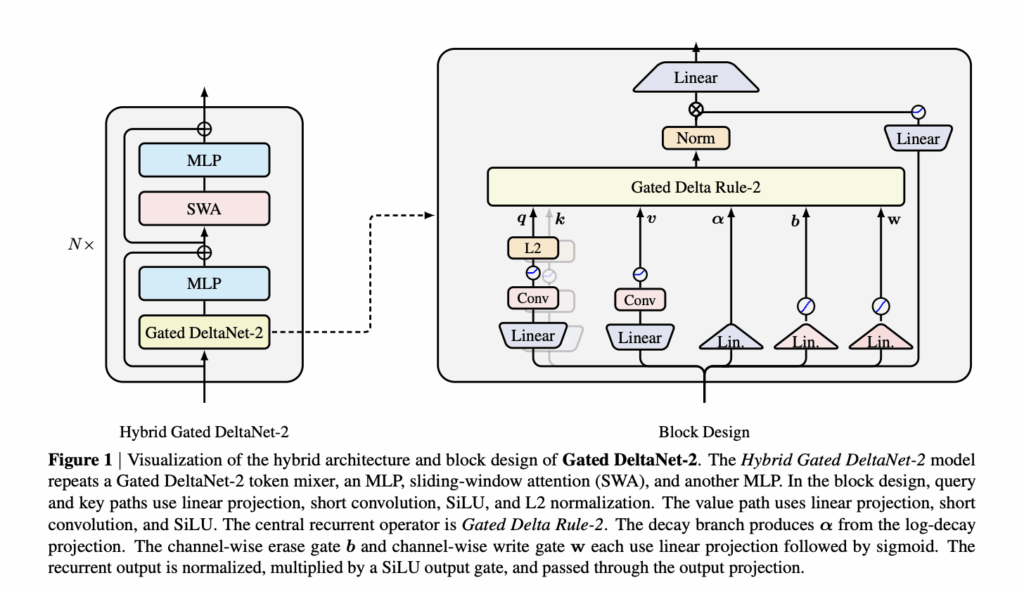
Linear attention replaces the unbounded KV cache of softmax attention with a fixed-size recurrent state. This cuts sequence mixing to linear time and decoding to constant memory. The hard part is not what to forget. It is how to edit a compressed memory without scrambling existing associations. NVIDIA has released Gated DeltaNet-2, a linear attention layer that targets that bottleneck. The model decouples the active memory edit into two channel-wise gates. It is trained at 1.3B parameters on 100B FineWeb-Edu tokens. It outperforms Mamba-2, Gated DeltaNet, KDA, and Mamba-3 across the researchs benchmark suite. The scalar gate problem in delta-rule models A recurrent linear attention layer stores a matrix state St and reads it with the query. DeltaNet adds an active edit by subtracting the value currently associated with the current key. It uses a scalar step size βt to control how much to overwrite. Mamba-2 adds a data-dependent scalar decay αt for global forgetting. Gated DeltaNet combined both operations, but both gates remained scalar per head. Kimi Delta Attention (KDA) refines the decay side. It replaces the scalar αt with a channel-wise vector. KDA still keeps a single scalar βt for the active edit. That scalar controls two different things at once. It decides how much old content to erase on the key side. It also decides how much new content to commit on the value side. These two decisions act on different axes of the state. Tying them together is a modeling restriction, not a property of the delta rule. https://github.com/NVlabs/GatedDeltaNet-2/blob/main/paper/GDN2_paper.pdf Gated Delta Rule-2: two gates instead of one Gated DeltaNet-2 separates the two decisions through Gated Delta Rule-2. It introduces a channel-wise erase gate bt ∈ [0,1]dk on the key axis. It also introduces a channel-wise write gate wt ∈ [0,1]dv on the value axis. Both gates are produced by sigmoid projections of the token representation. The update applies decay before the active edit. Written compactly, the recurrence is: St = (I − kt (bt ⊙ kt)⊤) Dt St−1 + kt (wt ⊙ vt)⊤ Here Dt = Diag(αt) is the channel-wise decay carried over from KDA. The left factor of the erase matrix stays kt, preserving the delta-rule write direction. The right factor becomes bt ⊙ kt, making the read direction channel-selective. The write term kt zt⊤ uses zt = wt ⊙ vt, making the value update channel-selective. When both gates collapse to the same scalar βt, the update recovers KDA exactly. When the decay αt also collapses to a scalar, it recovers Gated DeltaNet. Both prior models are preserved as tied subspaces of the new update. In the fast-weight view, Gated Delta Rule-2 is one online gradient step on a local regression loss. The decayed state stays close to memory, while the residual edit uses gated read and gated write targets. Chunkwise training and gate-aware backward The recurrence admits a chunkwise WY form that matches the structure used by KDA. Cumulative channel-wise decay is absorbed into the two factors of each rank-one erase. The per-chunk update becomes a product of asymmetric matrices of the form I − k̄r ēr⊤. The implementation uses chunk size C = 64 with fused Triton kernels. For the backward pass, the scalar shortcut used by KDA no longer applies. The write side contains a different diagonal gate over value channels. The erase side contains a different diagonal gate over key channels. So the gate factors must appear inside the dot products that accumulate gradients. The paper derives this gate-aware vector-Jacobian product explicitly. On Hopper GPUs, the fused WY backward kernel is restricted to two and four warps to avoid a Triton WGMMA layout assertion. Block design and hybrid model Gated DeltaNet-2 is used as the recurrent token mixer in a standard Transformer-style block. Query and key paths use linear projection, short causal convolution, SiLU, and L2 normalization. The value path uses linear projection, short convolution, and SiLU. The decay αt, erase gate bt, and write gate wt come from separate linear branches. The recurrent output is RMS-normalized, multiplied by a SiLU output gate, and projected back. A hybrid variant inserts Sliding-Window Attention (SWA) after the recurrent mixer. A repeated cell contains Gated DeltaNet-2, an MLP, SWA, and another MLP. SWA handles exact local interactions, while the recurrent mixer compresses long histories. The hybrid retains linear sequence scaling with a bounded attention cache. Results at 1.3B parameters All models are 1.3B parameters trained on 100B FineWeb-Edu tokens. Parameter count and recurrent state size are matched across models. The recurrent state holds 262,144 floats per layer per batch element. Training length is 4K tokens, and hybrid models use a 2K SWA window. The Mamba-3 MIMO baseline uses rank R = 4. On language modeling and commonsense reasoning, Gated DeltaNet-2 has the best average in both settings. The recurrent model averages 53.11 across LAMBADA and the reasoning suite. That sits above Mamba-3 MIMO at 52.39 and KDA at 52.28. In the hybrid setting, Gated DeltaNet-2 averages 53.97 against Mamba-3 MIMO at 52.72. Since recurrent state size is matched, the gain points to the update rule, not more memory. The clearest gains appear on RULER long-context retrieval. In the recurrent setting, S-NIAH-2 at 4K rises from 89.0 (KDA) to 93.0. S-NIAH-3 at 2K jumps from 63.2 (KDA) to 89.8. MK-NIAH-1 at 4K climbs from 28.0 (KDA) to 37.8. On real-world retrieval (SWDE, SQuAD, FDA, TriviaQA, NQ, DROP), Gated DeltaNet-2 also leads both settings. The recurrent average is 29.88 and the hybrid average is 42.28. Marktechpost’s Visual Explainer Gated DeltaNet-2 · Quickstart 01 / 08 NVIDIA · 2026 Gated DeltaNet-2 Decoupling Erase and Write in Linear Attention. A delta-rule recurrent attention layer with channel-wise erase and write gates. PyTorch Triton kernels 1.3B params 100B FineWeb-Edu tokens Authors Ali Hatamizadeh, Yejin Choi, Jan Kautz Repo github.com/NVlabs/GatedDeltaNet-2 License NVIDIA Source Code License-NC Step 01 · The Idea Two gates instead of one scalar Linear attention compresses an unbounded KV cache into a fixed-size recurrent state. Editing this memory without scrambling existing associations is the hard part. The

NVIDIA AI Releases Gated DeltaNet-2: A Linear Attention Layer That Decouples Erase and Write in the Delta Rule Read Post »

AI, Committee, News, Uncategorized

Microsoft Research Releases Webwright: A Terminal-Native Web Agent Framework That Scores 60.1% on Odysseys, Up from Base GPT-5.4’s 33.5%

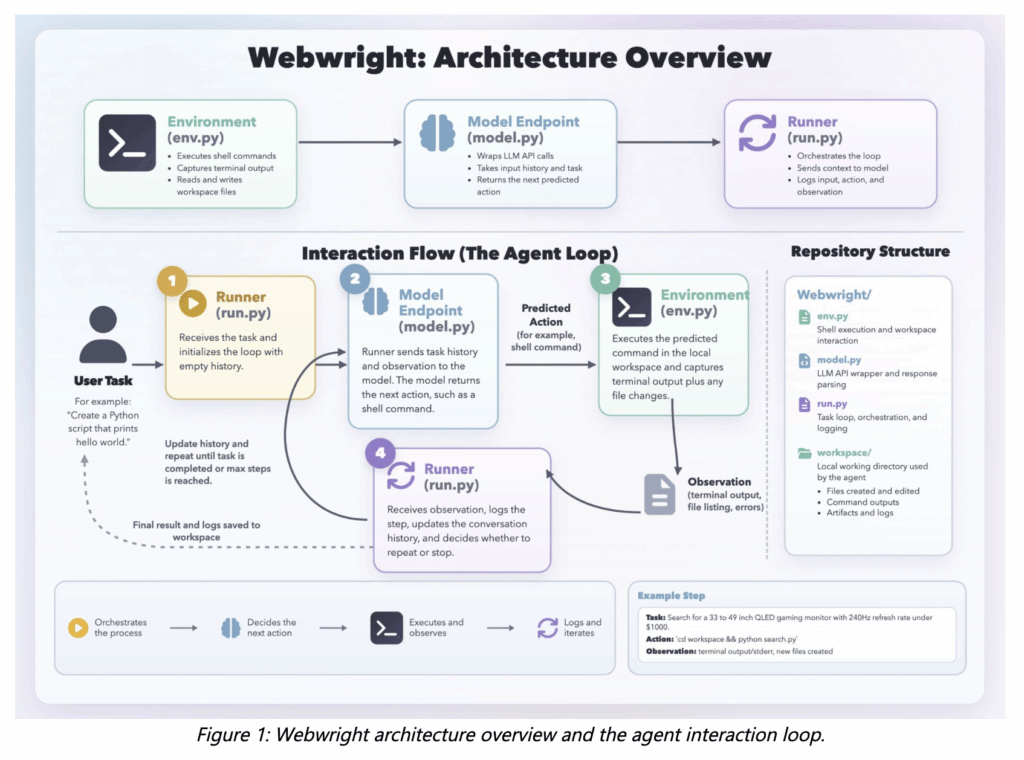
Most web agents today drive a browser one action at a time. The model receives the current page state — as a screenshot or DOM text — and predicts the next click, keypress, or scroll. This action-at-a-time design made sense when language models had limited reasoning ability. As models have become more capable at writing and debugging code, that rigid loop has become a constraint rather than a structure that helps. Microsoft Research’s AI Frontiers lab built a different approach. Their new open-source framework, Webwright, gives the agent a terminal instead of a stateful browser session. The agent writes Playwright code to control browsers, runs bash commands, inspects logs, and iteratively refines scripts. Playwright is an open-source browser automation library, also from Microsoft, that supports programmatic control of Chromium, Firefox, and WebKit browsers. What Webwright Does Differently Webwright separates the agent from the browser and treats the browser as something the agent can launch, inspect, and discard while developing a program. The persistent artifact is not the browser session but the code and logs in the local workspace. This is the same model a developer uses when writing an RPA (Robotic Process Automation) script. Instead of manually clicking through a site each time, they write a script once. That script can be rerun, adapted, and shared. Webwright applies this to LLM-powered agents. The system has three core components: a Runner, a Model Endpoint, and a terminal Environment. The runner is about 150 lines of code, the model interface about 550 lines, and the environment about 300 lines. There is no multi-agent orchestration or complex planning hierarchy — just a single agent loop. All intermediate code, logs, screenshots, and results are stored in the workspace, making each run easy to inspect. https://www.microsoft.com/en-us/research/articles/webwright-a-terminal-is-all-you-need-for-web-agents/ The Agent Loop The Runner sends the current context to the model. The model returns a thinking block and a shell command. That command runs in the Environment, which returns terminal output, logs, screenshots, or error tracebacks. These observations go back into context, and the loop continues. Rather than issuing one primitive action at a time, a coding agent can naturally express multi-step interactions — such as selecting a date or filling out an entire form — as a compact program. Loops, functions, and abstractions allow the agent to generalize across similar tasks without repeatedly predicting similar sequences of low-level steps. Two Engineering Challenges Premature ‘done’ and context explosion are the two core issues. With open-ended bash actions, the model must self-report completion and often claims success without actually finishing. They added a gate: the agent must generate a self-reflection config, run a final script in a fresh folder with logs and screenshots, and pass its own self-reflection judgement that outputs success or failure before emitting done: true. Otherwise, the flag is dropped and it retries. For context length, long coding trajectories quickly exceed context limits, so they compact history every 20 steps into a single summary. Benchmark Results Webwright was evaluated on two benchmarks: Online-Mind2Web and Odysseys. Online-Mind2Web contains 300 tasks across 136 widely used sites and uses an automated LLM-as-a-Judge evaluation framework. GPT-5.4 achieves 86.67% overall accuracy, representing the highest among all open-sourced harness recipes in the AutoEval category of the Online-Mind2Web benchmark, with a 100-step budget. Claude Opus 4.7 reached 84.7% overall but performed better on hard tasks at N=100 steps — 80.5% versus 76.6% for GPT-5.4. They also reproduced a GPT-5.4 baseline in a conventional screenshot-based agent setting, where the model predicts x,y coordinates for clicks and typing actions. Using the same underlying model, Webwright achieves substantial gains across all three difficulty categories, highlighting the benefit of the code-driven terminal-based approach over step-by-step coordinate prediction. Odysseys evaluates long-horizon browsing tasks spanning multiple websites. Tasks average 272.3 words of instructions. In the April 2026 leaderboard, the best-performing model was Opus 4.6, with a top score of 44.5. Webwright powered by GPT-5.4 reaches 60.1%, a 35.1% relative improvement over the previous state of the art. Compared to the base GPT-5.4 performance of 33.5%, this corresponds to a 79.4% relative improvement — or 26.6 absolute points. Cost Analysis Claude Opus 4.7 is more efficient in the number of steps to solve each task (mean 21.9 steps) compared to GPT-5.4 (mean 26.3 steps). However, Claude Opus 4.7 is priced significantly higher compared to GPT-5.4 ($5 vs. $2.50 per 1M input tokens, and $25 vs. $15.00 per 1M output tokens, April 2026), which makes the average per-task cost higher compared to GPT-5.4 ($2.37 vs. $6.09). The first 50 steps deliver 82% accuracy, and the next 50 steps deliver 3–4 additional points. Small Model Performance The research team also tested Qwen3.5-9B on the hard split of Online-Mind2Web. When tasks are augmented with pre-built reusable tool scripts, Qwen3.5-9B achieves 66.2% on Online-Mind2Web websites with more than five tools. This shows that smaller, lower-cost models can handle complex web tasks when paired with a pre-built tool library. Marktechpost’s Visual Explainer Webwright Quick Start Guide 01 / 05 — Overview What Is Webwright? Webwright is an open-source, terminal-native web agent framework from Microsoft Research. Instead of predicting one browser click at a time, the agent writes Playwright code, runs bash commands, and stores reusable scripts in a local workspace. ~1,000 lines of harness code across 3 modules — no hidden orchestration Single agent loop: Runner, Model Endpoint, and terminal Environment 86.7% on Online-Mind2Web  |  60.1% on Odysseys with GPT-5.4 Backends: OpenAI, Anthropic, OpenRouter Scripts reusable in Claude Code, Codex, OpenClaw # GitHub repository github.com/microsoft/Webwright 02 / 05 — Prerequisites What You Need Before Installing Confirm the following are ready before running any install commands. Python 3.10+ — required minimum runtime Chromium — installed via Playwright in the next step API key — OpenAI, Anthropic, or OpenRouter Git — to clone the repository # Check your Python version python –version # Must return Python 3.10 or higher 03 / 05 — Installation Clone and Install Webwright Clone the repo, install in editable mode, then install Chromium for Playwright browser control. # 1. Clone the

Microsoft Research Releases Webwright: A Terminal-Native Web Agent Framework That Scores 60.1% on Odysseys, Up from Base GPT-5.4’s 33.5% Read Post »

AI, Committee, News, Uncategorized

Perplexity Open-Sources Bumblebee: A Read-Only Supply-Chain Scanner for Developer Endpoints

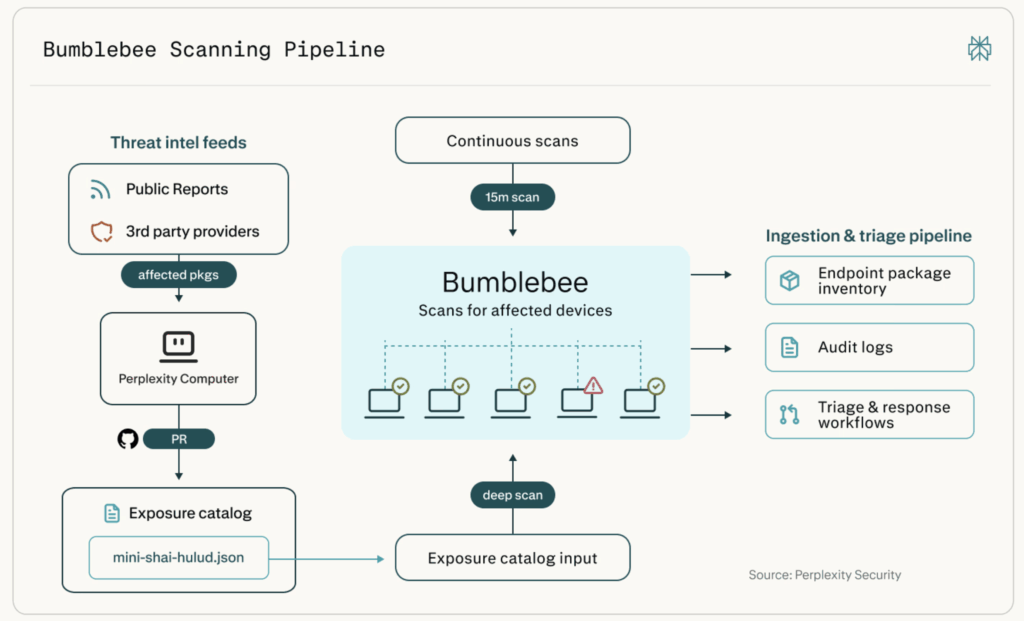
Attackers increasingly target the packages, editor extensions, and AI tool configs on developer machines and not just production systems. Perplexity has open-sourced an internal tool it uses to address this problem. Perplexity released Bumblebee on GitHub. The tool is a read-only inventory collector for macOS and Linux developer endpoints. It is written entirely in Go and carries zero non-stdlib dependencies. Perplexity already uses it internally to protect developer systems behind its search product, Comet browser, and Computer agent. Problem that Bumblebee Solves If you are a software engineer or data scientist, you likely have dozens of packages installed locally. You have editor extensions, browser add-ons, and possibly MCP (Model Context Protocol) configs on your machine. When a new vulnerability surfaces, your security team faces one urgent question: which developer machines are exposed right now? Existing tools do not fully answer this. SBOMs (Software Bills of Materials) and vulnerability scanners cover build artifacts and repositories. EDR (Endpoint Detection and Response) products track what processes ran or touched the network. Neither checks local developer state — lockfiles, package metadata, extension manifests, and AI tool configs scattered across a laptop’s filesystem. Bumblebee fills that gap. When an advisory names a package, extension, or version, it answers which machines show a match in their on-disk metadata right now. The ecosystem scope was also deliberate: the covered ecosystems map to recent active supply-chain campaigns, including the Mini Shai-Hulud series, which hit npm, PyPI, RubyGems, Go modules, and Composer packages across companies including TanStack, SAP, and Zapier. How Bumblebee Works Bumblebee is a one-shot scanner. Each invocation performs a single scan and exits. Cadence is the operator’s responsibility — cron, launchd, systemd, or MDM fleet tooling. It outputs structured records as NDJSON (newline-delimited JSON), one per line, with diagnostics going to stderr. The tool supports three scan profiles. The baseline profile scans common global and user package roots, language toolchains, editor extensions, browser extensions, and MCP configs. The project profile targets configured development directories such as ~/code or ~/src. The deep profile sweeps operator-supplied roots, typically a bare home directory during an active incident. Internally, Perplexity uses Bumblebee inside a five-step workflow. A threat signal arrives from public disclosures or third-party intel feeds. Perplexity Computer then drafts a catalog update, entering the signal as a structured entry with ecosystem, package name, and version — and opens a GitHub PR with source links. A human dev reviews and merges the PR. Bumblebee then runs on endpoints with the updated catalog, and findings are shared with the security team. Image source: https://www.perplexity.ai/hub/blog/perplexity-is-open-sourcing-bumblebee What Bumblebee Scans Bumblebee covers four surface areas that existing tools typically handle separately. For language package managers, it reads from npm, pnpm, Yarn, Bun, PyPI, Go modules, RubyGems, and Composer. It reads lockfiles and installed package metadata directly — sources like package-lock.json, pnpm-lock.yaml, go.sum, and *.dist-info/METADATA. Note that bun.lockb, Bun’s binary lockfile format, is not parsed in v0.1; only the text bun.lock format is supported. For AI agent configs, Bumblebee reads MCP JSON host configuration files: mcp.json, .mcp.json, claude_desktop_config.json, mcp_config.json, mcp_settings.json, cline_mcp_settings.json, and ~/.gemini/settings.json for Gemini CLI. Non-JSON MCP configs such as Codex config.toml and Continue YAML are not parsed in v0.1. It parses these files for server inventory but does not emit environment values or environment key names found in env blocks. For editor extensions, it reads manifests from VS Code, Cursor, Windsurf, and VSCodium. For browser extensions, it covers Chromium-family browsers — Chrome, Comet, Edge, Brave, and Arc — plus Firefox. Why Read-Only npm packages can carry postinstall scripts that execute automatically on npm install. A scanner that invokes npm to check exposure has already triggered the attack it was looking for. Bumblebee avoids this entirely by never running install scripts or lifecycle hooks, never invoking npm, pnpm, bun, or pip, never reading application source files, and performing no process or network monitoring. It is not an EDR. Output and Exposure Catalog Each package record includes the hostname, OS, architecture, ecosystem, package name, version, source file, and a confidence field. Confidence is high when exact identity and version came from canonical metadata, medium when identity is reliable but version or source is partial, and low when only a config path or spec reference is found. Security teams supply their own exposure catalogs — simple JSON files specifying ecosystem, package name, and affected versions. When Bumblebee finds a match, it emits a finding record including severity, catalog ID, and evidence. Each finding is fully traceable back to which catalog entry triggered it. The repo also includes a threat_intel/ directory with maintained exposure catalogs built from public supply-chain campaign reporting. Getting Started Bumblebee requires Go 1.25 or later. Install with: Copy CodeCopiedUse a different Browser go install github.com/perplexityai/bumblebee/cmd/bumblebee@latest After install, bumblebee selftest verifies the binary works correctly against embedded fixtures. The tool is licensed under Apache License 2.0. The current release is v0.1.1. Key Takeaways Bumblebee is Perplexity’s open-sourced, read-only developer endpoint scanner for supply-chain exposure checks. It covers npm, pnpm, Yarn, Bun, PyPI, Go modules, RubyGems, Composer, MCP configs, editor extensions, and browser extensions. Three scan profiles — baseline, project, and deep — support routine inventory and active incident response. The tool never executes install scripts or invokes package managers, preventing scan-triggered attacks. Built in Go with zero non-stdlib dependencies; available now on GitHub under Apache 2.0. Check out the GitHub Repo and Technical details. Also, feel free to follow us on Twitter and don’t forget to join our 150k+ ML SubReddit and Subscribe to our Newsletter. Wait! are you on telegram? now you can join us on telegram as well. Need to partner with us for promoting your GitHub Repo OR Hugging Face Page OR Product Release OR Webinar etc.? Connect with us The post Perplexity Open-Sources Bumblebee: A Read-Only Supply-Chain Scanner for Developer Endpoints appeared first on MarkTechPost.

Perplexity Open-Sources Bumblebee: A Read-Only Supply-Chain Scanner for Developer Endpoints Read Post »

We use cookies to improve your experience and performance on our website. You can learn more at Privacy Policy and manage your privacy settings by clicking Settings.

Privacy Preferences

You can choose your cookie settings by turning on/off each type of cookie as you wish, except for essential cookies.

Allow All
Manage Consent Preferences
  • Always Active

Save
en_US