YouZum

Uncategorized

AI, Committee, News, Uncategorized

Generation, Evaluation, and Explanation of Novelists’ Styles with Single-Token Prompts

arXiv:2511.20459v1 Announce Type: new Abstract: Recent advances in large language models have created new opportunities for stylometry, the study of writing styles and authorship. Two challenges, however, remain central: training generative models when no paired data exist, and evaluating stylistic text without relying only on human judgment. In this work, we present a framework for both generating and evaluating sentences in the style of 19th-century novelists. Large language models are fine-tuned with minimal, single-token prompts to produce text in the voices of authors such as Dickens, Austen, Twain, Alcott, and Melville. To assess these generative models, we employ a transformer-based detector trained on authentic sentences, using it both as a classifier and as a tool for stylistic explanation. We complement this with syntactic comparisons and explainable AI methods, including attention-based and gradient-based analyses, to identify the linguistic cues that drive stylistic imitation. Our findings show that the generated text reflects the authors’ distinctive patterns and that AI-based evaluation offers a reliable alternative to human assessment. All artifacts of this work are published online.

Generation, Evaluation, and Explanation of Novelists’ Styles with Single-Token Prompts Read Post »

AI, Committee, News, Uncategorized

OceanBase Releases seekdb: An Open Source AI Native Hybrid Search Database for Multi-model RAG and AI Agents

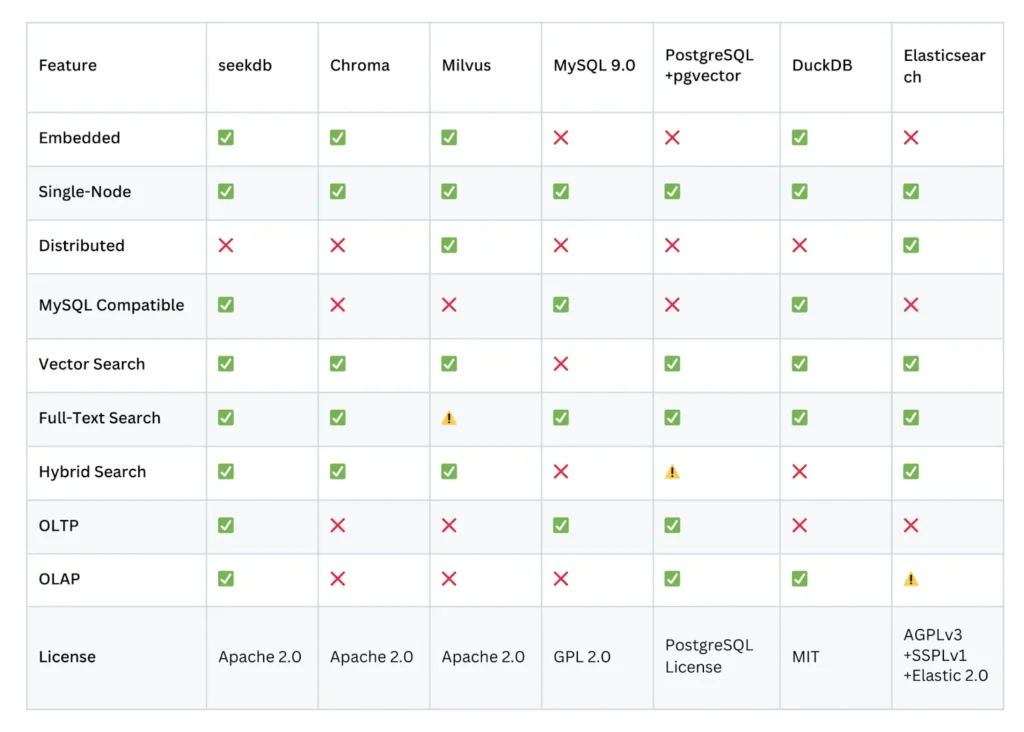
AI applications rarely deal with one clean table. They mix user profiles, chat logs, JSON metadata, embeddings, and sometimes spatial data. Most teams answer this with a patchwork of an OLTP database, a vector store, and a search engine. OceanBase released seekdb, an open source AI focused database (under the Apache 2.0 license). seekdb is described as an AI native search database that unifies relational data, vector data, text, JSON, and GIS in one engine and exposes hybrid search and in database AI workflows.  What is seekdb? seekdb is positioned as the lightweight, embedded version of the OceanBase engine, aimed at AI applications rather than general purpose distributed deployments. It runs as a single node database, supports embedded mode and client or server mode, and remains compatible with MySQL drivers and SQL syntax. In the capability matrix, seekdb is marked as: Embedded database supported Standalone database supported Distributed database not supported while the full OceanBase product covers the distributed case. From a data model perspective, seekdb supports: Relational data with standard SQL Vector search Full text search JSON data Spatial GIS data all inside one storage and indexing layer. Hybrid search as the core feature The main feature OceanBase pushes is hybrid search. This is search that combines vector based semantic retrieval, full text keyword retrieval, and scalar filters in a single query and a single ranking step. seekdb implements hybrid search through a system package named DBMS_HYBRID_SEARCH with two entry points: DBMS_HYBRID_SEARCH.SEARCH which returns results as JSON, sorted by relevance DBMS_HYBRID_SEARCH.GET_SQL which returns the concrete SQL string used for execution The hybrid search path can run: pure vector search pure full text search combined hybrid search and can push relational filters and joins down into storage. It also supports query reranking strategies like weighted scores and reciprocal rank fusion and can plug in large language model based re-rankers. For retrieval augmented generation (RAG) and agent memory, this means you can write a single SQL query that does semantic matching on embeddings, exact matching on product codes or proper nouns, and relational filtering on user or tenant scopes. Vector and full text engine details At its core, seekdb exposes a modern vector and full text stack. For vectors, seekdb: supports dense vectors and sparse vectors supports Manhattan, Euclidean, inner product, and cosine distance metrics provides in memory index types such as HNSW, HNSW SQ, HNSW BQ provides disk based index types including IVF and IVF PQ Hybrid vector index show how you can store raw text, let seekdb call an embedding model automatically, and have the system maintain the corresponding vector index without a separate preprocessing pipeline. For text, seekdb offers full text search with: keyword, phrase, and Boolean queries BM25 ranking for relevance multiple tokenizer modes The key point is that full text and vector indexes are first class and are integrated in the same query planner as scalar indexes and GIS indexes, so hybrid search does not need external orchestration. AI functions inside the database seekdb includes built in AI function expressions that let you call models directly from SQL, without a separate application service mediating every call. The main functions are: AI_EMBED to convert text into embeddings AI_COMPLETE for text generation using a chat or completion model AI_RERANK to rerank a list of candidatesAI_PROMPT to assemble prompt templates and dynamic values into a JSON object for AI_COMPLETE Model metadata and endpoints are managed by the DBMS_AI_SERVICE package, which lets you register external providers, set URLs, and configure keys, all on the database side.  Multimodal data and workloads seekdb is built to handle multiple data modalities in one node. it has a multimodal data and indexing layer that covers vectors, text, JSON, and GIS, and a multi-model compute layer for hybrid workloads across vector, full text, and scalar conditions. It also provides JSON indexes for metadata queries and GIS indexes for spatial conditions. This allows queries like: find semantically similar documents filter by JSON metadata like tenant, region, or category constrain by spatial range or polygon without leaving the same engine. Because seekdb is derived from the OceanBase engine, it inherits ACID transactions, row and column hybrid storage, and vectorized execution, although high scale distributed deployments remain a job for the full OceanBase database. Comparison Table Key Takeaways AI native hybrid search: seekdb unifies vector search, full text search and relational filtering in a single SQL and DBMS_HYBRID_SEARCH interface, so RAG and agent workloads can run multi signal retrieval in one query instead of stitching together multiple engines. Multimodal data in one engine: seekdb stores and indexes relational data, vectors, text, JSON and GIS in the same engine, which lets AI applications keep documents, embeddings and metadata consistent without maintaining separate databases. In database AI functions for RAG: With AI_EMBED, AI_COMPLETE, AI_RERANK and AI_PROMPT, seekdb can call embedding models, LLMs and rerankers directly from SQL, which simplifies RAG pipelines and moves more orchestration logic into the database layer. Single node, embedded friendly design: seekdb is a single node, MySQL compatible engine that supports embedded and standalone modes, while distributed, large scale deployments remain the role of full OceanBase, which makes seekdb suitable for local, edge and service embedded AI workloads. Open source and tool ecosystem: seekdb is open sourced under Apache 2.0 and integrates with a growing ecosystem of AI tools and frameworks, with Python support via pyseekdb and MCP based integration for code assistants and agents, so it can act as a unified data plane for AI applications. Check out the Repo and Project. Feel free to check out our GitHub Page for Tutorials, Codes and Notebooks. Also, feel free to follow us on Twitter and don’t forget to join our 100k+ ML SubReddit and Subscribe to our Newsletter. Wait! are you on telegram? now you can join us on telegram as well. The post OceanBase Releases seekdb: An Open Source AI Native Hybrid Search Database for Multi-model RAG and AI Agents appeared first on MarkTechPost.

OceanBase Releases seekdb: An Open Source AI Native Hybrid Search Database for Multi-model RAG and AI Agents Read Post »

AI, Committee, News, Uncategorized

Online-PVLM: Advancing Personalized VLMs with Online Concept Learning

arXiv:2511.20056v1 Announce Type: new Abstract: Personalized Visual Language Models (VLMs) are gaining increasing attention for their formidable ability in user-specific concepts aligned interactions (e.g., identifying a user’s bike). Existing methods typically require the learning of separate embeddings for each new concept, which fails to support real-time adaptation during testing. This limitation becomes particularly pronounced in large-scale scenarios, where efficient retrieval of concept embeddings is not achievable. To alleviate this gap, we propose Online-PVLM, a framework for online concept learning by leveraging hyperbolic representations. Our approach makes a train-free paradigm for concept embeddings generation at test time, making the use of personalized VLMs both scalable and efficient. In addition, we develop OP-Eval, a comprehensive and large-scale benchmark comprising 1,292 concepts and over 30K high-quality instances with diverse question types, designed to rigorously assess online concept learning in realistic scenarios. Extensive experiments demonstrate the state-of-the-art performance of our proposed framework. Our source code and dataset will be made available.

Online-PVLM: Advancing Personalized VLMs with Online Concept Learning Read Post »

AI, Committee, News, Uncategorized

EfficientXpert: Efficient Domain Adaptation for Large Language Models via Propagation-Aware Pruning

arXiv:2511.19935v1 Announce Type: cross Abstract: The rapid advancement of large language models (LLMs) has increased the demand for domain-specialized variants in areas such as law, healthcare, and finance. However, their large size remains a barrier to deployment in resource-constrained environments, and existing compression methods either generalize poorly across domains or incur high overhead. In this work, we propose textbf{EfficientXpert}, a lightweight domain-pruning framework that combines a propagation-aware pruning criterion (Foresight Mask) with an efficient adapter-update algorithm (Partial Brain Surgeon). Integrated into the LoRA fine-tuning process, EfficientXpert enables a one-step transformation of general pretrained models into sparse, domain-adapted experts. Across health and legal tasks, it retains up to 98% of dense-model performance at 40% sparsity, outperforming state-of-the-art methods. Further analysis reveals substantial domain-dependent structural shifts that degrade the effectiveness of general pruning masks, underscoring the need for adaptive, domain-aware pruning strategies tailored to each domain.

EfficientXpert: Efficient Domain Adaptation for Large Language Models via Propagation-Aware Pruning Read Post »

AI, Committee, News, Uncategorized

How to Implement Functional Components of Transformer and Mini-GPT Model from Scratch Using Tinygrad to Understand Deep Learning Internals

In this tutorial, we explore how to build neural networks from scratch using Tinygrad while remaining fully hands-on with tensors, autograd, attention mechanisms, and transformer architectures. We progressively build every component ourselves, from basic tensor operations to multi-head attention, transformer blocks, and, finally, a working mini-GPT model. Through each stage, we observe how Tinygrad’s simplicity helps us understand what happens under the hood when models train, optimize, and fuse kernels for performance. Check out the FULL CODES here. Copy CodeCopiedUse a different Browser import subprocess, sys, os print(“Installing dependencies…”) subprocess.check_call([“apt-get”, “install”, “-qq”, “clang”], stdout=subprocess.DEVNULL, stderr=subprocess.DEVNULL) subprocess.check_call([sys.executable, “-m”, “pip”, “install”, “-q”, “git+https://github.com/tinygrad/tinygrad.git”]) import numpy as np from tinygrad import Tensor, nn, Device from tinygrad.nn import optim import time print(f” Using device: {Device.DEFAULT}”) print(“=” * 60) print(“n PART 1: Tensor Operations & Autograd”) print(“-” * 60) x = Tensor([[1.0, 2.0], [3.0, 4.0]], requires_grad=True) y = Tensor([[2.0, 0.0], [1.0, 2.0]], requires_grad=True) z = (x @ y).sum() + (x ** 2).mean() z.backward() print(f”x:n{x.numpy()}”) print(f”y:n{y.numpy()}”) print(f”z (scalar): {z.numpy()}”) print(f”∂z/∂x:n{x.grad.numpy()}”) print(f”∂z/∂y:n{y.grad.numpy()}”) We set up Tinygrad in our Colab environment and immediately begin experimenting with tensors and automatic differentiation. We create a small computation graph and observe how gradients flow through matrix operations. As we print the outputs, we gain an intuitive understanding of how Tinygrad handles backpropagation under the hood. Check out the FULL CODES here. Copy CodeCopiedUse a different Browser print(“nn PART 2: Building Custom Layers”) print(“-” * 60) class MultiHeadAttention: def __init__(self, dim, num_heads): self.num_heads = num_heads self.dim = dim self.head_dim = dim // num_heads self.qkv = Tensor.glorot_uniform(dim, 3 * dim) self.out = Tensor.glorot_uniform(dim, dim) def __call__(self, x): B, T, C = x.shape[0], x.shape[1], x.shape[2] qkv = x.reshape(B * T, C).dot(self.qkv).reshape(B, T, 3, self.num_heads, self.head_dim) q, k, v = qkv[:, :, 0], qkv[:, :, 1], qkv[:, :, 2] scale = (self.head_dim ** -0.5) attn = (q @ k.transpose(-2, -1)) * scale attn = attn.softmax(axis=-1) out = (attn @ v).transpose(1, 2).reshape(B, T, C) return out.reshape(B * T, C).dot(self.out).reshape(B, T, C) class TransformerBlock: def __init__(self, dim, num_heads): self.attn = MultiHeadAttention(dim, num_heads) self.ff1 = Tensor.glorot_uniform(dim, 4 * dim) self.ff2 = Tensor.glorot_uniform(4 * dim, dim) self.ln1_w = Tensor.ones(dim) self.ln2_w = Tensor.ones(dim) def __call__(self, x): x = x + self.attn(self._layernorm(x, self.ln1_w)) ff = x.reshape(-1, x.shape[-1]) ff = ff.dot(self.ff1).gelu().dot(self.ff2) x = x + ff.reshape(x.shape) return self._layernorm(x, self.ln2_w) def _layernorm(self, x, w): mean = x.mean(axis=-1, keepdim=True) var = ((x – mean) ** 2).mean(axis=-1, keepdim=True) return w * (x – mean) / (var + 1e-5).sqrt() We design our own multi-head attention module and a transformer block entirely from scratch. We implement the projections, attention scores, softmax, feedforward layers, and layer normalization manually. As we run this code, we see how each component contributes to a transformer layer’s overall behavior. Check out the FULL CODES here. Copy CodeCopiedUse a different Browser print(“n PART 3: Mini-GPT Architecture”) print(“-” * 60) class MiniGPT: def __init__(self, vocab_size=256, dim=128, num_heads=4, num_layers=2, max_len=32): self.vocab_size = vocab_size self.dim = dim self.tok_emb = Tensor.glorot_uniform(vocab_size, dim) self.pos_emb = Tensor.glorot_uniform(max_len, dim) self.blocks = [TransformerBlock(dim, num_heads) for _ in range(num_layers)] self.ln_f = Tensor.ones(dim) self.head = Tensor.glorot_uniform(dim, vocab_size) def __call__(self, idx): B, T = idx.shape[0], idx.shape[1] tok_emb = self.tok_emb[idx.flatten()].reshape(B, T, self.dim) pos_emb = self.pos_emb[:T].reshape(1, T, self.dim) x = tok_emb + pos_emb for block in self.blocks: x = block(x) mean = x.mean(axis=-1, keepdim=True) var = ((x – mean) ** 2).mean(axis=-1, keepdim=True) x = self.ln_f * (x – mean) / (var + 1e-5).sqrt() return x.reshape(B * T, self.dim).dot(self.head).reshape(B, T, self.vocab_size) def get_params(self): params = [self.tok_emb, self.pos_emb, self.ln_f, self.head] for block in self.blocks: params.extend([block.attn.qkv, block.attn.out, block.ff1, block.ff2, block.ln1_w, block.ln2_w]) return params model = MiniGPT(vocab_size=256, dim=64, num_heads=4, num_layers=2, max_len=16) params = model.get_params() total_params = sum(p.numel() for p in params) print(f”Model initialized with {total_params:,} parameters”) We assemble the full MiniGPT architecture using the components built earlier. We embed tokens, add positional information, stack multiple transformer blocks, and project the final outputs back to vocab logits. As we initialize the model, we begin to appreciate how a compact transformer can be built with surprisingly few moving parts. Check out the FULL CODES here. Copy CodeCopiedUse a different Browser print(“nn PART 4: Training Loop”) print(“-” * 60) def gen_data(batch_size, seq_len): x = np.random.randint(0, 256, (batch_size, seq_len)) y = np.roll(x, 1, axis=1) y[:, 0] = x[:, 0] return Tensor(x, dtype=’int32′), Tensor(y, dtype=’int32′) optimizer = optim.Adam(params, lr=0.001) losses = [] print(“Training to predict previous token in sequence…”) with Tensor.train(): for step in range(20): start = time.time() x_batch, y_batch = gen_data(batch_size=16, seq_len=16) logits = model(x_batch) B, T, V = logits.shape[0], logits.shape[1], logits.shape[2] loss = logits.reshape(B * T, V).sparse_categorical_crossentropy(y_batch.reshape(B * T)) optimizer.zero_grad() loss.backward() optimizer.step() losses.append(loss.numpy()) elapsed = time.time() – start if step % 5 == 0: print(f”Step {step:3d} | Loss: {loss.numpy():.4f} | Time: {elapsed*1000:.1f}ms”) print(“nn PART 5: Lazy Evaluation & Kernel Fusion”) print(“-” * 60) N = 512 a = Tensor.randn(N, N) b = Tensor.randn(N, N) print(“Creating computation: (A @ B.T + A).sum()”) lazy_result = (a @ b.T + a).sum() print(“→ No computation done yet (lazy evaluation)”) print(“nCalling .realize() to execute…”) start = time.time() realized = lazy_result.realize() elapsed = time.time() – start print(f”✓ Computed in {elapsed*1000:.2f}ms”) print(f”Result: {realized.numpy():.4f}”) print(“nNote: Operations were fused into optimized kernels!”) We train the MiniGPT model on simple synthetic data and observe the loss decreasing across steps. We also explore Tinygrad’s lazy execution model by creating a fused kernel that executes only when it is realized. As we monitor timings, we understand how kernel fusion improves performance. Check out the FULL CODES here. Copy CodeCopiedUse a different Browser print(“nn PART 6: Custom Operations”) print(“-” * 60) def custom_activation(x): return x * x.sigmoid() x = Tensor([[-2.0, -1.0, 0.0, 1.0, 2.0]], requires_grad=True) y = custom_activation(x) loss = y.sum() loss.backward() print(f”Input: {x.numpy()}”) print(f”Swish(x): {y.numpy()}”) print(f”Gradient: {x.grad.numpy()}”) print(“nn” + “=” * 60) print(” Tutorial Complete!”) print(“=” * 60) print(“”” Key Concepts Covered: 1. Tensor operations with automatic differentiation 2. Custom neural network layers (Attention, Transformer) 3. Building a mini-GPT language model from scratch 4. Training loop with Adam optimizer 5. Lazy evaluation and kernel fusion 6. Custom activation functions “””) We implement a custom activation function and verify that gradients propagate correctly through it. We then print a summary

How to Implement Functional Components of Transformer and Mini-GPT Model from Scratch Using Tinygrad to Understand Deep Learning Internals Read Post »

AI, Committee, News, Uncategorized

Black Forest Labs Releases FLUX.2: A 32B Flow Matching Transformer for Production Image Pipelines

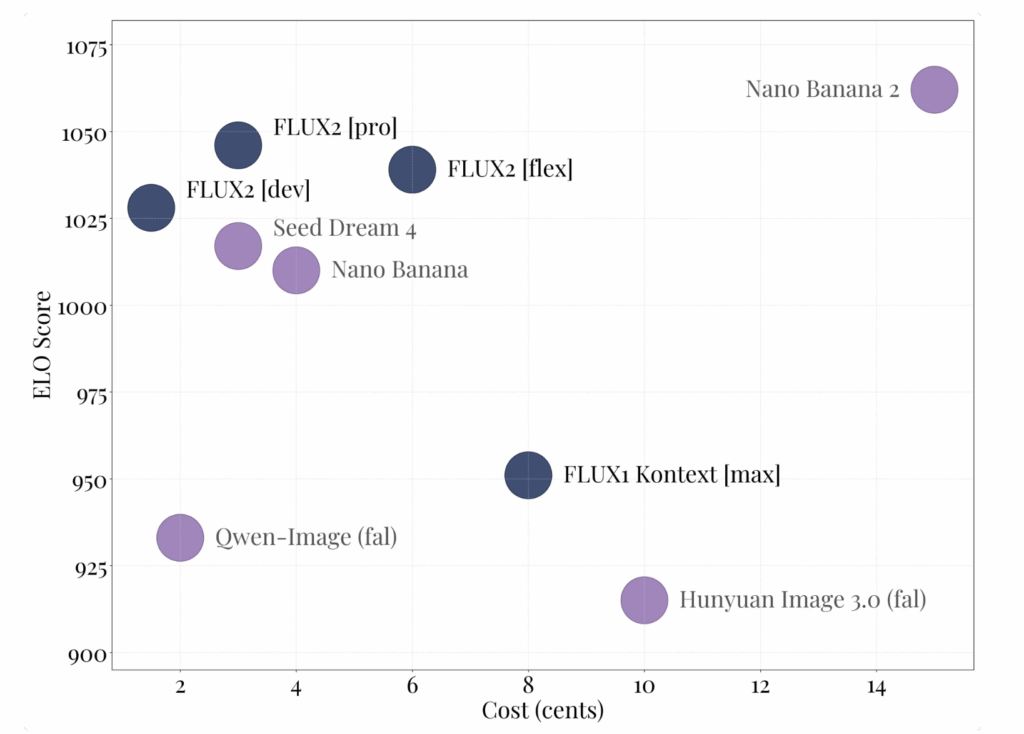
Black Forest Labs has released FLUX.2, its second generation image generation and editing system. FLUX.2 targets real world creative workflows such as marketing assets, product photography, design layouts, and complex infographics, with editing support up to 4 megapixels and strong control over layout, logos, and typography. FLUX.2 product family and FLUX.2 [dev] The FLUX.2 family spans hosted APIs and open weights: FLUX.2 [pro] is the managed API tier. It targets state of the art quality relative to closed models, with high prompt adherence and low inference cost, and is available in the BFL Playground, BFL API, and partner platforms. FLUX.2 [flex] exposes parameters such as number of steps and guidance scale, so developers can trade off latency, text rendering accuracy, and visual detail. FLUX.2 [dev] is the open weight checkpoint, derived from the base FLUX.2 model. It is described as the most powerful open weight image generation and editing model, combining text to image and multi image editing in one checkpoint, with 32 billion parameters. FLUX.2 [klein] is a coming open source Apache 2.0 variant, size distilled from the base model for smaller setups, with many of the same capabilities. All variants support image editing from text and multiple references in a single model, which removes the need to maintain separate checkpoints for generation and editing. Architecture, latent flow, and the FLUX.2 VAE FLUX.2 uses a latent flow matching architecture. The core design couples a Mistral-3 24B vision language model with a rectified flow transformer that operates on latent image representations. The vision language model provides semantic grounding and world knowledge, while the transformer backbone learns spatial structure, materials, and composition. The model is trained to map noise latents to image latents under text conditioning, so the same architecture supports both text driven synthesis and editing. For editing, latents are initialized from existing images, then updated under the same flow process while preserving structure. A new FLUX.2 VAE defines the latent space. It is designed to balance learnability, reconstruction quality, and compression, and is released separately on Hugging Face under an Apache 2.0 license. This autoencoder is the backbone for all FLUX.2 flow models and can also be reused in other generative systems. https://bfl.ai/blog/flux-2 Capabilities for production workflows The FLUX.2 Docs and Diffusers integration highlight several key capabilities: Multi reference support: FLUX.2 can combine up to 10 reference images to maintain character identity, product appearance, and style across outputs. Photoreal detail at 4MP: the model can edit and generate images up to 4 megapixels, with improved textures, skin, fabrics, hands, and lighting suitable for product shots and photo like use cases. Robust text and layout rendering: it can render complex typography, infographics, memes, and user interface layouts with small legible text, which is a common weakness in many older models. World knowledge and spatial logic: the model is trained for more grounded lighting, perspective, and scene composition, which reduces artifacts and the synthetic look. https://bfl.ai/blog/flux-2 Key Takeaways FLUX.2 is a 32B latent flow matching transformer that unifies text to image, image editing, and multi reference composition in a single checkpoint. FLUX.2 [dev] is the open weight variant, paired with the Apache 2.0 FLUX.2 VAE, while the core model weights use the FLUX.2-dev Non Commercial License with mandatory safety filtering. The system supports up to 4 megapixel generation and editing, robust text and layout rendering, and up to 10 visual references for consistent characters, products, and styles. Full precision inference requires more than 80GB VRAM, but 4 bit and FP8 quantized pipelines with offloading make FLUX.2 [dev] usable on 18GB to 24GB GPUs and even 8GB cards with sufficient system RAM. Editorial Notes FLUX.2 is an important step for open weight visual generation, since it combines a 32B rectified flow transformer, a Mistral 3 24B vision language model, and the FLUX.2 VAE into a single high fidelity pipeline for text to image and editing. The clear VRAM profiles, quantized variants, and strong integrations with Diffusers, ComfyUI, and Cloudflare Workers make it practical for real workloads, not only benchmarks. This release pushes open image models closer to production grade creative infrastructure. Check out the Technical details, Model weight and Repo. Feel free to check out our GitHub Page for Tutorials, Codes and Notebooks. Also, feel free to follow us on Twitter and don’t forget to join our 100k+ ML SubReddit and Subscribe to our Newsletter. Wait! are you on telegram? now you can join us on telegram as well. The post Black Forest Labs Releases FLUX.2: A 32B Flow Matching Transformer for Production Image Pipelines appeared first on MarkTechPost.

Black Forest Labs Releases FLUX.2: A 32B Flow Matching Transformer for Production Image Pipelines Read Post »

AI, Committee, News, Uncategorized

Prompt Optimization as a State-Space Search Problem

arXiv:2511.18619v1 Announce Type: new Abstract: Language Models are extremely susceptible to performance collapse with even small changes to input prompt strings. Libraries such as DSpy (from Stanford NLP) avoid this problem through demonstration-based prompt optimisation. Inspired by this, I propose an alternative approach that treats prompt optimisation as a classical state-space search problem. I model the prompt space as a graph where nodes represent prompt states and edges correspond to deliberate transformations such as shortening, adding examples, or re- ordering content. Using beam search and random walk algorithms, I systematically explore this space, evaluating candidates on development sets and pruning unpromising branches. Across five NLP tasks (sentiment classification, question answering, summarisation, reason- ing, and natural language inference), I find that even shallow search configurations (beam width=2, depth=2) improve upon seed prompts on development sets. For instance, beam search achieves development accuracy gains from 0.40 to 0.80 on reasoning tasks, though test set improvements are more modest (0.20 to 0.50), indicating overfitting to the develop- ment heuristic. Analysis of successful optimisation paths reveals that transformations that make prompts concise appear most frequently, while verbosity operators are never selected. My results validate prompt optimization as a search problem and suggest that with greater computational resources and improved evaluation metrics, deeper exploration could yield more robust prompts that generalize beyond development sets. Code and implementation are available at [https://github.com/MaanasTaneja/PromptOptimiser].

Prompt Optimization as a State-Space Search Problem Read Post »

AI, Committee, News, Uncategorized

GEM: Gaussian Embedding Modeling for Out-of-Distribution Detection in GUI Agents

arXiv:2505.12842v4 Announce Type: replace-cross Abstract: Graphical user interface (GUI) agents have recently emerged as an intriguing paradigm for human-computer interaction, capable of automatically executing user instructions to operate intelligent terminal devices. However, when encountering out-of-distribution (OOD) instructions that violate environmental constraints or exceed the current capabilities of agents, GUI agents may suffer task breakdowns or even pose security threats. Therefore, effective OOD detection for GUI agents is essential. Traditional OOD detection methods perform suboptimally in this domain due to the complex embedding space and evolving GUI environments. In this work, we observe that the in-distribution input semantic space of GUI agents exhibits a clustering pattern with respect to the distance from the centroid. Based on the finding, we propose GEM, a novel method based on fitting a Gaussian mixture model over input embedding distances extracted from the GUI agent that reflect its capability boundary. Evaluated on eight datasets spanning smartphones, computers, and web browsers, our method achieves an average accuracy improvement of 23.70% over the best-performing baseline while only increasing training time by 4.9% and testing time by 6.5%. We also experimentally demonstrate that GEM can improve the step-wise success rate by 9.40% by requesting assistance from the cloud model when encountering OOD samples. Analysis verifies the generalization ability of our method through experiments on nine different backbones. The codes are available at https://github.com/Wuzheng02/GEM-OODforGUIagents.

GEM: Gaussian Embedding Modeling for Out-of-Distribution Detection in GUI Agents Read Post »

AI, Committee, News, Uncategorized

OpenGloss: A Synthetic Encyclopedic Dictionary and Semantic Knowledge Graph

arXiv:2511.18622v1 Announce Type: new Abstract: We present OpenGloss, a synthetic encyclopedic dictionary and semantic knowledge graph for English that integrates lexicographic definitions, encyclopedic context, etymological histories, and semantic relationships in a unified resource. OpenGloss contains 537K senses across 150K lexemes, on par with WordNet 3.1 and Open English WordNet, while providing more than four times as many sense definitions. These lexemes include 9.1M semantic edges, 1M usage examples, 3M collocations, and 60M words of encyclopedic content. Generated through a multi-agent procedural generation pipeline with schema-validated LLM outputs and automated quality assurance, the entire resource was produced in under one week for under $1,000. This demonstrates that structured generation can create comprehensive lexical resources at cost and time scales impractical for manual curation, enabling rapid iteration as foundation models improve. The resource addresses gaps in pedagogical applications by providing integrated content — definitions, examples, collocations, encyclopedias, etymology — that supports both vocabulary learning and natural language processing tasks. As a synthetically generated resource, OpenGloss reflects both the capabilities and limitations of current foundation models. The dataset is publicly available on Hugging Face under CC-BY 4.0, enabling researchers and educators to build upon and adapt this resource.

OpenGloss: A Synthetic Encyclopedic Dictionary and Semantic Knowledge Graph Read Post »

We use cookies to improve your experience and performance on our website. You can learn more at Privacy Policy and manage your privacy settings by clicking Settings.

Privacy Preferences

You can choose your cookie settings by turning on/off each type of cookie as you wish, except for essential cookies.

Allow All
Manage Consent Preferences
  • Always Active

Save
en_US