YouZum

Uncategorized

AI, Committee, News, Uncategorized

Three technologies that will shape biotech in 2026

Earlier this week, MIT Technology Review published its annual list of Ten Breakthrough Technologies. As always, it features technologies that made the news last year, and which—for better or worse—stand to make waves in the coming years. They’re the technologies you should really be paying attention to. This year’s list includes tech that’s set to transform the energy industry, artificial intelligence, space travel—and of course biotech and health. Our breakthrough biotechnologies for 2026 involve editing a baby’s genes and, separately, resurrecting genes from ancient species. We also included a controversial technology that offers parents the chance to screen their embryos for characteristics like height and intelligence. Here’s the story behind our biotech choices. A base-edited baby! In August 2024, KJ Muldoon was born with a rare genetic disorder that allowed toxic ammonia to build up in his blood. The disease can be fatal, and KJ was at risk of developing neurological disorders. At the time, his best bet for survival involved waiting for a liver transplant. Then he was offered an experimental gene therapy—a personalized “base editing” treatment designed to correct the specific genetic “misspellings” responsible for his disease. It seems to have worked! Three doses later, KJ is doing well. He took his first steps in December, shortly before spending his first Christmas at home. KJ’s story is hugely encouraging. The team behind his treatment is planning a clinical trial for infants with similar disorders caused by different genetic mutations. The team members hope to win regulatory approval on the back of a small trial—a move that could make the expensive treatment (KJ’s cost around $1 million) more accessible, potentially within a few years. Others are getting in on the action, too. Fyodor Urnov, a gene-editing scientist at the University of California, Berkeley, assisted the team that developed KJ’s treatment. He recently cofounded Aurora Therapeutics, a startup that hopes to develop gene-editing drugs for another disorder called phenylketonuria (PKU). The goal is to obtain regulatory approval for a single drug that can then be adjusted or personalized for individuals without having to go through more clinical trials. US regulators seem to be amenable to the idea and have described a potential approval pathway for such “bespoke, personalized therapies.” Watch this space. Gene resurrection It was a big year for Colossal Biosciences, the biotech company hoping to “de-extinct” animals like the woolly mammoth and the dodo. In March, the company created what it called “woolly mice”—rodents with furry coats and curly whiskers akin to those of woolly mammoths. The company made an even more dramatic claim the following month, when it announced it had created three dire wolves. These striking snow-white animals were created by making 20 genetic changes to the DNA of gray wolves based on genetic research on ancient dire wolf bones, the company said at the time. Whether these animals can really be called dire wolves is debatable, to say the least. But the technology behind their creation is undeniably fascinating. We’re talking about the extraction and analysis of ancient DNA, which can then be introduced into cells from other, modern-day species. Analysis of ancient DNA can reveal all sorts of fascinating insights into human ancestors and other animals. And cloning, another genetic tool used here, has applications not only in attempts to re-create dead pets but also in wildlife conservation efforts. Read more here. Embryo scoring IVF involves creating embryos in a lab and, typically, “scoring” them on their likelihood of successful growth before they are transferred to a person’s uterus. So far, so uncontroversial. Recently, embryo scoring has evolved. Labs can pinch off a couple of cells from an embryo, look at its DNA, and screen for some genetic diseases. That list of diseases is increasing. And now some companies are taking things even further, offering prospective parents the opportunity to select embryos for features like height, eye color, and even IQ. This is controversial for lots of reasons. For a start, there are many, many factors that contribute to complex traits like IQ (a score that doesn’t capture all aspects of intelligence at any rate). We don’t have a perfect understanding of those factors, or how selecting for one trait might influence another. Some critics warn of eugenics. And others note that whichever embryo you end up choosing, you can’t control exactly how your baby will turn out (and why should you?!). Still, that hasn’t stopped Nucleus, one of the companies offering these services, from inviting potential customers to have their “best baby.” Read more here. This article first appeared in The Checkup, MIT Technology Review’s weekly biotech newsletter. To receive it in your inbox every Thursday, and read articles like this first, sign up here.

Three technologies that will shape biotech in 2026 Read Post »
AI, Committee, News, Uncategorized

Google AI Releases TranslateGemma: A New Family of Open Translation Models Built on Gemma 3 with Support for 55 Languages

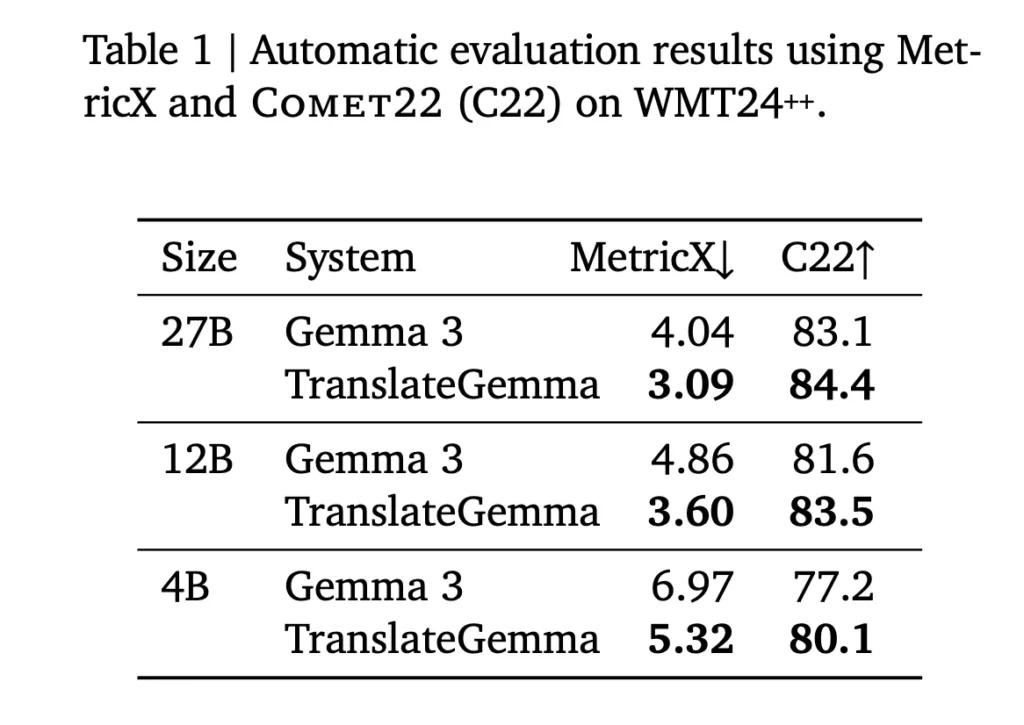
Google AI has released TranslateGemma, a suite of open machine translation models built on Gemma 3 and targeted at 55 languages. The family comes in 4B, 12B and 27B parameter sizes. It is designed to run across devices from mobile and edge hardware to laptops and a single H100 GPU or TPU instance in the cloud. TranslateGemma is not a separate architecture. It is Gemma 3 specialized for translation through a two stage post training pipeline. (1) supervised fine tuning on large parallel corpora. (2) Reinforcement learning that optimizes translation quality with a multi signal reward ensemble. The goal is to push translation quality while keeping the general instruction following behavior of Gemma 3. Supervised fine tuning on synthetic and human parallel data The supervised fine tuning stage starts from the public Gemma 3 4B, 12B and 27B checkpoints. The research team uses parallel data that combines human translations with high quality synthetic translations generated by Gemini models. Synthetic data is produced from monolingual sources with a multi step procedure. The pipeline selects candidate sentences and short documents, feeds them to Gemini 2.5 Flash, and then filters outputs with MetricX 24 QE to keep only examples that show clear quality gains. This is applied across all WMT24 plus plus language pairs plus 30 more language pairs. Low resource languages receive human generated parallel data from the SMOL and GATITOS datasets. SMOL covers 123 languages and GATITOS covers 170 languages. This improves coverage of scripts and language families that are under represented in publicly available web parallel data. The final supervised fine tuning mixture also keeps 30 percent generic instruction following data from the original Gemma 3 mixture. This is important. Without it, the model would over specialize on pure translation and lose general LLM behavior such as following instructions or doing simple reasoning in context. Training uses the Kauldron SFT (Supervised Fine tuning) tooling with the AdaFactor optimizer. The learning rate is 0.0001 with batch size 64 for 200000 steps. All model parameters are updated except the token embeddings, which are frozen. Freezing embeddings helps preserve representation quality for languages and scripts that do not appear in the supervised fine tuning data. Reinforcement learning with a translation focused reward ensemble After supervised fine tuning, TranslateGemma runs a reinforcement learning phase on top of the same translation data mixture. The reinforcement learning objective uses several reward models. The reward ensemble includes: MetricX 24 XXL QE, a learned regression metric that approximates MQM scores and is used here in quality estimation mode without a reference. Gemma AutoMQM QE, a span level error predictor fine tuned from Gemma 3 27B IT on MQM labeled data. It produces token level rewards based on error type and severity. ChrF, a character n gram overlap metric that compares model output with synthetic references and is rescaled to match the other rewards. A Naturalness Autorater that uses the policy model as an LLM judge and produces span level penalties for segments that do not sound like native text. A generalist reward model from the Gemma 3 post training setup that keeps reasoning and instruction following ability intact. TranslateGemma uses reinforcement learning algorithms that combine sequence level rewards with token level advantages. Span level rewards from AutoMQM and the Naturalness Autorater attach directly to the affected tokens. These token advantages are added to sequence advantages computed from reward to go and then batch normalized. This improves credit assignment compared with pure sequence level reinforcement learning. Benchmark results on WMT24++ TranslateGemma is evaluated on the WMT24++ benchmark using MetricX 24 and Comet22. MetricX is lower better and correlates with MQM error counts. Comet22 is higher better and measures adequacy and fluency. https://arxiv.org/pdf/2601.09012 The above Table from the research pape summarizes results for English centered evaluation over 55 language pairs. 27B: Gemma 3 baseline has MetricX 4.04 and Comet22 83.1. TranslateGemma 27B reaches MetricX 3.09 and Comet22 84.4. 12B: Gemma 3 baseline has MetricX 4.86 and Comet22 81.6. TranslateGemma 12B reaches MetricX 3.60 and Comet22 83.5. 4B: Gemma 3 baseline has MetricX 6.97 and Comet22 77.2. TranslateGemma 4B reaches MetricX 5.32 and Comet22 80.1. The key pattern is that TranslateGemma improves quality for every model size. At the same time, model scale interacts with specialization. The 12B TranslateGemma model surpasses the 27B Gemma 3 baseline. The 4B TranslateGemma model reaches quality similar to the 12B Gemma 3 baseline. This means a smaller translation specialized model can replace a larger baseline model for many machine translation workloads. https://arxiv.org/pdf/2601.09012 A language level breakdown in the above appendix table from the research paper shows that these gains appear across all 55 language pairs. For example, MetricX improves from 1.63 to 1.19 for English to German, 2.54 to 1.88 for English to Spanish, 3.90 to 2.72 for English to Hebrew, and 5.92 to 4.45 for English to Swahili. Improvements are also large for harder cases such as English to Lithuanian, English to Estonian and English to Icelandic. Human evaluation on WMT25 with MQM confirms this trend. TranslateGemma 27B usually yields lower MQM scores, that is fewer weighted errors, than Gemma 3 27B, with especially strong gains for low resource directions such as English to Marathi, English to Swahili and Czech to Ukrainian. There are two notable exceptions. For German as target both systems are very close. For Japanese to English TranslateGemma shows a regression caused mainly by named entity errors, even though other error categories improve. Multimodal translation and interface for developers TranslateGemma inherits the image understanding stack of Gemma 3. The research team evaluates image translation on the Vistra benchmark. They select 264 images that each contain a single text instance. The model receives only the image plus a prompt that asks it to translate the text in the image. There is no separate bounding box input and no explicit OCR step. On this setting, TranslateGemma 27B improves MetricX from 2.03 to 1.58 and Comet22 from 76.1 to 77.7. The 4B variant shows smaller but positive gains. The 12B model improves MetricX

Google AI Releases TranslateGemma: A New Family of Open Translation Models Built on Gemma 3 with Support for 55 Languages Read Post »

AI, Committee, News, Uncategorized

Collaborative Multi-Agent Test-Time Reinforcement Learning for Reasoning

arXiv:2601.09667v1 Announce Type: cross Abstract: Multi-agent systems have evolved into practical LLM-driven collaborators for many applications, gaining robustness from diversity and cross-checking. However, multi-agent RL (MARL) training is resource-intensive and unstable: co-adapting teammates induce non-stationarity, and rewards are often sparse and high-variance. Therefore, we introduce textbf{Multi-Agent Test-Time Reinforcement Learning (MATTRL)}, a framework that injects structured textual experience into multi-agent deliberation at inference time. MATTRL forms a multi-expert team of specialists for multi-turn discussions, retrieves and integrates test-time experiences, and reaches consensus for final decision-making. We also study credit assignment for constructing a turn-level experience pool, then reinjecting it into the dialogue. Across challenging benchmarks in medicine, math, and education, MATTRL improves accuracy by an average of 3.67% over a multi-agent baseline, and by 8.67% over comparable single-agent baselines. Ablation studies examine different credit-assignment schemes and provide a detailed comparison of how they affect training outcomes. MATTRL offers a stable, effective and efficient path to distribution-shift-robust multi-agent reasoning without tuning.

Collaborative Multi-Agent Test-Time Reinforcement Learning for Reasoning Read Post »

AI, Committee, News, Uncategorized

TaxoBell: Gaussian Box Embeddings for Self-Supervised Taxonomy Expansion

arXiv:2601.09633v1 Announce Type: new Abstract: Taxonomies form the backbone of structured knowledge representation across diverse domains, enabling applications such as e-commerce catalogs, semantic search, and biomedical discovery. Yet, manual taxonomy expansion is labor-intensive and cannot keep pace with the emergence of new concepts. Existing automated methods rely on point-based vector embeddings, which model symmetric similarity and thus struggle with the asymmetric “is-a” relationships that are fundamental to taxonomies. Box embeddings offer a promising alternative by enabling containment and disjointness, but they face key issues: (i) unstable gradients at the intersection boundaries, (ii) no notion of semantic uncertainty, and (iii) limited capacity to represent polysemy or ambiguity. We address these shortcomings with TaxoBell, a Gaussian box embedding framework that translates between box geometries and multivariate Gaussian distributions, where means encode semantic location and covariances encode uncertainty. Energy-based optimization yields stable optimization, robust modeling of ambiguous concepts, and interpretable hierarchical reasoning. Extensive experimentation on five benchmark datasets demonstrates that TaxoBell significantly outperforms eight state-of-the-art taxonomy expansion baselines by 19% in MRR and around 25% in Recall@k. We further demonstrate the advantages and pitfalls of TaxoBell with error analysis and ablation studies.

TaxoBell: Gaussian Box Embeddings for Self-Supervised Taxonomy Expansion Read Post »

AI, Committee, News, Uncategorized

Template-Based Probes Are Imperfect Lenses for Counterfactual Bias Evaluation in LLMs

arXiv:2404.03471v5 Announce Type: replace Abstract: Bias in large language models (LLMs) has many forms, from overt discrimination to implicit stereotypes. Counterfactual bias evaluation is a widely used approach to quantifying bias and often relies on template-based probes that explicitly state group membership. It aims to measure whether the outcome of a task performed by an LLM is invariant to a change in group membership. In this work, we find that template-based probes can introduce systematic distortions in bias measurements. Specifically, we consistently find that such probes suggest that LLMs classify text associated with White race as negative at disproportionately elevated rates. This is observed consistently across a large collection of LLMs, over several diverse template-based probes, and with different classification approaches. We hypothesize that this arises artificially due to linguistic asymmetries present in LLM pretraining data, in the form of markedness, (e.g., Black president vs. president) and templates used for bias measurement (e.g., Black president vs. White president). These findings highlight the need for more rigorous methodologies in counterfactual bias evaluation, ensuring that observed disparities reflect genuine biases rather than artifacts of linguistic conventions.

Template-Based Probes Are Imperfect Lenses for Counterfactual Bias Evaluation in LLMs Read Post »

AI, Committee, News, Uncategorized

GIFT: Unlocking Global Optimality in Post-Training via Finite-Temperature Gibbs Initialization

arXiv:2601.09233v1 Announce Type: cross Abstract: The prevailing post-training paradigm for Large Reasoning Models (LRMs)–Supervised Fine-Tuning (SFT) followed by Reinforcement Learning (RL)–suffers from an intrinsic optimization mismatch: the rigid supervision inherent in SFT induces distributional collapse, thereby exhausting the exploration space necessary for subsequent RL. In this paper, we reformulate SFT within a unified post-training framework and propose Gibbs Initialization with Finite Temperature (GIFT). We characterize standard SFT as a degenerate zero-temperature limit that suppresses base priors. Conversely, GIFT incorporates supervision as a finite-temperature energy potential, establishing a distributional bridge that ensures objective consistency throughout the post-training pipeline. Our experiments demonstrate that GIFT significantly outperforms standard SFT and other competitive baselines when utilized for RL initialization, providing a mathematically principled pathway toward achieving global optimality in post-training. Our code is available at https://github.com/zzy1127/GIFT.

GIFT: Unlocking Global Optimality in Post-Training via Finite-Temperature Gibbs Initialization Read Post »

AI, Committee, News, Uncategorized

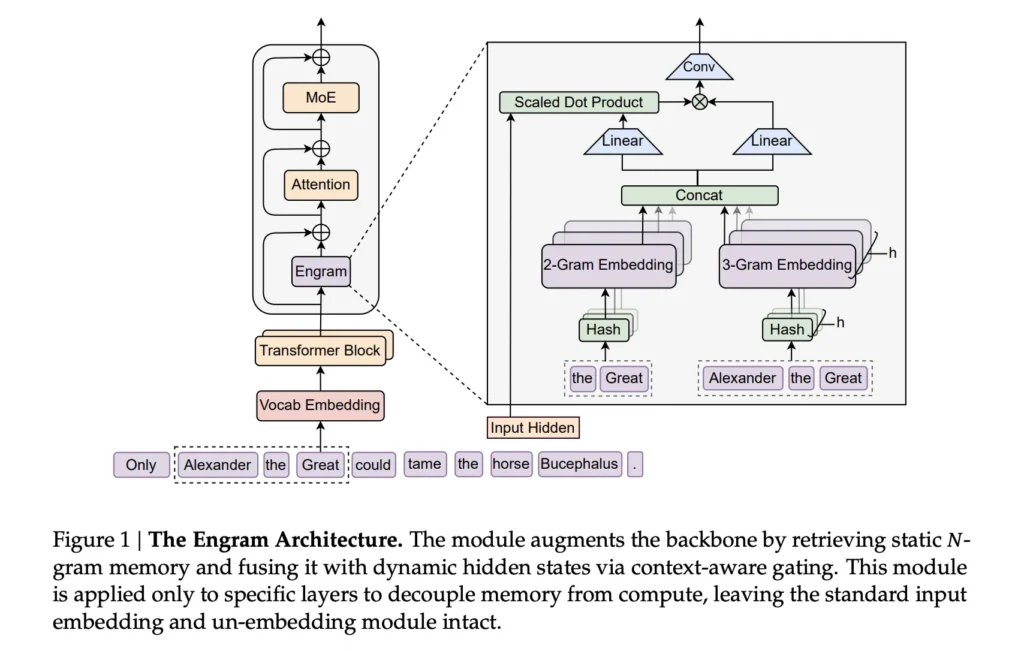
DeepSeek AI Researchers Introduce Engram: A Conditional Memory Axis For Sparse LLMs

Transformers use attention and Mixture-of-Experts to scale computation, but they still lack a native way to perform knowledge lookup. They re-compute the same local patterns again and again, which wastes depth and FLOPs. DeepSeek’s new Engram module targets exactly this gap by adding a conditional memory axis that works alongside MoE rather than replacing it. At a high level, Engram modernizes classic N gram embeddings and turns them into a scalable, O(1) lookup memory that plugs directly into the Transformer backbone. The result is a parametric memory that stores static patterns such as common phrases and entities, while the backbone focuses on harder reasoning and long range interactions. https://github.com/deepseek-ai/Engram/tree/main How Engram Fits Into A DeepSeek Transformer The proposed approach use the DeepSeek V3 tokenizer with a 128k vocabulary and pre-train on 262B tokens. The backbone is a 30 block Transformer with hidden size 2560. Each block uses Multi head Latent Attention with 32 heads and connects to feed forward networks through Manifold Constrained Hyper Connections with expansion rate 4. Optimization uses the Muon optimizer. Engram attaches to this backbone as a sparse embedding module. It is built from hashed N gram tables, with multi head hashing into prime sized buckets, a small depthwise convolution over the N gram context and a context aware gating scalar in the range 0 to 1 that controls how much of the retrieved embedding is injected into each branch. In the large scale models, Engram-27B and Engram-40B share the same Transformer backbone as MoE-27B. MoE-27B replaces the dense feed forward with DeepSeekMoE, using 72 routed experts and 2 shared experts. Engram-27B reduces routed experts from 72 to 55 and reallocates those parameters into a 5.7B Engram memory while keeping total parameters at 26.7B. The Engram module uses N equal to {2,3}, 8 Engram heads, dimension 1280 and is inserted at layers 2 and 15. Engram 40B increases the Engram memory to 18.5B parameters while keeping activated parameters fixed. https://github.com/deepseek-ai/Engram/tree/main Sparsity Allocation, A Second Scaling Knob Beside MoE The core design question is how to split the sparse parameter budget between routed experts and conditional memory. The research team formalize this as the Sparsity Allocation problem, with allocation ratio ρ defined as the fraction of inactive parameters assigned to MoE experts. A pure MoE model has ρ equal to 1. Reducing ρ reallocates parameters from experts into Engram slots. On mid scale 5.7B and 9.9B models, sweeping ρ gives a clear U shaped curve of validation loss versus allocation ratio. Engram models match the pure MoE baseline even when ρ drops to about 0.25, which corresponds to roughly half as many routed experts. The optimum appears when around 20 to 25 percent of the sparse budget is given to Engram. This optimum is stable across both compute regimes, which suggests a robust split between conditional computation and conditional memory under fixed sparsity. The research team also studied an infinite memory regime on a fixed 3B MoE backbone trained for 100B tokens. They scale the Engram table from roughly 2.58e5 to 1e7 slots. Validation loss follows an almost perfect power law in log space, meaning that more conditional memory keeps paying off without extra compute. Engram also outperforms OverEncoding, another N gram embedding method that averages into the vocabulary embedding, under the same memory budget. Large Scale Pre Training Results The main comparison involves four models trained on the same 262B token curriculum, with 3.8B activated parameters in all cases. These are Dense 4B with 4.1B total parameters, MoE 27B and Engram 27B at 26.7B total parameters, and Engram 40B at 39.5B total parameters. On The Pile test set, language modeling loss is 2.091 for MoE 27B, 1.960 for Engram 27B, 1.950 for the Engram 27B variant and 1.942 for Engram 40B. The Dense 4B Pile loss is not reported. Validation loss on the internal held out set drops from 1.768 for MoE 27B to 1.634 for Engram 27B and to 1.622 and 1.610 for the Engram variants. Across knowledge and reasoning benchmarks, Engram-27B consistently improves over MoE-27B. MMLU increases from 57.4 to 60.4, CMMLU from 57.9 to 61.9 and C-Eval from 58.0 to 62.7. ARC Challenge rises from 70.1 to 73.8, BBH from 50.9 to 55.9 and DROP F1 from 55.7 to 59.0. Code and math tasks also improve, for example HumanEval from 37.8 to 40.8 and GSM8K from 58.4 to 60.6. Engram 40B typically pushes these numbers further even though the authors note that it is likely under trained at 262B tokens because its training loss continues to diverge from the baselines near the end of pre training. https://github.com/deepseek-ai/Engram/tree/main Long Context Behavior And Mechanistic Effects After pre-training, the research team extend the context window using YaRN to 32768 tokens for 5000 steps, using 30B high quality long context tokens. They compare MoE-27B and Engram-27B at checkpoints corresponding to 41k, 46k and 50k pre training steps. On LongPPL and RULER at 32k context, Engram-27B matches or exceeds MoE-27B under three conditions. With about 82 percent of the pre training FLOPs, Engram-27B at 41k steps matches LongPPL while improving RULER accuracy, for example Multi Query NIAH 99.6 versus 73.0 and QA 44.0 versus 34.5. Under iso loss at 46k and iso FLOPs at 50k, Engram 27B improves both perplexity and all RULER categories including VT and QA. Mechanistic analysis uses LogitLens and Centered Kernel Alignment. Engram variants show lower layer wise KL divergence between intermediate logits and the final prediction, especially in early blocks, which means representations become prediction ready sooner. CKA similarity maps show that shallow Engram layers align best with much deeper MoE layers. For example, layer 5 in Engram-27B aligns with around layer 12 in the MoE baseline. Taken together, this supports the view that Engram effectively increases model depth by offloading static reconstruction to memory. Ablation studies on a 12 layer 3B MoE model with 0.56B activated parameters add a 1.6B Engram memory as a reference configuration, using N equal to {2,3} and inserting Engram at layers 2 and 6. Sweeping a

DeepSeek AI Researchers Introduce Engram: A Conditional Memory Axis For Sparse LLMs Read Post »

AI, Committee, News, Uncategorized

To Retrieve or To Think? An Agentic Approach for Context Evolution

arXiv:2601.08747v1 Announce Type: new Abstract: Current context augmentation methods, such as retrieval-augmented generation, are essential for solving knowledge-intensive reasoning tasks.However, they typically adhere to a rigid, brute-force strategy that executes retrieval at every step. This indiscriminate approach not only incurs unnecessary computational costs but also degrades performance by saturating the context with irrelevant noise. To address these limitations, we introduce Agentic Context Evolution (ACE), a framework inspired by human metacognition that dynamically determines whether to seek new evidence or reason with existing knowledge. ACE employs a central orchestrator agent to make decisions strategically via majority voting.It aims to alternate between activating a retriever agent for external retrieval and a reasoner agent for internal analysis and refinement. By eliminating redundant retrieval steps, ACE maintains a concise and evolved context. Extensive experiments on challenging multi-hop QA benchmarks demonstrate that ACE significantly outperforms competitive baselines in accuracy while achieving efficient token consumption.Our work provides valuable insights into advancing context-evolved generation for complex, knowledge-intensive tasks.

To Retrieve or To Think? An Agentic Approach for Context Evolution Read Post »

AI, Committee, News, Uncategorized

Spatial Context Improves the Integration of Text with Remote Sensing for Mapping Environmental Variables

arXiv:2601.08750v1 Announce Type: new Abstract: Recent developments in natural language processing highlight text as an emerging data source for ecology. Textual resources carry unique information that can be used in complementarity with geospatial data sources, thus providing insights at the local scale into environmental conditions and properties hidden from more traditional data sources. Leveraging textual information in a spatial context presents several challenges. First, the contribution of textual data remains poorly defined in an ecological context, and it is unclear for which tasks it should be incorporated. Unlike ubiquitous satellite imagery or environmental covariates, the availability of textual data is sparse and irregular; its integration with geospatial data is not straightforward. In response to these challenges, this work proposes an attention-based approach that combines aerial imagery and geolocated text within a spatial neighbourhood, i.e. integrating contributions from several nearby observations. Our approach combines vision and text representations with a geolocation encoding, with an attention-based module that dynamically selects spatial neighbours that are useful for predictive tasks.The proposed approach is applied to the EcoWikiRS dataset, which combines high-resolution aerial imagery with sentences extracted from Wikipedia describing local environmental conditions across Switzerland. Our model is evaluated on the task of predicting 103 environmental variables from the SWECO25 data cube. Our approach consistently outperforms single-location or unimodal, i.e. image-only or text-only, baselines. When analysing variables by thematic groups, results show a significant improvement in performance for climatic, edaphic, population and land use/land cover variables, underscoring the benefit of including the spatial context when combining text and image data.

Spatial Context Improves the Integration of Text with Remote Sensing for Mapping Environmental Variables Read Post »

AI, Committee, News, Uncategorized

SwiftMem: Fast Agentic Memory via Query-aware Indexing

arXiv:2601.08160v1 Announce Type: new Abstract: Agentic memory systems have become critical for enabling LLM agents to maintain long-term context and retrieve relevant information efficiently. However, existing memory frameworks suffer from a fundamental limitation: they perform exhaustive retrieval across the entire storage layer regardless of query characteristics. This brute-force approach creates severe latency bottlenecks as memory grows, hindering real-time agent interactions. We propose SwiftMem, a query-aware agentic memory system that achieves sub-linear retrieval through specialized indexing over temporal and semantic dimensions. Our temporal index enables logarithmic-time range queries for time-sensitive retrieval, while the semantic DAG-Tag index maps queries to relevant topics through hierarchical tag structures. To address memory fragmentation during growth, we introduce an embedding-tag co-consolidation mechanism that reorganizes storage based on semantic clusters to improve cache locality. Experiments on LoCoMo and LongMemEval benchmarks demonstrate that SwiftMem achieves 47$times$ faster search compared to state-of-the-art baselines while maintaining competitive accuracy, enabling practical deployment of memory-augmented LLM agents.

SwiftMem: Fast Agentic Memory via Query-aware Indexing Read Post »

We use cookies to improve your experience and performance on our website. You can learn more at Privacy Policy and manage your privacy settings by clicking Settings.

Privacy Preferences

You can choose your cookie settings by turning on/off each type of cookie as you wish, except for essential cookies.

Allow All
Manage Consent Preferences
  • Always Active

Save
en_US