YouZum

Committee

AI, Committee, News, Uncategorized

A Method for Characterizing Disease Progression from Acute Kidney Injury to Chronic Kidney Disease

arXiv:2511.14603v1 Announce Type: new Abstract: Patients with acute kidney injury (AKI) are at high risk of developing chronic kidney disease (CKD), but identifying those at greatest risk remains challenging. We used electronic health record (EHR) data to dynamically track AKI patients’ clinical evolution and characterize AKI-to-CKD progression. Post-AKI clinical states were identified by clustering patient vectors derived from longitudinal medical codes and creatinine measurements. Transition probabilities between states and progression to CKD were estimated using multi-state modeling. After identifying common post-AKI trajectories, CKD risk factors in AKI subpopulations were identified through survival analysis. Of 20,699 patients with AKI at admission, 3,491 (17%) developed CKD. We identified fifteen distinct post-AKI states, each with different probabilities of CKD development. Most patients (75%, n=15,607) remained in a single state or made only one transition during the study period. Both established (e.g., AKI severity, diabetes, hypertension, heart failure, liver disease) and novel CKD risk factors, with their impact varying across these clinical states. This study demonstrates a data-driven approach for identifying high-risk AKI patients, supporting the development of decision-support tools for early CKD detection and intervention.

A Method for Characterizing Disease Progression from Acute Kidney Injury to Chronic Kidney Disease Read Post »

AI, Committee, News, Uncategorized

PRISM: Prompt-Refined In-Context System Modelling for Financial Retrieval

arXiv:2511.14130v1 Announce Type: cross Abstract: With the rapid progress of large language models (LLMs), financial information retrieval has become a critical industrial application. Extracting task-relevant information from lengthy financial filings is essential for both operational and analytical decision-making. The FinAgentBench dataset formalizes this problem through two tasks: document ranking and chunk ranking. We present PRISM, a training-free framework that integrates refined system prompting, in-context learning (ICL), and a lightweight multi-agent system. Each component is examined extensively to reveal their synergies: prompt engineering provides precise task instructions, ICL supplies semantically relevant few-shot examples, and the multi-agent system models coordinated scoring behaviour. Our best configuration achieves an NDCG@5 of 0.71818 on the restricted validation split. We further demonstrate that PRISM is feasible and robust for production-scale financial retrieval. Its modular, inference-only design makes it practical for real-world use cases. The source code is released at https://bit.ly/prism-ailens.

PRISM: Prompt-Refined In-Context System Modelling for Financial Retrieval Read Post »

AI, Committee, News, Uncategorized

Entropy-Guided Reasoning Compression

arXiv:2511.14258v1 Announce Type: new Abstract: Large reasoning models have demonstrated remarkable performance on complex reasoning tasks, yet the excessive length of their chain-of-thought outputs remains a major practical bottleneck due to high computation cost and poor deployability. Existing compression methods have achieved partial success but overlook a crucial phenomenon in the training process — the entropy conflict. During compression training, entropy decreases, leading to shorter reasoning but limited exploration, while accuracy-oriented objectives increase entropy, lengthening reasoning chains. This can cause the model to get stuck in a local dilemma. Our analysis further reveals the origin of the entropy conflict: many high-entropy tokens are logical connectors that receive larger gradients and are encouraged under the performance objective, while the compression objective simultaneously penalizes these potentially redundant connectors. This opposing pressure creates a direct source of entropy conflict. To address these issues, we adopt an entropy-guided training framework. As entropy descends, the model is guided toward efficient reasoning by encouraging concise thought steps; as entropy rises, exploration is reinforced under the compact reasoning mode to improve robustness. Experiments on six mathematical benchmarks show that our method compresses reasoning length to 20% of the original while maintaining or even surpassing baseline accuracy. Code and models will be released publicly.

Entropy-Guided Reasoning Compression Read Post »

AI, Committee, News, Uncategorized

Predicting the Performance of Black-box LLMs through Self-Queries

arXiv:2501.01558v3 Announce Type: replace-cross Abstract: As large language models (LLMs) are increasingly relied on in AI systems, predicting when they make mistakes is crucial. While a great deal of work in the field uses internal representations to interpret model behavior, these representations are inaccessible when given solely black-box access through an API. In this paper, we extract features of LLMs in a black-box manner by using follow-up prompts and taking the probabilities of different responses as representations to train reliable predictors of model behavior. We demonstrate that training a linear model on these low-dimensional representations produces reliable and generalizable predictors of model performance at the instance level (e.g., if a particular generation correctly answers a question). Remarkably, these can often outperform white-box linear predictors that operate over a model’s hidden state or the full distribution over its vocabulary. In addition, we demonstrate that these extracted features can be used to evaluate more nuanced aspects of a language model’s state. For instance, they can be used to distinguish between a clean version of GPT-4o-mini and a version that has been influenced via an adversarial system prompt that answers question-answering tasks incorrectly or introduces bugs into generated code. Furthermore, they can reliably distinguish between different model architectures and sizes, enabling the detection of misrepresented models provided through an API (e.g., identifying if GPT-3.5 is supplied instead of GPT-4o-mini).

Predicting the Performance of Black-box LLMs through Self-Queries Read Post »

AI, Committee, News, Uncategorized

A Human Behavioral Baseline for Collective Governance in Software Projects

arXiv:2510.08956v2 Announce Type: replace Abstract: We study how open source communities describe participation and control through version controlled governance documents. Using a corpus of 710 projects with paired snapshots, we parse text into actors, rules, actions, and objects, then group them and measure change with entropy for evenness, richness for diversity, and Jensen Shannon divergence for drift. Projects define more roles and more actions over time, and these are distributed more evenly, while the composition of rules remains stable. These findings indicate that governance grows by expanding and balancing categories of participation without major shifts in prescriptive force. The analysis provides a reproducible baseline for evaluating whether future AI mediated workflows concentrate or redistribute authority.

A Human Behavioral Baseline for Collective Governance in Software Projects Read Post »

AI, Committee, News, Uncategorized

SoK: Large Language Model Copyright Auditing via Fingerprinting

arXiv:2508.19843v3 Announce Type: replace-cross Abstract: The broad capabilities and substantial resources required to train Large Language Models (LLMs) make them valuable intellectual property, yet they remain vulnerable to copyright infringement, such as unauthorized use and model theft. LLM fingerprinting, a non-intrusive technique that compares the distinctive features (i.e., fingerprint) of LLMs to identify whether an LLM is derived from another, offers a promising solution to copyright auditing. However, its reliability remains uncertain due to the prevalence of diverse model modifications and the lack of standardized evaluation. In this SoK, we present the first comprehensive study of the emerging LLM fingerprinting. We introduce a unified framework and taxonomy that structures the field: white-box methods are classified based on their feature source as static, forward-pass, or backward-pass fingerprinting, while black-box methods are distinguished by their query strategy as either untargeted or targeted. Furthermore, we propose LeaFBench, the first systematic benchmark for evaluating LLM fingerprinting under realistic deployment scenarios. Built upon 7 mainstream foundation models and comprising 149 distinct model instances, LeaFBench integrates 13 representative post-development techniques, spanning both parameter-altering methods (e.g., fine-tuning, quantization) and parameter-independent techniques (e.g., system prompts, RAG). Extensive experiments on LeaFBench reveal the strengths and weaknesses of existing methods, thereby outlining future research directions and critical open problems in this emerging field. The code is available at https://github.com/shaoshuo-ss/LeaFBench.

SoK: Large Language Model Copyright Auditing via Fingerprinting Read Post »

AI, Committee, News, Uncategorized

Evaluating Autoformalization Robustness via Semantically Similar Paraphrasing

arXiv:2511.12784v1 Announce Type: new Abstract: Large Language Models (LLMs) have recently emerged as powerful tools for autoformalization. Despite their impressive performance, these models can still struggle to produce grounded and verifiable formalizations. Recent work in text-to-SQL, has revealed that LLMs can be sensitive to paraphrased natural language (NL) inputs, even when high degrees of semantic fidelity are preserved (Safarzadeh, Oroojlooyjadid, and Roth 2025). In this paper, we investigate this claim in the autoformalization domain. Specifically, we evaluate the robustness of LLMs generating formal proofs with semantically similar paraphrased NL statements by measuring semantic and compilation validity. Using the formal benchmarks MiniF2F (Zheng, Han, and Polu 2021) and Lean 4 version of ProofNet (Xin et al. 2024), and two modern LLMs, we generate paraphrased natural language statements and cross-evaluate these statements across both models. The results of this paper reveal performance variability across paraphrased inputs, demonstrating that minor shifts in NL statements can significantly impact model outputs.

Evaluating Autoformalization Robustness via Semantically Similar Paraphrasing Read Post »

AI, Committee, News, Uncategorized

Live-SWE-agent: Can Software Engineering Agents Self-Evolve on the Fly?

arXiv:2511.13646v1 Announce Type: cross Abstract: Large Language Models (LLMs) are reshaping almost all industries, including software engineering. In recent years, a number of LLM agents have been proposed to solve real-world software problems. Such software agents are typically equipped with a suite of coding tools and can autonomously decide the next actions to form complete trajectories to solve end-to-end software tasks. While promising, they typically require dedicated design and may still be suboptimal, since it can be extremely challenging and costly to exhaust the entire agent scaffold design space. Recognizing that software agents are inherently software themselves that can be further refined/modified, researchers have proposed a number of self-improving software agents recently, including the Darwin-G”odel Machine (DGM). Meanwhile, such self-improving agents require costly offline training on specific benchmarks and may not generalize well across different LLMs or benchmarks. In this paper, we propose Live-SWE-agent, the first live software agent that can autonomously and continuously evolve itself on-the-fly during runtime when solving real-world software problems. More specifically, Live-SWE-agent starts with the most basic agent scaffold with only access to bash tools (e.g., mini-SWE-agent), and autonomously evolves its own scaffold implementation while solving real-world software problems. Our evaluation on the widely studied SWE-bench Verified benchmark shows that Live-SWE-agent can achieve an impressive solve rate of 75.4% without test-time scaling, outperforming all existing open-source software agents and approaching the performance of the best proprietary solution. Moreover, Live-SWE-agent outperforms state-of-the-art manually crafted software agents on the recent SWE-Bench Pro benchmark, achieving the best-known solve rate of 45.8%.

Live-SWE-agent: Can Software Engineering Agents Self-Evolve on the Fly? Read Post »

AI, Committee, News, Uncategorized

Uni-MoE-2.0-Omni: An Open Qwen2.5-7B Based Omnimodal MoE for Text, Image, Audio and Video Understanding

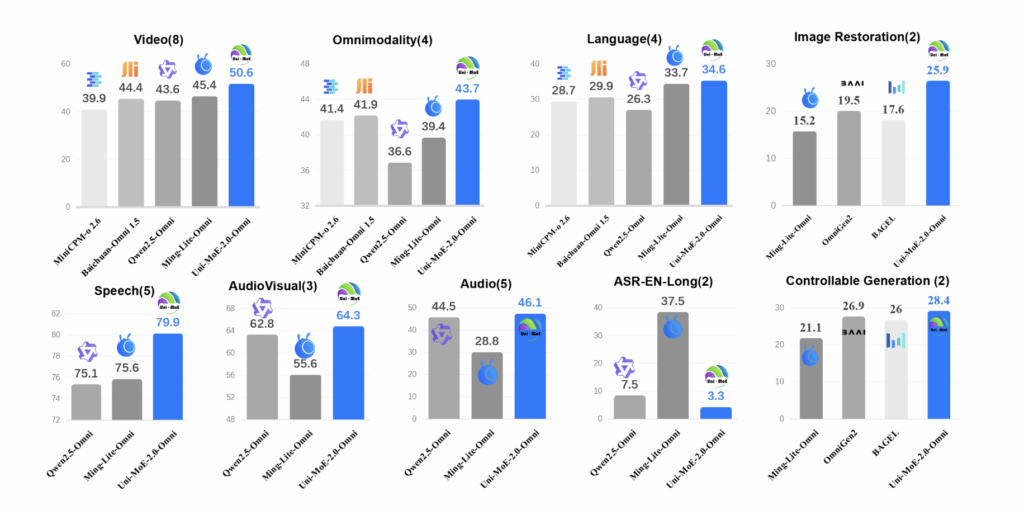
How do you build one open model that can reliably understand text, images, audio and video while still running efficiently? A team of researchers from Harbin Institute of Technology, Shenzhen introduced Uni-MoE-2.0-Omni, a fully open omnimodal large model that pushes Lychee’s Uni-MoE line toward language centric multimodal reasoning. The system is trained from scratch on a Qwen2.5-7B dense backbone and extended into a Mixture of Experts architecture with dynamic capacity routing, a progressive supervised and reinforcement learning recipe, and about 75B tokens of carefully matched multimodal data. It handles text, images, audio and video for understanding and can generate images, text and speech. https://idealistxy.github.io/Uni-MoE-v2.github.io/ Architecture, unified modality encoding around a language core The core of Uni-MoE-2.0-Omni is a Qwen2.5-7B style transformer that serves as a language centric hub. Around this hub, the research team attach a unified speech encoder that maps diverse audio, including environmental sound, speech and music, into a common representation space. On the vision side, pre-trained visual encoders process images and video frames, then feed token sequences into the same transformer. For generation, a context aware MoE based TTS module and a task aware diffusion transformer handle speech and image synthesis. https://idealistxy.github.io/Uni-MoE-v2.github.io/ All modalities are converted into token sequences that share a unified interface to the language model. This design means the same self attention layers see text, vision and audio tokens, which simplifies cross modal fusion and makes the language model the central controller for both understanding and generation. The architecture is designed to support 10 cross modal input configurations, such as image plus text, video plus speech and tri modal combinations. Omni Modality 3D RoPE and MoE driven fusion Cross modal alignment is handled by an Omni Modality 3D RoPE mechanism that encodes temporal and spatial structure directly into the rotary positional embeddings. Instead of only using one dimensional positions for text, the system assigns three coordinates to tokens, time, height and width for visual and audio streams, and time for speech. This gives the transformer an explicit view of when and where each token occurs, which is important for video understanding and audio visual reasoning tasks. The Mixture of Experts layers replace standard MLP blocks with an MoE stack that has three expert types. Empty experts act as null functions that allow computation skipping at inference time. Routed experts are modality specific and store domain knowledge for audio, vision or text. Shared experts are small and always active, providing a communication path for general information across modalities. A routing network chooses which experts to activate based on the input token, giving specialization without paying the full cost of a dense model with all experts active. Training recipe, from cross modal pretraining to GSPO DPO The training pipeline is organised into a data matched recipe. First, a language centric cross modal pretraining phase uses paired image text, audio text and video text corpora. This step teaches the model to project each modality into a shared semantic space aligned with language. The base model is trained on around 75B open source multimodal tokens and is equipped with special speech and image generation tokens so that generative behaviour can be learned by conditioning on linguistic cues. Next, a progressive supervised fine tuning stage activates modality specific experts grouped into audio, vision and text categories. During this stage, the research team introduce special control tokens so that the model can perform tasks like text conditioned speech synthesis and image generation inside the same language interface. After large scale SFT (Supervised Fine-Tuning), a data balanced annealing phase re-weights the mixture of datasets across modalities and tasks and trains with a lower learning rate. This avoids over fitting to a single modality and improves stability of the final omnimodal behaviour. To unlock long form reasoning, Uni-MoE-2.0-Omni adds an iterative policy optimisation stage built on GSPO and DPO. GSPO uses the model itself or another LLM as a judge to evaluate responses and construct preference signals, while DPO converts these preferences into a direct policy update objective that is more stable than standard reinforcement learning from human feedback. The research team apply this GSPO DPO loop in multiple rounds to form the Uni-MoE-2.0-Thinking variant, which inherits the omnimodal base and adds stronger step by step reasoning. Generation, MoE TTS and task aware diffusion For speech generation, Uni-MoE-2.0-Omni uses a context aware MoE TTS module that sits on top of the language model. The LLM emits control tokens that describe timbre, style and language, along with the text content. The MoE TTS consumes this sequence and produces discrete audio tokens, which are then decoded into waveforms by an external codec model, aligning with the unified speech encoder on the input side. This design makes speech generation a first class controlled generation task instead of a separate pipeline. On the vision side, a task aware diffusion transformer is conditioned on both task tokens and image tokens. Task tokens encode whether the system should perform text to image generation, editing or low level enhancement. Image tokens can capture semantics from the omnimodal backbone, for example from a text plus image dialogue. Lightweight projectors map these tokens into the diffusion transformer conditioning space, enabling instruction guided image generation and editing, while keeping the main omnimodal model frozen during the final visual fine tuning stage. Benchmarks and open checkpoints Uni-MoE-2.0-Omni is evaluated on 85 multimodal benchmarks that cover image, text, video, audio and cross or tri modal reasoning. The model surpasses Qwen2.5-Omni, which is trained on about 1.2T tokens, on more than 50 of 76 shared benchmarks. Gains include about +7% average on video understanding across 8 tasks, +7% average on omnimodality understanding across 4 benchmarks including OmniVideoBench and WorldSense, and about +4% on audio visual reasoning. For long form speech processing, Uni-MoE-2.0-Omni reduces word error rate by up to 4.2% relative on long LibriSpeech splits and brings about 1% WER improvement on TinyStories-en text to speech. Image generation and editing results are competitive with specialised visual models. The research team reports a small but

Uni-MoE-2.0-Omni: An Open Qwen2.5-7B Based Omnimodal MoE for Text, Image, Audio and Video Understanding Read Post »

AI, Committee, News, Uncategorized

A methodological analysis of prompt perturbations and their effect on attack success rates

arXiv:2511.10686v1 Announce Type: new Abstract: This work aims to investigate how different Large Language Models (LLMs) alignment methods affect the models’ responses to prompt attacks. We selected open source models based on the most common alignment methods, namely, Supervised Fine-Tuning (SFT), Direct Preference Optimization (DPO), and Reinforcement Learning with Human Feedback (RLHF). We conducted a systematic analysis using statistical methods to verify how sensitive the Attack Success Rate (ASR) is when we apply variations to prompts designed to elicit inappropriate content from LLMs. Our results show that even small prompt modifications can significantly change the Attack Success Rate (ASR) according to the statistical tests we run, making the models more or less susceptible to types of attack. Critically, our results demonstrate that running existing ‘attack benchmarks’ alone may not be sufficient to elicit all possible vulnerabilities of both models and alignment methods. This paper thus contributes to ongoing efforts on model attack evaluation by means of systematic and statistically-based analyses of the different alignment methods and how sensitive their ASR is to prompt variation.

A methodological analysis of prompt perturbations and their effect on attack success rates Read Post »

We use cookies to improve your experience and performance on our website. You can learn more at Privacy Policy and manage your privacy settings by clicking Settings.

Privacy Preferences

You can choose your cookie settings by turning on/off each type of cookie as you wish, except for essential cookies.

Allow All
Manage Consent Preferences
  • Always Active

Save
en_US