YouZum

Committee

AI, Committee, News, Uncategorized

BanglaIPA: Towards Robust Text-to-IPA Transcription with Contextual Rewriting in Bengali

arXiv:2601.01778v1 Announce Type: new Abstract: Despite its widespread use, Bengali lacks a robust automated International Phonetic Alphabet (IPA) transcription system that effectively supports both standard language and regional dialectal texts. Existing approaches struggle to handle regional variations, numerical expressions, and generalize poorly to previously unseen words. To address these limitations, we propose BanglaIPA, a novel IPA generation system that integrates a character-based vocabulary with word-level alignment. The proposed system accurately handles Bengali numerals and demonstrates strong performance across regional dialects. BanglaIPA improves inference efficiency by leveraging a precomputed word-to-IPA mapping dictionary for previously observed words. The system is evaluated on the standard Bengali and six regional variations of the DUAL-IPA dataset. Experimental results show that BanglaIPA outperforms baseline IPA transcription models by 58.4-78.7% and achieves an overall mean word error rate of 11.4%, highlighting its robustness in phonetic transcription generation for the Bengali language.

BanglaIPA: Towards Robust Text-to-IPA Transcription with Contextual Rewriting in Bengali Read Post »

AI, Committee, News, Uncategorized

Simulated Reasoning is Reasoning

arXiv:2601.02043v1 Announce Type: cross Abstract: Reasoning has long been understood as a pathway between stages of understanding. Proper reasoning leads to understanding of a given subject. This reasoning was conceptualized as a process of understanding in a particular way, i.e., “symbolic reasoning”. Foundational Models (FM) demonstrate that this is not a necessary condition for many reasoning tasks: they can “reason” by way of imitating the process of “thinking out loud”, testing the produced pathways, and iterating on these pathways on their own. This leads to some form of reasoning that can solve problems on its own or with few-shot learning, but appears fundamentally different from human reasoning due to its lack of grounding and common sense, leading to brittleness of the reasoning process. These insights promise to substantially alter our assessment of reasoning and its necessary conditions, but also inform the approaches to safety and robust defences against this brittleness of FMs. This paper offers and discusses several philosophical interpretations of this phenomenon, argues that the previously apt metaphor of the “stochastic parrot” has lost its relevance and thus should be abandoned, and reflects on different normative elements in the safety- and appropriateness-considerations emerging from these reasoning models and their growing capacity.

Simulated Reasoning is Reasoning Read Post »

AI, Committee, News, Uncategorized

CSCBench: A PVC Diagnostic Benchmark for Commodity Supply Chain Reasoning

arXiv:2601.01825v1 Announce Type: new Abstract: Large Language Models (LLMs) have achieved remarkable success in general benchmarks, yet their competence in commodity supply chains (CSCs) — a domain governed by institutional rule systems and feasibility constraints — remains under-explored. CSC decisions are shaped jointly by process stages (e.g., planning, procurement, delivery), variety-specific rules (e.g., contract specifications and delivery grades), and reasoning depth (from retrieval to multi-step analysis and decision selection). We introduce CSCBench, a 2.3K+ single-choice benchmark for CSC reasoning, instantiated through our PVC 3D Evaluation Framework (Process, Variety, and Cognition). The Process axis aligns tasks with SCOR+Enable; the Variety axis operationalizes commodity-specific rule systems under coupled material-information-financial constraints, grounded in authoritative exchange guidebooks/rulebooks and industry reports; and the Cognition axis follows Bloom’s revised taxonomy. Evaluating representative LLMs under a direct prompting setting, we observe strong performance on the Process and Cognition axes but substantial degradation on the Variety axis, especially on Freight Agreements. CSCBench provides a diagnostic yardstick for measuring and improving LLM capabilities in this high-stakes domain.

CSCBench: A PVC Diagnostic Benchmark for Commodity Supply Chain Reasoning Read Post »

AI, Committee, News, Uncategorized

Not All Needles Are Found: How Fact Distribution and Don’t Make It Up Prompts Shape Literal Extraction, Logical Inference, and Hallucination Risks in Long-Context LLMs

arXiv:2601.02023v1 Announce Type: new Abstract: Large language models (LLMs) increasingly support very long input contexts. Yet it remains unclear how reliably they extract and infer information at scale. Performance varies with context length and strongly interacts with how information is distributed in real-world corpora. Motivated by these observations, we study how fact placement, corpus-level fact distributions, and Don’t Make It Up prompts influence model behavior. We introduce an extended needle-in-a-haystack benchmark across four production-scale models: Gemini-2.5-flash, ChatGPT-5-mini, Claude-4.5-haiku, and Deepseek-v3.2-chat. Unlike prior work, we separately evaluate literal extraction, logical inference, and hallucination risk. Our study considers both positional effects and realistic distributions of evidence across long contexts, as well as prompts that explicitly discourage fabrication. We find that longer contexts alone do not guarantee better performance and can be detrimental when relevant evidence is diluted or widely dispersed. Performance varies substantially across models: some show severe degradation under realistic conditions, while others remain more robust at longer context lengths. Anti-hallucination (AH) instructions can make some models overly conservative, sharply reducing accuracy in literal extraction and logical inference. While we do not directly compare retrieval-augmented generation (RAG) and cache-augmented generation (CAG), our results suggest many failures stem from ineffective context utilization. Models often struggle to identify and prioritize relevant information even when it is present. These findings have direct practical implications, as enterprise workflows increasingly involve pasting large volumes of unfiltered documents into LLM prompts. Effective context length and model-specific robustness to long contexts are therefore critical for reliable LLM deployment in research and business.

Not All Needles Are Found: How Fact Distribution and Don’t Make It Up Prompts Shape Literal Extraction, Logical Inference, and Hallucination Risks in Long-Context LLMs Read Post »

AI, Committee, News, Uncategorized

Why AI predictions are so hard

This story originally appeared in The Algorithm, our weekly newsletter on AI. To get stories like this in your inbox first, sign up here. Sometimes AI feels like a niche topic to write about, but then the holidays happen, and I hear relatives of all ages talking about cases of chatbot-induced psychosis, blaming rising electricity prices on data centers, and asking whether kids should have unfettered access to AI. It’s everywhere, in other words. And people are alarmed. Inevitably, these conversations take a turn: AI is having all these ripple effects now, but if the technology gets better, what happens next? That’s usually when they look at me, expecting a forecast of either doom or hope.  I probably disappoint, if only because predictions for AI are getting harder and harder to make.  Despite that, MIT Technology Review has, I must say, a pretty excellent track record of making sense of where AI is headed. We’ve just published a sharp list of predictions for what’s next in 2026 (where you can read my thoughts on the legal battles surrounding AI), and the predictions on last year’s list all came to fruition. But every holiday season, it gets harder and harder to work out the impact AI will have. That’s mostly because of three big unanswered questions. For one, we don’t know if large language models will continue getting incrementally smarter in the near future. Since this particular technology is what underpins nearly all the excitement and anxiety in AI right now, powering everything from AI companions to customer service agents, its slowdown would be a pretty huge deal. Such a big deal, in fact, that we devoted a whole slate of stories in December to what a new post-AI-hype era might look like.  Number two, AI is pretty abysmally unpopular among the general public. Here’s just one example: Nearly a year ago, OpenAI’s Sam Altman stood next to President Trump to excitedly announce a $500 billion project to build data centers across the US in order to train larger and larger AI models. The pair either did not guess or did not care that many Americans would staunchly oppose having such data centers built in their communities. A year later, Big Tech is waging an uphill battle to win over public opinion and keep on building. Can it win?  The response from lawmakers to all this frustration is terribly confused. Trump has pleased Big Tech CEOs by moving to make AI regulation a federal rather than a state issue, and tech companies are now hoping to codify this into law. But the crowd that wants to protect kids from chatbots ranges from progressive lawmakers in California to the increasingly Trump-aligned Federal Trade Commission, each with distinct motives and approaches. Will they be able to put aside their differences and rein AI firms in?  If the gloomy holiday dinner table conversation gets this far, someone will say: Hey, isn’t AI being used for objectively good things? Making people healthier, unearthing scientific discoveries, better understanding climate change? Well, sort of. Machine learning, an older form of AI, has long been used in all sorts of scientific research. One branch, called deep learning, forms part of AlphaFold, a Nobel Prize–winning tool for protein prediction that has transformed biology. Image recognition models are getting better at identifying cancerous cells.  But the track record for chatbots built atop newer large language models is more modest. Technologies like ChatGPT are quite good at analyzing large swathes of research to summarize what’s already been discovered. But some high-profile reports that these sorts of AI models had made a genuine discovery, like solving a previously unsolved mathematics problem, were bogus. They can assist doctors with diagnoses, but they can also encourage people to diagnose their own health problems without consulting doctors, sometimes with disastrous results.  This time next year, we’ll probably have better answers to my family’s questions, and we’ll have a bunch of entirely new questions too. In the meantime, be sure to read our full piece forecasting what will happen this year, featuring predictions from the whole AI team.

Why AI predictions are so hard Read Post »

AI, Committee, News, Uncategorized

C-VARC: A Large-Scale Chinese Value Rule Corpus for Value Alignment of Large Language Models

arXiv:2506.01495v5 Announce Type: replace Abstract: Ensuring that Large Language Models (LLMs) align with mainstream human values and ethical norms is crucial for the safe and sustainable development of AI. Current value evaluation and alignment are constrained by Western cultural bias and incomplete domestic frameworks reliant on non-native rules; furthermore, the lack of scalable, rule-driven scenario generation methods makes evaluations costly and inadequate across diverse cultural contexts. To address these challenges, we propose a hierarchical value framework grounded in core Chinese values, encompassing three main dimensions, 12 core values, and 50 derived values. Based on this framework, we construct a large-scale Chinese Value Rule Corpus (C-VARC) containing over 250,000 value rules enhanced and expanded through human annotation. Experimental results demonstrate that scenarios guided by C-VARC exhibit clearer value boundaries and greater content diversity compared to those produced through direct generation. In the evaluation across six sensitive themes (e.g., surrogacy, suicide), seven mainstream LLMs preferred C-VARC generated options in over 70.5% of cases, while five Chinese human annotators showed an 87.5% alignment with C-VARC, confirming its universality, cultural relevance, and strong alignment with Chinese values. Additionally, we construct 400,000 rule-based moral dilemma scenarios that objectively capture nuanced distinctions in conflicting value prioritization across 17 LLMs. Our work establishes a culturally-adaptive benchmarking framework for comprehensive value evaluation and alignment, representing Chinese characteristics.

C-VARC: A Large-Scale Chinese Value Rule Corpus for Value Alignment of Large Language Models Read Post »

AI, Committee, News, Uncategorized

A Chain-of-Thought Approach to Semantic Query Categorization in e-Commerce Taxonomies

arXiv:2601.00510v1 Announce Type: cross Abstract: Search in e-Commerce is powered at the core by a structured representation of the inventory, often formulated as a category taxonomy. An important capability in e-Commerce with hierarchical taxonomies is to select a set of relevant leaf categories that are semantically aligned with a given user query. In this scope, we address a fundamental problem of search query categorization in real-world e-Commerce taxonomies. A correct categorization of a query not only provides a way to zoom into the correct inventory space, but opens the door to multiple intent understanding capabilities for a query. A practical and accurate solution to this problem has many applications in e-commerce, including constraining retrieved items and improving the relevance of the search results. For this task, we explore a novel Chain-of-Thought (CoT) paradigm that combines simple tree-search with LLM semantic scoring. Assessing its classification performance on human-judged query-category pairs, relevance tests, and LLM-based reference methods, we find that the CoT approach performs better than a benchmark that uses embedding-based query category predictions. We show how the CoT approach can detect problems within a hierarchical taxonomy. Finally, we also propose LLM-based approaches for query-categorization of the same spirit, but which scale better at the range of millions of queries.

A Chain-of-Thought Approach to Semantic Query Categorization in e-Commerce Taxonomies Read Post »

AI, Committee, News, Uncategorized

EXAONE 4.0: Unified Large Language Models Integrating Non-reasoning and Reasoning Modes

arXiv:2507.11407v2 Announce Type: replace Abstract: This technical report introduces EXAONE 4.0, which integrates a Non-reasoning mode and a Reasoning mode to achieve both the excellent usability of EXAONE 3.5 and the advanced reasoning abilities of EXAONE Deep. To pave the way for the agentic AI era, EXAONE 4.0 incorporates essential features such as agentic tool use, and its multilingual capabilities are extended to support Spanish in addition to English and Korean. The EXAONE 4.0 model series consists of two sizes: a mid-size 32B model optimized for high performance, and a small-size 1.2B model designed for on-device applications. The EXAONE 4.0 demonstrates superior performance compared to open-weight models in its class and remains competitive even against frontier-class models. The models are publicly available for research purposes and can be easily downloaded via https://huggingface.co/LGAI-EXAONE.

EXAONE 4.0: Unified Large Language Models Integrating Non-reasoning and Reasoning Modes Read Post »

AI, Committee, News, Uncategorized

Tencent Researchers Release Tencent HY-MT1.5: A New Translation Models Featuring 1.8B and 7B Models Designed for Seamless on-Device and Cloud Deployment

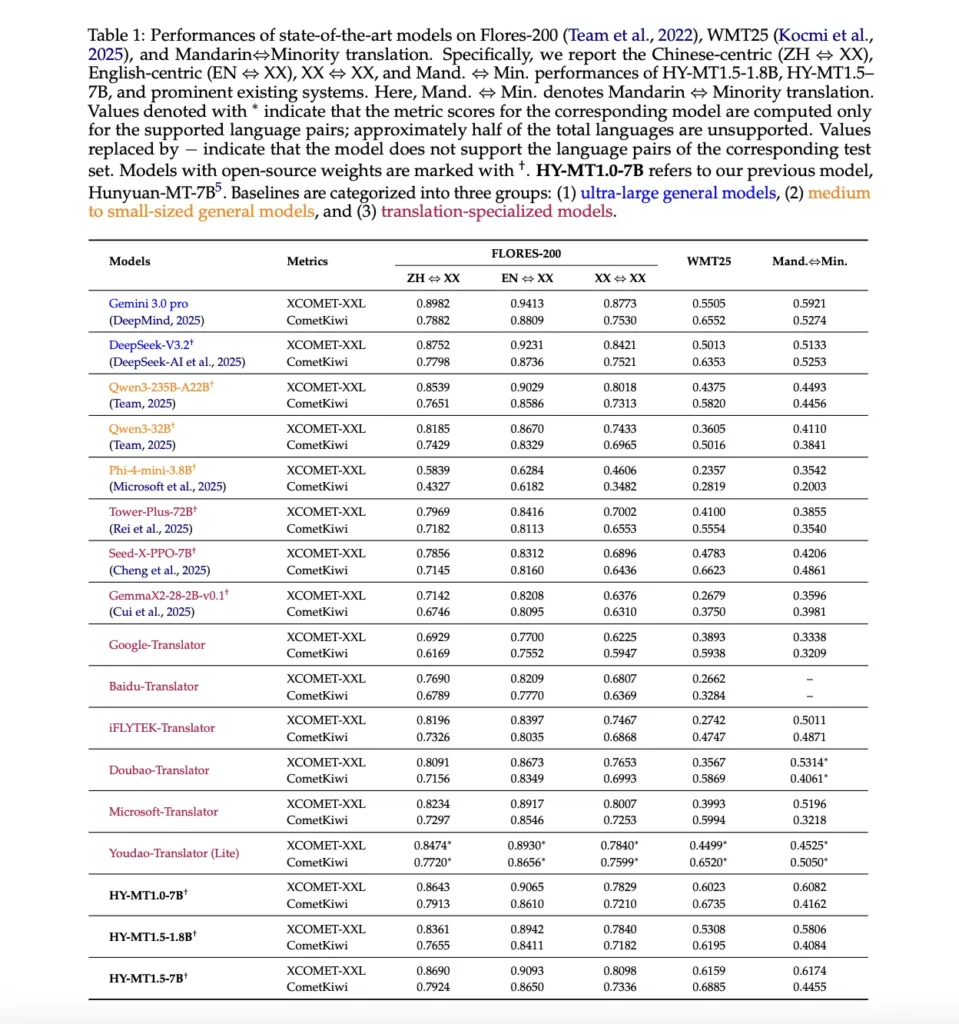
Tencent Hunyuan researchers have released HY-MT1.5, a multilingual machine translation family that targets both mobile devices and cloud systems with the same training recipe and metrics. HY-MT1.5 consists of 2 translation models, HY-MT1.5-1.8B and HY-MT1.5-7B, supports mutual translation across 33 languages with 5 ethnic and dialect variations, and is available on GitHub and Hugging Face under open weights. Model family and deployment targets HY-MT1.5-7B is an upgraded version of the WMT25 championship system Hunyuan-MT-7B. It is optimized for explanatory translation and mixed language scenarios, and adds native support for terminology intervention, contextual translation and formatted translation. HY-MT1.5-1.8B is the compact variant. It has less than one third the parameters of HY-MT1.5-7B but delivers comparable translation performance in the reported benchmarks. After quantization, the 1.8B model can run on edge devices and support real time translation. The quantized HY-MT1.5-1.8B operates on devices with about 1 GB of memory and reaches an average response time of about 0.18 seconds for Chinese inputs of around 50 tokens, while surpassing mainstream commercial translation APIs in quality. HY-MT1.5-7B targets server and high end edge deployment, where latency around 0.45 seconds is acceptable in exchange for higher quality. Holistic training framework The research team defines HY-MT1.5 as a translation specific language model trained with a multi stage pipeline. The pipeline has 5 main components: General pre training: The base model is first pre-trained on large scale multilingual text with a language modeling objective. This builds shared representations across languages. MT oriented pre training: The model is then exposed to parallel corpora and translation oriented objectives. This step aligns the generation distribution with real translation tasks rather than open ended text generation. Supervised fine tuning: High quality sentence and document level parallel data is used to fine tune the model with supervised loss. This stage sharpens literal correctness, domain coverage and direction specific behavior, such as ZH to EN versus EN to ZH. On policy distillation from 7B to 1.8B: HY-MT1.5-7B is used as a teacher for HY-MT1.5-1.8B. The research team collects about 1 million monolingual prompts across the 33 languages, runs them through the teacher and uses reverse Kullback Leibler divergence on the student rollouts to match the teacher distribution. This yields a 1.8B student that inherits most of the 7B model’s translation behavior with much lower cost. Reinforcement learning with rubrics based evaluation: In the final stage, both models are optimized with a group relative policy optimization style algorithm and a rubrics based reward model. Human reviewers score translations on multiple axes such as accuracy, fluency, idiomaticity and cultural appropriateness. The reward model distills those scores and guides the policy update. This pipeline is specific to machine translation. It differs from chat oriented LLM training by combining translation centric supervised data, on policy distillation within the translation domain and RL tuned with fine grained translation rubrics. Benchmark results against open and commercial systems HY-MT1.5 is evaluated on Flores 200, WMT25 and a Mandarin to minority language benchmark using XCOMET-XXL and CometKiwi. https://arxiv.org/pdf/2512.24092v1 Key results from the above Table in the report: On Flores 200, HY-MT1.5-7B reaches XCOMET-XXL scores of 0.8690 for ZH to XX, 0.9093 for EN to XX and 0.8098 for XX to XX. It outperforms translation specialized models such as iFLYTEK Translator and Doubao Translator and matches or exceeds medium sized general models like Qwen3-235B-A22B. On WMT25, HY-MT1.5-7B reaches XCOMET-XXL 0.6159. This is about 0.065 higher than Gemini 3.0 Pro and significantly above translation oriented models such as Seed-X-PPO-7B and Tower-Plus-72B. HY-MT1.5-1.8B scores 0.5308, which still exceeds many medium sized general models and translation systems. On Mandarin to minority language pairs, HY-MT1.5-7B achieves 0.6174 in XCOMET-XXL, higher than all baselines including Gemini 3.0 Pro. The 1.8B variant reaches 0.5806 and still surpasses several very large models like DeepSeek-V3.2. In human evaluation on a 0 to 4 scale for Chinese to English and English to Chinese, HY-MT1.5-1.8B achieves an average score of 2.74, which is higher than Baidu, iFLYTEK, Doubao, Microsoft and Google translator systems under the same protocol. Practical features for product use The models expose three prompt driven capabilities that matter in production systems: Terminology intervention: A prompt template lets you inject term mappings such as “混元珠 → Chaos Pearl”. Without the mapping, the model outputs an ambiguous transliteration. With the mapping, it enforces a consistent domain specific term. This is critical for legal, medical or brand constrained content. Context aware translation: A second template accepts a context block plus the sentence to translate. The report shows the word “pilot” misinterpreted as a person when context is absent. When a paragraph about TV series is added, the model correctly translates “pilot” as an episode. Format preserving translation: A third template wraps the source in <source> tags and marks spans with <sn> tags. The instruction forces the model to keep tags and output inside <target> tags. This allows HTML or XML like text to survive translation with structure preserved. These are implemented as prompt formats, so they are available even when you call the public weights through standard LLM stacks. Quantization and edge deployment HY-MT1.5-1.8B is evaluated with FP8 and Int4 post training quantization using GPTQ. https://arxiv.org/pdf/2512.24092v1 The above Table 4 shows: FP8 keeps XCOMET-XXL scores very close to the full precision model, for example 0.8379 versus 0.8361 for ZH to XX. Int4 reduces size further but introduces clear quality drops on Flores 200. On Hugging Face, Tencent publishes both FP8 and GPTQ Int4 variants for HY-MT1.5-1.8B and HY-MT1.5-7B, along with GGUF versions for local inference stacks. Quantization is the mechanism that enables the reported 1 GB memory deployment and low latency on consumer hardware. Key Takeaways HY-MT1.5 is a 2 model translation family, HY-MT1.5-1.8B and HY-MT1.5-7B, supporting mutual translation across 33 languages plus 5 dialect or variant forms, released with open weights on GitHub and Hugging Face. HY-MT1.5-1.8B is a distillation based edge model that runs on about 1 GB memory with around 0.18 seconds latency for 50 token Chinese inputs, while achieving industry leading performance among models of similar size

Tencent Researchers Release Tencent HY-MT1.5: A New Translation Models Featuring 1.8B and 7B Models Designed for Seamless on-Device and Cloud Deployment Read Post »

AI, Committee, News, Uncategorized

LLM-Pruning Collection: A JAX Based Repo For Structured And Unstructured LLM Compression

Zlab Princeton researchers have released LLM-Pruning Collection, a JAX based repository that consolidates major pruning algorithms for large language models into a single, reproducible framework. It targets one concrete goal, make it easy to compare block level, layer level and weight level pruning methods under a consistent training and evaluation stack on both GPUs and TPUs. What LLM-Pruning Collection Contains? It is described as a JAX based repo for LLM pruning. It is organized into three main directories: pruning holds implementations for several pruning methods: Minitron, ShortGPT, Wanda, SparseGPT, Magnitude, Sheared Llama and LLM-Pruner. training provides integration with FMS-FSDP for GPU training and MaxText for TPU training. eval exposes JAX compatible evaluation scripts built around lm-eval-harness, with accelerate based support for MaxText that gives about 2 to 4 times speedup. Pruning Methods Covered LLM-Pruning Collection spans several families of pruning algorithms with different granularity levels: Minitron Minitron is a practical pruning and distillation recipe developed by NVIDIA that compresses Llama 3.1 8B and Mistral NeMo 12B to 4B and 8B while preserving performance. It explores depth pruning and joint width pruning of hidden sizes, attention and MLP, followed by distillation. In LLM-Pruning Collection, the pruning/minitron folder provides scripts such as prune_llama3.1-8b.sh which run Minitron style pruning on Llama 3.1 8B. ShortGPT ShortGPT is based on the observation that many Transformer layers are redundant. The method defines Block Influence, a metric that measures the contribution of each layer and then removes low influence layers by direct layer deletion. Experiments show that ShortGPT outperforms previous pruning methods for multiple choice and generative tasks. In the collection, ShortGPT is implemented through the Minitron folder with a dedicated script prune_llama2-7b.sh. Wanda, SparseGPT, Magnitude Wanda is a post training pruning method that scores weights by the product of weight magnitude and corresponding input activation on a per output basis. It prunes the smallest scores, requires no retraining and induces sparsity that works well even at billion parameter scale. SparseGPT is another post training method that uses a second order inspired reconstruction step to prune large GPT style models at high sparsity ratios. Magnitude pruning is the classical baseline that removes weights with small absolute value. In LLM-Pruning Collection, all three live under pruning/wanda with a shared installation path. The README includes a dense table of Llama 2 7B results that compares Wanda, SparseGPT and Magnitude across BoolQ, RTE, HellaSwag, Winogrande, ARC E, ARC C and OBQA, under unstructured and structured sparsity patterns such as 4:8 and 2:4. Sheared Llama Sheared LLaMA is a structured pruning method that learns masks for layers, attention heads and hidden dimensions and then retrains the pruned architecture. The original release provides models at multiple scales including 2.7B and 1.3B. The pruning/llmshearing directory in LLM-Pruning Collection integrates this recipe. It uses a RedPajama subset for calibration, accessed through Hugging Face, and helper scripts to convert between Hugging Face and MosaicML Composer formats. LLM-Pruner LLM-Pruner is a framework for structural pruning of large language models. It removes non critical coupled structures, such as attention heads or MLP channels, using gradient based importance scores and then recovers performance with a short LoRA tuning stage that uses about 50K samples. The collection includes LLM-Pruner under pruning/LLM-Pruner with scripts for LLaMA, LLaMA 2 and Llama 3.1 8B. Key Takeaways LLM-Pruning Collection is a JAX based, Apache-2.0 repo from zlab-princeton that unifies modern LLM pruning methods with shared pruning, training and evaluation pipelines for GPUs and TPUs. The codebase implements block, layer and weight level pruning approaches, including Minitron, ShortGPT, Wanda, SparseGPT, Sheared LLaMA, Magnitude pruning and LLM-Pruner, with method specific scripts for Llama family models. Training integrates FMS-FSDP on GPU and MaxText on TPU with JAX compatible evaluation scripts built on lm-eval-harness, giving roughly 2 to 4 times faster eval for MaxText checkpoints via accelerate. The repository reproduces key results from prior pruning work, publishing side by side “paper vs reproduced” tables for methods like Wanda, SparseGPT, Sheared LLaMA and LLM-Pruner so engineers can verify their runs against known baselines. Check out the GitHub Repo. Also, feel free to follow us on Twitter and don’t forget to join our 100k+ ML SubReddit and Subscribe to our Newsletter. Wait! are you on telegram? now you can join us on telegram as well. The post LLM-Pruning Collection: A JAX Based Repo For Structured And Unstructured LLM Compression appeared first on MarkTechPost.

LLM-Pruning Collection: A JAX Based Repo For Structured And Unstructured LLM Compression Read Post »

We use cookies to improve your experience and performance on our website. You can learn more at Privacy Policy and manage your privacy settings by clicking Settings.

Privacy Preferences

You can choose your cookie settings by turning on/off each type of cookie as you wish, except for essential cookies.

Allow All
Manage Consent Preferences
  • Always Active

Save
en_US