
YouZum

Uncategorized

AI, Committee, ข่าว, Uncategorized

The Download: helping cancer survivors to give birth, and cleaning up Bangladesh’s garment industry

This is today’s edition of The Download, our weekday newsletter that provides a daily dose of what’s going on in the world of technology. An experimental surgery is helping cancer survivors give birth An experimental surgical procedure that’s helping people have babies after they’ve had  treatment for bowel or rectal cancer. Radiation and chemo can have pretty damaging side effects that mess up the uterus and ovaries. Surgeons are pioneering a potential solution: simply stitch those organs out of the way during cancer treatment. Once the treatment has finished, they can put the uterus—along with the ovaries and fallopian tubes—back into place. It seems to work! Last week, a team in Switzerland shared news that a baby boy had been born after his mother had the procedure. Baby Lucien was the fifth baby to be born after the surgery and the first in Europe, and since then at least three others have been born. Read the full story. —Jessica Hamzelou This article first appeared in The Checkup, MIT Technology Review’s weekly biotech newsletter. To receive it in your inbox every Thursday, and read articles like this first, sign up here.  Bangladesh’s garment-making industry is getting greener Pollution from textile production—dyes, chemicals, and heavy metals—is common in the waters of the Buriganga River as it runs through Dhaka, Bangladesh. It’s among many harms posed by a garment sector that was once synonymous with tragedy: In 2013, the eight-story Rana Plaza factory building collapsed, killing 1,134 people and injuring some 2,500 others.  But things are starting to change. In recent years the country has become a leader in “frugal” factories that use a combination of resource-efficient technologies to cut waste, conserve water, and build resilience against climate impacts and global supply disruptions.  The hundreds of factories along the Buriganga’s banks and elsewhere in Bangladesh are starting to stitch together a new story, woven from greener threads. Read the full story. —Zakir Hossain Chowdhury This story is from the most recent print issue of MIT Technology Review magazine, which shines a light on the exciting innovations happening right now. If you haven’t already, subscribe now to receive future issues once they land. The must-reads I’ve combed the internet to find you today’s most fun/important/scary/fascinating stories about technology. 1 ICE used a private jet to deport Palestinian men to Tel Aviv The luxury aircraft belongs to Donald Trump’s business partner Gil Dezer. (The Guardian)+ Trump is mentioned thousands of times in the latest Epstein files. (NY Mag $) 2 How Jeffrey Epstein kept investing in Silicon ValleyHe continued to plough millions of dollars into tech ventures despite spending 13 months in jail. (NYT $)+ The range of Epstein’s social network was staggering. (FT $)+ Why was a picture of the Mona Lisa redacted in the Epstein files? (404 Media) 3 The risks posed by taking statins are lower than we realisedThe drugs don’t cause most of the side effects they’re blamed for. (STAT)+ Statins are a common scapegoat on social media. (Bloomberg $) 4 Russia is weaponizing the bitter winter weatherIt’s focused on attacking Ukraine’s power grid. (New Yorker $)+ How the grid can ride out winter storms. (MIT Technology Review) 5 China has a major spy-cam porn problemHotel guests are being livestreamed having sex to an online audience without their knowledge. (BBC) 6 Geopolitical gamblers are betting on the likelihood of warAnd prediction markets are happily taking their money. (Rest of World) 7 Oyster farmers aren’t signing up to programs to ease water pollutionThe once-promising projects appear to be fizzling out. (Undark)+ The humble sea creature could hold the key to restoring coastal waters. Developers hate it. (MIT Technology Review) 8 Your next payrise could be approved by AIMaybe your human bosses aren’t the ones you need to impress any more. (WP $) 9 The FDA has approved a brain stimulation device for treating depressionIt’s paving the way for a non-invasive, drug-free treatment for Americans. (IEEE Spectrum)+ Here’s how personalized brain stimulation could treat depression. (MIT Technology Review) 10 Cinema-goers have had enough of AIMovies focused on rogue AI are flopping at the box office. (Wired $)+ Meanwhile, Republicans are taking aim at “woke” Netflix. (The Verge) Quote of the day “I’m all for removing illegals, but snatching dudes off lawn mowers in Cali and leaving the truck and equipment just sitting there? Definitely not working smarter.”  —A web user in a forum for current and former ICE and border protection officers complains about the agency’s current direction, Wired reports. One more thing Is this the electric grid of the future? Lincoln Electric System, a publicly owned utility in Nebraska, is used to weathering severe blizzards. But what will happen soon—not only at Lincoln Electric but for all electric utilities—is a challenge of a different order. Utilities must keep the lights on in the face of more extreme and more frequent storms and fires, growing risks of cyberattacks and physical disruptions, and a wildly uncertain policy and regulatory landscape. They must keep prices low amid inflationary costs. And they must adapt to an epochal change in how the grid works, as the industry attempts to transition from power generated with fossil fuels to power generated from renewable sources like solar and wind. The electric grid is bracing for a near future characterized by disruption. And, in many ways, Lincoln Electric is an ideal lens through which to examine what’s coming. Read the full story. —Andrew Blum We can still have nice things A place for comfort, fun and distraction to brighten up your day. (Got any ideas? Drop me a line or skeet ’em at me.) + Glamour puss alert—NYC’s bodega cats are gracing the hallowed pages of Vogue.+ Ancient Europe was host to mysterious hidden tunnels. But why?+ If you’re enjoying the new season of Industry, you’ll love this interview with the one and only Ken Leung.+ The giant elephant shrew is the true star of Philly Zoo.
The Download: helping cancer survivors to give birth, and cleaning up Bangladesh’s garment industry Read Post »

AI, Committee, ข่าว, Uncategorized

NVIDIA AI releases C-RADIOv4 vision backbone unifying SigLIP2, DINOv3, SAM3 for classification, dense prediction, segmentation workloads at scale

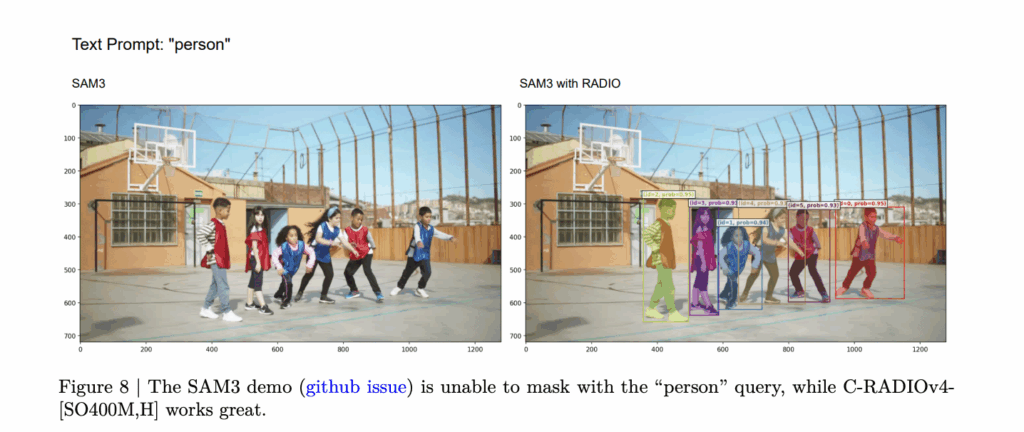
How do you combine SigLIP2, DINOv3, and SAM3 into a single vision backbone without sacrificing dense or segmentation performance? NVIDIA’s C-RADIOv4 is a new agglomerative vision backbone that distills three strong teacher models, SigLIP2-g-384, DINOv3-7B, and SAM3, into a single student encoder. It extends the AM-RADIO and RADIOv2.5 line, keeping similar computational cost while improving dense prediction quality, resolution robustness, and drop-in compatibility with SAM3. The key idea is simple. Instead of choosing between a vision language model, a self supervised dense model, and a segmentation model, C-RADIOv4 tries to approximate all three at once with one backbone. https://www.arxiv.org/pdf/2601.17237 Agglomerative distillation in RADIO The RADIO family uses agglomerative distillation. A single ViT style student is trained to match both dense feature maps and summary tokens from several heterogeneous teachers. Earlier RADIO models combined DFN CLIP, DINOv2, and SAM. They already supported multi resolution training but showed ‘mode switching’, where the representation changed qualitatively as input resolution changed. Later work such as PHI-S, RADIOv2.5, and FeatSharp added better multi resolution distillation and regularization, but the teacher set was still limited. C-RADIOv4 upgrades the teachers: SigLIP2-g-384 for stronger image text alignment DINOv3-7B for high quality self supervised dense features SAM3 for segmentation oriented features and compatibility with the SAM3 decoder The student is trained so that its dense features match DINOv3 and SAM3, while its summary tokens match SigLIP2 and DINOv3. This gives one encoder that can support classification, retrieval, dense prediction, and segmentation. Stochastic multi resolution training C-RADIOv4 uses stochastic multi resolution training rather than a small fixed set of resolutions. Training samples input sizes from two partitions: Low resolution: {128, 192, 224, 256, 384, 432} High resolution: {512, 768, 1024, 1152} SigLIP2 operates natively at 384 pixels. Its features are upsampled by a factor of 3 using FeatSharp to align with 1152 pixel SAM3 features. SAM3 is trained with mosaic augmentation at 1152 × 1152. This design smooths the performance curve over resolution and improves low resolution behavior. For example, on ADE20k linear probing, C-RADIOv4-H reaches around: 55.20 mIoU at 512 px 57.02 mIoU at 1024 px 57.72 mIoU at 1536 px The scaling trend is close to DINOv3-7B while using roughly an order of magnitude fewer parameters. Removing teacher noise with shift equivariant losses and MESA Distilling from large vision models tends to copy their artifacts, not just their useful structure. SigLIP2 has border noise patterns, and ViTDet style models can show window boundary artifacts. Direct feature regression can force the student to reproduce those patterns. C-RADIOv4 introduces two shift equivariant mechanisms to suppress such noise: Shift equivariant dense loss: Each teacher and the student see independently shifted crops of an image. Before computing the squared error, features are aligned via a shift mapping and the loss only uses overlapping spatial positions. Because the student never sees the same absolute positions as the teacher, it cannot simply memorize position fixed noise and is forced to track input dependent structure instead. Shift equivariant MESA: C-RADIOv4 also uses MESA style regularization between the online network and an EMA copy. Here again, the student and its EMA see different crops, features are aligned by a shift, and the loss is applied after layer normalization. This encourages smooth loss landscapes and robustness, while being invariant to absolute position. In addition, training uses DAMP, which injects multiplicative noise into weights. This further improves robustness to corruptions and small distribution shifts. Balancing teachers with an angular dispersion aware summary loss The summary loss in previous RADIO models used cosine distance between student and teacher embeddings. Cosine distance removes magnitude but not directional dispersion on the sphere. Some teachers, such as SigLIP2, produce embeddings concentrated in a narrow cone, while DINOv3 variants produce more spread out embeddings. If raw cosine distance is used, teachers with wider angular dispersion contribute larger losses and dominate optimization. In practice, DINOv3 tended to overshadow SigLIP2 in the summary term. C-RADIOv4 replaces this with an angle normalized loss. The squared angle between student and teacher embeddings is divided by the teacher’s angular dispersion. Measured dispersions show SigLIP2-g-384 around 0.694, while DINOv3-H+ and DINOv3-7B are around 2.12 and 2.19. Normalizing by these values equalizes their influence and preserves both vision language and dense semantics. Performance: classification, dense prediction, and Probe3d On ImageNet-1k zero shot classification, C-RADIOv4-H reaches about 83.09 % top-1 accuracy. It matches or improves on RADIOv2.5-H and C-RADIOv3-H across resolutions, with the best performance near 1024 px. On k-NN classification, C-RADIOv4-H improves over RADIOv2.5 and C-RADIOv3, and matches or surpasses DINOv3 starting around 256 px. DINOv3 peaks near 192–256 px and then degrades, while C-RADIOv4 keeps stable or improving performance at higher resolutions. Dense and 3D aware metrics show the intended tradeoff. On ADE20k, PASCAL VOC, NAVI, and SPair, C-RADIOv4-H and the SO400M variant outperform earlier RADIO models and are competitive with DINOv3-7B on dense benchmarks. For C-RADIOv4-H, typical scores are: ADE20k: 55.20 mIoU VOC: 87.24 mIoU NAVI: 63.44 SPair: 60.57 https://www.arxiv.org/pdf/2601.17237 On Probe3d, which includes Depth Normals, Surface Normals, NAVI, and SPair, C-RADIOv4-H achieves the best NAVI and SPair scores in the RADIO family. Depth and Surface metrics are close to those of C-RADIOv3-H, with small differences in either direction, rather than a uniform improvement. Integration with SAM3 and ViTDet-mode deployment C-RADIOv4 is designed to be a drop in replacement for the Perception Encoder backbone in SAM3. The SAM3 decoder and memory components remain unchanged. A reference implementation is provided in a SAM3 fork. Qualitative examples show that segmentation behavior is preserved for both text prompts such as “shoe”, “helmet”, “bike”, “spectator” and box prompts, and in some reported cases C-RADIOv4 based SAM3 resolves failure cases from the original encoder. For deployment, C-RADIOv4 exposes a ViTDet-mode configuration. Most transformer blocks use windowed attention, while a few use global attention. Supported window sizes range from 6 × 6 to 32 × 32 tokens, subject to divisibility with patch size and image resolution. On an A100, the SO400M model with window size at most 12 is faster than the SAM3

NVIDIA AI releases C-RADIOv4 vision backbone unifying SigLIP2, DINOv3, SAM3 for classification, dense prediction, segmentation workloads at scale Read Post »

AI, Committee, ข่าว, Uncategorized

An experimental surgery is helping cancer survivors give birth

This week I want to tell you about an experimental surgical procedure that’s helping people have babies. Specifically, it’s helping people who have had treatment for bowel or rectal cancer. Radiation and chemo can have pretty damaging side effects that mess up the uterus and ovaries. Surgeons are pioneering a potential solution: simply stitch those organs out of the way during cancer treatment. Once the treatment has finished, they can put the uterus—along with the ovaries and fallopian tubes—back into place. It seems to work! Last week, a team in Switzerland shared news that a baby boy had been born after his mother had the procedure. Baby Lucien was the fifth baby to be born after the surgery and the first in Europe, says Daniela Huber, the gyno-oncologist who performed the operation. Since then, at least three others have been born, adds Reitan Ribeiro, the surgeon who pioneered the procedure. They told me the details. Huber’s patient was 28 years old when a four-centimeter tumor was discovered in her rectum. Doctors at Sion Hospital in Switzerland, where Huber works, recommended a course of treatment that included multiple medications and radiotherapy—the use of beams of energy to shrink a tumor—before surgery to remove the tumor itself. This kind of radiation can kill tumor cells, but it can also damage other organs in the pelvis, says Huber. That includes the ovaries and uterus. People who undergo these treatments can opt to freeze their eggs beforehand, but the harm caused to the uterus will mean they’ll never be able to carry a pregnancy, she adds. Damage to the lining of the uterus could make it difficult for a fertilized egg to implant there, and the muscles of the uterus are left unable to stretch, she says. In this case, the woman decided that she did want to freeze her eggs. But it would have been difficult to use them further down the line—surrogacy is illegal in Switzerland. Huber offered her an alternative. She had been following the work of Ribeiro, a gynecologist oncologist formerly at the Erasto Gaertner Hospital in Curitiba, Brazil. There, Ribeiro had pioneered a new type of surgery that involved moving the uterus, fallopian tubes, and ovaries from their position in the pelvis and temporarily tucking them away in the upper abdomen, below the ribs. Ribeiro and his colleagues published their first case report in 2017, describing a 26-year-old with a rectal tumor. (Ribeiro, who is now based at McGill University in Montreal, says the woman had been told by multiple doctors that her cancer treatment would destroy her fertility and had pleaded with him to find a way to preserve it.) Huber remembers seeing Ribeiro present the case at a conference at the time. She immediately realized that her own patient was a candidate for the surgery, and that, as a surgeon who had performed many hysterectomies, she’d be able to do it herself. The patient agreed. Huber’s colleagues at the hospital were nervous, she says. They’d never heard of the procedure before. “When I presented this idea to the general surgeon, he didn’t sleep for three days,” she tells me. After watching videos from Ribeiro’s team, however, he was convinced it was doable. So before the patient’s cancer treatment was started, Huber and her colleagues performed the operation. The team literally stitched the organs to the abdominal wall. “It’s a delicate dissection,” says Huber, but she adds that “it’s not the most difficult procedure.” The surgery took two to three hours, she says. The stitches themselves were removed via small incisions around a week later. By that point, scar tissue had formed to create a lasting attachment. The woman had two weeks to recover from the surgery before her cancer treatment began. That too was a success—within months, her tumor had shrunk so significantly that it couldn’t be seen on medical scans. As a precaution, the medical team surgically removed the affected area of her colon. At the same time, they cut away the scar tissue holding the uterus, tubes, and ovaries in their new position and transferred the organs back into the pelvis. Around eight months later, the woman stopped taking contraception. She got pregnant without IVF and had a mostly healthy pregnancy, says Huber. Around seven months into the pregnancy, there were signs that the fetus was not growing as expected. This might have been due to problems with the blood supply to the placenta, says Huber. Still, the baby was born healthy, she says. Ribeiro says he has performed the surgery 16 times, and that teams in countries including the US, Peru, Israel, India, and Russia have performed it as well. Not every case has been published, but he thinks there may be around 40. Since Baby Lucien was born last year, a sixth birth has been announced in Israel, says Huber. Ribeiro says he has heard of another two births since then, too. The most recent was to the first woman who had the procedure. She had a little girl a few months ago, he tells me. No surgery is risk-free, and Huber points out there’s a chance that organs could be damaged during the procedure, or that a more developed cancer could spread. The uterus of one of Ribeiro’s patients failed following the surgery. Doctors are “still in the phase of collecting data to [create] a standardized procedure,” Huber says, but she hopes the surgery will offer more options to young people with some pelvic cancers. “I hope more young women could benefit from this procedure,” she says. Ribeiro says the experience has taught him not to accept the status quo. “Everyone was saying … there was nothing to be done [about the loss of fertility in these cases],” he tells me. “We need to keep evolving and looking for different answers.” This article first appeared in The Checkup, MIT Technology Review’s weekly biotech newsletter. To receive it in your inbox every Thursday, and read articles like this first, sign up here.

An experimental surgery is helping cancer survivors give birth Read Post »

AI, Committee, ข่าว, Uncategorized

Position: The Real Barrier to LLM Agent Usability is Agentic ROI

arXiv:2505.17767v2 Announce Type: replace Abstract: Large Language Model (LLM) agents represent a promising shift in human-AI interaction, moving beyond passive prompt-response systems to autonomous agents capable of reasoning, planning, and goal-directed action. While LLM agents are technically capable of performing a broad range of tasks, not all of these capabilities translate into meaningful usability. This position paper argues that the central question for LLM agent usability is no longer whether a task can be automated, but whether it delivers sufficient Agentic Return on Investment (Agentic ROI). Agentic ROI reframes evaluation from raw performance to a holistic, utility-driven perspective, guiding when, where, and for whom LLM agents should be deployed. Despite widespread application in high-ROI tasks like coding and scientific research, we identify a critical usability gap in mass-market, everyday applications. To address this, we propose a zigzag developmental trajectory: first scaling up to improve information gain and time savings, then scaling down to reduce cost. We present a strategic roadmap across these phases to make LLM agents truly usable, accessible, and scalable in real-world applications.

Position: The Real Barrier to LLM Agent Usability is Agentic ROI Read Post »

AI, Committee, ข่าว, Uncategorized

EBPO: Empirical Bayes Shrinkage for Stabilizing Group-Relative Policy Optimization

arXiv:2602.05165v1 Announce Type: cross Abstract: Reinforcement Learning with Verifiable Rewards (RLVR) has proven effective for enhancing the reasoning capabilities of Large Language Models (LLMs). However, dominant approaches like Group Relative Policy Optimization (GRPO) face critical stability challenges: they suffer from high estimator variance under computational constraints (small group sizes) and vanishing gradient signals in saturated failure regimes where all responses yield identical zero rewards. To address this, we propose Empirical Bayes Policy Optimization (EBPO), a novel framework that regularizes local group-based baselines by borrowing strength from the policy’s accumulated global statistics. Instead of estimating baselines in isolation, EBPO employs a shrinkage estimator that dynamically balances local group statistics with a global prior updated via Welford’s online algorithm. Theoretically, we demonstrate that EBPO guarantees strictly lower Mean Squared Error (MSE), bounded entropy decay, and non-vanishing penalty signals in failure scenarios compared to GRPO. Empirically, EBPO consistently outperforms GRPO and other established baselines across diverse benchmarks, including AIME and OlympiadBench. Notably, EBPO exhibits superior training stability, achieving high-performance gains even with small group sizes, and benefits significantly from difficulty-stratified curriculum learning.

EBPO: Empirical Bayes Shrinkage for Stabilizing Group-Relative Policy Optimization Read Post »

AI, Committee, ข่าว, Uncategorized

CoSteer: Collaborative Decoding-Time Personalization via Local Delta Steering

arXiv:2507.04756v3 Announce Type: replace Abstract: Personalization has become crucial for adapting models to the diverse and evolving needs of users across cultural, temporal, and contextual dimensions. While existing methods often rely on centralized fine-tuning or static preference alignment within a single model, they struggle to achieve both real-time and high-quality personalization under the resource and privacy constraints of personal devices. To address this challenge, we propose CoSteer, a collaborative framework that enables tuning-free, real-time personalization via decoding-time adaptation. By leveraging logit differences between context-aware and context-agnostic local small models, CoSteer steers cloud-based large models, ensuring effective personalization while preserving the large model’s capabilities. Personalization is handled locally, with only final tokens sent to the cloud, maintaining both user context and system efficiency. Through extensive experiments across a wide range of tasks, we demonstrate that CoSteer generates high-quality personalized content, ensuring both effectiveness and computational efficiency. Our results highlight its robustness across models and environments, confirming its practical applicability in real-world scenarios.

CoSteer: Collaborative Decoding-Time Personalization via Local Delta Steering Read Post »

AI, Committee, ข่าว, Uncategorized

When Shared Knowledge Hurts: Spectral Over-Accumulation in Model Merging

arXiv:2602.05536v1 Announce Type: cross Abstract: Model merging combines multiple fine-tuned models into a single model by adding their weight updates, providing a lightweight alternative to retraining. Existing methods primarily target resolving conflicts between task updates, leaving the failure mode of over-counting shared knowledge unaddressed. We show that when tasks share aligned spectral directions (i.e., overlapping singular vectors), a simple linear combination repeatedly accumulates these directions, inflating the singular values and biasing the merged model toward shared subspaces. To mitigate this issue, we propose Singular Value Calibration (SVC), a training-free and data-free post-processing method that quantifies subspace overlap and rescales inflated singular values to restore a balanced spectrum. Across vision and language benchmarks, SVC consistently improves strong merging baselines and achieves state-of-the-art performance. Furthermore, by modifying only the singular values, SVC improves the performance of Task Arithmetic by 13.0%. Code is available at: https://github.com/lyymuwu/SVC.

When Shared Knowledge Hurts: Spectral Over-Accumulation in Model Merging Read Post »

AI, Committee, ข่าว, Uncategorized

Mistral AI Launches Voxtral Transcribe 2: Pairing Batch Diarization And Open Realtime ASR For Multilingual Production Workloads At Scale

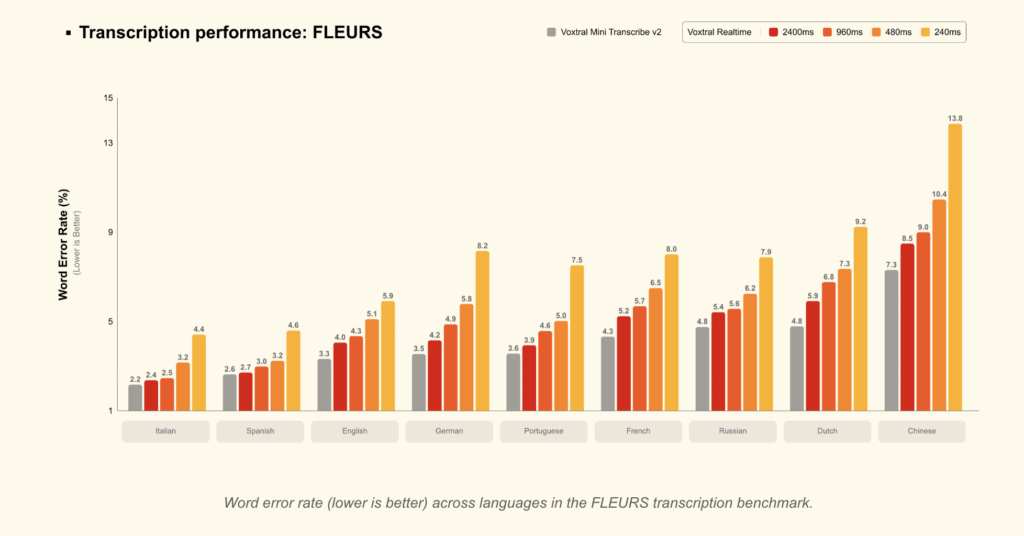
Automatic speech recognition (ASR) is becoming a core building block for AI products, from meeting tools to voice agents. Mistral’s new Voxtral Transcribe 2 family targets this space with 2 models that split cleanly into batch and realtime use cases, while keeping cost, latency, and deployment constraints in focus. The release includes: Voxtral Mini Transcribe V2 for batch transcription with diarization. Voxtral Realtime (Voxtral Mini 4B Realtime 2602) for low-latency streaming transcription, released as open weights. Both models are designed for 13 languages: English, Chinese, Hindi, Spanish, Arabic, French, Portuguese, Russian, German, Japanese, Korean, Italian, and Dutch. Model family: batch and streaming, with clear roles Mistral positions Voxtral Transcribe 2 as ‘two next-generation speech-to-text models’ with state-of-the-art transcription quality, diarization, and ultra-low latency. Voxtral Mini Transcribe V2 is the batch model. It is optimized for transcription quality and diarization across domains and languages and exposed as an efficient audio input model in the Mistral API. Voxtral Realtime is the streaming model. It is built with a dedicated streaming architecture and is released as an open-weights model under Apache 2.0 on Hugging Face, with a recommended vLLM runtime. A key detail: speaker diarization is provided by Voxtral Mini Transcribe V2, not by Voxtral Realtime. Realtime focuses strictly on fast, accurate streaming transcription. Voxtral Realtime: 4B-parameter streaming ASR with configurable delay Voxtral Mini 4B Realtime 2602 is a 4B-parameter multilingual realtime speech-transcription model. It is among the first open-weights models to reach accuracy comparable to offline systems with a delay under 500 ms. Architecture: ≈3.4B-parameter language model. ≈0.6B-parameter audio encoder. The audio encoder is trained from scratch with causal attention. Both encoder and LM use sliding-window attention, enabling effectively “infinite” streaming. Latency vs accuracy is explicitly configurable: Transcription delay is tunable from 80 ms to 2.4 s via a transcription_delay_ms parameter. The Mistral describes latency as “configurable down to sub-200 ms” for live applications. At 480 ms delay, Realtime matches leading offline open-source transcription models and realtime APIs on benchmarks such as FLEURS and long-form English. At 2.4 s delay, Realtime matches Voxtral Mini Transcribe V2 on FLEURS, which is appropriate for subtitling tasks where slightly higher latency is acceptable. From a deployment standpoint: The model is released in BF16 and is designed for on-device or edge deployment. It can run in realtime on a single GPU with ≥16 GB memory, according to the vLLM serving instructions in the model card. The main control knob is the delay setting: Lower delays (≈80–200 ms) for interactive agents where responsiveness dominates. Around 480 ms as the recommended “sweet spot” between latency and accuracy. Higher delays (up to 2.4 s) when you need accuracy as close as possible to the batch model. Voxtral Mini Transcribe V2: batch ASR with diarization and context biasing Voxtral Mini Transcribe V2 is a closed-weights audio input model optimized only for transcription. It is exposed in the Mistral API as voxtral-mini-2602 at $0.003 per minute. On benchmarks and pricing: Around 4% word error rate (WER) on the FLEURS transcription benchmark, averaged over the top 10 languages. “Best price-performance of any transcription API” at $0.003/min. Outperforms GPT-4o mini Transcribe, Gemini 2.5 Flash, Assembly Universal, and Deepgram Nova on accuracy in their comparisons. Processes audio ≈3× faster than ElevenLabs’ Scribe v2 while matching quality at one-fifth the cost. Enterprise-oriented features are concentrated in this model: Speaker diarization Outputs speaker labels with precise start and end times. Designed for meetings, interviews, and multi-party calls. For overlapping speech, the model typically emits a single speaker label. Context biasing Accepts up to 100 words or phrases to bias transcription toward specific names or domain terms. Optimized for English, with experimental support for other languages. Word-level timestamps Per-word start and end timestamps for subtitles, alignment, and searchable audio workflows. Noise robustness Maintains accuracy in noisy environments such as factory floors, call centers, and field recordings. Longer audio support Handles up to 3 hours of audio in a single request. Language coverage mirrors Realtime: 13 languages, with Mistral noting that non-English performance “significantly outpaces competitors” in their evaluation. https://mistral.ai/news/voxtral-transcribe-2 APIs, tooling, and deployment options The integration paths are straightforward and differ slightly between the two models: Voxtral Mini Transcribe V2 Served via the Mistral audio transcription API (/v1/audio/transcriptions) as an efficient transcription-only service. Priced at $0.003/min. (Mistral AI) Available in Mistral Studio’s audio playground and in Le Chat for interactive testing. Voxtral Realtime Available via the Mistral API at $0.006/min. Released as open weights on Hugging Face (mistralai/Voxtral-Mini-4B-Realtime-2602) under Apache 2.0, with official vLLM Realtime support. The audio playground in Mistral Studio lets users: Upload up to 10 audio files (.mp3, .wav, .m4a, .flac, .ogg) up to 1 GB each. Toggle diarization, choose timestamp granularity, and configure context bias terms. Key Takeaways Two-model family with clear roles: Voxtral Mini Transcribe V2 targets batch transcription and diarization, while Voxtral Realtime targets low-latency streaming ASR, both across 13 languages. Realtime model- 4B parameters with tunable delay: Voxtral Realtime uses a 4B architecture (≈3.4B LM + ≈0.6B encoder) with sliding-window and causal attention, and supports configurable transcription delay from 80 ms to 2.4 s. Latency vs accuracy trade-off is explicit: Around 480 ms delay, Voxtral Realtime reaches accuracy comparable to strong offline and realtime systems, and at 2.4 s it matches Voxtral Mini Transcribe V2 on FLEURS. Batch model adds diarization and enterprise features: Voxtral Mini Transcribe V2 provides diarization, context biasing with up to 100 phrases, word-level timestamps, noise robustness, and supports up to 3 hours of audio per request at $0.003/min. Deployment- closed batch API, open realtime weights: Mini Transcribe V2 is served via Mistral’s audio transcription API and playground, while Voxtral Realtime is priced at $0.006/min and also available as Apache 2.0 open weights with official vLLM Realtime support. Check out the Technical details and Model Weights. Also, feel free to follow us on Twitter and don’t forget to join our 100k+ ML SubReddit and Subscribe to our Newsletter. Wait! are you on telegram? now you can join us on telegram as well. The post Mistral AI Launches Voxtral Transcribe 2: Pairing Batch Diarization And

Mistral AI Launches Voxtral Transcribe 2: Pairing Batch Diarization And Open Realtime ASR For Multilingual Production Workloads At Scale Read Post »

AI, Committee, ข่าว, Uncategorized

No One-Size-Fits-All: Building Systems For Translation to Bashkir, Kazakh, Kyrgyz, Tatar and Chuvash Using Synthetic And Original Data

arXiv:2602.04442v1 Announce Type: new Abstract: We explore machine translation for five Turkic language pairs: Russian-Bashkir, Russian-Kazakh, Russian-Kyrgyz, English-Tatar, English-Chuvash. Fine-tuning nllb-200-distilled-600M with LoRA on synthetic data achieved chrF++ 49.71 for Kazakh and 46.94 for Bashkir. Prompting DeepSeek-V3.2 with retrieved similar examples achieved chrF++ 39.47 for Chuvash. For Tatar, zero-shot or retrieval-based approaches achieved chrF++ 41.6, while for Kyrgyz the zero-shot approach reached 45.6. We release the dataset and the obtained weights.

No One-Size-Fits-All: Building Systems For Translation to Bashkir, Kazakh, Kyrgyz, Tatar and Chuvash Using Synthetic And Original Data Read Post »

AI, Committee, ข่าว, Uncategorized

DeepAgent: A General Reasoning Agent with Scalable Toolsets

arXiv:2510.21618v2 Announce Type: replace-cross Abstract: Large reasoning models have demonstrated strong problem-solving abilities, yet real-world tasks often require external tools and long-horizon interactions. Existing agent frameworks typically follow predefined workflows, which limit autonomous and global task completion. In this paper, we introduce DeepAgent, an end-to-end deep reasoning agent that performs autonomous thinking, tool discovery, and action execution within a single, coherent reasoning process. To address the challenges of long-horizon interactions, particularly the context length explosion from multiple tool calls and the accumulation of interaction history, we introduce an autonomous memory folding mechanism that compresses past interactions into structured episodic, working, and tool memories, reducing error accumulation while preserving critical information. To teach general-purpose tool use efficiently and stably, we develop an end-to-end reinforcement learning strategy, namely ToolPO, that leverages LLM-simulated APIs and applies tool-call advantage attribution to assign fine-grained credit to the tool invocation tokens. Extensive experiments on eight benchmarks, including general tool-use tasks (ToolBench, API-Bank, TMDB, Spotify, ToolHop) and downstream applications (ALFWorld, WebShop, GAIA, HLE), demonstrate that DeepAgent consistently outperforms baselines across both labeled-tool and open-set tool retrieval scenarios. This work takes a step toward more general and capable agents for real-world applications. The code and demo are available at https://github.com/RUC-NLPIR/DeepAgent.

DeepAgent: A General Reasoning Agent with Scalable Toolsets Read Post »

We use cookies to improve your experience and performance on our website. You can learn more at นโยบายความเป็นส่วนตัว and manage your privacy settings by clicking Settings.

ตั้งค่าความเป็นส่วนตัว

You can choose your cookie settings by turning on/off each type of cookie as you wish, except for essential cookies.

ยอมรับทั้งหมด
จัดการความเป็นส่วนตัว
  • เปิดใช้งานตลอด

บันทึกการตั้งค่า
th